



INTRODUCTION
The cocoa tree (Theobroma cacao L., Malvaceae) (Alverson et al., Reference Alverson, Whitlock, Nyffeler, Bayer and Baum1999) is considered one of the most important perennial crops in the world. It is economically important in many tropical countries, where it is cultivated by nearly 6 million farmers (Baligar et al., Reference Baligar, Bunce, Machado and Elson2008), with an estimated world output of 3.97 million tonnes in 2012/2013 (ICCO, 2013). Cocoa is a tropical woody species that typically grows in the understory of rain forests in areas of high annual rainfall (1,500–2,000 mm) (Bae et al., Reference Bae, Kim, Kim, Sicher, Strem, Natarajan and Bailey2008; Baligar et al., Reference Baligar, Bunce, Machado and Elson2008), and it is considered a shade tolerant plant as it grows well in moderate shade, and young plants suffer less water and nutrient stress under this condition (Wood and Lass, Reference Wood and Lass2001).
Cocoa exhibits considerable genetic variability regarding morphological and physiological traits (Daymond et al., Reference Daymond, Hadley, Machado and Ng2002a, b). However, studies of genotypic variation in photosynthetic traits in cocoa are limited (Daymond et al., Reference Daymond, Tricker and Hadley2011). There are three types or morpho-geographic groups of cocoa known as ‘Criollo’, ‘Forastero’ and ‘Trinitario’, which differ in quality, vigor and yield (Cheesman, Reference Cheesman1944). Recently, Motamayor et al. (Reference Motamayor, Lachenaud, da Silva e Mota, Loor, Kuhn, Brown and Schnell2008) suggested a new classification of cocoa germplasm and grouped them into 10 genetic clusters, which would reflect the genetic diversity available for breeders in a better way than the previous classification. The Criollo cocoa identified within these 10 clusters has a low genetic variability (Motamayor et al., Reference Motamayor, Risterucci, Lopez, Ortiz, Moreno and Lanaud2002) and it is considered one of the best quality cocoa in the world (Elwers et al., Reference Elwers, Zambrano, Rohsius and Lieberei2009). Venezuela has maintained Criollo cultivars in germplasm banks and recently, national programs are introducing some of these cultivars in cocoa farms in order to improve cocoa seed quality and amount of production.
Venezuelan cocoa contributes to less than 0.5% of the world cocoa production (ICCO, 2012). Furthermore, little is known about Venezuelan Criollo cocoa related to their physiological performance (water status, gas exchange and photochemical activity) or their responses to changing environmental conditions.
Climate change scenarios for Venezuela predicted less rainfall averages for DS (Gornall et al., Reference Gornall, Betts, Burke, Clark, Camp, Willet and Wiltshire2010). Therefore, it is important to select cultivars with higher tolerance to prolonged drought periods or climate regimes with less average precipitation. Water deficit is the main ecological factor that constrains photosynthesis in terrestrial ecosystems (McDowell et al., Reference McDowell, Pockman, Allen, Breshears, Cobb, Kolb, Plaut, Sperry, West, Williams and Yepez2008), limiting plant growth and survival (Chaves and Pereira, Reference Chaves and Pereira1992; Chaves et al., Reference Chaves, Pereira, Maroco, Rodrigues, Ricardo, Osório, Carvalho, Faria and Pinheiro2002). This is an important factor to consider for cultivation of cocoa since it requires a high amount of water (> 1,500 mm rainfall a year), especially during the early juvenile stage (Carr and Lockwood, Reference Carr and Lockwood2011).
The amount and distribution of rainfall represent important environmental factors that affect cocoa yield under field conditions (Alvim and Nair, Reference Alvim and Nair1986; Balasimha et al., Reference Balasimha, Daniel and Bhat1991). Cocoa plants are sensitive to prolonged periods of drought (Abo-Hamed et al., Reference Abo-Hamed, Collin and Hardwick1983; Belsky and Siebert, Reference Belsky and Siebert2003; Wood and Lass, 2001) and very little research has been directed towards the identification and development of drought tolerant Criollo cocoa cultivars. Only a few studies have examined differences in gas exchange among Forastero and Trinitario cocoa plants, and no significant differences were found in terms of photosynthetic rate (A), stomatal conductance (gs), internal CO2 concentration (Ci) and transpiration rate (E) between one Trinitario and two Forastero clones (Baligar et al., Reference Baligar, Bunce, Machado and Elson2008). However, A of two Trinitario clones responded differently to applied N in a greenhouse experiment, despite the existence of close genetic relatedness between them (Ribeiro et al., Reference Ribeiro, da Silva, Aitken, Machado and Baligar2008).
Some information for few cultivars from the western region in Venezuela is available (Araque et al., Reference Araque, Jaimez, Tezara, Coronel, Urich and Espinoza2012; Rada et al., Reference Rada, Jaimez, García–Nuñez, Azócar and Ramírez2005; Tezara et al., Reference Tezara, Coronel, Urich, Marín, Jaimez and Chacón2009). Comparative ecophysiological studies between different cultivars during RS and DS is a strategic way to select cocoa elite cultivars and for their management in agroforestry systems (Jaimez et al., Reference Jaimez, Tezara, Coronel and Urich2008, Reference Jaimez, Araque, Guzman, Mora, Azócar, Espinoza and Tezara2013).
The principal aim of this study was to evaluate the ecophysiology of 12 Criollo cocoa cultivars grown under the same climatic and soil conditions in the southern region of Maracaibo Lake Basin, Venezuela, during RS and DS, to recognize traits that are associated with drought tolerance. The photosynthetic capacity of three Criollo cultivars was assessed to determine whether the commonly low measured values of gs may explain low A due to high relative stomatal limitation (Ls).
MATERIALS AND METHODS
Plant material and field site
The cultivars were arranged in a single plot, each cultivar represented by 6 plants separated by 3.0 m between them. The plants were grown under the shade of banana (Musa sp.), Erythrina fusca and Gliricidia sepium. Most of the cultivars studied were ancestral Criollo cocoa cultivars from The Andes region (Table 1 shows the information available for the cultivars). The average pod weight of the cultivars is 460 g, and there are c. 25 seeds per pod with a seed index, average dry mass per seed, > 1 g (Table 1). All cultivars are considered Criollo, mostly with white seeds and high homozygosis percentage (> 90%; Marcano, Reference Marcano2007).
Name, acronym, pod weight, number of seeds per pod, seed colour and seed index (refers to the average dry mass per seed) of the studies cultivars.

*Collected from Táchira State.
†Collected from Zulia State.
‡According to Munsell table.
The study was conducted at the Criollo germplasm bank of Centro Socialista de Investigación y Desarrollo del Cacao (CESID-Cacao) (8°43′27″ N, 71°44′33″ W) in the southern region of Maracaibo Lake Basin, where the mean annual temperature is 27–28 °C and total rainfall is 1750–1880 mm. Adult trees (7 years old) from 12 Criollo cocoa cultivars were evaluated in March 2007 during the DS (rainfall 480 mm January to March, rain 2 days in February and the last 14 days of March), and in November 2007 during the RS (rainfall of 1900 mm between October and December, rain 25 out of 30 days in November). These cultivars grow under the same climatic and soil conditions, but were collected from different locations at the south western region of Venezuela: Táchira and Zulia states. After this first physiological evaluation (Figures 1 and 4), three cultivars: Los Caños 001 (LCA001), Sur Porcelana 010 (SP010) and Escalante 001 (ESC001), were selected to carry out a further evaluation during RS of 2009 and 2010 (rainfall of 1850 and 1980 mm between October to December, respectively).
Measurements of instantaneous gas exchange: (a, d) photosynthetic rate (A), (b, e) stomatal conductance (gs) and (c, f) WUE of 12 Criollo cocoa cultivars during RS and DS in 2007 and three selected cultivars measured in 2009 and 2010 from the southern region of Maracaibo Lake Basin. Values are mean ± SE (n = 6). Asterisk (*) in the right panel indicate significant difference between years for each cultivar (p < 0.05). Measurements were made at ambient (CO2) (Ca) of 380 ± 10 μmol mol−1, 21% O2, PPFD of 400 ± 10 μmol m−2 s−1 and, a leaf temperature (TL) of 28 ± 0.5 °C.

Water relations
Leaf water potential (ΨL) was measured in 12 cultivars in early morning hours (~0600 h) in leaves of at least three individuals of each cultivar in both RS and DS in 2007, using a Scholander pressure chamber (PMS Instruments Inc., Corvallis, Oregon). Leaf relative water content (RWC) was determined in 2009 and 2010 for the three selected cultivars, according to the following equation: RWC = (FM–DM)/(TM–DM)*100, where, FM is fresh mass, DM is dry mass and TM is turgor mass. Turgor mass was calculated by rehydrating leaves in darkness overnight, which were weighted the following day.
GAS EXCHANGE
Instantaneous gas exchange measurements
Measurements of instantaneous maximum A (Amax), gs and instantaneous water use efficiency (WUE = Amax/E) were done on fully expanded leaves in six individuals of each cultivar with a portable infrared gas analyser (CIRAS 2, PP Systems, Hitchin, UK) used in conjunction with an assimilation chamber (PLC, PP Systems, Hitchin, UK) and an attached LED light source. Measurements were made at ambient (CO2) (Ca) of 380 ± 10 μmol mol−1, 21% O2, PPFD of 400 ± 10 μmol m−2 s−1 and leaf temperature (TL) of 28 ± 0.5 °C. The Amax was measured between 8:30–10:00 h since previous measurements shown that photosynthesis is at maximum within these hours.
A/Ci and A/PPFD curves
Response curves of A to Ci (A/Ci curves) were done during RS in four individuals per cultivar (LCA001, SP010 and ESC001) by decreasing Ci from approximately 298 μmol mol−1 (at which A at Ca = 380 μmol mol−1 was initially measured) to 0 μmol mol−1 CO2 and then progressively increasing it to 1200 μmol mol−1 CO2. Measurements were done between 09:00–11:00 h at PPFD of 400 ± 10 μmol m−2 s−1, 21% O2, and TL of 28 ± 0.5 °C.
The A/Ci curves were fitted to the empirical equation A = b + d*ek*Ci, where b is Ci-saturated A (ACO2sat) and (b+d) is diurnal respiration rate (Rd) (Tezara et al., Reference Tezara, Fernández, Donoso and Herrera1998). CE was calculated from the initial slope of the curve as k*d and the CO2 compensation point (Γ) as Ln (–b/d)/k (Tezara et al., Reference Tezara, Fernández, Donoso and Herrera1998). Relative stomatal limitation (Ls) was calculated as Ls = 100 * (Ao–A)/Ao), where Ao is A at Ci = Ca (i.e. at infinite gs) (Farquhar and Sharkey, Reference Farquhar and Sharkey1982).
Response curves of A to PPFD (A/PPFD) were done during RS in four individuals per cultivar (LCA001, SP010 and ESC001) by decreasing PPFD from 400 μmol m−2 s−1 (at which A was initially measured) to 0 μmol m−2 s−1 and then progressively increasing it to 1400 μmol m−2 s−1 in eight steps, using the leaf microclimate control system of CIRAS 2. Measurements were done between 09:00–11:00 h at Ca of 380 ± 10 μmol mol−1, 21% O2 and TL of 28 ± 0.5 °C.
The A/PPFD curves were fitted to the empirical equation A = b + d*ek*PPFD, where b is PPFD-saturated A (APPFDsat) and (b+d) is dark respiration rate (RD) (Tezara et al., Reference Tezara, Fernández, Donoso and Herrera1998). Apparent quantum yield (ΦCO2) was calculated from the initial slope of the curve as k*d and light compensation point (LCP) as Ln (–b/d)/k (Tezara et al., Reference Tezara, Fernández, Donoso and Herrera1998).
STABLE ISOTOPE DETERMINATIONS AND NITROGEN CONTENT
For 12 cultivars, leaf samples of adult individuals (n = 4) were ground and then analysed for carbon isotope composition (δ13C) and leaf N content at the University of Illinois-Chicago, using an elemental analyser (Costech, Valencia, California) coupled to a Delta + XL isotope ratio mass spectrometer (Finnigan, Bremen, Germany) operated in continuous flow and run against NIST and lab standards to a precision of 0.05‰ for C and 0.15‰ for N.
CHLOROPHYLL A FLUORESCENCE
Chlorophyll a fluorescence was measured on attached dark-acclimated leaves (n = 6) of the three selected cultivars with a portable fluorometer (PAM 2100, Walz, Effeltrich, Germany) using the protocol described by Genty et al. (Reference Genty, Briantais and Baker1989). Maximum quantum yield of PSII was measured in situ at predawn as Fv/Fm = (Fm–Fo)/Fm, where Fm and Fo are maximum and minimum fluorescence, respectively. Response curves of photochemistry parameters to PPFD were performed in four individuals per cultivar. Relative quantum yield of PSII (ΦPSII) at steady state of A was calculated as ΦPSII = (F′m–Fs)/F′m, where Fs and F′m are steady state and maximum fluorescence in light, respectively. Electron transport rate of PSII (J) was estimated as J = ΦPSII*PPFD*a*0.5, where a is the fraction of incident PPFD absorbed by the leaf (assumed as 0.84).
Photochemical (qP) and non-photochemical (qN) quenching coefficients were calculated from measurements of chlorophyll fluorescence as follows: qP = (F′m–Fs)/(F′m–F′o) and qN = 1– (F′m–F′o)/(Fm–Fo), where F′o is minimum fluorescence in light.
STATISTICAL ANALYSIS
T-tests, one-way and two-way analyses of variance were performed to evaluate differences in the parameters measured between years, between cultivars, and between cultivars and seasons, respectively (p < 0.05). Fisher's least significant difference test was used as post-hoc analysis. SYSTAT 10 was used to run the analyses and Sigmaplot 11 to fit the curves.
RESULTS
Water relations
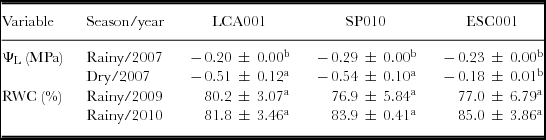
Average ΨL of the 12 cultivars was significantly lower during DS compared to RS in 2007 (−0.41 ± 0.05 MPa and −0.21 ± 0.02, respectively, p < 0.05), as it was for LCA001 and SP010, while in ESC001 no differences were found between seasons (Table 2). There was no significant difference in RWC of these cultivars between 2009 and 2010, indicating high water availability during both sampling years (Table 2).
Early morning leaf water potential (ΨL) and relative leaf water content (RWC) of three Criollo cocoa cultivars form the southern region of Maracaibo Lake Basin, during rainy and dry seasons in 2007 and rainy seasons in 2009 and 2010. Different letters between and within columns for ΨL indicate significant differences between cultivars and seasons/year, respectively (p < 0.05). (Means ± SE, n = 3).
Gas exchange
There was a significant effect of season, cultivar and interaction season*cultivar in Amax and gs values (p < 0.05), with Amax and gs higher in RS than in DS for most cultivars (Figure 1). Maximum photosynthetic rate ranged between 2 and 6 μmol m−2 s−1, with the highest values found in CHA010, CBL005 and NOV006 in RS, UVI003 and ESC001 in DS, and SP010 in both seasons (Figure 1a). The highest values of gs where found in CHA010 and SP010 in RS, and in LOB022 and SSN004 in DS (Figure 1b). The highest Amax values did not fully correspond with the highest gs values in all cultivars (Figures 1a–b), but the observed variation in A between these Criollo cacao cultivars can be partially explained by the variation in gs (r 2 = 0.47, p < 0.01). WUE was different among cultivars (p < 0.05) and ranged between 2 and 6 mmol mol−1, with the highest values found in NOV006 in RS and SP010 in DS (Figure 1c). There was no significant effect of season on WUE (p > 0.05).
The cultivars LCA001, SP010 and ESC001 were selected because of their high physiological performance: LCA001 had relatively high Amax and intermediate WUE in both seasons, SP010 had high Amax in both seasons and higher WUE in DS, and ESC001 had higher Amax in DS and WUE did not change between seasons.
Measurements of Amax and gs in the three selected cultivars showed a different pattern between 2009 and 2010 (Figures 1d–f). The lowest Amax value was found in LCA001 in 2010 (2 μmol m−2 s−1), while in the other cultivars and years the average was 5.2 μmol m−2 s−1 (Figure 1d). For all cultivars, gs ranged between 90 and 300 mmol m−2 s−1, with the highest values in LCA001 and ESC001 in 2009 (Figure 1e). Despite of differences in Amax and gs, WUE was similar (3.3 mmol mol−1 on average) in all cultivars and years (p > 0.05; Figure 1f).
The A/Ci curves showed that LCA001 and ESC001 had the highest ACO2sat (Figure 2), but CE, Rd, Γ and Ls were not different among the three cultivars (Table 3). The parameters of A/PPFD curves of the cultivars showed low APPFDsat (in average 3.8 μmol m−2 s−1), low values of saturating PPFD (400–500 μmol m−2 s−1), RD (−0.30 μmol m−2 s−1) and LCP (11.1 μmol m−2 s−1) (Figure 3), which are characteristic of shade plants. All cultivars showed no difference in the aforementioned parameters (Table 3).
Response curves of photosynthetic rate (A) to intercellular CO2 concentration (Ci) of three Criollo cocoa cultivars (● LCA001, ■ SP010, and ♦ ESC001) from the southern region of Maracaibo Lake Basin. Values are mean ± SE (n = 4). Asterisk (*) indicates that SP010 ACO2sat was significant different from the others (p < 0.05). Measurements were made at PPFD of 400 ± 10 μmol m−2 s−1, 21% O2 and, TL of 28 ± 0.5 °C.

Response curves of photosynthetic rate (A) to photosynthetic photon flux density (PPFD) of three Criollo cocoa cultivars (● LCA001, ■ SP010, and ♦ ESC001) from the southern region of Maracaibo Lake Basin. Values are mean ± SE (n = 4). Measurements were made at Ca of 380 ± 10 μmol mol−1, 21% O2 and TL of 28 ± 0.5 °C.

Photosynthetic rate at saturating CO2 (ACO2sat), carboxylation efficiency (CE), diurnal respiration rate (Rd), CO2 compensation point (Γ) and relative stomatal limitation (Ls) of LCA001, SP010 and ESC001. Photosynthetic rate at saturating PPFD (APPFDsat), apparent quantum yield (ΦCO2), dark respiration rate (RD) and light compensation point (LCP) of LCA001, SP010 and ESC001. Maximum quantum yield (Fv/Fm) in years 2009 and 2010. Different letters among columns indicate significant differences among cultivars (p < 0.05). (Means ± SE, n = 4).

Stable isotope determinations and nitrogen content
There was a significant effect of season, cultivar and interaction season*cultivar in δ13C and N content for the 12 cultivars (p < 0.05) in 2007. Carbon isotope composition was found to be higher in RS than in DS, suggesting a higher integrated WUE during RS (Figure 4a). Nitrogen content was higher in RS than in DS in all evaluated cultivars (Figure 4b). There was a significant negative correlation between A and N content in RS, but not in DS (p = 0.0163 and p = 0.2655, respectively).
Isotopic composition (δ13C) and nitrogen content (N) of 12 Criollo cocoa cultivars from the southern region of Maracaibo Lake Basin during rainy and dry seasons in 2007. Values are mean ± SE (n = 4).

Chlorophyll a fluorescence
In all cultivars, Fv/Fm was higher in 2010 than 2009 (p < 0.05) with no differences among cultivars and no signs of photoinhibition in either year (Table 3). The response curves of J to PPFD showed that ESC001 had the highest maximum J (Jmax) (Figure 5a). This is consistent with the higher ΦPSII and qP that this cultivar showed at high PPFD (Figures 5b and c), whereas qN was higher in LCA001 than in the others cultivars at low PPFD (Figure 5d).
Response curves of (a) electron transport rate (J), (b) relative quantum yield of photosystem II (ΦPSII), (c) photochemical quenching coefficient (qP) and (d) non-photochemical quenching coefficient (qN) to photosynthetic photon flux density (PPFD) of three Criollo cocoa cultivars (● LCA001, ■ SP010, and ♦ ESC001) from the southern region of Maracaibo Lake Basin.

DISCUSSION
The response of physiological and photochemical traits of Criollo cocoa cultivars to seasonal drought was evaluated using adult plants grown in a germplasm bank without soil volume limitation, to identify traits that are associated with drought tolerance that could be used for cultivar screening-breeding programs. Our results showed variations in physiological traits and differential responses to drought among cultivars; during the periods of low rainfall most cultivars showed a decrease in the leaf water status estimated by ΨL. The studied Criollo cultivars may be recommended for cultivation due to a relatively high integrated WUE estimated by δ13C when comparing to Forastero and Trinitario cultivars from different ecosystems (Tezara et al., Reference Tezara, Coronel, Urich, Marín, Jaimez and Chacón2009) and other Criollo cultivars from agroforestry systems (Araque et al., Reference Araque, Jaimez, Tezara, Coronel, Urich and Espinoza2012) in Venezuela. Criollo cultivars showed low Amax, but the associated low gs may not necessarily indicate that stomata explain the low rates of photosynthesis, a fact that is supported by low electron transport rate (≤ 80 μmol e− m−2 s−1) and 23% of relative stomatal limitation in the three studied cultivars.
Water relations
On average, ΨL of the12 cultivars was significantly higher in RS than in DS in 2007 except for ESC001, indicating that the water status for this cultivar was not affected by drought. During DS of 2007 rainfall was 25% of that in RS; this combined with high evaporative demand and high PPFD in the study area caused low water availability for most cultivars during DS, as it was observed before by Araque et al. (Reference Araque, Jaimez, Tezara, Coronel, Urich and Espinoza2012). Osmotic adjustment has been reported for some Forastero and Criollo cocoa cultivars (Almeida and Valle, Reference Almeida and Valle2007; Araque et al., Reference Araque, Jaimez, Tezara, Coronel, Urich and Espinoza2012; Rada et al., Reference Rada, Jaimez, García–Nuñez, Azócar and Ramírez2005) and it is usually associated with greater drought resistance (Almeida and Valle, Reference Almeida and Valle2007; Moser et al., Reference Moser, Leuschner, Hertel, Hölscher, Köhler, Leitner, Michalzik, Prihastanti, Tjitrosemito and Schwendenmann2010). In our study case this hypothesis is not discarded. Leaf RWC values were around 80% with no difference between 2009 and 2010, which indicated no difference in water status of the plants in these two years. Lower ΨL with no changes in RWC could indicate osmotic adjustments through accumulation of solutes and/or changes in the cell wall module of elasticity in response to drought.
Gas exchange, water use efficiency and carbon isotope composition
The very low average Amax observed for all cultivars studied in 2007 (4.6 ± 0.31 and 3.6 ± 0.41 μmol m−2 s−1 in RS and DS, respectively) might be associated with low gs (147.4 ± 20.3 and 86.2 ± 7.3 mmol m−2 s−1 in RS and DS, respectively). Similarly, Amax values have been found to range from 0.7 to 6.5 μmol m−2 s−1 with low gs (20–150 mmol m−2 s−1) in different studies (Almeida et al., Reference Almeida, Gomes, Araujo, Santos and Valle2014; Baker and Hardwick, Reference Baker and Hardwick1973, Reference Baker and Hardwick1976; Daymond et al., Reference Daymond, Tricker and Hadley2011; Joly and Hahn, Reference Joly and Hahn1989; Miyaji et al., Reference Miyaji, Silva and Alvim1997a, b; Tezara et al., Reference Tezara, Coronel, Urich, Marín, Jaimez and Chacón2009).
Different Amax and gs responses to drought were found in 2007. In most Criollo cocoa cultivars, both Amax and gs decreased during DS. Similar responses of Amax and gs have been reported for some Trinitario, Forastero and Criollo cultivars of different ages and grown in different conditions and ecosystems (Acheampong et al., Reference Acheampong, Hadley and Daymond2013; Araque et al., Reference Araque, Jaimez, Tezara, Coronel, Urich and Espinoza2012; Baligar et al., Reference Baligar, Bunce, Machado and Elson2008; Daymond et al., Reference Daymond, Tricker and Hadley2011; Galyuon et al., Reference Galyuon, McDavid, Lopez and Spence1996; Mohd Razi et al., 1992; Joly and Hahn, Reference Joly and Hahn1989; Tezara et al., Reference Tezara, Coronel, Urich, Marín, Jaimez and Chacón2009); all of them indicating that cocoa is sensitive to water deficit, as has been reported in recent reviews (Almeida and Valle, Reference Almeida and Valle2007; Carr and Lockwood, Reference Carr and Lockwood2011).
During DS (2007) four cultivars showed an increase of instantaneous WUE, in six cultivars WUE was similar between seasons, and in two WUE decreased despite plants growing under similar environmental conditions (Figure 1). The reduction in gs in some cultivars led to the increase in WUE during DS for some of these cultivars (e.g. CHA010 and SP010 more than 70%). It seems that these cultivars are less sensitive to drought in terms of Amax and WUE. These results have also been found in other Criollo cultivars from the southern region of Maracaibo Lake Basin (Rada et al., Reference Rada, Jaimez, García–Nuñez, Azócar and Ramírez2005).
Stable carbon isotope composition revealed that, in all cultivars, long-termed integrated WUE was always higher in RS than in DS, although the opposite was expected as it is usually found: higher WUE during the period of water deficit (Farquhar and Richards, Reference Farquhar and Richards1984). In this case, it seems that these cultivars came from natural populations that were selected and maintained due to their high WUE during RS, when most of growth and flowering occurs. Similar values of δ13C have been reported for two clones of cocoa, ICS 1 and IMC 47 (Daymond et al., Reference Daymond, Tricker and Hadley2011).
Nitrogen content
Leaf N content was significantly higher in RS than in DS (p < 0.05, Figure 4). All of the photochemical and biochemical process of photosynthesis involve nitrogen. Indeed, nitrogenous compounds that provide the basis for photosynthesis include: proteins that catalyse the reactions of CO2 fixation (by Rubisco) and the regeneration of the CO2 acceptor (RuBP) (typically 16% nitrogen), chlorophyll (6% nitrogen), and thylakoids proteins (chlorophyll proteins, electron transport proteins and ATP-synthesizing enzyme) (Field and Mooney, Reference Field and Mooney1986). In many species, growth under lower PPFD greatly increases the partitioning of nitrogen into chlorophyll and thylakoid proteins (Evans, Reference Evans1989). At least eight cultivars in DS showed low Amax and N content suggesting that in those cultivars low Amax might be explained by this low N content. Total leaf N content in the Criollo cultivars studied ranged between 2 and 5 g m−2, been those values higher than the reported in eight clones of cacao (Daymond et al., Reference Daymond, Tricker and Hadley2011)
The fact that A is poor correlated with gs in some cultivars during DS, but instead associated with the reduction of leaf N content (r = 0.35) suggests that biochemical factors could be regulating A. The typical positive correlation between photosynthesis and N content was not found in this study, perhaps due to the fact that A was area-based whereas the N content was weight-based. In general, the correlation coefficient between Amax and N content is higher for weight-based measurements (r = 0.92) than for area-based measurements (r = 0.53) (Field and Mooney, Reference Field and Mooney1986). In contrast, a strong relationship between A and N was found in eight coca clones, where a high percentage of the variation in A was explained by the variation in N (r2 = 0.81 and p < 0.01; Daymond et al., Reference Daymond, Tricker and Hadley2011). In addition, some evergreen sclerophylls have high N per unit area but low Amax, as cocoa did, that could be possible due to the proportionally less nitrogen allocation to compounds functionally related to Amax and more allocation towards defence compounds (Field and Mooney, Reference Field and Mooney1986).
Evaluation of parameters of A/Ci and A/PPFD curves, and chlorophyll fluorescence in three cultivars
The A/Ci curves showed that there was variation in ACO2sat between cultivars, where the highest photosynthetic capacity was found in LCA001 and ESC001, although differences in CE were not found (Table 3). These results indicated that the three cultivars have similar Rubisco content and/or activity and for those with the highest ACO2sat, probably a higher rate of RuBP regeneration (the highest Jmax was also found in ESC001). Balasimha et al. (Reference Balasimha, Daniel and Bhat1991) have reported a linear relationship between A and Ci (A = 0.015Ci – 1.637, r2 = 0.94) in 16 Forastero cultivars (among drought tolerant and susceptible cultivars), with the highest value of A at a Ci of 230 μmol mol−1. However, this might account just for the linear part of the A to Ci response curve. A quadratic response of A to Ci (A = 5.55 + (−8.94)e(−0.01Ci), recalculated from Baligar et al., Reference Baligar, Bunce, Machado and Elson2008) was found in three Trinitario and Forastero cultivars from Perú, Ecuador and Brazil, and ACO2sat was around 4 μmol m−2 s−1 (Baligar et al., Reference Baligar, Bunce, Machado and Elson2008), quite lower than the ACO2sat found in this study. This indicated that under conditions of high CO2 concentration, Criollo cultivars might have a higher A when comparing to Trinitario and Forastero cultivars. Currently, increases of Ca are known, and it is predicted to continue increasing over time (IPCC, 2014). This might suggest a benefit for Criollo cultivars in terms of photosynthetic capacity.
In spite of low gs values, Ls was around 23% in the three cultivars evaluated in this study (Table 3). Similar results were found in Trinitario and Forastero cultivars, with Ls values around 22%, (recalculated data from Baligar et al., Reference Baligar, Bunce, Machado and Elson2008), and are similar to what is usually found in most C3 plants, c. 17% (Farquhar and Sharkey, Reference Farquhar and Sharkey1982). The fact that cocoa showed low gs does not necessarily indicate that stomata are regulating the rate of photosynthesis, a fact that is supported by the low Ls found in this study.
The parameters of A/PPFD curves of the Criollo cultivars showed adaptation to a shade regime, i.e. low values of APPFDsat, RD and LCP. The saturating PPFD was relatively low, ranging from about 300 to 600 μmol m−2 s−1, and similar to other cocoa cultivars (Almeida and Valle, Reference Almeida and Valle2007; Almeida et al., Reference Almeida, Gomes, Araujo, Santos and Valle2014; Balasimha et al., Reference Balasimha, Daniel and Bhat1991; Baligar et al., Reference Baligar, Bunce, Machado and Elson2008; Joly and Hahn, Reference Joly and Hahn1989). Low yield of cocoa may be related to its low production of photoassimilates since A is low; however, variation in photosynthesis is not directly related to yield due to variation in canopy traits which might mask photosynthesis at the leaf level (Daymond et al., Reference Daymond, Hadley, Machado and Ng2002a, b). The apparent quantum yield observed in this studied was lower (0.028 μmol(CO2) μmol(photon)−1) than the reported for T. cacao (0.052 ± 0.016 μmol(CO2) μmol(photon)−1) and other species of the Theobroma genus (Almeida et al., Reference Almeida, Gomes, Araujo, Santos and Valle2014), and slightly lower than the average reported in eight clones of cacao (0.033 ± 0.016 μmol(CO2) μmol(photon)−1; Daymond et al., Reference Daymond, Tricker and Hadley2011) indicating a low use efficiency of light in these Criollo cocoa cultivars.
Despite of having the same water availability during 2009 and 2010 (according to RWC data), the three cultivars showed an increase in Fv/Fm in 2010 when comparing to 2009. This increase in Fv/Fm did not explain the decrease in Amax in LCA001; in this case, gs explained it better. Low values of Fv/Fm (~ 0.7) have been reported in other Criollo cultivars from Maracaibo Lake Basin probably explained by a low P availability (Araque et al., Reference Araque, Jaimez, Tezara, Coronel, Urich and Espinoza2012). In our study, Fv/Fm did not drop below 0.75, suggesting absence of chronic photoinhibition.
Low values of J (≤ 80 μmol e− m−2 s−1) were found in these Criollo cocoa cultivars, which are lower than what has been found in other shade tolerant crops such as tea (Mohotti et al., Reference Mohotti, Dennett and Lawlor2000) and coffee (Martins et al., Reference Martins, Galmés, Cavatte, Pereira, Ventrella and DaMatta2014), that also saturate at low PPFD; this suggests that low values of Amax found might be related to this low J. The response curves of photochemistry parameters to light in the three cultivars indicated that ESC001 had the best response to this resource, with the highest J, ΦPSII and qP at high PPFD values (Figure 5). Non-photochemical quenching was similar in all cultivars, suggesting that the mechanism of energy dissipation is similar in all of them, as it has been found in other Criollo cultivars in western Venezuela (Araque et al., Reference Araque, Jaimez, Tezara, Coronel, Urich and Espinoza2012).
In conclusion, our results indicated differences in physiological traits and differential responses to drought among the cultivars studied. All cultivars showed low Amax, but the associated low gs may not necessarily indicate that stomata explain the low rates of photosynthesis, a fact that is supported by low values of J and Ls in the three cultivars selected. Maximum photosynthesis was poorly correlated with decreases in gs in some cultivars during DS, but it was in accordance to low J which might cause reductions in RuBP regeneration and therefore low A values, suggesting that biochemical factors could be affecting photosynthesis more than stomatal. ESC001 seems to be a promising cultivar for cultivation in agroforestry systems in the southern region of Maracaibo Lake Basin and other ecosystems with similar climatic conditions, due to its better response to drought (no decrease in ΨL during DS), best gas exchange performance (highest Amax and ACO2sat) and best response of photochemical activity to light. However, pod yield information should support the selection of this cultivar. The other Criollo cultivars (LCA001 and SP010) can be recommended to be grown in areas with low rainfall periods occurring during the year due to their high long-termed integrated WUE (determined by δ13C).
Acknowledgements
This study was financed by CDCH PG 03-00-6874-2007, PG 03-7981-2011 and FONACIT PEI N° 2012000649. We want to thank Santiago Lab group for critically reading the manuscript and providing very helpful comments. Also thanks to the anonymous reviewers for their suggestions which substantially improved the final version of this manuscript.



