The election of the first African American President in 2008 was thought to usher in a new postracial political era in America. Barack Obama's early victory in the Iowa Caucuses during the Democratic nomination process in January 2008 was significant not only because it signaled his viability as a candidate, but also because he was able to garner significant support in states where white voters comprise 94% of the electorate. His success in the nomination process, electoral victory in the general election, and subsequent re-election were all seen as signs of racial progress with respect to voter preferences. Beyond vote choice, many turned their attention to the constant fixture of racial stratification in participation throughout the United States (Leighley Reference Leighley2001; Verba, Schlozman, and Brady Reference Verba, Schlozman, Brady and Peterson1995; Verba et al. Reference Verba, Schlozman, Brady and Nie1993). Indeed, it is noteworthy that in 2012, Black voter turnout was higher than white turnout for the first time. While it seemed that the persistent voter turnout gap between whites and racial and ethnic minorities had been overcome, it was only a slight deviation in expected patterns of political participation.
Voter turnout in the 2016 election reverted back to pre-2008 participation patterns rather than diverging from them. Historical trends of lower turnout rates among Blacks, and more recently Latinos, compared with white voters are largely seen as an effect of differences in resources.Footnote 1 The participation gap between those with lower and greater economic resources is consequential to the representation gap in the United States. This relationship between political participation and representation harkens back to Schattschneider's (Reference Schattschneider1975) compelling thesis that the established political order favors those with more resources. He levels a critique of pluralism because pressure groups do not fully represent lower income groups. In an oft-cited quote, Schattschneider notes that “the flaw in the pluralist heaven is that the heavenly chorus sings with a strong upper-class accent” (Reference Schattschneider1975, 34-–35). The assumption that the accent favors those with greater resources overlooks the possibility that the inequality of political voice affecting non-white voters did not happen by chance or only because they lacked resources, but precisely because not everyone is invited to sing. Rather than simply lament the continuing stratification of political voice, Schlozman and her colleagues draw upon data spanning more than five decades to explore the possibility of breaking this pattern through political recruitment (Reference Schlozman, Verba and Brady2012). More specifically, their examination of unequal political voice as a persistent feature of American politics asks, “to what extent can political recruitment bring in a more representative set of activists and thus moderate the accent of the political chorus?” (447). Schlozman and her colleagues’ sobering account that inequality of political voice is likely to remain a tenacious feature of American politics has a lot to do with entrenched mobilization strategies that largely neglect those who are perceived to be less likely to participate (Reference Schlozman, Verba and Brady2012).
In line with previous research, this paper demonstrates that the prevailing mobilization strategies employed by elites selectively benefit some and leave others out. What we add to the literature on mobilization is that the selective recruitment exacerbates racial inequality in politics and suggest that they are not unique to this political moment but endemic to American politics. More specifically, in order to understand why some people turned out and others do not, we first unpack the self-perpetuating and mutually reinforcing patterns of unequal mobilization that lead to unequal electoral political participation levels across racial-ethnic groups in the United States. We contend that this is not only due to partisan calculations by Republicans that Black, Latino, and Asian American voters are captured groups by the Democratic Party, but also calculations by Democrats and “progressives” who neglect minority voters (Phillips Reference Phillips2016). The 2016 campaign is a clear example of this because the Democratic Party tried and failed to win over white voters residing in battleground states rather than invest more in activating its minority base. Given the closeness of the elections in Florida and key rustbelt states, it is possible that greater turnout among minority voters could have helped the Clinton campaign win. In his chapter “Blinded by the White,” Steve Phillips draws attention to the reality that “much of the progressive movement and many progressive campaigns are still dominated by White leadership, fixated on White voters” (Reference Phillips2016, 45). We argue that the stakes go beyond a single election outcome; the story here is about the political incorporation (or the continued lack thereof) of some groups over others, to the detriment and erosion of American democracy. Phillips’ account of the leadership within the progressive campaigns suggests that it is not only about the demographics of the targeted population, but also about the demographics of the mobilizers.
In order to unpack the endogenous relationship between who turns out and who is mobilized, this paper takes up the question of who seeks to contact racial and ethnic minorities and whether this is distinct from the experience of whites. We examine the strategic mobilization strategies in the 2016 Presidential election cycle and highlight the role of race and state context. Utilizing the 2016 Collaborative Multi-Racial Post-Election Survey (CMPS) (Barreto et al. Reference Barreto, Frasure, Vargas and Wong2016), we model the impact of both contextual and individual-level variables on the probability of mobilization in the months leading up to the election. Unlike previous accounts that focus on the strategic nature of partisan elites, we make the case that the race of the mobilizers matters and adds another layer to the puzzle of participation. Our analysis suggests that even when controlling for battleground context and likely voter characteristics, minority voters are neglected, but this is contingent on the racial demographics of those doing the mobilizing. Moreover, we argue that minority voters, who did turnout in 2016, actually did so despite mobilization patterns of neglect.
ALWAYS ALREADY UNEQUAL
Whereas the Civil Rights Movement was characterized by protests, boycotts, and voter-registration-drives, the lack of mobilization by parties and campaigns account for nearly half of the decline in overall electoral participation in contemporary U.S. politics (Rosenstone and Hansen Reference Rosenstone and Hansen1993). However, this decline in participation is not uniform. The extent of bias in who is mobilized and neglected explains the inequality of political voice. Much work has looked at what factors account for who is contacted by political campaigns and non-partisan organizations, but their conclusions are uncritical of the very practices they help to illuminate. Increased technological innovation and segmented voter mobilization strategies have allowed modern campaigns to alter the size and composition of the electorate (Enos and Fowler Reference Enos and Fowler2016). One possible reason that certain segments of the electorate tend to be neglected by mobilizers is that they are perceived to be too hard to mobilize or too unpredictable given that a large segment of the population is not registered to vote. This is especially the case for Latino and Asians who are perceived as being more likely to be ineligible to vote because of the large foreign-born population in their communities (Lee, Ramakrishnan, and Ramirez Reference Lee, Ramakrishnan and Ramirez2006). There is some support for this perception. Based on the 2011–2015 American Community Survey, the Census Bureau estimates that 24% of Latinos and 28% of Asian Americans are non-citizens. But citizenship is not the only barrier to voting because of segments of these population are not of voting age. Whereas 21% of Asian Americans are under the age of 18, among all Latinos the figure is 33%. When age and citizenship are considered simultaneously, it further reduces the voting eligible population significantly (i.e. citizen voting age population). In 2015 only 54% of Asian Americans and 45% of Latinos were eligible to register to vote, compared with 79% of whites (U.S. Census Bureau 2017).
Additionally, the perceived captured status of black voters within the democratic party and voter-segmentation campaign strategies by political parties have led to campaign efforts of high-propensity voters and only symbolic outreach to minority groups (Frymer Reference Frymer1999; Fraga and Leal Reference Fraga and Leal2004; Wong Reference Wong2006; Ramirez Reference Ramirez2013). While Latinos of higher socio-economic status are more likely to participate in electoral politics, the majority of the Latino electorate is typically younger, with lower levels of education, putting them in the category of traditionally low-propensity voters (Rodriguez, Reference Rodriguez2000). Lower rates of participation among Asian Americans are not due to socioeconomic status, but instead because of a higher proportion of immigrants who speak languages other than English and have less access to political socialization into American politics. Meanwhile, African Americans have traditionally participated at a higher level than expected, often explained by the politicization of the community.
Analyses of mobilization strategies of political campaigns have also deemed it important to focus on partisanship as another important factor to consider. The general intuition of this line of work indicates that political parties differ in whom they seek to mobilize and that this has consequences for voter characteristics. Indeed, using the American National Election Studies (ANES) data, Gershtenson's analysis of partisan contact from 1956–2000 finds that parties are strategic in who they reach out to. Race and place matter in specific ways. For example, in the 1964 and 1968 elections, Black voters were less likely to report contact from Republicans. In subsequent elections, the relationship continued but was not statistically significant. Southern whites were more likely to report contact from Democrats between 1956 and 1960, but less likely to do so between 1964 and 1968. The period between 1972 and 2000 was not consistent or predictable. On the whole, Gershtenson's findings demonstrate that partisan mobilization of voters is affected by temporal, spatial, and racial considerations.
Drawing upon the ANES, Panagopoulos and Wielhouwer (Reference Panagopoulos and Wielhouwer2008) also find that when considering any self-reported contact, Black respondents were significantly more likely to be targeted in 2000 but not in 2004. However, a closer consideration of who does the contacting finds that Republicans contacted “blacks at a significantly lower rate than nonblacks in both years” (Panagopoulos and Wielhouwer Reference Panagopoulos and Wielhouwer2008, 356). They explain that this is consistent with a “base” mobilization strategy. In other words, the perception that blacks are a captured constituency leads Republicans to contact them less. In keeping with the base mobilization strategy, the parties’ technological resources have become increasingly sophisticated allowing them greater precision in who mobilizers contact. Whereas previous analyses focused on partisan differences of mobilization strategies, others have recognized that it is also important to consider the differences in mobilization strategies between partisan and non-partisan groups. Panagapolous (Reference Panagopoulos2006) concludes that even non-partisan groups have an incentive to distribute their resources in similar ways as partisan groups whom may focus more on battleground states because of their vested interests in election outcomes. However, his comparison of partisan and group interest resource allocation focuses on a database of political advertising contacts in 2000, which does not consider groups whose mobilization strategy only focuses on direct voter contact, or a “ground game.”
A simple observation that political parties focus on mobilization of their base constituency does not deal with the racial inequality of being asked to vote at differential rates. It is also not simply about Democrats and Republicans trying to mobilize different voters. The question is whether non-partisan groups similarly neglect those who are recruited less by either political party. Stevens and Bishin (Reference Stevens and Bishin2011) and Ramírez et al. (Reference Ramírez, Bacalao, Garcia, Narula-Woods, Rosa, Gabriel and Sanchez2015) find that non-partisan groups do not simply behave like their partisan counterparts. The “differential contact thesis” proposed by Stevens and Bishin finds that “minority groups are neither contacted at the same rate, nor in a manner that is as effective as are whites” (135). They provide evidence from multiple national and local surveys in 2004 that conform to their thesis because Black and Latino voters were less likely to report being contacted than white voters. Similarly, Ramírez et al. (Reference Ramírez, Bacalao, Garcia, Narula-Woods, Rosa, Gabriel and Sanchez2015) find that the tactical mobilization of political parties leads them to target different segments of the Latino electorate. In the 2012 election, non-partisan groups were more likely to recruit immigrants and Spanish-speakers than partisan campaigns or candidates for office.
Finally, in Hacking The Electorate: How Campaigns Perceive Voters, Eitan Hersh (Reference Hersh2015) finds that campaigns are strategic in whom they contact but that increased capacity to identify voters is not unfolding as some media accounts suggest. The notion that all campaigns can micro-target their mobilization strategies with increased access to consumer data, would suggest that microtargeting is partially to blame for racial patterns of mobilization neglect or inequality in recruitment. However, he finds that most campaigns simply work with the data that they can get access to more easily in public records, such as voter files, rather than characteristics such as political interest, partisan identification, and political efficacy. While some well-financed national campaigns can append consumer data to possibly identify political interest or preferences, it is public records and census data that most affects patterns of mobilization.
Overall, the extant mobilization literature has helped to illustrate the ways in which parties and non-partisan organizations neglect certain populations more than others without offering a real critique of the continuation of these practices and how we might seek to ameliorate the problem. Race has been demonstrated to structure how groups are perceived in U.S. politics and has profound implications for the way that individuals and organizations identify, and ultimately how they see themselves and whether they have the agency to mobilize (Phoenix Reference Phoenix2017; Barreto, and Collingwood Reference Barreto and Collingwood2015; Collingwood, Barreto, and Garcia-Rios Reference Collingwood, Barreto and Garcia-Rios2014; Phoenix Reference Phoenix2017; Ramirez, Reference Ramirez2013; Ong Reference Ong2011). The role of race, however, should not be limited to how these communities become activated and mobilized in reaction to external stimuli such as threat, fear, pride, or symbolic inclusion, but instead as a key factor structuring strategic considerations of who gets contacted. This study aims to add to the mobilization literature by examining what variables determine who is contacted, where, and by whom.
THEORETICAL FRAMEWORK AND EXPECTATIONS
There are several theories to explain why some individuals participate in politics while others do not. The standard models of political participation are the socioeconomic model and political attitudes models of political participation. Socioeconomic or resource models typically find that those with higher levels of education and income are more likely to participate in politics (Rosenstone and Hansen Reference Rosenstone and Hansen1993; Verba and Nie Reference Verba, Nie and Kim1972; Verba, Nie, and Kim Reference Verba, Nie and Kim1978; Rosenstone and Hansen Reference Rosenstone and Hansen1993). Political attitude models find that in addition the standard predictors, higher levels of political efficacy, trust, engagement or interest in politic, and strength of partisan identification are also important predictors of political participation (Almond and Verba Reference Almond and Verba1980; Verba, Schlozman, and Brady Reference Verba, Brady and Schlozman1995). In addition to having the necessary resources, and feeling psychologically vested and interested in politics, people participate in politics when they are asked. The centrality of mobilization for participation is clear. What is less clear is whether significant changes in the demographics of the country and modernization of political campaigns require a reevaluation of the strategic nature of mobilization (Hersh Reference Hersh2015). Because politicians are strategic, they will seek to expend their resources in the most effective and efficient manner thereby being selective in their mobilization efforts, targeting those who are already more likely to participate. The resource model of participation indicates that those with higher education and income will register to vote and turnout at higher rates than those with lower levels of education and income. It, therefore, makes sense that a higher share of whites are registered to vote, which concomitantly makes them more likely to be targets of mobilization (Leighley Reference Leighley2001). These are “legacy” or historical outcomes from wealth distribution in the United States. Because socio-economic status or education at the individual level is not readily available in public sources, it is more likely that neighborhood characteristics are used as a proxy for well-resourced individuals. Given this reality, we expect that respondents of all backgrounds living in a neighborhood with higher levels of education and income will report higher levels of contact.
Rosenstone and Hansen (Reference Rosenstone and Hansen1993) make a compelling case for who will be targeted and when. That is, politicians will mobilize those who they know, and those who are likely to respond. This strategy is inherently biased in favor of the status quo because politicians “know” those who are already registered to vote and they assume that those who vote are also more responsive to appeals. Because resources are finite, politicians will also be strategic “when” they mobilize, especially when outcomes are closely decided, thereby focusing their resources on mobilization during election cycles. Implicit in the “who” and the “when” is the “where” mobilization will take place. The strategy of selective recruitment means that they focus more on presidential cycles and that they focus more of their resources in close contests, like battleground states. While these “legacy advantages” are straightforward and exacerbated by favorable economic conditions, what is less clear is how white voters benefit from another factor, that we call “unearned advantage.” This advantage arises from the fact that, over the last several presidential cycles, political parties and campaigns have done more to court white voters than Black, Latino, or Asian American voters because of the perception that they are less likely to be a captured constituency. This leads both parties to target a perceived “swing” voter constituency and therefore actually leads to a split in voter preferences. This self-fulfilling prophecy leads to certain states being considered battleground states, resulting in an unearned advantage for white voters because a higher share of their registered voters live in said states.
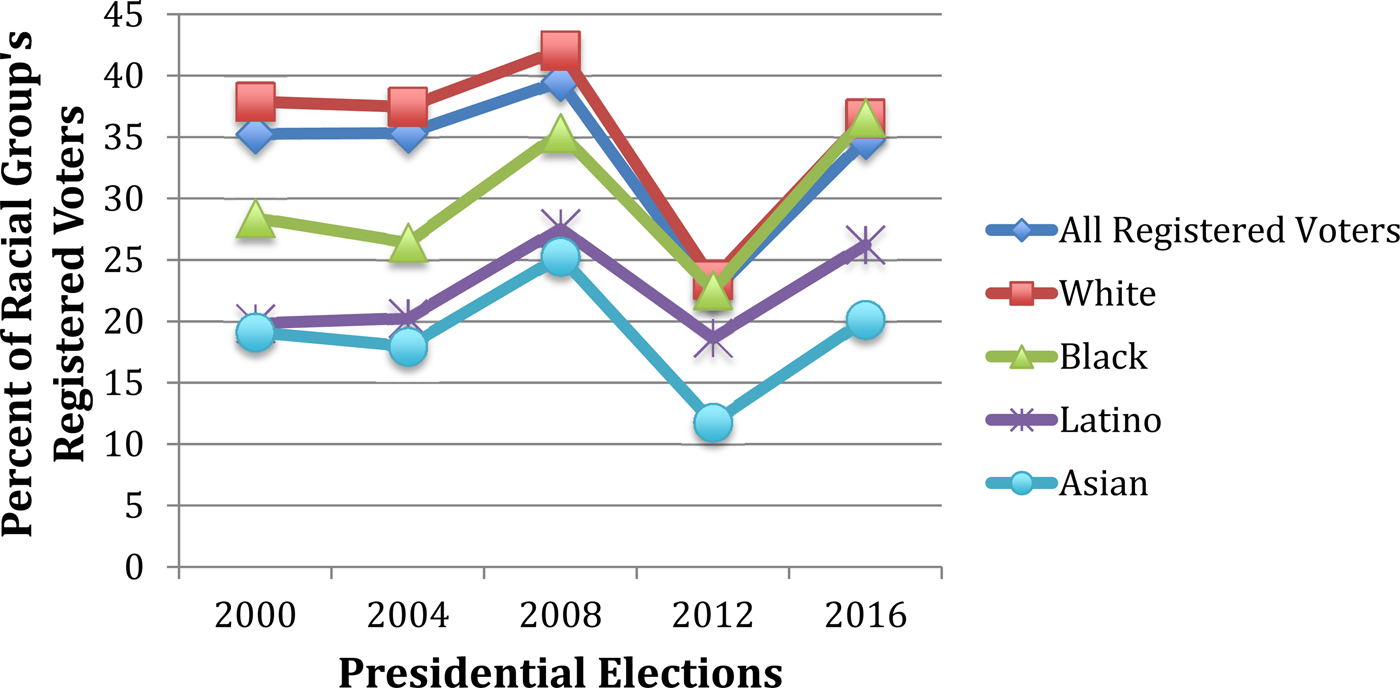
What is less clear is who is left out or neglected as a result of strategic mobilization. Figure 1 considers whether racial and ethnic minorities have been equally as likely to live in battleground states. Whites typically enjoy the “unearned advantage” of having at least a third of their registered voters living in Battleground states (with the exception of 2012, when there were only nine battleground states). What does this tell us? If campaigns are rational, then they invest more in those states perceived to be battleground states because that is where elections are won and lost. The beneficiaries of this logic are those select number of people who are disproportionately advantaged. Battleground states tend to be predominately white. To the extent that African Americans, Latinos, and Asian Americans live in these states, they also may be contacted more. We explore this possibility and in particular ask when and how racial-ethnic minorities will be mobilized. We expect that respondents, regardless of race, living in battleground states will report higher levels of contact.
Registered Voters by Race in Battleground States, 2000–2016.

The question that remains for our paper is, even if we control for battleground state, do some of the variables that predict (self-reported) contact vary by race/ethnicity? Ceteris paribus, the same independent variables that predict whites being contacted should hold true for minorities. Is that the case? We make that case that this is not so. Race and ethnicity also matter in two other ways. In the aggregate, it is possible that respondents living in racially and ethnically diverse neighborhoods are perceived to matter differently for election outcomes. This aggregate measure of percent minorities may not only impact minorities living there, but also whites living in those neighborhoods. For Latinos and Asian respondents, in addition to the standard model variables, group consciousness variables, and other factors such as citizenship status, nativity, language proficiency also matter. Many registrars of voters include a question about the place of birth. Those who are foreign-born may include the specific country, but many are just coded “foreign-born.” We expect direct and indirect effects of race and ethnicity, where Latino and Asian immigrants are contacted less than white respondents, but also that respondents of any race who live in racially and ethnically diverse neighborhoods will report lower levels of contact because of perceptions that they will not be responsive to mobilization or because they are not seen as a priority.
The expectations listed thus far focus on both contextual and individual-level characteristics of voters to explain who is contacted and where. Our main contribution is delving deeper into the final question: “contacted by whom?” If, as Schlozman et al. (Reference Schlozman, Verba and Brady2012) suggest, the inequality in participation favors those who are already more economically advantaged because that is who is doing the recruiting, is it possible to independently extend the logic to the racial and ethnic inequality of participation? As noted above, Phillips (Reference Phillips2016) indicates that there is a bias that favors white mobilization because most of those with resources to recruit others are also white. Rather than rely on anecdotal evidence or a view from the top, we control for all of the standard variables that should impact strategically-minded mobilization efforts. We expect minority mobilizers will behave differently than white mobilizers, expanding the pool of targeted voters to those populations that are harder to tap into, such as immigrants and those living in more racially diverse neighborhoods.
DATA AND MEASURES
Having outlined our expectations here, we now turn to a brief discussion of the methodology employed in this analysis and how we operationalized certain measures. The paper culminates with the presentation of some initial statistical findings and a more extensive discussion of its implications for future research in racial-ethnic politics. We use the 2016 CMPS, a nationally representative sample of residents with large over samples of Blacks, Latinos, and Asian Americans. The 2016 CMPS was fielded immediately after the 2016 presidential election and contains the type of variables we are interested in. To the individual level survey data, we have appended census-measured demographic variables that correspond to the respondents’ zip code.
With individual-level data and census-measured contextual data, we can largely replicate the set of information used by various mobilizers when seeking to mobilize voters. Hersh (Reference Hersh2015) discusses that campaigns have access to a rich set of information for each voter that includes age, address, gender, etc.Footnote 2 In some states, voter rolls contain the race and ethnicity of the respondent. Because these data are not gathered in every state jurisdiction, voter file vendors have computed the predicted race scores for each voter using various prediction algorithms. While the algorithms are all slightly different, the basic premise is very similar. Conditional on registered voters' names and where they live, a probability can be assigned to any given individual's racial or ethnic membership. Because we want to understand systematic neglect and how mobilizers are neglecting some groups over others, in the main analysis, we only include the variables that a campaign or non-profit group could reasonably have access too. Our primary modeling strategy includes being female, whether the respondent lives in a battleground state, % non-white in zip code, % in zip code with a college degree, median household income of zip code, age, age-squared. For Latinos and Asian Americans, we include a dummy variable for whether or not the respondent is foreign-born.
In terms of the dependent variable, respondents in the CMPS are first asked if they were contacted in the past 12 months to register or to vote by a candidate for office or a person working for a candidate, a representative of a political party, or someone from an organization working in their community. Possible outcomes are yes, no, and don't know. Among those who said they were contacted, a follow-up question asked the racial and ethnic composition of the mobilizers. The possible outcomes include White, Blacks, Latino, Asian, and Don't Know. Respondents were permitted to select multiple categories. We then collapsed these into the following: no contact, white only contact, minority-only contact, and mixed contact. We begin by modeling any campaign neglect (1 = neglect, 0 = contact) with a logistic regression. We then turn to modeling the different types of contact with a multinomial logistic regression given the nominal structure to our key dependent variable.
NEGLECT
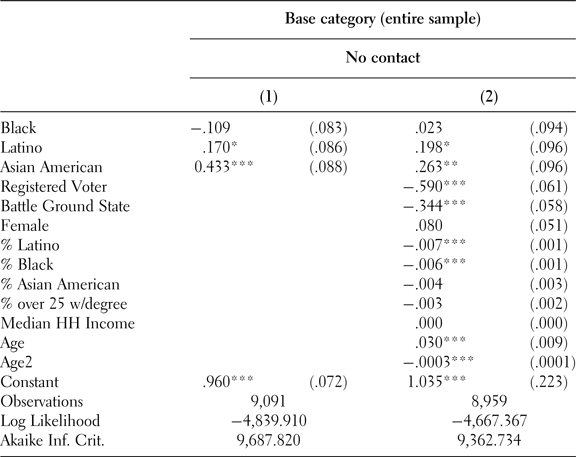
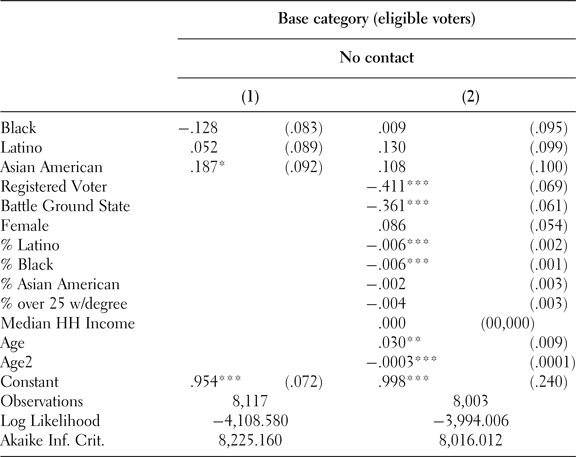
Our first model considers whether or not a respondent was neglected by a campaign in the 2016 electoral context. We use a logistic regression and include dummy indicators for Black, Latino, and Asian American to make a comparison between groups. Based on the theoretical expectations that there may be racial patterns of neglect, whites are established as the reference category. These results are presented in Table 1. In the first column, we include dichotomous variables for each of the three racial/ethnic groups. A positive coefficient should be interpreted as an increase in the probability of neglect. In column 1 of Table 1, we see that indicator variables for Latinos and Asian Americans are positive and significant, suggesting that members of those two groups are more likely to be neglected in terms of mobilization contact compared with whites. In column 2, we include the covariates that we anticipate should help explain variation in neglect versus contact. Again, these are variables that campaigns are likely to have access to Hersh (Reference Hersh2015). Including these variables, we see that Asian American and Latino respondents remain more likely to report neglect.
No self-reported contact

Note: *p < .05; **p < .01; ***p < .001.
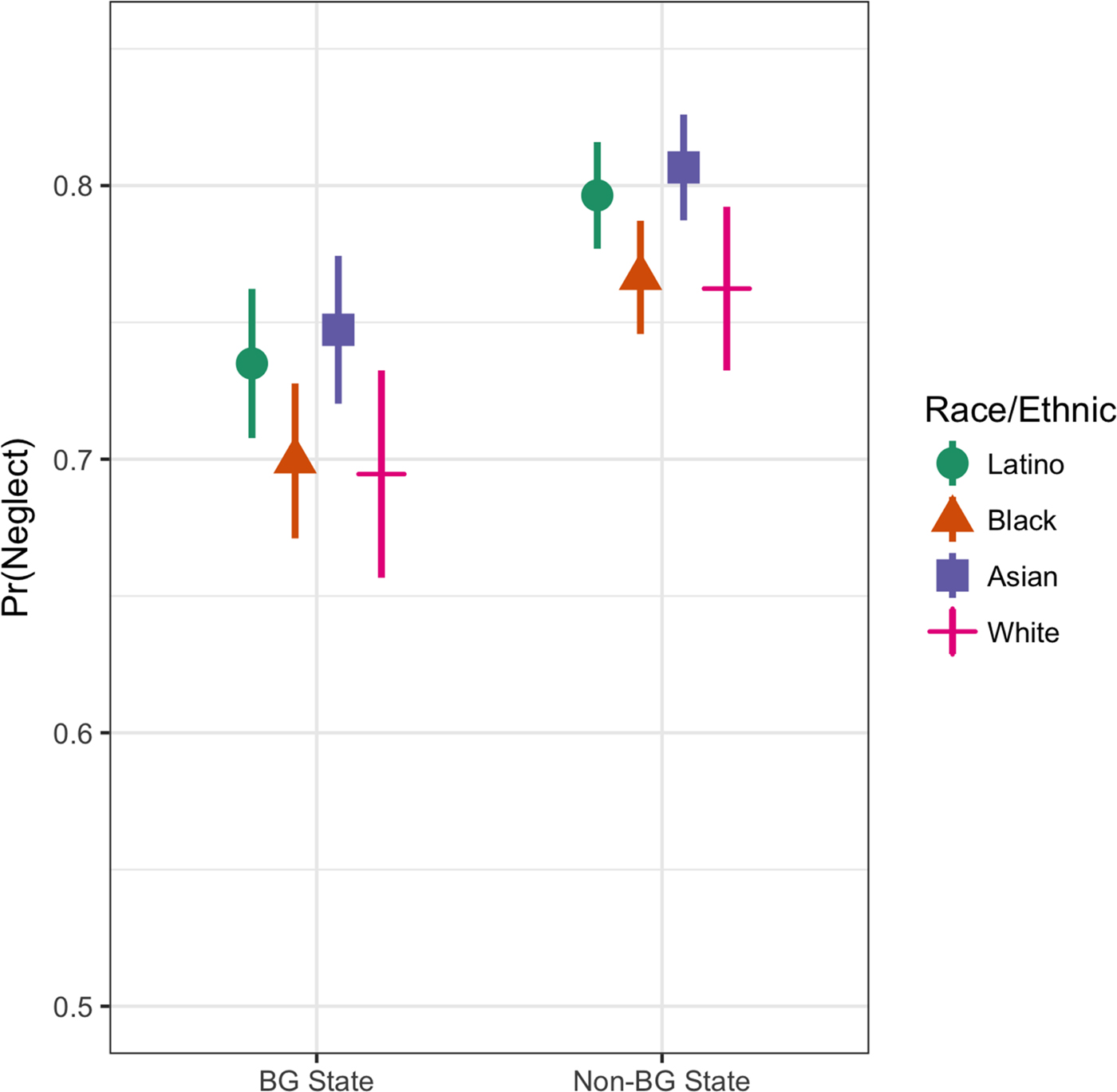
We also plot the probability of neglect in Figure 2. On the y-axis is the predicted probability of neglect from the model in Table 1 that considers all the control covariates. We split this between those living in battleground states and non-battleground states. The patterns in the figure are quite revealing. It should be noted that being contacted is not the norm, given that most respondents do not report contact. The modal response is no contact, but neglect is more likely among Latinos and Asian Americans. This is the case in both battleground states and non-battleground states. In general, whites are the least likely group to be neglected by mobilizers.
Probability of Neglect (no self-reported contact) by Race and Battleground State.

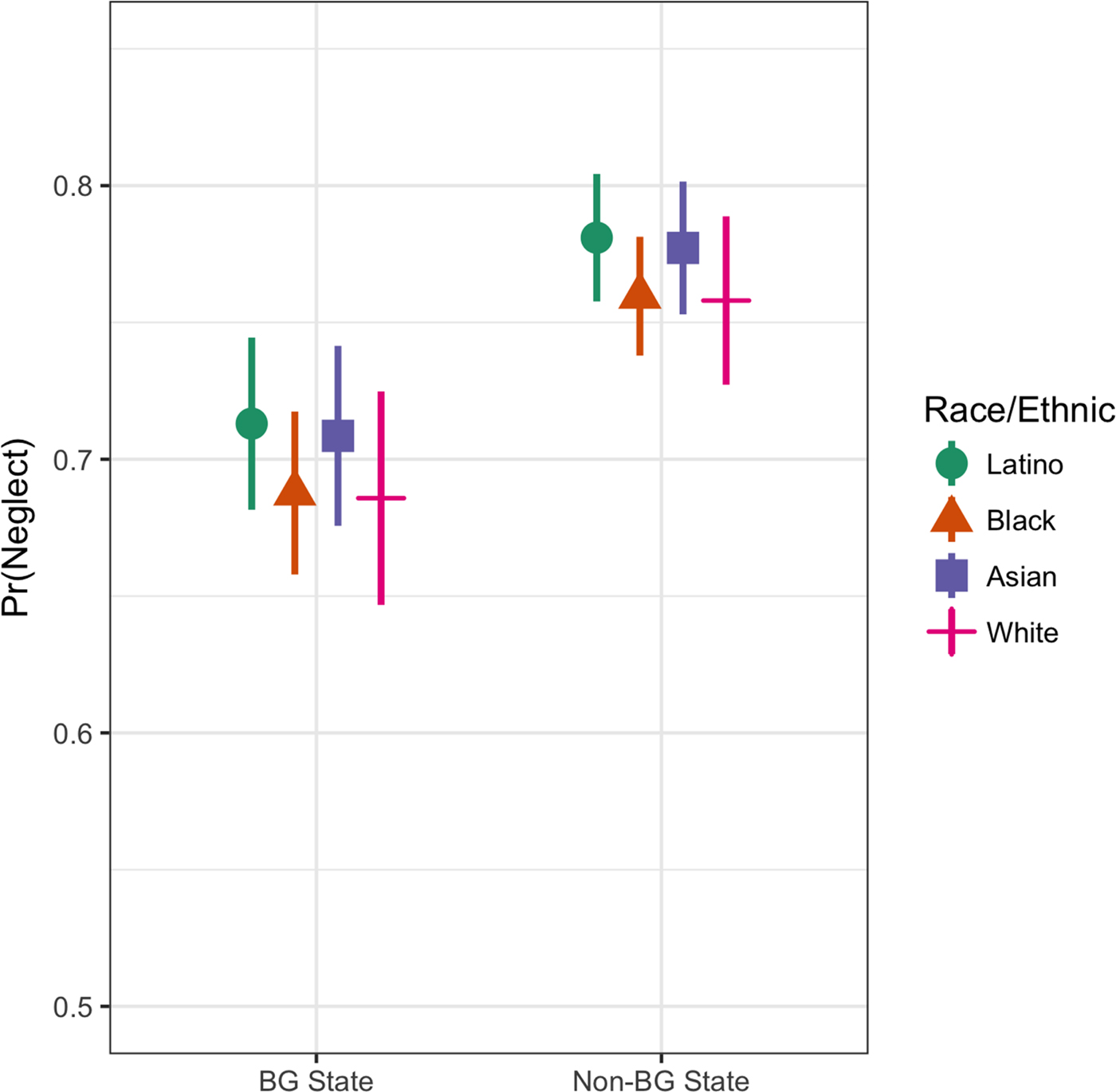
Next, we restrict this analysis to those who are eligible to vote. These are individuals who are U.S. citizens either through birthright or naturalization. While this may seem more important than the above analysis, our original question asked not just about mobilization to vote, but also about voter registration. Thus, it is important that we consider not only those who are eligible, but those who could be mobilized in other contexts such as voter mobilization drives, community meetings, etc. Yet, we know that campaigns and mobilizers are strategic and do have access to a host of information about individuals. We highlight these results in Figure 3. Here we see that among those eligible, there is no statistically distinguishable difference between the groups as we saw above but the point estimate of the predicted probability remains higher for both Latinos and Asian Americans.
Probability of Neglect (no self-reported contact) by Race and Battleground State among Eligible Voters.

By restricting the analysis to eligible voters in Table 2, we see a similar pattern. In the race only model (column 1), Latino and Asian American are more likely to be neglected than their white counterparts. However, this is only statistically significant for Asian Americans. The coefficient is in the correct direction for Latinos, however. Adding the additional control variables, column 2, does indeed erase any statistical significance for Latinos and Asian Americans, but the coefficients are in the correct direction. Living in a battleground state and being registered are significantly related to contact.
No self-reported contact among eligible voters

Note: *p < .05; **p < .01; ***p < .001.
NEGLECT BY MOBILIZER
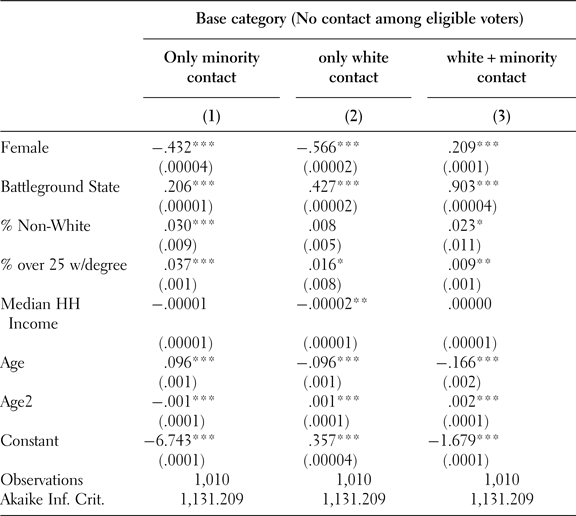
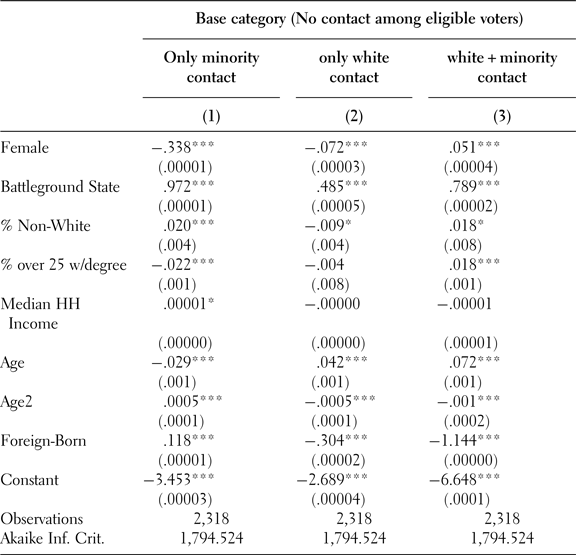
Next, we turn to a set of multinomial models to better understand the conditional nature of neglect by mobilizers across the different racial and ethnic groups. As a reminder, minority-only mobilization refers to those who reported contact during the 2016 election season and those who contacted them were minorities. White + minority mobilization, or “mixed,” are those who were contacted and reported being contacted by whites and minority group members. Finally, white only mobilization refers to contact during the election by only whites. The point of this is to fully understand how certain groups are more or less likely to be reached out to for their support in an electoral context. We begin with whites. In Table 3, we see a model that considers three different types of contact where the base category is no contact. The first column is a minority-based contact. These individuals reported being contacted by only someone who was non-white. Here we see that living in a battleground state is significantly associated with reporting only minority contact. In fact, living in a battleground state is positively associated with all types of contact, whether minority, white, or mixed. Only the percent of residents with a college degree is consistently positively associated with contacts across the three groups. Among the other predictors, we see quite differential patterns. Whites are more likely to see minority contact as the % non-white in the neighborhood increases, suggesting that minority-based mobilizers, who may focus their attention on more densely minority areas, also reach out to whites.
Patterns of contact and neglect among white eligible voters

Note: *p < .05; **p < .01; ***p < .001.
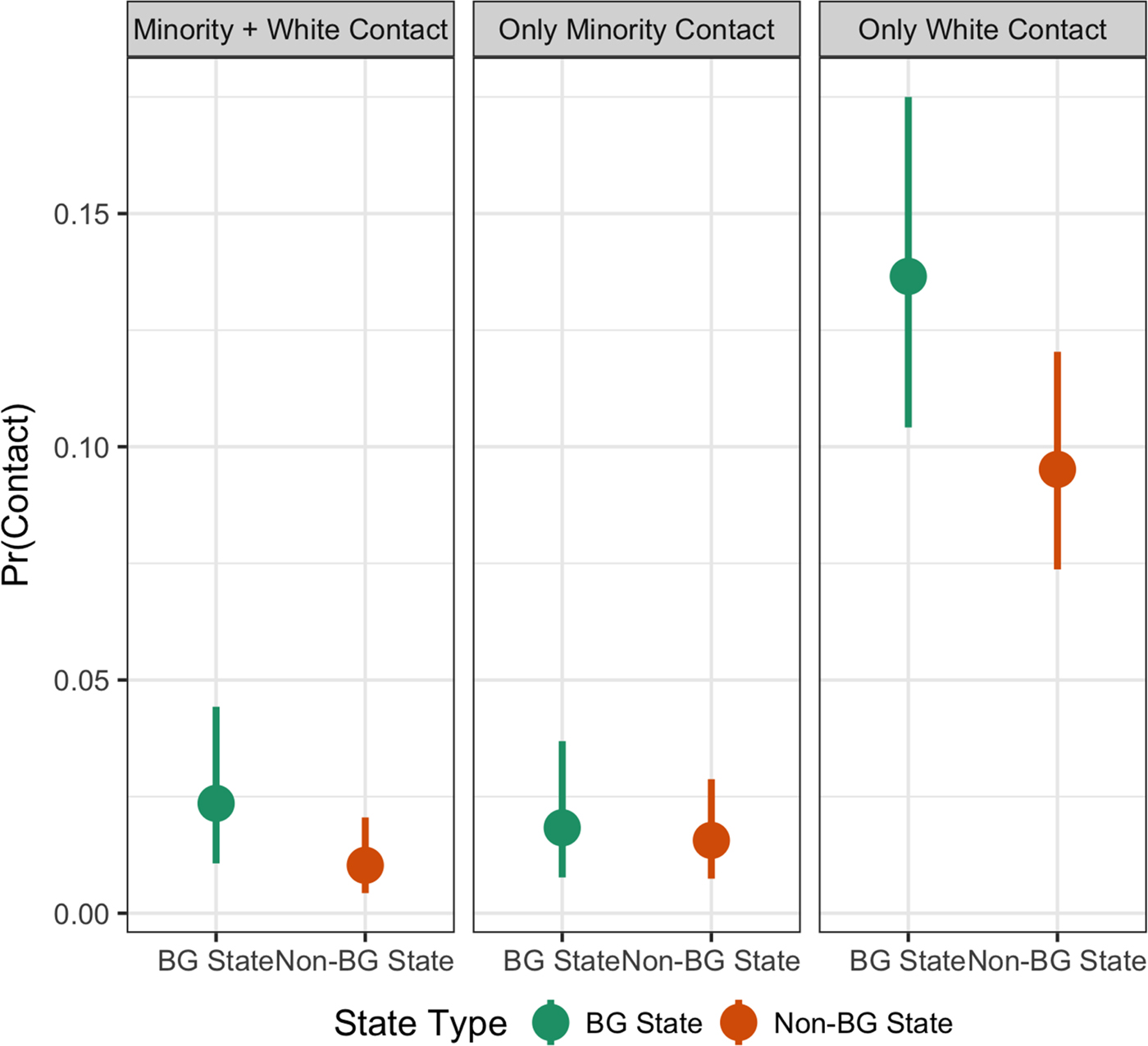
In Figure 4, we show the predicted probabilities of contact among whites by the various mobilization patterns. As the figure shows, whites are much more likely to report being contacted only by whites compared with any other pattern. Among whites, we see that contact by minorities or minorities and whites is quite unlikely. The probability of contact is less than .05, regardless of whether they live in a battleground state or not.
Probability of Contact by Mobilizer Race and Battleground State among White Eligible Voters.

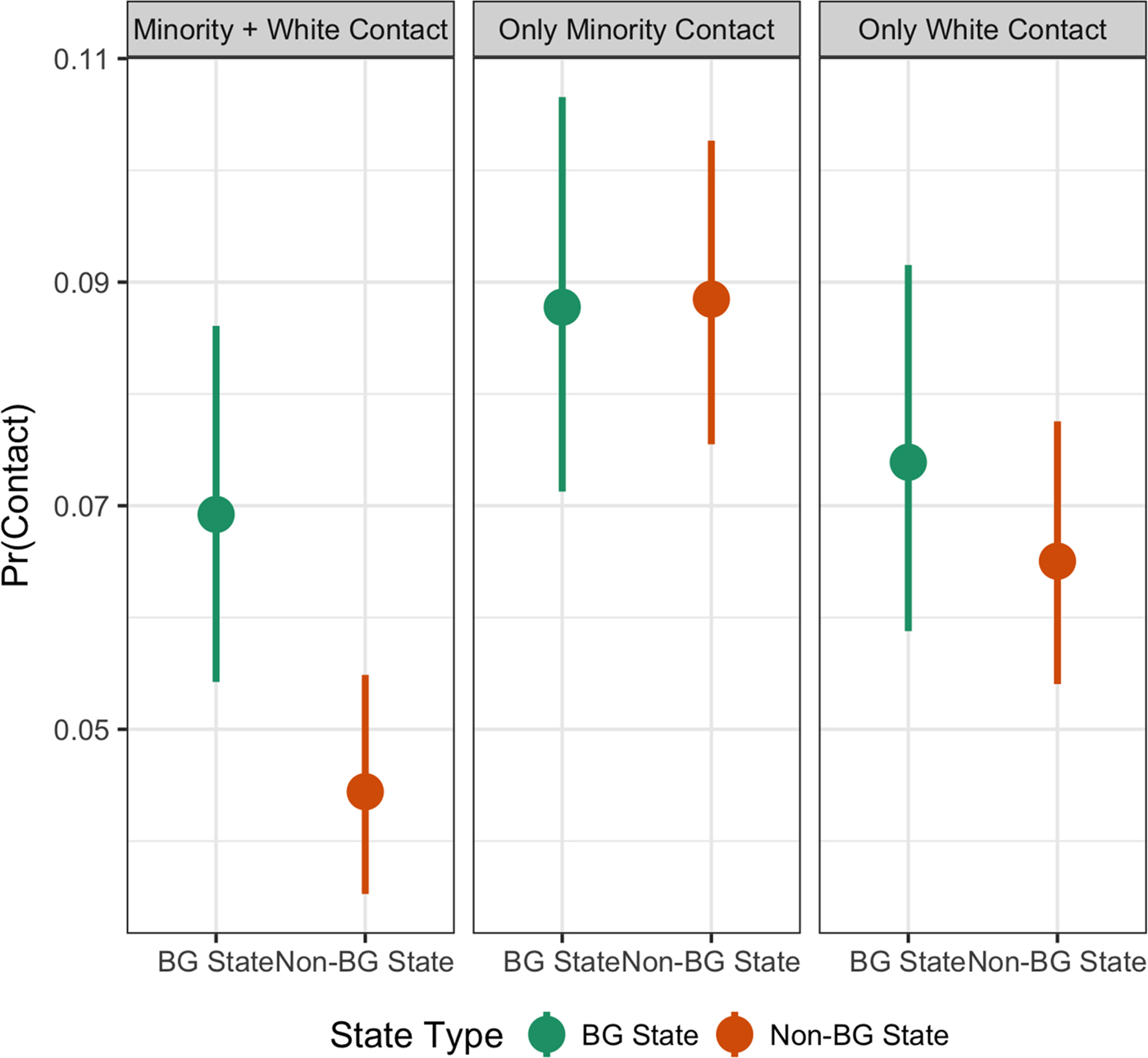
In Table 4, we explore this pattern among Black eligible voters. Again, as we saw with whites, Blacks are much more likely to receive contact from any group when they reside in a battleground state. Also, Blacks are more likely to report some minority contact as the percent non-white in the zip code increases. However, they are less likely to report only white contact as the percent non-white increases in the zip code. Females are more likely to be contacted by only minority groups. For Blacks, the SES of the neighborhood has little impact on contact with any type of mobilizer group. Both median household income and percent over 25 with a degree are non-significant, suggesting that those seeking to mobilize Blacks are not seeking out areas with higher or lower SES. In Figure 5, we show the probability of contact among Blacks. Here we see that Blacks are likely to report contact by all groups, a sharp difference from whites. It is only among mixed-status contact that we see a strong departure, but this only occurs in battleground states. Blacks are especially likely to report being mobilized by a minority-only groups.
Probability of Contact by Mobilizer Race and Battleground State among Black Eligible Voters.

Patterns of contact and neglect among Black eligible voters

Note: *p < .05; **p < .01; ***p < .001.
In Table 5, we present the first of two results among Latinos. In this model, we limit the base population to Latino registered voters because of the likely strong perception that many Latinos are not eligible to vote given their higher incidence of immigrant status and population under the age of eighteen. We also add a variable to account for whether the respondent is foreign born or born in the United States. This is a higher bar, but likely one that enters the calculus of strategic mobilization. Unlike what we saw before, here we see a difference in mobilization type depending on whether or not a respondent lives in a battleground state. Those who live in a battleground state are significantly less likely to receive only minority contact whereas those who live in battleground states are more likely to be contacted by whites or mixed contact (which contains whites). In terms of the ethnic composition, Latinos who live in more non-white areas are more likely to be contacted, but only by minority groups. Similarly, foreign-born Latinos are more likely to be contacted by other minorities, but the relationship is negative for whites or mixed contact. Figure 6, shows the predicted probabilities for Table 5. Here we added the foreign-born variable to the plot to see how groups work to mobilize different segments of the population in different ways. Latinos are very unlikely to report mixed contact and it is not much different among native born and foreign-born Latinos. However, only minority groups are more likely to mobilize foreign-born members.
Probability of Contact by Mobilizer Race, Battleground State, and Respondent Nativity among Latino Registered Voters.

Patterns of contact and neglect among Latino registered voters

Note: *p < .05; **p < .01; ***p < .001.
In model 6, we open the population back to eligible voters, rather than a more restricted version where we only looked at registered voters. Here we see a quite different pattern compared to the model above. Among eligible voters, all Latinos are more likely to see contact by any means. This coefficient is positive and significant for all groups. Similar to above, only minority contact is more likely as the percent of the neighborhood increases in non-white composition. We also see that being foreign-born is positively associated with all types of contact, a sharp contrast to the subset among registered voters. In Figure 7, we show the predicted probabilities for Table 6. Similar to the more restricted sample of registered Latino voters, foreign-born eligible Latino voters are more likely to be mobilized, but only by “minority only” mobilizers.
Probability of Contact by Mobilizer Race, Battleground State, and Respondent Nativity among Latino Eligible Voters.

Patterns of contact and neglect among Latino eligible voters

Note: *p < .05; **p < .01; ***p < .001.
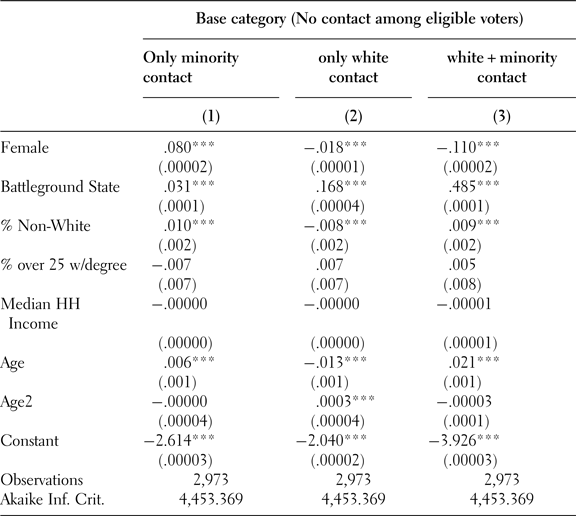
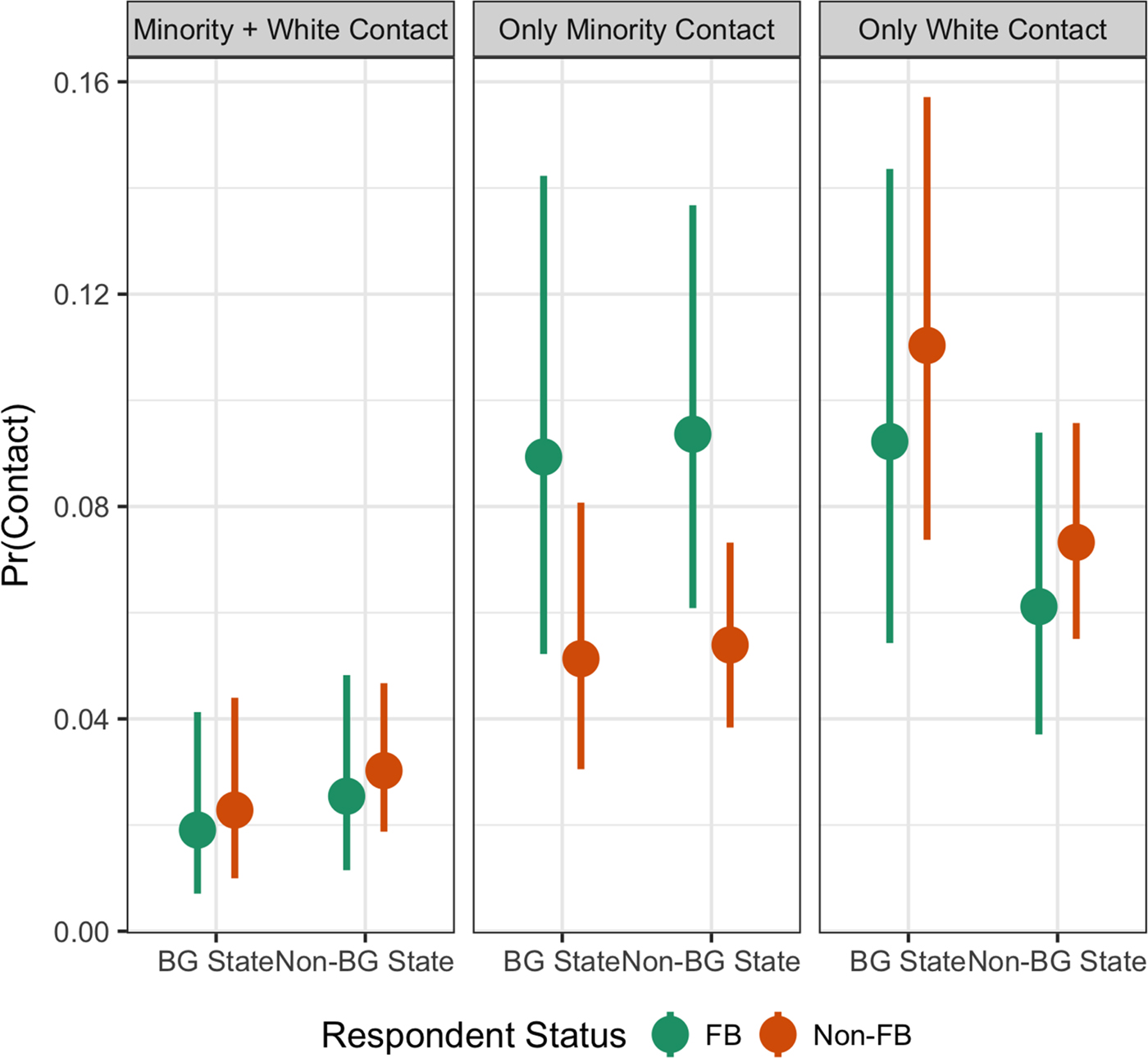
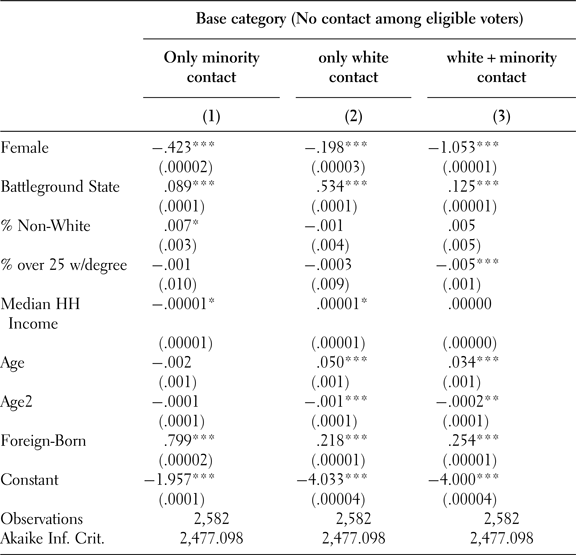
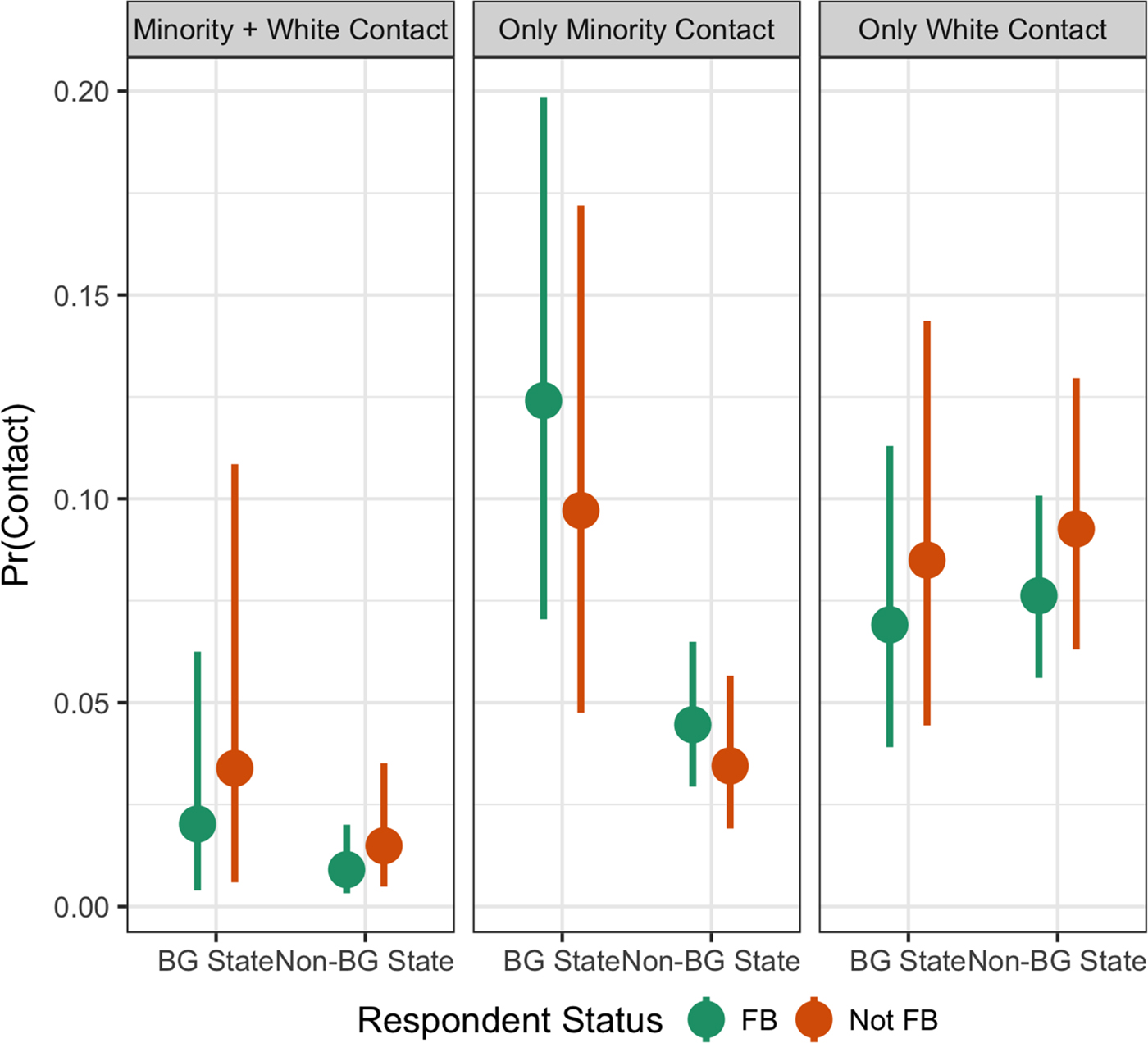
Turning to Asian Americans, the last set of models we examine in Table 7, again is subset to registered Asian American voters for the same reason as for Latino voters. Battleground state is positively associated with minority and mixed contact, suggesting that minority groups are often reaching out to Asian Americans, whereas only white contact is less likely. This pattern is mimicked for the percent non-white in the zip code. “Only minority” and mixed contact is positively related to increases in the percent non-white population of the neighborhood. However, “only white” contact is negatively associated with this increase. With respect to nativity, those who are foreign-born are significantly more likely to report “only minority” contact. Foreign-born Asian Americans are less likely to report contact by “only white” or mixed mobilizers. In Figure 8, we show the results for Asian American voters. Only minority contact is higher among both foreign-born and native-born populations, but only in battleground states. Only white contact is low regardless of the battleground state. Finally, “mixed contact” is very low among the respondents in the sample.
Probability of Contact by Mobilizer Race, Battleground State, and Respondent Nativity among Asian American Registered Voters.

Patterns of contact and neglect among Asian American registered voters

Note: *p < .05; **p < .01; ***p < .001.
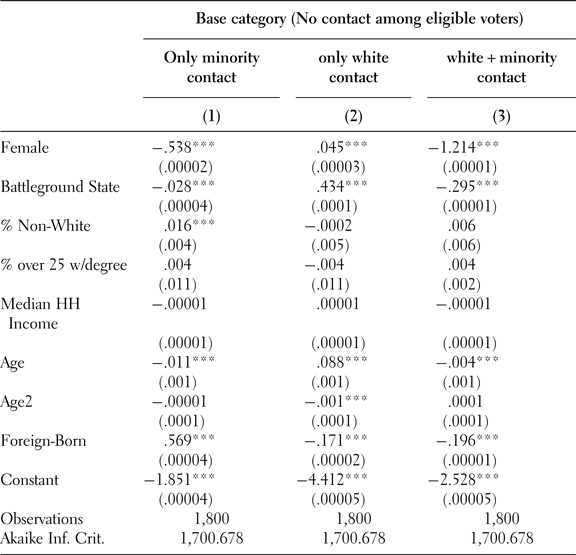
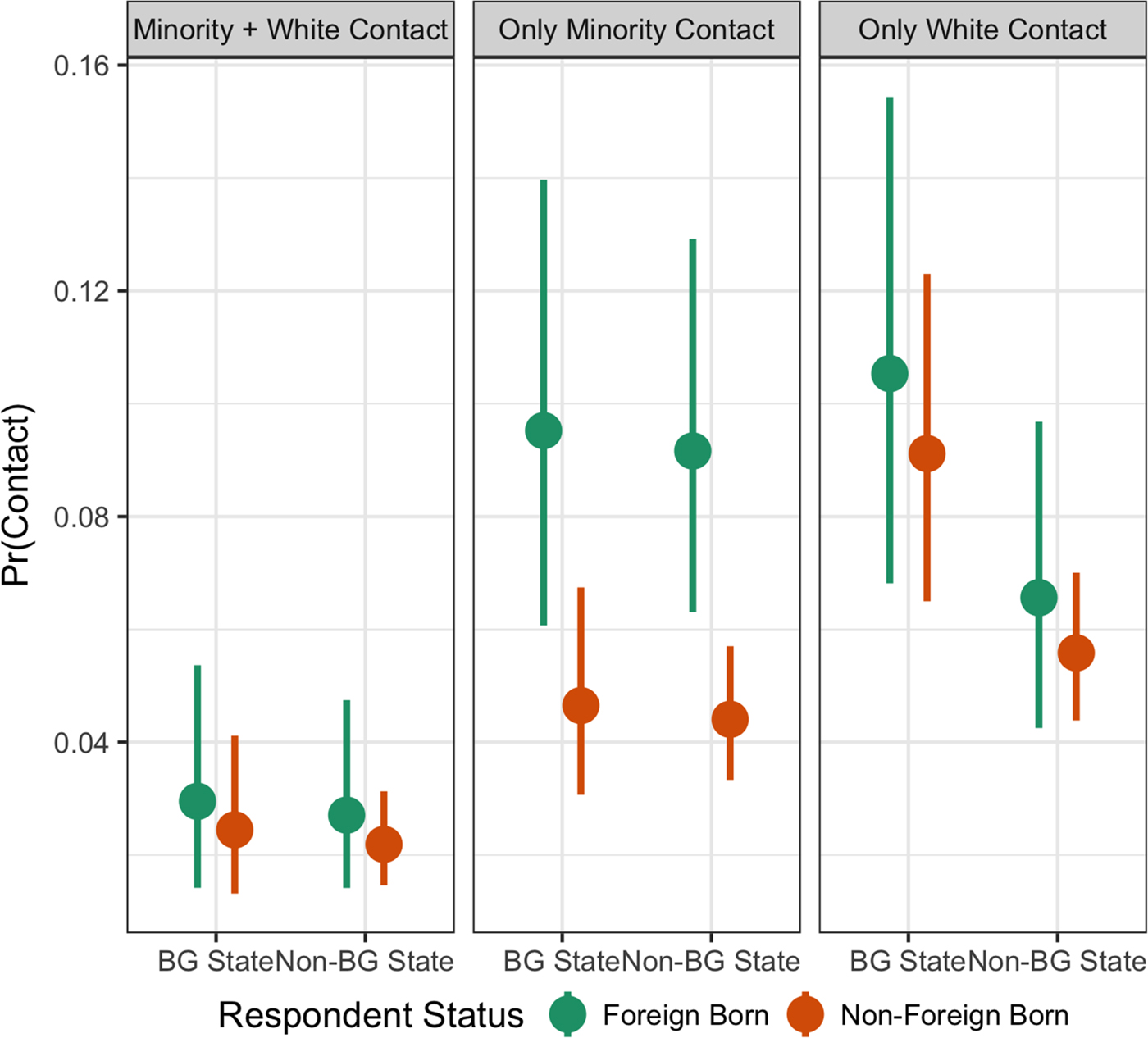
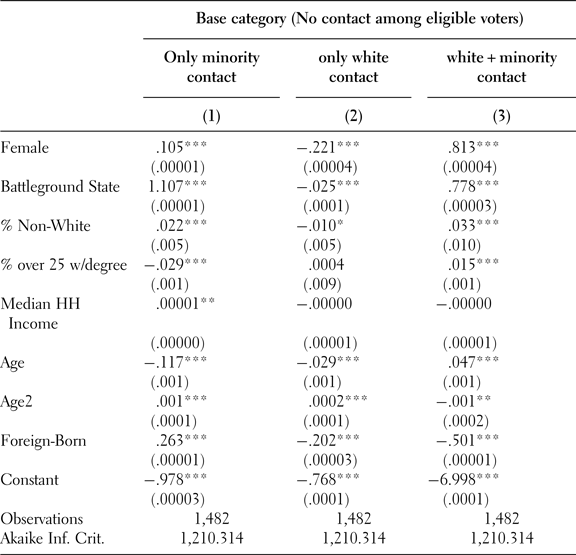
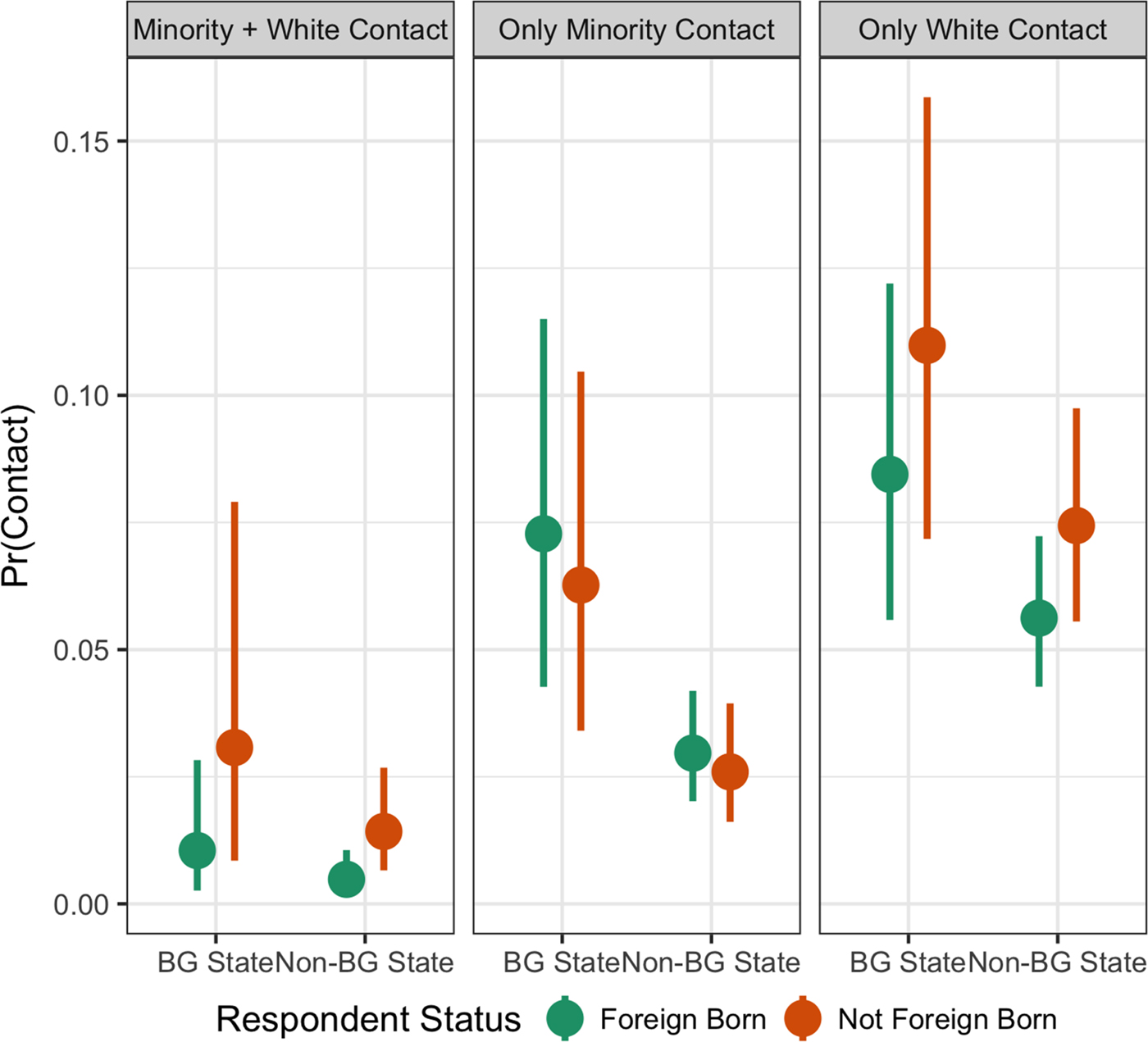
Lastly, in Table 8, we examine the relationships among eligible Asian American voters. As we saw among Latino eligible voters, those in a battleground state are more likely to report all types of contact. As the percent non-white increases, both minority only contact and mixed contact are more likely. However, only white contact is less likely, suggesting only white mobilizers may neglect areas with large non-white populations. Finally, foreign-born Asian Americans are more likely to report “only minority” contact and significantly less likely to report “only white” contact or “mixed” contact. As we have seen, minority mobilization groups are effective at mobilizing the foreign-born population. The findings in Figure 9 are largely consistent with those presented in Figure 8. There is clear pattern of contact across Asian American eligible voters. White mobilizers appear to seek out those Asian Americans who are native-born.
Probability of Contact by Mobilizer Race, Battleground State, and Respondent Nativity among Asian American Eligible Voters.

Patterns of contact and neglect among Asian American eligible voters

Note: *p < .05; **p < .01; ***p < .001.
While the findings may seem inconsistent, there are some key patterns and findings that we want to highlight. Moreover, we think that what appear to be inconsistencies, actually fit with what we know about how campaigns and non-profits mobilize and think about voter contact. In general, living in a battleground state is positively associated with the contact. However, conditional on living in a battleground state, the likelihood of neglect varies given one's racial/ethnic status and where one lives. White only mobilization is less likely in places that are more diverse among the minority community. That is, our evidence suggests that only white contact appears to neglect diverse areas of the country. In minority-heavy areas, other minorities and co-ethnics are doing much of the contact work. Surprisingly, the SES of the zip code was not consistently related to contact by any of the groups. This suggests that groups are not considering the SES characteristics in who to contact, except among whites, where the SES of the zip is positively related to contact. When working to mobilize whites, groups consider the SES of the neighborhood. This, of course, fits long-standing theories that suggest that those with higher SES are more likely to participate, but as we know, that model is most explanatory for Whites. As strategic actors, campaigns may be on to something. While SES is important, our results suggest that its importance is conditional on the group, where it is most important for whites and Asian Americans, two higher status groups.
DISCUSSION AND CONCLUSION
These findings lend some support to the expectation that who gets contacted is very much a function of who contacts (minority, white, mixed), and where (geographically) people are being contacted. As Jan Leighley so eloquently states, “it is virtually impossible to estimate the effects of mobilization on participation while giving sufficient consideration to the extent to which they are interrelated. Individuals and institutions are likely to mobilize those who are likely to participate and mobilization always predicts participation successfully” (2001, 161). This paper represents a first attempt at untangling this relationship in the 2016 presidential election. The mobilization strategies of those who are on the ground doing the mobilizing work matters, because racial groups are not distributed evenly in battleground states and the Electoral College system privileges some voters over others. Therefore, on several metrics that campaigns use to target voters, minority voters always start with a deficit simply by not living in battleground states and white voters always start with an “unearned advantage”.
The results corroborate the expectation that the patterns of contact matter for when and where racial and ethnic minorities are mobilized. The perception that these minority groups are assumed to be low-propensity voters means that they are often neglected by traditional mobilizers. Contact by minority mobilizers, therefore, is especially important in terms of engaging those voters that are systematically neglected by traditional mobilization strategies. Simply as a function of demographics, Asian Americans and Latinos are the two fastest-growing segments of the electorate yet have largely remained relatively neglected in voter registration and Get Out The Vote efforts. Rather than invest in these growing constituencies in 2016, the Democratic party tried and failed to win over white voters residing in battleground states. In the years to come, and as these populations age and become naturalized citizens, their eligible voter population is likely to attract more campaign and non-campaign outreach. In short, the potential is there, if only campaigns were willing to see it.
Rosenstone and Hansen claim in their seminal work, that the Resource Model of participation is missing half of the story, namely mobilization. Contemporary mobilization strategies, however, make it increasingly evident that the Resource Model of participation is missing more than half of the story. It is not just that resources and socio-economic status lead to political inequality and inequality of participation. Race continues to be a significant feature of American politics in ways that are not related to socio-economic status. More directly, we make the case that it is not just the accent of the chorus that we should be concerned with, but the race and accent of the conductors of the heavenly chorus.
ACKNOWLEDGEMENTS
We are grateful to the editors and the anonymous referees and participants of the Political Behavior Conference at the University of Southern California for comments and valuable suggestions. Any errors remain our own.