Introduction
Hypertension-related complications have become a major global health risk, accounting for nearly 9.4 million deaths annually (WHO, 2013), with heart disease being responsible for about 45% of these deaths and 51% of other cases related to stroke. A major concern is that hypertension tends to be under-diagnosed and under-treated (Cornwell & Waite, Reference Cornwell and Waite2012; Basu & Millett, Reference Basu and Millett2013). It is estimated that only about half of people with hypertension are diagnosed, and only half of diagnosed patients are treated and have their blood pressure controlled (Cornwell & Waite, Reference Cornwell and Waite2012). Hypertension can be asymptomatic; many people with high blood pressure often experience no pain, discomfort or declining function, resulting in inadequate disease awareness and management (Cornwell & Waite, Reference Cornwell and Waite2012). Lack of awareness and/or effective treatment or control of hypertension poses higher risk of deaths from hypertension-related conditions such as cardiovascular diseases, stroke or kidney diseases, often causing a devastating economic burden for the family and society due to the ensuing high health care cost (Cai et al., Reference Cai, Shu, Dong and Zhao2012; Cornwell & Waite, Reference Cornwell and Waite2012; Feng et al., Reference Feng, Pang and Beard2014).
In recent years, multiple global health campaigns have been undertaken, ranging from healthy lifestyle promotion to other non-lifestyle-based approaches (Ueshima et al., Reference Ueshima, Zhang and Choudhury2000; Shaya et al., Reference Shaya, Chirikov, Mullins, Shematek, Howard, Foster and Saunders2013). One of the recommended preventions and treatments of hypertension by the Mayo Clinic is to increase social contacts and quality of social relationships for patients with myocardial infraction (Shaya et al., Reference Shaya, Chirikov, Mullins, Shematek, Howard, Foster and Saunders2013). This recommendation was based on a large body of literature pointing to the positive associations between social engagement and health outcomes observed in both clinical and community settings in Western countries (Christenfeld et al., Reference Christenfeld, Gerin, Linden, Sanders, Mathur, Deich and Pickering1997; Berkman, Reference Berkman2000; Kawachi & Berkman, Reference Kawachi and Berkman2000; Holt-Lunstad et al., Reference Holt-Lunstad, Jones and Birmingham2009; Hughes & Howard, Reference Hughes and Howard2009; Cornwell & Waite, Reference Cornwell and Waite2012). An abundant literature has indicated that social engagement with friends, relatives and community members is beneficial to health, as manifested by reduced risk of mortality, disability and cognitive impairment among adults (Berkman et al., Reference Berkman, Glass, Brissette and Seeman2000; Lennartsson & Silverstein, Reference Lennartsson and Silverstein2001; Mendes de Leon et al., Reference Mendes de Leon, Glass and Berkman2003; Zunzunegui et al., Reference Zunzunegui, Alvarado, Del Ser and Otero2003).
The association between social engagement and physical health outcomes such as hypertension can operate through mechanisms such as psychological benefits conferred by social support received from, or provided for, social ties (Carels et al., Reference Carels, Blumenthal and Sherwood1998; Hughes & Howard, Reference Hughes and Howard2009) and healthy lifestyles being promoted among socially engaged peers (Nieminen et al., Reference Nieminen, Martelin, Koskinen, Aro, Alanen and Hyyppä2010; Gorman & Porter, Reference Gorman and Porter2011). However, theoretical and empirical support for these hypotheses is largely based on studies conducted in the West, with little evidence available for low- or middle-income societies where the prevalence of hypertension has been rapidly growing in recent years (Elwell-Sutton et al., Reference Elwell-Sutton, Timothy, Chao, Zhang, Cheng and Lam2013; Kim, Reference Kim2014) and social engagement may carry different social meanings and exert different impacts on health is different settings. More research is clearly needed to understand the risk or protective factors of hypertension in these non-western regions.
The present study examines the association between social engagement and hypertension in China, a unique setting characteristic of an enormous population size, rapid ageing trend, remarkable economic growth and fast-paced urbanization (Ueshima et al., Reference Ueshima, Zhang and Choudhury2000; Cook & Dummer, Reference Cook and Dummer2004). The estimated prevalence of hypertension in China was 34% in 2010, but this is likely to be an underestimate due to the common unawareness issue of hypertension (Ahn et al., Reference Ahn, Zhao, Tai-Seale, Huber, Smith, Ory and Phillips2012; Feng et al., Reference Feng, Pang and Beard2014). There are more than 100 million annual cases of hypertension in China and the count has been steadily increasing in recent years, partly due to the adverse forces of urbanization and the adoption of Westernized lifestyles (Ueshima et al., Reference Ueshima, Zhang and Choudhury2000; Cook & Dummer, Reference Cook and Dummer2004; Van de Poel et al., Reference Van de Poel, O’Donnell and Van Doorslaer2009). The increasing prevalence of obesity and unhealthy health behaviours such as sedentary lifestyles, the consumption of processed food, binge drinking and cigarette smoking have placed today’s Chinese people at higher risk of hypertension compared with earlier generations (Katz et al., Reference Katz, Stevens, Truesdale, Cai and North2012; Meng et al., Reference Meng, Dong, Wang, Liu, Liu and Zhao2012; Elwell-Sutton et al., Reference Elwell-Sutton, Timothy, Chao, Zhang, Cheng and Lam2013). Although many studies have examined the awareness, prevalence, treatment and risk factors of hypertension in China, there is limited knowledge on whether and how social engagement may play a role in lowering the risk of hypertension. In addition, previous studies in China used data that were either old, or small-scale and non-representative, with limited generalizability of the study findings (Li et al., Reference Li, Liu, Puente, Li, Jiang and Jin2005; Prince et al., Reference Prince, Ebrahim, Acosta, Ferri, Guerra and Huang2012). Studies using recent and large-scale data are needed to examine the prevalence and aetiology of hypertension in China.
To fill the gap, this study used data from a recent national survey conducted in China to examine the link between social engagement and hypertension and explore the underlying psychological and lifestyle mechanisms. In addition to examining the main association between social engagement and hypertension, the study also explores how this association may vary by gender. Men and women have been found to differ in hypertension prevalence and social network patterns. Specifically, men tend to have higher hypertension prevalence than women (Carels et al., Reference Carels, Blumenthal and Sherwood1998; Hughes & Howard, Reference Hughes and Howard2009) and women are likely to report greater number of social contacts and greater satisfaction with them than men (Pugliesi & Shook, Reference Pugliesi and Shook1998; Okamoto & Tanaka, Reference Okamoto and Tanaka2004; Musalia, Reference Musalia2006; Hughes & Howard, Reference Hughes and Howard2009; McLaughlin et al., Reference McLaughlin, Vagenas, Pachana, Begum and Dobson2010; Gorman & Porter, Reference Gorman and Porter2011; Staber, Reference Staber2013; Baheiraei et al., Reference Baheiraei, Mirghafourvand, Charandabi, Mohammadi and Nedjat2014). In addition, men and women also differ in the health effects of social influences. Evidence is mixed, however, regarding how gender interacts with social influences on health, with some studies finding that women are more responsive to social-relational contexts than men (Fuhrer & Stansfeld, Reference Fuhrer and Stansfeld2002; Wen & Zhang, Reference Wen and Zhang2009), while others report that men are more vulnerable to social deprivation indicated by factors such as living alone (Jeon et al., Reference Jeon, Jang, Rhee, Kawachi and Cho2007) and being separated, divorced or single (McLaughlin et al., Reference McLaughlin, Vagenas, Pachana, Begum and Dobson2010).
The following hypotheses were thus formulated: 1) in general, people reporting greater social engagement with friends, relatives, neighbours and coworkers, and more social outings, are less likely to take any hypertensive medication or treatment as an indicator of their having hypertension; 2) lifestyle factors (i.e. body mass index (BMI), cigarette smoking and physical activity) and psychological factors (i.e. depression, anxiety and overall quality of life) are important covariates as well as mediators of the link between social engagement and hypertension; and 3) gender moderates these associations with the direction of these interactions hard to predict a priori given the inconsistent findings in previous work.
Methods
Data
Data were from the first wave of the longitudinal WHO Study on Global AGEing and Adult Health (WHO-SAGE), which collected data from six low- and middle-income countries (China, Ghana, India, Mexico, Russia and South Africa) between 2007 and 2010. Information was collected at both the household and individual level, resembling the World Health Survey and the Health and Retirement Survey conducted in the US and the Longitudinal Study of Ageing conducted in England. The strengths of the WHO-SAGE include its longitudinal design, large sample size, nationally representative sample, high response rates and rich social and health information typically unavailable in developing countries (Kowal et al., Reference Kowal, Chatterji, Naidoo, Biritwum, Fan and Ridaura2012). The present study focuses on China, with data collection completed in 2010. The response rate was 93%. After list-wise deletion of missing data, the analytical sample size included 11,046 participants aged between 18 and 69 years at the time of the survey. The focus was on working-age adults, considering that the role of social engagement in hypertension prevention can be quite different for people under 18 years or older than 70 years due to physiological and social differences across the age groups.
Measurements
The dependent variable was self-reported use of hypertensive medication or treatment based on responses to the question ‘Have you ever been taking any medication or other treatments for it [hypertension] during the last 12 months? Other treatments might include weight loss programmes or changes in eating habits.’ The hypertensive medication variable was coded as ‘1’ for any medication or treatment, and ‘0’ otherwise. In an ad hoc analysis, this variable was positively correlated with the objective measures of hypertension in the survey, including clinical diagnosis and readings of systolic and diastolic blood pressure (data not shown but available upon request). This subjective measure of hypertension was chosen as the key outcome, rather than the clinical measure of blood pressure, because blood pressure was only taken once at the clinic visit rather than several times (as recommended to avoid so-called ‘white coat bias’).
The key independent variable was social engagement, measured by the frequency of the following social activities: visiting friends, visiting relatives, socializing with co-workers after work, volunteer work with neighbours and social outings in the previous 12 months. The response categories ranged from ‘never’ (coded 1) to ‘daily’ (coded 5). An index for social engagement was constructed using factor principal component analysis (Cronbach’s α=0.62). Factor loadings for the five items ranged from 0.55 to 0.76. Higher values of this variable indicated greater levels of social engagement.
Three lifestyle factors were included: ever smoking status (‘1’ for ‘ever smoked’ and ‘0’ for ‘otherwise’), regular physical activity (‘1’ for ‘75+ minutes of vigorous activity or 140+ minutes of moderate exercise weekly’ and ‘0’ for ‘otherwise’) and BMI tapped by five dummy variables indicating categories (in kg/m²) of ‘less than 18.5’, ‘18.5–24.9’, ‘25–29.9’, ‘30–34.9’ and ‘more than 35’. Psychological health was captured by three variables. Depressive symptoms were tapped by a question asking ‘Overall in the last 30 days, how much of a problem did you have with feeling sad, low or depressed?’ Anxiety was measured by a question asking ‘Overall, in the last 30 days, how much of a problem did you have with worry or anxiety?’ For both variables, the response categories ranged from ‘Not at all a problem’ (coded 1) to ‘Severe problem’ (coded 5). In addition, a measure of overall quality of life was created based on responses to the question ‘How would you rate your overall quality of life?’ with response categories ranging from ‘Very dissatisfied’ (coded 1) to ‘Very satisfied’ (coded 5).
Following prior research (Gong et al., Reference Gong, Song, Carlton, Jiang, Wu, Wang and Remais2012; Ploubidis et al., Reference Ploubidis, Mathenge, De Stavola, Grundy, Foster and Kuper2013; Wu et al., Reference Wu, Yang, Peng, Yao, Zou and Liu2013), the study’s analyses also controlled for several socio-demographic variables, including age (two groups: 18–49 versus 50–69), marital status (currently married versus other), socioeconomic status (completed high school or not, currently employed or not, and a five-level ordinal measure of wealth quintile) and urban–rural residence. Urban–rural residence was determined by WHO-SAGE in accordance with the World Bank standard definition; it was controlled in the analysis to account for the rural–urban contextual differences in China (Basu & Millett, Reference Basu and Millett2013).
Statistical analyses
Factor principal component analysis was conducted to create the social engagement scale and a series of logistic regression modelling analyses were performed to test the hypotheses. Model 1 tested the main effects of social engagement on use of hypertensive medication or treatment net of control variables, including age, gender, marital status, education, employment, wealth and urban–rural residence. Model 2 added lifestyle factors to Model 1, including ever smoked, regular physical activity and BMI dummy variables. Model 3 added three psychological variables to Model 1, including overall quality of life, depression and anxiety. The last model included all significant variables in the previous models. The interaction between social engagement and gender was also examined, and a significant effect was found. Thus, findings are reported for the whole sample as well as for female and male subsamples. All analyses were performed using Stata Statistical Software Release 13 (Stata Corp LP, College Station, TX).
Results
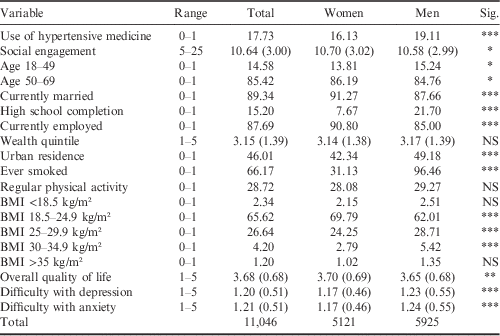
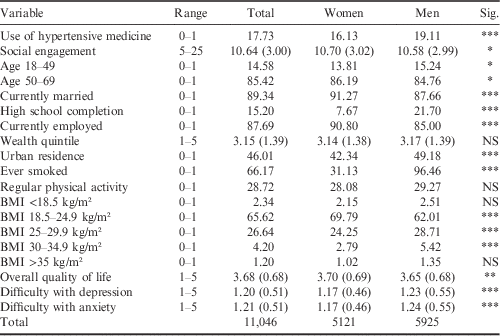
Table 1 shows sample statistics of 5121 female and 5925 male respondents. About 18% of the participants reported having used hypertensive medication or treatment (abbreviated as ‘hypertension’ below) in the 12 months before the survey. Proportionally more men (19%) reported hypertension than women (16%). Women reported a slightly higher level of social engagement (10.70) than men (10.58). Consistent with the design of the WHO-SAGE, 85% of the sample were aged between 50 and 69 at the time of the survey. About 89% of the sample were married. In terms of socioeconomic status, 15% of the sample had completed high school or higher formal education, 88% were currently employed and the majority of the participants were in the third wealth quintile. A slight minority of respondents were urban residents, with more men living in urban areas than women (49.18% versus 42.34%, respectively). Regarding lifestyle factors, about 66% of the sample had ever smoked, with more men (96%) reporting ever smoking than women (31%). A minority of the sample reported conducting regular physical activity (29%). Proportionally more women (70%) had normal weight than did men (62%). As for psychological health, men seemed to be more psychologically distressed than women, reporting higher levels of depressive symptoms (1.23 in men and 1.17 in women) and anxiety (1.24 in men and 1.17 in women) and lower levels of overall quality of life reported compared with women (3.70 in women and 3.65 in men).
Descriptive statistics (percentages, or means and standard deviations in parentheses) of WHO-SAGE sample, China, 2010
*p<0.05; **p<0.01; ***p<0.001; NS, not significant.
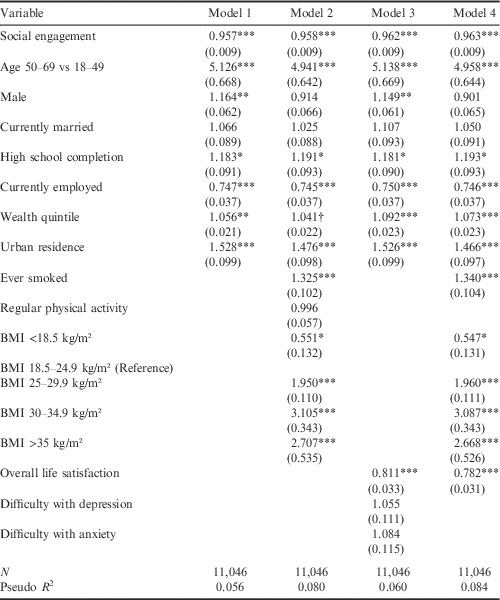
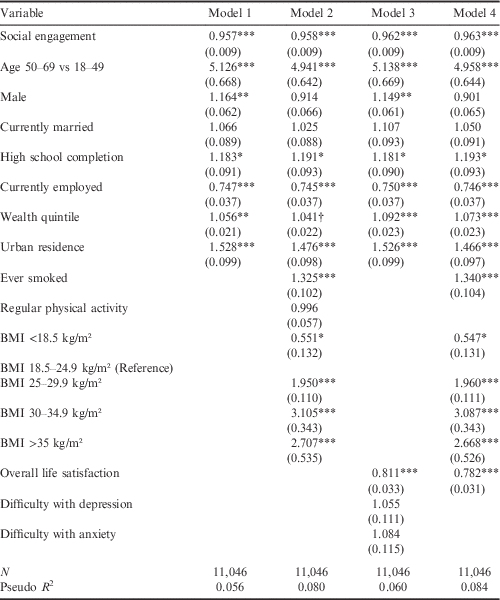
Table 2 presents the logistic regression results for both men and women. In Model 1, social engagement was significantly correlated with lower odds of hypertension (OR=0.957, p<0.001). In Model 2 adding the lifestyle factors, physical activity was not a significant covariate but the odds ratios of ever-smoking (OR=1.325, p<0.001) and BMI categories were all significant and positive. In addition, the odds ratio of social engagement barely changed from Model 1 to Model 2, suggesting little mediating effects of these lifestyle factors. By contrast, in Model 3, the odds ratio of social engagement decreased to 0.962 (p<0.001), a 12.0% reduction (from 4.49% (1/0.957)) in Model 1 to 3.95% (1/0.962) in Model 3), suggesting some mediating effect of psychological factors. In fact, among the three psychological factors examined in Model 3, only quality of life was significant, negatively correlated with the odds of hypertension (OR=0.811, p<0.001).
Logistic regression results for use of hypertensive medication or treatment for women and men, WHO-SAGE, China, 2010
Odds ratios and robust standard errors in parentheses.
†p<0.10; *p<0.05; **p<0.01; ***p<0.001.
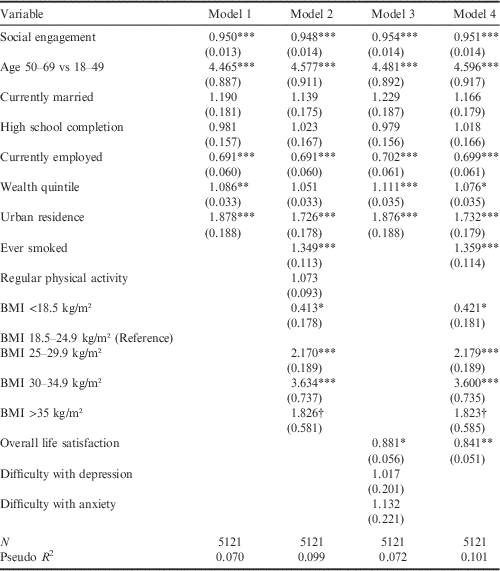
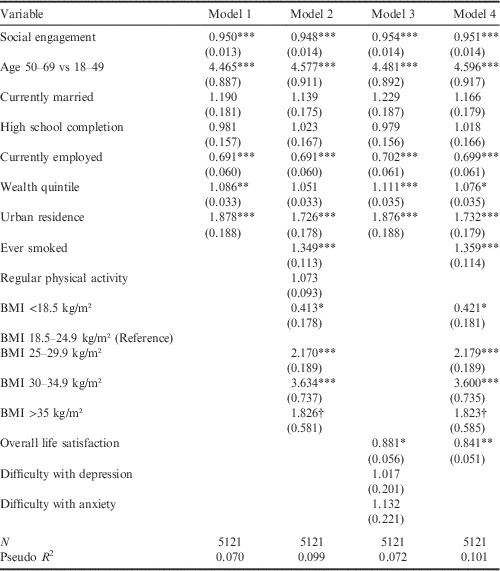
Table 3 shows logistic regression results for women only. Similar patterns were observed for women to those for the whole sample. That is, the social engagement effect remained strong across all four models; BMI categories, smoking and overall life satisfaction were all significant covariates of hypertension but only life satisfaction played some mediating role in the link between social engagement and hypertension. From Model 1 to Model 3 (with the addition of the psychological factors), the odds ratios of social engagement slightly decreased from 0.950 to 0.954, an 8.4% reduction (from 5.26% (1/0.950) to 4.82% (1/0.954)).
Logistic regression results for use of hypertensive medication or treatment for women, WHO-SAGE, China, 2010
Odds ratios and robust standard errors in parentheses.
†p<0.10; *p<0.05; **p<0.01; ***p<0.001.
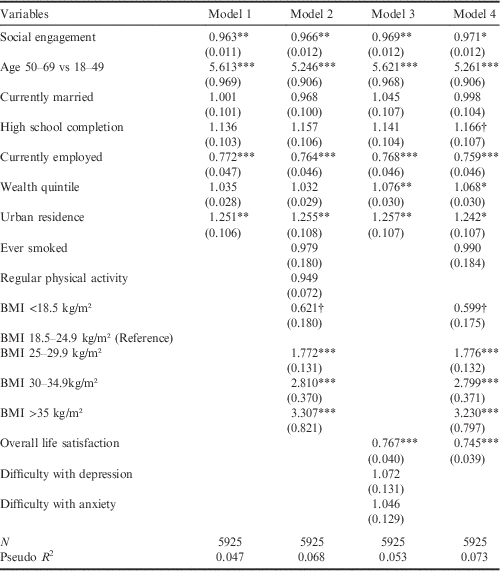
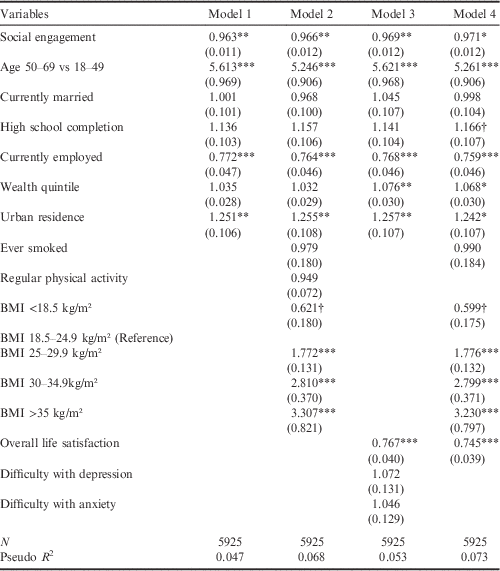
Table 4 presents the logistic regression results for men only. In Model 1, similar to the results for women, social engagement was associated with lower odds of hypertension (OR=0.963, p<0.01). What remained unchanged were the insignificant effect of physical activity and significant effects of BMI categories and overall life satisfaction in the same directions. Moreover, the mediating effect of life satisfaction emerged again; the odds ratio of social engagement reduced from 0.963 in Model 1 to 0.969 in Model 3, a 16.7% reduction (from 3.84% (1/0.963) to 3.20% (1/0.969)). Two differences are noteworthy. First, smoking became insignificant for men; second, the mediating effects of BMI categories emerged, which was not observed for women. The odds ratio of social engagement decreased from 0.963 in Model 1 to 0.966 Model 2, an 8.1% reduction (from 3.84% (1/0.963) to 3.52% (1/0.966)), suggesting some mediating effect of weight status for the social engagement benefits among men.
Logistic regression results for use of hypertensive medication or treatment for men, WHO-SAGE, China, 2010
Odds ratios and robust standard errors in parentheses.
†p<0.10; *p<0.05; **p<0.01; ***p<0.001.
Among all the control variables, three variables exhibited fairly consistent effects across gender: the older age group, greater wealth and urban residence were all positively associated with the odds of hypertension. Marital status and education were not significant covariates for either men or women, whereas being currently employed was beneficial for both men and women.
Discussion
The results of this cross-sectional analysis of the first wave of the WHO-SAGE data collected in China suggest three important messages. First, social engagement with friends, relatives, coworkers and neighbours, and social outings, were significantly and negatively associated with the odds of taking hypertensive medication or treatment regardless of gender, lending support to the study’s first hypothesis. This finding is consistent with a body of literature, conducted in Western societies, highlighting the beneficial effects of greater social engagement on health outcomes, including, but not limited to, cognitive functioning (Zunzunegui et al., Reference Zunzunegui, Alvarado, Del Ser and Otero2003), cardiovascular functioning (Christenfeld et al., Reference Christenfeld, Gerin, Linden, Sanders, Mathur, Deich and Pickering1997; Cornwell & Waite, Reference Cornwell and Waite2012; Shaya et al., Reference Shaya, Chirikov, Mullins, Shematek, Howard, Foster and Saunders2013), disability (Mendes de Leon et al., Reference Mendes de Leon, Glass and Berkman2003) and mortality (Lennartsson & Silverstein, Reference Lennartsson and Silverstein2001). That said, it is noteworthy that the effect of being married, albeit statistically insignificant, goes in an opposite direction to the social engagement effect. These findings suggest that the relationship between social ties and health can be complex and the beneficial health effects of social engagement observed in this study do not necessarily extend to other aspects of social relationships.
Second, overweight and obesity and smoking were significant risk factors for hypertension, whereas overall life satisfaction was a negative covariate of hypertension. In addition, life satisfaction helped explain some of the social engagement and hypertension link with the mediating role being stronger for men than for women. If the observed effects were causal, the story could go like this: social engagement enhances individuals’ psychological health, which in turn can help prevent hypertension (Christenfeld et al., Reference Christenfeld, Gerin, Linden, Sanders, Mathur, Deich and Pickering1997; Cornwell & Waite, Reference Cornwell and Waite2012; Shaya et al., Reference Shaya, Chirikov, Mullins, Shematek, Howard, Foster and Saunders2013). This result provides support for part of the second hypothesis, but not all. It was surprising to see that feelings of depression and anxiety were neither significant covariates of hypertension nor mediators of the social engagement and hypertension link. It is possible that the effect of overall life satisfaction has fully absorbed the effects of specific aspects of psychological states, manifested in affect factors such as depression and anxiety.
It was also found that a portion of the social engagement effect on hypertension was attributable to a lower odds of overweight and obesity among more socially engaged men (but not women). This finding lends support to the notion that social engagement may facilitate the rapid diffusion and implementation of healthful message, increasing the likelihood of involved individuals following healthy lifestyles and being healthy (Seeman et al., Reference Seeman, Lusignolo, Albert and Berkman2001; Christensen & Carpiano, Reference Christensen and Carpiano2014). That said, how social engagement may affect lifestyle conceivably depends on the lifestyle norms of an individual’s social circle. US-based evidence (Christakis & Fowler, Reference Christakis and Fowler2007) has shown that obesity may spread in social networks in a quantifiable and discernable pattern that depends on the nature of social ties, and that social distance appears to be more important than geographic distance within these social networks in terms of the person-to-person spread of obesity. Lacking relevant data, the present study was not able to account for this nuance in social engagement processes. Theoretically, behavioural contagion can occur via psychosocial mechanisms such as altered tolerance level of overweight and perceptional and behavioural changes of energy-balance-related factors among a group of friends. It can be speculated that working-age adult men in China who are more socially engaged may have a lower prevalence of overweight and obesity compared with the general male population and are thus at lower risk of hypertension. Why this mediating pattern was observed in men but not in women is intriguing. One possible explanation is that there may be gendered patterns of social engagement in China where men are less likely than women to conduct sedentary activities when hanging out with friends (Fan et al., Reference Fan, Kowleski-Jones and Wen2012; Hallal et al., Reference Hallal, Andersen, Bull, Guthold, Haskell and Ekelund2012). More research is clearly needed to sort out these complex processes.
Third, the association between social engagement and hypertension was stronger for women than for men, providing support for the notion that men experience weaker effects of social engagement than women. This result is consistent with previous work showing that women tend to report more social contacts and more satisfaction with social relationships compared with men (Pugliesi & Shook, Reference Pugliesi and Shook1998; Okamoto & Tanaka, Reference Okamoto and Tanaka2004; Musalia, Reference Musalia2006; Hughes & Howard, Reference Hughes and Howard2009; McLaughlin et al., Reference McLaughlin, Vagenas, Pachana, Begum and Dobson2010; Gorman & Porter, Reference Gorman and Porter2011; Staber, Reference Staber2013; Baheiraei et al., Reference Baheiraei, Mirghafourvand, Charandabi, Mohammadi and Nedjat2014).
This study is limited in two important ways. The analyses relied on cross-sectional data, producing no causal inferences on the observed associations. Reverse causation cannot be ruled out. Individuals with hypertension may be less likely to be socially engaged due to their health issues. Nonetheless, being a silent killer, hypertension typically does not cause symptoms that would affect their social behaviours unless it is at a severe stage. The nature of this condition to some extent mitigates the reverse selection concern. The social engagement and hypertension link can be more rigorously studied in the future with the second wave of WHO-SAGE and other longitudinal data becoming available.
Another limitation lies in the dependent variable. The key outcome was use of hypertensive medication or treatment, which was conceptualized as a proxy measure of hypertension. As noted earlier, onsite readings of blood pressure were not used because they were only taken at one time in the WHO-SAGE data, whereas the standard procedure is to take three consecutive readings at one visit to reduce the ‘white-coat’ reaction during blood pressure measurement (Cornwell & Waite, Reference Cornwell and Waite2012). Ideally, objective and reliable measures of blood pressure should be used to identify hypertension.
This study focused on working-age adults. Since the prevalence of hypertension increases with age, and also considering that older people tend to experience role loss and reduced socializing opportunities, social engagement may become particularly important in later life than in prime-age adulthood. Future research should examine these issues for older people who are facing increasing amount of social and physical challenges in life. Despite these limitations, this study provides novel evidence to suggest that among Chinese adults social engagement should be a protective factor against hypertension, suggesting that the development of chronic conditions like hypertension can be socially patterned across different settings (Wen & Li, Reference Wen and Li2015). Psychological mechanisms appeared to play a role in this association for both men and women and BMI-related lifestyle factors seemed to help explain some of the benefits of social engagement for men. To replicate this study and to put these findings into perspective, longitudinal research is needed to comprehensively examine the multiple dimensions of social engagement and their prospective effects on health risk factors such as hypertension in developing countries, where hypertension has become a silent killer and a public health crisis (WHO, 2013).
Acknowledgment
An earlier version of this manuscript was presented at the American Sociological Association Conference, 22–25th August 2015, Chicago, Illinois.