Major depressive disorder (MDD) is a potentially devastating illness with a high lifetime prevalence, yet the available treatments are inadequate or ineffective for a large portion of those affected (Kessler, Berglund, & Demler, Reference Kessler, Berglund and Demler2003). Furthermore, MDD has a high and rising prevalence during adolescence (Burke, Burke, Rae, & Regier, Reference Burke, Burke, Rae and Regier1991). It is also evident in school-age children (Birmaher, Ryan, Williamson, & Brent, Reference Birmaher, Ryan, Williamson and Brent1996; Kaufman, Martin, King, & Charney, Reference Kaufman, Martin, King and Charney2001) and even in preschool-age children, where preschool-onset depression shows homotypic continuity in early childhood and strongly predicts DSM-V MDD in later childhood and early adolescence (Luby, Si, Belden, Tandon, & Spitznagel, Reference Luby, Si, Belden, Tandon and Spitznagel2009). These findings underscore the need for work identifying depression risk factors early in development that can guide early identification and intervention, with aims to both treat early-onset depression and to ameliorate negative trajectories that may be set into place early in development.
Much foundational work has been done in adult populations to characterize core deficits associated with MDD and their neural underpinnings. This work is integral to identifying key systems disrupted in depression; however, to address goals of early intervention and prevention, research must be extended earlier in development in order to explore the relationship between individual differences in these core deficits and their putative neural mechanisms in healthy individuals. Here, we focus specifically on emotion processing, because adult and pediatric MDD have been related to psychological and behavioral differences in emotion processing as well as alterations in emotion processing neural circuitry.
We will investigate how structural and functional disruptions in several key regions of relevance to emotion reactivity and/or regulation predict individual differences in depressive symptomology and emotion regulation skills in psychiatrically healthy children, with both cross-sectional and longitudinal analyses. Below, we briefly review work identifying two broad systems in the brain relevant to emotion reactivity and emotion regulation and examine evidence for their functional impairment in depression. We also review evidence for changes in the structure of several specific regions within these networks in depression, with a particular focus on the insula, hippocampus, and amygdala, each of which is thought to play a key role in emotion reactivity and/or regulation.
Emotion reactivity and regulation networks
Task-based functional magnetic imaging (fMRI) studies in healthy adults suggest that emotion reactivity and regulation activate several neural systems with both common and distinct components (McRae et al., Reference McRae, Gross, Weber, Robertson, Sokol-Hessner and Ray2012; Ochsner, Bunge, Gross, & Gabrieli, Reference Ochsner, Bunge, Gross and Gabrieli2002; Ochsner et al., Reference Ochsner, Ray, Cooper, Robertson, Chopra and Gabrieli2004, Reference Ochsner, Ray, Hughes, McRae, Cooper and Weber2009; Silvers et al., Reference Silvers, McRae, Gabrieli, Gross, Remy and Ochsner2012). In particular, a “bottom-up” system, involved in the generation of emotion, has been shown to include the amygdala, striatum, hippocampus, and temporal regions that typically show increased reactivity to emotionally evocative stimuli (Ochsner & Feldman Barrett, Reference Ochsner, Feldman Barrett, Mayne and Bonanno2001; Ochsner & Gross, Reference Ochsner and Gross2005, Reference Ochsner, Gross and Gross2007, Reference Ochsner and Gross2008; Ochsner & Phelps, Reference Ochsner and Phelps2007). It is important that these regions show functional responses to emotionally evocative stimuli in children and adolescents as well, though the specific patterns of activity in response to stimulus valence may vary across age (e.g., Guyer et al., Reference Guyer, Monk, McClure-Tone, Nelson, Roberson-Nay and Adler2008; Monk et al., Reference Monk, McClure, Nelson, Zarahn, Bilder and Leibenluft2003; Pagliaccio et al., Reference Pagliaccio, Luby, Gaffrey, Belden, Botteron and Harms2013; Thomas et al., Reference Thomas, Drevets, Whalen, Eccard, Dahl and Ryan2001).
In contrast, studies of emotion regulation have consistently highlighted important roles for dorsal regions of the prefrontal cortex and the parietal cortex in a network of “top-down” regions that implement control processes for modulating and regulating activity in the limbic and subcortical systems (Buhle et al., Reference Buhle, Silvers, Wager, Lopez, Onyemekwu and Kober2013; Diekhof, Geier, Falkai, & Gruber, Reference Diekhof, Geier, Falkai and Gruber2011; Ochsner, Bunge, Gross, & Gabrieli, Reference Ochsner, Bunge, Gross and Gabrieli2002, Reference Ochsner, Ray, Cooper, Robertson, Chopra and Gabrieli2004, Reference Ochsner, Ray, Hughes, McRae, Cooper and Weber2009; Silvers et al., Reference Silvers, McRae, Gabrieli, Gross, Remy and Ochsner2012). Consistent with these findings in adults, school-age children also show recruitment of top-down regions during reappraisal of negative emotional content (Belden, Luby, Pagliaccio, & Barch, Reference Belden, Luby, Pagliaccio and Barch2014; McRae et al., Reference McRae, Gross, Weber, Robertson, Sokol-Hessner and Ray2012). It should also be noted that activity in top-down control regions during regulation may increase with age (presumably as regulation efficacy increases), while some research suggests that self-reported negative affect and amygdala reactivity may not show the same changes with age (McRae et al., Reference McRae, Gross, Weber, Robertson, Sokol-Hessner and Ray2012).
In concert with the above task-based fMRI studies, studies of resting-state functional connectivity in healthy adults have also supported this distinction between brain regions involved in the experience of emotion and those involved in the regulation of emotion. Briefly, resting-state functional connectivity represents correlations between spontaneous fluctuations in regional activity measured when a participant is at rest; this type of correlation may be interpreted as the “background pattern” of communication between brain regions reflecting a history of co-activation. Connectivity studies in adults have shown positive correlations between resting-state fluctuations in amygdala activity and fluctuations in activity in regions such as the hippocampus, striatum, and temporal lobe regions (Anticevic, Repovs, & Barch, Reference Anticevic, Repovs and Barch2010; Roy et al., Reference Roy, Shehzad, Margulies, Kelly, Uddin and Gotimer2009; Stein et al., Reference Stein, Wiedholz, Bassett, Weinberger, Zink and Mattay2007), that is, similar to the bottom-up network described above. In contrast, a host of frontal/parietal control regions show negative correlations with fluctuations in amygdala activity (Anticevic et al., Reference Anticevic, Repovs and Barch2010; Roy et al., Reference Roy, Shehzad, Margulies, Kelly, Uddin and Gotimer2009; Stein et al., Reference Stein, Wiedholz, Bassett, Weinberger, Zink and Mattay2007), that is, similar to the top-down network. Both task and resting-state studies suggest that positive connectivity between the amygdala and bottom-up regions like the hippocampus remain relatively stable over development, while connectivity between the amygdala and top-down cortical regions strengthens over development (Gabard-Durnam et al., Reference Gabard-Durnam, Flannery, Goff, Gee, Humphreys and Telzer2014; Vink, Derks, Hoogendam, Hillegers, & Kahn, Reference Vink, Derks, Hoogendam, Hillegers and Kahn2014). Studies suggest that patients with depression may exhibit alterations in functional connectivity between the amygdala, cingulate, and insula (Connolly et al., Reference Connolly, Wu, Ho, Hoeft, Wolkowitz and Eisendrath2013; Matthews, Strigo, & Simmons, Reference Matthews, Strigo and Simmons2008) and between prefrontal cortex regions and the cingulate and hippocampus (Greicius et al., Reference Greicius, Flores, Menon, Glover, Solvason and Kenna2007; Sheline, Price, Yan, & Mintun, Reference Sheline, Price, Yan and Mintun2010). In addition, childhood depression and maternal depression have been associated with reductions in connectivity between the amygdala and both these top-down and bottom-up regions (Luking et al., Reference Luking, Repovs, Belden, Gaffrey, Botteron and Luby2011), potentially relating to disruptions in both emotion processing and regulation abilities.
Amygdala
As noted above, there is a network of regions in the brain that respond to emotionally evocative stimuli. Among these regions, the amygdala has perhaps received the most attention. More specifically, functional activity of the amygdala in response to emotional stimuli is one of the most well-studied neural markers in affective psychopathology. The amygdala responds to highly emotionally salient stimuli of either positive or negative emotional valence (Davidson & Irwin, Reference Davidson and Irwin1999). While the amygdala responds to both positive and negative emotional stimuli, it is generally found to show greater responses to emotional versus neutral stimuli (Fusar-Poli et al., Reference Fusar-Poli, Placentino, Carletti, Landi, Allen and Surguladze2009). Yet most studies to date have focused on the role of the amygdala in processing negative emotional stimuli, particularly threat- and sadness-related images. Along this line, it has been established that stronger amygdala responses to negative emotional faces are observed with increasing negative affect (Davidson & Irwin, Reference Davidson and Irwin1999). Amygdala reactivity to emotional faces is increased in adolescents as compared to adults, which may relate to the increased vulnerability to affective disorders during adolescence (Guyer et al., Reference Guyer, Monk, McClure-Tone, Nelson, Roberson-Nay and Adler2008). Further suggestive of important developmental differences, there is evidence that differential activation to different face types may not be evident in school-age children, who show undifferentiated amygdala reactivity to a variety of emotional and neutral face types (Pagliaccio et al., Reference Pagliaccio, Luby, Gaffrey, Belden, Botteron and Harms2013).
Nonetheless, depression has been related to amygdala hyperreactivity to negative emotional stimuli in adults (Groenewold, Opmeer, de Jonge, Aleman, & Costafreda, Reference Groenewold, Opmeer, de Jonge, Aleman and Costafreda2012; Hamilton et al., Reference Hamilton, Etkin, Furman, Lemus, Johnson and Gotlib2012; Stuhrmann, Suslow, & Dannlowski, Reference Stuhrmann, Suslow and Dannlowski2011) and in children and adolescents (e.g., Barch, Gaffrey, Botteron, Belden, & Luby, Reference Barch, Gaffrey, Botteron, Belden and Luby2012; Beesdo et al., Reference Beesdo, Lau, Guyer, McClure-Tone, Monk and Nelson2009; Gaffrey et al., Reference Gaffrey, Luby, Belden, Hirshberg, Volsch and Barch2011; Pagliaccio et al., Reference Pagliaccio, Luby, Gaffrey, Belden, Botteron and Gotlib2011; Yang et al., Reference Yang, Simmons, Matthews, Tapert, Frank and Max2010). Specifically, preschool-onset depression severity has been shown to correlate with increasing amygdala responses to sad versus neutral faces in school-age children (Barch et al., Reference Barch, Gaffrey, Botteron, Belden and Luby2012; Gaffrey et al., Reference Gaffrey, Luby, Belden, Hirshberg, Volsch and Barch2011). Further, children/adolescents at risk for depression based on a parental history of MDD show elevated amygdala reactivity to fearful faces (Monk et al., Reference Monk, Klein, Telzer, Schroth, Mannuzza and Moulton2008). Limbic hyperactivity may also be clinically relevant because it has been associated with treatment outcomes (Canli et al., Reference Canli, Cooney, Goldin, Shah, Sivers and Thomason2005; Siegle, Carter, & Thase, Reference Siegle, Carter and Thase2006) and this hyperactivity may remit with successful antidepressant treatment (Fu et al., Reference Fu, Williams, Cleare, Brammer, Walsh and Kim2004).
Despite the focus that the amygdala has received in task-based fMRI studies, there have been relatively few investigations of amygdala volume in depressed and high-risk samples. One impediment is that the amygdala is a small structure with less distinct boundaries, making the measurement of volume more difficult to conduct reliably. Furthermore, studies that have investigated amygdala volumes have produced mixed results, with some reporting larger volumes (Frodl et al., 2002, 2004; Lange & Irle, Reference Lange and Irle1999; Saleh et al., Reference Saleh, Carballedo, Lisiecka, Fagan, Connolly and Boyle2012; Van Eijndhoven et al., Reference Van Eijndhoven, van Wingen, van Oijen, Rijpkema, Goraj and Verkes2009; Vassilopoulou et al., Reference Vassilopoulou, Papathanasiou, Michopoulos, Boufidou, Oulis and Kelekis2012) and others reporting smaller amygdala volumes in depressed groups (Hastings, Parsey, Oquendo, Arango, & Mann, Reference Hastings, Parsey, Oquendo, Arango and Mann2004; Sheline, Gado, & Price, Reference Sheline, Gado and Price1998; Sheline, Sanghavi, Mintun, & Gado, Reference Sheline, Sanghavi, Mintun and Gado1999; Siegle, Konecky, Thase, & Carter, Reference Siegle, Konecky, Thase and Carter2003). In pediatric populations, risk and protective factors have been related to amygdala volume, with some evidence that larger volumes are related to poorer outcomes. For example, early life stress (late adoption after institutional rearing) predicts larger amygdala volumes later in childhood, which in turn has been associated with anxiety and internalizing symptoms (Tottenham et al., Reference Tottenham, Hare, Quinn, McCarry, Nurse and Gilhooly2010). Similarly, larger amygdala volumes have been related to greater fearfulness among girls, especially those with a family history of MDD (van der Plas, Boes, Wemmie, Tranel, & Nopoulos, Reference van der Plas, Boes, Wemmie, Tranel and Nopoulos2010). Conversely, positive parenting during childhood predicted attenuated growth of amygdala volume into adolescence (Whittle et al., Reference Whittle, Simmons, Dennison, Vijayakumar, Schwartz and Yap2013).
Hippocampus
Although not often the focus of studies on emotional reactivity, the hippocampus has been shown to be active during the processing of facial emotion (Gur et al., Reference Gur, Schroeder, Turner, McGrath, Chan and Turetsky2002; Williams et al., Reference Williams, Phillips, Brammer, Skerrett, Lagopoulos and Rennie2001), where its response may correlate with increasing intensities of fearful face expression (Surguladze et al., Reference Surguladze, Brammer, Young, Andrew, Travis and Williams2003). Developmental differences in hippocampal reactivity are also evident, such that hippocampal responses to face stimuli strengthen across pubertal development (Moore et al., Reference Moore, Pfeifer, Masten, Mazziotta, Iacoboni and Dapretto2012). Positive functional connectivity between the hippocampus and amygdala may strengthen from adolescence to adulthood (Guyer et al., Reference Guyer, Monk, McClure-Tone, Nelson, Roberson-Nay and Adler2008). Structure–function correlations suggest that smaller hippocampal volumes are related to greater cortico-limbic responses to negative emotional faces in children (Suzuki et al., Reference Suzuki, Botteron, Luby, Belden, Gaffrey and Babb2012). Examining depression, hippocampal responses to sad faces tend to be elevated among depressed patients; this hyperreactivity did not change with antidepressant treatment (Fu et al., Reference Fu, Williams, Cleare, Brammer, Walsh and Kim2004). In school-age children, depression symptom severity at preschool age positively predicted hippocampal response to emotional faces (Barch et al., Reference Barch, Gaffrey, Botteron, Belden and Luby2012). However, it is currently unclear whether alterations in hippocampal responses to emotion are a risk factor for depression, a result of depression, and/or indicative of a specific underlying mechanistic alteration in depression (e.g., increased reactivity to emotional content).
The hippocampus plays a critical role in the regulation of the stress response (Jacobson & Sapolsky, Reference Jacobson and Sapolsky1991), and there is consistent evidence that hippocampal volumes are altered by experiences of adversity and stress (e.g., Carballedo et al., Reference Carballedo, Lisiecka, Fagan, Saleh, Ferguson and Connolly2012; Luby et al., Reference Luby, Belden, Botteron, Marrus, Harms and Babb2013; Stein, Koverola, Hanna, Torchia, & McClarty, Reference Stein, Koverola, Hanna, Torchia and McClarty1997; Woon & Hedges, Reference Woon and Hedges2008). Given the role of early life stress in the etiology of depression (Green et al., Reference Green, McLaughlin, Berglund, Gruber, Sampson and Zaslavsky2010; Kessler & Magee, Reference Kessler and Magee2009) and evidence for altered stress reactivity in depression (e.g., Burke, Davis, Otte, & Mohr, Reference Burke, Davis, Otte and Mohr2005; Heuser, Yassouridis, & Holsboer, Reference Heuser, Yassouridis and Holsboer1994; Morris, Rao, & Garber, Reference Morris, Rao and Garber2012), a number of studies have examined hippocampal volumes in depression. These studies have consistently shown reduced bilateral hippocampal volume in adult patients with depression (for meta-analyses, see Campbell & MacQueen, Reference Campbell and MacQueen2004; Videbech & Ravnkilde, Reference Videbech and Ravnkilde2004). This has been suggested as a potential risk factor for depression because volume reductions are observed in girls at risk for depression based on parental history (Amico et al., Reference Amico, Meisenzahl, Koutsouleris, Reiser, Möller and Frodl2011; Chen, Hamilton, & Gotlib, Reference Chen, Hamilton and Gotlib2010). One hypothesis is that early life stress may be a key causal factor in hippocampal volume reductions (e.g., Dannlowski et al., Reference Dannlowski, Kugel, Huber, Stuhrmann, Redlich and Grotegerd2012). Alternatively, volume reductions may be a marker of deleterious effects of MDD, because the severity of volume reductions tends to correlate with the number of MDD episodes experienced (Videbech & Ravnkilde, Reference Videbech and Ravnkilde2004). In addition, smaller hippocampal volumes may predict poorer clinical outcomes with antidepressant treatment, while treatment may also contribute to increases in volume over time (Frodl et al., Reference Frodl, Jäger, Smajstrlova, Born, Bottlender and Palladino2008).
Despite robust findings in adult depression, the literature on changes in hippocampal volume in childhood depression is mixed, with some reporting decreased volume (e.g., Caetano et al., Reference Caetano, Fonseca, Hatch, Olvera, Nicoletti and Hunter2007; MacMaster & Kusumakar, Reference MacMaster and Kusumakar2004; MacMaster et al., Reference MacMaster, Mirza, Szeszko, Kmiecik, Easter and Taormina2008; Rao et al., Reference Rao, Chen, Bidesi, Shad, Thomas and Hammen2010) and others failing to detect an effect of childhood depression (e.g., Rosso et al., Reference Rosso, Cintron, Steingard, Renshaw, Young and Yurgelun-Todd2005), of exposure to maternal depression (Lupien et al., Reference Lupien, Parent, Evans, Tremblay, Zelazo and Corbo2011), or of early life stress (Tottenham et al., Reference Tottenham, Hare, Quinn, McCarry, Nurse and Gilhooly2010). This may be consistent with animal literature suggesting that negative factors, like early life stress, show a delayed effect on hippocampal volume that is not evident until later in development (Andersen & Teicher, Reference Andersen and Teicher2004). However, other findings suggest that examining individual differences in risk factors for depression may reveal early hippocampal reductions; for example, poverty has been related to hippocampal reductions in children, as mediated by increased adverse parenting and life stress (Luby et al., Reference Luby, Belden, Botteron, Marrus, Harms and Babb2013).
Insula
The insular cortex is a key region implicated in emotion processing. In particular, it has been suggested that the anterior insula, in particular, may be crucial for the experience of emotion and interoceptive awareness (Gu, Hof, Friston, & Fan, Reference Gu, Hof, Friston and Fan2013; Park & Tallon-Baudry, Reference Park and Tallon-Baudry2014). Further, the anterior insula may be a key waypoint for integrating top-down regulatory signals with bottom-up information about interoceptive experiences (Gu et al., Reference Gu, Hof, Friston and Fan2013). Additional work suggests that the anterior insula may be involved in social emotions, such as guilt (Lamm & Singer, Reference Lamm and Singer2010). Recent work suggests that the anterior insula may be important for integrating information about the outcome of events in the world with internal goals and context factors to help support the generation of complex feeling states, which may include guilt (Koban & Pourtois, 2014). Consistent with this hypothesis, meta-analytic work shows robust activation of the insula in response to face stimuli displaying angry or disgusted expressions (Fusar-Poli et al., Reference Fusar-Poli, Placentino, Carletti, Landi, Allen and Surguladze2009). Insula activity has been consistently shown to be reduced in MDD patients in resting PET/SPECT studies and in response to negative stimuli in task-based fMRI studies (Fitzgerald, Laird, Maller, & Daskalakis, Reference Fitzgerald, Laird, Maller and Daskalakis2008). Further, in structural MRI studies, anterior insula gray matter volume has been shown to be reduced in people with current or remitted depression (Liu et al., Reference Liu, Jing, Ma, Xu, Zhang and Li2014). Insula gray matter volume and density have also been shown to be reduced in first-episode MDD patients (Lai & Wu, Reference Lai and Wu2014; Peng et al., Reference Peng, Liu, Nie, Li, Shan and Wang2011). Furthermore, volumetric changes in the anterior insula may predict treatment response in adults (Mayberg et al., Reference Mayberg, Brannan, Tekell, Silva, Mahurin and McGinnis2000) and may serve as a biomarker for chronicity in early-onset MDD (Belden et al., Reference Belden, Barch, Oakberg, April, Harms and Botteron2014).
Summary and Goals for the Current Study
Given this literature identifying regions involved in emotion processing that show alterations in structure and function in depression and in high-risk states, we sought to explore relationships between these factors and depressive symptomology and emotion regulation skills in psychiatrically healthy school-age children. Specifically, we tested the hypotheses that depression-related alterations in both the structure and the function of brain regions involved in emotion reactivity and regulation would predict greater subclinical depressive symptomology and decreased ability to regulate sadness in 8- to 12-year-olds. Furthermore, we tested whether these neural factors would predict change in depressive symptomology and sadness regulation skills over approximately 18 months. Examining neural function, we took a broad network perspective and examined reactivity to sad faces in two networks of brain regions thought to be involved in emotion reactivity, including the amygdala, hippocampus, and additional medial temporal regions, or thought to be involved in emotion regulation, including the dorsal frontal and parietal regions (Luking et al., Reference Luking, Repovs, Belden, Gaffrey, Botteron and Luby2011). We hypothesized that greater responses to sad faces compared to neutral faces in the emotion reactivity-related network would predict greater depressive symptomology and poorer sadness regulation skills at baseline and would predict worsening of these outcomes over time. For the emotion regulation-related regions, we hypothesized that reduced activity would predict greater depressive symptomology and poorer sadness regulation skills at baseline and would predict worsening of these outcomes over time. We also tested whether volume of the bilateral amygdala, hippocampus, and insula would predict these outcomes. For both the hippocampus and the insula, based on the literature linking depression and reduced volumes in adults, we hypothesized that smaller volumes would be associated with greater depressive symptomology and poorer sadness regulation skills at baseline and would predict worsening of these outcomes 18 months later. As noted above, the literature on amygdala volume in depression is mixed, but given findings that negative factors tend to predict larger volumes, we predicted that larger amygdala volumes would predict greater depressive symptomology and poorer sadness regulation skills at baseline and would predict worsening of these outcomes 18 months later.
Methods
Participants
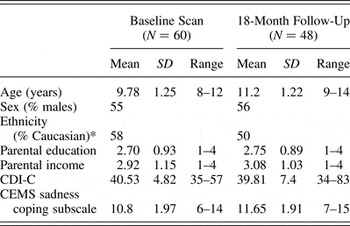
The participants were a subsample of the children enrolled in the Preschool Depression Study (PDS), a prospective longitudinal investigation of preschoolers and their families conducted in the Early Emotional Development Program at the Washington University School of Medicine (WUSM). The current study reports on 60 children from the PDS (of the 305 total enrolled in the study) who did not have any prior history of a psychiatric disorder or any current disorders at the time of scan and who did not have a history of head trauma, neurological disease, or developmental delay. Forty-eight of these children had longitudinal data at an 18-month follow-up (see Table 1). Participants were between the ages of 8 and 12 (M = 9.8, SD = 1.3) at the time of the first scan and between the ages of 9 and 14 (M = 11.2, SD = 1.2) at the time of the follow-up. Parental written consent and child assent were obtained prior to participation and the institutional review board at WUSM approved all experimental procedures.
Demographic and clinical characteristics of participants

Note: Parental Education: 1 = “high school diploma or lower,” 2 = “some college,” 3 = “four year degree,” 4 = “graduate education and above.” Parental Income: 1 = ≤$20K, 2 = $20–$40K, 3 = $40–$60K, 4 = $60K+. CDI-C, Child Depression Inventory Self-Report; CEMS, Children's Emotion Management Scale.
*p < .05 significant chi-squared test of differences in ethnicity distribution between the 48 children who did complete the follow-up and the 12 who did not.
Recruitment for the PDS study occurred in two waves. The first wave recruited 3- to 6-year-old preschoolers from sites throughout the Saint Louis area for participation in a study examining the nosology of preschool depression. Recruitment was conducted through primary care practices and preschools/daycares that were accessible to the general community to ensure the socioeconomic and ethnic diversity of the sample. Recruitment sites were chosen at random using a geographically stratified method. The aim of this sampling technique was to recruit a large group of depressed preschoolers as well as smaller groups of disruptive and healthy preschoolers for comparison. To achieve this goal, caregivers completed a validated screening checklist, the Preschool Feelings Checklist (PFC; Luby, Heffelfinger, Koenig-McNaught, Brown, & Spitznagel, Reference Luby, Heffelfinger, Koenig-McNaught, Brown and Spitznagel2004). Previous studies indicated that a PFC score of 3 or higher has high sensitivity and specificity for diagnosing depression (Luby et al., Reference Luby, Heffelfinger, Koenig-McNaught, Brown and Spitznagel2004). In addition to children with high PFC scores, children with no endorsed symptoms were recruited to establish a healthy comparison group (of interest in the current analyses). Approximately 6,000 checklists were distributed to sites between May 2003 and March 2005. In daycares and preschools, from which approximately 75% of the sample was ascertained, checklists were handed out to all parents of children in the target age range. Checklists were made available in waiting areas of primary care settings next to a poster describing a study of early emotional development. Completed checklists were collected by the sites and returned. Using this method, N = 1,474 checklists were returned, and those with scores of 0 (presumed healthy) or 3 or higher (above established cutoff) were contacted for further participation. Of those who returned checklists, N = 335 were ineligible due to being out of the age range and N = 240 had PFC scores out of range (e.g., 1 or 2). The remaining N = 899 met all initial screening and inclusion criteria and were contacted by phone for further screening. Based on phone screening, subjects with chronic illness, marked speech and language delays, and/or neurologic or autistic spectrum disorders were excluded. Those without exclusions (N = 416) were invited for study participation, and N = 305 agreed and presented for the assessment.
Psychiatrically healthy children and those with preschool-onset MDD who had no contraindication for MRI were eligible for an MRI scan session after the fourth wave of annual assessments. Of the 86 eligible and psychiatrically healthy children, 49 agreed to be scanned. Of these 49 children, 6 were excluded because they developed an Axis I psychiatric disorder. Of the remaining 43, data was excluded from 10 children because of incomplete scan runs or poor quality fMRI data. (Note that 77% usable functional data is not unusual for child studies, but it improved after the start of the study as our methods for ensuring compliance and low movement improved.) Of these 33 children, 29 also had complete data on all of the clinical variables examined at scan.
The second wave of recruitment involved recruiting additional children with no prior psychiatric diagnosis to enhance the subsample of healthy subjects. Subjects were screened from local schools using the Child Behavior Checklist (Achenbach & Edelbrock, Reference Achenbach and Edelbrock1991), and those in the healthy range without scan exclusions were invited to participate. Forty-two children were interviewed using the same age-appropriate semistructured diagnostic measure used in the larger sample (see below for details). One child was excluded for a neurological issue and 4 were excluded because they met criteria for an Axis I psychiatric diagnosis. An additional 4 children were excluded because of poor-quality MRI data. Of the remaining 33 children, 31 had complete data on all of the clinical variables examined at scan.
Diagnostic assessment
Trained staff from the WUSM Early Emotional Development Program conducted up to three in-person assessment sessions with participants and their primary caregivers prior to the MRI scan session, and up to two more in-person assessments over the course of 3 years (to date) after the scan session. The assessments included age-appropriate, semistructured diagnostic interviews to assess psychiatric symptoms; before children were age 8, the Preschool-Age Psychiatric Assessment (Egger, Erkanli, Keeler, & Potts, Reference Egger, Erkanli, Keeler and Potts2006; Luby et al., Reference Luby, Si, Belden, Tandon and Spitznagel2009) was used, whereas parent and child report on the Childhood and Adolescent Psychiatric Assessment was used when children were older than age 8. Because the current report focuses on psychiatrically healthy children, any child who met criteria for any Axis I DSM-IV psychiatric disorder prior to the first scan session was excluded from the analyses.
Self-report instruments
Children completed the Children's Depression Inventory (CDI-C; Kovacs, Reference Kovacs1985) at the time of first scan to assess current depression symptom severity. Children then completed the CDI-C again at a follow-up approximately 18 months later. Total CDI-C scores were computed and converted to t scores. The Children's Emotional Management Scale (CEMS) was used to measure children's ability to manage/regulate their experiences of sadness (Zeman, Shipman, & Penza-Clyve, Reference Zeman, Shipman and Penza-Clyve2001). The CEMS was administered at the annual assessment prior to the scanning session and then again at the 18-month follow-up. For the CEMS, we focused on the sadness coping subscale as a relevant measure of emotion regulation skills, where higher CEMS sadness coping scores indicate better emotion regulation skills.
Functional task and stimuli
The facial emotion processing task of interest here represents one segment of a longer scanning session that the children in the PDS completed, which included high-resolution structural imaging, diffusion imaging, and resting-state functional connectivity scans. The fMRI task was an event-related facial emotion processing task, similar to that used in previous research in adults and adolescents with depression (Beesdo et al., Reference Beesdo, Lau, Guyer, McClure-Tone, Monk and Nelson2009; Gotlib et al., Reference Gotlib, Sivers, Gabrieli, Whitfield-Gabrieli, Goldin and Minor2005; Lau et al., Reference Lau, Burt, Leibenluft, Pine, Rijsdijk and Shiffrin2009; Roberson-Nay et al., Reference Roberson-Nay, McClure, Monk, Nelson, Guyer and Fromm2006; Surguladze et al., Reference Surguladze, Brammer, Keedwell, Giampietro, Young and Travis2005; Thomas et al., Reference Thomas, Drevets, Whalen, Eccard, Dahl and Ryan2001). Children were shown faces that varied in affective content and were asked to decide whether the face was male or female. We used a task that did not require explicit attention to the emotional content because evidence suggests that heightened amygdala responses associated with depression may be more apparent with a less constrained response (Fales et al., Reference Fales, Barch, Rundle, Mintun, Snyder and Cohen2008; Monk et al., Reference Monk, Klein, Telzer, Schroth, Mannuzza and Moulton2008). The face stimuli were drawn from the MacArthur Network Face Stimuli Set (Tottenham et al., Reference Tottenham, Tanaka, Leon, McCarry, Nurse and Hare2009). Children were shown sad, fearful, angry, happy, and neutral expressions from 10 individuals. In addition, we created intermediate sad, fearful, angry, and happy expressions by morphing the neutral expression for each individual with each of their emotional expressions so that the resulting face was halfway between neutral and the target emotion (Morph Age software). We included these stimuli to test whether brain activation biases in depression may be more apparent with lower intensity emotional expressions. Thus, each “actor” in the stimulus set provided a total of 9 expressions (neutral; and 50% and 100% sad, fearful, angry, and happy).
In this report, we focus on brain response to sad faces versus neutral faces, given prior findings suggesting that there are specific impairments associated with sad face processing in children with a history of preschool-onset depression from both this study sample as well as from an independent sample (Barch et al., Reference Barch, Gaffrey, Botteron, Belden and Luby2012; Gaffrey, Barch, Singer, Shenoy, & Luby, Reference Gaffrey, Barch, Singer, Shenoy and Luby2013; Gaffrey et al., Reference Gaffrey, Luby, Belden, Hirshberg, Volsch and Barch2011). Further, we focused on the average functional activations to the full and half intensity faces in order to increase power and because our prior work in this sample suggests that alterations associated with depression are not specific to either intensity of sad expression (Barch et al., Reference Barch, Gaffrey, Botteron, Belden and Luby2012). The results were not substantively different if we focused only on the high-intensity faces.
Each scan run consisted of 45 stimuli, 5 from each of the 9 conditions. Each stimulus was presented for 2500 ms, followed by an intertrial interval ranging between 500 and 6500 ms. Each child performed two task runs with no stimuli repetition. In addition, prior to performing this task, all children underwent a mood induction in the scanner based on prior work (Gotlib et al., Reference Gotlib, Sivers, Gabrieli, Whitfield-Gabrieli, Goldin and Minor2005). We included this mood manipulation because affective processing biases (Scher, Ingram & Segal, 2005) and hyperactivity of limbic regions (Ramel et al., 2007) can be reactivated in individuals with a past history of MDD following a mood induction and can be elicited using mood induction in nondepressed children at risk due to maternal MDD history (Joormann & Gotlib, Reference Joormann and Gotlib2006; Joormann, Talbot, & Gotlib, Reference Joormann, Talbot and Gotlib2007; Taylor & Ingram, Reference Taylor and Ingram1999). We used a film clip from My Girl (see Joormann et al., Reference Joormann, Talbot and Gotlib2007), which focuses on a child's loss of a close friend, to induce a negative mood state, coupled with directions to elaborate on this negative mood by imagining oneself in the situation (Westermann, Spies, Stahl, & Hesse, Reference Westermann, Spies, Stahl and Hesse1996). This mood induction occurred immediately before children began the facial emotion processing task. A positive mood repair clip was shown at the end of the session.
MRI data acquisition
Structural and functional scanning was performed on a 3.0 Tesla TIM TRIO Siemens whole-body system. For structural data, three-dimensional T1-weighted images (resonance time = 2400 ms, echo time = 3.16 ms, flip angle = 8°, slab = 176 mm, 176 slices, matrix size = 256 × 256, field of view = 256 mm, voxel size = 1 × 1 × 1 mm, 1 signal average) were acquired in the sagittal plane with the use of magnetization-prepared rapid gradient echo sequence. Blood oxygen level dependent (BOLD) images during face processing were acquired with a T2*-weighted asymmetric spin-echo echo-planar sequence (resonance time = 3000 ms, echo time = 27 ms, flip angle = 90°, field of view = 256 mm, voxel size = 4 × 4 × 4 mm) in the axial plane paralleling to the anterior–posterior commissure, with a 12-channel head coil. During each functional run, 99 sets of 36 contiguous axial images with isotropic voxels (4 mm3) were acquired parallel to the anterior–posterior commissure plane.
fMRI data processing
The fMRI data were preprocessed using standard preprocessing steps, including the following:
-
1. compensation for slice-dependent time shifts;
-
2. removal of the first five images of each run to allow BOLD signal to reach steady state;
-
3. elimination of odd/even slice intensity differences due to interpolated acquisition;
-
4. realignment of data acquired in each subject within and across runs to compensate for rigid body motion (Ojemann et al., Reference Ojemann, Akbudak, Snyder, McKinstry, Raichle and Conturo1997);
-
5. intensity normalization to a whole-brain mode value of 1,000;
-
6. registration of the three-dimensional structural volume (T1) to the atlas representative template in the Talairach coordinate system (Talairach & Tournoux, Reference Talairach and Tournoux1988) using a 12-parameter affine transform and resampling to 1 mm cubic representation (Buckner et al., Reference Buckner, Head, Parker, Fotenos, Marcus and Morris2004; Ojemann et al., Reference Ojemann, Akbudak, Snyder, McKinstry, Raichle and Conturo1997);
-
7. coregistration of the three-dimensional fMRI volume to the T2, and the T2 to the participants structural image;
-
8. transformation of the fMRI volumes to atlas space using a single affine 12-parameter transform; and
-
9. spatial smoothing using a 6-mm full-width at half-maximum Gaussian filter.
The common atlas template was optimized for children in our age range; the use of co-registration to this type of common template space has been validated in several prior studies (Burgund et al., Reference Burgund, Kang, Kelly, Buckner, Snyder and Petersen2002; Kang, Burgund, Lugar, Petersen, & Schlaggar, Reference Kang, Burgund, Lugar, Petersen and Schlaggar2003).
Previously validated “motion scrubbing” procedures adapted for fMRI data were used to remove artifacts due to head motion (Power, Barnes, Snyder, Schlaggar, & Petersen, Reference Power, Barnes, Snyder, Schlaggar and Petersen2013; Power, Mitra, et al., Reference Power, Mitra, Laumann, Snyder, Schlaggar and Petersen2013). As discussed and validated previously for use in this sample (Pagliaccio et al., Reference Pagliaccio, Luby, Gaffrey, Belden, Botteron and Harms2013), the motion-scrubbing procedure assesses framewise displacement based on the parameters used in reprocessing Step 4. This represents the differential head motion from one acquisition frame to the next summing across linear (x, y, and z) and rotational displacements (yaw, pitch, and roll, where degrees of rotation are converted to millimeters of movement by calculating displacement on the surface of a sphere with a radius of 50 mm). Any frame with a sum displacement greater than 0.9 mm was masked out of the analysis.
Analysis of fMRI data was performed using in-house software (FIDL analysis package, http://www.nil.wustl.edu/~ fidl) utilized in numerous previously published studies (Becerril, Repovs, & Barch, Reference Becerril, Repovs and Barch2011; Braver, Paxton, Locke, & Barch, Reference Braver, Paxton, Locke and Barch2009; Gaffrey et al., Reference Gaffrey, Luby, Belden, Hirshberg, Volsch and Barch2011; Jimura, Locke, & Braver, Reference Jimura, Locke and Braver2010; Ollinger, Shulman, & Corbetta, Reference Ollinger, Shulman and Corbetta2001). Estimates of BOLD response to each face type for each subject were obtained using fixed effects general linear models incorporating regressors for linear trend and baseline shifts. A hemodynamic response shape was assumed (SPM canonical function) and used to derive magnitude estimates relative to fixation baseline. These single-subject estimates were then entered into group-level analyses that treated subjects as random effects.
A priori region of interest definitions
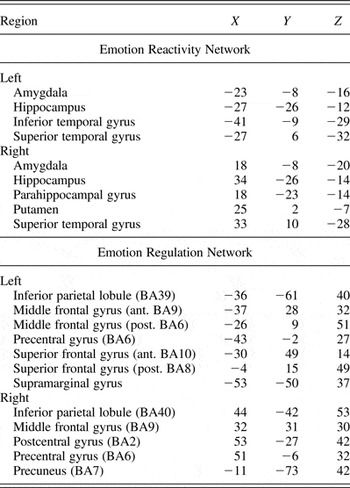
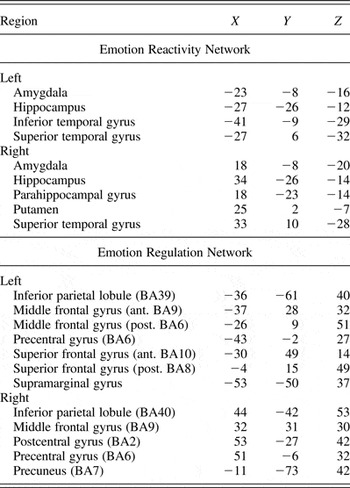
As a measure of responsivity to emotionally evocative stimuli, we examined responses to sad faces versus neutral faces in regions associated with emotion responsivity and in regions associated with emotion regulation. To do so, we examined task-related responsivity in two previously identified networks (Anticevic & Repovs, Reference Anticevic and Repovs2011; Luking et al., Reference Luking, Repovs, Belden, Gaffrey, Botteron and Luby2011). The first was a network of regions associated with bottom-up emotion responsivity, including the bilateral amygdala and regions that show positive resting-state functional connectivity with the amygdala (i.e., hippocampal, parahippocampal, striatal, and temporal regions). Although an oversimplification, we will refer to this as the emotion reactivity network (Table 2). The second network included regions associated with top-down emotion regulation that show negative resting-state functional connectivity with the amygdala, including the dorsal frontal and parietal regions. Again, though an oversimplification, we will refer to this as the emotion regulation network (Table 2). In prior work, we found that connectivity of both sets of regions was disturbed in children with a history of depression and in those at risk for depression (Luking et al., Reference Luking, Repovs, Belden, Gaffrey, Botteron and Luby2011) and are thus of key interest for studying responses to emotional faces. For each region, we created a spherical region of interest, 12 mm in diameter, around its centroid, listed in Table 2. Magnitude estimates of the response to sad versus neutral faces were averaged across all of the regions of interest within each of the two networks to create an overall estimate of responses in emotion reactivity regions and in emotion regulation regions.
Regions included as part of emotion reactivity and emotion regulation networks
Note: BA, Brodmann area.
Structural data processing
We were interested in the volume of the amygdala, hippocampus, and insula given evidence for altered volume of these regions in depression and given their putative involvement in emotion processing. FreeSurfer version 4.5.0 (http://surfer.nmr.mgh.harvard.edu; Fischl et al., Reference Fischl, Salat, Busa, Albert, Dieterich and Haselgrove2002, Reference Fischl, Salat, van der Kouwe, Makris, Ségonne and Quinn2004) was used to segment each participant's anatomical image (using the Desikan-Killiany Atlas for cortical segmentation; Desikan et al., Reference Desikan, Ségonne, Fischl, Quinn, Dickerson and Blacker2006), allowing estimation of the volume of the left and right hippocampal, amygdala, and insula. To reduce the number of predictors in our analyses, we averaged volume estimates for both hemispheres of the amygdala, hippocampus, and insula. In addition, we estimated whole-brain volume (total gray + cortical white matter volume). The white and pial FreeSurfer surfaces were visually inspected and were regenerated with manual intervention to correct errors when necessary. Cortical gray matter volume was defined as the volume between the pial and white matter surfaces. White matter volume was calculated by subtracting the subcortical and ventricular volumes from the volume bounded by the white matter surface.
Analytical approach
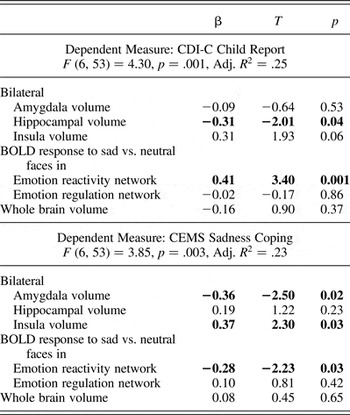
The aim of the current analyses was to investigate how the structure and function of key brain regions involved in emotion reactivity/regulation predict concurrent and follow-up measures of subclinical depressive symptomology and emotion regulation skills in psychiatrically healthy children. First, we used linear regression models to tested whether amygdala volume, hippocampal volume, insula volume, emotion reactivity network activity, and/or emotion regulation network activity predict individual differences in self-reported depression (CDI-C) or self-reported emotion regulation skills (CEMS) from the assessments concurrent with the imaging data acquisition. To test the specificity of the brain volume effects, we controlled for effects of whole-brain volume as well. Second, we used linear regressions to test whether the factors that significantly predicted scores at scan also predict CDI-C or CEMS scores at the 18-month follow-up. When significant predictors were found, we then tested whether these factors remained significant when controlling for CDI-C or CEMS scores concurrent to the scan (i.e., to test for factors that predict change over time). Standardized regression coefficients and their associated T statistics and p values are presented in Table 3 and in the text below.
Regressions predicting CDI-C and CEMS self-reports concurrent to scan

Note: CDI-C, Child Depression Inventory Self-Report; CEMS, Children's Emotion Management Scale; BOLD, blood oxygen level dependent.
Results
Demographic and clinical characteristics
Comparing the children recruited as part of the two recruitment waves, there were no significant differences in age, t (58) = 0.35, p = .58; sex, χ2(1) = 0.61, p = .38; ethnicity, χ2 (2) = 2.65, p = .27; CDI-C at scan, t (58) = –0.77, p = .44; activity in the emotion regulation network, t (58) = –0.31, p = .76; or any brain volume measures of interest here (ps > .05). Children recruited in the first wave did show somewhat higher CEMS scores at scan, t (58) = 2.28, p = .03, and somewhat lower activity in the emotion reactivity network, t (58) = –2.50, p = .02.
Table 1 summarizes the demographic and self-report information from the children who contributed data at the time of scan (N = 60) and from the children who contributed data to the 18-month follow-up (N = 48). There were no significant differences in sex, χ2 (1) = 0.70, p = .47; age, t (58) = 0.67, p = .51; family income, t (58) = 1.71, p = .09; parental education level, t (58) = 1.63, p = .11; recruitment wave, χ2 (1) = 0.60, p = .44; CDI-C scores, t (58) = –0.23, p = .82; CEMS sadness coping scores, t (58) = 0.88, p = .38; or any of the brain structure/function measures (ps > .05) between the 48 children who did and the 12 children who did not complete the follow-up. None of these factors predicted the likelihood of attrition in a logistic regression (ps > .05). However, the follow-up included a smaller percentage of Caucasian children, χ2 (2) = 7.86, p = .02, because 11 of the 12 children who did not complete the follow-up were Caucasian.
Intercorrelation among predictors and network reliability
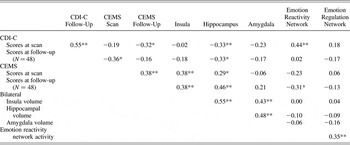
Examining the correlation between our two outcome measures of interest (see Table 4), we found that CDI-C and CEMS scores were not significantly correlated at the time of scan, r (58) = –.19, p = .146, or at follow-up, r (46) = –.16, p = .28. However, as expected, CDI-C scores were significantly correlated across time from scan to follow-up, r (46) = .55, p < .001, as were CEMS scores, r (46) = .38, p = .008.
Intercorrelations between factors of interest

*p < .05. **p < .01.
Examining our predictors of interest (see Table 4), we found significant intercorrelation among insula, hippocampal, and amygdala volumes, insula–hippocampus: r (58) = .55, p < .001; insula–amygdala: r (58) = .43, p = .001; hippocampus–amygdala: r (58) = .48, p < .001. We also found that our measures of average network activity were highly reliable because there was strong intercorrelation among activity estimates from the emotion reactivity network regions of interest (Cronbach α = 0.77) and among emotion regulation network regions of interest (Cronbach α = 0.90). In addition, average sad versus fearful face activity estimates from the two networks were correlated, r (58) = .35, p = .006. There were no significant correlations between insula, hippocampal, or amygdala volumes and activity in either network (ps > .05).
Predicting concurrent self-reports of subclinical depressive symptomology and emotion regulation
CDI-C scores
A linear regression with amygdala volume, hippocampus volume, insula volume, and activity in the emotion reactivity and emotion regulation networks predicted a significant amount of variance in self-reported subclinical depressive symptomology (CDI-C scores) at the time of scan, F (6, 53) = 4.30, p = .001, adjusted R 2 = .25. As shown in Table 3, both reduced hippocampus volume and increased BOLD response to sad versus neutral faces in the emotion reactivity network predicted higher self-reports of depressive symptoms, though activity in the emotion regulation network did not predict it. It is important that both hippocampus volume and the emotion reactivity network activity significantly predicted CDI-C scores, while controlling for whole-brain volume, which was not a significant predictor.
CEMS scores
As above, we used a linear regression to test whether brain volume and/or reactivity measures predict concurrent self-reports of emotion regulation on the CEMS (higher scores on the CEMS indicating better sadness coping skills). This regression predicted a significant amount of variance in CEMS scores, F (6, 53) = 3.85, p = .003, adjusted R 2 = .23. As shown in Table 3, larger insula volume and smaller amygdala volume predicted better emotion regulation skills. In addition, less BOLD response to sad versus neutral faces in the emotion reactivity network predicted higher CEMS scores, though activity in the emotion regulation network did not. It is important that these measures significantly predicted CEMS scores, controlling for whole-brain volume, which was not a significant predictor.
Predicting follow-up self-reports of subclinical depressive symptomology and emotion regulation
CDI-C scores
We tested whether the same structural and functional measures that predicted concurrent CDI-C scores could also predicted CDI-C scores at the 18-month follow-up. Smaller hippocampal volumes predicted higher CDI-C scores at follow-up (β = –0.33, t = –2.34, p = .02), but emotion reactivity network activity did not (β = 0.02, t = 0.12, p = .91). However, hippocampal volume did not predict CDI-C scores at follow-up when accounting for concurrent CDI scores (β = –0.15, t = –1.11, p = .27).
CEMS scores
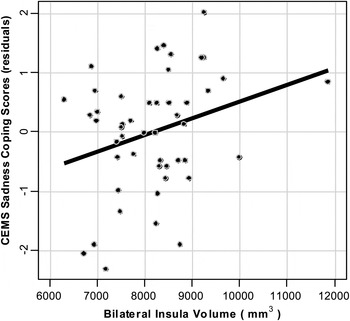
As above, we tested whether the same structural and functional measures that predicted concurrent CEMS scores also predicted CEMS scores at follow-up. Larger insula volumes (β = 0.38, t = 2.79, p = .008) and less BOLD response to sad versus neutral faces in the emotion reactivity network (β = –0.311, t = –2.22, p = .031) both predicted better CEMS sadness coping scores at follow-up. However, amygdala volumes did not (β = 0.21, t = 1.45, p = .15). It is important that, as shown in Figure 1, insula volumes continued to predict CEMS scores at follow-up even after accounting for concurrent CEMS scores (β = 0.29, t = 2.11, p = .04), suggesting that greater insula volumes predict a greater increase in self-reported emotion regulation over time. There was also a trend for less BOLD activity in the emotion reactivity network to predict CEMS scores at follow-up even after accounting for concurrent CEMS scores (β = –0.23 t = –1.69, p = .098).
Scatterplot illustrating the relationship between insula volumes and emotion regulation at 18-month follow-up. The Children's Emotional Management Scale sadness coping values represent the standardized residuals of follow-up score accounting for baseline Children's Emotional Management Scale sadness coping scores, where positive scores indicate improvements in sadness coping from baseline to follow-up. This relationship remains significant (β = 0.29, t = 2.10, p = .04) after Winsorizing the volume of the potential outlier participant with the largest insula volume (11852.5 mm3).

Discussion
The current findings demonstrate specific brain–behavioral relationships in emotion processing relevant to depressive symptoms in the normative subclinical range and emotion regulation in healthy children. We found evidence that brain structure (decreased hippocampal volume) and function (increased sad–neutral face activity in the emotion reactivity network) relate to increased subclinical depressive symptomology in healthy school-age children at the time of scan, while increased amygdala volume, increased emotion reactivity network activity, and decreased insula volume relate to better emotion regulation skills. Furthermore, brain structure (increased insula volume) and function (decreased emotion reactivity network activity) can prospectively predict improvements in emotional regulation skills (CEMS sadness coping scores) at an 18-month follow-up. The volume of the insula was predictive of later regulation skills over and above the effect of emotion regulation scores at scan.
These findings begin to elucidate how the structure of the several key brain regions, the hippocampus, amygdala, and insula, and the overall responsivity of emotion reactivity regions are associated with the normative experience of depressive symptoms and with emotion regulatory capacities as early as school age. This type of multimodal individual difference approach in a psychiatrically healthy, developmental sample can be highly informative for studies of pediatric and adult psychopathology. Such investigations in healthy developing populations help to inform our understandings of brain–behavior relationships underlying normal variation in emotionality. Such data may guide our understanding of the normative developmental trajectories of these relationships. Furthermore, understanding normal relationships between brain structure/function and emotion can then lead to more informed interpretations of neural alterations in depression; that is, if increased insula volume positively predicts sadness coping skills and improvements in coping skills over development, then decreased insula volumes evident in depressed patients versus healthy controls may indicate emotion regulation deficits in the depressed sample.
Predicting subclinical depressive symptomology
Our finding that decreased hippocampal volumes predict greater self-reported depressive symptomology among healthy children is of interest because reports of decreased volume in pediatric depression are somewhat mixed. This finding extends the literature by suggesting that the severity of depressive symptomology, even those not reaching clinically significant thresholds, is related to reductions in hippocampal volume in childhood. Although hippocampal volume was predictive of depressive symptomology at ~18 months postscan, this did not predict over and above CDI-C scores concurrent to the scan. Thus, while hippocampal volume may be a key marker of or risk factor for depressive symptomology, volume does not appear to relate significantly to change in depressive symptomology over this relatively short interval. As such, this finding might suggest that hippocampal volume reductions index some early occurring vulnerability factor that may not change over time. However, an important follow-up to this is to explore whether change in hippocampal volume over time relates to change in depressive symptomology over longer periods of time.
Sad versus neutral face activity in emotion reactivity regions was a robust predictor of depressive symptomology, where greater response magnitude predicted greater depressive symptomology. This is highly congruous with studies suggesting that hyperreactivity to negative emotional stimuli in the amygdala, hippocampus, and related regions is associated with depression in both adult and pediatric populations. This finding elaborates on previous work to suggest that individual differences in severity may be reflected in reactivity levels across this whole network of regions that show positive resting-state functional connectivity with the amygdala. As noted previously, this effect in psychiatrically healthy children does indicate that this may be a normative brain–behavior relationship, not restricted to clinical populations. Of interest here, the magnitude of activity in this network did not predict follow-up depression severity. Thus, activity in emotion reactivity regions may reflect more state-level differences in depressive symptomology rather than trait-level differences or trajectories over time. Relevant to this, research on the test–retest reliability of amygdala reactivity to emotional faces has shown relatively low values (over a 90-day gap, moderate reliability for fearful faces: ICC ~ 0.3 to 0.4; low reliability for angry faces: ICC ~ –0.1 to 0.1; Sauder, Hajcak, Angstadt, & Phan, Reference Sauder, Hajcak, Angstadt and Phan2013). This could reflect changes in amygdala reactivity as a function of emotional state, and if so, it may suggest that these reactivity measures may be better state-level predictors.
Predicting emotion regulation skills
Turning to emotion regulation (CEMS scores of sadness coping skills), we found that larger amygdala volumes predicted poorer emotion regulation skills at the time of scan. Though literature on adult depression shows mixed results for amygdala volume effects, the pediatric literature, structure–function work, and animal studies suggest that larger amygdala volumes are related to both early adversity and greater emotionality and negative outcomes (e.g., Tottenham et al., Reference Tottenham, Hare, Quinn, McCarry, Nurse and Gilhooly2010; van der Plas et al., Reference van der Plas, Boes, Wemmie, Tranel and Nopoulos2010). For example, girls, particularly those with a family history of depression, show a positive correlation between amygdala volume and fearfulness (van der Plas et al., Reference van der Plas, Boes, Wemmie, Tranel and Nopoulos2010). Our results build on these and other results to suggest that larger amygdala volumes are related to less effective self-reported sadness coping skills, even in healthy school-age children.
Greater activity in emotion reactivity network regions was related to poorer concurrent emotion regulation skills, though it only predicted change in emotion regulation over time at a trend level. Previous work in this sample also showed that greater right amygdala sad versus neutral face activity in school-age children was related to poorer sadness regulation skills summing across all three subscales of the CEMS (Pagliaccio et al., Reference Pagliaccio, Luby, Gaffrey, Belden, Botteron and Harms2013). This is highly relevant for the well-replicated finding that people with depression show elevated amygdala responses to emotional stimuli and that greater depression severity correlates with greater amygdala responses to these stimuli (e.g., Barch et al., Reference Barch, Gaffrey, Botteron, Belden and Luby2012; Beesdo et al., Reference Beesdo, Lau, Guyer, McClure-Tone, Monk and Nelson2009; Gaffrey et al., Reference Gaffrey, Luby, Belden, Hirshberg, Volsch and Barch2011; Pagliaccio et al., Reference Pagliaccio, Luby, Gaffrey, Belden, Botteron and Gotlib2011; Yang et al., Reference Yang, Simmons, Matthews, Tapert, Frank and Max2010). First, these findings suggest that exploring individual differences in constructs, like emotion regulation, may be key to understanding the underlying neural and psychological deficits in depression (Aldao, Nolen-Hoeksema, & Schweizer, Reference Aldao, Nolen-Hoeksema and Schweizer2010; Garnefski & Kraaij, Reference Garnefski and Kraaij2006; Joormann & Gotlib, Reference Joormann and Gotlib2010; Silk, Steinberg, & Morris, Reference Silk, Steinberg and Morris2003). Second, this finding indicates that exploring activity in a variety of emotion reactivity-related regions may help to give a more holistic understanding of the neural correlates of emotional functioning rather than focusing, for example, solely on the amygdala.
Finally, we found that larger insula volumes predicted better emotion regulation skills at scan and improvements in emotion regulation over time (i.e., at 18-month follow-up, controlling for scan concurrent scores). This is a key finding given work highlighting decreased insula volume as a marker of depression in adults (Lai & Wu, Reference Lai and Wu2014; Liu et al., Reference Liu, Jing, Ma, Xu, Zhang and Li2014; Peng et al., Reference Peng, Liu, Nie, Li, Shan and Wang2011) and in children (Belden et al., Reference Belden, Barch, Oakberg, April, Harms and Botteron2014). Further, while much of the literature has focused on the insula's relationship with guilt, disgust, and somatosensory experience, these findings suggest that insula volume may also show a relationship with emotion regulation skills. Consistent with this, pathological guilt may be viewed as a deficit of emotion regulation of sadness (Cole & Michel, Reference Cole and Michel1994). The finding that insula volume can prospectively predict improvement in emotion regulation is particularly important to improving our understandings of normative developmental trajectories of emotionality and also may be key to identifying neural markers of negative trajectories contributing to risk for developing depression.
Limitations
One limitation to this study is the sample size. Though our sample size is relatively large for neuroimaging studies, greater sample sizes are integral to exploring individual differences relationships for both cross-sectional and longitudinal analyses. In contrast, the current subsample of children from the PDS have been thoroughly screened and evaluated in great detail, which helps to establish, through several waves of clinical interview, that our participants are truly psychiatrically healthy. In addition, there are likely other important brain–behavior relationships not being captured by the current analyses, but we aimed to maintain a very specific focus on brain regions well characterized to relate to emotion reactivity/regulation and to show disruptions in MDD. Next, while the prospective longitudinal design utilized here is quite powerful for exploring developmental change, the relatively high correlation between CDI-C or CEMS scores concurrent to the scan and at later follow-up may limit our ability to find predictors that account for variance in follow-up scores over and above the predictive power of scores concurrent with the scan data. Given the null effects of emotion regulation network activity and the positive correlation between activity in both networks, another limitation to note is that only activity during an emotional face-processing task was utilized here. While these regions are likely required even for implicit regulation of induced emotion, using a task requiring more explicit regulation may tap into key individual differences in emotion regulation-related brain activity and may reveal stronger relationships to depression and emotion regulation either concurrently or over time.
A further conceptual and methodological limitation to this work and to most studies relating neuroimaging to emotion and psychopathology is that they often require reducing the many complexities of emotion (e.g., tone, intensity, time course, regulation) into simplified summary statistics, such as questionnaire scores, for the ease of statistical analysis. In parallel, we must generally reduce the complexity of the dynamic and developing neural circuitry underlying emotion into summary measures of volume or reactivity, which again are useful for statistical analysis. Thus, while the current approaches are still powerful for understanding brain–behavior relationships, they are potentially limited by the current measures, which may be masking key nuances in phenotypic variation and internal emotional experience. Hopefully, future work can continue to expand our understandings of these relationships and shed light on the developmental psychopathology of mood disorders by exploring the great complexity of both emotional experience and its underlying neurobiology.
Future directions
In order to more fully understand the neural mechanisms that underlie individual differences in emotion reactivity/regulation, work must continue to explore brain–behavior relationships, not only those relationships that may be disrupted in psychopathology, but also relationships during normative development. This requires more study of individual differences in processes/skills that are altered in MDD and other disorders in relation to brain structure and function, as well as in relation to risk/resilience factors. In addition, it will be important to test what neural markers help to explain further longitudinal change over time, exploring more factors beyond depressive symptomology and sadness coping, and prospectively beyond this 18-month follow-up. Furthermore, it will be important to explore how trajectories of neural change predict emotional development. This will hopefully be addressed by data from the PDS sample and others in the future. In addition, it will be important to examine behavioral and neural markers of risk for depression even earlier in development, as the tools and methods for noninvasive brain imaging in young children become more robust and easy to implement.