Implications
We have shown that mating animals by minimising the covariance between ancestral contributions (MCAC mating) generates less inbreeding than minimum-coancestry mating, the currently preferred mating criterion, without compromising genetic gain in breeding schemes where animals with the highest performance are selected as parents (i.e., truncation selection). MCAC mating is readily applicable to any animal species provided pedigree information is recorded and the management system allows controlled mating. The benefits of MCAC mating can be achieved at no extra cost, as it merely pairs selected animals more appropriately than other mating criteria. MCAC mating may also be beneficially coupled with any other selection systems, such as optimum-contribution selection.
Introduction
Selective breeding schemes for animals involve two steps in practice: selection and mating. Selection chooses the animals to be used as parents and determines the genetic contribution of each parent (i.e., number of matings) to the next generation. It is the step with the largest impact on the aim of most breeding schemes, namely to maximise genetic gain while maintaining inbreeding at, or under, pre-defined levels. Mating, on the other hand, pairs the selected parents to produce the offspring of the next generation. Developing and implementing mating criteria that pair the selected parents appropriately are worthwhile for two reasons. First, mating the parents appropriately can further improve genetic gain and/or reduce inbreeding (Caballero et al., Reference Caballero, Santiago and Toro1996; Sonesson and Meuwissen, Reference Sonesson and Meuwissen2000). Second, any improvements in genetic gain or reductions in inbreeding can be seen as additional benefits to a breeding scheme as many mating criteria can be implemented without extra costs or practical constraints. Several systematic mating criteria, such as minimum-coancestry, compensatory and minimum-variance mating, generate less inbreeding while producing at least as much genetic gain as random mating in breeding schemes where the parents are truncation-selected (i.e., animals with the highest performance are selected) (Caballero et al., Reference Caballero, Santiago and Toro1996). The criterion that is generally recommended to generate the least amount of inbreeding is minimum-coancestry mating (Caballero et al., Reference Caballero, Santiago and Toro1996; Meuwissen, Reference Meuwissen2007). Minimum-coancestry mating pairs the parents by minimising the average coancestry of the individual matings (Wright, Reference Wright1921).
There are two reasons why minimum-coancestry mating generates less inbreeding than random mating when the parents are truncation-selected. First, minimum-coancestry mating delays the onset of inbreeding by minimising the level of inbreeding in the next generation (Toro and Pérez-Enciso, Reference Toro and Pérez-Enciso1990; Caballero et al., Reference Caballero, Santiago and Toro1996; Sonesson and Meuwissen, Reference Sonesson and Meuwissen2000). It is unlikely that other mating criteria can delay the onset further. Random mating, on the other hand, can produce inbred individuals already after the initial generation of selection. The second reason is that minimum-coancestry mating generates lower rates of inbreeding after the onset of inbreeding (Caballero et al., Reference Caballero, Santiago and Toro1996). The lower rates can be explained by the theory of genetic contributions (Woolliams and Thompson, Reference Woolliams and Thompson1994). This theory is based on the definition that the genetic contribution of an ancestor is the proportion of genes that it contributes to the descendants of a population (James and McBride, Reference James and McBride1958; Wray and Thompson, Reference Wray and Thompson1990). The genetic contributions of all ancestors stabilise after several generations, at which point they are referred to as long-term genetic contributions. After stabilisation, an ancestor makes the same long-term contribution to all descendants, with the contributions differing between ancestors. The minimum rate of inbreeding that can be generated, given the genetic gain obtained by truncation selection (or any other selection system), is when an exact linear relationship exists between the long-term contributions of the ancestors and their Mendelian sampling terms (Lindgren and Matheson, Reference Lindgren and Matheson1986; Grundy et al., Reference Grundy, Villanueva and Woolliams1998; Woolliams et al., Reference Woolliams, Pong-Wong and Villanueva2002). This implies that the more ancestors that make a long-term genetic contribution, and the closer their contributions stabilise to the exact linear relationship, the lower the rate of inbreeding. The problem in practice is that some, if not all, long-term genetic contributions deviate from the exact linear relationship (some ancestors even fail to make a long-term contribution). The contributions deviate because it is not possible for selection to manage the genetic contributions of each ancestor independently. Changing the contribution of an animal by selection changes the contributions of all its ancestors, and changing the contribution of an animal through its descendants tends to change the contribution of the animal’s mates. Minimum-coancestry mating generates lower rates of inbreeding than random mating by making the ancestral genetic contributions more independent prior to stabilisation. It disperses the contributions more rapidly across the population and increases the number of ancestors that make genetic contributions to each descendent (Woolliams et al., Reference Woolliams, Pong-Wong and Villanueva2002). Changing the contribution of an ancestor by selection has less impact on the genetic contributions of other ancestors. This gives selection greater opportunity to increase the genetic contributions of those animals with the highest Mendelian sampling terms, managing the genetic contributions so that they stabilise closer to the exact linear relationship. All of this means, therefore, that when developing improved mating criteria, we should focus on decreasing the rate of inbreeding by making the ancestral genetic contributions more independent prior to stabilisation.
Minimum-coancestry mating generates at least as much genetic gain as random mating presumably because it generates less inbreeding. Less inbreeding is synonymous with higher levels of additive genetic variation under the additive genetic model, increasing the potential to generate genetic gain (Falconer and McKay, Reference Falconer and McKay1996). This counterbalances any short-term loss in genetic variation that may result from a negative correlation between Mendelian sampling terms of parents that are paired together by minimum-coancestry mating (Caballero et al., Reference Caballero, Santiago and Toro1996). So, it appears that we will not lose genetic gain and may, in fact, make improvements by developing mating criteria that reduce inbreeding.
Despite the benefits of minimum-coancestry mating, there is no guarantee that it will find the matings that minimise the rate of inbreeding. The reason is that minimum-coancestry mating only uses the degree of coancestry, a condensed summary of the genetic contributions, to mate the parents. It does not use a formal measure of independence, it does not work directly with the contributions to increase independence and it cannot quantify differences in independence for mating combinations that have the same degree of coancestry, but different ancestral backgrounds. The increase in independence compared to random mating is merely a by-product of minimising the level of inbreeding in the next generation. Furthermore, Caballero et al. (Reference Caballero, Santiago and Toro1996) and Sánchez et al. (Reference Sánchez, Bijma and Woolliams2003) showed that the rate of inbreeding is reduced when managing the contributions across generations prior to stabilisation. This suggests that we could develop an improved mating criterion that works directly with all ancestral contributions, both within and across generations, to find matings that make the contributions more independent prior to stabilisation. We propose a mating criterion that increases independence by maximising the number of combinations of ancestral contributions in the offspring of each generation, which is achieved by minimising the covariance of genetic contributions between ancestors across all matings using the same pedigree information as minimum-coancestry mating. We refer to this criterion as mating by minimising the covariance of ancestral contributions (MCAC mating). If MCAC mating does increase independence, it should reduce the rate of inbreeding more than minimum-coancestry mating because animals selected in each generation will have contributions from more ancestors and these ancestral contributions will stabilise closer to the exact linear relationship. Based on this information, we reasoned that MCAC mating will generate less inbreeding and at least as much genetic gain as minimum-coancestry mating in breeding schemes where the parents are truncation-selected. We tested this hypothesis by stochastic simulation and compared the two mating criteria in hierarchical and factorial breeding schemes, where the parents were selected based on breeding values predicted by animal-model BLUP. Random selection and random mating were included as reference scenarios.
Material and methods
Procedure
We compared the levels of inbreeding and genetic gain generated by MCAC, minimum-coancestry and random mating in two simulated breeding schemes with discrete generations. The breeding schemes were:
Hierarchical breeding scheme (20 sires, 120 dams)
Twenty sires and 120 dams were selected each generation. Each sire was mated to six dams, resulting in 120 full-sib families (i.e., 20 paternal half-sib families). Each mating (dam) produced 10 offspring and 1200 offspring were produced each generation.
Factorial breeding scheme (60 sires, 60 dams)
Sixty sires and 60 dams were selected each generation. Each sire was mated with two dams and each dam with two sires, resulting in the 120 full-sib families (i.e., 60 paternal and 60 maternal half-sib families). Each mating produced 10 offspring and 1200 offspring were produced each generation.
We simulated the breeding schemes with truncation and random selection. The criterion for truncation selection was breeding value predicted by animal-model BLUP based on the phenotypes of all animals.
Mating criteria
MCAC mating
The selected sires and dams in each generation of the breeding schemes were mated by minimising the sum of absolute values of the covariances between ancestral genetic contributions. Let C be an m × n matrix of genetic contributions, where m is the number of matings and n is the number of ancestors, including the selected sires and dams that make genetic contributions to the offspring of the matings. Element Cij represents the genetic contribution of the jth ancestor to the offspring of the ith mating. It can range between 0 and 1. The matings that minimise the covariance between genetic contributions are those that minimise the function,
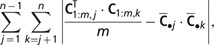
where  and
 are the means of the jth and kth columns of C. The algorithm we used to find the matings that minimised this function is presented in the Appendix. Because MCAC mating works with all genetic contributions, both within and across generations, it is readily applicable to breeding schemes with discrete or overlapping generations.
We restricted the number of ancestors, n, by excluding ancestors more than eight generations back from the selected sires and dams. Our preliminary results showed that the genetic contributions of ancestors more than eight generations back had stabilised. These ancestors did not contribute to the sum of the covariances (i.e., covariances involving these ancestors were zero). Including them only increased computational costs. The fact that the genetic contributions stabilised over generations also implies that more weight was given to ancestors from recent generations.
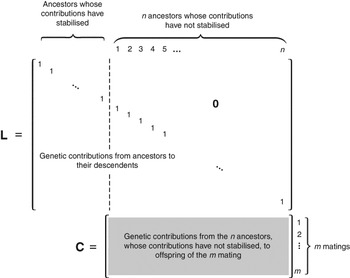
C is a function of the normed lower-triangular matrix, L, which was first described by Quaas (Reference Quaas1976) to decompose matrices of additive genetic relationships. The relationship between L and C is illustrated in Figure 1. For a given set of selected parents, the mean of the jth column of C is the same for all possible mating combinations (i.e., the mean of genetic contributions from the jth ancestor to the m matings does not change). However, the variance of these genetic contributions can differ.
Relationship between matrices L and C. L is a normed lower-triangular matrix describing the genetic contribution from ancestors to their descendents. C (shaded matrix) is an m × n matrix of genetic contributions, where m is the number of matings and n is the number of ancestors, including the sires and dams of the matings, that make genetic contributions to the offspring of the matings and whose contributions to their descendents have not yet stabilised. Element Cij represents the genetic contribution of the jth ancestor to the offspring of the ith mating. It is the average of the two elements in L that represent the jth ancestor’s contribution to the sire and dam of mating i.

Minimum-coancestry mating
The selected sires and dams were mated by minimising the average coancestry of the individual matings. In the factorial breeding scheme, where each sire and dam was mated twice, we imposed the restriction that a sire or dam could not be paired with the same individual twice. The algorithm we used to find the minimum-coancestry matings was described by Meuwissen (Reference Meuwissen2007, p. 175). However, we modified it to obtain the minimum-coancestry matings involving the sires and dams from four randomly sampled matings, instead of two, in each round of sampling.
Random mating
The selected sires and dams were mated randomly.
Simulations
The hierarchical and factorial breeding schemes were run for 20 discrete generations. They were simulated by generating a base population of unrelated sires and dams (generation 0). Twenty sires and 120 dams were in the base population of the hierarchical breeding scheme; there were 60 sires and 60 dams in the base population of the factorial breeding scheme. The base population produced the first generation of offspring. Offspring produced by the base populations were selected in generation 1 and the first generation of offspring from selected parents was produced in generation 2. Offspring produced in generation 20 were the result of 19 generations of selection.
Selection was for a single trait. The phenotype of the trait was recorded for all animals. The trait was assumed to be genetically controlled by the infinitesimal model of additive genetic effects. Its heritability was 0.10 in the base populations. The trait was simulated for each animal as pi = ai + ei, where pi is the phenotypic value of the ith animal, and ai and ei are its additive genetic and residual environmental values. The additive genetic values of the sires and dams in the base populations were sampled from the distribution N(0, 0.10), where 0.10 is the additive genetic variation. The environmental values were sampled from N(0, 0.90), where 0.90 is the residual environmental variation.
The additive genetic values of the offspring in subsequent generations were simulated as  , where a si and a di are the additive genetic values of the sire, si, and the dam, di, of animal i, and mi is its Mendelian sampling term. The Mendelian sampling term, mi, was sampled from the distribution
 , where
 is the average inbreeding coefficient of parents, si and di. The environmental values, ei, were sampled from N(0, 0.90), as described for the base population. The offspring were assigned as males or females with a probability of 0.5.
Each combination of breeding scheme and mating criterion was replicated 100 times. Within each replicate, the levels of inbreeding and genetic gain in each generation were calculated as the mean inbreeding coefficients and additive genetic values of the offspring.
The levels of inbreeding and genetic gain for each combination of breeding scheme and mating criterion are presented as means (±s.d.) of the 100 replicates. Rates of inbreeding following the onset of inbreeding were calculated using the mean levels of inbreeding. The rates are presented as the average rate of inbreeding per generation, where the rate of inbreeding in each generation was calculated as (Ft−Ft −1)/(1−Ft −1) and Ft is the level of inbreeding in the tth generation.
We also present two analyses of the ancestral genetic contributions to verify the mechanisms that cause the rate of inbreeding to differ between MCAC, minimum-coancestry and random mating when there is truncation selection. First, we present the number of ancestors from generations 0 to 19 that made a genetic contribution to the offspring in generation 20. Second, we present the deviation of long-term genetic contributions from the exact linear relationship between long-term genetic contributions and Mendelian sampling terms. We do this by presenting the standard deviation of residuals from a linear regression of genetic contributions on Mendelian sampling terms using the ancestors in generations 0 to 19 that made a genetic contribution to the offspring in generation 20. The numbers of ancestors and the standard deviations in each generation are presented as means of the 100 replicates. The analyses are only presented for the factorial breeding scheme with truncation selection; the conclusions were the same for the hierarchical breeding scheme.
The simulations were carried out using the program ADAM (Pedersen et al., Reference Pedersen, Sørensen, Henryon, Ansari-Mahyari and Berg2009). The BLUP breeding values were predicted using the program DMU6 (Madsen et al., Reference Madsen, Sørensen, Su, Damgaard, Thomsen and Labouriau2006). The animal model fitted to predict the breeding values included a fixed overall mean and a random animal effect. The genetic contributions were calculated using the program EVA (Berg et al., Reference Berg, Nielsen and Sørensen2006).
Results
Truncation selection
Inbreeding
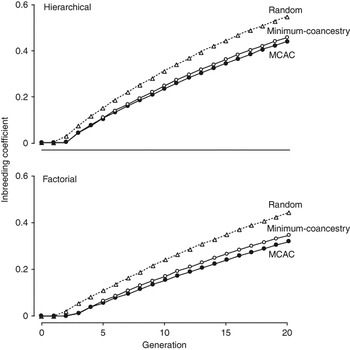
MCAC mating generated less inbreeding than minimum-coancestry mating when the parents were truncation-selected (Figure 2). At generation 20, MCAC mating had generated 3.6% less inbreeding than minimum-coancestry mating in the hierarchical breeding scheme and 8.0% less in the factorial scheme. Moreover, it generated 19.7% and 27.9% less inbreeding than random mating. The levels of inbreeding (±s.d.) generated by MCAC, minimum-coancestry and random mating at generation 20 were 0.436 ± 0.0288, 0.454 ± 0.0272 and 0.546 ± 0.0489 in the hierarchical scheme and 0.319 ± 0.0194, 0.346 ± 0.0215 and 0.442 ± 0.0431 in the factorial scheme.
Levels of inbreeding generated by MCAC (●), minimum-coancestry (○) and random (▵) mating in hierarchical and factorial breeding schemes where the parents were truncation-selected.

The different levels of inbreeding generated by the three mating criteria were the result of two effects. First, MCAC and minimum-coancestry mating delayed the onset of inbreeding until generation 3, while random mating produced inbred animals already in generation 2. Second, MCAC mating generated lower rates of inbreeding than minimum-coancestry mating after the onset of inbreeding, while minimum-coancestry mating generated lower rates than random mating. The rates of inbreeding for MCAC, minimum-coancestry and random mating after the onset of inbreeding were 0.031, 0.033 and 0.041 per generation in the hierarchical breeding scheme. They were 0.021, 0.024 and 0.031 per generation in the factorial scheme.
Genetic gain
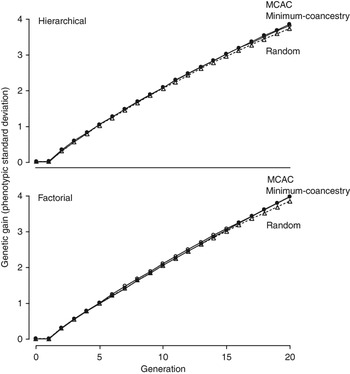
MCAC mating generated approximately the same amount of genetic gain as minimum-coancestry mating (Figure 3). In turn, both MCAC and minimum-coancestry mating generated about 3% more genetic gain than random mating. The genetic gains (±s.d.) generated by MCAC, minimum-coancestry and random mating at generation 20 were 3.84 ± 0.244, 3.80 ± 0.227 and 3.72 ± 0.234 phenotypic standard deviations in the hierarchical scheme and 3.96 ± 0.181, 3.95 ± 0.210 and 3.84 ± 0.222 phenotypic standard deviations in the factorial scheme.
Levels of genetic gain generated by MCAC (●), minimum-coancestry (○) and random (▵) mating in hierarchical and factorial breeding schemes where the parents were truncation-selected.

Random selection
Inbreeding
MCAC mating generated approximately the same amount of inbreeding as minimum-coancestry mating when the parents were randomly selected. Both MCAC and minimum-coancestry mating generated approximately 16% less inbreeding than random mating at generation 20. The levels of inbreeding (±s.d.) generated by MCAC, minimum-coancestry and random mating at generation 20 were 0.108 ± 0.0032, 0.107 ± 0.0035 and 0.126 ± 0.0056 in the hierarchical scheme. They were 0.060 ± 0.0018, 0.059 ± 0.0017 and 0.072 ± 0.0034 in the factorial scheme.
Mating animals by minimising the covariance between ancestral contributions and minimum-coancestry mating generated less inbreeding than random mating by delaying the onset of inbreeding. MCAC and minimum-coancestry mating delayed the onset until generation 4 in the hierarchical breeding scheme and until generation 5 in the factorial scheme. Random mating, by comparison, produced inbred animals already in generation 2 in both breeding schemes. After the onset of inbreeding, there was very little difference in the rates of inbreeding generated by MCAC, minimum-coancestry and random mating. The rate generated by the three criteria was 0.007 (approximately) per generation in the hierarchical breeding scheme and 0.004 (approximately) per generation in the factorial scheme.
Genetic gain
No genetic gain was generated in any of the breeding schemes when the parents were randomly selected.
Genetic contributions
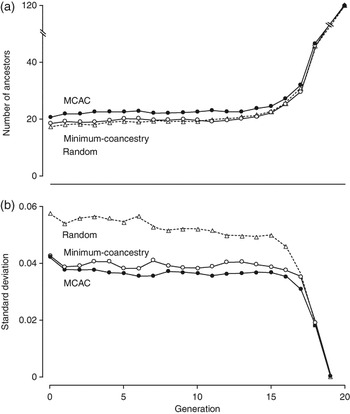
Mating animals by minimising the covariance between ancestral contributions increased the number of ancestors that made a genetic contribution to the offspring in generation 20 when there was truncation selection. It also caused the genetic contributions of these ancestors to stabilise closer to the exact linear relationship between the genetic contributions and their Mendelian sampling terms. In the factorial breeding scheme, the number of ancestors from generations 0 to 15 that made a genetic contribution to the offspring in generation 20 averaged 22.5 per generation with MCAC mating and 19.8 and 19.4 per generation with minimum-coancestry and random mating (Figure 4a). The standard deviation of the residuals from the linear relationship averaged 0.037 per generation with MCAC mating in generations 0 to 15, and 0.039 and 0.053 with minimum-coancestry and random mating (Figure 4b). We obtained similar findings when the parents were truncation-selected in the hierarchical breeding scheme.
(a) Number of ancestors in generations 0 to 19 that made a genetic contribution to offspring in generation 20 of a factorial breeding scheme where the parents were truncation-selected and mated by MCAC (●), minimum-coancestry (○) and random (▵) mating, and (b) standard deviation of residuals from a linear regression of genetic contributions on Mendelian sampling terms for the ancestors in generations 0 to 19 that made a genetic contribution to the offspring in generation 20.

Discussion
Our results supported our hypothesis that MCAC mating generates less inbreeding while producing at least as much genetic gain as minimum-coancestry mating in breeding schemes where the parents are truncation-selected. The 4% to 8% reduction in inbreeding is worthwhile, particularly if it can be achieved without burdening breeding schemes with extra costs or practical constraints. Moreover, MCAC mating generated up to 28% less inbreeding than random mating, and like minimum-coancestry mating, it produced about 3% more genetic gain. MCAC mating merely uses pedigree information to pair the parents more appropriately and is clearly a worthy alternative to minimum-coancestry mating in selective breeding schemes with truncation selection. We believe, therefore, that MCAC mating should be used in breeding schemes where pedigree information is available.
As we contended, MCAC mating generated less inbreeding than minimum-coancestry mating for two reasons. First, it delayed the onset of inbreeding for as long as minimum-coancestry mating. Second, MCAC mating reduced the rate of inbreeding by making the ancestral genetic contributions more independent prior to stabilisation. It maximised the number of combinations of ancestral genetic contributions in the offspring of each generation, providing selection with a greater opportunity of increasing the contribution of ancestors with the largest Mendelian sampling terms. As a consequence, the contributions stabilised closer to the exact linear relationship between the long-term genetic contributions and Mendelian sampling terms. This reasoning was verified by our analysis of the genetic contributions, which confirmed that MCAC mating increased the number of ancestors that made a long-term genetic contribution to the descendents of a population. It also showed that MCAC mating enabled the contributions to stabilise closer to the exact linear relationship. So, MCAC mating should always generate less inbreeding, or certainly no more, than minimum-coancestry mating, and probably any other mating criterion, in breeding schemes where parents are truncation-selected.
Not only did MCAC mating generate less inbreeding than minimum-coancestry mating, it also produced as much genetic gain, presumably by maintaining higher levels of additive genetic variation. It was unlikely that MCAC mating per se had a large bearing on genetic gain. This was supported by a parallel simulation study which showed that MCAC, minimum-coancestry and random mating generated the same amount of genetic gain when the additive genetic variation was assumed to be unaffected by inbreeding (i.e., the variance of the Mendelian sampling terms was not reduced) (M. Henryon, unpublished results). Factors other than the loss of genetic variation brought about by inbreeding have little influence on genetic gain, at least when an additive genetic model is assumed. Therefore, we are not losing anything by using MCAC mating and may, in fact, be able to improve genetic gain by small amounts.
It was not surprising that MCAC and minimum-coancestry mating generated less inbreeding and more genetic gain than random mating when the parents were truncation-selected. Several systematic mating criteria are well known to achieve this (Caballero et al., Reference Caballero, Santiago and Toro1996). The situation was somewhat different with random selection. Both MCAC and minimum-coancestry mating still generated less inbreeding than random mating, but they only did so by delaying the onset of inbreeding. After the onset, all three criteria generated the same rate of inbreeding because the animals were selected at random. There was no pressure to increase the genetic contributions of those ancestors with the highest Mendelian sampling terms and, as a consequence, independence of the contributions was not important. Therefore, random mating is a poor mating criterion compared to MCAC and minimum-coancestry mating, and MCAC mating is only better than minimum-coancestry mating when there is directional selection.
Mating animals by minimising the covariance between ancestral contributions has the benefit of being readily applicable to any breeding scheme, provided pedigree information is recorded. When this information is available, the management system allows controlled mating and the selected parents breed at the same time, the process of mating the parents more appropriately is simple. It’s a little more complex when the breeding population is divided into sub-populations, mating decisions are not coordinated across sub-populations and/or the selected parents breed at different times. Even so, this could be partly overcome by using MCAC mating within sub-populations and/or breeding groups. Thus, provided there is pedigree information available and the management system allows it, the benefits from MCAC mating can be achieved at no extra cost.
We introduced the concept of MCAC mating with truncation selection, as truncation selection remains the most widely used selection system in animal breeding. This does not mean that the benefits of MCAC mating are restricted to truncation selection. MCAC mating may also be beneficially coupled with other selection systems. The most important of these, at least from an animal-breeding perspective, is optimum-contribution selection (Brisbane and Gibson, Reference Brisbane and Gibson1994; Wray and Goddard, Reference Wray and Goddard1994; Meuwissen, Reference Meuwissen1997). Optimum-contribution selection maximises genetic gain while constraining the rate of inbreeding at, or below, predefined levels by restricting the coancestry of the selected parents. The line of reasoning that leads us to believe that MCAC mating can be beneficially coupled with optimum-contribution selection is as follows. In breeding schemes that use optimum-contribution selection, there are several systematic mating criteria that generate more genetic gain than random mating for a predefined rate of inbreeding (Sonesson and Meuwissen, Reference Sonesson and Meuwissen2000). The criterion that is recommended to generate the most genetic gain is once again minimum-coancestry mating (Sonesson and Meuwissen, Reference Sonesson and Meuwissen2000; Meuwissen, Reference Meuwissen2007). Minimum-coancestry mating generates more genetic gain than random mating because it minimises the degree of coancestry in the next generation, which makes pair-wise relationships between individuals less variable. This enables optimum-contribution selection to increase the contribution of animals with the highest Mendelian sampling terms while having less influence on average coancestry. As a by-product, the genetic contributions become more independent, providing selection with a greater opportunity to increase the contribution of those animals with the highest Mendelian sampling terms. The fact that MCAC mating makes the genetic contributions more independent than minimum-coancestry mating, and as a by-product, it makes the pair-wise relationship between individuals less variable, at least when compared with random mating, suggests that MCAC mating will increase genetic gain more than minimum-coancestry mating in breeding schemes that use optimum-contribution selection. This needs to be verified. However, our reasoning suggests that MCAC mating should be ideally suited for coupling with optimum-contribution selection by increasing genetic gain for a given rate of inbreeding.
Acknowledgements
This study was funded by the Danish Pig Production, Danish Cattle Federation and Danish Ministry of Food, Agriculture and Fisheries.
Appendix
The algorithm we used to carry out MCAC mating included the following matrices and variables:

Nnoimprove, Maxrounds and Improved are control variables.
The algorithm we used to find the MCAC matings was:

If algorithm stops because Nnoimprove = 0, M contains the MCAC matings.
If algorithm stops because Maxrounds = 0, there is no guarantee that the MCAC matings were found. Repeat steps 2 to 12 using M, instead of the minimum-coancestry matings, as the initial matings.