Open heart surgery is commonly performed in children with congenitally malformed hearts. The postoperative course can be complicated with several problems, which may affect subsequent survival. One of the most common postoperative problems is arrhythmia.Reference Delaney, Moltedo, Dziura, Kopf and Snyder1 Although junctional ectopic tachycardia, and ectopic atrial tachycardia, can develop separately in the postoperative course, occurrence of both tachyarrhythmias in the same patient is rare. We describe here, therefore, our experience with a 2-year-old girl who developed both arrhythmias during the immediate postoperative course following closure of a ventricular septal defect, both abnormal rhythms being controlled successfully following intravenous administration of amiodarone.
Case report
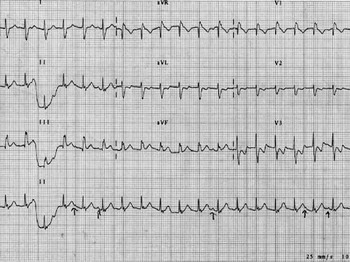
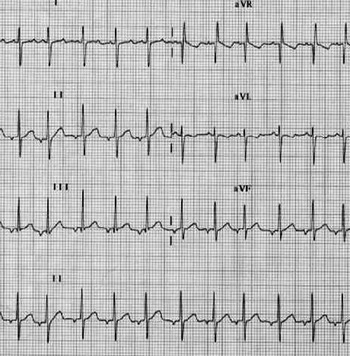
The patient underwent surgical closure of a large ventricular septal defect. Prior to the surgery, cardiac catheterization had revealed systolic, diastolic, and mean pressures in the pulmonary arteries of 65, 17, and 42 millimetres of mercury, respectively. The ratio of systemic to pulmonary flows was calculated as 2.64, and pulmonary vascular resistance was 4.02 Wood units. The postoperative first day was uneventful, albeit that electrocardiographic monitoring showed complete right bundle branch block. On the second postoperative day, she developed tachycardia and tachypnea. Her laboratory evaluation, including a complete blood count, electrolytes, blood urea nitrogen, creatinine, and glucose, was unremarkable. The chest X-ray was normal. The rhythm was evaluated as a junctional ectopic tachycardia, with a ventricular rate of 150 beats per minute (Fig. 1). An intravenous infusion of amiodarone was started, using a loading dose of 5 miligrams per kilogram for 2 hours, and a maintenance dose of 5 micrograms per kilogram. Approximately 12 hours after starting the infusion, the rhythm converted to ectopic atrial tachycardia, with a rate of 150 to 160 beats per minute (Fig. 2). We increased the dosage of amiodarone to 10 micrograms per kilogram per minute for 12 hours, and 15 micrograms per kilogram per minute thereafter, and continued the infusion at this dosage. Prior to the restoration of sinus rhythm, there was no change in the heart rate during the periods of junctional ectopic and ectopic atrial tachycardias. At the 48th hour of infusion, sinus rhythm was restored. We then stopped the infusion 24 hours after restoration of sinus rhythm, continuing to administer the drug orally. During infusion, temporary hypotension developed, which was controlled with replacement of volume and infusion of dopamine. Hepatic function tests remained within normal limits during the administration of amiodorone. An echocardiographic study demonstrated a minimal residual ventricular septal defect and mild tricuspid regurgitation. The ejection fraction and shortening fraction were normal. We then started treatment with inhaled iloprost at 2.5 micrograms per dose, increasing this to 5 micrograms per dose, and repeating the dose 6 times daily, once every 2 hours over the waking hours. This was discontinued on the 20th postoperative day.
The electrocardiogram taken on the second postoperative day shows a junctional ectopic tachycardia with right bundle brunch block. There is atrioventricular dissociation, with a ventricular rate of 150 beats per minute, and an atrial rate of 124 beats per minute.

Following 12 hours of intravenous infusion of amiodarone, the junctional ectopic tachycardia resolved, albeit with conversion to an ectopic rhythm originating from low right atrium. Note the positive P wave in lead I, and the negative P wave in lead aVF. There is a narrow QRS complex, with a rate of 150 beats per minute.

The patient was discharged on the 10th postoperative day, neither junctional nor ectopic atrial tachycardias having recurred subsequent to the restoration of sinus rhythm. As of the third postoperative month, the arrhythmias had not recurred, and we were able to discontinue the amiodarone.
Discussion
Immediate postoperative arrhythmias are widely recognized as complications of cardiothoracic surgery in both adults and children. When occurring early after corrective surgery, such arrhythmias may have a major influence on recovery of haemodynamically impaired patients, and carry a diminished prognosis for the long-term outcome.Reference Delaney, Moltedo, Dziura, Kopf and Snyder1 Recent studies have reported such arrhythmias in up to one-sixth of cases.Reference Delaney, Moltedo, Dziura, Kopf and Snyder1, Reference Rekawek, Kansy and Miszczak-Knecht2
Junctional ectopic tachycardia is the most common postoperative tachyarrhythmia encountered in children,Reference Delaney, Moltedo, Dziura, Kopf and Snyder1, Reference Rekawek, Kansy and Miszczak-Knecht2 with incidences reported to range to one-tenth of cases.Reference Delaney, Moltedo, Dziura, Kopf and Snyder1, Reference Rekawek, Kansy and Miszczak-Knecht2 The arrhythmia is believed to originate from an automatic focus in the bundle of His, but for the most part, the pathophysiology remains unknown. This tachycardia is self-limiting over time, but since it usually occurs immediately after surgery, when the heart is particularly vulnerable, the high heart rate and loss of atrioventricular synchrony can lead to severe haemodynamic deterioration.Reference Gillette3 It can be resistant and life-threatening despite aggressive treatment. Its incidence is associated with a more than six-fold increase in mortality.Reference Andreasen, Johnsen and Ravn4 Therapeutic strategies include stepwise treatment with sedation, stabilization of electrolytes, and if possible, reduction of endogenous inotropic stimulation with active cooling to 34 to 35 degrees Celsius, muscle relaxation, and intravenous infusion of amiodarone.Reference Gillette3 Several clinical trials have shown that amiodarone yields a success rate approaching 100%, and only a few side effects have been reported.Reference Plumpton, Justo and Haas5 In our patient, the heart rate during junctional ectopic tachycardia was relatively slower than previously reported rates.Reference Haas, Plumpton, Justo, Jalali and Pohlner6 Our patient, however, become tachypneic and developed pulmonary hypertension. Because of this, we started treatment with amiodarone to prevent possible unwanted events. The drug was well tolerated, the only side effect being systemic hypotension.
Ectopic atrial tachycardia is seen in children with structurally normal hearts as a spontaneous event, and after surgical correction of congenital cardiac malformations.Reference Case and Gillette7 This tachycardia, however, is uncommon after congenital cardiac surgery. We are aware of only 1 study investigating its frequency and clinical course.Reference Rosales, Walsh, Wessel and Triedman8 This investigation suggested that the arrhythmia is sporadic, and well tolerated by most patients. Although clinical outcome was favourable, one patient required therapy for persistent tachycardia, and 2 patients died, emphasizing its potential hazards in the perioperative period. Although amiodarone is reported to be highly effective in its treatment in children,Reference Perry, Fenrich, Hulse, Triedman, Friedman and Lamberti9 little data exists regarding its effectiveness in postoperative cases. Although our patient had improved markedly subsequent to the cessation of the junctional ectopic tachycardia, in the light of the high rate of the ectopic atrial tachycardia, we continued to infuse amiodarone until sinus rhythm was restored. When compared to junctional ectopic tachycardia, the ectopic atrial tachycardia could be controlled by a higher rate of infusion over a longer period, suggesting that postoperative ectopic atrial tachycardia is more resistant to therapy.
To the best of our knowledge, the co-existence of junctional ectopic and ectopic atrial tachycardias has previously been reported on but one occasion.Reference Haas, Fox and Skinner10 In the previous patient,Reference Haas, Fox and Skinner10 the clinical course was catastrophic, and the arrhythmias could only be controlled with combination of a continuous infusion of amiodarone together with flecainide. In our patient, in contrast, the haemodynamic state was affected but moderately, and the arrhythmias were controlled with infusion of amiodarone alone. Our experience, therefore, shows that the combination of postoperative junctional ectopic and ectopic atrial tachycardias can occur in children, and can successfully be controlled with an intravenous infusion of amiodarone.