The dry period is a critical stage for the dairy cow. Intramammary infections (IMI) present at drying off can persist through the dry period and new IMI can be acquired increasing the risk of clinical mastitis in the early subsequent lactation leading to increased milk loss (Neave et al., Reference Neave, Dodd and Henriques1950). Treatment of cows with an intramammary (IM) antibiotic at drying off is an established practice in mastitis prevention protocols. The purposes of dry cow antimicrobial infusion (DCAI) are to eliminate IMI present at drying off and prevent new IMI during the early dry period (Smith et al., Reference Smith, Neave, Dodd and Brander1966). This strategy has some disadvantages, including variable cure rate, potential selection of antibiotic-resistant organisms and increased risk of antibiotic residues in the milk (Gomes and Henriques, Reference Gomes and Henriques2016). Besides, recent public concerns over the widespread prophylactic use of antibiotics, has led to a re-evaluation of the treatment of cows at drying-off with the objective of reducing the use of antibiotics (Ruegg, Reference Ruegg2017). Different strategies have been proposed, including enhancement of the natural mammary gland (MG) defences (Erskine et al., Reference Erskine, Bartlet, Tavernier, Fowler, Walker, Seguin and Shuster1998).
Ginseng, the root of Panax ginseng C.A. Meyer (cultivated ginseng), has found widespread therapeutic use due to its wide spectrum of medicinal effects (Liu et al., Reference Liu, Xu and Che2000). We have previously shown that the IM inoculation of Panax ginseng extract (PGe) in noninfected cows at cessation of milking activated the innate immune response in the MG and enhanced early mammary involution (Dallard et al., Reference Dallard, Baravalle, Andreotti, Ortega, Neder and Calvinho2011; Baravalle et al., Reference Baravalle, Silvestrini, Cadoche, Beccaria, Andreotti, Renna, Pereyra, Ortega, Calvinho and Dallard2015). In complementary studies, using a mouse mastitis model, PGe was shown to enhance host immunity protecting from a S. aureus experimental infection by partially inhibiting its multiplication within the MG (Silvestrini et al., Reference Silvestrini, Beccaria, Pereyra, Renna, Ortega, Calvinho, Dallard and Baravalle2017). In an in vitro model, PGe reduced S. aureus internalization into mammary epithelial cells (Beccaria et al., Reference Beccaria, Silvestrini, Renna, Ortega, Calvinho, Dallard and Baravalle2018). According to results obtained so far, the use of PGe either as an alternative or an adjunct for DCAI appears promising. The objective of this study was to evaluate the efficacy of IM administration at drying-off of PGe combined with cephalexin (Ceph) on new IMI during the dry period and bacteriological cure rate of pre-existent post-calving IMI. In addition, any effects of treatment on milk yield and SCC in the ensuing lactation were evaluated.
Materials and methods
Panax ginseng extract
Panax ginseng extract, was kindly provided by the Indena Company (Indena® SpA, Milan, Italy). The PGe preparation is detailed in the Supplementary File.
Minimal inhibitory concentration and minimal bactericidal concentration of Ceph with PGe
Before IM treatment, we investigated the in vitro interactions between PGe and Ceph (Romikin S.A., Buenos Aires, Argentina). The minimal inhibitory concentration (MIC) and minimal bactericidal concentration (MBC) were determined by a microdilution method. Materials and methods used are detailed in the Supplementary File.
Animals and experimental design
One hundred and eight cows in late lactation belonging to two dairy farms were included in the study. Forty eight Holstein cows came from the School of Agriculture and Livestock of Universidad Nacional del Litoral (UNL) (farm A) and sixty crossbred cows (Holstein × Jersey) were from Rafaela Experiment Station of Instituto Nacional de Tecnología Agropecuaria (INTA) (farm B). Farm A had 110 lactating cows with an average milk yield per cow of 23.3 litres and average of SCC of 445 × 103 cells/ml throughout lactation. Farm B had 180 lactating cows with an average milk yield per cow of 22.4 land average of SCC of 520 × 103 cells/ml throughout lactation.
Cows were randomly assigned to two experimental groups and were treated at drying-off with two different formulations. Cows (n = 51) of Ceph group received IM infusions of a formulation containing 100 mg of Ceph in a slow-release oily vehicle in each quarter. Cows (n = 57) of PGe + Ceph group received IM infusions of PGe (3 mg/ml in 10 ml of gelled water soluble quick-release vehicle) in each quarter immediately preceding the IM infusion of Ceph (same formulation as Ceph group). Description of animals, parity, production system, random selection and IM administration procedure are shown in the Supplementary File.
The mammary quarter was the experimental unit (n = 432) and IM infusions were performed after the last milking of the lactation. The PGe concentration was chosen based on previous reports (Dallard et al., Reference Dallard, Baravalle, Andreotti, Ortega, Neder and Calvinho2011; Baravalle et al., Reference Baravalle, Silvestrini, Cadoche, Beccaria, Andreotti, Renna, Pereyra, Ortega, Calvinho and Dallard2015). All IM formulations were pyrogen free and prepared by Laboratorio Allignani Hermanos S.R.L. (Santa Fe, Argentina) using the PGe provided by Indena Company.
Sampling procedures, isolation and identification of microorganisms are detailed in the Supplementary File.
Diagnosis of intramammary infections and bacteriological cures
Intramammary infection was defined as presence of one or two bacterial species in a quarter sample. Bacteriological cure was defined at the quarter level as the proportion of pathogen-positive pre-drying off samples that were negative for the same pathogen at post-calving culture. New dry period IMI were those quarters bacteriologically negative at pre-drying off but that presented an IMI at post-calving (within 24 h after calving). Bacteriological cure of a pre-existent IMI at drying off and new dry period IMI were determined within pathogen groups.
Pathogens were further grouped into contagious (S. aureus, Streptococcus agalactiae and Corynebacterium spp.) and environmental (Streptococcus dysgalactiae, Streptococcus uberis and Escherichia coli).
Milk yield and somatic cell count
Milk yield and milk samples for SCC from all cows enrolled in the study were obtained monthly during the whole lactation subsequent to treatment from the regional dairy herd improvement system. Detailed descriptions are shown in the Supplementary File.
Statistical analysis
Generalized linear mixed models with binary logistic link function were used to determine the effect of treatment on bacteriological cure rate and incidence of new dry period IMI. The following variables were included as fixed effects in both models: treatment (Ceph or PGe + Ceph) and lactation number of the cow. To control the lack of independence of the samples, cow nested in farm was used as random effect in both models. The effect of PGe on milk yield and SCC was analysed using repeated measures ANOVA. All statistical analyses were performed using InfoStat software version 2011 (Universidad Nacional de Córdoba, Argentina).
Results
Effect of PGe on Ceph MIC and MBC
Assays with S. aureus ATCC 29213 showed that the Ceph MIC was 0.25 μg/ml in wells treated with 3 mg/ml of PGe, whereas in those treated either with 0.5 mg/ml PGe or without PGe (control) it was 0.5 μg/ml. Cephalexin MBC was 8 μg/ml in wells treated with 3 mg/ml of PGe, while it was 16 μg/ml in wells treated with 0.5 mg/ml PGe and without PGe (control).
Initial bacteriological status from treated quarters at pre-drying off
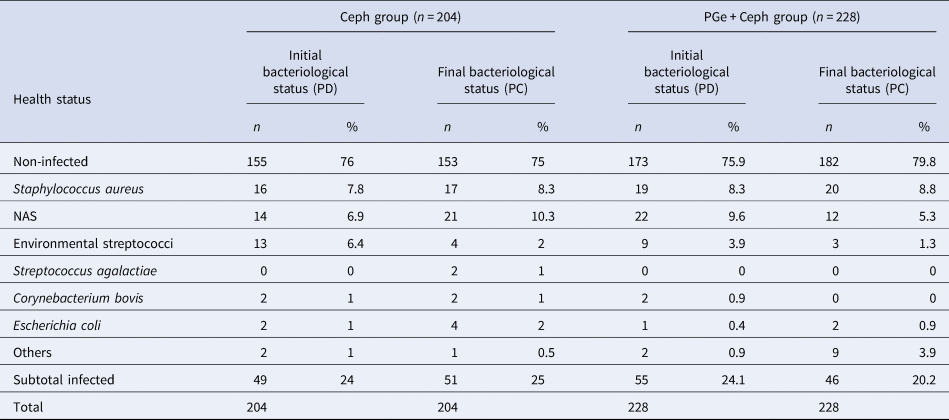
A total of 104 out of 432 mammary quarters (24.1%) yielded a positive culture at drying off. The overall quarter prevalence of IMI at pre-drying was 24% (49/204) for the Ceph group and very similar (24.1%, 55/228) for the PGe + Ceph group (Table 1). The distribution of bacteria recovered from quarter milk samples taken pre-drying off is shown in Table 1. The most frequently isolated bacterial pathogens in Ceph group and PGe + Ceph group respectively were S. aureus (7.8% and 8.3%), non-aureus staphylococci (NAS) (6.9% and 9.6%), and environmental streptococci (S. uberis, S. dysgalactiae, Streptococcus spp.) (6.4% and 3.9%), respectively.
Initial bacteriological status at (pre-drying off) and final bacteriological status (post-calving) in mammary quarters treated with Ceph or PGe + Ceph

PD, pre-drying off; PC, post-calving; NAS, non-aureus staphylococci.
Environmental Streptococci includes: S. uberis, S. dysgalactiae and Streptococcus spp. The percent (%) was calculated considering the number of specific bacteria isolated from quarters × 100/total quarters.
Final bacteriological status from treated quarters at post-calving
A total of 97 out of 432 mammary quarters (22.5%) yielded a positive culture post-calving. The overall quarter prevalence of IMI at post-calving was 25% (51/204) for Ceph group and 20.2% (46/228) for PGe + Ceph group (non-significant difference, Table 1). The distribution of bacteria recovered from quarter milk samples taken post-calving is shown in Table 1. The most common bacterial pathogens isolated from the Ceph group and the PGe + Ceph group were S. aureus (8.3% and 8.8%) and NAS (10.3% and 5.3%), respectively. Environmental streptococci were isolated with a lower prevalence (2% in Ceph group and 1.3% in PGe + Ceph group).
New dry period IMI rate
The overall rate of new dry period IMI for all quarters was 14.9% (64/432). The effect of treatment on incidence of new dry period IMI is shown in online Supplementary Table S1. Infusion of PGe + Ceph at drying-off had no effect on preventing new dry period IMI (OR = 0.75, 95% CI% = 0.38–1.51), showing similar incidence (13.3%; 30/228) compared with Ceph treatment (16.7%; 34/204).
The incidence of new dry period IMI for S. aureus was 5.3% for Ceph group and 1.9% for PGe + Ceph group (OR = 0.67, 95% CI% = 0.24–1.81). For NAS, the incidence of new dry period IMI was 7.1% for Ceph group and 6.8% for PGe + Ceph group (OR = 0.86, 95% CI% = 0.37–2.02). For environmental pathogens, the incidence of new dry period IMI was 10.3% for Ceph group and 11% for PGe + Ceph group (OR = 1.04, 95% CI% = 0.46–2.36). For contagious pathogens, the incidence of new dry period IMI was 7.7% for Ceph group and 2.3% for PGe + Ceph group (OR = 0.49, 95% CI% = 0.19–1.27).
Bacteriological cure rate
The overall cure rate of IMI for all quarters was 56.7% (245/432). The effect of treatment on the bacteriological cure rate evaluated on infected quarters is shown in online Supplementary Table S2. The cure rates of infected quarters at drying-off were similar for both treatments (OR = 0.95, 95% CI% = 0.33–2.74), showing percentages of 54.2% (111/204) and 58.9% (134/228) for those treated with Ceph and PGe + Ceph, respectively.
The estimated bacteriological cure for S. aureus was 56.3% for Ceph group and 15.8% for PGe + Ceph group (OR = 15.4, 95% CI% = 1.66–142.52). For NAS, the bacteriological cure was 71.4% for Ceph group and 95.5% for PGe + Ceph group (OR = 0.102, 95% CI% = 0.006–1.71). For environmental pathogens, the bacteriological cure was 80% for Ceph group and 86.5% for PGe + Ceph group (OR = 0.52, 95% CI% = 0.10–2.70). For contagious pathogens, the bacteriological cure was 55.6% for Ceph group and 27.8% for PGe + Ceph group (OR = 6.99, 95% CI% = 1.07–45.54).
Milk yield and SCC in ensuing lactation
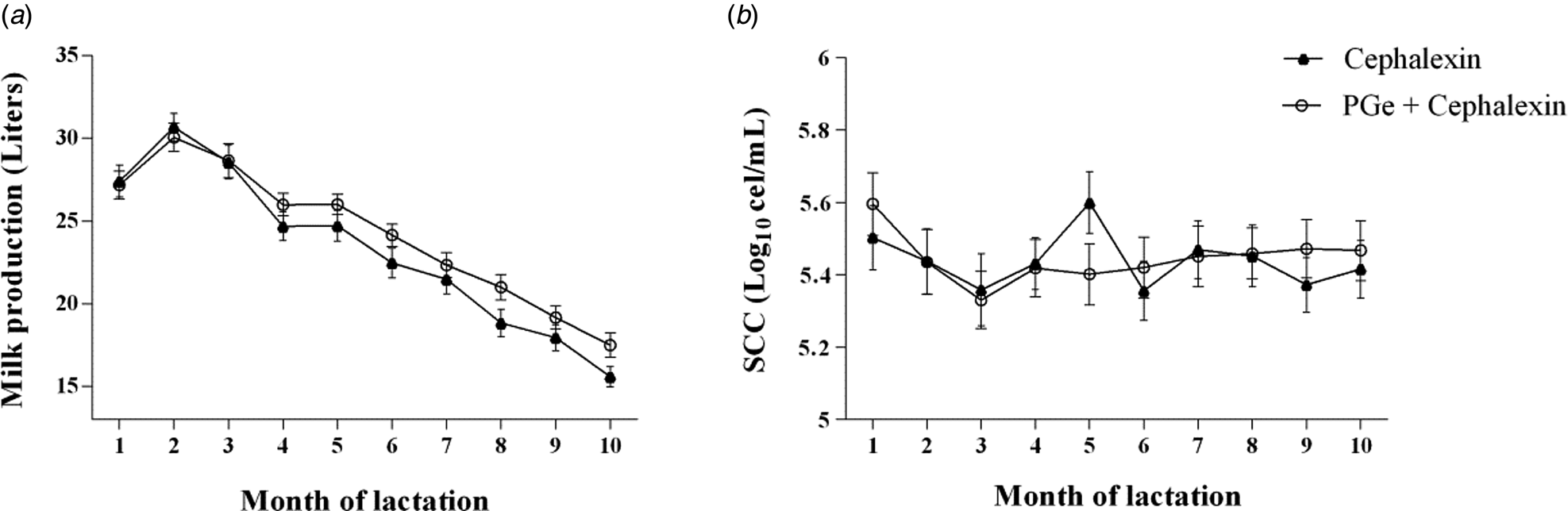
The average of milk yield and SCC per cow during lactation was 23.7 ± 5.7 l and 455 ± 126 × 103 cells/ml, respectively. Although the milk yield was higher after the fourth month of lactation in cows from PGe + Ceph group, no evidence of any significant effect of treatment on milk yield was found (P > 0.05: Fig. 1a). Although values of SCC reached a peak at the fifth month of lactation in cows treated with Ceph, no significant differences throughout lactation were found between treated groups (P > 0.05: Fig. 1b). Means and 95% CI of milk yield and SCC are shown in online Supplementary Table S3.
Effect of dry cow formulations containing Ceph or PGe + Ceph on milk yield and SCC during the subsequent lactation (mean ± sem). (a) Averages of litres of milk produced by cows treated with Ceph and PGe + Ceph in relation to the months of lactation: no significant differences were observed (P > 0.05). (b) Average SCC (log10) for each treatment in relation to the months of lactation: no significant differences were observed (P > 0.05).

Discussion
In the present study, although the MIC of Ceph remained within the range of 0.12–0.5 μg/ml reported by Clinical and Laboratory Standards Institute (CLSI, 2013) for the reference strains used; S. aureus MIC and MBC were lower when combined with 3 mg/ml of PGe. This is in accord with Sung and Lee (Reference Sung and Lee2008) who observed a synergistic effect of kanamycin and cefotaxime combined with ginsenosides extracted from Korean red ginseng against methicillin-resistant S. aureus (MRSA). Since the mechanism of the antibacterial effect is unknown, further studies will be required to elucidate the nature of the interaction of PGe with Ceph, as well as to determine if the minimal differences observed in vitro translate into a biological effect in vivo.
In previous studies reviewed by Dingwell et al. (Reference Dingwell, Kelton and Leslie2003) the prevalence of IMI at drying-off ranged between 5 and 28%. In the present study, the overall quarter prevalence of IMI at drying-off was 24.1% (104/432). The bacteria most commonly isolated from IMI in both treatment groups at drying-off were S. aureus, followed by NAS and environmental streptococci. In Argentina, a recent study that included 2,296 composite milk samples belonging to 51 dairy herds from Córdoba province, reported that the most commonly isolated bacteria were NAS, followed by S. aureus, Corynebacterium spp., S. agalactiae and S. dysgalactiae (Dieser et al., Reference Dieser, Vissio, Lasagno, Bogni, Larriestra and Odierno2014). Our results and those reported by other authors clearly indicate that S. aureus remains a significant cause of mastitis in dairy herds of Argentina.
In the present study, although the prevalence of IMI post-calving was numerically lower in the quarters treated with PGe + Ceph compared with those treated with Ceph, this difference was not significant and so no evidence of an additive curative effect was observed. Previous studies have shown that bacteriological cure rates during the dry period showed a wide range, greatly depending on the pathogen (Bradley and Green, Reference Bradley and Green2004). In our study, the bacteria most commonly isolated from IMI in Ceph treated quarters at post-calving were NAS, followed by S. aureus and environmental streptococci; while in PGe + Ceph treated quarters the most isolated bacteria were S. aureus followed by NAS and environmental streptococci. The vast majority of NAS infections present at drying-off resolve spontaneously post-calving, while S. aureus infections are difficult to cure and persist after calving (Smith et al., Reference Smith, Neave, Dodd and Brander1966). In our study, cephalexin treatment achieved a curative effect on S. aureus IMI post-calving, however, the addition of PGe to dry cow therapy did not show advantage over the use of cephalexin alone.
In the present study, cows treated with PGe + Ceph at drying-off showed similar percentages of new dry period IMI as cows treated with Ceph alone. Other plant compounds have been used as possible replacements for DCAI. Mullen et al. (Reference Mullen, Anderson and Washburn2014) examined the effects of two commercial herbal IM products on milk production and quality compared with conventional DCAI and no DCAI. They found that the percentages of new IMI determined around 3 and 5 d after calving did not differ between treatments. In our study, although the rates of new dry period IMI were lower for S. aureus and NAS in quarters treated with PGe + Ceph compared with those treated with Ceph no differences were observed between treatments. Similar results were observed when the pathogens were grouped into contagious and environmental.
Cure percentages were similar for both treatments at 58.9% and 54.2% for quarters treated with PGe + Ceph and Ceph alone, respectively. These cure rates were lower than those reported by Bryan et al. (Reference Bryan, Heuer and Emslie2011) who recorded cure rates of 75% and 78% in quarters treated with two commercial products containing 250 mg of cephalonium. The main discrepancies observed with this study could be related not only to the pharmacological composition and the concentration of the antibiotic administered but also to the type of herd, cows, milk production, pathogens and chronicity of IMI.
Previous studies reviewed by Dingwell et al. (Reference Dingwell, Kelton and Leslie2003) showed large variation in IM cure rates for S. aureus after DCAI, ranging from 20 to 70%. In the present study, the mammary quarters treated with cephalexin that presented S. aureus IMI at drying-off (n = 16), showed a cure rate of 56.3%, which was lower than cure rate observed by Bryan et al. (Reference Bryan, Heuer and Emslie2011) (68.6%) for S. aureus infected quarters treated with two different dry cow cephalonium formulations. In contrast PGe + Ceph-treated quarters that presented IMI by S. aureus at drying-off (n = 19) had a significantly lower cure rate (15.8%) than Ceph-treated quarters, which was not an expected outcome. In previous research in vitro we observed that addition of 3 mg/ml of PGe to the bacterial culture medium stimulated the growth of S. aureus after 24 h (Beccaria et al., Reference Beccaria, Silvestrini, Renna, Ortega, Calvinho, Dallard and Baravalle2018). However, this is unlikely to occur in the MG environment, where bacterial growth would not only be regulated by the availability of nutrients but also by the host immune response and other cow factors such as age, which is associated with chronicity of IMI. As expected, the cure rate observed for contagious pathogens was similar to that for S. aureus, since this was the prevalent pathogen in this category.
Our cure rate was apparently higher in PGe + Ceph treated quarters (95.5%) compared with Ceph-treated quarters (71.4%), however, this difference was not significant. The cure rates observed here were similar to those observed by other authors using first generation cephalosporin as DCAI (Bryan et al., Reference Bryan, Heuer and Emslie2011).
A previous study suggested that PGe treatment at drying-off could contribute to increased milk yield in the ensuing lactation (Dallard et al., Reference Dallard, Baravalle, Andreotti, Ortega, Neder and Calvinho2011). Although milk yield was apparently higher after the fourth month of lactation in PGe + Ceph treated quarters, we found no evidence of an effect of treatment on milk yield. Similarly, although SCC in cephalexin treated quarters were higher than those in PGe + cephalexin treated quarters during the fifth month of lactation, this difference was not statistically significant. This outcome is not unexpected since no differences in cure rate between treatments were detected that in turn would have led to a lower rate of IMI and therefore a lower inflammatory response.
In conclusion, combination of PGe + Ceph showed a greater bactericidal effect against S. aureus than Ceph alone when assessed in vitro. In contrast, field trials demonstrated similar efficacy of PGe + Ceph compared with Ceph alone on reducing new dry period IMI and bacteriological cure of existing IMI in vivo. Milk production and SCC in the ensuing lactation were not affected by PGe + Ceph. Cure rates for S. aureus were significantly lower in quarters treated with PGe + Ceph than in those treated with Ceph. Addition of PGe to dry cow therapy in the current experimental conditions did not show any advantage over the use of dry cow therapy alone.
Supplementary material
The supplementary material for this article can be found at https://doi.org/10.1017/S0022029921000017
Acknowledgements
The authors express their appreciation to Mr. Gaston Reibel, Mr. José Maria Copes and Mr. Oscar Warnke for field technical assistance and to Laboratorio Allignani Hermanos S.R.L. for providing the IM formulations. This work was supported by Argentine National Agency for the Promotion of Science and Technology (ANPCyT) (PICT 2017-1547) and Asociación Cooperadora de la Estación Experimental Agropecuaria Rafaela (INTA), Argentina.