INTRODUCTION
During the last years, the interest in using biogenic hard parts as ecological and environmental variables, and archives of past climate, has been reflected by a rapidly increasing number of publications and research groups focused on different types of conchological studies: i.e. groups devoted to the fields of sclerochronology (Dunca et al., Reference Dunca, Mutvei and Schöne2005; Schöne et al., Reference Schöne, Fiebig, Pfeiffer, Gleβ, Hickson, Johnson, Dreyer and Oschmann2005; among many others), archaeomalacology (Claassen, Reference Claassen1998; Bar-Yosef Mayer, Reference Bar-Yosef Mayer2006) and actualistic taphonomy (Kowalewski & LaBarbera, Reference Kowalewski and LaBarbera2004; and references therein).
This study evaluates if the marine bivalve Tawera gayi (Hupé in Gay, 1854) from Tierra del Fuego represents an opportunity to test ecological variability and environmental changes during the last 6000 years (mid-to-late Holocene) in southern South America. The choice of a target species (and not pooled species) was based on the possibility of eliminating differences in preservation among taxa, associated with shell properties, life habits and habitat. Tawera gayi was selected for this study because of two reasons: firstly, it has a thick and solid shell, and secondly, it is a common species in modern and mid-to-late Holocene assemblages (Gordillo, Reference Gordillo1999; Lomovasky et al., Reference Lomovasky, Brey and Morriconi2005).
Although with much smaller amplitude than the huge climatic oscillations which occurred during the Late Pleistocene, Holocene global and regional climatic variability can be reconstructed on the basis of multi-proxy data. In Tierra del Fuego, palaeoecological and stable isotope records from peat cores and marine terraces taken from different sites along the Beagle Channel have yielded valuable palaeoclimatic proxies (Heusser, Reference Heusser1998; Obelic et al., Reference Obelic, Álvarez, Argullós and Piana1998; Gordillo et al., Reference Gordillo, Coronato and Rabassa2005; Borromei & Quattrocchio, Reference Borromei and Quattrocchio2007; Strelin et al., Reference Strelin, Casassa, Rosqvist and Holmlund2008; Candel et al., Reference Candel, Borromei, Martínez, Gordillo, Quattrocchio and Rabassa2009) which can be combined to illustrate an image of Holocene climate change in this region. Furthermore, considering the biases affecting fossil records, a wide range of tools is necessary to better understand the driving mechanisms of climate and environmental change during the Holocene. For this purpose, we analysed both fossil (mid-to-late Holocene) and modern T. gayi shells from this region using different techniques, including taphonomy, stable isotopes, cathodoluminiscence and linear morphometrics.
A taphonomic analysis allows death assemblages to be interpreted by observing the shell remains in the context of physical and biological processes; and a strong signal of the living community can be captured in the initial death assemblage stage of accumulating a fossil record (Kidwell & Bosence, Reference Kidwell, Bosence, Allison and Briggs1991; Kidwell, Reference Kidwell, De Renzi, Alonso, Belinchon, Penalver and Montoya2002).
By using geochemistry, a more complete understanding of past climate and environmental conditions can be obtained from stable isotopes in conjunction with many other techniques (e.g. cathodoluminiscence and X-ray) as proxy evidence. On the one hand, skeletal carbonate oxygen (δ18O) and carbon (δ13C) isotopic compositions of shells are frequently used as a proxy of environmental factors such as temperature and productivity (Wang & Peng, Reference Wang and Peng1990; Brand & McCarthy, Reference Brand and McCarthy2005; Goman et al., Reference Goman, Lynn Ingram and Strom2008; among many others). On the other hand, X-ray examination of shells gives information related to mineralogical composition, and cathodoluminiscence (CL) applied to recent benthic biogenic carbonates such as mollusc shells shows growth patterns (Barbin, Reference Barbin1992; Barbin & Gaspard, Reference Barbin and Gaspard1995). X-ray and CL analysis respectively can therefore be useful when comparing mineralogy and growth rates of fossil and modern organisms belonging to the same species.
In relation to shell morphology, changes in space and time need not be interpreted solely as a species-level phenomenon, but can and should be considered in a community or palaeocommunity context, in which phenotypic variation between localities may represent a source of ecological information suitable for the evaluation of environmental changes. In a previous study, Gordillo et al. (Reference Gordillo, Márquez, Cárdenas and Zubimendi2010) analysed the significance of the overall shell shape of T. gayi from different regions within the Magellan Region, concluding that morphological variability of this species is the product of both heredity and environmental conditions. Besides contour analysis, linear morphometrics applied to bivalves remains a potent tool for describing patterns of shell variation within species (e.g. Gordillo, Reference Gordillo1995; Roy et al., Reference Roy, Jablonski and Valentine2001; Laudien et al., Reference Laudien, Flint, Van Der Bank and Brey2003).
In this paper we attempt to answer the following questions: (i) does the taphonomic analysis of T. gayi shells give information on physical changes between sites and/or through time?; (ii) can T. gayi shells be used as geochemical archives of palaeoenvironmental conditions during the last 6000 years?; and (iii) is morphometric analysis a palaeoenvironmental tool for discriminating between fossil and modern T. gayi shells from the Beagle Channel?
General characteristics of the studied area
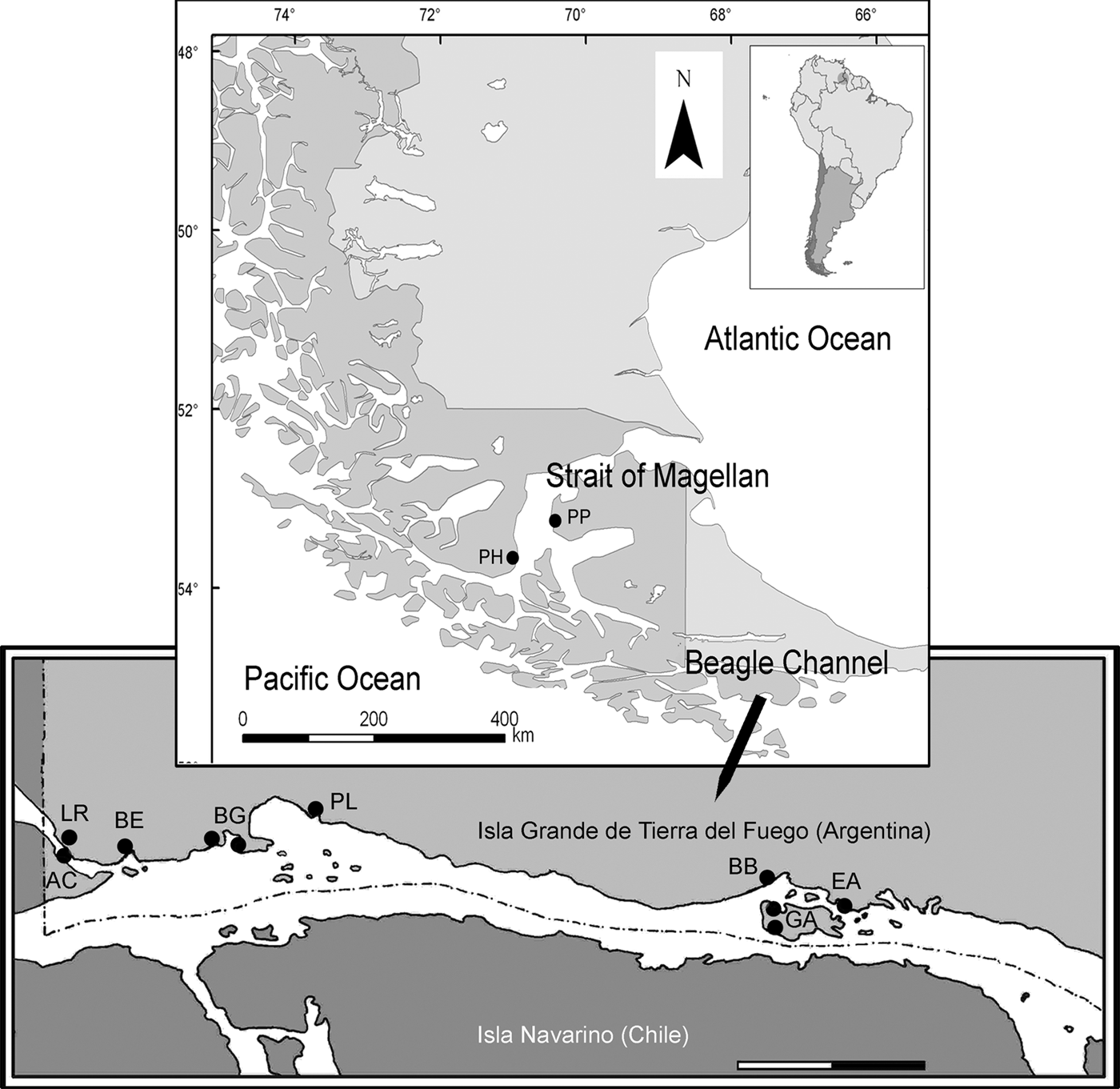
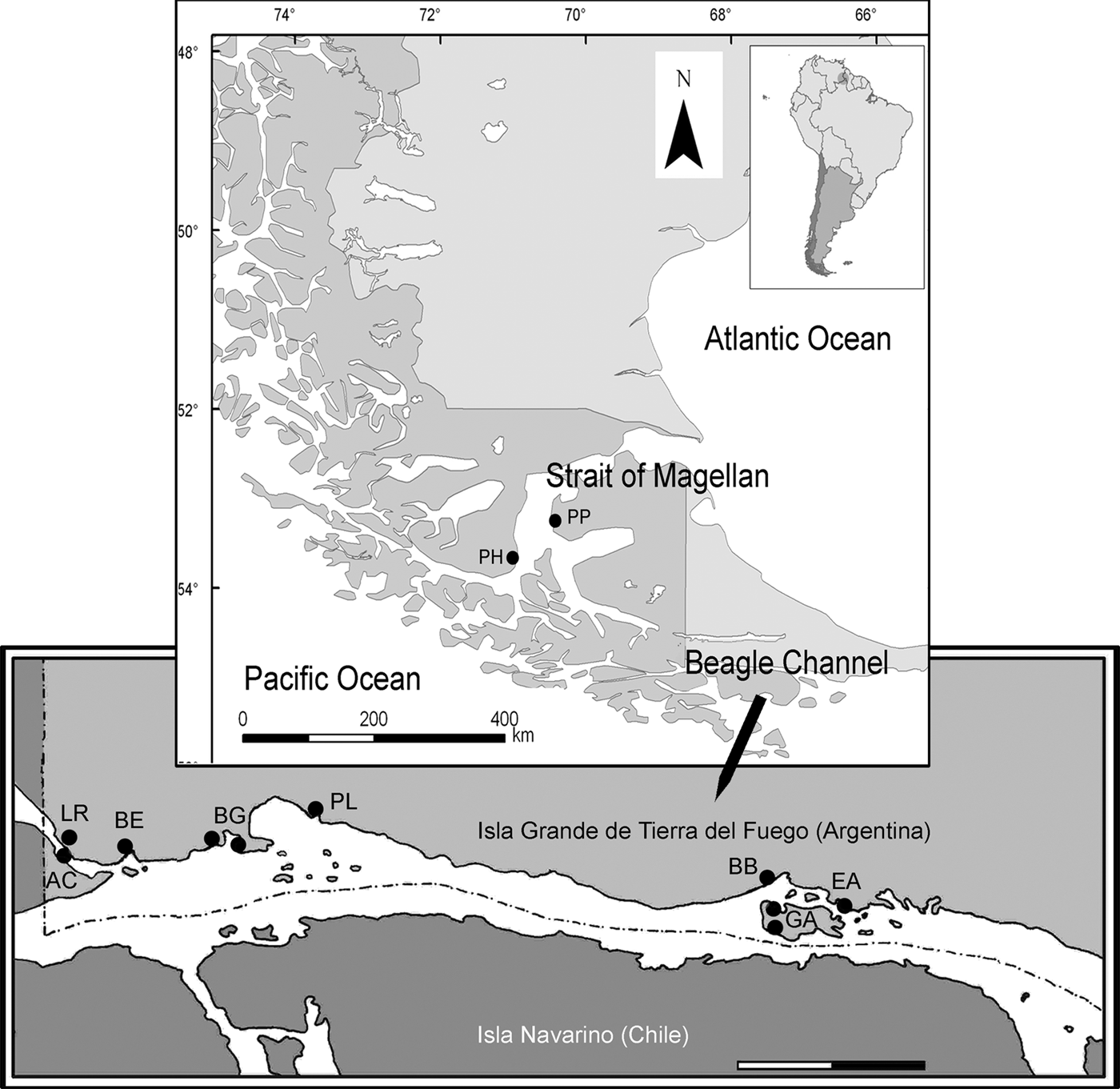
The Strait of Magellan (53o36′S 68o–74oW; Figure 1) separates Patagonia from Tierra del Fuego. It was repeatedly occupied by outlet glaciers from an expanded southern Andean ice cap during successive Pleistocene glaciations (Porter et al., Reference Porter, Clapperton and Sugden1992; Killian et al., Reference Killian, Baeza, Steinke, Arévalo, Ríos and Schneider2007). Today, the Strait of Magellan is dominated by an indented rocky shoreline and characterized by semi-diurnal and heterogeneous tides with mean amplitudes ranging from 1.2 m on the west coast to 9 m in the Atlantic inlet of the east coast (Andrade, Reference Andrade1991). In southern Tierra del Fuego, the Beagle Channel (54o53′S 67o–68oW; Figure 1) links the Atlantic and Pacific Oceans, thus separating Isla Grande de Tierra del Fuego from the southern islands of the Fuegian Archipelago. It is 180 km in length and was also covered during the Last Glacial Maximum (Rabassa et al., Reference Rabassa, Coronato, Bujalesky, Salemme, Roig, Meglioli, Heusser, Gordillo, Roig, Borromei and Quattrocchio2000). Today, the Beagle Channel is dominated by an indented rocky shoreline, with pocket gravel beaches. Tides are semi-diurnal with average amplitudes of around one metre (e.g. 1.1 m at Ushuaia; Servicio de Hidrografía Naval, 1981).
Location map of Tierra del Fuego and a Beagle Channel sector showing localities considered in this paper. Abbreviations in Table 1.
Climatic fluctuations and sea level changes during the Holocene
In Tierra del Fuego, a variety of evidence indicates climatic fluctuations during the Holocene. One of the most significant palaeoclimatic events which took place during the Early to Middle Holocene was marine transgression (from ~8000 to 4500 years BP), with a progressive decrease until the present level (Porter et al., Reference Porter, Stuiver and Heusser1984; McCulloch et al., Reference McCulloch, Fogwill, Sugden, Bentley and Kubik2005). The Holocene marine transgression is documented as marine terraces of different altitudes distributed along the coasts of the Strait of Magellan and the Beagle Channel (Gordillo et al., Reference Gordillo, Bujalesky, Pirazzoli, Rabassa and Saliege1992, Reference Gordillo, Coronato and Rabassa1993; Brambati et al., Reference Brambati, De Muro and Di Grande1998). The altitude of these terraces, ranging between 1 and 10 m above sea level (a.s.l.) is the result of a combination of tectonic, eustatic and isostatic factors (Porter et al., Reference Porter, Stuiver and Heusser1984; Rabassa et al., Reference Rabassa, Heusser, Stuckenrath, Rabassa, Heusser and Stuckenrath1986, Reference Rabassa, Coronato, Bujalesky, Salemme, Roig, Meglioli, Heusser, Gordillo, Roig, Borromei and Quattrocchio2000; De Muro et al., Reference De Muro, Di Grande and Brambati2000; Brambati et al., Reference Brambati, De Muro and Di Grande1998).
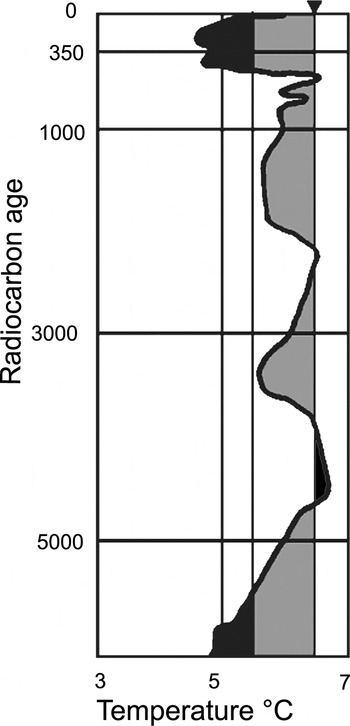
In the marine realm, Obelic et al. (Reference Obelic, Álvarez, Argullós and Piana1998) recognized that sea temperature of the Beagle Channel in ~6000 14C years BP was 1.5°C lower than the present one. After 5000 14C years BP, the seawater temperature in this channel shows a warming trend, with a maximum around 4500 14C years BP, and slightly warmer temperatures than at present (Obelic et al., Reference Obelic, Álvarez, Argullós and Piana1998). For this region, evidence based on diversification of mollusc taxa also supports the theory that the climate optimum took place ~4500–4000 years BP (Gordillo et al., Reference Gordillo, Coronato and Rabassa2005). After that, seawater temperature in this channel decreased again to a minimum around 3500 14C years BP, which would have been about 1°C below the present mean value, with another seawater temperature increase in the Beagle Channel shortly before 3000 14C years BP (Obelic et al., Reference Obelic, Álvarez, Argullós and Piana1998). Finally, during the Late Holocene, new cooling periods were recorded between 2000 and 900 14C years BP, and more recently between 400 and 100 14C years BP, in correlation with the Little Ice Age (Obelic et al., Reference Obelic, Álvarez, Argullós and Piana1998; Strelin et al., Reference Strelin, Casassa, Rosqvist and Holmlund2008). The last 100 years interval was characterized by a clear temperature increase, with a last neoglacial event around 60 years BP (Strelin et al., Reference Strelin, Casassa, Rosqvist and Holmlund2008). A water temperature reconstruction covering the last 6000 years, based on data obtained by Obelic et al. (Reference Obelic, Álvarez, Argullós and Piana1998), is shown in Figure 2.
Climatic fluctuations during the Middle–Late Holocene in the Beagle Channel. Data obtained by Obelic et al. (Reference Obelic, Álvarez, Argullós and Piana1998) and graphic reconstruction taken from Strelin et al. (Reference Strelin, Casassa, Rosqvist and Holmlund2008).

MATERIALS AND METHODS
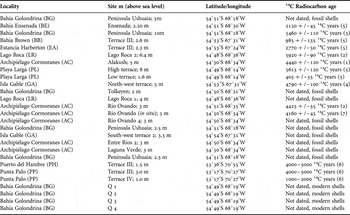
Both fossil and modern mollusc assemblages containing T. gayi shells were collected from several localities along the northern coast of the Beagle Channel and from two sites on the Strait of Magellan (Figure 1). Fossil T. gayi shells were taken from bulk sediment samples of ~500 cm3 coming from selected Holocene raised marine terraces, while modern shells were collected from the active beach and sampled using a 0.5 × 0.5 m quadrat (Table 1).
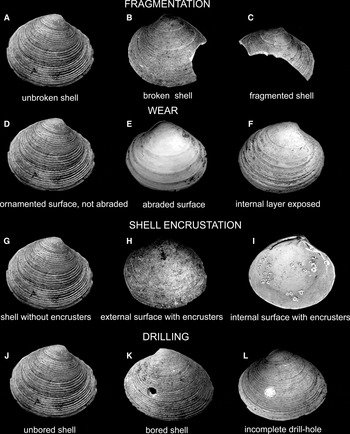
Figure of Tawera gayi shells displaying the three taphonomic grades for fragmentation, wear, encrustation and drilling.

Localities and chronological control performed by different authors. See geographical location in Figure 1.

Source of data: (1) Figuerero & Mengoni, Reference Figuerero and Mengoni1986; (2) Rabassa et al., Reference Rabassa, Heusser, Stuckenrath, Rabassa, Heusser and Stuckenrath1986; (3) Gordillo, Reference Gordillo1990; (4) Gordillo, Reference Gordillo1991; (5) Gordillo et al., Reference Gordillo, Bujalesky, Pirazzoli, Rabassa and Saliege1992; (6) Brambatti et al., 1998; (7) Coronato et al., Reference Coronato, Rabassa, Borromei, Quattrochio and Bujalesky1999. Q, quadrat
Taphonomic analysis was based on 981 individual T. gayi shells (201 modern and 780 fossil shells). The taphonomic features studied include the ratio of opposite valves, fragmentation, wear, encrustation, drilling and size-sorting.
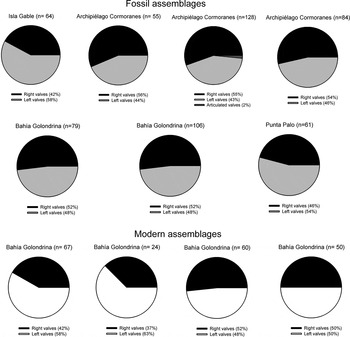
The ratio of opposite valves refers to the number of left and right valves of T. gayi in each assemblage. This feature was analysed in seven fossil sites (Archipiélago Cormoranes × 3, Bahía Golondrina × 2, Punta Palo and Isla Gable) and in four modern sites (Bahía Golondrina × 4). The left/right ratio is useful for evaluating transport from the original community. An exact binomial test was used to assess if the proportion of left and right at each site differed from random distributions.
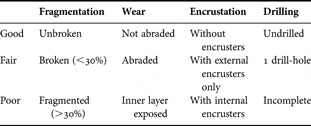
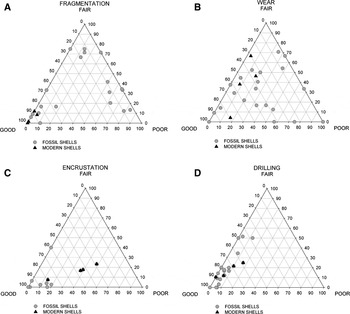
Fragmentation, wear, encrustation and drilling were evaluated on a three-grade scale from best preservation to poorest: good, fair and poor, following Kowalewski et al. (Reference Kowalewski, Flessa and Hallman1995). The degree of taphonomic features for individual shells was studied in each sample, and was then averaged over the entire sample. These features and grades are displayed in Figure 3 and a brief description of the qualitative categories can be found in Table 2. Each taphonomic variable was analysed individually using ternary taphograms (Kowalewski et al., Reference Kowalewski, Flessa and Hallman1995). These diagrams constitute a simple graphic technique that permits a rapid comparison of the taphonomic characteristics among samples (De Francesco & Hassan, Reference De Francesco and Hassan2008).
Taphonomic attributes analysed for Tawera gayi shells (fragmentation, wear, encrustation and drilling) and their correspondence with qualitative categories (good, fair, poor).

Fragmentation is associated with the breakage of shells and serves as a proxy of environmental energy. The degree of shell fragmentation tends to be highest in environments with high water turbulence and coarse substrates, such as beaches and tidal channels, as a consequence of impact with other shells, rocks and waves (Parsons & Brett, Reference Parsons, Brett and Donovan1991), although it can also be influenced by ecological interactions, like shell-breaking predation or bioturbation (Zuschin et al., Reference Zuschin, Stachowitschm and Stanton2003), and postmortem compaction (Klompmaker, Reference Klompmaker2009). Tawera gayi shells were classified as unbroken (Figure 3A), broken (up to ~30% missing; Figure 3B) or fragmented (more than ~30% missing; Figure 3C) shell.
Wear is related to abrasive agents, which produce the loss of surface ornamentation and shell details (Parsons & Brett, Reference Parsons, Brett and Donovan1991). The three taphonomic grades of shells were: shell not abraded (Figure 3D); shell abraded (Figure 3E); and shell with internal layer exposed (Figure 3F).
Encrustation refers to organisms (e.g. epibionts) that use shells as substrate. Tawera gayi shells were classified as shells without encrustation (Figure 3G), shells with encrustation on the external surface only (Figure 3H), and shells with encrustation on the internal surface (Figure 3I).
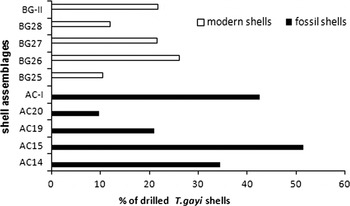
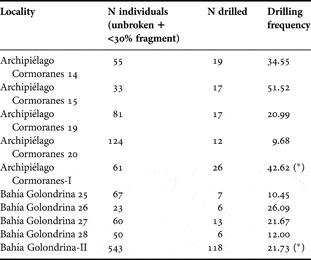
Drilling predation is the result of a search for food by predator organisms (in this case drilling gastropods). These borings are easily distinguished from others produced by clionid sponges or algae and fungal borings. The identification of drill-holes is based on previous works in this region (Gordillo, Reference Gordillo1994, Reference Gordillo, Johnson and Haggart1998). Tawera gayi shells were classified as unbored (undrilled) shells (Figure 3J), shells with one drill-hole or bored shells (Figure 3K), and shells with an incomplete drill-hole (Figure 3L). To test changes of drilling frequencies through time we compared values of drilling predation in modern assemblages from Bahía Golondrina, with fossil assemblages from Archipiélago Cormoranes corresponding to the mid-Holocene Hypsithermal interval (~4500–4000 years BP). To make this analysis comparable, the subsample AC-20 containing a large number of juvenile specimens was excluded. In each assemblage, the number of drilled valves was divided by the total number of valves (unbroken + less than 30% fragmentation). We included fragmented valves (less than 30%) because they also exhibit drill-holes. A t-test was used to assess if there were differences between the drilling frequencies of fossil and modern shells.
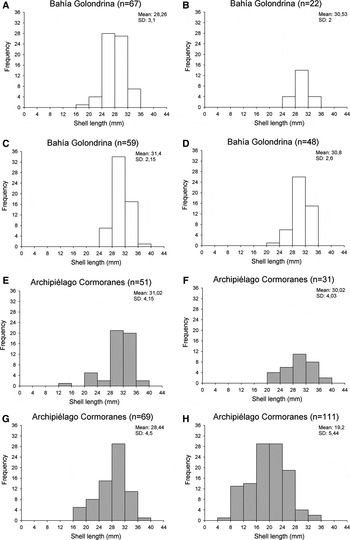
In relation to size sorting, although size is not a taphonomic attribute, size–frequency can indicate some taphonomic processes such as selection by hydrodynamic or aeolian processes. Sorting involves a systematic segregation of shells, and size-sorted associations imply selective winnowing and transport of shells by currents in high energy settings (Speyer & Brett, Reference Speyer and Brett1988).
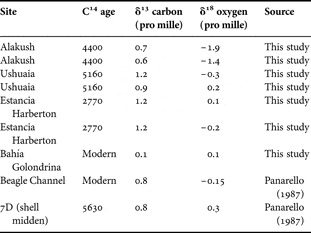
Carbon and oxygen isotopic analyses on modern and fossil T. gayi shells from the Beagle Channel were made at Instituto de Geocronología y Geología Isotópica (INGEIS, CONICET—Universidad de Buenos Aires). Ratios of isotopes are measured as relative deviations from a laboratory standard value. The standards (δ) employed here are PDB (Belemnite shell) for the analysis of carbonates and Standard Mean Ocean Water (SMOW) for the analysis of water. The isotope ratios are presented in pro mille (‰). High values of these parameters indicate the enrichment of oxygen or carbon in heavy isotopes, while the low values mark the depletion in heavy isotopes relative to the standards. The new values were compared with previous isotopic data by Panarello (Reference Panarello1987) on T. gayi shells from the Beagle Channel. More details of δ18O and δ13C in carbonates of marine organisms can be found in Lowe & Walker (Reference Lowe and Walker1997).
Concerning CL, one modern T. gayi shell from Bahía Golondrina and two other fossil T. gayi shells from Archipiélago Cormoranes (dated at 4425 years BP) and from Isla Gable (dated at 4790 years BP) were observed under CL. For this purpose, these shells were first air-dried and embedded in epoxy resin, and then sectioned along a plane perpendicular to the shell surface. A high sensitivity CL-microscope (hot cathode), which allows the observation of low-intensity luminescence was used for this study (instrument described in Ramseyer et al., Reference Ramseyer, Fischer, Matter, Eberhardt and Geiss1989).
Furthermore, to distinguish aragonite from calcite, the mineralogical composition of one modern (from Bahía Golondrina) and seven fossil T. gayi shells (from Lago Roca, Archipiélago Cormoranes, Bahía Golondrina, Ushuaia, Bahía Brown, Isla Gable and Estancia Harberton) were also observed by X-ray diffraction. This analysis was performed at the INGEIS, using the technique described in Do Campo (Reference Do Campo1991).
Finally, for conventional morphometric analysis, two linear distances, shell length and shell height, were measured with a caliper in 304 unbroken T. gayi shells (194 modern and 110 fossil shells). Only fossil shells from Archipiélago Cormoranes previously dated in ~4500–4000 years were used for this analysis. The height/length ratio was used as a proxy for shape. Differences in size and height/length ratio between modern and fossil shells were evaluated with a non-parametric test.
RESULTS AND DISCUSSION
Taphonomic analysis
The ratio of opposite valves (Figure 4) and size–frequency distribution (Figure 5) of T. gayi shells in different modern and fossil mollusc assemblages indicate, respectively, the degree of lateral transport and size-sorting.
Ratio of opposite valves. Right and left valves do not differ significantly in proportion.

Shell size–frequency distribution for modern and fossil Tawera gayi shells from different sites. (A) Modern shells from Bahía Golondrina locality; (B) fossil shells from Archipiélago Cormoranes locality (for location of sites see Figure 1).

Fossil and modern assemblages showed no divergences from random in the proportion of right to left valves (i.e. fossil assemblages displayed values between 37% and 52% and modern assemblages between 42% and 56%). The high rate of disarticulated T. gayi shells seems to be associated with the high to moderate energetic conditions prevailing in the Beagle Channel. However, the similar number of right and left valves indicates that they were transported together preventing a differential lateral transport or left/right sorting (Frey & Henderson, Reference Frey and Henderson1987) characterized by uneven distribution of right and left valves.
In comparison, size–frequency histograms of modern shells (Figure 5A) show greater size-sorting than fossil ones (Figure 5B). These differences can be explained on the basis of different origin of the assemblages involved; i.e. modern shells from Bahía Golondrina belong to allochthonous assemblages, while fossil shells from Archipiélago Cormoranes belong to mixed autochthonous and parautochthonous assemblages (Kidwell & Bosence, Reference Kidwell, Bosence, Allison and Briggs1991). Therefore, size–frequency data are best related to post-mortem processes. However, slight variations in size-sorting between fossil and modern T. gayi shells could be associated with changes of hydraulic energy regimes throughout the Holocene. These variations were also observed in other taxa (Gordillo et al., Reference Gordillo, Bayer and Martinelli2009).
Results of fragmentation, wear, encrustation and drilling are presented in Figure 6. The taphograms show the proportion of good, fair and poor shells at each site for each taphonomic feature. The entire sample can be characterized by the proportion of shells in each of these categories. This scheme allows each site to be represented by a single dot. The location of the samples within each ternary taphogram reflects the variation in the taphonomic features within a site, and among different sites (Kowalewski et al., Reference Kowalewski, Flessa and Hallman1995).
Ternary taphograms showing variation among sampling sites for different taphonomic attributes of Tawera gayi shells. (A) Fragmentation; (B) wear; (C) encrustation; (D) drilling. Modern shell assemblages are represented by black triangles and fossil ones by grey circles.

Fragmentation (Figure 6A) was good in modern T. gayi shells (there are only a few fragmented shells), and varied from good to fair and poor in T. gayi fossil shells. The low fragmentation of modern shells collected in Bahía Golondrina is probably because these shells were transported short distances by waves and tides and accumulated in great abundance on the active beach. Some thick shells remain articulated. As Bahía Golondrina is influenced by western winds, the low fragmentation also indicates that thick T. gayi shells were able to pass through strong currents generated by storms or tides without either damage or breakage. Moreover, different degrees of fragmentation of fossil shells may reflect different hydrodynamic conditions along the northern coast of the Beagle Channel.
Wear (Figure 6B) was good–fair in modern T. gayi shells and varied greatly, from good to fair–poor, in fossil T. gayi shells. Typical features produced by shell dissolution, including the exposure of inner shell layers, were rare. However, abraded shells with loss of external ornamentation were common. The great variation between sites shows that this feature is strongly affected by local environmental factors.
Encrustation (Figure 6C) was good–poor in modern and fossil T. gayi shells. However, modern shells had more encrusters than fossil ones. These differences most probably reflect the fact that modern shells were exposed longer than the fossil ones, allowing postmortem encrustation. But, the lack of encrusters in fossil shells can also represent a bad preservation. Spirorbis, a tubed polychaete worm, is the most common species that colonizes T. gayi shells (13% of the valves), followed by boring sponges (probably Cliona (1% of the valves)), and finally coralline algae, barnacles and bryozoans (less than 0.2% of the valves).
Drilling produced by boring gastropods (Figure 6D) was good in modern T. gayi shells and good–fair in fossil ones. Taking into account their biological implications, this feature was analysed (see below) in great detail.
Taphonomic analysis of these features shows that the preservation of T. gayi shells varies greatly from site to site, and differences between fossil and modern shells seem to be related to local variations of physical factors associated with hydrodynamic energy and freshwater input, with the consequent differences in postmortem transportation and differential destruction.
Drilling gastropod predation
Based on its morphology (see Gordillo Reference Gordillo1994, Reference Gordillo, Johnson and Haggart1998), drilling holes were attributed to the muricid gastropods Trophon geversianus (Pallas) and Xymenopsis muriciformis (King), two common species in benthic communities of this region. As in the ternary diagram (Figure 6D), Table 3 and Figure 7 also show a great variation in frequencies of muricid predation on modern and fossil T. gayi shells. However, frequencies of drilling predation on modern shells were statistically lower than those on fossil shells (t-test; P = 0.02). Differences between modern and fossil T. gayi shells could be caused by sampling different habitats, by taphonomic effects, or by random sampling variability, but changes in drilling frequency through time must also be considered. However, variation within fossil shell assemblages is attributed to a great proportion of small T. gayi shells (undrilled juvenile specimens) in one subsample (AC-20) of the Archipiélago Cormoranes site, which was eliminated for this analysis.
Comparison of drilling frequencies of Tawera gayi shells for modern (BG) and fossil (AC) shell assemblages. BG, Bahía Golondrina; AC, Archipiélago Cormoranes. Numbers identify subsamples. Localities with roman numbers (AC-I, BG-II) indicate data obtained by Gordillo (Reference Gordillo1994).

Number of individuals with less than 30% of the valve fragmented, number of drilled individuals and drilling frequency (%) for the different sites analysed.

*, source of data: Gordillo (Reference Gordillo1994).
Burrowing behaviour of T. gayi, living semi-infaunally or partially buried, may increase predation risk by epifaunal muricid gastropods. This ecological explanation can be applied to fossil shells from Archipiélago Cormoranes collected in life position. A second phenomenon associated with storms explains better the presence of modern bored T. gayi shells along the exposed beach of Bahía Golondrina. The mode of life of T. gayi, just beneath the surface of the sediments, makes this species particularly vulnerable to storms or events with both strong winds and bottom currents. Under these conditions, T. gayi specimens would be exhumed from their life position, then transported alive and deposited outside the sediment, in relatively shallow waters with bottoms less suitable as habitat. There, unable to burrow down, T. gayi would probably be easily preyed upon by muricid predators. The mortality of clams (mass mortality) after storms, which facilitates their attack by invertebrates and fish, has been previously described in other shallow marine ecosystems (e.g. Thórarindsóttir et al., Reference Thórarindsóttir, Gunnarsson and Bogason2009). This phenomenon must be taken into account when comparing drilling frequencies of fossil and modern shells, since it would artificially shorten the differences in drilling frequency between the two sets of data.
Stable isotopes of T. gayi shells from the Beagle Channel
Table 4 shows the results of carbon and oxygen isotopic analysis on T. gayi shells from the Beagle Channel. These values are in good accordance with the stable isotopic data previously obtained by Panarello (Reference Panarello1987).
Isotopic analysis on modern and fossil Tawera gayi shells from the Beagle Channel. See localities in Figure 1.

The isotopic composition of carbonate shells depends on the organism's environment and metabolism (McConnaughey, Reference McConnaughey1989). Then, shell δ18O depends on temperature and δ18O of the water at the time of precipitation (Epstein et al., Reference Epstein, Buchsbaum, Lowestam and Urey1951). The δ13C value of marine shells is controlled by the δ13C value of dissolved inorganic carbon found in the organism's internal water pool at the site of calcification (McConnaughey et al., Reference McConnaughey, Burdett, Whelan and Paull1997). Therefore, one aspect that makes our interpretations difficult when estimating palaeotemperatures for the Beagle Channel is the lack of information on salinity and isotopic composition of the surface seawater, a discrepancy also noted by Obelic et al. (Reference Obelic, Álvarez, Argullós and Piana1998).
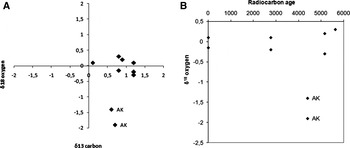
Figure 8 shows oxygen isotopic data versus carbon isotopic data (Figure 8A), and versus their respective relative radiocarbon ages (Figure 8B; AK, Alakush).
Stable isotopes of Tawera gayi (see references in Table 2). (A) Relationship between oxygen and carbon isotopic composition in T. gayi shells; (B) scatter plot of oxygen isotopic values on T. gayi shells and their radiocarbon age.

These diagrams show that carbon and oxygen isotopic analysis on T. gayi shells gave values within a same range, with the exception of the Alakush site, which showed lower values (i.e. high depletion in heavy isotopes relative to the standard).
Carbon values are within the –2 and +2 interval, which is associated with marine environments (Keith et al., Reference Keith, Anderson and Eichler1964). In comparison, waters coming from rivers are relatively deficient in 18O and 13C and isotopically more variable: δ18O< –2‰; δ13C< 0‰ (Epstein & Mayeda, Reference Epstein and Mayeda1953, Keith et al., Reference Keith, Anderson and Eichler1964).
Similarly, the oxygen isotopic analysis of T. gayi shells (with the exception of shells from Alakush site) gave values within a similar range.
These isotopic data are difficult to explain (particularly carbon) due to the fact that shells from the shallow marine environments along the Beagle Channel coast were exposed to freshwater, which derived from glacial ice melting that discharged into rivers that lead into the sea. In this regard, as shell carbonate is controlled by temperature and by the isotopic composition of ambient water, stable isotopic composition of mollusc shells from freshwater environments shows wider and more depleted values than those from marine environments. This is due to the relative deficiency in δ18O and δ13C and the isotopically more variable nature of freshwater (see Wang et al., Reference Wang, Peng and Chen1991). Besides, in the Magellan Region, the mixture of seawater and freshwater from melting Andean snow also produces cooler waters (Massimo, 1991; in Palma & Aravena, Reference Palma and Aravena2001). However, the great isotopic differences between Alakush (~4400 years BP) and the other sites could be associated with warmer temperatures during the Hypsithermal (Obelic et al., Reference Obelic, Álvarez, Argullós and Piana1998; Strelin et al., Reference Strelin, Casassa, Rosqvist and Holmlund2008), and a high volume of freshwater entering the Beagle Channel, partly due to an increase in rain (Candel et al., Reference Candel, Borromei, Martínez, Gordillo, Quattrocchio and Rabassa2009), and partly from melting snow at this period. During this period, large volumes of water enriched in 16O came back into the seas, resulting in lower ratios.
Further studies including more isotopic data, combined with individual growth using sclerochronology, and calibrated against temperatures, are needed to evidence the impact of climatic changes on shell growth and structure, and to discriminate between environmental changes and ecological reasons. To have a more precise understanding of the isotopic data, further analysis will include Mg/Ca ratio as an alternative proxy of palaeotemperatures (Purton-Hildebrand et al., Reference Purton-Hildebrand, Grime, Shields and Brasier2001; Richardson et al., Reference Richardson, Peharda, Kennedy, Kennedy and Onofri2004) to verify climate assumptions.
Cathodoluminiscence and X-ray examination: modern versus fossil T. gayi shells
The X-ray diffraction showed that modern and fossil T. gayi shells are composed of aragonite (100%). The fact that fossil T. gayi shells do not have a mixed composition of aragonitic and calcitic is due to the absence of post-depositional recrystallizations (i.e. from aragonite to calcite) in fossil shells.
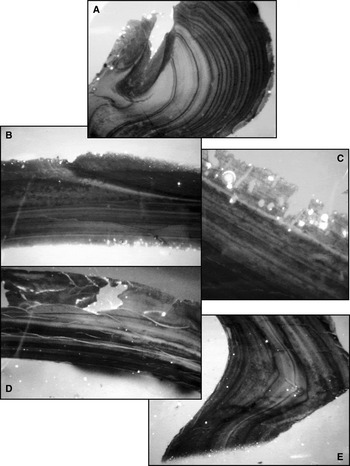
Under CL-microscopy, modern and fossil T. gayi shells show a well defined pattern, with parallel spaced CL lines (Figure 9A–E). This zonation reflects the cycles of skeletal growth and a luminescence intensity typical of aragonitic shells, and may be related to the alternating amount of manganese present in the aragonite (Barbin, Reference Barbin1992).
View under cathodoluminiscence (CL) of sections of modern (A) and fossil (B–E) Tawera gayi shells showing a well defined pattern of CL lines, almost concentric. Luminescent bands (here light bands) border the winter (dark) growth rings. (A) Modern specimen, Bahía Golondrina; (B &C) fossil specimen, Archipiélago Cormoranes (4425 years BP); C is the high magnification of a sector of B (10X); (D & E) fossil specimen, Isla Gable (4790 years BP). Scale: 2.5X.

Rapid growth rate during the earlier life stages of T. gayi (Figure 9A), and CL lines that terminate in an external growth line (Figure 9B), as well as the regular repetition of CL with outlines approaching the shape of internal structures, indicate that these lines are related to the growth dynamics of the shell (see discussion in Tomašovych & Farkaš, Reference Tomašovych and Farkaš2005).
The aragonitic T. gayi shells give a weak blue-green luminescence (probably due to a slower growth rate) alternating with dark areas associated with periods with a different growth rate (or a cessation of growth). In addition, a different luminescence (light, bright yellow luminescence) affecting outer and inner shell surfaces is interpreted as a bioeroded surface caused by external factors (i.e. bacteria and microboring organisms), but not produced by the mollusc biomineralization process (Figure 9C).
Although the data presented on shell structure of T. gayi under CL is not enough to explain the true reasons behind the differences or changes between shells, it does indicate that CL lines correspond to zones recording changes in growth rate. Thus, the analysis of CL lines in this species can provide another important tool for the evaluation of T. gayi growth rates, in addition to external growth rates, isotopes and trace elements, since CL lines in bivalves are correlated with periods of slow growth, such as winter, spawning seasons or environmental disturbance (Barbin, Reference Barbin1992; Barbin & Gaspar, 1995). A systematic examination of CL line pattern in T. gayi can be useful for adding to our knowledge of changes during the Holocene.
Shell morphology and possible causes of variation
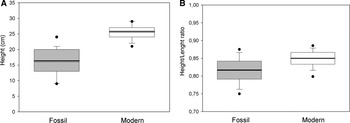
Linear morphometric analysis applied to fossil and modern T. gayi shells shows that whereas the modern shells are more rounded, the fossil ones are slightly elongated. Fossil shells are significantly smaller (Figure 10A) and shorter for their length (Figure 10B) than modern shells (Mann–Whitney rank-sum test; P < 0.001 in both cases).
Boxplots showing the differences in size (left) and shape (right) between fossil and modern Tawera gayi shells. The dots represent 5 and 95 percentiles, upper part of the box 50 percentiles, low part 75 percentiles, line represents median, and whiskers represent 10 and 90 percentiles, respectively. Modern shells reached larger sizes and are more quadrangular than fossil T. gayi shells.

To discuss the possible causes of variation in shell morphology different factors were taken into account, as mentioned below.
Previous studies on bivalves (Kirby, Reference Kirby2000; Vermeij, Reference Vermeij1990) and turritelid gastropods (Allmon, Reference Allmon1992; Teusch et al., Reference Teusch, Jones and Allmon2002) offer strong evidence that size and shape differences in shells may be explained by different temperature and productivity conditions. In southern South America, recent studies on venerids from Patagonia also show that shell variation is related to phenotypic plasticity as the result of different environmental conditions (Márquez et al., Reference Márquez, Robledo, Escati Peñaloza and Ven der Molen2009; Gordillo et al., Reference Gordillo, Márquez, Cárdenas and Zubimendi2010). In addition, other works indicate that morphological variations in molluscs may also result from biotic interactions as predator–prey relationships (Hagadorn & Boyajian, Reference Hagadorn and Boyajian1997; Teusch et al., Reference Teusch, Jones and Allmon2002). Therefore, to explain the changes in size and shape between modern and fossil T. gayi shells from the Beagle Channel, environmental and ecological factors including temperature, productivity and biotic interactions have been taken into account.
Because T. gayi is a suspension feeder and directly dependent on primary productivity for growth, it is assumed here that increased primary productivity has a positive effect on shell growth. As modern T. gayi shells exhibit larger size than fossil shells it is reasonable to infer that the increase in nutrient concentrations may have played a role in affecting shell size. However, a higher productivity does not explain the different shape between both ages with modern shells more rounded than fossil ones.
Under this situation, another reason is postulated here as the possible cause of modern shells reaching a more rounded shape than the fossil ones: a greater chance of avoiding drilling predation. This interpretation is supported by the fundamental relationship between shape and function in clams (Stanley, Reference Stanley1975), and the development of antipredatory adaptation. Morphometric data obtained in this work, together with differences in drilling frequency through time also sustain this explanation, as detailed below.
Stanley (Reference Stanley1975) observed that the prosogyrous condition and the rotational mechanism of burrowing are fundamental adaptations of burrowing clams, showing that each rocking motion of a typical clam involves purely rotational movement, with no translational component. Thus, one can predict that the prosogyrous shape and flattened lunule should cause a backward rotation, shifting the axis of rotation towards the anterior region. The relationship between the length axis and the height axis (height/length ratio), therefore, has a significant effect on the burrowing of clams, and more rounded modern T. gayi shells may burrow faster than the more elongated fossil T. gayi shells.
Taking into account data on shell-boring gastropods on T. gayi, it is also plausible that T. gayi from the Beagle Channel developed an antipredatory strategy. For this region, a slight decrease in predation by drilling gastropods is noticed (see also Gordillo (Reference Gordillo1994) and Gordillo (Reference Gordillo, Johnson and Haggart1998)). This decrease in predation risk probably correlates with changes in the shape of T. gayi. In other words, changes in T. gayi shape are perhaps an evidence of effective resistance adaptation against drilling by gastropods (antipredatory adaptation). As fossil shells are more elongated, the burrowing mechanism is less effective than in modern shells. Modern shells are more rounded than fossil shells, thus offer less resistance to the substrate and consequently burrow faster in order to avoid predation by muricid gastropods such as T. geversianus or X. muriciformis. These statements become even more relevant when considered together with the short South American biogeographical history of Tawera, which apparently arrived from New Zealand during the Quaternary (Gordillo, Reference Gordillo2006), and the need to improve strategies for avoiding predators in its new environment in South America. More work on this topic is needed to reinforce these assumptions.
FINAL REMARKS
Taphonomic analysis has been used as a tool for interpreting the environmental characteristics associated with the studied bivalve indicating that shell variations of T. gayi between different sites are best associated with physical factors that prevail in each site than to changes during the Holocene, although slight changes in energy during the Holocene would also have occurred.
The carbon isotopic analysis of T. gayi shells indicates the existence of a mixing of waters from pure marine waters to marine waters with signs of freshwater influence. The high depletion of δ18O at ~4400 years BP would be associated with warmer temperatures during the Hypsithermal, and a maximum freshwater input to the Beagle Channel, probably due to an increase in rain during this period. In addition, under CL modern and fossil T. gayi shells show a well defined pattern, with parallel spaced CL lines related to the growth dynamics of the shell. Holocene T. gayi shells can, hence, be utilized as environmental and climate proxy archives and a systematic examination of the internal growth pattern in combination with isotopes and traces can lead to a better understanding of their biology and can add detail to palaeoenvironmental analysis.
When considering T. gayi shell shape, linear morphometrics showed that fossil T. gayi shells are smaller and more elongated than the modern shells. As morphological variation of T. gayi shells is the product of both heredity and environment, morphological changes should be considered in a community or palaeocommunity context, in which phenotypic variation between localities may represent a source of ecological information suitable for the evaluation of environmental changes. In T. gayi from the Beagle Channel morphological differences in shells are best explained on the basis of biotic interactions rather than Holocene environmental changes. However, further studies that include a wider range of geological time will be essential to reinforce these interpretations. In this regard, the theory of co-evolution and the escalation hypothesis (Vermeij, Reference Vermeij1987, Reference Vermeij1994; Thompson, Reference Thompson2009) suggest that microevolutionary variation is influenced by local conditions and biotic interactions, and T. gayi represents an opportunity to test this assertion.
This integrated approach indicates that T. gayi is a good candidate for looking at evidences of environmental changes in southern South America, and multi-proxy data are necessary to better understand the driving mechanisms of ecological variability and changes over short geological time intervals of hundreds to thousands of years.
ACKNOWLEDGEMENTS
We thank V. Barbin (Université de Reims) who helped with cathodoluminiscence analysis. M. Do Campo (INGEIS, CONICET) performed the X ray analysis and D. Balseiro (CICTERRA, CONICET) helped with statistical analysis. We thank Sven N. Nielsen (Institut für Geowissenschaften, Germany) and Alan Beu (Geological Nuclear Science, New Zealand) who reviewed a preliminary version of this manuscript. We thank Adiël A. Klompmaker (Kent State University) and one anonymous referee who offered valuable comments and suggestions. This work was supported by the National Research Council, CONICET (S.G., grant number PIP 09-260).