Introduction
The treatment of older adults in inpatient rehabilitative care requires special attention due to the unique challenges associated with increased cognitive and physical risk factors that result from aging (e.g., increased risk of accidental bodily injury due to falls and cerebrovascular/neurologic problems such as stroke) (Ambrose, Paul, & Hausdorff, Reference Ambrose, Paul and Hausdorff2013; Centers for Disease Control and Prevention, 2014). Many older individuals who enter rehabilitation care settings, whether as a result of bodily injury, cerebrovascular/neurologic conditions or other problems, present with cognitive impairment (Kalaria, Reference Kalaria2012; Woods, Mark, Pitts, & Mennemeier, Reference Woods, Mark, Pitts and Mennemeier2011; Zinn, Bosworth, Hoenig, & Swartzwelder, Reference Zinn, Bosworth, Hoenig and Swartzwelder2007). In fact, research has indicated that executive functioning deficits are most closely and consistently linked to conditions that prompt rehabilitative care, such as falls (Herman, Mirelman, Giladi, Schweiger, & Hausdorff, Reference Herman, Mirelman, Giladi, Schweiger and Hausdorff2010; Mirelman et al., Reference Mirelman, Herman, Brozgol, Dorfman, Sprecher, Schweiger and Hausdorff2012; Muir, Gopaul, & Odasso, Reference Muir, Gopaul and Odasso2012) and stroke (Ballard et al., Reference Ballard, Stephens, Kenny, Kalaria, Tovee and O'Brien2003; Pohjasvaara, et al., Reference Pohjasvaara, Leskelä, Vataja, Kalska, Ylikoski, Hietanen and Erkinjuntti2002; Zinn et al., Reference Zinn, Bosworth, Hoenig and Swartzwelder2007). These associations highlight the importance of studying aspects of executive functioning within rehabilitative care settings.
Executive functions are conceptualised as a family of higher order cognitive processes involved in managing goal-oriented behaviours (Zinn et al., Reference Zinn, Bosworth, Hoenig and Swartzwelder2007). Core executive functions include inhibition (e.g., resisting to act impulsively) and interference control (e.g., focusing on a task and suppressing attention to other stimuli), working memory (i.e., holding and manipulating information) and cognitive flexibility (e.g., changing perspectives or behaviour to accommodate new demands) (Diamond, Reference Diamond2013). Other components include initiation/perseveration (e.g., initiating and discontinuing behaviour at appropriate times, persisting at a task or changing strategies as needed), self-monitoring (e.g., choosing behaviours in new situations based on the situation and personal goals) and abstract thinking (e.g., planning) (Zinn et al., Reference Zinn, Bosworth, Hoenig and Swartzwelder2007). Because of the complex nature of this family of cognitive abilities, impaired executive functioning is likely to have a detrimental effect on an individual's autonomy and decision-making abilities (Woods, Patterson, & Whitehouse, Reference Woods, Patterson and Whitehouse2000).
Judgement is an important aspect of executive functioning and may be defined as the ability to evaluate the relevant circumstances of a novel situation and formulate sound inferences based on careful contemplation (Rabin et al., Reference Rabin, Borgos, Saykin, Wishart, Crane, Nutter-Upham and Flashman2007). For example, while making a vital medical decision concerning surgery vs. an alternative treatment for a chronic medical condition, one might consult with several specialists and consider the risks and benefits of each possibility. As such, intact judgement is critical to real-world functioning, personal independence and safety.
Several aspects of executive function are particularly relevant to judgement such as planning how to resolve a dilemma, recognising and ranking one's objectives, implementing behaviour change, shifting between concepts, appraising possible risks, preventing inappropriate responses and re-evaluating the success of a selected resolution (Rabin et al., Reference Rabin, Borgos, Saykin, Wishart, Crane, Nutter-Upham and Flashman2007). Judgement also depends on other cognitive dimensions including memory, language, basic attention, perception and visuospatial skills (Rabin et al., Reference Rabin, Borgos, Saykin, Wishart, Crane, Nutter-Upham and Flashman2007). In addition, aspects of social and emotional functioning, personality, culture, educational background, experience and context impact judgement ability (Rabin et al., Reference Rabin, Borgos, Saykin, Wishart, Crane, Nutter-Upham and Flashman2007).
The assessment of judgement and related constructs such as everyday problem solving warrant investigation in neuropsychological assessments of older adults (Mayo et al., Reference Mayo, Wallhagen, Cooper, Mehta, Ross and Miller2013), particularly those in rehabilitative settings. Information derived from judgement evaluations may inform treatment and discharge planning by providing an objective understanding of competence to live independently after inpatient treatment has concluded. This information also may assist clinicians in identifying patients with increased risk of poor outcomes following discharge. Evaluation results may be communicated to patients, family members and other important contacts (e.g., employers) to facilitate caregiving arrangements and other post-rehabilitation support. This information may also help prepare patients and close relatives emotionally for possible limitations and necessary accommodations (Hanks, Rapport, Millis, & Deshpande, Reference Hanks, Rapport, Millis and Deshpande1999).
Previous research has found that executive functioning predicts functional outcomes after inpatient rehabilitation. Hanks and colleagues (Reference Hanks, Rapport, Millis and Deshpande1999) studied functional outcomes six months after acute rehabilitation. Results supported the link between higher order cognitive ability and real-world functioning upon community re-entry. Their study also revealed that executive functioning and verbal memory better predicted functional outcomes than visuospatial processing and functional motor ability.
Although previous research has found a link between performance on tasks of executive functioning and post-rehabilitation functional outcomes, there is a dearth of research on the assessment of judgement ability specifically. A survey of neuropsychologists found that most respondents reported being only ‘slightly’ confident in their ability to assess judgement with existing neuropsychological tests and 87% expressed a need for new standardised measures. Additionally, study results revealed that neuropsychologists tend to rely on common measures of executive functioning and related constructs such as appreciation of social standards, problem solving/cognitive flexibility and verbal abstraction as proxies for evaluating judgement ability (Rabin, Borgos, & Saykin, Reference Rabin, Borgos and Saykin2008).
In response to this identified need for psychometrically validated neuropsychological measures of this construct, the Test of Practical Judgment (TOP-J) was developed in 2005 (Rabin et al., Reference Rabin, Borgos, Saykin, Root, Wishart, Flashman and Santulli2005). The full measure consists of 15 open-ended scenarios to which examinees provide open-ended responses, and requires approximately 15 minutes to administer. The measure was designed to tap into the content areas of financial, medical, safety, and social/ethical practical judgement ability (see methods section for additional details). Since its introduction, the TOP-J has been validated among older adults, including individuals with amnestic mild cognitive impairment (aMCI) and Alzheimer's disease (AD). In addition, TOP-J scores have been positively correlated with gray matter density in prefrontal brain regions in euthymic older adults, providing support for the TOP-J's sensitivity to the integrity of brain regions associated with executive functioning (Rabin et al., Reference Rabin, Saykin, West, Borgos, Wishart, Nutter-Upham and Santulli2009).
In rehabilitation settings, neuropsychological measures of executive functioning and other domains are typically used in conjunction with functional assessment tools and measures of global cognition such as the Mini-Mental State Examination (MMSE; Folstein, Folstein, & McHugh, Reference Folstein, Folstein and McHugh1975). Research has shown that MMSE total scores significantly correlate with both judgement (MacDougall & Mansbach, Reference MacDougall and Mansbach2013) and motor functional ability (Özdemir, Birtane, Tabatabaei, Ekuklu, & Kokino, Reference Özdemir, Birtane, Tabatabaei, Ekuklu and Kokino2001) in assisted living and rehabilitation samples, respectively. Thus, it has been recommended that the MMSE be used as part of a standard cognitive status battery to predict functional improvement and treatment planning in rehabilitation settings (Özdemir et al., Reference Özdemir, Birtane, Tabatabaei, Ekuklu and Kokino2001).
The Functional Independence Measure (FIM) allows practitioners to monitor the functional ability of patients from admission through discharge and follow-up (Chumney et al., Reference Chumney, Nollinger, Shesko, Skop, Spencer and Newton2010; Granger & Hamilton, Reference Granger and Hamilton1985). For over 20 years, the FIM has been utilised in rehabilitation settings that treat a variety of conditions, such as stroke, traumatic brain injury, cancer and spinal cord injury (Chumney et al., Reference Chumney, Nollinger, Shesko, Skop, Spencer and Newton2010). There are several benefits of using functional measures at discharge, particularly the FIM. A potential benefit of using the FIM at discharge is the increased accuracy in identifying patients at risk for poor outcomes. In fact, the utilisation of neuropsychological tests in conjunction with functional measures may enhance outcome predictions (Gabbe et al., Reference Gabbe, Simpson, Sutherland, Williamson, Judson, Kossmann and Cameron2008). Hanks and colleagues (Reference Hanks, Rapport, Millis and Deshpande1999) proposed that given the theoretical association between measures of higher order cognitive ability and real-world behaviours, tests that tap skills such as problem solving, planning and cognitive flexibility should be strongly associated with outcomes in post-rehabilitative living. Moreover, Mayo and colleagues (2013) have emphasised the importance of adequately assessing judgement among older adults, as poorer judgement ability has been associated with impairment in independent activities of daily living (i.e., functional status) in individuals with dementia. Other research has found a modest to moderate association between performance on neuropsychological tests and functional ability, suggesting that neuropsychology and geriatric rehabilitation literatures could benefit from closer collaboration. However, some cognitive domains may be more relevant to functional capacity than others; for example, measures of executive function are particularly strong correlates of medical or financial decision making (Martyr & Clare, Reference Martyr and Clare2012; Royall et al., Reference Royall, Lauterbach, Kaufer, Malloy, Coburn and Black2007). At present, it is uncertain whether and to what extent data derived from the TOP-J and functional measures overlap.
To our knowledge, the current pilot study is the first to investigate judgement ability of older adult inpatients in a rehabilitation settings. In light of the research presented above, our pilot study had two major aims: (1) to examine TOP-J performance within this inpatient rehabilitation sample, including a comparison to performance of older adults with neurodegenerative cognitive decline (i.e., those with aMCI and mild AD); and (2) to examine the utility of using the TOP-J with older adults in inpatient rehabilitative care – in other words, knowing that there is some evidence that global cognition scores correlate with judgement and motor functional ability (MacDougall & Mansbach, Reference MacDougall and Mansbach2013; Özdemir et al., Reference Özdemir, Birtane, Tabatabaei, Ekuklu and Kokino2001), establish correlations between TOP-J performance and measures of (a) functional ability and (b) global cognition. We hypothesised that (1) older adults in inpatient rehabilitation would perform within the impaired range on the TOP-J; (2a) TOP-J performance would positively correlate with the FIM items of problem solving, comprehension and memory; (2b) TOP-J performance would positively correlate with MMSE performance, and the effect size would be moderate in size (comparable to current literature) (MacDougall & Mansbach, Reference MacDougall and Mansbach2013).
Method
Participants
Potential participants were clinical rehabilitation patients undergoing care at a subacute inpatient unit in an academically affiliated rehabilitation facility in rural New England. The facility was a 10-bed unit connected to a hospital and nursing home. The facility director was a psychiatrist. The full-time staff was comprised of a neuropsychologist, social worker, speech therapist, recreational therapist, as well as rehabilitation nurses, physical therapists, occupational therapists and a part-time music therapist. Patients generally included young to older adults with various diagnoses (e.g., traumatic brain injury, stroke, joint replacements, post infectious encephalitis, cancer and brain tumours). On admission, all patients consented to retrospective analyses of their medical records for research and quality assurance. Data were analysed for consecutive inpatients seen for standard cognitive screening from January 2006 to July 2006. The measures reported in the present analysis were obtained by the clinical staff neuropsychologist as part of routine clinical care in preparation for discharge. Only de-identified data were analysed.
This mixed rehabilitation sample consisted of 25 inpatients, over the age of 55 (four patients under the age of 55 were excluded). Diagnoses included brain-related injury/conditions (44%, including intracerebral haemorrhage, cerebrovascular disease, cerebral artery occlusion, subdural hemorrhage, malignant neoplasm of brain, cerebellar or brain stem contusion and encephalitis) and various other injuries/conditions (56%, including various fractures, osteoarthrosis, various infections, pneumonia, intraspinal abscess and spinal stenosis of the lumbar region). The mean length of inpatient stay on the rehabilitation unit was 14.36 days (SD = 8.94). The TOP-J was administered within 27 days of the FIM (M = 8.84, SD = 7.02). In all cases, the MMSE and TOP-J were administered prior to the administration of the FIM. All participants were Caucasian, fluent in English, and had at least 12 years of education. Inclusion criteria required the following: (a) comprehensible expressive/receptive conversational speech; (b) able to use dominant hand for basic writing/drawing; gave consent for ~1-hour assessment (c) and completed the tests of interest (MMSE, TOP-J and FIM). Exclusion criteria included (a) blind; (b) deaf; (c) non-English speaking; (d) globally aphasic; (e) uncooperative with treatment team, i.e., declined to be evaluated; (f) had a medical condition that posed risks either to their ability to participate safely or provide valid data and/or (g) had emotional/behavioural problems that might interfere with the evaluation.
Measures
TOP-J
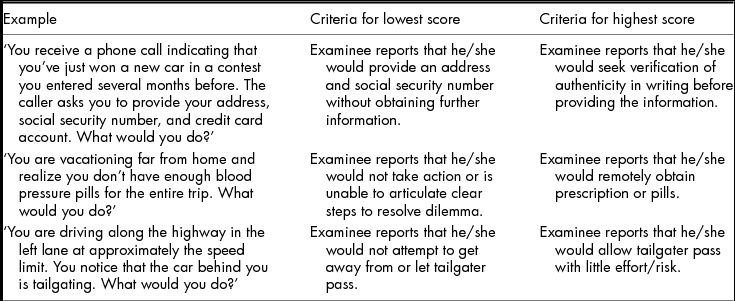
Everyday judgement was assessed using the TOP-J, an objective test that evaluates judgement related to financial, medical, safety and social/ethical issues (Rabin et al., Reference Rabin, Borgos, Saykin, Wishart, Crane, Nutter-Upham and Flashman2007). Examples of three TOP-J items with scoring criteria are provided in Table 1. Trained professionals verbally present 15 brief scenarios about everyday problems to examinees, who are then asked to report aloud their proposed solutions (Rabin et al., Reference Rabin, Aronov, Chi, Fogel, Charcape, Borgos and Saykin2013). Responses are recorded verbatim and each response is scored 0 to 3 points based on the soundness of the response (according to scoring criteria), with higher scores indicating better judgement ability. Total scores range from 0 to 45 points. The TOP-J has shown adequate psychometric properties in those with aMCI and AD (Rabin et al., Reference Rabin, Borgos, Saykin, Wishart, Crane, Nutter-Upham and Flashman2007). Correlational analyses have revealed that TOP-J scores do not correlate significantly with age, sex or depressive symptoms in older adults (Rabin et al., Reference Rabin, Borgos, Saykin, Wishart, Crane, Nutter-Upham and Flashman2007).
Sample TOP-J Items and Scoring Criteria

Note. The 9- and 15-item TOP-J protocols are both available upon request from Laura A. Rabin, Ph.D. (lrabin@brooklyn.cuny.edu).
FIM
The FIM is a rating scale of assistance needed to carry out activities of daily living (e.g., toileting, feeding, dressing and grooming) and assesses physical and cognitive disability to gauge rehabilitation progress. It is based on observer ratings by trained staff. Items are scored on the level of assistance required for an individual to perform activities of daily living. The scale includes 18 items, with 13 relating to physical ability and 5 relating to cognition. The cognition subscale includes items related to expression, social interaction, problem solving, comprehension and memory; however, for the purpose of this paper, problem solving, comprehension and memory items are of particular focus. Each FIM item is scored from 1 to 7 points, based on the subject's level of independence. Possible total scores range from 18 to 126, with higher scores indicating a higher level of independence in performing activities of daily living (Uniform Data System for Medical Rehabilitation, 2012). The FIM has shown adequate psychometric properties in rehabilitation populations (Dodds, Martin, Stolov, & Deyo, Reference Dodds, Martin, Stolov and Deyo1993; Hobart et al., Reference Hobart, Lamping, Freeman, Langdon, McLellan, Greenwood and Thompson2001; Ottenbacher, Hsu, Granger, & Fiedler, Reference Ottenbacher, Hsu, Granger and Fiedler1996). However, there was a 16.1% ceiling effect noted for the cognition subscale scores (Hobart, et al., Reference Hobart, Lamping, Freeman, Langdon, McLellan, Greenwood and Thompson2001). Researchers have also questioned the dimensionality of the test, suggesting that subscale scores should be utilised instead of the total score (Ravaud, Delcey, & Yelnik, Reference Ravaud, Delcey and Yelnik1999).
MMSE
Global cognition was assessed using the MMSE (Folstein et al., Reference Folstein, Folstein and McHugh1975), an objective screening tool that measures various aspects of cognition such as basic orientation, attention/working memory, immediate and short-term recall of verbal information, expressive language and the ability to follow simple verbal and written commands. Total scores range from 0 to 30, with higher scores indicating better global cognition. The MMSE has also shown acceptable psychometric properties and has utility in geriatric populations (Tombaugh & McIntyre, Reference Tombaugh and McIntyre1992). However, the MMSE has been noted to have a number of limitations including relatively low reliability, numerous items that are too easy and lead to ceiling effects, various cut-off points and a lack of standardised scores (Lopez, Charter, Mostafavi, Nibut, & Smith, Reference Lopez, Charter, Mostafavi, Nibut and Smith2005). Kukull et al. (Reference Kukull, Larson, Teri, Bowen, McCormick and Pfanschmidt1994) has suggested that a cut-off score of 26 shows gains in sensitivity over a score of 24, and exhibits higher specificity than other cut-off values. A higher score, such as 27, may be more appropriate for highly educated subjects and when the objective is to minimise false negative scores (Kukull et al., Reference Kukull, Larson, Teri, Bowen, McCormick and Pfanschmidt1994).
Procedures
Testing occurred during the patients’ inpatient stays and data were analysed retrospectively. First, the MMSE and then the TOP-J were administered at bedside in a single session in each participant's room by the staff neuropsychologist. FIM data were collected by FIM trained occupational, physical and speech therapists in final treatment sessions with the patients prior to discharge. The FIM evaluators were blind to the TOP-J and MMSE data; conversely, the TOP-J and MMSE evaluator was blind to the FIM data.
Statistical Analyses
Statistical analyses were performed using IBM SPSS Version 24 for Windows (IBM Corp., Armonk, NY). Parametric assumptions were assessed and all variables were tested for normality. Several variables were transformed due to non-normality. A square-root transformation (Field, Reference Field2013) was used for the TOP-J total scores and MMSE scores to correct for significant negative skew. A reciprocal transformation (Field, Reference Field2013) was used for the FIM comprehension item variable to correct for significant negative skew that was not adequately corrected by the square root transformation. Transformed variables were used in all subsequent analyses.
In order to address aim 1 (to establish test performance within this sample), we calculated the mean and standard deviations for TOP-J total scores, MMSE total scores, FIM total scores, FIM motor subscale total scores, FIM cognition subscale total scores and the three FIM cognition items that were of particular interest (problem solving, comprehension and memory). We also conducted an independent samples t-test to further assess TOP-J performance within the sample based on level of global cognition: intact (N = 16) vs. impaired (N = 9) MMSE scores using a cut-off of ≤ 26/30 and calculated Cohen's d as a measure of effect size (this also addresses aim 1). We used an alpha level of .05 (two-tailed) for the t-test.
In order to address aim 2, we conducted bivariate Pearson correlations between TOP-J total scores and (a) the FIM cognition items of problem solving, comprehension and memory, and (b) MMSE scores, to establish evidence of convergent validity (in terms of its association with functional outcomes and with a common cognitive screening tool). For the correlational analyses between the TOP-J and the three FIM items, we applied a Bonferroni correction to minimise type I error for three independent tests, the alpha level was set to .016.
Results
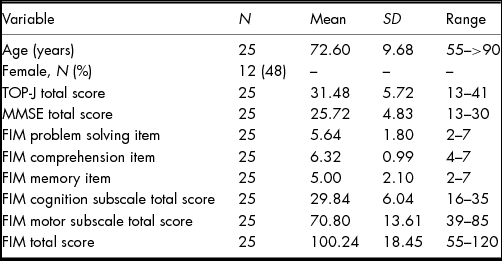
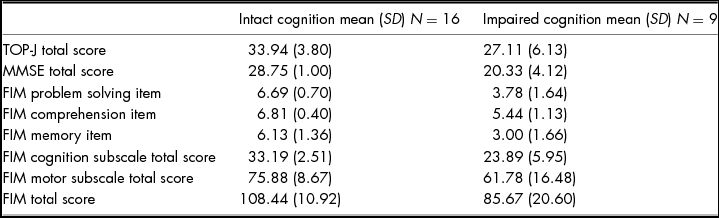
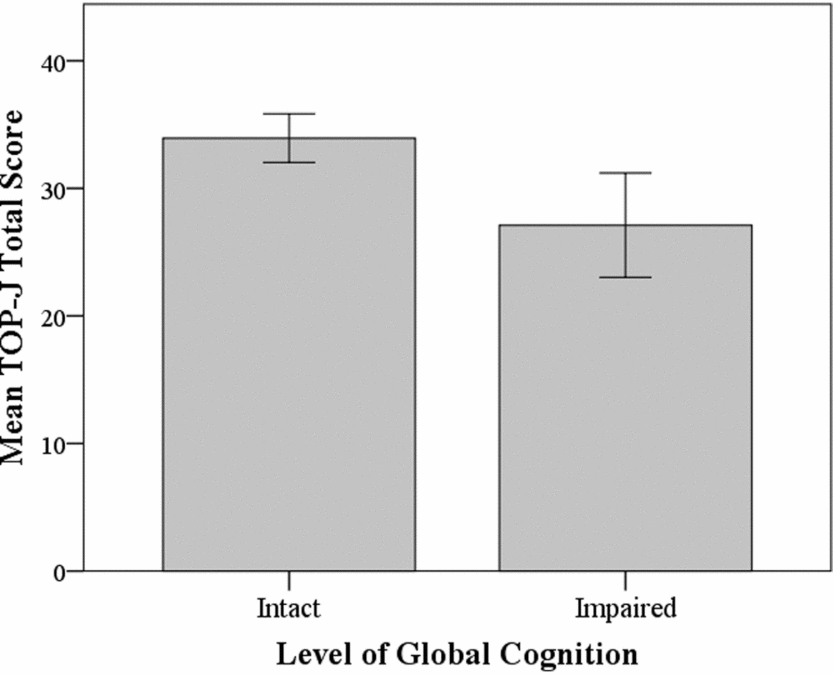
In order to address aim 1, means and standard deviations for demographic data, FIM cognition items of problem solving, comprehension and memory, and FIM total scores (including subscale total scores) are reported in Table 2. In addition, we applied a cut-off of ≤ 26/30 on the MMSE to indicate impaired cognition in order to better understand the mean range observed within the whole sample. We tested whether those with intact cognition performed significantly higher on the TOP-J than those with impaired cognition. Participants with intact global cognition obtained significantly higher TOP-J total scores than those with impaired global cognition t(23) = 3.42, p = .002, d = 1.44 (see Table 3 for mean scores on TOP-J by level of cognition). These groups were not significantly different in terms of age or sex. Figure 1 shows the distribution of TOP-J scores by level of cognition.
Demographic and Test Performance Data

Test Performance by Level of Cognition

Note. Impaired cognition was determined by using a cut-off of ≤ 26/30 on the MMSE.
TOP-J performance by level of cognition (intact vs. impaired based on the MMSE). Error bars represent two standard errors. Participants with intact global cognition obtained significantly higher TOP-J scores than those with impaired global cognition (p = .002).

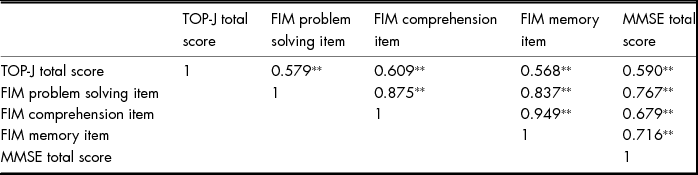
Addressing aim 2, results revealed statistically significant moderate positive correlations between TOP-J total scores and the three FIM cognition items of problem solving (r = .579, p = .002), comprehension (r = .609, p = .001) and memory (r = .568, p = .003) within the whole sample. In addition, a statistically significant moderate–strong positive correlation emerged between the MMSE and TOP-J total scores (r = .590, p = .002); this result also addressed aim 2. Table 4 shows the correlation matrix between TOP-J total scores, MMSE total scores and FIM problem solving, comprehension and memory items.
Correlation Matrix

Note. **Indicates correlation is significant at the .01 level (two-tailed).
Discussion
The accurate assessment of everyday judgement is critical to effective discharge planning interventions for older adults in inpatient rehabilitative care. Unfortunately, there is an observed scarcity of valid measures to assess everyday judgement of several areas of functioning (i.e., areas related to safety, financial, medical, social/ethical circumstances that are assessed by the TOP-J). In response to the identified need, we investigated the utility of the TOP-J in assessing judgement ability of older adults in inpatient rehabilitative treatment, including its association with functional outcomes and global cognition at rehabilitation discharge.
Our results established mean TOP-J performance for this mixed rehabilitation sample of older adults. Notably, TOP-J performance for the whole sample (M = 31.48, SD = 5.72) fell between the means typically observed in individuals with aMCI (M = 34.1, SD = 4.2) and mild AD (M = 28.4, SD = 6.1) (Rabin et al., Reference Rabin, Borgos, Saykin, Root, Wishart, Flashman and Santulli2005). To investigate this result further, we used a cut-off of ≤ 26/30 on the MMSE to compare those in our sample with intact vs. impaired cognition. We found a significant difference between groups, with a large effect size (Ellis, Reference Ellis2010), such that those with impaired global cognition on the MMSE scored in the mild AD range on the TOP-J, while those with intact global cognition scored in the aMCI range (see Table 3). Thus, respondents with some mild impairment in judgement may score in the normal range on the MMSE. This is consistent with previous research that has found limited ability of the MMSE to capture subtle cognitive impairment in specific domains (Kahokehr, Siegert, & Weatherall, Reference Kahokehr, Siegert and Weatherall2004).
We also investigated correlations between the TOP-J and functional outcomes (assessed by FIM problem solving, comprehension and memory items). As expected, statistically significant correlations of moderate effect size emerged between TOP-J total scores and relevant FIM independence scores (problem solving, comprehension and memory) within the whole sample. These correlations provide evidence of the TOP-J's usefulness in capturing objective, ecologically relevant, functional ability and may be informative for treatment and discharge planning. Practically, the TOP-J may provide objective information about cognitive abilities beyond the FIM ratings to optimise discharge plans to private homes, continuing-care facilities (e.g., assisted living residences) or other dwellings.
Consistent with previous research (LaBuda & Lichtenberg, Reference LaBuda and Lichtenberg1999; Ruchinskas, Singer, & Repetz, Reference Ruchinskas, Singer and Repetz2000), we found that reduced cognition was correlated with reduced functional capacity. The means established in this study also indicate an increased likelihood of cognitive impairment among rehabilitation inpatients of various diagnoses. These findings complement previous research that has identified a link between physical functioning and cognitive abilities in various cognitive areas, such as executive functioning (although directionality cannot be confirmed by these findings alone) (Clouston et al., Reference Clouston, Brewster, Kuh, Richards, Cooper, Hardy and Hofer2013; Herman et al., Reference Herman, Mirelman, Giladi, Schweiger and Hausdorff2010; Muir et al., Reference Muir, Gopaul and Odasso2012; Tolea, Morris, & Galvin, Reference Tolea, Morris and Galvin2015).
A statistically significant moderate correlation emerged between the MMSE and TOP-J, which was consistent in size with previous research (MacDougall & Mansbach, Reference MacDougall and Mansbach2013). From a psychometric perspective, our findings provide evidence of convergent validity for the TOP-J (as well as for the FIM items and MMSE). Convergent validity informs construct validity, which refers to the degree to which scores on a neuropsychological measure can be construed as reflecting a specific psychological construct (Furr & Bacharach, Reference Furr and Bacharach2013). In other words, our findings provide partial validity evidence supporting the use of the TOP-J in assessing judgement ability among older adults in inpatient rehabilitation settings. Furthermore, criterion-related validity evidence was gathered, as the tool is able to significantly distinguish patients with intact versus impaired cognition. Psychometrically, a test's ability to differentiate groups provides some evidence of criterion validity (an aspect of validity that is included within the larger concept of construct validity) (Furr & Bacharach, Reference Furr and Bacharach2013).
Limitations and Future Directions
Several study limitations warrant mention. The sample was of convenience and therefore a power analysis for the modest sample size was not conducted. Also, there were no a priori quantifications of the expected magnitude of TOP-J correlations (given limited previous research on which to base such estimates). Other limitations were the racial/ethnic uniformity of participants and our limited information about educational level (i.e., only that all participants had at least 12 years of education). Therefore, it is possible that there was a significant difference in the mean educational background between the current sample and the sample that previously established TOP-J norms (Rabin et al., Reference Rabin, Borgos, Saykin, Root, Wishart, Flashman and Santulli2005), such a difference could have influenced the interpretation of our data. Future work should focus on using the TOP-J with a larger sample of rehabilitation patients, including those of diverse educational backgrounds.
It would also be valuable to establish TOP-J performance for a specific type of condition observed in rehabilitative settings, such as a subtype of stroke – as the current sample included individuals with various diagnoses. We hope to continue to collect data to support the construct validity of the TOP-J (i.e., through investigation of discriminant and predictive validity evidence). Such evidence may further inform the utility of the TOP-J in forecasting diagnoses, effective interventions and overall judgement ability.
Clinical Implications
TOP-J data may help gauge patients’ functional skills such as managing medications, scheduling and attending medical appointments, appropriately sequencing tasks in the kitchen to maintain safety (e.g., avoiding intermediary tasks while cooking that may leave pans unattended or cleaning grease spills in a timely fashion) and responding to other types of compromising situations (e.g., identity theft, financial exploitation and interpersonal conflict). The usefulness of administering the TOP-J is further supported by Mayo and colleagues (2013), who concluded that decline in functional status and judgement may indicate a need for additional cognitive evaluation and are both important domains to be considered by health care providers.
Qualitative results (i.e., the open-ended responses) from the TOP-J may also be communicated to family members in order to help facilitate role transitions, as appropriate. Such responses may serve as a starting point for discussion about how TOP-J performance may translate to real-world scenarios. This type of discussion may also help to emotionally prepare patients and family members for changes that may occur in the patient's ability to live an independent lifestyle. For example, family members may choose to attend medical appointments with their loved ones if concerning responses related to major medical decisions are observed. A conversation based on results from the TOP-J may open the door to further discussion about challenging topics that should not be avoided.
Acknowledgements
Portions of this research project were presented at the 45th Annual Meeting of the International Neuropsychological Society (February 2017). We would like to thank Heather Pixley, Andrea Oakes, Hande Jackson, and Ashu Kapoor for assisting with data preparation. We thank Dr Jennifer L. Stewart for valuable feedback on the manuscript. We also thank Meaghan Quinn for providing an occupational therapy perspective.
Financial Support
This work was supported in part by a CUNY Doctoral Student Research Grant awarded to C. G. Quinn.
Conflict of Interest
C. G. Quinn has no conflicts of interest to disclose. L. A. Rabin has no conflicts of interest to disclose. G. C. Sprehn has no conflicts of interest to disclose.
ETHICAL STANDARDS
Participants signed a uniform consent form consistent with the standards of the U.S. Department of Health and Human Services, Office for Human Research Protections. They consented to retrospective analyses of their medical records for research and quality assurance. (This study meets the criteria of the Basic HHS policy for protection of human research subjects 46.101 subpart b.)