Introduction
Postacute care hospitals (PACHs) are a type of long-term care facilities (LTCFs) that care for patients with complex medical conditions. The prevalence of carriage of multidrug-resistant organisms (MDROs) is high among patients in these facilities. Reference Cassone and Mody1 Carbapenem-resistant Acinetobacter baumannii (CRAB) is endemic in many PACHs, especially in mechanical ventilation or skilled nursing wards. Reference Harris, Pineles and Johnson2,Reference Schechner, Masarwa and Levi3 Although colonized patients in PACHs serve as a reservoir that facilitates CRAB transmission, their individual risk of subsequent infection remains poorly defined.
Carriage of MDROs almost invariably precedes clinical infection. Most data on progression from colonization to infection originate from acute care hospitals (ACHs). Reference Willems, van Dijk and Vehreschild4 In LTCFs, data are sparse. Reference Cassone and Mody1 Outcome ascertainment is a key limitation, since infections are often identified only following transfer to ACHs. Moreover, diagnostic capabilities in LTCFs may be limited and causative agents of infection may be missed.
We aimed to quantify the one-year risk of subsequent CRAB infection and CRAB bacteremia among PACH patients with a positive CRAB screening test. We also sought to identify predictors of progression from CRAB colonization to infection among PACH patients.
Methods
Study design, setting, and sample
This retrospective study included all 17 PACHs in Israel with ventilation and skilled nursing wards. The sample included patients in these wards with a positive CRAB screening test between June 2021 and December 2023. For each patient, the first positive screening test was included.
Data collection
CRAB carriers were identified using the databases of the National Institute for Antibiotic Resistance and Infection Control (2021–2023). Screening was conducted as part of a national point prevalence survey (PPS) of MDRO carriage in PACH Reference Schechner, Masarwa and Levi3 or infection control activities. Data on prior and subsequent CRAB-positive clinical cultures were obtained through linkage with the national CRAB surveillance database, which captures all CRAB-positive clinical samples reported by ACHs (2016–2024). We lacked data on CRAB infections occurring in PACHs. Information regarding death dates came from the Ministry of the Interior’s death registries. Additional patient characteristics were extracted from medical records as part of a previous study. Reference Schechner, Masarwa and Levi3
CRAB screening and microbiological methods
Skin samples were obtained using premoistened sterile sponges and rectal samples using swabs; patients with tracheostomies also had tracheal aspirates collected. Reference Nutman, Levi and Keren-Paz5
Outcome
CRAB infection was defined as a CRAB-positive culture obtained from a clinical (non-screening) specimen in an ACH within one year of the index screening; bacteremia was defined as a CRAB-positive blood culture within one year.
Statistical analysis
Because patients who died during follow-up would not have an opportunity to develop infection, we used a Fine and Gray competing risk model with death as the competing event. We included PACH as a random effect. Among ventilated patients, a subgroup analysis evaluated potential effect modification by screening source (sputum versus other).
We used multivariable logistic regression to evaluate associations between patient characteristics and the occurrence of clinical CRAB infection within one year. This analysis included only patients whose index screening occurred as part of the PPS. To account for clustering at the PACH level, robust standard errors clustered by institution were used.
All analyses were conducted using R version 4.3.1.
Ethics
The study was approved by the institutional review board of Tel Aviv Sourasky Medical Center.
Results
The sample included 523 patients colonized with CRAB (Table S1). Of these, 344 participated in the PPS. The median age was 72 years (interquartile range [IQR], 61–81), and 45% were female. Overall, 356 patients (68.1%) were in mechanical ventilation wards and 167 (31.9%) in skilled nursing wards. A total of 103 patients had a CRAB-positive clinical culture prior to screening, including 67 in the previous year.
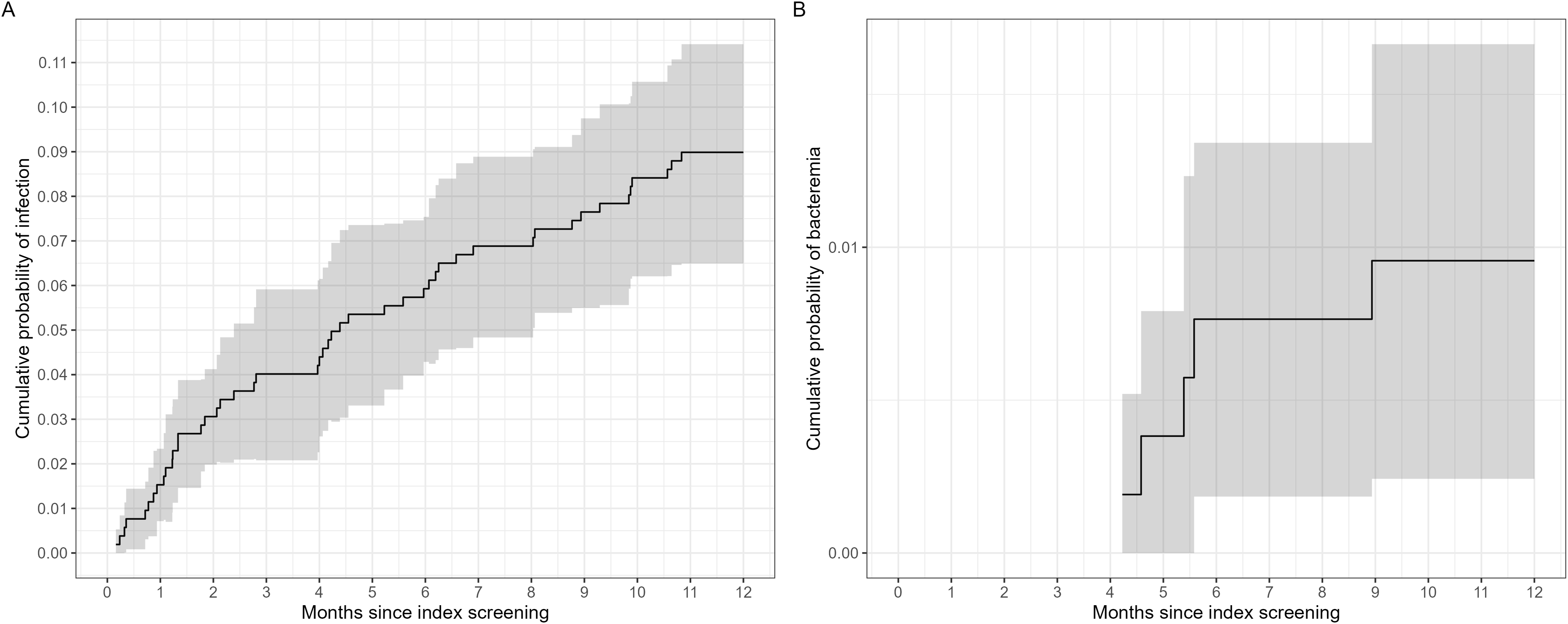
Within one year of screening, 47 patients had a CRAB infection detected in an ACH, including 5 cases of bacteremia. Non-blood specimens were respiratory (62%), urine (21%) and wound (17%). Nearly half of infections (21/47, 45%) occurred within 3 months of the positive screening test. Among infections with an available hospitalization date (n = 46), 36 (78%) were identified within the first 3 days of ACH admission, consistent with infection present on admission. Competing-risk analysis demonstrated a one-year cumulative incidence of 9% for infection and 1% for bacteremia (Figure 1). Infection risk did not differ significantly between the two ward types (Figure S1).
Cumulative incidence of CRAB infection (A) and CRAB bacteremia (B) following detection of CRAB carriage, with death as a competing risk.

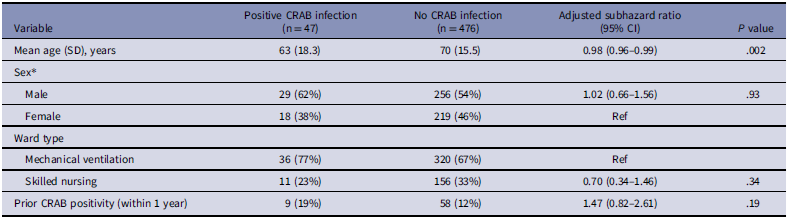
In multivariable competing-risk regression, increasing age was associated with a lower risk of subsequent CRAB infection (Table 1). Sex, ward type, and prior CRAB-positive clinical samples were not associated with infection risk. Among ventilated patients, site of positive screening was not associated with CRAB infection (Table S2).
Multivariable competing risk regression for the outcome CRAB infection

Table 1. Long description
A table comparing variables related to CRAB infection risk. The table has 9 rows and 5 columns. Column headers are Variable, Positive CRAB infection (n = 47), No CRAB infection (n = 476), Adjusted sub-hazard ratio (95% CI), and P value. Row labels include Mean age (SD), Sex (Male, Female), Ward type (Mechanical ventilation, Skilled nursing), and Prior CRAB positivity (within 1 year). Each row provides specific values for each column. Notable trends include the adjusted sub-hazard ratio and P values for each variable.
* One missing value.
The multivariable logistic regression model included 344 patients who participated in the PPS and therefore had additional clinical characteristics available. Diabetes mellitus was associated with an increased risk of CRAB infection, while older age, oral feeding, and longer time since index screening were protective (Table S3).
Discussion
In this cohort of PACH patients with a positive screening test for CRAB, 9% developed clinical infection within one year, with bacteremia occurring in 1%. These numbers are underestimates because they only capture infections diagnosed in ACHs. Nearly half of infections occurred within three months, and the risk was not associated with having a prior CRAB-positive clinical culture. Longer time since index screening was associated with reduced risk of infection. Older age was also protective, perhaps because older patients received less intensive care and were not transferred to ACHs. Most infections were identified early after ACH admission, indicating that the transition from carriage to infection was not simply because of ACH-related events.
Data on the clinical implications of MDRO carriage in PACHs remain limited. One study found that 15% of newly identified MRSA carriers at a US ACH developed MRSA infections after hospital discharge; 54% of these patients had been discharged to LTCFs. Reference Huang and Platt6 A population-based study from Canada that included MDRO carriers detected in LTCF demonstrated marked variability in infection risk by organism, ranging from 0.8% for VRE to 32.9% for ESBL-producing Enterobacterales. Reference Blagojevic, Brown and Diong7
Data on clinical infections among CRAB carriers largely originate from ACHs. In a study from Italy, 27.8% of CRAB carriers developed infection during hospitalization. Reference Peghin, Givone and de Martino8 In a meta-analysis of studies conducted in ICU and solid organ transplant units, 34% of CRAB carriers developed invasive infection. Reference Margalit, Kunwar and Gadot9 Indirect evidence on the clinical outcomes of CRAB carriers in LTCF comes from an investigation of a regional cluster of CRAB infections in ACHs that was linked to a single PACH. This triggered screening in the PACH, which detected a high prevalence of CRAB carriers among mechanically ventilated and tracheostomized patients. Reference Mortensen, Trivedi and Rosenberg10 To our knowledge, our study is the first to present estimates of infection risk among CRAB carriers in PACHs.
Several limitations should be considered. First, infections were identified using clinical cultures, without clinical confirmation of infection, which may have led to misclassification. A prior investigation found that 64% of CRAB clinical isolates represented true infection. Reference Mortensen, Trivedi and Rosenberg10 Second, infections diagnosed and managed entirely within PACHs were not recorded, potentially resulting in underestimation of infection risk. Finally, patient characteristics were measured at the time of screening and may not reflect changes during follow-up that could influence progression to infection.
In conclusion, among patients in PACHs with CRAB carriage, approximately one in ten carriers developed infection within one year. These findings establish that CRAB carriage in PACHs is not only a reservoir for transmission but also a risk to the individual carrier.
Supplementary material
The supplementary material for this article can be found at https://doi.org/10.1017/ice.2026.10535.
Acknowledgments
The Israel PACH CRAB Working Group: Jacob Haviv, Emilia Anis, Esther-Lee Marcus, Allon E Moses, Hana Yosef (Herzog Medical Center); Ari Lauden (Reut Rehabilitation Hospital and Faculty of Health Sciences, Ben Gurion University of the Negev); Orit Stein-Reisner (Reut Rehabilitation Hospital and Tel Aviv University); Maya Elyashiv, Esmael Atamny (Reut Rehabilitation Hospital); Debby Ben-David, Angela Shimonov (Beit Rivka Geriatric Medical Center); Jochanan Stessman, Esther Ben Hamo, Moria Atun (Hod Amal Ma’ale Adumim Geriatric Hospital); Oshra Tirosh, Yana Vishnevski, Irena Uzlianer (Beit Hadar Medical Rehabilitation and Nursing Center); Nadya Kagansky, Yohai Levy, Ahuva Tzabari, Limor Goren (Shmuel Harofe Geriatric Medical Center); Tammy Porat-Packer, Ksenia Markov, Tali Atari, Kifah Nadaf (Shoham Geriatric Medical Center); Ramzi Kurd (Bayit Balev Rishon Le’zion Geriatric Rehabilitation Center); Gregory Leibovich (Bayit Balev Nesher Geriatric Rehabilitation Center); Galia Rahav (Bayit Balev Geriatric and Rehabilitation Healthcare Services); Margalit Ben Shimol (Dorot Geriatric Rehabilitation Center); Mohamed Nassar, Tatiana Nagulevich, Maria Zalevsky (Golden Care Ness Ziona Geriatric Rehabilitation Center); Boris Svirsky, Subhi Azzam (Golden Care Dushi Nazareth Geriatric Rehabilitation Center); Amir Amara, Valeria Razum (Golden Care Tel Aviv Geriatric Rehabilitation Center); Pavel Gur (Herzfeld Geriatric Rehabilitation Medical Center); Tamar Gottesman, Ilana Or, Nurit Ben Aroya (Loewenstein Rehabilitation Hospital); Olga Druker (Neve Amit Geriatric Center); Inna Kaganovich Zafrany (Neve Shva Geriatric Center); Inna Shugaev, Eduard Zalyesov, Alona Paz (Fliman Geriatric Rehabilitation Hospital and The Ruth and Bruce Rappaport Faculty of Medicine, Technion—Israel Institute of Technology); Svetlana Zheleznyak (Fliman Geriatric Rehabilitation Hospital); Efrat Gil, Ariel Yakim (Geriatrics Branch, Ministry of Health); Fadi Assi (National Institute for Antibiotic Resistance and Infection Control).
Financial support
None.
Competing interests
Yehuda Carmeli has received grants and personal fees from Antabio, Enlivex Therapeutics, Omnix Medical, Pfizer, and Roche. All other authors report no potential conflicts of interest.