Behavioural parent training (BPT) has a long history as an effective treatment for attention-deficit/hyperactivity disorder (ADHD), oppositional defiant disorder (ODD), and conduct disorder (CD; Eyberg, Nelson, & Boggs, Reference Eyberg, Nelson and Boggs2008; Pelham & Fabiano, Reference Pelham and Fabiano2008). Although efficacious, engagement to BPT is a critical issue. Studies have demonstrated that families who are more engaged in BPT (e.g., attending, participating during session, implementing skills at home) have significantly better outcomes (Boggs et al., Reference Boggs, Eyberg, Edwards, Rayfield, Jacobs, Bagner and Hoode2004; Prinz & Miller, Reference Prinz and Miller1994). Unfortunately, it is common for 40–60% of families with children diagnosed with ADHD, ODD, and/or CD to have challenges in fully engaging in BPT (e.g., Chacko et al., Reference Chacko, Wymbs, Arnold, Pelham, Swanger-Gagne, Girio and O'Connor2009; Fernandez, Butler, & Eyberg, Reference Fernandez, Butler and Eyberg2011; Prinz & Miller, Reference Prinz and Miller1994). Poor engagement is a significant limiting factor in BPT attaining full public health impact (Chacko et al., Reference Chacko, Wymbs, Arnold, Pelham, Swanger-Gagne, Girio and O'Connor2009).
A central aspect of engagement to BPT is homework (HW), which is between-session exercises where the client (i.e., parent) practises specific skills learned within-session in order to promote skill acquisition (Kazantzis, Deane, Ronan, & L'Abate, Reference Kazantzis, Deane, Ronan and L'Abate2005). Although limited, studies of BPT suggest that HW completion is related to improved outcomes, even after taking into account parent/child characteristics (baseline severity of mental health problems, motivation), attendance at treatment sessions, and even within-session participation (Bayard, Reid, & Webster-Stratton, Reference Baydar, Reid and Webster-Stratton2003; Nock & Ferriter, Reference Nock and Kazdin2005). Collectively, data suggests that attending BPT and being actively involved when in a BPT session is necessary but insufficient in producing desired outcomes following treatment — HW completion is necessary to maximise benefits of BPT. Unfortunately, the limited data available suggest that HW is not often completed in BPT (for review see Chacko et al., Reference Chacko, Wymbs, Arnold, Pelham, Swanger-Gagne, Girio and O'Connor2009; Nock & Kazdin, Reference Kazdin2005). As such, attention to how best to support parents in completing HW is needed in order to attain the full potential therapeutic benefits of BPT.
In order to improve the quality and quantity of HW completed during BPT, it is necessary to understand HW as a process that occurs during and between treatment sessions. Conceptually, the work of Kazantzis and colleagues (Reference Kazantzis, Deane, Ronan and L'Abate2005) has been seminal in better understanding the HW process by integrating well-established models of behaviour change into an integrated social-cognitive behavioural theory of HW process and implementation. This model proposes four phases involved in HW implementation: (1) Designing HW, (2) Assigning HW, (3) Doing HW, and (4) Reviewing HW (i.e., DADR model), although the design and assign phases are often grouped together. The design phase of the DADR model involves the therapist and client determining the content and form of the HW assignment. Assigning HW involves the therapist and client collaborating on methods to facilitate and reduce barriers to HW implementation. The do phase of the DADR model involves primarily the client implementing the HW assignment. Finally, the review phase involves the specific review of HW implementation, barriers to implementation, and integration of skills learned through HW assignments over the course of treatment. The DADR model posits that specific social, cognitive and behavioural factors related to the HW-task (e.g., perceived difficulty and relevance of HW), therapist (e.g., ability to tailor HW/address barriers and support facilitators to HW implementation), client (e.g., perceived self-efficacy/motivation to complete HW/realised difficulty, costs, benefits, and relevance of HW) and environment (e.g., social support to implement HW/environmental barriers and facilitators to HW/life stressors) affect the quality of each of the four phases of the DADR model, ultimately impacting the quantity and quality of HW completed. These facilitators/barriers to the DADR model have been shown to be predictive of HW compliance, though these findings are almost exclusively in adult-focused studies (Detweiler & Whisman, Reference Detweiler and Whisman1999, Reference Detweiler-Bedell and Whisman2005; Helbig & Fehm, Reference Helbig and Fehm2004; Kazantzis & Shinkfield, Reference Kazantzis and Shinkfield2007; Nock & Ferriter, Reference Nock and Ferriter2005).
Although there have been successful efforts at improving HW completion in BPT (Chacko et al., Reference Chacko, Wymbs, Arnold, Pelham, Swanger-Gagne, Girio and O'Connor2009; Nock & Kazdin, Reference Kazdin2005) through supporting various factors related to the DADR model, an under-investigated yet intuitively important area of empirical inquiry are the reasons parents provide for not completing HW. Identifying the reasons why HW is not completed allows for the development of new, or refinements of existing, engagement methods to BPT to further enhance HW completion. More specifically, by mapping reasons for poor HW completion to the DADR HW process model, BPT developers and providers can tailor and target efforts during key steps of the DADR model (i.e., the design, assign, do, and review phases) and within various key domains (i.e., the HW task, therapist, client, and environment) to improve HW implementation. Data on efforts to understand how best to support HW completion in youth mental health, including ADHD, ODD, and CD, have broadly focused on what therapists do with their clients (i.e., youth and their families) in general (e.g., Chacko et al., Reference Chacko, Wymbs, Arnold, Pelham, Swanger-Gagne, Girio and O'Connor2009; Houlding, Schmidt, & Walker, Reference Houlding, Schmidt and Walker2010; Nock & Ferriter, Reference Nock and Ferriter2005; Nock & Kazdin, Reference Kazdin2005) rather than what therapists can do in response to identified barriers to HW completion. It is important to identify specific methods based on identified HW challenges, given that even with enhanced non-specific efforts to improve HW completion, rates of HW completion are not uniformly high, particularly for high-risk populations (Chacko et al., Reference Chacko, Wymbs, Arnold, Pelham, Swanger-Gagne, Girio and O'Connor2009). Unfortunately, to our knowledge, there is no study that reports data on parent-identified reasons for poor HW completion in BPT.
The general aim of this article is to understand parent-endorsed/identified factors for poor HW completion in a group-based BPT program for school-age children with ADHD from families who are high-risk for poor engagement to BPT. More specifically, data on parent-endorsed/identified HW completion from single mothers of school-age youth with ADHD in a randomised clinical trial of an enhanced group-based BPT program (the Strategies to Enhance Positive Parenting program [STEPP]; Chacko et al., Reference Chacko, Wymbs, Arnold, Pelham, Swanger-Gagne, Girio and O'Connor2009) will be presented. In a randomised clinical trial, compared to a traditional group-based BPT, the STEPP program was found to significantly improve child and parenting behaviour and also to significantly improve attendance and homework completion, with moderate-to-large between-group effect sizes (Cohen's d > .70) for both engagement outcomes (Chacko et al., Reference Chacko, Wymbs, Arnold, Pelham, Swanger-Gagne, Girio and O'Connor2009). Interestingly, data demonstrated that, on average, only 48% and 29% of HW was completed for the STEPP and traditional BPT groups, respectively. As such, even with enhancements, HW completion is a notable issue in this high-risk population. We hypothesise that reasons for not completing HW will vary and include factors related to the therapist, the HW task, the client (i.e., parent), and the environment. Moreover, reasons for HW non-completion will be identified across the DADR HW process model (issues with how HW is designed, assigned, done, and reviewed). Collectively, this article is an initial attempt to provide descriptive data regarding the reasons for not fully completing HW in group-based BPT, ultimately in order to better tailor efforts to support HW implementation, particularly for high-risk families of youth with ADHD participating in group-based BPT.
Methods
Participants
Between September 2002 and March 2005, single-mother families were recruited for this study through radio advertisements, mailings, and school referrals. Single mothers were required to be the primary caregiver and residing without a significant other (e.g., child's father, boyfriend, fiancé); however, single mothers were included in this study if they resided with other individuals (e.g., parents, siblings, roommates). Single mothers were not excluded from participation for the presence of any psychiatric conditions. Children were required to be between 5 to 12 years old at the start of treatment and were required to meet diagnostic criteria for ADHD (any type). The family met with study staff to conduct a formal assessment for a diagnosis of ADHD prior to enrolling in the study. ADHD diagnosis was determined through completion of parent and teacher rating scales of DSM symptoms (i.e., Disruptive Behavior Disorder [DBD] rating scale; Pelham, Gnagy, Greenslade, & Milich, Reference Pelham, Gnagy, Greenslade and Milich1992), completion of semi-structured interviews with the parent (Disruptive Behavior Disorder [DBD] semi-structured parent interview; Pelham, Reference Pelham2002), and assessment of cross-situational impairment through completion of parent and teacher rating scales (Impairment Rating Scale; Fabiano et al., Reference Fabiano, Pelham, Waschbusch, Gnangy, Lahey, Chronis, Onyango and Burrows-MacLean2006). More specifically, an ADHD symptom was counted toward meeting the symptom criterion for ADHD if either the parent or the teacher endorsed the symptom as occurring at a clinically significant rate (pretty much or very much of the time). Additionally, information from DBD rating scales were integrated with the DBD interview, and discrepancies between the parent rating scale and interview endorsements of symptoms were addressed through a consensus between the therapist and clinical supervisor. Both the single mother and teacher were required to endorse clinically significant impairment on the Children's Impairment Rating Scale at home and school, respectively, in order to meet impairment criterion for ADHD. Families were excluded if the child had an estimated full-scale IQ of less than 80; or was diagnosed with a pervasive developmental disorder from testing during the 6 months prior to the intake; or if there was evidence of psychosis. Institutional Review Board approval was obtained through the university for the research study.
Procedures
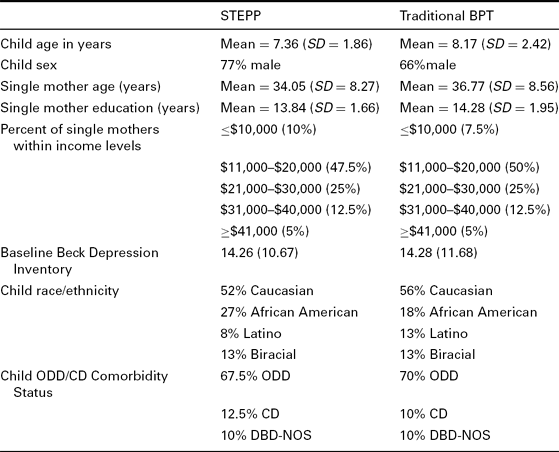
The mother's consent and child assent were obtained before the initial intake. The informed consent and assent forms and study procedures were approved by the university's Institutional Review Board. Treatment conditions included: (1) a 9-week, group-based traditional behavioural parenting training group (traditional BPT; n = 40); (2) the 9-week group-based Strategies to Enhance Positive Parenting (STEPP; n = 40) program; or (3) a wait-list control group (n = 40). Given the aims of this article, participants in the wait-list control group were not included in the analyses. Characteristics of the traditional BPT and STEPP program participants are detailed in Table 1. The groups did not differ on any of the demographic variables.
Participant Characteristics for STEPP and Traditional BPT Groups

Note: STEPP = Strategies to Enhance Positive Parenting; BPT = Behavioral Parent Training; SD = Standard Deviation; ODD = Oppositional Defiant Disorder; CD = Conduct Disorder. Some percentages sum to greater than 100% due to rounding error.
Traditional BPT
The traditional BPT program is a manualised, 9-week, group-based BPT program held for 2.5 hours each week, led by the two study authors (AC and FAW). Single mothers engaged in a collaborative, large-group format to discuss and learn about effective parenting strategies (e.g., positive attending, planned ignoring, incentive systems, logical/natural consequences, time-out). Sessions included videotaped vignettes of parenting errors whereby single mothers identified these errors and then formulated alternative parenting strategies. Furthermore, the therapist facilitated group discussions by asking questions to encourage single mothers to make adaptive attributions about the effects of their parenting on their children's behaviour. Therapists modelled the parenting techniques with further role play by single mothers. Single mothers were also assigned weekly homework assignments based on the context of the session. During the program, children participated in a concurrent traditional, group-based social skills program (see Chacko et al., Reference Chacko, Wymbs, Arnold, Pelham, Swanger-Gagne, Girio and O'Connor2009; Chacko et al., Reference Chacko, Wymbs, Flammer-Rivera, Pelham, Walker, Arnold and Herbst2008, for more details).
STEPP program
Identical to traditional BPT, the STEPP program includes a collaborative, large-group format, identical evidence-based BPT content, identical order of presentation of BPT content, identical videotaped vignettes to depict parenting errors, therapist-facilitated questions and group discussions, modelling, and role-plays by parents. The STEPP program was also led by the two study authors (AC and FAW). Children also participated in a group-based social skills program. The STEPP program, however, includes several enhancements to the format, delivery, and content of traditional BPT, conceptualised to improve engagement and outcomes for high-risk families, including: (1) incorporating an enhanced intake procedure that improves parents’ motivation to engage in treatment, addressing possible practical barriers to treatment participation, and addressing maternal cognitions regarding expectations for treatment, and maternal attributions regarding their own parenting behaviour and their child's behaviour (McKay, Stoewe, McCadam, & Gonzales, Reference McKay, Stoewe, McCadam and Gonzales1998; Nock & Kazdin, Reference Kazdin2005); (2) incorporating small subgroups within the traditional large-group format to improve social support between parents and to increase participation among parents (Cunningham, Bremner, & Secord, Reference Cunningham, Bremner and Secord1998); (3) incorporating a systematic, manualised, problem-solving treatment (D'Zurilla & Nezu, Reference D'Zurilla and Nezu1999) to address parent-initiated, adult- and child-focused problems that are not typically addressed in traditional BPT (e.g., Kazdin & Whitley, Reference Kazdin and Whitley2003; Prinz & Miller, Reference Prinz and Miller1994); (4) incorporating parent-child interactions within the children's social skills group to enhance parenting skill acquisition; and (5) a child motivation enhancement incorporated within the children's social skills group to provide children incentives for attaining within-session and home-based behavioural goals (see Chacko et al., Reference Chacko, Wymbs, Arnold, Pelham, Swanger-Gagne, Girio and O'Connor2009; Chacko et al., Reference Chacko, Wymbs, Flammer-Rivera, Pelham, Walker, Arnold and Herbst2008, for more details).
Dependent Measure
Reasons for not completing HW
HW was assigned for session 1 through 8 for each BPT group and focused primarily on the implementation of the BPT skill learned during the session. HW was counted as completed if the family attended the previous BPT session, submitted their HW for the week, and attempted to complete some portion of the HW assignment. Reasons for not completing HW were assessed anonymously after each treatment session through completion of the Weekly Homework Completion Checklist, a measure developed specifically for this study. The Weekly Homework Completion Checklist required parents to check-off whether a particular reason for not fully completing HW was applicable to them across key areas related to the therapist (e.g., ‘HW was not explained well by the therapist’); the parent (e.g., ‘I did not agree with the reasons for doing HW’); the HW task (e.g., ‘HW would not help’), or the environment (e.g., ‘HW did not fit into my routine’). Furthermore, parents had an opportunity to provide their own specific reasons for not completing HW. As BPT HW is assigned to be conducted on a daily basis over the course of a week, parents were able to identify multiple reasons for not implementing HW across the week. All reasons for not completing HW were then categorised as occurring during the design/assign (which was combined), do, or the review phases within the DADR HW process model by two independent coders (κ = .96). Responses on the Weekly Homework Completion Checklist from parents in the traditional BPT program and the STEPP program were combined as there were no differences between the two groups on reasons endorsed/identified.
Results
Reasons for HW non-completion
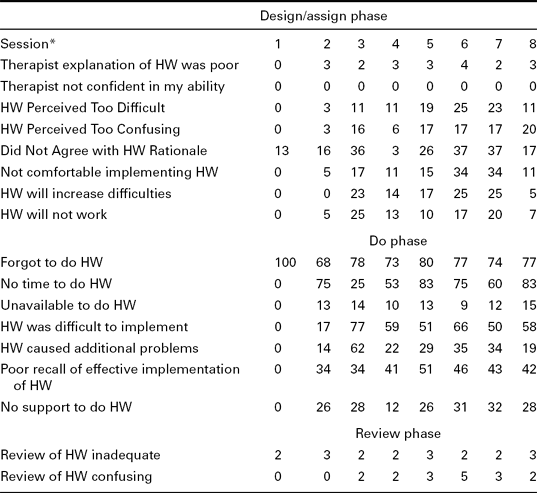
Reasons for not completing homework varied between the different phases of the DADR model. As seen in Table 2, reasons for not completing HW that occurred during the design/assign phase of the HW process were identified between 0–40% of the time. The reasons most often identified within the design/assign phase focused primarily on parent perspectives regarding the acceptability or perceived benefits/costs of HW. Very few parents endorsed therapist-related factors as reasons for not completing HW. Reasons for not completing HW that occurred during the do phase of the HW process were identified between 0–100% of the time. The reasons most often identified within the do phase (occurring greater than 50%) focused primarily on forgetting, lack of time, and difficulties in implementing the HW task. The remaining reasons were also often reported, with rates generally varying between 25–50%. Reasons for not completing HW that occurred during the review phase of the HW process were identified infrequently (i.e., less than 6%).
Percentage of Time Reason for Incomplete Homework was Indicated by Parent by Session Within Design/Assign, Do, and Review Phases
Note: HW = Homework. *Topics for treatment sessions included, respectively: (1) Introduction to social learning theory and the causes of child behaviour; (2) Contingent Attention/Special Parent-Child Interactions/Play; (3) Planned Ignoring; (4) Effective Commands, Instructions, Premack Principles, and Transitional Warnings; (5) Developing Incentive Systems; (6) Introducing Time Out from Positive Reinforcement; (7) Time-Out Part II; (8) Planning Ahead; (9) Closing Session; Programming for Maintenance. Percentages are greater than 100% as parents were asked to identify all reasons HW was not completed during the course of a week.
Discussion
The specific aim of this article was to report reasons endorsed or identified by parents for not completing homework assignments during group-based BPT for the treatment of ADHD in school-age youth. Reasons for not fully completing HW were coded as occurring during one of the four phases of the DADR HW process model. In general, we found very few factors related to the design/assign and review portions of the model. Importantly, the vast majority of reasons identified for not completing HW occurred during the do phase of the DADR model. We discuss these issues in greater detail below, suggest possible methods to address barriers to HW completion within each DADR phase, discuss limitations of the present study, and future directions in this important, yet understudied, area of research.
The design/assign process of the HW model is comprised of the therapist working collaboratively with the parent to develop feasible and effective HW tasks that help support implementation of particular BPT content (e.g., planned ignoring). Successful HW design/assign is collaborative, aligns with the patient's treatment priorities, involves in-session practice and is perceived by the patient to be practical and meaningful. Designing HW and collaboratively assigning HW is crucial to the HW process, because if the parent does not believe that the HW task is meaningful and feasible to implement or has maladaptive cognitions, expectations or beliefs about the HW task, then it is more likely that HW will not be completed. Data from this study suggest that parents endorsed perceptions that HW would be too difficult, was too confusing, did not agree with HW rationale, and that HW would have increased the difficulties parents experienced. The rate of endorsement for these reasons for not fully completing HW is significant; however, this process is likely amenable to direct intervention by the therapist. For instance, therapists who treat youth often focus on explaining the relevance of HW and align HW rationale with therapy goals (Houlding et al., Reference Houlding, Schmidt and Walker2010).
Interestingly, parents did not endorse issues related to the therapist during the design/assign phase as a reason for not completing HW. First, despite the anonymity of the answers provided, parents may not have wanted to disclose problems with the therapist while participating in BPT. Moreover, in this clinical trial, only two therapists delivered the intervention, thereby limiting the potential variability of the ‘therapist-factor’. Finally, no parent endorsed that the therapist was not confident in their ability. This may be a function of the group BPT format where, given the more limited one-to-one interaction between a therapist and any particular parent, it may be more difficult for a parent to gauge a therapist's perception of their ability to implement any particular HW content.
The do phase of the DADR model is the implementation of a learned skill within the client's environment. The do phase allows the parent to implement a new set of behaviours learned during BPT to help achieve treatment goals. Some have argued that this phase of HW is what is essential for skill retention, generalisation of BPT content, and maintenance of child behaviour gains after completion of BPT (Kazdin, Reference Kazdin2005). Unfortunately, data from this study suggests that factors related to the do phase are the most often cited reasons for not completing HW. More specifically, parents endorsed that they simply forgot to do HW (77–100%), they did not have enough time to complete HW (0–83%), or HW was difficult to implement (0–66%). Although strategies have been reported by therapists that will likely aid in addressing barriers during the do phase (e.g., problem-solving practical barriers to HW completion; Houlding et al., Reference Houlding, Schmidt and Walker2010), fully engaging parents appears to require ongoing support outside BPT sessions. Houlding and colleagues’ (Reference Houlding, Schmidt and Walker2010) data on practising therapists, as well as Gearing, Schwalbe, Dweck, and Berkowitz (Reference Gearing, Schwalbe, Dweck and Berkowitz2012) data on strategies employed by researchers in clinical trials, suggest that a very small number of therapists and researchers utilise methods (e.g., phone calls, short message service) to connect and support with youth and their families outside of treatment. This may not be surprising, given that these methods still require considerable therapist time and effort.
More recently, however, with mobile health (mHealth) strategies facilitated through smartphone technology, there may be unique opportunities to support the do phase of the HW process. For instance, through features available on smartphones (e.g., camera/video/voice recording, internet access, global positioning systems, bio-sensing technology) there are increasingly novel methods to interface with and support HW. Through the use of these features, mHealth applications can be used to educate (e.g., provide BPT content through written/audio/visual methods when parents do not recall effective implementation of HW tasks), connect (e.g., parents to their therapists for advice when having difficulty implementing HW; parent-to-parent to support HW efforts), track (e.g., HW completion), and remind (e.g., prompt for implementation of HW tasks based on time of day or location). These applications often use a ‘pull-out’ (the client is required to access the mHealth application to pull-out desired information) and ‘push-in’ (content, processes, procedures are delivered or pushed-in directly to the client when and where it is pertinent based on data-driven algorithms). State-of-the art mHealth applications that utilise the full array of features and integrate pull-out and push-in methods offer a great opportunity to provide personalised support for HW implementation but, to our knowledge, have not been systematically studied as an adjunctive treatment to BPT (see, however, ongoing work by Jones, Forehand, McKee, Kincaid, & Cuellar, Reference Jones, Forehand, McKee, Kincaid and Cuellar2010).
The review portion of the DADR model is comprised of the therapist and the parent evaluating the homework, both in terms of process and product, with the goal of identifying facilitators and barriers. The importance of review is to support parents to synthesise their efforts over the course of a week and draw conclusions about the HW task in terms of relevance, and cost versus benefit. Very few parents in our sample endorsed/identified not completing HW because of issues with the review phase of the DADR model. This is likely due to the manualised nature of both BPT interventions and the explicit inclusion of HW review at the beginning of a BPT session. As such, BPT approaches that do not include formal HW review procedures may result in greater challenges in this specific aspect of the DADR model.
Limitations
There are several limitations to this study. The instrument used to collect parent-reported data was developed based on feedback from parents in a pilot study of BPT (Chacko et al., Reference Chacko, Wymbs, Arnold, Pelham, Swanger-Gagne, Girio and O'Connor2009) along with the clinical experience of the study authors. As such, it may not represent the full range of reasons parents endorse for not fully completing HW. Moreover, the data gathered from this study are most directly relevant to group-based, manualised BPT conducted with high-risk (i.e., single mothers) families of school-age youth with ADHD. It is likely that there will be different variability and significance of the reasons for not completing HW as a function of other BPT formats (e.g., individual), age groups (e.g., preschool children), treatment duration, and child/family risk status/characteristics (e.g., intact families).
Future Directions
To our knowledge, the data presented herein represent the first attempt to document the reasons parents identify/endorse for not fully completing HW in BPT within a theoretical framework (e.g., DADR model). As such, it provides a starting point for addressing further investigation into an important yet understudied area of empirical investigation. Future research should further ascertain reasons that parents do not fully complete HW in order to identify the complete range of potential barriers. This should be conducted keeping in mind that BPT interventions vary along important parameters (e.g., formats, duration, content) and therefore may elicit different barriers to HW completion for different families. Once reasons have been better documented, it will be important to understand the extent to which these reasons are related to quality and quantity of HW implementation, and ultimately, the development of methods to address the most common and problematic reasons for poor HW adherence. More broadly, increased attention must be given to the HW process and its role in outcomes following BPT. Very little empirical investigation has been conducted in this area despite the theoretical importance of HW in BPT. Given that BPT is, arguably, one of the most efficacious psychosocial treatments for ADHD (Pelham & Fabiano, Reference Pelham and Fabiano2008) and related problems (oppositional and conduct problems; Eyberg et al., Reference Eyberg, Nelson and Boggs2008), it is critical to understand how best to maximise the benefits of BPT. Understanding and improving the HW process and the quality and quantity of HW completed appears to be a significant way to maximise the benefits of an already potent intervention.