The majority of children with congenital heart disease (CHD) now survive into adulthood, Reference Khairy, Ionescu-Ittu, Mackie, Abrahamowicz, Pilote and Marelli1 and many women with CHD want to pursue pregnancy. Pregnancy represents a complex issue for the CHD care provider. It requires balancing the interests of the woman against the risk to her health during pregnancy, while also factoring in the long-term risks to her health and the risk to her fetus.
Our knowledge of this subject has been historically limited by lack of data regarding the outcome of pregnancy in CHD; however, in recent years, more data have begun to emerge.Reference Drenthen, Pieper and Roos-Hesselink2 In this review, we will summarise what is known about risk assessment in pregnant CHD patients. We will then provide a framework for healthcare providers managing pregnancy in this population, with a focus on the systemic right ventricle and the Fontan operation.
Pregnancy physiology
In pregnancy, a variety of haemodynamic and physiological changes occur, which allow the mother to support the growing fetus. They include an ~20% increase in heart rate, a doubling in cardiac output and plasma volume, and a small increase in red blood cell mass. Peripheral vascular resistance and blood pressure decrease. There is a hypercoagulable state associated with pregnancy. This is of particular importance in women who are at increased risk of thrombotic events, including Fontan patients, those with a history of atrial flutter or fibrillation, and individuals with mechanical heart valves.Reference Regitz-Zagrosek, Blomstrom Lundqvist and Borghi3
Labour and delivery present additional haemodynamic stress for the body. During labour, the circulating blood volume increases by up to 500 ml per contraction. Heart rate and blood pressure increase as well. The cardiac output peaks at a level 80% above the baseline during the early post-partum period, as the uterus involutes and leg oedema is re-absorbed. The use of epidural anaesthesia to reduce pain during labour and delivery can help reduce the stress of delivery and is beneficial in many cardiac patients. Anaesthesia can be associated with hypotension, however, and providers managing cardiac patients during labour and delivery must have a clear plan to deal with this complication if it arises. Elective caesarean delivery, which was previously proposed as a “safer” alternative for cardiac patients, also involves fluid shifts, as well as a higher risk of blood loss and thromboembolic events. Therefore, vaginal delivery is the preferred route for the majority of patients.Reference Regitz-Zagrosek, Blomstrom Lundqvist and Borghi3, Reference Ruys, Roos-Hesselink and Pijuan-Domenech4
Assessing risk in the pregnant patient with CHD
There are three commonly utilised risk stratification schemes for pregnant women with heart disease: the CARPREG score, the ZAHARA score, and the WHO classification.
CARPREG score
The CARPREG – CARdiac disease in PREGnancy – score was derived from a prospective, multicentre study of pregnancy outcomes in Canadian women with heart disease.Reference Trojnarska, Markwitz, Katarzynski and Gwizdala5 A total of 562 women were enrolled, with 599 pregnancies that did not end in miscarriage. It is important to note that this was a relatively healthy cohort of patients: 96% of them were New York Heart Association function class I or II patients. The CARPREG cohort included all types of women with heart disease; 74% of them had a CHD diagnosis. The most common diagnoses were shunt lesions, aortic stenosis/bicuspid aortic valve, pulmonic stenosis, and tetralogy of Fallot. The study assessed maternal cardiac events – defined as pulmonary oedema, sustained arrhythmia, cerebrovascular event/transient ischaemic attack, and cardiac arrest or cardiac death – maternal obstetrical events – non-cardiac death, pregnancy-induced hypertension, and post-partum haemorrhage – and neonatal events – premature birth, small for gestational age, respiratory distress syndrome, intraventricular haemorrhage, and fetal or neonatal death. The study found 13% of pregnancies were complicated by a maternal cardiac event. Neonatal events, the majority of which were premature birth, were relatively common at 20%. The live birth rate was 98%. The independent predictors of maternal cardiac events are shown in Table 1.
The CARPREG scoring system for risk assessment in pregnancy.
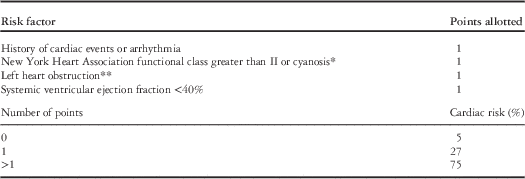
* Aortic valve area <1.5 cm2, left ventricular outflow peak gradient greater than 30 mm of mercury, or mitral valve area <2 cm2
** Oxygen saturation <90%
The strengths of the CARPREG score are that it was developed in a prospective cohort and is easy to calculate, making it amenable for use in clinical practice. The CARPREG score is commonly utilised for pregnancy risk assessment in the United States. It does have important limitations, however. First, the number of women with complex CHD in the cohort was small, both because of the relative rarity of these lesions and because many of these women may have been counselled against pregnancy.Reference Siu, Sermer and Colman6 Second, in our experience, and that of others, the CARPREG score tends to overestimate risk in moderate-to-high risk groups.Reference Balci, Sollie-Szarynska and van der Bijl7
ZAHARA score
The ZAHARA score was developed in a retrospective manner from a multicentre cohort.Reference Drenthen, Boersma and Balci8 Unlike the CARPREG cohort, this study was limited to women with CHD. The study included a total of 1802 women with 1696 gestations. There were 1302 (77%) completed pregnancies. Similar to the CARPREG cohort, the included patients were relatively healthy. Only 2.5% of them had a history of a cardiac complication. The rate of cardiac medication use before pregnancy was 7%. The most common lesions were atrial and ventricular septal defects, coarctation, pulmonic stenosis, and tetralogy of Fallot. The maternal cardiac complication rate was 7.6%, lower than that of the CARPREG study and other cohorts.Reference Khairy, Ouyang, Fernandes, Lee-Parritz, Economy and Landzberg9 The factors associated with increased maternal risk of cardiac complications in the ZAHARA study are listed in Table 2.
The ZAHARA scoring system for cardiac risk assessment in pregnancy.
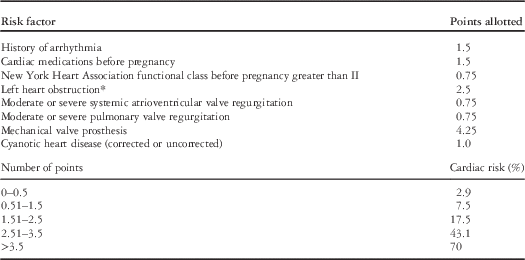
Cardiac risks include risk of clinically significant arrhythmia or heart failure events, thromboembolic events, myocardial infarction, cerebrovascular accidents, and endocarditis
* Aortic valve peak gradient >50 mm of mercury or aortic valve area less than 1.0 cm2
The principle strength of the ZAHARA score was that it was developed in a large CHD-specific population. As with the CARPREG study, however, complex lesions were under-represented, and therefore the score should be used with caution in these patients. It is also important to note that ascertainment of ventricular ejection fraction was limited in this study, perhaps explaining why ventricular dysfunction was not a predictor of outcome.
World Health Organisation classification
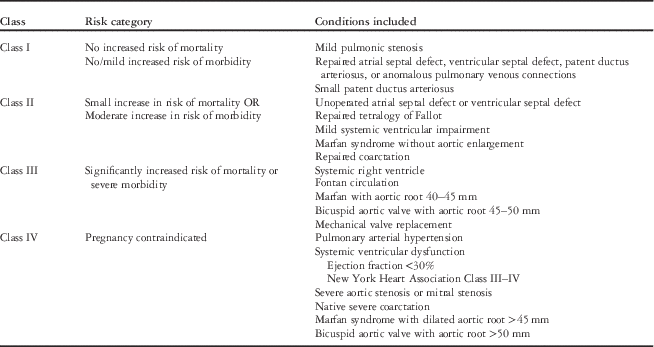
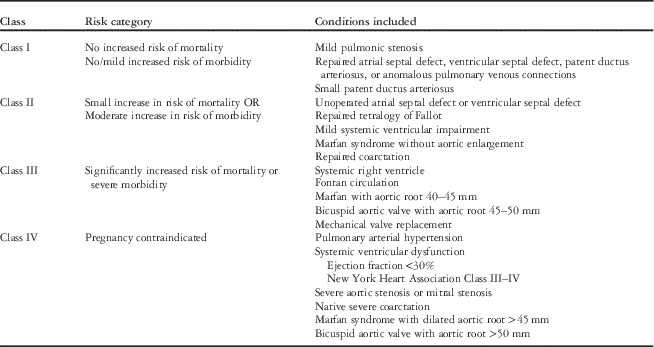
The World Health Organisation classification is a method of risk stratification based on the underlying cardiac diagnosis. It ranges from class I – minimally increased risk – to class IV – pregnancy contraindicated (Table 3). The predominant strengths of this classification are that it is easy to use and that it is based on the totality of the evidence regarding pregnancy risk for each diagnosis. This is in contrast to the CARPREG and ZAHARA scores, which were developed in single cohorts and may not perform as well in other groups. The WHO classification also explicitly states which category of patients should not become pregnant, unlike the other risk scores. It is the mode of risk assessment that is recommended in the European Society of Cardiology guidelines for the management of cardiovascular diseases during pregnancy.Reference Regitz-Zagrosek, Blomstrom Lundqvist and Borghi3 Limitations include the fact that it does not provide a numerical assessment of risk, and therefore may be viewed as less favourable by clinicians and patients. A single CHD diagnosis – for example, tetralogy of Fallot – may present with a range of phenotypes, and therefore not all patients will fall into the same risk category. Other CHD diagnoses are not included in the schema at all.
World Health Organisation pregnancy risk categories.
Focus on complex disease: the Fontan operation and the systemic right ventricle
Patients with the Fontan palliation and those with systemic right ventricles present a particular challenge when they are considering pregnancy.
Both lesions are classified under WHO Class III, predicting a significantly increased risk of pregnancy complications. In this manuscript, we will review the pertinent literature regarding pregnancy in this population.
Fontan physiology
Historically, it was thought that pregnancy was not possible in women after the Fontan operation. Although this has now been disproven, it is true that the physiological changes of pregnancy place a unique stress on the functional single ventricle, which may not be able to tolerate the increase in blood volume or adequately increase cardiac output, placing patients at risk for heart failure and worsening valvular regurgitation. Chronotropic incompetence impairs the normal physiological response to pregnancy.Reference Ohuchi, Arakaki, Yagihara and Kamiya10, Reference Lui, Silversides and Khairy11 Compression of the inferior caval vein, which occurs in the gravid state, can compromise venous return in Fontan patients, leading to hypotension. The Fontan patient’s underlying predisposition to arrhythmias and thrombosis are worsened by pregnancy, increasing the risk of these complications. Finally, cyanosis, if present, is associated with poor outcomes in pregnancy.Reference Presbitero, Somerville, Stone, Aruta, Spiegelhalter and Rabajoli12
Over the past 10–15 years, numerous case reports and small case series have emerged documenting successful, although not uncomplicated, pregnancies in this population.Reference Trojnarska, Markwitz, Katarzynski and Gwizdala5, Reference Inoue, Masuyama, Akagi and Hiramatsu13–Reference Opotowsky, Shellenberger and Dharan22 Although is it is difficult to draw conclusions about absolute rates of complications, given the publication bias that is inherent in these types of reports, they are notable for a high rate of obstetrical complications, especially preterm labour.Reference Hoare and Radford19 They also highlight the potential risk of long-term decline in single ventricular function following pregnancy.Reference Suchonska, Borowiecka, Szymusik, Krzemien-Wiczynska and Borowiecka-Elwertowska17 It is also important to note that rates of infertility may be higher after the Fontan operation; case reports and case series fail to take this into account as they usually include only women who have become pregnant.Reference Gouton, Nizard and Patel23
Several authors have published data from small- to medium-sized cohorts of pregnant Fontan patients. The largest thus far, by Gouton et al, was a multicentre study including 59 pregnancies in 37 patients.Reference Gouton, Nizard and Patel23 The miscarriage rate was 27% and there were a total of 36 live births. The cardiac complication rate was 10%, with the most common complication being atrial arrhythmias. There were two patients with systemic thromboembolism during pregnancy and 1 had a thrombotic event after pregnancy; three patients had post-partum heart failure, one associated with an atrial arrhythmia. The premature birth rate was very high at 69%. There was one late intrauterine death, one stillbirth, and one neonatal death related to extreme prematurity.Reference Gouton, Nizard and Patel23
Drenthen et al conducted a registry-based study of 38 Fontan patients, with a total of 10 pregnancies in six women. The miscarriage rate in this study was 50% and there was one aborted ectopic pregnancy, resulting in four live births. Among them, one patient developed atrial flutter during pregnancy. All four pregnancies were complicated by an obstetrical or neonatal complication, including premature delivery or small for gestational age.Reference Drenthen, Pieper and Roos-Hesselink24
In summary, the available data regarding pregnancy in Fontan patient highlight two important issues. First, the cardiac event rate in this population is high, but not prohibitively so. Second, based on the study by Gouton et al, it appears that the thrombotic risk in pregnancy and in the post-partum period is also relatively high. It has not yet been determined whether anticoagulation is beneficial for pregnant Fontan patients.Reference Gouton, Nizard and Patel23
Systemic right ventricle
Patients with a systemic right ventricle – after Mustard or Senning repair for D-transposition of the great arteries or those with congenitally corrected transposition of the great arteries – have a unique physiology that predisposes them to cardiac complications during pregnancy.Reference Jain, Moghbeli, Webb, Srinivas, Elovitz and Pare25 The predominant concerns in this population are arrhythmias and heart failure, which can occur because the systemic right ventricle has an impaired ability to cope with the increased demands of pregnancy. Tricuspid regurgitation, when present, may also worsen.Reference Guedes, Mercier, Leduc, Berube, Marcotte and Dore26, Reference Connolly, Grogan and Warnes27 Studies on pregnant patients with a systemic right ventricle are limited both in number and in sample size. Many studies include both atrial switch and congenitally corrected transposition patients in the same sample, which fail to account for important physiological differences between the two.Reference Jain, Moghbeli, Webb, Srinivas, Elovitz and Pare25, Reference Gelson, Curry and Gatzoulis28, Reference Bowater, Selman, Hudsmith, Clift, Thompson and Thorne29
In one of the largest studies of atrial switch patients alone, Canobbio et al investigated a total of 70 pregnancies in 40 women; 54 of these pregnancies resulted in live births. The majority of women belonged to New York Heart Association functional class I at the beginning of pregnancy. Despite this, the cardiac event rate was high at 36%. The most common events were arrhythmia and heart failure, and they developed both in the third trimester and in the first 1–2 weeks post-partum. Among them, one woman required cardiac transplantation due to severe systemic ventricular dysfunction post-partum. A review article including more than 170 pregnancies in patients with D-transposition of the great arteries concluded that the arrhythmia rate was 15.6% and the heart failure rate was 10.8%. Other cardiac complications were rarely observed.Reference Drenthen, Pieper and Roos-Hesselink2
In a relatively large study of 60 pregnancies in 22 women with congenitally corrected transposition, Connolly et al found that cardiac complications developed in two women. In both cases, the complication was heart failure. In one case, it was related to worsening atrioventricular valve regurgitation, and valve replacement was required following pregnancy. Out of 60 pregnancies, 50 of them were successful, and only one was complicated by premature birth. Overall, this study and others suggest that pregnancy is well tolerated in many women with congenitally corrected transposition.Reference Connolly, Grogan and Warnes27, Reference Kowalik, Klisiewicz, Biernacka and Hoffman30 Serious adverse outcomes such as the need for cardiac transplantation have been reported in the post-partum period in this population, however.Reference Drenthen, Pieper and Roos-Hesselink2, Reference Canobbio, Morris, Graham and Landzberg31
Importantly, there may be a risk of premature decline in systemic right ventricular function associated with pregnancy. Bowater et al identified 18 women with a systemic right ventricle who had become pregnant and age-matched them with males and nulliparous female controls. At baseline, there was no difference in New York Heart Association functional class or right ventricular function between cases and controls. Both right ventricular function and functional class declined significantly during and after pregnancy, and the decline in ventricular function persisted over time.Reference Bowater, Selman, Hudsmith, Clift, Thompson and Thorne29 Zentner et al also performed a case–control study in patients after the atrial switch procedure to determine whether long-term outcomes such as sudden cardiac death and clinical heart failure were more common in these women than in nulliparous controls, and they found that they were common, although the event rates were low in both the groups.Reference Zentner, Wheeler and Grigg32
Fertility in complex CHD
Relatively little is known about sub-fertility and infertility in the complex CHD population. In the study by Gouton et al of pregnancy after the Fontan, 21% of women had infertility, requiring assisted reproductive technology, compared with an age-expected rate of 6%.Reference Gouton, Nizard and Patel23 Other authors have also found a relatively high rate of infertility in this population.Reference Drenthen, Pieper and Roos-Hesselink24 In women with complex CHD who do become pregnant, there is a high rate of miscarriage, especially in cyanotic patients and those after the Fontan operation.Reference Drenthen, Pieper and Roos-Hesselink2, Reference Connolly, Grogan and Warnes27
Assisted reproductive technology can be utilised in these patients but it does have documented risks including a risk for thrombosis.Reference Fiedler and Ezcurra33 This topic will be discussed in further detail in the next section.
The approach to pregnancy in complex CHD patients
Risk assessment in CHD patients desiring pregnancy should always begin with a thorough review of the patient’s history, functional status, and the presence of cardiac symptoms. A detailed physical examination should be performed. A particular note should be made of oxygen saturation at rest and with ambulation, as cyanosis is poorly tolerated in pregnancy.Reference Presbitero, Somerville, Stone, Aruta, Spiegelhalter and Rabajoli12 Non-invasive imaging is used to delineate patient physiology and any haemodynamic factors that may increase pregnancy risk. A baseline echocardiogram should be ordered for all pregnant patients or those considering pregnancy. Magnetic resonance imaging can be helpful in select patients. We perform cardiopulmonary exercise testing in all but the lowest risk patients. Heart rate parameters such as chronotropic incompetence have been associated with adverse events in some studies.Reference Lui, Silversides and Khairy11, Reference Ohuchi, Tanabe and Kamiya34 In addition to assessing the woman’s overall risk, the goal of the initial evaluation is to identify any factors that could be improved upon to improve her risk profile – for example, haemodynamically significant atrial septal defects should be closed.Reference Regitz-Zagrosek, Blomstrom Lundqvist and Borghi3 Collaboration with a high-risk obstetrical team is mandatory for moderate- and high-risk cases. Low-risk patients can be usually managed by a general obstetrician.
For women who are determined to go through a high-risk pregnancy, we advocate discussing alternatives to biological pregnancy. These include adoption or the use of a gestational carrier, either with the patient’s own or a donated egg. In vitro fertilisation using the patient’s own egg does involve the use of hormonal therapy to stimulate the ovaries; rarely, this can result in ovarian hyperstimulation syndrome.Reference Fiedler and Ezcurra33 Ovarian hyperstimulation syndrome is characterised by third spacing of fluid and haemoconcentration. In some cases, it can be complicated by venous thrombosis. Ovarian hyperstimulation syndrome is of particular concern in Fontan patients who are already at risk for thrombosis and who are vulnerable to fluid shifts. We recommend partnering with an obstetrical colleague who is familiar with performing ovarian stimulation in higher-risk patients and who will incorporate strategies to minimise such risks.Reference Fiedler and Ezcurra33
With regard to management during the pregnancy, our standard practice is to order an echocardiogram in the first and third trimesters, with additional echocardiograms performed on an as-needed basis. A second trimester fetal echocardiogram is required to screen for fetal heart diseases. We also discuss the use of genetic counselling before pregnancy in women who are interested in knowing the risk of transmission of CHD.
The frequency of follow-up during pregnancy is dependent on the severity of the underlying CHD and whether or not the patient develops any symptoms or complications. As previously mentioned, vaginal delivery is the preferred mode of delivery, unless there are obstetrical indications for a caesarean section. Notable exceptions to this include patients with Marfan syndrome with a dilated aortic root (>45 mm), patients with known aortic dissection, intractable heart failure, and patients presenting with preterm labour while on oral anticoagulants.Reference Regitz-Zagrosek, Blomstrom Lundqvist and Borghi3 Elective caesarean section may also be considered in cases with other very-severe lesions such as critical aortic stenosis or pulmonary hypertension. Careful monitoring of the patient should occur for at least 24 hours following delivery due to continued fluid shifts and may include telemetry for those considered at high risk for arrhythmia. It is also important to note that the increased risk for cardiac complications does not end at delivery; it continues into the post-partum period.Reference Roos-Hesselink, Ruys and Stein35 We routinely see women in the clinic about 4–6 weeks after delivery with imaging. Some patients may need to be seen sooner.
Conclusions
Pregnancy presents a unique physiological state that can be challenging for women with CHD. Patients with Fontan physiology and those with systemic right ventricles are at particularly high risk of pregnancy complications. Even so, many are able to complete successful pregnancies. There is no “one-size-fits-all” way to assess risk factors in CHD patients desiring pregnancy. Instead, providers must perform an individualised assessment in each patient, taking into account her haemodynamics, cardiac function, and functional status, as well her feelings and beliefs regarding the importance of pregnancy. The ultimate goal of both the provider and the patient is not just to have an uncomplicated pregnancy but also to preserve the long-term health of the mother. As such, it is important for providers to counsel patients not just about the risks during pregnancy but also about the risk of potential long-term complications that may occur as a result of pregnancy.
Acknowledgement
None.