Introduction
There is to our knowledge no evaluation of the sustainability of pig farming systems considering the three classical pillars of sustainability (economy, environment and society) in an integrated way, although such studies are available in other species (dairy: Van Calker et al., Reference Van Calker, Berentsen, Giesen and Huirne2005; egg: Mollenhorst et al., Reference Mollenhorst, Berentsen and De Boer2006; conceptual: Van Cauwenbergh et al., Reference Van Cauwenbergh, Biala, Bielders, Brouckaert, Franchois, Garcia Cidad, Hermy, Mathijs, Muys, Reijnders, Sauvenier, Valckx, Vanclooster, Van der Veken, Wauters and Peeters2007; sheep: Ripoll-Bosch et al., Reference Ripoll-Bosch, Diez-Unquera, Ruiz, Villalba, Molina, Joy, Olaizola and Bernues2012). Previous studies on pig farming have mostly focused on environmental impact (e.g. Basset-Mens et al., Reference Basset-Mens and Van der Werf2005), economy or social acceptance (e.g. Boogaard et al., Reference Boogaard, Boekhorst, Oosting and Sørensen2011).
A collaborative work has been conducted within the EU-funded research project Quality PorkChains (Q-PorkChains (www.q-porkchains.org)) to build a tool for the multidimensional evaluation of the sustainability of pig farming systems. Within the same framework, the tool was then used to assess the sustainability of 15 contrasted pig farming systems. The systems were selected on the basis of an inventory of farming systems that was conducted within the same project (Bonneau et al., Reference Bonneau, Antoine, Phatsara, Brinkmann, Hviid, Groes-Christiansen, Fabrega, Rodriguez, Rydhmer, Enting, De Greef, Edge, Dourmad and Edwards2011) and documented the variety of existing farming systems in European countries. The tools for the evaluation of sustainability were elaborated from literature and from the expertise of the participants to the research project (Edwards et al., 2008). Sustainability was evaluated along eight themes: Animal Welfare, Animal Health, Breeding Programmes, Environmental Sustainability, Meat Safety, Market Conformity, Economy and Working Conditions. An overall evaluation was also performed.
This paper is an introduction to a series of companion papers providing the results of the evaluation of the systems regarding Breeding Programmes (Rydhmer et al., Reference Rydhmer, Gourdine, De Greef and Bonneau2014), Environmental Sustainability (Dourmad et al., Reference Dourmad, Ryschawy, Trousson, Bonneau, Gonzàlez, Houwers, Hviid, Zimmer, Nguyen and Morgensen2014), Market Conformity (Gonzàlez et al., Reference Gonzàlez, Gispert, Gil, Hviid, Dourmad, De Greef, Zimmer and Fàbrega2014), Economy (Ilari-Antoine et al., Reference Ilari-Antoine, Bonneau, Klauke, Gonzàlez, Dourmad, De Greef, Houwers, Fàbrega, Zimmer, Hviid, Van der Oever and Edwards2014) and the Integrated Evaluation (Bonneau et al., Reference Bonneau, Klauke, Gonzàlez, Rydhmer, Ilari-Antoine, Dourmad, De Greef, Houwers, Cinar, Fàbrega, Zimmer, Hviid, Van der Oever and Edwards2014). The integrated evaluation was conducted with inputs from the eight theme evaluations. The aim of this paper is to present the procedure that was used for the evaluation, the farming systems that were evaluated and a brief overview of the tools that were used to evaluate sustainability.
Procedure used for the evaluation
The evaluation was carried out as a collaborative work between the people and organisations presented in the list of authors and affiliations. The first step was the elaboration of the tools for the evaluation of sustainability of pig farming systems. This work was carried out in 2007 and 2008 under the responsibility of S.A. Edwards. Eight themes were defined and each of them was placed under the responsibility of a theme leader (Animal Welfare and Working Conditions: H.L. Edge; Animal Health: C. Phatsara; Breeding Programmes: L. Rydhmer; Environment: J.Y. Dourmad; Meat Safety: D. Brinkman; Market Conformity: J. Gonzàlez; Economy: E. Ilari-Antoine).
A survey of the literature was performed and resulted in the elaboration of an internal document that served as a basis for the elaboration of the eight tools, described in the relevant companion papers, and summarised in the section ‘The tools used for sustainability evaluation’ below.
In a second step, the tools were used for the evaluation of 15 farming systems. This work was carried out in 2009 to 2010 under the overall responsibility of M. Bonneau. The data for the eight themes were collected, using a form under Microsoft Excel that was specially designed for this study, under the responsibility of five country leaders (Denmark: M. Hviid; France: J.Y. Dourmad; Germany: C. Zimmer; Spain: J. Gonzàlez; The Netherlands: K. de Greef). The third step was the analysis of the results. Theme-wise analyses were first performed, under the responsibility of S.A. Edwards (Animal Welfare and Working Conditions), L. Rydhmer (Breeding Programmes), J.Y. Dourmad (Environment), M.U. Cinar and T.N. Klauke (Animal Health), T.N. Klauke (Meat Safety), J. Gonzàlez (Market Conformity) and E. Ilari-Antoine (Economy). Each theme then contributed with a restricted number of the most representative variables (primary indicators) to an integrated evaluation that was carried out under the responsibility of M. Bonneau.
Evaluated systems
In this paper as well as in all companion papers, the studied ‘pig farming systems’ were defined nationally from the expertise of national scientists working in the Q-porkChains team and having a good knowledge of pig production in their country. The wording ‘pig farming systems’ stands for a group of farms within a country that are similar in terms of objectives, production methods and market orientation. The previously performed inventory (see ‘Introduction’ section) resulted in the identification of 84 production systems of which 40 were considered as ‘conventional’ whereas 44 were identified as ‘differentiated’ on the basis of claims for better achievements regarding Animal Welfare, Eating Quality, Nutritional Quality or Environment or of claims to be local or organic. The 15 systems assessed in the present study were selected on the basis of:
-
∙ Availability of a national team to perform the studies.
-
∙ Presence of a conventional system and two differentiated systems in each of the five countries.
-
∙ Representation of all claims in the differentiated systems.
-
∙ Achieve a high diversity of systems.
Our hypothesis was that putting the tools to the test of very diverse systems would enable us to develop a final tool that is robust to accommodate the very diverse situations that can be found in Europe and worldwide, from intensive, indoor, conventional systems using highly performing breeds for standard meat to extensive, outdoor systems using local breeds for very high quality target markets.
Our aim was to evaluate 10 farms/system, mostly through interviews of farmers (see ‘The tools used for sustainability evaluation’ section). Farms were selected on the basis of representativeness of the system, availability at the time of the study and willingness of the farmer to participate. The achieved number of farms per system was somewhat lower (average: 8.7; range 3 to 13). In all, 11 systems were represented by 9 to 13 farms. Four systems were represented by three to five farms, the reasons for such low numbers being either availability of farms (one system was real tiny) or lack of willingness of farmers to participate. Overall, even for the best represented systems, the farm numbers are too low to enable a statistically satisfactory representation of the systems. Therefore, in this series of papers, the emphasis will be put on exploring the capacity of the tools to exemplify differences between farms and systems rather than on comparing systems and the systems will be kept anonymous.
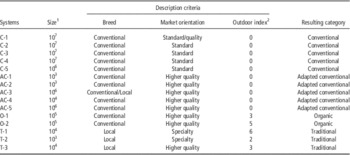
The selected systems were evaluated in five countries (Denmark, France, Germany, The Netherlands and Spain) with three systems per country ranging in size from 2500 to 32 million slaughter pigs produced per year. Farms were predominantly family owned except in two systems (one was mostly on the integration model; one was partly family owned, partly integrated). They were classified in four categories: Conventional (n=5, one per country), Adapted Conventional (n=5), Organic (n=2) and Traditional (n=3), on the basis of three parameters: breeding line, targeted market segment and extent of outdoor housing, as described in Table 1. These parameters were considered as good markers of conventionality (conventional breed, standard meat as targeted market, no outdoor rearing) or distanciation from conventionality (local breed, higher quality or specialty target market, outdoor rearing). The conventional systems (C-1 to C-5) were all common standard systems in their countries, but they have different conditions because of, for example, regulations, market, policies and climate. They commonly practiced indoor systems meeting minimum EU space requirements described in Council Directive 2008/120/EC (European Commission, 2008), a fully or partly slatted floor and 100% concentrate feeding. The adapted conventional systems differed from the Conventional with regard to specific claims, that is, claims for superior animal welfare (AC-1 and AC-4), meat quality (AC-2, AC-3 and AC-5) and on being environmentally friendly (AC-4). They had extra qualities like extra space for housing, special feed or took special measures to prevent environmental pollution and aimed at a special market segment. The organic production systems (O-1 and O-2) were both inspired by the organic principles stated by the International Federation of Organic Agriculture Movements (IFOAM, 2005) although one of them was not classified as organic according to the EU regulation for organic production No 834/2007 (European Commission, 2007). The traditional systems (T-1 and T-3) were systems aiming at preserving local breeds in a traditional environment and claiming special traits, and also aiming at special markets. They were small scale systems associated with specific regions of Europe and they used local breeds from small populations.
Size of the farming systems and criteria used for categorising them

1 Order of magnitude of the number of slaughters pig produced per year. No precise figures are given for reasons of anonymity.
2 Outdoor index=sum of the scores given for the housing of sows, piglets and fatteners with 0 for indoor, 1 for semi-outdoor (indoor with access to outdoor concrete runs) and 2 for outdoor (access to pasture or forest).
The tools used for sustainability evaluation
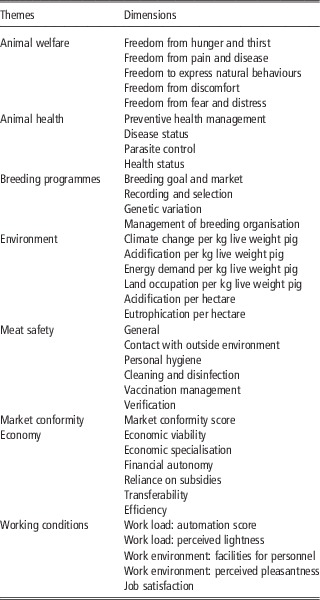
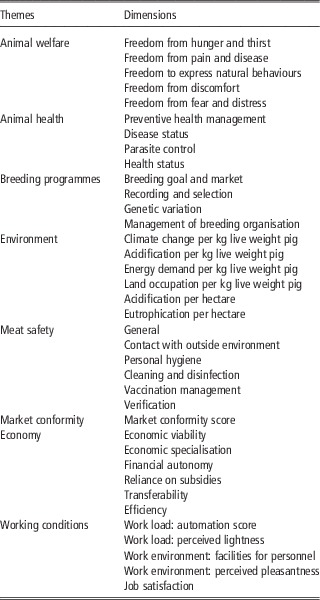
Detailed descriptions of the tools used for theme-wise evaluations are provided in the relevant companion papers (Breeding Programmes: Rydhmer et al., Reference Rydhmer, Gourdine, De Greef and Bonneau2014; Environment: Dourmad et al., Reference Dourmad, Ryschawy, Trousson, Bonneau, Gonzàlez, Houwers, Hviid, Zimmer, Nguyen and Morgensen2014; Market Conformity: Gonzàlez et al., Reference Gonzàlez, Gispert, Gil, Hviid, Dourmad, De Greef, Zimmer and Fàbrega2014; Economy: Ilari-Antoine et al., Reference Ilari-Antoine, Bonneau, Klauke, Gonzàlez, Dourmad, De Greef, Houwers, Fàbrega, Zimmer, Hviid, Van der Oever and Edwards2014) or as Supplementary Material (Supplementary Material S1) for Animal Welfare, Animal Health, Meat Safety and Working Conditions. Briefly, each theme was assessed along one to six dimensions, as described in Table 2. For Animal Welfare, the five dimensions corresponded to the Five Freedoms (FAWC, 1993; Webster, Reference Webster2001). For Animal Health, the four dimensions summarised the information provided by a questionnaire modified from the one developed by Berns (Reference Berns1996); Van der Wolf et al. (Reference Van der Wolf, Mack, Gymnich, Schulze Althoff and Petersen2004) and Mack (Reference Mack2007). The questionnaire for Breeding Programmes was based on a checklist for sustainable breeding schemes developed by Woolliams et al. (Reference Woolliams, Berg, Mäki-Tanila, Meuwissen and Fimland2005). When assessing farming systems using local breeds, questions about the characteristics of the breed were added to that list, based on Ruane’s study (Reference Ruane1999). The dimension Environment used the Life Cycle Assessment approach that is well adapted for the environmental evaluation of livestock farms and has been already widely used as reviewed by De Vries and de Boer (Reference De Vries and De Boer2010). For Meat Safety, the questionnaire was developed following the ideas of quality management (Stretch, Reference Stretch2005). The six dimensions of the questionnaire were designed following earlier reports (Von Borell et al., Reference Von Borell, Bockisch, Büscher, Hoy, Krieter, Mueller, Parvizi, Richter, Rudovsky, Sundrum and Van den Weghe2001; Norrung and Buncic, Reference Norrung and Buncic2008; Fosse et al., Reference Fosse, Seegers and Magras2009; Doyle and Erickson, Reference Doyle and Erickson2012; Jenson and Sumner, Reference Jenson and Sumner2012). Market Conformity was defined as the extent to which the quality of the carcasses and of the meat produced in the farms matched the requirements of the system’s targeted market(s). Carcass and meat quality criteria were measured at slaughter. Acceptability benchmarks and market shares for each pork product category were obtained from the literature, from the specifications defined by the quality brands in some systems, and from personal communications with experts on the systems. The Economy dimension was assessed, using the economy part of the IDEA method (Indicateurs de Durabilité des Exploitations Agricoles=Farm Sustainability Indicators; Vilain et al., Reference Vilain2003; Zahm et al., Reference Zahm, Viaux, Vilain, Girardin and Mouchet2008). The questionnaire on Working Conditions was designed specifically for the present study.
Dimensions considered within sustainability themes
Most of the information was derived from interviews with farmers (with a total of over 500 questions asked to the farmers), with the following exceptions:
-
∙ The greater part of the information pertaining to Breeding Programmes was gathered from interviews with the nine breeding organisations that provided the genetic material to the farms included in the study, and a lesser part from interviews with farmers.
-
∙ The information on Market Conformity was derived from eight measurements at slaughterhouses and from the expertise of chain operators.
Within each of the 37 dimensions, the results obtained from the various questions or observations were aggregated in one primary indicator, which contributed to the integrated evaluation, as described in a study by Bonneau et al. (Reference Bonneau, Klauke, Gonzàlez, Rydhmer, Ilari-Antoine, Dourmad, De Greef, Houwers, Cinar, Fàbrega, Zimmer, Hviid, Van der Oever and Edwards2014).
Acknowledgements
The authors gratefully acknowledge from the European Community financial participation under the Sixth Framework Programme for Research, Technological Development and Demonstration Activities, for the Integrated Project Q-PorkChains FOOD-CT-2007-036245. The views expressed in this publication are the sole responsibility of the author(s) and do not necessarily reflect the views of the European Commission. Neither the European Commission nor any person acting on behalf of the Commission is responsible for the use, which might be made of the information. The information in this document is provided as is and no guarantee or warranty is given that the information is fit for any particular purpose. The user thereof uses the information at its sole risk and liability.
Supplementary material
To view supplementary material for this article, please visit http://dx.doi.org/10.1017/S1751731114002110