


Introduction
Social determinants of health (SDOH) – the social and economic conditions shaping how individuals live, work, and age – are increasingly recognized as foundational drivers of health outcomes. Individuals facing unmet needs like food insecurity, housing instability, unemployment, or unsafe living environments suffer higher rates of chronic illness, mental health challenges, and premature mortality [Reference Drake, Batchelder and Lian1,Reference Weir, Proser and Jester2]. The World Health Organization has affirmed that addressing these determinants is essential to achieving equitable health systems [3]. In the United States, people with significant social risk frequently rely on emergency departments (EDs) as their primary point of care, resulting in fragmented services, avoidable utilization, and higher costs [Reference Molina, Cash and Loo4,Reference Loo, Molina and Ahmad5].
The ED is uniquely positioned to identify and help mitigate these upstream risks. Patients presenting to EDs are more likely to confront socioeconomic hardship, lack stable primary care, and encounter systemic barriers to healthcare access [Reference Capp, Kelley and Ellis6,Reference Rodriguez, Fortman and Chee7]. Studies document high prevalence of social needs among ED patients – including food insecurity, housing instability, and transportation challenges – all correlating with adverse healthcare usage and outcomes [Reference Baggett, Singer and Rao8]. For instance, food insecurity is independently tied to increased ED visits and hospitalizations [Reference Murray, Roosevelt and Vogel9]. These factors underscore the importance of integrating social needs identification into ED workflows as part of comprehensive, patient-centered care.
Policy shifts are increasingly driving this integration. The Centers for Medicare & Medicaid Services now require hospitals to report on SDOH domains such as housing, food, and transportation through the 2024 Inpatient Quality Reporting Program [10]. The Joint Commission mandates that accredited institutions systematically identify and address patient-level disparities, including social risk factors [11]. The American College of Preventive Medicine advocates for social needs screening only when appropriate referral mechanisms are in place – emphasizing the need for actionable, not merely observational, approaches [Reference Livingston, Titus, Yerokun and Patel12]. Together, these changes elevate SDOH screening from an optional innovation to an expected component of quality clinical care.
A range of screening instruments exist to facilitate social needs identification. The Accountable Health Communities Health-Related Social Needs (AHC-HRSN) tool, developed by CMS, assesses multiple domains and has shown moderate feasibility in ED contexts [Reference Alley, Asomugha, Conway and Sanghavi13]. The Core 5 screening tool offers brevity but sacrifices breadth [Reference Buitron de la Vega, Losi and Sprague Martinez14]. In contrast, the PRAPARE tool, established by the National Association of Community Health Centers, offers a comprehensive, 21-item assessment spanning housing, food, employment, stress, and more. It is heavily used in primary care, with proven patient acceptability and utility in intervention planning [Reference Drake, Batchelder and Lian1,Reference Weir, Proser and Jester2].
However, the PRAPARE tool’s length poses challenges within the fast-paced ED environment. Evidence shows administrative time constraints, staff capacity, and workflow complexity impede implementation [Reference Loo, Molina and Ahmad5,Reference Gold, Cottrell and Bunce15,Reference Kangovi, Barg, Carter, Long, Shannon and Grande16]. Despite this, innovative adaptations show promise. Some EDs have piloted electronic or volunteer-administered tools with or without EHR integration to minimize impact on clinical staff [Reference Alley, Asomugha, Conway and Sanghavi13,Reference Buitron de la Vega, Losi and Sprague Martinez14,Reference Bailey, Krieger, Agénor, Graves, Linos and Bassett17–Reference Rhodes, Pollock and Molesky19]. To enhance feasibility further, several studies have evaluated short-form versions of social needs screening instruments. A shortened, digital variant of a multidomain tool used in maternal health retained sensitivity while reducing respondent burden [Reference Andermann20]. Other programs incorporating streamlined questions into EHR pathways demonstrated improved uptake and scalability [Reference De Marchis, Hessler and Fichtenberg21]. Yet, rigorous assessment of abridged PRAPARE tools tailored to ED settings remains scarce, and questions persist regarding their workflow integration and ability to identify actionable needs.
Beyond feasibility, impact remains an underexplored area. Technical briefs and systematic reviews warn that the current literature focuses primarily on feasibility and has limited data on outcomes related to health utilization or patient well-being [Reference Eder, Henninger and Durbin22,Reference Henrikson, Blasi and Dorsey23]. There is also a lack of validation studies assessing PRAPARE specifically in ED populations [Reference Eder, Henninger and Durbin22,24]. These gaps underscore the need for ED-specific research evaluating pragmatically adapted instruments, their ability to identify social risk, the operational models through which they can be deployed, and the actions that follow.
Addressing these gaps, our study describes the feasibility of implementing an 11-item abridged PRAPARE screening process in a high-volume academic ED, using an operational model that minimizes burden on clinical staff while identifying substantial unmet social needs. By focusing on the most prevalent and actionable domains – selected based on local prevalence, resource alignment, and consensus – we aimed to create a streamlined tool suited to ED workflow. We draw on the operational model established by the ParallelED program to efficiently integrate volunteer assistance [Reference Purakal, Moon and Lee25]. Our objectives were to evaluate (1) the feasibility of implementing the abridged PRAPARE screening process using a volunteer-based model operating outside the clinical workflow in a high-volume ED, (2) the prevalence and types of unmet social needs identified, and (3) patient willingness to engage with assistance among those screened.
Materials and methods
Study design and setting
This retrospective quality improvement study was conducted from October 2021 to October 2023 in the ED of a large academic tertiary care medical center in Durham, North Carolina. The ED is a Level I trauma center with an annual census of more than 80,000 visits and serves a socioeconomically and racially diverse patient population. The study leveraged waiting-room time for survey administration to minimize disruption to clinical workflows.
Population
All adult patients (≥18 years) presenting to the ED during volunteer screening shifts were eligible for participation. Exclusion criteria included patients requiring immediate triage for medical instability, those with altered mental status, those who did not speak English or Spanish (due to the absence of validated translated instruments during the study period), and those unable to provide informed consent or complete the survey because of acute illness (e.g., respiratory distress, severe pain, vomiting). Patients were approached in the waiting room by trained student volunteers and invited to participate after providing verbal informed consent.
Survey instrument
The study team adapted the Protocol for Responding to and Assessing Patients’ Assets, Risks, and Experiences (PRAPARE) survey for use in the ED. The original 21-item tool was shortened to 11 items to improve feasibility in the acute care environment. Items were selected through a consensus-based process involving emergency physicians, social workers, and student volunteers, informed by (1) prevalence of needs identified in prior institutional ED data, (2) alignment with locally available community referral resources, and (3) review of existing short-form social needs instruments in comparable care settings [Reference Buitron de la Vega, Losi and Sprague Martinez14,Reference Andermann20]. We acknowledge that patient voices were not formally included in the item selection process, a limitation we address in the discussion. The abridged tool was designed for efficient administration under real-world ED time constraints and to cover domains known to be prevalent and actionable in this setting. This study describes the implementation of an adapted instrument rather than a formal validation; psychometric properties such as sensitivity, specificity, and construct validity relative to the full PRAPARE tool were not evaluated, and the abridged tool should not be considered a validated instrument on the basis of these data. The abridged version retained domains addressing housing stability, food insecurity, utilities, transportation, employment, safety, insurance coverage, and stress (Supplement 1). The survey instrument was translated into Spanish and verified by two native-Spanish-speakers.
Survey administration
Surveys were administered verbally by trained undergraduate student volunteers using a model utilized previously by this study group [Reference Purakal, Moon and Lee25]. Student volunteers underwent structured training before data collection. Training included instruction in standardized patient approach, survey administration, confidentiality protections, and accurate documentation of responses. Volunteers were also oriented to available referral resources and taught escalation procedures for urgent safety concerns. Surveys were administered in the ED waiting room during two scheduled 2-hour shifts each day (10:00 AM and 5:00 PM). Participant responses were recorded on paper forms and subsequently entered into a secure REDCap database by the study team. Spanish-speaking volunteers administered the survey to Spanish-speaking patients.
Statistical analysis
Descriptive statistics were used to characterize patient demographics and the prevalence of social needs. Frequencies and proportions were calculated for each survey item. The racial and ethnic distribution of screened patients was compared with the overall ED census to assess representativeness. Formal subgroup or inferential comparisons of need prevalence by age, sex, or race/ethnicity were not performed, as the study was designed as a descriptive quality improvement analysis. Data analysis was conducted using R v.4.2.2 (The R Foundation, Vienna, Austria).
Ethical considerations
The Duke University School of Medicine Institutional Review Board reviewed the study and deemed it exempt as a quality improvement initiative. Verbal informed consent was obtained from all participants prior to survey administration. All data were de-identified prior to analysis, and procedures were conducted in accordance with institutional standards for confidentiality.
Results
Study population
During the study period, 814 patients initiated the abridged PRAPARE survey. Of these, 683 (83.9%) completed all survey items and were included in the analysis; 131 (16.1%) had incomplete responses and were excluded. A flowchart depicting participant selection from the general ED population is shown in Figure 1.
Flowchart depicting selection of study participants from the general patient population. Abbreviations: ED, emergency department; EHR, electronic health record; N, number of patients.

Figure 1. Long description
A vertical flowchart with six stacked boxes connected by downward arrows, each with a branch arrow to the right showing the number of patients excluded at that stage. The top box reads: patients asked to participate in screening, N equals 6,931. A branch to the right reads: patients declined to participate, N equals 6,094. The second box reads: patients started screening, N equals 837. A branch reads: collapsed patient duplicates, N equals 23. The third box reads: unique patients, N equals 814. A branch reads: patients who started screening more than once, N equals 16. The fourth box reads: patients who started screening once, N equals 798. A branch reads: patients with unavailable electronic health record data, N equals 69. The fifth box reads: patients with available electronic health record data, N equals 729. A branch reads: patients with incomplete screening, N equals 46. The final box reads: patients who completed all screening questions, N equals 683.
Among respondents, the majority identified as non-Hispanic Black (n = 426, 62.4%), followed by non-Hispanic White (n = 121, 17.7%) and Hispanic (n = 101, 14.8%). Most participants were female (n = 419, 61.3%), with 258 (37.8%) male and 3 (0.4%) non-binary. Participants represented a wide age distribution: <15 years (n = 1, 0.1%), 15–25 years (n = 80, 11.7%), 26–35 years (n = 131, 19.1%), 36–45 years (n = 116, 16.9%), 46–55 years (n = 112, 16.3%), 56–65 years (n = 125, 18.3%), and >65 years (n = 92, 13.5%). Insurance coverage was reported by 493 respondents (72.2%): private (n = 230, 33.7%), Medicaid (n = 114, 16.7%), and Medicare (n = 153, 22.4%). One in five respondents (n = 136, 19.9%) were uninsured. Compared with the overall ED census, in which Black patients comprised approximately 40% of visits, non-Hispanic Black patients were overrepresented among those screened (62.4%). Complete demographic details are shown in Table 1.
Demographic characteristics of patients who completed the PRAPARE screening survey. PRAPARE, Protocol for Responding to and Assessing Patients’ Assets, Risks, and Experiences; N, number; %, percent

Table 1. Long description
A table with two columns, headed Category and N with percent in parentheses, describing the 683 patients who completed all PRAPARE items. Rows are grouped under four headings. Under Age: under 15 years, 1 patient, 0.1 percent; 15 to 25 years, 80, 11.7 percent; 25 to 35 years, 131, 19.1 percent; 35 to 45 years, 116, 16.9 percent; 45 to 55 years, 112, 16.3 percent; 55 to 65 years, 125, 18.3 percent; 65 years and over, 92, 13.5 percent. Under Race and Ethnicity: American Indian or Alaska Native, 23, 3.4 percent; Asian, 16, 2.3 percent; Black Hispanic, 8, 1.2 percent; Black non-Hispanic, 426, 62.4 percent; Hispanic, 101, 14.8 percent; White Hispanic, 22, 3.2 percent; White non-Hispanic, 121, 17.7 percent. Under Sex: male, 258, 37.8 percent; female, 419, 61.3 percent; non-binary, 3, 0.4 percent. Under Insurance Status: private, 230, 33.7 percent; Medicaid, 114, 16.7 percent; Medicare, 153, 22.4 percent; uninsured, 136, 19.9 percent. Black non-Hispanic patients are the largest racial and ethnic group, and most respondents are female.
Screening reach and implementation
Across the study period, volunteers approached 6,931 patients during covered shifts, of whom 837 initiated screening. After collapsing duplicates and excluding records with unavailable data or incomplete responses, 683 patients (9.8% of those approached) completed the full abridged survey. Screening was conducted entirely during waiting-room time by trained volunteers, without requiring dedicated time from triage nurses, physicians, or other clinical staff. No adverse events or escalations for acute safety concerns interrupted clinical operations during the study period.
Prevalence of social needs
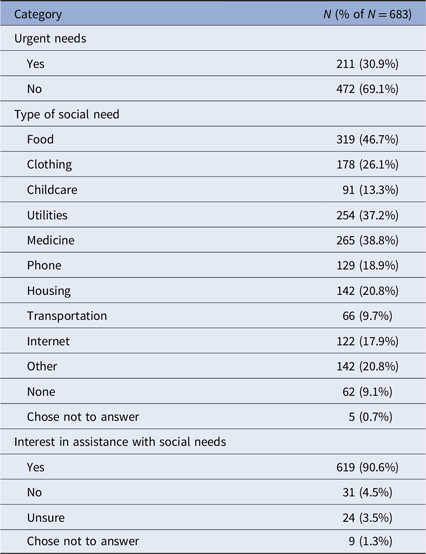
Nearly all participants (n = 645, 94.4%) reported at least one unmet social need. Among these, 360 (55.8%) endorsed three or more concurrent needs, indicating substantial cumulative social burden. The most frequently reported needs included food insecurity (n = 321, 47.0%), difficulty affording medications (n = 267, 39.1%), and utilities insecurity (n = 253, 37.0%). Housing instability was reported by 185 participants (27.1%), unemployment by 177 (25.9%), and transportation barriers by 191 (28.0%). A smaller but important subset (n = 103, 15.1%) reported feeling unsafe in their home environment.
Patient willingness to engage with assistance
Of those with identified needs, 619 participants (90.6%) expressed willingness to engage with assistance, 31 (4.5%) declined, and 24 (3.5%) were unsure. The full distribution of identified social needs and patient willingness to engage is presented in Table 2. The high proportion of patients willing to engage indicates that the abridged screening process was well-tolerated when delivered through this volunteer-based model operating outside the clinical workflow.
Social needs identified by participants who completed the abridged PRAPARE screening survey. PRAPARE, Protocol for Responding to and Assessing Patients’ Assets, Risks, and Experiences; N, number; %, percent

Table 2. Long description
A table with two columns, headed Category and N with percent of 683 in parentheses, grouped under three headings. Under Urgent Needs: yes, 211 patients, 30.9 percent; no, 472, 69.1 percent. Under Type of Social Need: food, 319, 46.7 percent; clothing, 178, 26.1 percent; childcare, 91, 13.3 percent; utilities, 254, 37.2 percent; medicine, 265, 38.8 percent; phone, 129, 18.9 percent; housing, 142, 20.8 percent; transportation, 66, 9.7 percent; internet, 122, 17.9 percent; other, 142, 20.8 percent; none, 62, 9.1 percent; chose not to answer, 5, 0.7 percent. Patients could report more than one need, so these categories do not sum to 100 percent. Under Interest in Assistance with Social Needs: yes, 619, 90.6 percent; no, 31, 4.5 percent; unsure, 24, 3.5 percent; chose not to answer, 9, 1.3 percent. Food, medicine, and utilities are the most frequently reported needs, and the large majority of respondents expressed interest in assistance.
Discussion
This quality improvement study demonstrates the feasibility of implementing an abridged PRAPARE screening process in a high-volume academic ED using a volunteer-driven operational model that runs parallel to, and imposes minimal burden on, clinical staff. Over a two-year period, trained volunteers completed screening with 683 patients entirely during waiting-room time, identifying a high prevalence of unmet social needs and a high degree of patient willingness to engage with assistance. In the sections that follow, we focus on what this experience shows about how to operationalize social needs screening in the ED, addressing the volunteer staffing model, workflow integration, referral infrastructure, scalability, and sustainability, rather than on the prevalence findings alone.
Burden of unmet social need
The population screened carried a high cumulative burden of social need. Nearly all respondents endorsed at least one need, and over half reported three or more, with food insecurity, medication affordability, and utilities insecurity most common. These rates are consistent with prior ED studies identifying food and housing as particularly prevalent needs [Reference Loo, Molina and Ahmad5,Reference Murray, Roosevelt and Vogel9,Reference Buitron de la Vega, Losi and Sprague Martinez14,Reference Wallace, Luther and Guo26], and they exceed national household estimates of approximately 12–15% for food insecurity and 4–5% for unstable housing [Reference Henrikson, Blasi and Dorsey23,24]. This gap reflects the concentrated vulnerability of ED populations [Reference Weir, Proser and Jester2,Reference Gold, Cottrell and Bunce15]. Non-Hispanic Black patients were overrepresented among those screened relative to the ED census (62% vs 40%), consistent with longstanding structural inequities in housing, employment, and access to care that disproportionately affect Black populations [Reference Bailey, Krieger, Agénor, Graves, Linos and Bassett17–Reference Rhodes, Pollock and Molesky19]. ED-based social needs screening may therefore serve as a critical opportunity for advancing health equity, but only when paired with referral systems that ensure identified needs are addressed [Reference De Marchis, Hessler and Fichtenberg21].
A volunteer-based staffing model
The program relied on trained undergraduate volunteers who administered screening during ED waiting-room time, separate from triage and clinical care. This design addresses the barrier most often cited in ED social needs screening, competing demands on clinician and nursing time [Reference Loo, Molina and Ahmad5,Reference Rodriguez, Fortman and Chee7,Reference Gold, Cottrell and Bunce15,Reference Kangovi, Barg, Carter, Long, Shannon and Grande16], by shifting the screening task to a dedicated, low-cost workforce. Three factors were important to the model’s viability: structured volunteer training in patient approach and confidentiality, clear escalation procedures for urgent safety concerns, and reliable shift coverage during high-census hours. The approach builds on the ParallelED model previously described by our group [Reference Purakal, Moon and Lee25] and may be feasible for other institutions with access to student or community volunteers, including academic health centers and health professions schools.
Screening reach, workflow integration, and scalability
The principal limitation of the volunteer model was its reach: only 9.8% of approached patients completed screening, a rate well below those reported by programs that embed screening directly into nursing triage or electronic health record (EHR) intake workflows [Reference Molina, Cash and Loo4,Reference Loo, Molina and Ahmad5]. This gap reflects the model’s dependence on shift coverage, volunteer availability, and the voluntary, convenience-based nature of participation. For institutions prioritizing population-level screening coverage, embedding brief screening into standard triage or EHR-based intake for every registered patient will achieve substantially greater reach, though at the cost of added clinical staff burden. A hybrid approach may offer the best balance: using EHR-based prompts to achieve broad reach for a small set of high-priority items, while deploying volunteers or navigators to conduct deeper assessment and warm hand-offs for patients who screen positive. The abridged, 11-item instrument described here could serve as the front-end trigger in such a tiered model, given its brevity and coverage of the most actionable domains.
Referral infrastructure and sustainability
Screening is only the first step, and its value depends on the capacity to act on the needs it identifies. The high proportion of patients willing to engage with assistance (96%) reflects a level of demand that a screening program must be prepared to meet. As the American College of Preventive Medicine notes, screening without actionable follow-up risks frustrating patients and staff [Reference Livingston, Titus, Yerokun and Patel12]. Sustainable programs require partnerships with community-based organizations, embedded care coordinators or community health workers, closed-loop referral platforms, and dedicated funding [Reference Garg, Boynton-Jarrett and Dworkin27,Reference Sandel, Waters and Walker28]. Prior work supports pairing ED screening with specific interventions, such as housing navigation and ED-based case management for frequent utilizers [Reference Katz, Collier and Coles29,Reference Raven, Kushel, Ko, Penko and Bindman30]. Institutions considering adoption should plan and budget for referral capacity before launching screening and align program design with CMS and Joint Commission expectations for actionable SDOH screening [10,11].
Interpreting patient willingness
The high proportion of patients willing to engage with assistance is consistent with studies demonstrating that ED patients find social risk questions relevant and appropriate, even during the COVID-19 pandemic [Reference Murray, Roosevelt and Vogel9,Reference Eder, Henninger and Durbin22]. We interpret this measure as reflecting willingness to engage rather than formal acceptability, satisfaction, or perceived appropriateness, which we did not assess. Willingness to engage is also distinct from actual receipt of services or improved outcomes, which this study did not measure. Closing the gap between expressed willingness and realized service linkage remains a critical priority for future implementation research.
Implications for practice and policy
These operational findings have several practical implications. For clinical leaders, they show that social needs screening can be started quickly and at low cost through a volunteer-based model that operates outside the clinical workflow, offering a practical entry point for institutions beginning to address CMS and Joint Commission mandates [10,11]. For those seeking population-level coverage, they clarify the trade-off between the broader reach of workflow-embedded screening and the lower burden of a volunteer model, and suggest a role for tiered or hybrid designs. For policymakers and funders, they indicate that screening mandates must be paired with investment in referral and navigation capacity if identification is to lead to assistance. Future work should prioritize EHR integration to embed brief front-end screening into triage workflows, prospective evaluation of referral pathways and service-linkage rates, and longitudinal assessment of whether identifying social needs leads to measurable improvements in care utilization, linkage, and patient-reported outcomes, particularly in underserved populations.
Limitations
Limitations include the single-center design and use of convenience sampling, which may limit generalizability. The volunteer-dependent model reached fewer than 10% of approached patients, further constraining conclusions about population-level coverage. Exclusion of non-English speakers likely underestimated unmet needs among immigrant and marginalized populations. Responses were self-reported and subject to recall or social desirability bias. We also did not track referral outcomes, precluding conclusions about the effectiveness of screening in reducing utilization or improving health. Additionally, abridgment of the PRAPARE instrument excluded some domains (e.g., education, social isolation), potentially underestimating total social burden, and the abridged tool was not formally validated. As noted, patients were not included in the item selection process, which may have resulted in omission of domains particularly salient to this population. Future efforts should incorporate community-engaged and patient-centered approaches to instrument refinement.
In conclusion, this quality improvement study shows that an abridged PRAPARE screening process can be implemented in a high-volume ED through a low-burden, volunteer-based model, and that doing so identifies a substantial burden of unmet social need and a high degree of patient willingness to engage with assistance. The main contribution of this work is operational: it shows how such a program can be staffed, run alongside existing clinical workflows, and connected to referral resources, and where its limits lie, for institutions working to establish and sustain social needs screening in emergency care. Making ED-based screening effective will require pairing efficient identification with the referral and navigation capacity needed to turn patient willingness into actual assistance.
Supplementary material
The supplementary material for this article can be found at https://doi.org/10.1017/cts.2026.10838.
Acknowledgments
The authors are entirely responsible for the scientific content of the paper. This paper adheres to the JCTS authorship policy. The authors made use of OpenEvidence to assist with the background literature review of this article. OpenEvidence was accessed on July 13, 2025 at https://www.openevidence.com/ and used with modification in the introduction and discussion of this article.
Author contributions
John Purakal: Conceptualization, Methodology, Project administration, Supervision, Writing – original draft, Writing – review & editing; Julia Mook: Conceptualization, Data curation, Investigation, Methodology, Project administration, Visualization, Writing – review & editing; James Zheng: Formal analysis, Methodology, Writing – review & editing; Raquel Sasha Garcia: Visualization, Writing – original draft, Writing – review & editing; Gene Moon: Data curation, Investigation, Writing – review & editing; Matthew Yuan: Data curation, Investigation, Writing – review & editing.
Funding statement
This research received no specific grant from any funding agency, commercial, or not-for-profit sectors.
Competing interests
The authors declare none.




 Open access

