In The Discovery of India, Nehru wrote, “To [William] Jones and to the many other European scholars, India owes a deep debt of gratitude for the rediscovery of her past literature.”Footnote 1 Some years later, upon receiving Wadiʿ al-Bustani's Arabic translation of the Mahabharata, Nehru is said to have remarked that it was “the greatest gift the Arabs could give India.”Footnote 2 A debt owed, a gift given, a past rediscovered: how do we write the modern history of translation between India and the Arab world? And what are the idioms of this past that are occluded in our scholarship specifically and our imaginations generally? The geographical and institutional locations of modern European scholarly knowledge about the world are well known. Relatively unknown and scarcely acknowledged are the scholarly practices of non-Europeans, especially when they are not easily categorized as indigenous exegesis or caricatured as colonized mimicry. Countless volumes attest to the contours of Europe's India; what of the Arab's India?
This article focuses on one largely forgotten figure from the first half of the twentieth century, the Lebanese Palestinian poet, lawyer, and translator Wadiʿ al-Bustani. In doing so I engage the historiography not just of modern Arab thought, but also of global intellectual history and British colonialism in the Middle East. How did one Arab intellectual present an idea of India to his Arab readers? Or rather, what India did he invent in Arabic? The “India” of colonial historiography which was bequeathed to the nation-state was an invention that displaced older geographical and political concepts in South Asia.Footnote 3 Ideas of India in Arabic emerged in the nineteenth and twentieth centuries that were distinct from those of the past. Historically characterized by the exchange of Islamic texts and the great translation project of Sanskrit science and mathematics in Abbasid Baghdad, European colonialism in the nineteenth century changed the terms of the Arab–Indian intellectual exchange.Footnote 4 Shifting sovereignties and new genres created new possibilities. The end of imperial patronage for Persian in South Asia, the subsumption of non-European texts into the categories of literature and religion, and the material and epistemic consequences of print's ascendancy, were the circumstances for Bustani's intellectual project and scene of his political engagement. New kinds of people and texts were being written, read, and translated. The emergence of a new colonial frame in the nineteenth and twentieth centuries occasioned Indian and Arab intellectual collaborations in forms distinct from the old and slow movement of the ʿulema.Footnote 5 In the shadow of Lords Curzon and Cromer, Arab and Indian intellectuals connected across a new world of empire. Bustani wrote his India from a Palestine under British colonial rule. Untangling the significance of those conditions, both for Bustani himself and for the challenge they pose to existing histories of colonialism, anticolonialism, and their forms of knowledge, is the task of this article.
Concomitantly, I engage a debate which has raged over the sites and epistemological investments of “global intellectual history,” chiefly its presumed Eurocentrism. Some scholars have taken issue with the burgeoning subfield's seeming preoccupation with the reception, translation, interpretation, and critique of European ideas by non-Europeans.Footnote 6 These criticisms raise two points in particular: first, the incommensurability of non-European histories and ideas with European concepts; and second, the preponderance of rich, multilingual, south–south histories in the time before European hegemony.Footnote 7 While it is beyond the scope of the present article to weigh in on the former, I argue that a discussion of south–south intellectual histories need not be confined to the precolonial or premodern. What this article aims to show is that although south–south connections may not have been the strongest, or most prevalent, or best-documented connections in the colonial period, they nevertheless warrant serious historical attention. Indeed, narrating these very links can begin to account for the world that is missing in intellectual history's global.
Generally, the case for the global in histories of modern thought is made by making Europe one dyad in—to use a popular metaphor—an “encounter” with the rest of the world's peoples and texts. Mere mention of the world beyond Europe propels the provincial into the global. From this view, the global is inevitably imperial; it amounts to a rewriting of European intellectual history with attention to its international locations and colonial pursuits. While valuable, these are accounts of the global from above, from a privileged place in an unequal geography. The intellectual production and the social conditions of non-European thinkers, therefore, remain largely absent in this global past. Histories of India and the Middle East, however, can lay claim to the global merely on the argument that most of humanity lives there. Indeed, it would be prudent for historians to consider the note June Jordan appended to her 1985 collection of essays On Call. “Given that they were the first to exist on the planet and currently make up the majority,” Jordan wrote, “the author will refer to that population usually termed Third World as the First World.”Footnote 8 Jordan's inversion is instructive. Today, we should take seriously—think about the historiographical implications of—the “global” in global South. “Europe,” Fanon famously wrote, “is literally the creation of the Third World.”Footnote 9 So too the global cannot be thought without its south.
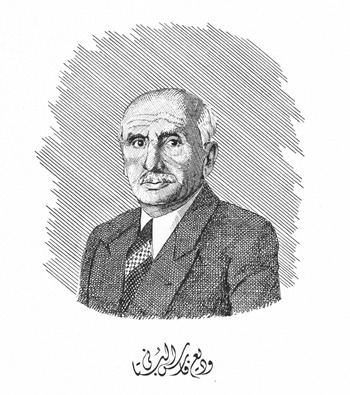
Wadiʿ al-Bustani (Fig. 1), there can be no doubt, was one of many. Scattered across the “regions” and “areas” of Western academic study, these non-European intellectuals read with, responded to, and participated in political and intellectual movements that were global in their condition and scope. Certainly, the whole world was engrossed with the texts, histories, and languages of Europe. But either through resilient older avenues of scholarly exchange, or through newer routes of European orientalism and anticolonial solidarity, Asians and Africans connected with each other. Writing south–south intellectual history does not mean writing out Europe. European hegemony was real. It manifested itself as much in the expropriation of lands as it did in the expropriation of imaginations.Footnote 10 There is no reason to overlook the fact that forms of commerce, cultural and otherwise, were destroyed or irrevocably altered by colonialism. The Indian historian Ashin Das Gupta described Europe's forced entrance into the Indian Ocean simply: “the fellowship upon the ocean was broken.”Footnote 11 However in this period of arrogance, intolerance, and violence—the characteristics and program of colonial rule—profound relationships between the colonized were formed. Colonialism and its attendant anticolonialism created new forms of connection, communication, and comparison. New opportunities to travel for some, which were of course coupled with new restrictions on movement for others, allowed people and texts to travel in ways previously impossible. Bustani himself moved across Asia, Africa, and Europe, and his thought moved with him.
Wadiʿ al-Bustani (1888–1954). Frontispiece to Al-Mahabharata: al-Malhama al-Hinduwiyya (Beirut, 1952).

Bustani was born to a Maronite family in 1888 in the small mountain town of Dibiyye, in today's Lebanon. His intellectual inheritance is important to note at the outset. He comes from perhaps the most prominent family of the nahda. Butrus al-Bustani—a foundational figure in the history of Arab ideas and the founder of the first secular school in the Levant—is his most famous relative. And though Butrus died three years before Wadiʿ was born, Sulayman al-Bustani, Butrus's uncle and the translator of the Iliad into Arabic, had a profound personal impact on Wadiʿ.Footnote 12 Arguing that the young Wadiʿ's Arabic was weak, Sulayman once implored him to memorize the Quran, so Wadiʿ did. He went on to study English and French at Syrian Protestant College, now known as the American University of Beirut, graduating in 1907.Footnote 13 From Beirut, Bustani traveled to Cairo, Hudaydah, Bombay, Transvaal, and finally Haifa. By following him across this colonial space, this article traces the context and queries the content of the making of modern Arab indology. In Bustani's case, India and Palestine become important linkages in a larger colonial frame which stretched across Asia and Africa. It is impossible to account for Bustani's indology without attending to his political and poetical activity in Mandate Palestine. Particular ideas of religion and literature inducted Bustani into a new imperial culture at the dawn of the twentieth century. However, Bustani's experience of the British occupation of Palestine, where he initially served as an assistant to the colonial administration, chipped away at the edifice of this empire's self-presentation and its self-proclaimed principals in his mind. Bustani's responses to British imperial culture and colonial rule, in poetry, in philology, and in politics, are the primary sources of this study. The reconstruction of Bustani's life here relies on a careful reading of his own work and his traces in the British archives, the Indian archives, the Israeli archives, his family's small collection, and the unhoused archive of public utterances that constitutes the greatest source for Arab intellectual history. Below, I follow Bustani's thought from his earliest public writings in the 1910s until his death in 1954. Only by accounting for his work through his life can the particular contours of his thinking be revealed. The narrative arc of this article simulates Bustani's own journey. Beginning with his attachment to imperial routes and forms of knowledge, this article moves on to consider Bustani's disillusionment with imperial politics and ideas, chiefly as they are expressed in anticolonial poetry. I end in empire's wake, with the partitions of South Asia and Palestine which indelibly mark Bustani's life and scholarly practice. In doing so, I relate a history of global philology and an enabling colonial frame, long hidden in the many narrations of orientalism's travel and Palestine's colonization.
Imperial canons
“Oxford is my goal; a foul or a fall; a failer or a fool; I want to know more and become more. I may be hung; I may be stabbed; I may be smashed and ground to earth; but starvation can never be a cause to my death.”Footnote 14 Thus wrote a twenty-three-year-old Bustani from Cairo to John Lubbock, a science popularizer and confidant of Darwin in London known officially as Lord Avebury. Bustani was in Cairo at the time, working for the British in the Public Works Department, Eastern Division. “Dear sir,” Bustani wrote,
it is a critical moment—but my beats and throbs are as regular as ever. “To be or not to be, that is the question”. Whether I should stick to my present post of £10 per 1 moon's revolution, and continue to live on the figures (only Ten in shape I add and register—and die when Death knocks … or bid this routine together with colleagues, friends and relatives farewell, and entrust myself to the sear, with the sole hope of one-day anchoring on the British Isles with the twofold ambition of shaking hands with the author of “The Uses of Life” and “On Peace and Happiness” and of challenging that day's circumstances.Footnote 15
Bustani, the young romantic poet, was unsatisfied with his bureaucratic duties in Egypt, and longed to be a part of another world. He was writing to Lord Avebury because he had nearly finished translating On Peace and Happiness, one of Lubbock's books, and wished to have a photograph of its author for the frontispiece. When his translations were complete, Bustani made his way to London, where he finally met his guru.Footnote 16
Lubbock's books amounted to guides on how to become a certain kind of English gentleman: liberal, humane, and literate. He was popular globally, like his friend Darwin, and in the early twentieth century his books were being translated across the world into a number of non-European languages, from Armenian to Gujarati.Footnote 17 Bustani would translate three of Lubbock's books into Arabic: On Peace and Happiness, The Uses of Life, and The Pleasures of Life. These three would be the first Bustani would translate from English in what would become a long career of translation. In the preface to The Pleasures of Life Lubbock writes of the importance of a particular set of oriental texts: “The Ramayana and the Maha Bharata … are not only interesting in themselves, but very important in reference to our great oriental Empire.”Footnote 18 Lubbock lists the hundred books one must read. Besides the two aforementioned Sanskrit epics, he included three other non-European texts among his canon: the Quran (which Bustani had already memorized), Kalidasa's Shakuntala, and the Rubaiyat of Omar Khayyam.Footnote 19 In the nineteenth century, Eastern texts reinvigorated European intellectual culture. Literature, high and low, was infused with a corpus of lauded non-European classics. By the early twentieth century, Lubbock's list was as predictable as it was common.
This canon was indelibly imperial in its making. The European colonization of the world; the rise of the new historicist philology; the hegemony of romantic visions of human, nation, race, and world—all occasioned the emergence of two related and parallel discourses by the middle of the nineteenth century: world religions and world literature. Sanskrit texts like the Mahabharata (including the Bhagavad Gita) and the Ramayana sat at the confluence of these new ideas, representing both ancient Hinduism and ancient India. The celebration of these works in Europe was regularly—indeed, by requisite—accompanied by the denigration of contemporary Hinduism and India. “Decline” was the historiographical idiom of choice.
From their perch, the Orient appeared as the principal site of Weltliteratur for the European peninsula's philologists. And although ideologically and institutionally pan-European, the primacy of the British Empire in Asia made Great Britain a central location for the elaboration of these new ideas and English a key vehicle for their export. By 1900, centuries of philology, translation, collection, collation, and theft had produced a world canon—oriental in progeny—that was exceedingly well known and widely read. The place of empire in the constitution, proliferation, and distribution of a literary canon intelligible to British citizens (at home) and British subjects (abroad) has been thoroughly examined.Footnote 20 The colonial conditions of canonicity are impossible to deny. For example, Max Muller's Sacred Books of the East project—which “effectively defined the parameters of the ‘major religions of the world’,” according to Tomoko Masuzawa—may have been published by Oxford University Press but was funded by the India Office itself.Footnote 21 In addition to texts like Lubbock's, Bustani was reading this growing corpus of orientalism and its related projects. On his trip to London to visit Lubbock, he also traveled to Oxford to see David Margoliouth, doyen of Arabic studies in England, whom he would write about enthusiastically.Footnote 22 Aamir Mufti argues that the emergent intelligentsia of nineteenth-century India was “in a strong sense schooled in Orientalism, which constituted for it the very horizon of modern and Western humanistic knowledge.”Footnote 23 Bustani was no different. His understanding of India was inextricable from his reading of European orientalism.
In 1912, a year after publishing his Arabic translation of The Pleasures of Life, Bustani published the first translation of the Rubaiyat in Arabic. In Bustani's Arabic rendition of Edward Fitzgerald's infamous English “translation,” the Rubaiyat of Khayyam become sabiʿyyat. That is, rather than quatrains, Bustani's version is in stanzas of seven lines, a common Arabic poetic form. With his new translation, Bustani was joining the “Omarians” of late nineteenth-century Europe, or what John Yohannan called “the cult of the Rubaiyat.”Footnote 24 Having translated the syllabi of British imperial culture, Bustani began to execute their assignments. In his introduction to the translation, he provides a biography of the elusive poet and rehearses the familiar debates about the quatrain's authenticity and Khayyam's life story. Bustani also contributes his own dubious theory about Khayyam's origins. He argues that Khayyam—the name refers in Arabic to one who sews tents—was of Arab origins and that his family must have migrated to Persia, for Persians in the eleventh century did not use tents as Arabs did.Footnote 25 This fact, Bustani argues, is but one more reason why Khayyam's verses must be read in Arabic. World literature, therefore, as Yaseen Noorani has argued in the case of Sulayman al-Bustani's translation of the Iliad, is presented to “the Arabic reading public as a repository of national self-discovery.”Footnote 26 Bustani's Arabized Khayyam was part of a larger national discourse. As enthralled as he may have been in the world literary enterprise being promoted by imperial Europe, accounting for Bustani's intellectual activity demands a consideration of the colonial frame he worked within and the currents of nationalist and anticolonial thought he encountered.
When Bustani traveled away from Mount Lebanon and its environs, he was entering a world transformed by colonialism. In 1909, Bustani would follow the ever-tighter routes of capital and empire to Yemen. A job as a translator in the British consulate there took a young Bustani out of the American missionary enterprise he had long occupied and into another—undoubtedly related—colonial initiative in the East. This was his first experience of life under the Raj, which by then covered nearly a quarter of the globe. As the historian John Willis has written, “Aden and the Aden Protectorate constituted one of the westernmost parts of India.”Footnote 27 From there he went to a Cairo under British occupation, and finally, in 1912, to Bombay. Bustani recalls reading Monier Williams's translation of Kalidasa's Shakuntala on a Bombay beach, Williams's verse translation inspiring him later to render his own poetic translation of the text into Arabic.Footnote 28 But in India he was not simply engaged in the entangled web of orientalism and empire he had come to know. Bustani was employed as a bookkeeper by a well-known pearl merchant from the Persian Gulf, connecting him to those older histories of trade and family that had long characterized Arab and Indian interactions. Bustani was a new edition to the scene.
While in India he traveled to Bengal to visit Rabindranath Tagore at his school Shantiniketan, or Dar-as-Salam, the Abode of Peace. Long internationalist on his own accord, the Nobel Prize in Literature thrust Tagore into world consciousness in 1913. His visits to Egypt (in 1926) and Iraq (in 1932) were major political and intellectual events.Footnote 29 By the 1930s, translations of and commentaries on his writings could be found in all the major newspapers, journals, and textbooks of the Arab world. In 1941, one prominent Egyptian journal would confidently announce that Tagore “was the most translated foreign writer into Arabic.”Footnote 30 Bustani himself translated Tagore's play The Gardener into Arabic in 1916, giving the Arabic reading public their first taste of the Indian intellectual's writing. Bustani's translations of Tagore's poetry and drama traveled quickly across the nahda's global network of journals and writers. As Ilham Khuri-Makdisi has noted, journals like al-Hilal and al-Muqtataf “represented particularly powerful spheres that conferred legitimacy on ideas and discourses in the late nineteenth century and early twentieth in Beirut, Cairo, and Alexandria, but also beyond, including within the Syrian diaspora in the Americas.”Footnote 31
In May 1918, Bustani's Tagore arrived in New York City. The first Arabic literary magazine in North America, Nasib Arida's al-Funun, published Bustani's translations of Tagore's poetry.Footnote 32 A month later, Mikhail Naimy, one of al-Funun's most frequent contributors, reflected on the task of the translator in an article about Bustani. He begins by arguing for the necessity of more Arab writers and translators. Translators, Naimy argues, connect readers with humanity by opening up new oceans of knowledge to them.Footnote 33 But translation, he admits, is a tricky task. He takes up the example of Bustani's Tagore translations. Bustani, Naimy argued, made a major contribution to Arabic by translating these poems and must be praised for doing so. But his translations failed to capture the rhyme and music of Tagore's verses, in Naimy's estimation.Footnote 34 Naimy, who spent decades in the United States, was fluent in English and therefore able to read the English versions of the Tagore poems Bustani translated. Despite this criticism, the very presence of and spirited engagement with Bustani's translations in al-Funun speaks to the size of the intellectual world that Bustani himself trafficked in. His own itinerary may have been determined by his location inside the British colonial frame, but Bustani's work traveled further, across the Arab nahda's own world of print.
Bustani aimed to introduce Arab readers to India's past and present generally. In 1916, he published a series of articles about India and Indians in al-Hilal. Among them was an article entitled “With Rabindranath Tagore,” where he described his visit to Tagore's residence and school in Bengal in July 1914, only a few months after the announcement of the Nobel Prize. “I ate and drank and sat with Tagore.”Footnote 35 “His eyes,” Bustani goes on, “show his wisdom and his speech is sweet.” Bustani wrote about the character of Tagore's school, where on his visit he lectured the students on the state of Egypt and Syria. But the most profound and original section of the article is Bustani's intervention into the Arabic language and Arab understandings of Hinduism. He wrote,
He [Tagore] is “hinduwi,” that is, an Indian who is not a Muslim. Arabs call all Indians who do not believe in Allah idol-worshippers. So I have decided to use “hinduwi” and the plural “hinduwiyyun” to avoid confusion or ambiguity. Most of our writers refer to them as “Hindus” the translation of the English and French words using the letter “seen” which is not how you make a plural in Arabic. The word “hindi” or “hinud” means all those living in India.Footnote 36
While it is impossible to separate Tagore's fortunes from his entanglements with the British or English role across British imperial space, Bustani's engagement here offers insight into his larger literary and historical commitments.Footnote 37 It is clear that Bustani's intellectual investments were not simply bounded by European tastes. His dissatisfaction with the existing Arabic lexicon, and attempt to dispel misunderstanding, is a testament to his scholarly orientation toward the representation of India in Arabic. Without the civilizational condescension or imperial largesse that buttressed Europe's indologists, Bustani approached his study of India seriously.
Ecumenical Palestine
“Thus he entered the arena of battle,” wrote Abd al-Rahman Yaghi of Bustani's first poem in Palestine.Footnote 38 Bustani arrived in Jaffa in the last week of November 1917. He came to Palestine to work as an assistant in the British administration, again moving along those routes made by empire. Bustani left India in 1916, and stayed in South Africa for a year thereafter, partly in the employ of the British at Transvaal. While there, in the midst of the Great War, he wrote and published a slim volume of poems, the Quatrains of War. Dedicated to the “South African Overseas Contingent,” the martial poems ask their readers to repeatedly “Arise! March on, and Falter not! Respond!”Footnote 39 Some quatrains are explicit as to which side of the war Bustani champions: “join the Chorus of the Mighty Brave / Whose Bleeding Hearts encore ‘GOD SAVE THE KING’.”Footnote 40 Two years later, on his arrival in Palestine, Bustani's tune quickly changed. Writing in the immediate wake of the Balfour Declaration, his first poem from Palestine declared his concern over British intentions. Bustani's Indian career turned out to be instructive, and the germ of the disenchantment with the British which would lead to his resignation from the colonial government two years later can be discerned. In a work titled “The Infant State” (“Al-dawla al-radi’”) he wrote,
In Palestine, Bustani's fealty to the worldly culture cultivated by the British Empire was stretched to its limit. He spent the rest of his life in Palestine, mostly in the port city of Haifa, an important point on the map of war and trade that the British were forging between the Indian Ocean and the Mediterranean Sea. While Bustani continued to work on his translations of hinduwi texts, his fortunes and intellectual activity were increasingly tied to the politics of the British Mandate and the European Zionist colonization of Palestine. Bustani was thrust out of the literary world he had inhabited for the first half of his life and poured himself into the service of an Arab nation and the anticolonial struggle in Palestine in particular. The imperial culture that determined the global itinerary of his youth proved illusory. Despite his political and intellectual efforts, Bustani came to realize that respect for the lives and lands of people like him were not on the British agenda. His first foray into organized political activity is emblematic of the ethos he would carry in all his efforts. Bustani was one of the founders of the Muslim–Christian Association in Haifa, an important but short-lived organization across Palestine.Footnote 42 These associations were an early organized source of opposition to the British policies in Mandate Palestine that the historian Laura Robson has rightly characterized as sectarian. The British constructed, according to Robson, “a colonial administration that assumed the political centrality of communal identifications.”Footnote 43 Robson describes how Palestinian Christian intellectuals nevertheless embraced an ecumenical way of thinking, a form of knowledge that fundamentally marked the Arab nahda, according to Ussama Makdisi.Footnote 44 The British, keen on facilitating Zionist goals and wary of the Arab nationalist resistance that such ecumenical organizations could engender, changed the landscape of Muslim–Christian political cooperation in the Mandate by introducing new sectarian institutions like the Supreme Muslim Council.
As the Mandate dragged on, Bustani's poetry continued to pose a challenge to British activities in Palestine and to European colonialism in general. His verses evinced an ecumenical spirit and anticolonial instinct. In 1925, he published a poem entitled “We are all Muslims” (“Kulna Muslimin”) in the Egyptian magazine al-Zahra’.Footnote 45 That same year, Syrians revolted against the French Mandate government. The French response was draconian and included the bombing of Syrian villages and cities. Regarding this violent retaliation, one French general said, “you need to terrorize people,” and the then British consul in Damascus described it as “a sustained policy of frightfulness.”Footnote 46 This campaign culminated in the devastating bombardment of Damascus in October 1925, which lasted for forty-eight hours, led to the death of at least a thousand people, and garnered global attention. In his poem, Bustani summons the image of the incendiary bombs destroying the Syrian city. “Oh fragrant Damascus, what will we call you,” Bustani asked, “after you have been burned and destroyed / and your river has flowed with blood.”Footnote 47 But the core of the poem's message is not Bustani's lament over Damascus, but a call for Arab unity in the face of colonial violence:
Bustani understood that for the French, being “Muslim,” even if you were not, made you a killable subject. Bustani, nourished by an Arab nationalist project, flips what he recognized as an orientalist label: being Muslim, for him, only underlined the necessity of solidarity.
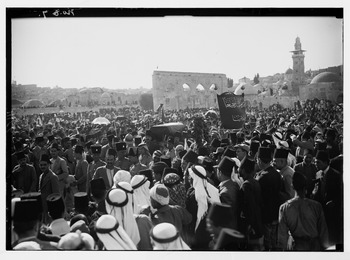
The many poems that Bustani wrote over the course of his time in Palestine were collected in his diwan, al-Falistiniyyat, published in 1946. “As far was we know,” Khalid Sulaiman wrote of Bustani, “he is the first Arab poet who published a collection of poems on Palestine.”Footnote 49 In the introduction to al-Falistiniyyat Bustani called himself a Lebanese Palestinian: “I was born in Lebanon, but am Palestinian by homeland.”Footnote 50 Bustani's ideas were forged under global, imperial conditions. In Palestine, Bustani was becoming increasingly aware of the unequal geography that structured the world. By the 1930s, Bustani was also writing verses—undoubtably inspired by Tagore—in celebration of the East. “The Easterner will return to the Westerner his faculties of reason,” he wrote in one poem, “for the Easterner possesses more care and reason.”Footnote 51 Attention to these elements in his work, and the context of their creation, challenge conventional understandings of Islam and politics in British Palestine. Take, for example, the occasion of the Indian activist Muhammad Ali Jouhar's funeral in Jerusalem on 23 January 1931, when Bustani recited a poem to the assembled (Fig. 2). His verse possessed the same ecumenical and anticolonial spirit as his other poems. Both Muslims and Christians, Bustani wrote, mourn Jouhar. And the “greedy” British, unnamed but implied, arrived in Palestine as in India, “to light a fire.” His poem was originally published alongside other speeches and poems from the event a few days later in the newspaper al-Jamiʿa al-ʿArabiyya. In the notes he appended to the poem when collected in al-Falistiniyyat, Bustani claims he was the first Christian to deliver a eulogy on the grounds of al-Haram al-Sharif.Footnote 52 Though a difficult assertion to verify, it would certainly reflect the spirit of the age. It was only a decade earlier that the Coptic priest Qommus Sergius famously preached from inside Al-Azhar's mosque during the heady days of 1919. In contrast to the repeated invocations of Sergius's sermon in accounts of Egyptian national unity, Bustani's presence in Jerusalem that day has been eclipsed in a historiography that adopts wholesale British colonial preoccupations with pan-Islam. Jouhar's funeral in Jerusalem, therefore, has only been narrated in those terms. It was indeed Amin al-Husseini, the mufti of Jerusalem and head of the Supreme Muslim Council in Palestine, who arranged for the burial to take place in his city. In a series of overtures to Muslims worldwide, culminating in the World Islamic Congress convened in December of 1931, al-Husseini aimed to cement Jerusalem's place among the sites and institutions of the “Muslim world.”Footnote 53
The funeral of Mohammad Ali Jauhar in Jerusalem (23 January 1931). G. Eric and Edith Matson, Photograph Collection, Library of Congress, Prints and Photographs Division, LC-DIG-matpc-03052.

Whatever the designs of al-Husseini, Bustani was not drawn to the Mulana because he wanted a place on the pan-Islamic stage, but rather because of a shared commitment to anticolonial nationalism. He wrote that Jauhar was in London, “with the Hindu [hinduwi] leader the Mahatma Gandhi, in the service of the Indian Nation [umma].” Bustani knew Jauhar and had met with him repeatedly years earlier when he lived in India. Confident assertions of the funeral's singularly pan-Islamic appeal ignore both Bustani's presence and the kind of politics he represented. The authors of a recent article on the event which focuses on al-Husseini's role as a “propagandist” mention only in passing that a “Christian Arab poet read a poem composed especially for the funeral,” without further comment or elaboration.Footnote 54 Moving beyond colonial rubrics and taking seriously the activities of anticolonial internationalists, whose utterances are suffused with local, ecumenical appeals, reveals connections like those forged by Bustani.
Palestinian writers have been particularly attuned to this aspect of Bustani's oeuvre. In a recent book on the poetry of Mandate Palestine, the Haifawi literary critic Suleiman Jubran writes that Bustani's poetry—packed as it is with references to the Islamicate past and the colonial present—“is not just Lebanese Palestinian poetry, it is Christian Muslim poetry, it is the first to address colonialism–Zionism in Palestine.”Footnote 55 Here, Jubran echoes the judgment of the Palestinian writer Ghassan Kanafani, who in his well-known study of the 1936 revolt in Palestine praises Bustani the anticolonial poet: “He was the first to warn against the Balfour Declaration and its challenges, the very month it was issued.” Kanafani argues that the poetry Bustani wrote in the 1920s was one of the most important influences on the multitude that moved in the 1930s. Bustani's insurgent poetics and ecumenical impulse is exemplified in a remarkable exchange with the British Mandate authorities, which Kanafani recounts:
[On] 28 March 1920, [Bustani] had himself led a demonstration, which chanted a song that he had composed himself. He was summoned to an inquiry, and the following appears in the records of the inquiry conducted by the Public Prosecutor:
Public Prosecutor: Statements have been made that you were carried shoulder-high, and that you said to the people who were following behind you: “Oh Christians, Oh Muslims.”
The Accused: Yes.
Public Prosecutor: And you also said: “To whom have you left the country?”
The Accused: Yes.
Public Prosecutor: Then you said: “Kill the Jews and unbelievers.”
The Accused: No. That violates the meter and the rhyme. I could not have said that. What I said was both rhyming and metrical. It is called poetry.Footnote 56
Bustani's political activities during his time in Haifa were not limited to what the historian A. L. Tibawi called his “distinct poetical gifts.”Footnote 57 In June 1923, at the Sixth Palestine Arab Congress held in Jaffa, Bustani asked the gathering to adopt a resolution stating that “taxation without representation” was not consistent with the democratic principles adopted in Great Britain itself and therefore a boycott should be called.Footnote 58 Despite regularly confronting British colonial rhetoric and practices in Palestine, Bustani nevertheless thought Arabs could reason with the British Empire. But the British simply did not uphold the principles they espoused.
In June of 1936, Bustani published in English and Arabic a salvo against the Balfour Declaration and the Mandate system as a whole, The Palestine Mandate: Invalid and Impracticable.Footnote 59 Bustani demonstrates, with meticulous detail, how the British Mandate in Palestine violates the principles of international law specifically and the ethos of British liberalism generally. Even within the uneven and unjust Mandate system, the situation in Palestine is an aberration, Bustani argues. “To this the Palestine Arabs revolted in 1920, in 1921, in 1924, in 1929, in 1933 and it is in the midst of the 1936 revolt that the present study is made.”Footnote 60 “This study,” he writes later “is merely a hurried but honestly motivated effort to expose facts and merits.”Footnote 61 He quotes at length from official League of Nations documents, the Balfour Declaration, and the work of the Mandate's Attorney General Norman Bentwich, annotating and introducing their utterances to explicate his case. He criticizes British policy and rhetoric, exposing their autocratic approach to the “Palestine Problem” and their endless obfuscation of the reality on the ground, including their habit of ordering hapless commissions of inquiry. The book was submitted to the high commissioner for Palestine and the Colonial Secretary in London to little effect, like much of the diplomatic efforts Palestinians undertook in the years before 1948. But the Arabic edition was enthusiastically received by pan-Arab journals like al-Mashriq in Beirut and al-Hilal in Cairo.Footnote 62
Bustani had more success in the courtroom. In addition to his poetry and his regular contributions to the burgeoning nationalist press, Bustani worked in the Mandate's courts in an effort to defend the lands of Palestinians. He studied law in Jerusalem, at the school established by the British for that express purpose.Footnote 63 As was the case with lawyers in much of the colonized world, many of the Arab law graduates became heavily involved in the Mandate's politics. Bustani was no exception and quickly added the law to his repertoire of political activity after graduating from the program. His most notable legal victory was the designation of a large tract of land in the Ghor-Beisan area as public land, and therefore off-limits to the Jewish Agency. Bustani argued that this land had long been under the dominion of the Arabs who occupied it. Though this may not have been entirely accurate in light of the particular forms of property rights that reigned during the Ottoman period, it served Bustani's larger political project. In his valuable study of how land law was transformed in Palestine from the mid-nineteenth century until 1948, the historian Munir Fakher Eldin argued that “Bustani's emphasis on local autonomy … had a definite purpose to serve: to downplay the reality of Ottoman sovereignty in favor of a normative claim of an original Arab national sovereignty.”Footnote 64 Bustani's activist lawyering drew the ire of the British authorities and the Zionist movement. In his autobiography, Chaim Weizmann expressed great disdain for Bustani's success in defending the Arab right to this particular tract of land.Footnote 65 Indeed, Bustani's activities in Palestine garnered him quite the reputation. He was described variously by his critics as “the worst scoundrel in the place,” “an excitable, energetic young demagogue,” a “notorious agitator,” “a man of very excitable disposition,” and “an active extremist.”Footnote 66 In all the comments of his vociferous critics, Bustani's indology was unmentioned.
Liberation philology
In March 1947 a journalist from Cairo's al-Risala—the Arab world's premier literary weekly—met Bustani at the city's Grand Continental Hotel. Bustani was on his way back to Haifa from London, where he had just been on a political mission. The Arab Higher Committee was still trying to make its case to the British authorities. Bustani took advantage of the sojourn to do some research in that entrepôt of global knowledge, the library of the British Museum. The journalist asked Bustani about the stack of papers he carried with him, manuscripts of his translations of hinduwi epics. Bustani was in the midst of translating the Ramayana and the Mahabharata into Arabic. In the interview Bustani mentions his reasons for translating these particular Sanskritic texts: “The translations of India's epics into European languages opened new doors in fiqh al-lugah, ‘al-philologiyya.’ Today, if you look at any comprehensive English-language dictionary you will see that many English words have their origins in Sanskrit. If we translate these texts into the Arabic language we will notice the same thing.”Footnote 67 Such a philological project lays bare the sheer boldness of Bustani's undertaking. But Bustani did not labor under conditions of his own choosing. Between 23 April and 22 May of that inauspicious year of 1948, thirty-three members of Haganah occupied Bustani's house on the sea in Haifa. Despite this, Bustani—like Emile Habibi—remained in Haifa. When the soldiers left, they took him and briefly imprisoned him. Upon returning to his home, he quickly packed up his precious manuscripts.Footnote 68 They ended up with his son Fuad, who with the help of Palestinian fishermen would periodically make his way down from Beirut to check on his parents. Bustani's was a philology under colonialism, not colonial philology.
A powerful body of historical scholarship has revealed how intellectuals in the colonized world adopted the religious, racial, or sexual prejudices of the European texts they read and translated.Footnote 69 In the Arab context, this work has shown how, in their involvement with nationalist state projects, intellectuals produced knowledge of poor, mobile, or illiterate populations—first by naming them as such—that did not significantly depart from the forms of knowledge propounded by colonial officials. However, a methodological nationalism has largely precluded investigations into how this knowledge was deployed at points further removed from the nation and its frontiers, beyond the boundaries of the state and its mechanisms of coercion. What Bustani's case begins to reveal is how Arab intellectuals studied the world beyond their nation and beyond the Europe whose concepts and categories they sometimes deployed.
There has been a search, since orientalism was knocked from its summit, for noncoercive, nonhierarchical approaches to the study of the other. How does one study from within an exploitative system? Over a series of erudite essays, Sheldon Pollock has recently sought to rehabilitate philology, despite its sordid past. In what he has variously referred to as “liberation philology” and “comparison without hegemony,” Pollock has argued that philology can offer “one important way out of the dead-end area-studies model of language labor as merely producing the raw data for the Lancashire mills of self-universalizing Western theory.”Footnote 70 Inspired by the work of Spinoza, Gramsci, D. D. Kosambi, and Edward Said, Pollock calls for a critical philology, attuned as much to political texts as to the literary. Any history of this scholarship must attend to those intellectuals from the colonized world who studied and translated old texts—however imperfectly—in the crucible of anticolonial revolt. Some accounts of comparative literature's origins begin provocatively with the German Jewish philologist Erich Auerbach's exile in Istanbul, where he wrote Mimesis while estranged from Europe and its libraries during the Second World War.Footnote 71 He recounts on the final page of his study a number of topics he “should have liked” to include, had circumstances been different.Footnote 72 In a striking parallel, Bustani, writing at roughly the same time in Haifa, makes a similar admission in the prologue of his Mahabharata. He intentionally calls his text a prologue or preamble (dibaja) rather than an introduction (muqaddima) because, according to him, an introduction would be impossible to write from his present location. But Bustani was writing from his besieged home, not from exile. “My books are as far from me now as India is, and then further.” “They are in the hands of my children outside of Israel,” he continued, “and I am in the grip of Israel. Between us is fire and steel and certain death.”Footnote 73
If we look at scholarship forged through a shared history of colonial rule and anticolonial revolt, rather than the scholarship produced in the process of subjugation and exclusion, a different kind of writing emerges.Footnote 74 What does the study of a region look like when it is produced under conditions of geographical proximity, cultural affiliation, and political solidarity, rather than distance, judgment, and domination? Bustani's life and work begin to reveal what the study of the not-so-distant other—who is also close, but is not a compatriot—can look like.Footnote 75 Such intellectual practices, forms of south–south knowledge, should be instructive. At the very least, they can bring into relief the methodological, disciplinary, geographical, and political presuppositions that the social sciences and humanities in the West inherited from colonialism. Bustani himself brings the same commitment to careful reading—and the same investment in liberation—to his excoriation of British rhetorics of rule as he does to his elucidation of those texts he believes to be irreducibly Indian. In both cases, having jettisoned from his reading practice any conscious devotion to British imperial precepts, he seeks to project a vision for an egalitarian future, free of domination and communal discord.
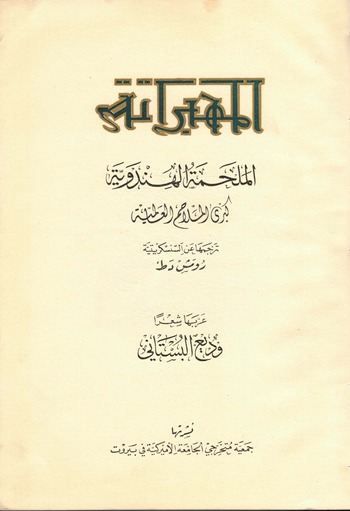
Bustani's Mahabharata, the only one of his Arabic translations that he prepared for publication before his death, was published in 1952, a collaboration between the Alumni Association of the American University of Beirut and the publisher Dar al-Ahad. Albert Hourani described Sulayman al-Bustani's Arabic Iliad as “a book of a kind which had never appeared in Arabic before: a handsome, well-produced volume of 1,260 pages, with an introduction, a running commentary, indexes and illustrations.”Footnote 76 The Mahabharata translated by Wadiʿ al-Bustani was similarly monumental in form. The cover spells out the title in an Arabic script that mimics the Devanagari of Sanskrit and the book is full of color illustrations borrowed from Indian editions of the epic text (Fig. 3). Bustani subtitled the book al-malhama al-Hinduwiyya, kubra’ al-malahim al-ʿalamiyya—“The Hindu epic, among the greatest epics in the world.”
The cover page of Wadiʿ al-Bustani's Mahabharata.

Bustani had studied Sanskrit during his time in India, but not to the extent needed to translate the epics he was interested in. His translation, or Arabization, comes from the Indian civil servant and historian Romesh Dutt's 1898 English verse translation of the Mahabharata. Bustani is explicit as to his role in the endeavor; the title page reads that the translation (tarjama) of the text from Sanskrit is Dutt's, and he is the one who has put it into Arabic poetic form (ʿarabiha shʿariyyan). However, Bustani does do more than simply render the text into Arabic. Unlike Dutt, who aimed to produce a modern, literary Mahabharata for modern Indian readers like himself, Bustani's project was more than just one of belles-lettres.Footnote 77 Introducing a new text to Arab readers, he sought to produce both an aesthetically beautiful piece of poetry and a scholarly edition. Therefore, in addition to Dutt's poetic version, Bustani drew on a number of other editions of the Mahabharata in English and French—hence his trips to London. Bustani's nearly one hundred pages of original endnotes—Dutt's edition contains no notes—are evidence of this larger project. Some of the notes refer readers to different episodes and characters within the epic, while others provide context, offer alternative translations, or explain specific concepts.
Bustani writes that while he was translating the Mahabharata from Dutt's English translation, he heard the Lebanese poet Shibli Faris utter on the radio that there “is no sectarianism in culture.”Footnote 78 After hearing this, Bustani said ameen—like the English “amen”—which he compared to the Sanskrit om. Bustani wrote, “we took from the Jews so there is nothing wrong with taking from the Indians.” “The Prophet,” he continues, “took from the Torah, so there is no problem taking from India,” and he cites that famous hadith that implores believers “to seek knowledge even unto China.”Footnote 79 Bustani then makes an explicit comparison, arguing that the ethos found in a Quranic verse which says that God is with the weak and the patient is shared with the Mahabharata. Bustani simultaneously argues that the Mahabharata both is an instructive text for his contemporary political context on the one hand and parallels Arabo-Islamic principles on the other. Beyond the discussion of his own circumstances, his introduction is suffused with the political. Gandhi gets repeated mention, as freedom fighter and inheritor of the Buddha's teachings. Bustani notes that he completed his translation of the Bhagavad Gita the day after Gandhi was assassinated. He sent a copy to G. D. Birla, the Indian businessman who had been hosting Gandhi in his home at the time of his murder. Bustani dedicated the translation to the “soul of the Mahatma, in the name the Arabs of Palestine.”Footnote 80 Bustani goes on to write that Dutt, who died in 1909, could never have imagined India's independence.Footnote 81 Dutt's introduction to his Mahabharata, which Bustani translates, is devoid of any political discussion.
As his citations and ideas reveal, the precise sources of Bustani's readings of Hinduism and India were often the voluminous works of European orientalists. Bustani's imagined readers, however, were not the same, so his points of emphasis, sources of comparison, and method of address differ markedly from the likes of Muller or even of Dutt. One of his unpublished manuscripts, Akhbar al-Ahala (Divine Chronicles), is a collection of quotations and commentaries testifying to the monotheistic origins of Hinduism.Footnote 82 The manuscript contains passages from Hindu texts, quotations from secondary sources, and Bustani's own interpretations and explanations. The book also serves as a general introduction for Arab readers to a series of Hindu concepts and characters: Vishnu, Brahma, Agni, Lakshmi, karma, ananda, and many others. He also explains the chronology of Hindu mythology. Bustani's specific form of address through comparison continues throughout the text. “Brahma,” he writes, for example, “is to Hinduism, what ‘allah’ is to Arabs.”Footnote 83 Certain ideas present in Bustani's works can be found both in the many centuries-old Arabo-Islamic corpus and in the writing of modern European orientalists. The notion of Hinduism as monotheism which captured Bustani so strongly is shared between these two bodies of knowledge. In his famous book, Al-Biruni himself repeatedly notes the monotheistic roots of Hinduism.Footnote 84 Bustani goes on to write that readers will be skeptical of his claim that Hinduism is monotheistic, but nevertheless it is the truth.Footnote 85 It is clear, then, that Bustani is writing into an already established sense of what India and Hinduism are thought to represent in Arab thinking. His writing was nothing short of an attempt to transform the terms and attitudes of Arabs’ India. And although he did so in the spirit of solidarity and in the interest of dispelling myths, Bustani's India was an invention which did not reflect the reality of difference or diversity in the land of Hindustan itself. Like Max Muller's India or Jawaharlal Nehru's, Bustani's India was his own, tied inexorably to his particular place in an unequal colonial geography.
In the end, Bustani's neologism hinduwi never caught on and the impact of his indology is difficult to account for. In 1966, the Indian Council for Cultural Relations (ICCR) published an edition of his Shakuntala based on the manuscripts Bustani's family donated to the Indian government.Footnote 86 In 2012, the ICCR and Abu Dhabi's Kalima Project finally published an edition of his Ramayana, unveiling the book at the Jaipur Literary Festival in January 2013 (although mention of the text has now been scrubbed from Kalima's website).Footnote 87 The rest of his unpublished manuscripts, including a translation of Kalila wa Dimna, remain in the library of the ICCR. Copies of Bustani's 1952 Mahabharata are, unfortunately, quite rare. The only citation of the text I have tracked down is quite notable, however: an article by the great Bahraini poet Ibrahim al-ʿArayyed for al-Abhath, the journal of Faculty of Arts and Sciences at the American University of Beirut.Footnote 88 Al-‘Arayyed himself was an important link between modern Arabic literature and India. Born in 1908 in Bombay, he studied Urdu at Aligarh and translated Persian and Urdu poetry into Arabic. He merely quotes from the translation, but its presence in his hands reveals at least some of the text's capacity to travel. In 1947, al-Risala had enthusiastically reported on Bustani's efforts in the months prior to their aforementioned interview with him in Cairo. They lamented that what they know today of India comes to them from orientalists (al-mustashriqin), despite the long, well-documented history of Arab and Indian knowledge production from at least the Abbasid period.Footnote 89 Bustani, they argued, should be praised for repeating that older tradition of shared knowledge and translation across West and South Asia in modern Arabic form. Bustani represents, then, the very possibility of producing knowledge of the other outside the confines of colonial formations.
Conclusion: Partition
After 1948, despite remaining in Haifa, Bustani resigned from the political activities he had been a part of in the preceding years. In one Israeli intelligence report from 9 February 1949, Moshe Yitah, the director of the short-lived Ministry of Minorities in Haifa, wrote that Wadiʿ
remained living in his home, even though most of the Arabs in Haifa moved in accordance with the decree of the military authority to Wadi Nisnas, and in his home there was for a long time a base of the Haganah. He is not engaged in public or political activity and is involved, as his acquaintances say, only with issues of rich literature.Footnote 90
Bustani's position, like that of all Arab inhabitants of the new Israeli state, was precarious. Obviously weary of his fate, he wrote to thank the Ministry of Minority Affairs for not expelling him or confiscating his property: “This has all become possible thanks to my presence here, with all my books and manuscripts for which the authorities in Israel have been thanked and will always be thanked in contrast to the memory of our friend Azra Haddad retains of the Iraqi authorities who robbed him of his Hebrew translation of Omar Khayyam.”Footnote 91 While his manuscripts would later be smuggled out of the country, the mention of Azra Haddad is telling. Haddad, one of Baghdad's most prominent Arab nationalist intellectuals, had just reluctantly arrived in the new state of Israel, along with more than 100,000 other Iraqi Jews. Bustani must have felt a certain kinship with Haddad, not only because they had both cut their teeth in the pan-Arabist press of the early twentieth century, but because he himself had translated Khayyam into Arabic. In 1953, the tragic fortunes of the Arab world's Jews were becoming increasingly clear. The world of translation and intellectual exchange that Bustani had tried to foster was collapsing around him.
But Bustani was not entirely without hope. As his health waned Bustani finally left Haifa and spent the last months of his life in the young state of Lebanon. In one of his final poems published shortly before his death, India served as a negative example. The poem praises Camille Chamoun, the second president of independent Lebanon. In it, Bustani juxtaposes the case of South Asia where Partition occurred—while also celebrating the role of Gandhi, who opposed Partition and upheld the ethics of the great Hindu epics—with the case of Lebanon, a model of ecumenism in the Arab East. He writes of the new, multi-sectarian state:
Despite the political passion of his life, Palestine, being gone, and his intellectual passion, India, being dismembered, Bustani remained committed to a vision of Eastern unity and pluralism. Global transformations birthed in Bustani a worldly imagination. The itinerary of his life and the content of his writing were inseparable. Each of his narrations of the Indian past was indelibly marked by the conditions and ideas of his Arab present. Bustani, it can be said, was a product of empire. His life and work reflect a history of imperial connections beyond those of administration and exploitation: an intellectual history of philology and solidarity. After 1948, Bustani's thinking was certainly guided by the language and conditions of the postcolonial nation-state. Lebanon, the land of his birth, became his final refuge, but his dreams of another, unpartitioned, world were not foreclosed.
Acknowledgements
For reading and support, I thank Ussama Makdisi, Manan Ahmed, Omnia El Shakry, Anjali Nath, Sherene Seikaly, Suleiman Hodali, Durba Mitra, Hana Sleiman, Hardeep Dhillon, and Laila Riazi. I am grateful to audiences and interlocutors who engaged versions of this article at Columbia University, the National University of Singapore, Simon Fraser University, NYU Abu Dhabi, Cambridge University, Suad Joseph's Middle East/South Asia Seminar at UC Davis, and the annual meetings of the Middle East Studies Association, the American Comparative Literature Association, and the Arab Council for the Social Sciences. My thanks also to the anonymous reviewers of this article and the editors of Modern Intellectual History. Enormous gratitude to Nora Boustany for generously sharing materials by and about her grandfather in Dibbiyeh and Beirut.