Introduction
Among the steps in in vitro embryo production (IVP), in vitro maturation (IVM) is one of the most critical, because the oocytes used are usually obtained from a heterogeneous population of follicles. Consequently, their competence for developing to the blastocyst stage and maintaining pregnancy will vary (Caixeta et al., Reference Caixeta, Ripamonte, Franco, Junior and Dode2009; Racedo et al., Reference Racedo, Wrenzycki, Lepikhov, Salamone, Walter and Niemann2009).
One of the many aspects that may affect IVM is reactive oxygen species (ROS) generation, which leads to oxidative stress and alterations of the cell functions. When oocytes are handled, prepared and manipulated for IVM procedures, they are exposed to various potential ROS-inducing factors, including exposure to visible light, culture media composition, pH, temperature and oxygen concentration – for a review see Agarwal et al.(Reference Agarwal, Durairajanayagam and du Plessis2014). Thus, an alternative that may protect against oxidative stress during in vitro culture (IVC) would be antioxidant supplementation of the media (Chwa et al., Reference Chwa, Atilano, Reddy, Jordan, Kim and Kenney2006).
An insulin–transferrin–selenium combination (ITS) is reported to provide better rates of nuclear and cytoplasmic maturation of porcine oocytes (Hu et al., Reference Hu, Ma, Bao, Li, Cheng, Gao, Lei, Yang and Wang2011) and cattle IVP embryos (Dalvit et al., Reference Dalvit, Llanes, Descalzo, Insani, Beconi and Cetica2005). Recently, supplementation of IVP medium with ITS was shown to significantly improve the blastocyst rates and quality of bovine embryos when an individual-culture system was used (Wydooghe et al., Reference Wydooghe, Heras, Dewulf, Piepers, Van den Abbeel, De Sutter, Vandaele and Van Soom2014).
Insulin induces the uptake of glucose and amino acids and has mitogenic and anti-apoptotic activity, increasing cleavage and blastocyst rates in bovines (Augustin et al., Reference Augustin, Pocar, Wrenzycki, Niemann and Fischer2003; Lee et al., Reference Lee, Kang, Lee and Hwang2005). Transferrin and selenium are trace elements that have antioxidant activity. The combination of these two elements in cell culture media causes a reduction in free radical production and lipid peroxidation (Kim et al., Reference Kim, Lee, Lee, Kim, Jeong, Kim, Kang, Lee and Hwang2005); in addition, their presence greatly enhances the maturation of oocytes, decreasing polyspermy and increasing pronuclear formation (Tatemoto et al., Reference Tatemoto, Muto, Sunagawa, Shinjo and Nakada2004; Cerri et al., Reference Cerri, Rutigliano, Lima, Araujo and Santos2009).
l-Ascorbic acid (AA) has an important antioxidant role, and certain intracellular concentrations of this substance in the oocyte seem to be essential for cytoplasmic maturation. Although adding AA to the culture medium improves blastocyst production in mice (Tilly & Tilly, Reference Tilly and Tilly1995; Eppig et al., Reference Eppig, Hosoe, O'Brien, Pendola, Requena and Watanabe2000), its addition to the maturation medium exerted no effect on developmental competence of bovine and porcine cumulus–oocyte complexes (COCs) (Blondin et al., Reference Blondin, Guilbault and Sirard1997; Tatemoto et al., Reference Tatemoto, Muto, Sunagawa, Shinjo and Nakada2004; Dalvit et al., Reference Dalvit, Llanes, Descalzo, Insani, Beconi and Cetica2005; Córdova et al., Reference Córdova, Morató, Izquierdo, Paramio and Mogas2010; Tao et al., Reference Tao, Chen, Tian, Huo, Li, Zhang, Liu, Fang, Ding and Zhang2010; Kere et al., Reference Kere, Siriboon, Lo, Nguyen and Ju2013). Furthermore, when ITS and AA are added together during the maturation of oocytes obtained from pre-pubertal bovine (Córdova et al., Reference Córdova, Morató, Izquierdo, Paramio and Mogas2010) and goat females (Hammami et al., Reference Hammami, Morató, Romaguera, Roura, Catalá, Paramio, Mogas and Izquierdo2013), an improvement in cytoplasmic maturation was observed, as evidenced by the embryo yield. Considering that those oocytes are typically less competent for development than those obtained from adult animals, these results indicate a beneficial effect of ITS and AA on oocyte competence.
Apart from the data presented by Córdova et al. (Reference Córdova, Morató, Izquierdo, Paramio and Mogas2010) and Hammami et al. (Reference Hammami, Morató, Romaguera, Roura, Catalá, Paramio, Mogas and Izquierdo2013), there are few reports on the effect of ITS alone in cattle (George et al., Reference George, Daniaux, Genicot, Verhaeghe, Lambert and Donnay2008; Dalvit et al., Reference Dalvit, Llanes, Descalzo, Insani, Beconi and Cetica2005), and even fewer reports on its use in association with AA during different periods of culture. Nevertheless, these supplements represent an alternative strategy to improve environmental conditions for IVM and, thus, the results of IVP. Therefore, we tested the effect of ITS during IVM and IVC on the quantity and quality of IVP embryos. We hypothesized that antioxidant supplementation for different periods during IVM in oocytes with different competencies could improve oocyte potential and embryo development.
Material and methods
Unless otherwise indicated, the reagents and chemicals used in this research and for the preparation of the maturation, fertilization and IVC media were purchased from Sigma (St. Louis, MO, USA).
Collection and classification of oocytes
Ovaries from crossbred adult cows were collected at a local slaughterhouse and transported to the laboratory in saline solution (0.9% NaCl) supplemented with antibiotics (100 IU/ml penicillin G and 100 μg/ml streptomycin sulfate) at 37°C. In the laboratory, follicles that were 3–8 mm in diameter were aspirated by vacuum pump. Only the COCs classified as grades 1 and 2 were used.
To obtain COCs with different degrees of competence, we used the previously described model (Caixeta et al., Reference Caixeta, Ripamonte, Franco, Junior and Dode2009). Briefly, 1–3 mm and 6–8 mm diameter follicles were dissected from the ovarian cortex using tweezers, scissors and a scalpel. Once dissected, the follicles were measured using a graduated ocular device (eyepiece micrometer OSM-4 Olympus®, Tokyo, Japan). To release COCs, the follicles were ruptured, and only those oocytes with at least four layers of cumulus cells and a homogeneous cytoplasm were used for further work. The whole process was conducted in washing medium [TCM-199 with Hank's salts (Gibco® Invitrogen, Carlsbad, CA, USA) supplemented with 10% fetal bovine serum (FBS; Gibco BRL, Burlington, ON, Canada) and 0.075 mg/ml of amikacin].
Assessment of nuclear maturation
For meiotic stage evaluation, oocytes were denuded and fixed for at least 48 h in a fixing solution consisting of 3:1 glacial acetic acid and ethanol. For evaluation, oocytes were placed on a slide, covered with a coverslip and stained with 1% lacmoid in 45% glacial acetic acid. The maturational stage of each oocyte was determined using phase contrast microscopy (Nikon® Eclipse E200, ×1000 magnification). Oocytes were classified as being in one of the following stages: germinal vesicle (GV), germinal vesicle breakdown (GVBD), metaphase I (MI), anaphase I (AI), telophase I (TI) and metaphase II (MII). Any oocytes that had diffuse or undefined chromatin or had chromosomal aberrations were considered to be abnormal or degenerate.
In vitro maturation (IVM)
After selection, the COCs were washed and transferred in groups of 25 to 30 to 200 μl droplets of maturation medium under silicone oil, and then were incubated for 24 h at 39°C and 5% CO2 in air. The maturation medium consisted of TCM-199 supplemented with 10% FBS, 0.01 IU/ml of FSH, 0.1 mg/ml of l-glutamine and antibiotic (amikacin at 0.075 mg/ml).
In vitro fertilization (IVF) and in vitro culture (IVC)
Following maturation, COCs were transferred to a 200 µl droplet of fertilization medium, which consisted of Tyrode's albumin, lactate and pyruvate (TALP) (Parrish et al., Reference Parrish, Krogenaes and Susko-Parrish1995) supplemented with penicillamine (2 mM), hypotaurine (1 mM), epinephrine (250 mM) and heparin (10 μg/ml–1). Frozen semen from a Nellore bull, which had previously been tested in our laboratory, was used for IVF. Motile spermatozoa were obtained by the Percoll gradient method (GE® Healthcare, Piscataway, NJ, USA) in microtubes (Machado et al., Reference Machado, Carvalho, Filho, Caixeta, Franco, Rumpf and Dode2009) and were added to the fertilization droplets containing the COCs at a final concentration of 1×10⁶ spermatozoa ml–1. The spermatozoa and oocytes were co-incubated for 18 h at 39°C in 5% CO2 in air, and the day of in vitro insemination was considered to be D0.
Eighteen hours post-insemination (pi), presumptive zygotes were washed and transferred to 200 µl droplets of synthetic oviduct fluid medium (SOFaaci) (Holm et al., Reference Holm, Shukri, Vajta, Booth, Bendixen and Callesen1998) supplemented with 2.77 mM of myo-inositol and 5% FBS, and cultured at 39°C in 5% CO2 in air for 7 days. The embryos were evaluated for cleavage on day 2 pi, and the blastocyst rates were determined on days 6 (D6), 7 (D7) and 8 (D8).
Embryo measurements and cell number
On D7, blastocysts were measured with a Motic Image Plus 2.0 (Moticam®, Xiamen, China) and classified by their diameter into three categories: 120–140 μm, 140–160 μm and > 160 μm. The embryos > 160 μm in diameter were used for cell number evaluation. Embryos were exposed to Hoechst 33342 dye at 1 μg/ml for 5 min and were subsequently transferred to a slide and covered with a cover slip. The cell nuclei were counted on the slides using an epifluorescence microscope (Zeiss Axiophot, Germany®) with a wavelength of 330–365 nm excitation/emission (×100 magnification).
Experimental design
Experiment 1. Effect of ITS during maturation and culture on embryo production and quality
In this experiment, we evaluated whether the presence of a combination of ITS would affect in vitro embryo production during IVM and IVC. In total, 1549 oocytes obtained from follicles of 3–8 mm diameter were distributed into four groups. These groups were: (1) the control oocytes; (2) the oocytes supplemented with ITS in the IVM medium for 24 h (ITS-IVM); (3) the oocytes supplemented with ITS in both the IVM and the IVC medium (ITS-IVM+ITS-IVC); and (4) the oocytes supplemented with ITS in the IVC medium (ITS-IVC). Cleavage rates on D2 and blastocyst rates on D6 and D7 were evaluated. Size and total cell number on D7 were determined.
Experiment 2. Evaluation of the presence of ITS and AA during in vitro maturation to improve the developmental competence of bovine oocytes
In this experiment we investigated if the presence of ITS plus AA in various periods of time during maturation could increase the oocyte's developmental potential moments. In total, 866 oocytes, obtained from 3–8 mm diameter follicles, were distributed into four groups. The groups were: (1) control oocytes, (2) the addition of ITS and AA during IVM in the first 12 h (ITS+AA-1st 12 h MIV), (3) the addition of ITS and AA during IVM in the last 12 h (ITS+AA-2nd 12 h MIV), and (4) the addition of ITS and AA throughout IVM (ITS+AA-24 h MIV). In order to evaluate embryo development, cleavage rate was determined at D2 and blastocyst rates at D6 and D7 after fertilization. On D7, size and total cell number were determined.
Experiment 3. Effect of ITS and AA during in vitro maturation of bovine oocytes on nuclear maturation and embryo development with different levels of competency
As we were investigating the potential beneficial effects of ITS and AA during maturation on less competent oocytes, it was necessary to confirm that no difference occurred in the kinetics of maturation between oocytes with lower and higher competence. To this end, we designed an experiment to verify whether the resumption and progression of meiosis occur similarly in oocytes with different degrees of competence. The meiotic stage of oocytes from small, medium and large follicles was evaluated at 0, 8 and 24 h of IVM. The following groups were used: (1) control oocytes aspirated from 3–8 mm diameter follicles, (2) oocytes obtained from 1–3 mm diameter follicles dissected from the ovary, and (3) oocytes obtained from 6–8 mm diameter follicles dissected from the ovary. At each time point, the oocytes were denuded, fixed, and stained before being classified according to their meiotic stage. Finally, we evaluated whether supplementation with both ITS and AA during the last 12 h of IVM increased the quality of oocytes from small follicles by increasing their ability to produce embryos. In total, 376 oocytes were distributed into four groups. These groups were: (1) control aspirated oocytes (Control 3–8 mm), (2) supplemented with ITS and AA in the last 12 h of IVM of aspirated oocytes (ITS+AA 3–8 mm), (3) control dissected oocytes (Control 1–3 mm), and (4) supplemented with ITS and AA in the last 12 h of IVM of dissected oocytes (ITS+AA 1–3 mm). Cleavage rates on D2 and blastocyst rates on D6 and D7, and size and total cell number on D7 were determined.
Statistical analysis
Data regarding embryonic development, embryo size and kinetics of maturation were analyzed by a chi-squared test, and total cell number was analyzed using a Kruskal–Wallis test. Statistical analyses were performed using the Prophet Version 5.0 software (BBN Technologies System, NIH, Bethesda, MD, USA, 1997).
Results
The addition of ITS during IVM, IVC or the entire culture period did not affect embryonic development, as no differences were observed (P> 0.05) in cleavage and blastocyst rates among all of the groups (Table 1).
Effect on embryo development with the inclusion of insulin–transferrin–selenium (ITS) on in vitro maturation (ITS-IVM), in vitro culture (ITS-IVC) or both (ITS-IVM+ITS-IVC)

Data evaluated by chi-square test (P< 0.05).
The embryo quality, as assessed by the speed of development and the total cell number, showed no effect due to the presence of ITS. In all of the groups, the majority of the blastocysts had a diameter ≥ 160 μm at D7, indicating that most of them were of high quality (Table 2). Likewise, when embryos of the same size were compared, the mean number of cells was similar (P> 0.05) between all of the groups (Table 3).
Effect on embryo size with the inclusion of insulin–transferrin–selenium (ITS) in the in vitro maturation medium for 24 h (ITS-IVM), in the in vitro culture medium (ITS-IVC) or both (ITS-IVM+ITS-IVC) on D7 of culture

a, b Different letters indicate significant differences by chi-squared test (P < 0.05).
Effect on the total cell number of embryos ≥ 160 μm with the inclusion of insulin-transferrin-selenium (ITS) in the in vitro maturation medium for 24 h (ITS-IVM), in the in vitro culture medium (ITS-IVC) or both (ITS-IVM+ITS-IVC) on D7 of culture

Data were evaluated by Kruskal–Wallis test (P < 0.05).
When oocytes were exposed to ITS and AA for different periods during IVM, we observed similar cleavage rates (P> 0.05) among all of the treatments. However, there was a beneficial effect on blastocyst rate in the presence of ITS and AA when the oocytes were supplemented for the final 12 h of maturation (Table 4).
Effect on embryonic development with the inclusion of insulin–transferrin–selenium (ITS) and l-ascorbic acid (AA) during the first 12 h (ITS+AA-1st 12 h IVM), the last 12 h (ITS+AA-2nd 12 h IVM) and 24 h (ITS+AA-24 h IVM) of in vitro maturation

a, b Different letters in the same column indicate significant differences by chi-squared test (P < 0.05).
Similarly, the data on embryo quality showed a higher percentage of embryos with increased developmental rate for the ITS+AA-22nd 12 h IVM group when compared with the other treatment groups (Table 5). The percentage of embryos larger than 160 μm in diameter and the total cell number in the larger embryos were similar (P> 0.05) between the group exposed to ITS and AA during the last 12 h of maturation and the control group (Table 6). In contrast, the group exposed to these supplements in the first hour of maturation showed not only a lower rate of blastocyst formation on D7 but also slower development and fewer cells than the group exposed to ITS and AA in the last 12 h of maturation (Table 6).
Effect on the size of the blastocysts on D7 of culture with the inclusion of insulin–transferrin–selenium (ITS) and l-ascorbic acid (AA) during the first 12 h (ITS+AA-1st 12 h IVM), the last 12 h (ITS+AA-2nd 12 h IVM) and 24 h (ITS+AA-24 h IVM) of in vitro maturation

a,b Different letters in the same column indicate significant differences by chi-squared test (P < 0.05).
Effect on cell number in embryos ≥ 160 μm on D7 of culture with the inclusion of insulin–transferrin–selenium (ITS) and l-ascorbic acid (AA) during the first 12 h (ITS+AA-1st 12 h IVM), the last 12 h (ITS+AA-2nd 12 h IVM) and 24 h (ITS+AA-24 h IVM) of in vitro maturation

a, b Different letters indicate different values by Kruskal–Wallis test (P < 0.05).
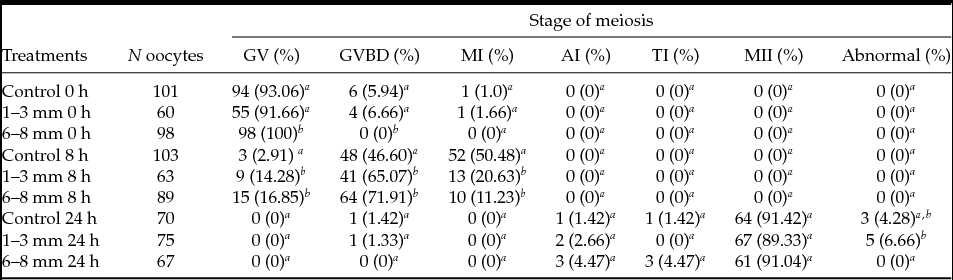
Before testing the effect of the presence of ITS and AA on the developmental competence of oocytes from small follicles, we compared the kinetics of nuclear maturation of the small follicle oocytes with those recovered from medium- and large-sized follicles. At 0 h of maturation the highest percentage (P < 0.05) of oocytes in the GV stage was observed from the group obtained from follicles of 6–8 mm diameter. However, in all of the groups, the percentage of oocytes at the GV stage was over 90%. We also observed that, at 8 h of culture, the oocytes from the control group were more advanced in meiosis than the other groups, as most of them had already undergone GVBD, while in the dissected groups approximately 15% of the oocytes were still at the GV stage (Table 7). However, that difference was not maintained; after 8 h, the nuclear maturation pattern was similar among all of the groups. At 24 h, all of the oocytes, regardless of their group, had completed meiosis (with 90% at MII stage).
Kinetics of nuclear maturation in oocytes recovered by follicular aspiration of 3–8 mm follicles (Control), and oocytes obtained from 1–3 mm and 6–8 mm follicles individually dissected from the ovarian cortex
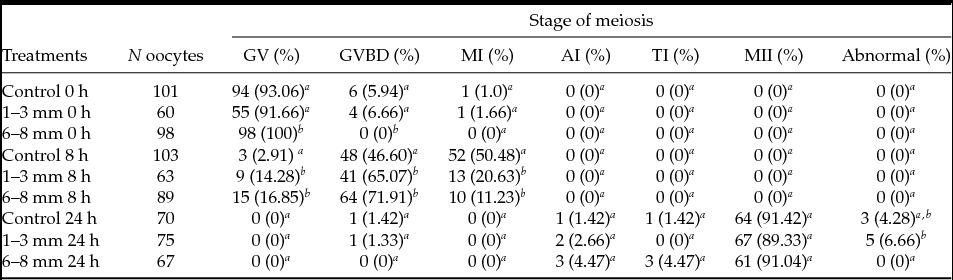
a,b Different letters indicate different values by chi-squared test (P < 0.05). GV: germinal vesicle; GVBD: germinal vesicle breakdown; MI: metaphase I; AI: anaphase I; TI: telophase I; MII: metaphase II.
Our assessment of the combinatory effect of ITS and AA during the last 12 h of IVM on small follicle oocyte developmental capacity showed that the cleavage rate (48 h pi) and blastocyst production on D6 and D7 of culture were lower compared with those oocytes obtained from follicles larger than 3 mm (Table 8). No difference was found (P < 0.05) in these parameters between the groups of oocytes from small follicles. However, as in Experiment 2, a beneficial effect on the blastocyst formation rate was observed in the control group after the addition of ITS and AA during the last 12 h of IVM (Table 8).
Effect on embryonic development with the inclusion of insulin–transferrin–selenium (ITS) and l-ascorbic acid (AA) during the last 12 h of in vitro maturation (IVM) on oocytes aspirated from 3–8 mm follicles (ITS+AA 3–8 mm) and oocytes from 1–3 mm follicles (ITS+AA 1–3 mm) dissected from ovarian cortex

a,b,c Different letters indicate different values by chi-squared test (P < 0.05).
The embryo quality results are presented in Tables 8 and 9. The ITS+AA 3–8 mm group had similar results to those obtained in Experiment 2. The oocytes obtained from small follicles resulted in no embryos or a low number of embryos in both groups, which makes it impossible to compare the low competence group to the control. The percentage of blastocysts with a size > 160 µm and the total cell numbers were similar between ITS+AA 1–3 mm and Control 3–8 mm (Table 9).
Effect on the size of embryos and total cell number in D7 culture with the inclusion of insulin–transferrin–selenium (ITS) and l-ascorbic acid (AA) during the first 12 h of in vitro maturation (IVM) on oocytes aspirated from 3–8 mm follicles (ITS+AA 3–8 mm), and oocytes from 1–3 mm follicles (ITS+AA 1–3 mm) dissected from the ovary

a,b,c Different letters indicate different values by Kruskal–Wallis test (P < 0.05).
Discussion
In the present study we investigated whether the addition of ITS and AA during maturation and embryo culture would improve the yield and quality of IVP embryos by analyzing blastocyst development, size and cell numbers.
Initially, ITS addition during IVM, IVC or during the entire culture period was assessed for an effect on embryo development. The data show that the presence of ITS at any stage of IVP did not affect the quantity or the quality of embryos produced. Our results differ from those previously reported for porcine oocytes (Jeong et al., Reference Jeong, Hossein, Bhandari, Kim, Kim, Park, Lee, Park, Jeong, Lee, Kim and Hwang2008).
The differences in the results of these studies may be due to the maturation time for porcine oocytes, which is twice as long as that of bovine oocytes (Hyttel et al., Reference Hyttel, Viuff, Laurincik, Schmidt, Thomsen, Avery, Callesen, Rath, Niemann, Rosenkranz, Schellander, Ochs and Greve2000). The longer time required for maturation may lead to a greater accumulation of free radicals and other harmful substances in the medium, making the action of the ITS more evident.
Another factor that may be responsible for the differences observed between the studies is the protein source used in the IVM medium. Our medium was supplemented with FBS, which contains hormones, growth factors, vitamins, heavy metal chelators, peptides, proteins, fatty acids, carbohydrates and other components (Keskintepe & Brackett, Reference Keskintepe and Brackett1996). In contrast, the comparative study used PVA, which is a well defined macromolecule. Therefore, it is quite possible that some substances present in FBS could mimic the action of ITS (Keskintepe & Brackett, Reference Keskintepe and Brackett1996), masking its effects.
Some studies have reported that combining ITS during oocyte maturation with AA, which is the most important water-soluble antioxidant present in the ovaries, has a beneficial effect on oocyte developmental capacity (Tatemoto et al., Reference Tatemoto, Muto, Sunagawa, Shinjo and Nakada2004; Tao et al., Reference Tao, Chen, Tian, Huo, Li, Zhang, Liu, Fang, Ding and Zhang2010). Although transferrin and selenium, present in the ITS combination, also have antioxidant activities, we hypothesized that their effect during culture was masked by the presence of FBS. To test the previously reported potential beneficial effect of antioxidants on the oocytes, we added AA to the maturation medium in Experiment 2, along with ITS. Considering that Córdova et al. (Reference Córdova, Morató, Izquierdo, Paramio and Mogas2010) and other authors (Blondin et al., Reference Blondin, Guilbault and Sirard1997; Tao et al., Reference Tao, Zhou, Xia, Wang, Wu and Fu2004; Tatemoto et al., Reference Tatemoto, Muto, Sunagawa, Shinjo and Nakada2004; Dalvit et al., Reference Dalvit, Llanes, Descalzo, Insani, Beconi and Cetica2005; Kere et al., Reference Kere, Siriboon, Lo, Nguyen and Ju2013) found that the addition of AA alone to the oocyte maturation medium exerted no effect on bovine and porcine COCs, we only evaluated the combination of both compounds. To assess if the effects of adding ITS and AA occur throughout maturation or if they are restricted to a certain period only, we supplemented the medium at different intervals during IVM.
The results showed a beneficial effect on blastocyst rate when oocytes were exposed to ITS and AA in the final 12 h of IVM. However, embryo quality, as assessed by the size and number of cells on D7, was similar to that of the control group. The effects of those individual components (ITS and AA) supplemented in maturation medium in different species have been reported by several authors (Bu et al., Reference Bu, Xie, Tao, Wang and Xia2004; Dalvit et al., Reference Dalvit, Llanes, Descalzo, Insani, Beconi and Cetica2005; Jeong et al., Reference Jeong, Hossein, Bhandari, Kim, Kim, Park, Lee, Park, Jeong, Lee, Kim and Hwang2008; Rossetto et al., Reference Rossetto, Lima-Verde, Matos, Saraiva, Martins, Faustino, Araujo, Silva, Name, Sn, Campello, Figueiredo and Blume2009; Tao et al., Reference Tao, Chen, Tian, Huo, Li, Zhang, Liu, Fang, Ding and Zhang2010; Hu et al., Reference Hu, Ma, Bao, Li, Cheng, Gao, Lei, Yang and Wang2011; Kere et al., Reference Kere, Siriboon, Lo, Nguyen and Ju2013). However, studies using ITS and AA in combination, as in the present study, are scarce.
In the present study, the best embryonic development results were found in the group exposed to ITS and AA in the second part of maturation. It is possible that a higher concentration of free radicals and other substances harmful to the oocyte could be present in the last hours of IVM compared with the early hours. Thus, the accumulation of injurious substances during the first 12 h of IVM could be offset by adding ITS and AA during the last 12 h of IVM to reduce stress on the oocytes. This effect would be responsible for the better results obtained in this group.
Based upon reports in the literature, which show that ITS and AA supplementation during maturation improved the developmental competence of oocytes obtained from pre-pubertal females, we questioned whether changing the maturation conditions would improve the IVP outcome of less competent oocytes obtained from small follicles.
To evaluate this possibility, we used the follicle size model, which is a well described model to obtain oocytes of varying competencies (Caixeta et al., Reference Caixeta, Ripamonte, Franco, Junior and Dode2009; Racedo et al., Reference Racedo, Wrenzycki, Lepikhov, Salamone, Walter and Niemann2009; Bessa et al., Reference Bessa, Nishimura, Franco and Dode2013). We then tested the effect of exposing less competent oocytes to ITS and AA during the last 12 h of maturation.
Because we were unsure whether the kinetics of meiosis were similar in oocytes obtained from different competencies, we first confirmed these kinetics. The results showed that, at 0 h of maturation, there was a higher percentage of oocytes from follicles of 6–8 mm in GV compared with the other groups. Despite the significant difference, this has little biological significance, because all of the groups showed more than 90% of the oocytes at the GV stage, which is consistent with other findings in the literature (Dode et al., Reference Dode, Rodovalho, Ueno and de Oliveira Alves2000; Dode & Adona, Reference Dode and Adona2001). At 8 h of maturation, the control group was more advanced in meiosis than the other groups. However, the groups of oocytes obtained from dissected follicles that had different degrees of competence were at the same stage at 8 h and 24 h of maturation. Finally, we evaluated the effect on less competent oocytes of adding both ITS and AA during the last 12 h of IVM. The results for the control group confirmed the beneficial effect of ITS and AA on cytoplasmatic maturation and on subsequent blastocyst development and quality, as was observed in the earlier experiments. When oocytes from 1–3 mm diameter follicles were used in the present study, no beneficial effect of adding ITS and AA was observed. Our results conflict with those found in the literature, where it is reported that ITS plus AA used in less competent oocytes had improved the development potential of the oocyte (Córdova et al., Reference Córdova, Morató, Izquierdo, Paramio and Mogas2010; Hammami et al., Reference Hammami, Morató, Romaguera, Roura, Catalá, Paramio, Mogas and Izquierdo2013). However, those studies used oocytes from pre-pubertal goats as their experimental model. Although most oocytes at this stage of development have lower competence and are obtained from various follicle sizes, it is possible that some oocytes had already reached competence (Revel et al., Reference Revel, Mermillod, Peynot, Renard and Heyman1995; Alberio & Palma, Reference Alberio and Palma1998). In contrast, the experimental model used to classify oocyte competence in our study ensures the similarity of the biological material, because the oocytes were obtained from follicles of defined sizes dissected from the ovarian cortex (Caixeta et al., Reference Caixeta, Ripamonte, Franco, Junior and Dode2009; Bessa et al., Reference Bessa, Nishimura, Franco and Dode2013). This difference in experimental design could increase the lowered competency of the oocytes that we used, which could account for the differences in blastocyst rates (Córdova et al., Reference Córdova, Morató, Izquierdo, Paramio and Mogas2010; Hammami et al., Reference Hammami, Morató, Romaguera, Roura, Catalá, Paramio, Mogas and Izquierdo2013). In addition, oocyte competence is directly related to the transcript and protein accumulation in the oocyte before resuming meiosis and completing maturation (Dode et al., Reference Dode, Dufort, Massicotte and Sirard2006; Caixeta et al., Reference Caixeta, Ripamonte, Franco, Junior and Dode2009; Racedo et al., Reference Racedo, Wrenzycki, Lepikhov, Salamone, Walter and Niemann2009; Bessa et al., Reference Bessa, Nishimura, Franco and Dode2013). Therefore, the action of substances such as ITS and AA, which act mainly on the production of free radicals and undesirable products in the oocyte and maturation medium at levels other than the molecular (Tilly & Tilly, Reference Tilly and Tilly1995; Eppig et al., Reference Eppig, Hosoe, O'Brien, Pendola, Requena and Watanabe2000; Murray et al., Reference Murray, Molinek, Baker, Kojima, Smith, Hillier and Spears2001; Kim et al., Reference Kim, Lee, Lee, Kim, Jeong, Kim, Kang, Lee and Hwang2005; Lee et al., Reference Lee, Kang, Lee and Hwang2005), may not have been sufficient to improve competence. Unless the oocytes could be exposed to those substances while they are kept arrested at the GV stage, an effect at the molecular level would not be possible. In fact, we are not dismissing the importance of those substances for the oocytes and for the environment where oocytes are exposed. The beneficial effects of these agents could help to explain the improvement observed in the embryonic development of oocytes treated with ITS and AA during IVM.
Despite the small sample sizes and lack of differences among groups 1–3, when ITS and AA were added, the outcome seems to have improved. This reinforces the hypothesis that the supplements do not improve embryo competence but affect the oocyte culture environment. It is possible that antioxidant substances may protect against oxidative stress in the cumulus cells, which are known to have an important role in supporting oocyte maturation.
Based on our findings, we can conclude that the addition of the insulin–transferrin–selenium complex plus ascorbic acid improved ability of oocytes to develop to blastocyst stage when used during the last 12 h of IVM. Furthermore, no such effect was observed when less competent oocytes were exposed to the same conditions.
Acknowledgements
This research was supported by Embrapa MP1 (grant number – 003.0709040000). The authors thank the personnel at QualiMax Meat Packing (Luziânia, Goiás, Brazil) for their generosity in supplying ovaries for research.
Conflicts of interests
None of the authors has any conflict of interest to declare.