Over 26% of Americans ages 18 and older suffer from a diagnosable mental disorder in a given year (Kessler, Chiu, Demler, & Walters, Reference Kessler, Chiu, Demler and Walters2005), including enduring conditions such as depression, bipolar disorder, and schizophrenia. Major depressive disorder (MDD) is a significant public health problem that is particularly prevalent in women during their childbearing years (Kessler, McGonagle, Swartz, Blazer, & Nelson, Reference Kessler, McGonagle, Swartz, Blazer and Nelson1993; Kessler et al., Reference Kessler, Berglund, Demler, Jin, Koretz and Merikangas2003; Regier et al., Reference Regier, Herschfeld, Goodwin, Burke, Lazar and Judd1988). Twenty percent of women will experience an episode of MDD at some point during their lives, and women residing in poverty are at even greater risk for MDD (Segre, O'Hara, Arndt, & Stuart, Reference Segre, O'Hara, Arndt and Stuart2007; Williams & Collins, Reference Williams and Collins1995). Despite the magnitude of the problem, many economically disadvantaged women do not seek treatment or receive substandard treatments that are ineffective (Wang et al., Reference Wang, Lane, Olfson, Pincus, Wells and Kessler2005). Of particular concern are findings that racial and ethnic minority groups, many of whom reside in poverty, receive poorer quality healthcare and have worse outcomes when care is received (Smedley, Stith, & Nelson, Reference Smedley, Stith and Nelson2002). We evaluate whether individuals vary in response to the provision of an evidence-based psychosocial treatment for MDD as a function of genetic moderation. In secondary analyses, we explore differential susceptibility in relation to self-reported ethnoracial group status.
Early Life Stress and Depression
A plethora of studies have elucidated the role of early life stress in the etiology of depression (Caspi, Hariri, Holmes, Uher, & Moffit, Reference Caspi, Hariri, Holmes, Usher and Moffitt2010; Caspi et al., Reference Caspi, Sugden, Moffitt, Taylor, Craig and Harrington2003; Danese, Reference Danese2008; Heim & Binder, Reference Heim and Binder2012). Disadvantaged women are frequently exposed to traumatic events, including child maltreatment and community and domestic violence (Browne & Bassuk, Reference Browne and Bassuk1997; Cicchetti & Lynch, Reference Cicchetti and Lynch1993; Kessler, Sonnega, Bromet, Hughes, & Nelson, Reference Kessler, Sonnega, Bromet, Hughes and Nelson1995), which further increase the likelihood that they will experience MDD (Chapman et al., Reference Chapman, Whitfield, Felitti, Dube, Edwards and Anda2004). Lifetime rates of MDD have actually been as high as 64% in women with histories of abuse (Weiss, Longhurst, & Mazure, Reference Weiss, Longhurst and Mazure1999). Statistics such as these underscore the criticality of providing and evaluating the efficacy of treatments for MDD in socioeconomically disadvantaged women. Because the stressors associated with parenting further exacerbate the likelihood that depression will emerge (Cicchetti & Toth, Reference Cicchetti, Toth, Cicchetti and Cohen1995, Reference Cicchetti and Toth1998), the conduct of investigations with low-income mothers is of paramount importance.
Interactive Effects of Trauma and Depression
In accord with a developmental psychopathology perspective, multilevel investigations of pathways to mental disorder are increasingly being called for (Cicchetti & Dawson, Reference Cicchetti and Dawson2002; Cicchetti & Toth, Reference Cicchetti and Toth2009). Such multilevel investigations have highlighted the heterogeneity of outcomes among individuals with similar risk factors, including those at heightened genetic risk. For example, despite moderate to high heritability estimates for depression, including rates as high as 48%–75% for individuals with recurrent depression (McGuffin, Katz, Watkins, & Rutherford, Reference McGuffin, Katz, Watkins and Rutherford1996; Sullivan, Neale, & Kendler, Reference Sullivan, Neale and Kendler2000), five genome-wide case-control association studies of over 7,000 individuals with depression failed to identify any genetic variant reliably associated with depression (Uher, Reference Uher2011). Moreover, significant variability also exists with regard to the role of trauma in contributing to the etiology of depression because not all individuals who experience early trauma, including child maltreatment, develop depression in adulthood (Cicchetti & Toth, in press).
In order to better understand pathways to psychopathology, in recent years efforts have been directed toward examining the interactive effects of early life stress and depression (Caspi et al., Reference Caspi, Sugden, Moffitt, Taylor, Craig and Harrington2003; Heim & Binder, Reference Heim and Binder2012). Specifically, a significant corpus of research has sought to identify candidate genetic variations that interact with early trauma in contributing to the emergence of MDD (Hornung & Heim, Reference Hornung and Heim2014). Candidate genes of particular interest in understanding the moderating effects of genes in relation to early life stress have included the corticotropin releasing hormone receptor 1 gene (CRHR1) and the linked polymorphic region of the serotonin transporter (5-HTTLPR) gene. The rationale for choosing these genes as potential moderators in the current investigation is delineated below.
CRHR1
Genes involved in biological stress systems are important candidates for investigations of genetic moderation of the effects of major stressors such as depression. Corticotropin releasing hormone (CRH) is a key activator of the hypothalamic–pituitary–adrenal axis, binding to receptors that initiate the stress response, culminating with release of cortisol from the adrenal cortex (Gunnar & Vasquez, Reference Gunnar, Vazquez, Cicchetti and Cohen2006). CRH receptors occupy widespread regions of the primate brain (Chrousos, Reference Chrousos1998; Lupien, McEwen, Gunnar, & Heim, Reference Lupien, McEwen, Gunnar and Heim2009; Sanchez, Young, Plotsky, & Insel, Reference Sanchez, Young, Plotsky and Insel1999). CRH receptors may function as transcription factors and thereby serve as regulators of gene transcription (Lupien et al., Reference Lupien, McEwen, Gunnar and Heim2009). Genotypic variation in CRHR1 has been linked to hypothalamic–pituitary–adrenal axis dysregulation in adults who reported having been maltreated in childhood (Tyrka et al., Reference Tyrka, Price, Gelernter, Schepker, Anderson and Carpenter2009) and, in interaction with childhood adversity, to risk for, and protection against, depression (Bradley et al., Reference Bradley, Binder, Epstein, Tang, Nair and Liu2008; Polanczyk et al., Reference Polanczyk, Caspi, Williams, Price, Danese and Sugden2009) and neuroticism (DeYoung, Cicchetti, & Rogosch, Reference DeYoung, Cicchetti and Rogosch2011). Furthermore, a three-way Gene × Gene × Environment interaction (5-HTTLPR × CRHR1 × Child Maltreatment) has been found for high internalizing symptoms (Cicchetti, Rogosch, & Oshri, Reference Cicchetti, Rogosch and Oshri2011).
5-HTT Gene
5-HTT is one of the major genes involved in serotonergic neurotransmission. The 5-HTT gene has a polymorphism in the linked polymorphic region (5-HTTLPR) in the 5′- regulatory region due to a 44 base pair deletion that eventuates in either the short or the long allele (Lesch et al., Reference Lesch, Bengel, Heiles, Sabol, Greenberg and Petri1996). Because the short variation of 5-HTTLPR appears to be dominant, heterozygous (short–long [SL]) individuals can be functionally categorized with individuals who possess the homozygous (short–short [SS]) genotype. In vitro research has revealed that the long allele variant has two to three times the transcriptional activity of the short variant (Lesch et al., Reference Lesch, Bengel, Heiles, Sabol, Greenberg and Petri1996).
The 5-HTT gene has been shown to play a pivotal role in brain development and in the emergence of individual differences in mood and emotion regulation (Caspi et al., 2013). Although there is some disagreement in the literature (compare Risch et al., Reference Risch, Herrell, Lehner, Liang, Eaves and Hoh2009; to Caspi et al., Reference Caspi, Hariri, Holmes, Usher and Moffitt2010; and Karg, Burmeister, Shedden, & Sen, Reference Karg, Burmeister, Shedden and Sen2011), variation in the promoter region of the 5-HTT gene has been linked to stress sensitivity in humans. The majority of Gene × Environment (G × E) research on 5-HTTLPR in humans conducted to date has primarily focused on depression. 5-HTTLPR short allele carriers are characterized by negative activity that develops into depression only under particular stress sensitive conditions. This stress sensitivity may result in the development of anxiety and fear neural circuitry (Hariri & Holmes, Reference Hariri and Holmes2006), and an attentional bias toward negative emotions and sensitivity to potential threat (Caspi et al., Reference Caspi, Hariri, Holmes, Usher and Moffitt2010; Watson & Clark, Reference Watson and Clark1984). The short allele of 5-HTTLPR is often considered to be the risk allele for depression, whereas the long allele is thought to be a protective factor against the occurrence of mood dysregulation.
Beyond Genetic Vulnerability
The view that a “risk” genotype makes an individual vulnerable to the effects of environmental adversity, whereas a “protective” genotype inoculates one to adversity, has fallen into disfavor (Uher, Reference Uher2011). According to the differential susceptibility to environmental influence hypothesis proffered by Belsky (Reference Belsky1997, Reference Belsky, Ellis and Bjorklund2005; Belsky & Pluess, Reference Belsky and Pluess2009), genes that confer risk in harsh environments may confer benefits in normal or nurturing environments. In other words, the characteristics of individuals (including their genotypes) that render them disproportionately more vulnerable to experiencing adversity also may make them more likely to benefit from supportive contexts (Belsky, Bakersman-Kranenburg, & van IJzendoorn, Reference Belsky, Bakersman-Kranenburg and van Ijzendoorn2007; Boyce & Ellis, Reference Boyce and Ellis2005; Ellis, Boyce, Belsky, Bakersman-Branenburg, & van IJzendoorn, Reference Ellis, Boyce, Belsky, Bakermans-Kranenburg and van IJzendoorn2011). A number of empirical studies have demonstrated that the same genetic variant that increases susceptibility to the effects of adversity may also result in an increased likelihood of benefitting from positive environmental experiences (Cicchetti & Rogosch, Reference Cicchetti and Rogosch2012; Cicchetti, Rogosch, Hecht, Crick, & Hetzel, Reference Cicchetti, Rogosch, Hecht, Crick and Hetzel2014; Davies & Cicchetti, Reference Davies and Cicchetti2014). These results also have been found in a meta-analysis of studies that primarily included Caucasian children and adolescents (van IJzendoorn, Belsky, & Bakersman-Kranenburg, Reference van IJzendoorn, Belsky and Bakermans-Kranenburg2012). Thus, the differential susceptibility framework does not view susceptible individuals as more vulnerable to adversity; rather, susceptible individuals are viewed as more malleable or plastic (Pluess & Belsky, Reference Pluess and Belsky2013).
Psychosocial Interventions for MDD
Cognitive behavioral therapy (CBT) and interpersonal psychotherapy (IPT) are two of the most widely investigated psychosocial treatments for MDD, and both have been found to be efficacious (Elkin et al., Reference Elkin, Shea, Watkins, Imber, Sotsky and Collins1989; Hollon & Ponniah, Reference Hollon and Ponniah2010). Because impoverished women with young children experience a multitude of interpersonal stressors, the provision of IPT might be particularly effective in treating MDD in this population. Investigations of the efficacy of IPT with low-income and minority populations have yielded promising results in reducing depressive symptoms as well as alleviating posttraumatic stress disorder (Grote et al., Reference Grote, Swartz, Geibel, Zuckoff, Houck and Frank2009; Krupnick et al., Reference Krupnick, Green, Stockton, Miranda, Krause and Mete2008; Mufson et al., Reference Mufson, Moreau, Weissman, Wickramaratne, Martin and Samilov1994; Mufson, Weissman, Moreau, & Garfinkle, Reference Mufson, Weissman, Moreau and Garfinkel1999; Rosello & Bernal, Reference Rossello and Bernal1999; Spinelli & Endicott, Reference Spinelli and Endicott2003).
Most recently, Toth et al. conducted a randomized clinical trial of IPT with economically disadvantaged mothers with MDD (Toth et al., Reference Toth, Rogosch, Oshri, Gravener, Sturm and Morgan-Lopez2013). Women in this sample also had extensive histories of trauma, with over 86% of women receiving IPT having histories of child maltreatment and over 90% experiencing at least one lifetime traumatic event. Depressive symptoms at the end of treatment and at 8 months postintervention were significantly lower among women who received IPT than in those who received treatment generally available in the community. Social adjustment and perceived stress also were identified as mediators of sustained positive treatment effects (Toth et al., Reference Toth, Rogosch, Oshri, Gravener, Sturm and Morgan-Lopez2013).
Genetic Moderation of Intervention Outcome
The importance of incorporating multilevel measurement strategies into intervention outcome studies has been increasingly highlighted (Cicchetti & Gunnar, Reference Cicchetti and Gunnar2008). However, to date little research has been directed specifically toward identifying genetic predictors of response to psychosocial interventions. In a notable exception involving a study of a family intervention directed toward reducing externalizing behavior in toddlers, the dopamine D4 receptor polymorphism (DRD4) was found to moderate intervention effects. Specifically, parental insensitivity was related to externalizing behaviors in preschoolers, but only in the presence of the DRD4 seven-repeat polymorphism (Bakermans-Kranenburg & van IJzendoorn, Reference Bakermans-Kranenburg and van IJzendoorn2006). Differential susceptibility to intervention effects based on the presence of the DRD4 seven-repeat allele in children also have been reported (Bakermans-Kranenburg et al., Reference Bakermans-Kranenburg, van IJzendoorn, Pijlman, Mesman and Juffer2008). Brody, Beach, Philibert, Chen, and Murry (Reference Brody, Beach, Philibert, Chen and Murry2009) also found 5-HTTLPR to moderate intervention effects such that youths with the risk allele (SS or SL) benefited more from the preventive parenting program than did youth with the LL genotype.
With respect to the examination of the potential moderating effects of genetic factors on stressful life events and the response to interventions directed specifically toward depression, investigations also have focused on pharmacological treatments and have identified individuals with 5-HTTLPR short alleles (SS or SL) as having poorer responses to medication treatment (Keers et al., Reference Keers, Uher, Huezo-Diaz, Smith, Jaffee and Rietschel2011; Mandelli et al., Reference Mandelli, Marino, Pirovano, Calati, Zanardi and Colombo2009). However, not all investigations of genetic moderation of psychotropic medications have yielded positive results (Bukh et al., Reference Bukh, Bock, Vinberg, Werge, Gether and Kessing2010), underscoring the importance of continued research on this issue. To our knowledge, the only investigation to examine possible genetic moderation of a psychosocial intervention on depression involved the parents of children who participated in a parent-training program for depressed African American parents. The intervention was associated with a greater impact on reducing parental depressive symptoms when children were at increased genetic risk (i.e., one or two copies of the short allele) for negative affect and poor self-control (Beach et al., Reference Beach, Brody, Kogan, Philibert, Chen and Lei2009).
Current Study
In the current investigation, genetic moderators of intervention efficacy were examined in the Toth et al. (Reference Toth, Rogosch, Oshri, Gravener, Sturm and Morgan-Lopez2013) randomized control trial of IPT in socially disadvantaged racially and ethnically diverse mothers with MDD. Specifically, we investigated the potential moderating effects of CRHR1 and 5-HTTLPR on depressive symptoms. Moreover, we examined CRHR1 and 5-HTTLPR as possible moderators of the previously identified IPT mediators (perceived stress and social adjustment). Based on prior research revealing genetic moderation of early life stress and depression (Caspi et al., Reference Caspi, Sugden, Moffitt, Taylor, Craig and Harrington2003; Karg et al., Reference Karg, Burmeister, Shedden and Sen2011), we expected to identify similar moderating effects on intervention response.
Given that the extant literature to date on genetic moderation of intervention has identified those with risk alleles (e.g., SS/SL) as being more likely to benefit from treatment, similar findings might be hypothesized for the current investigation. However, it is important to note that at least with respect to the 5-HTTLPR meta-analysis, these results on genetic moderation for individuals with risk allelles (SS/SL) held only for Caucasians (van IJzendoorn et al., Reference van IJzendoorn, Belsky and Bakermans-Kranenburg2012). For instance, a study that did not provide evidence for SS/SL as the risk allele was conducted among a racially and ethnically heterogeneous sample of youths. Specifically, Sadeh et al. (Reference Sadeh, Javdani, Jackson, Reynolds, Potenza and Gelernter2010) showed that lower socioeconomic status was associated with higher levels of callous–unemotional and narcissistic traits only among youth with the LL genotype, thus demonstrating that the SS/SL allele may not represent the risk allele with heterogeneous, non-Caucasian samples. Furthermore, in recent years, investigations of ancestrally heterogeneous samples of African American and mixed ethnicities have begun to demonstrate that the LL genotype may confer vulnerability to depression (see, e.g., Banny, Cicchetti, Rogosch, Oshri, & Crick, Reference Banny, Cicchetti, Rogosch, Crick and Oshri2013; Cicchetti et al., Reference Cicchetti, Rogosch and Oshri2011; Davies & Cicchetti, Reference Davies and Cicchetti2014; Laucht et al., Reference Laucht, Treutlein, Blomeyer, Buchmann, Schmid and Becker2009). Thus, race and ethnicity may play an extremely important role in the nature of G × E interactions (Cicchetti et al., Reference Cicchetti, Rogosch, Hecht, Crick and Hetzel2014; van IJzendoorn et al., Reference van IJzendoorn, Belsky and Bakermans-Kranenburg2012).
Given the large percentage of non-Caucasian participants included in the current investigation, in conjunction with findings that long alleles are more common in African American individuals (Odgerel, Talati, Hamilton, Levinson, & Weissmann, Reference Odegerel, Talati, Hamilton, Levinson and Weissman2013), we intended to utilize ancestral proportion scores to investigate whether the results on differential susceptibility in relation to intervention would operate similarly in a more diverse sample.
Method
Participants
The sample for this investigation included 126 racially and ethnically diverse low-income urban women (aged 18–40; mean age = 25.33 years; 54.0% African American, 22.2% Caucasian, and 23.8% Hispanic/biracial) with a 12-month-old infant. Informed consent for participation was obtained from mothers prior to the initiation of data collection, and the research was conducted in accord with institutional review board approval. All women met criteria for MDD. We recruited a community sample of non-treatment-seeking women from primary care clinics serving low-income women and from Women, Infant and Children clinics. Seventy-eight percent of the sample was at or below the US Department of Health and Human Services definition of poverty level, and 96% met Women, Infant and Children criteria (185% of the poverty level). A project recruitment coordinator initially screened women with the Center for Epidemiologic Studies—Depression Scale (CES-D; Radloff, Reference Radloff1977), and those scoring above 16 were targeted for further assessments to determine eligibility for inclusion. Women who subsequently scored 19 or higher on the Beck Depression Inventory II (BDI-II; Beck, Steer, & Brown, Reference Beck, Steer and Brown1996) and who met MDD diagnostic criteria based on the operational criteria on the Diagnostic Interview Schedule (DIS-IV; Robins, Cottler, Bucholz, & Compton, Reference Robins, Cottler, Bucholz and Compton1995) were eligible to participate. Following diagnostic confirmation, women were randomized to IPT or Enhanced Community Standard groups (ECS; see Intervention Groups Section for details on the interventions).
For all but 6.3% of the women, the onset of their first major depressive episode preceded the infant's birth. Accordingly, the current sample was not composed of women with depression restricted to the postpartum period, but rather was of longer standing duration. Regarding comorbid DSM-IV diagnoses, 50% of women met criteria for an anxiety disorder (non–posttraumatic stress disorder), 33.6% met criteria for posttraumatic stress disorder, and 16.4% met criteria for antisocial personality disorder. No statistically significant differences were found in rate of comorbid disorders between the IPT and ECS groups.
Although scores on the Hamilton Rating Scale for Depression of 14 or higher are generally considered indicative of MDD, utilization of this cutoff criteria for study admission has been criticized because individuals may be erroneously excluded (Bagby, Ryder, Schuller, & Marshall, Reference Bagby, Ryder, Schuller and Marshall2004; Morris et al., Reference Morris, Rush, Jain, Fava, Wisniewski and Balasubramani2007). Therefore, the Hamilton Rating Scale for Depression was not used to exclude participants in the current investigation. Women meeting diagnostic criteria for lifetime bipolar disorder or for any lifetime psychotic spectrum disorder were excluded. Women with mood disorder due to a general medical condition and substance-induced mood disorder were also excluded, as were women with any current alcohol or substance abuse disorder, as defined by DSM-IV criteria. Women with other comorbid disorders were not excluded.
Procedures
Assessments were conducted at baseline, postintervention, and at an 8-month postintervention follow-up. All assessments were conducted by trained interviewers who were unaware of group condition or study hypotheses. Due to possible variations in literacy and reading ability, all self-report measures were read to participants while they followed along and marked their answers. Following confirmation of diagnostic status, women were randomized to the IPT or to the ECS group, using a progressive block randomization procedure over the extended period of participant recruitment. Demographic variables including age, race, ethnicity, education, and number of children were used as blocking variables. Because the clinical trial involved women who were not seeking treatment, we expected that there would be a number of participants who would not be interested in the active IPT arm when offered and, thus, would decline treatment, thereby not complying with their random assignment to receive the intervention (Little & Yau, Reference Little and Yau1998). In this “treatment-as-received” investigation, women who were not interested in the active IPT intervention were considered in the ECS group (n = 39). This decision was made to maximize the sample in each intervention group (IPT and ECS), thus making Gene × Intervention analyses more feasible. Therefore, 58 women participated in IPT, with 84% completing all 14 sessions, and the mean number of sessions attended was 13.68. Group assignment was not revealed until completion of the baseline research assessments, at which time participants were informed of their group assignment by the recruitment coordinator.
Intervention groups
IPT
IPT was delivered in accord with the treatment manual (Weissman, Markowitz, & Klerman, Reference Weissman, Markowitz and Klerman2000) and included the provision of 14 1-hr sessions on a weekly basis. Although traditionally provided in clinic settings, flexibility of delivery site (home vs. clinic) was offered to reduce the possible stigma associated with receiving mental health services for low-income racially and ethnically diverse participants and to increase receptivity to services. Depression was explained to participants as common feelings that can be associated with the many challenges parents face with childrearing. At times, language focused more on “feeling overwhelmed, stressed, and down” because it was difficult for some clients to acknowledge feeling “depressed.” Therefore, psychoeducation around depression that therapists typically provide in the initial phase sometimes was provided later in treatment once therapeutic rapport was stronger. Therapists included master's- or doctoral-level practitioners who were trained in IPT in accord with credentialing recommendations. Therapists had a minimum of 10 years of experience with the provision of psychotherapy to low-income populations and at least 2 years of supervised experience in the provision of IPT. Weekly individual and group supervision was provided by supervisors who also met credentialing requirements for the supervisory level. Fidelity was monitored through the completion of therapist questionnaires at the initial, intermediate, and termination phases of IPT. The questionnaires, which were reviewed by supervisors, included information on sessions held, as well as therapists' evaluations of the extent of progress on client goals. One audiotape from each of the initial (Sessions 1–3), intermediate (Sessions 4–11), and termination (Sessions 12–14) phases for each client were randomly selected to be reviewed by an individual who had been trained to meet credentialing criteria established for IPT supervisors and who was not providing treatment to participants in order to ensure treatment fidelity. A standard rating scale was developed and utilized to rate tapes for adherence to the treatment protocol.
ECS
Because it is not ethical to withhold treatment from women who have been identified as depressed, all women in the ECS arm were actively offered referral to services typically available in the community (n = 68). However, these women were not required to be in treatment unless they chose to do so. Overall, 66.2% elected to be involved in treatment for depression, and all of these women received individual counseling or psychotherapy. In this subgroup participating in treatment, additional interventions also were received, including medication (40.4%), support groups (21.1%), family/marital counseling (12.3%), and day treatment (12.3%). All women in the ECS group also had access to a project staff member who provided periodic informational newsletters, basic education about MDD, support, and referrals to community mental health centers to assist them with accessing treatment, as requested. The staff member was very active in referring ECS participants to treatment and, if needed, would assist them in attending their initial intake appointments for support or follow-up with phone calls to ascertain how treatment was proceeding. Thus, treatment received in the ECS group varied from no active intervention to psychotherapy plus additional services.
Measures
The CES-D
The CES-D (Radloff, Reference Radloff1977) is a frequently used, well-validated 20-item scale to screen for depression. Scores higher than 16 predict a high likelihood of MDD.
The DIS-IV
The DIS-IV (Robins et al., Reference Robins, Cottler, Bucholz and Compton1995) is a structured interview designed to assess diagnostic criteria for Axis I disorders, as well as for antisocial personality disorder, as outlined in DSM-IV (American Psychiatric Association, 1994). The DIS-IV ascertains diagnoses present in the past year, the past 6 months, and those that are current or remitted. The DIS has been shown to be reliable and valid for use in psychiatric epidemiological field studies (Robins, Helzer, Croughan, & Ratcliff, Reference Robins, Helzer, Croughan and Ratcliff1981; Robins, Helzer, Ratcliff, & Seyfried, Reference Robins, Helzer, Ratcliff and Seyfried1982). Robins et al. (Reference Robins, Helzer, Croughan and Ratcliff1981) compared DSM diagnoses made using the DIS to those made by psychiatrists and reported mean κ = 0.69, sensitivity of 75%, and specificity of 94%. Given the forced choice structured format of the DIS, interviewers do not need to be trained clinicians. All interviewers were trained to criterion reliability in the administration of the DIS, and computer-generated diagnoses were utilized.
The BDI-II
The BDI-II (Beck et al., Reference Beck, Steer and Brown1996) is the most widely used self-report instrument for measuring the severity of depression. It includes 21 questions in a multiple-choice format, and scores of 19 or above indicate levels of depression with clinical significance. Previous studies report that the BDI-II demonstrates good internal consistency (α = 0.91) and validity (Dozois, Dobson, & Ahnberg Reference Dozois, Dobson and Ahnberg1998; Storch, Roberti, & Roth, Reference Storch, Roberti and Roth2004). In the current study, the average internal consistency of the BDI-II based on the three assessments was α = 0.94.
The Perceived Stress Scale (PSS)
The PSS (Cohen, Kamarck, & Mermelstein, Reference Cohen, Kamarck and Marmelstein1983) is a self-report measure of perceived stress. The PSS is a psychometrically sound 14-item questionnaire that measures the degree to which respondents feel their lives are unpredictable, uncontrollable, and overwhelming. Previous research with this measure has reported high internal consistency (α = 0.91), concurrent validity with a measure of mental health, and convergent validity with the Posttraumatic Stress-Arousal Symptoms Scale (Mitchell, Crane, & Kim, Reference Mitchell, Crane and Kim2008). Test–retest reliability has been reported to range from 0.85 to 0.55 for a 2-day and a 6-week period, respectively (Cohen et al., Reference Cohen, Kamarck and Marmelstein1983). The PSS has also been found to be correlated with depression and with physical symptoms (e.g., Cohen et al., Reference Cohen, Kamarck and Marmelstein1983; Whiffen & Gotlib, Reference Whiffen and Gotlib1993). The reliability score of the PSS based on the three assessments was α = 0.84.
The Social Adjustment Scale—Self-Report (SAS-SR)
The SAS-SR (Weissman, Reference Weissman1999) is a 54-item measure that evaluates functioning in six role areas, including work, social and leisure activities, relationships with extended family, role as a marital partner, parental role, and role within the family unit. Instrumental and expressive features of functioning within these roles are assessed. The overall social adjustment scale was used in the present study. The measure has been used extensively in studies of treatments for mental disorders (Bateman & Fonagy, Reference Bateman and Fonagy1999; Grote et al., Reference Grote, Swartz, Geibel, Zuckoff, Houck and Frank2009; Gunlicks-Stoessel, Mufson, Jekal, & Turner, Reference Gunlicks-Stoessel, Mufson, Jekal and Turner2010; Lenze et al., Reference Lenze, Dew, Mazumdar, Begley, Cornes and Miller2002), and research has demonstrated a high correlation (0.72) between interview ratings of overall adjustment and the SAS-SR (Weissman & Bothwell, Reference Weissman and Bothwell1976). The average SAS-SR internal consistency in the current study based on the three time assessments was α = 0.80.
DNA collection, extraction, and genotyping
Using an established protocol, trained research assistants obtained DNA samples from women by collecting buccal cells with the Epicentre Catch-All Collection Swabs. Subsequently, using the conventional method, DNA was extracted with the Epicentre BuccalAmp DNA Extraction Kit, in order to prepare DNA for polymerase chain reaction amplification. Genotyping was conducted following previously published protocols. DNA was whole-genome amplified using the Repli-g kit (Qiagen, Chatsworth, CA, Catalog No. 150043) per the kit instructions to ensure the availability of data over the long term for this valuable sample. Amplified samples were then diluted to a working concentration.
CRHR1 was genotyped using assays for single nucleotide polymorphisms (SNPs) rs110402, rs242924, and rs7209436 purchased from Applied Biosystems, Inc. (ABI, Bedford, MA) as C2544843 10, C2257689 10, and C1570087 10, respectively. Individual allele discriminations were made using Taq Man Genotyping Master Mix (ABI Catalog No. 4371357) with amplification in an ABI 9700 thermal cycler and analyzing the endpoint fluorescence using a Tecan M200. 5-HTTLPR samples were genotyped for fragment length polymorphisms of 5-HTTLPR with Hot Star Taq PCR Mix (Qiagen, Catalog No. 203205) and previously described primers (Gelernter, Kranzler, & Cubells, Reference Gelernter, Kranzler and Cubells1997), followed by fragment analysis using a CEQ8000 (Beckman–Coulter, Inc., Fullerton, CA).
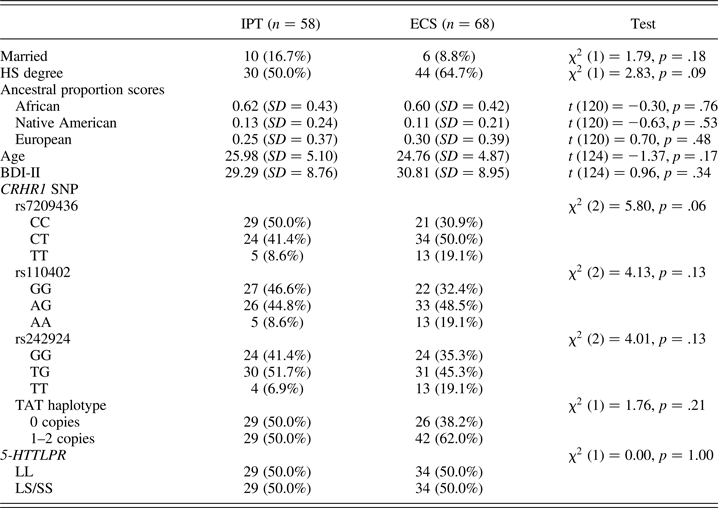
If a genotype for either gene or SNP could not be determined after the first run, then it was repeated up to four times. The call rates for the three CRHR1 SNPs were all 1.00. Genotype distributions were in Hardy–Weinberg equilibrium (all ps > .05). Haplotypes for the three CRHR1 SNPs were determined using Arlequin version 3.5.1.3, which employs a pseudo-Bayesian approach to estimate phase (Excoffier & Lischer, Reference Excoffier and Lischer2010). Arelquin was able to estimate haplotypes for every participant with a posterior probability higher than 0.94, which allowed us to assign a score of zero, one, or two copies of the TAT haplotype to participants with a high degree of certainty. The TAT haplotype accounted for 34.9% of all haplotypes in the sample, with its complement, CGG, accounting for 61.2%. Table 1 presents the allele and haplotype frequencies for the CRHR1 SNPs, TAT haplotype, and 5-HTTLPR genotype for both intervention groups (IPT and ECS). As displayed in Table 1, the groups did not differ by CRHR1 SNPs, TAT haplotype, or 5-HTTLPR.
Baseline demographic, genotype, and depression variables for IPT and ECS groups

Note: For ancestral proportion scores, n = 66 in the Enhanced Community Standard (ECS) group. IPT, Interpersonal psychotherapy; HS, high school; BDI-II, Beck Depression Inventory II; SNP, single nucleotide polymorphism.
All DNA samples were genotyped in duplicate for quality control. In addition, human DNA from cell lines was purchased from Coriell Cell Respositories for all representative genotypes in duplicate and genotypes confirmed by sequencing using DTCS chemistry on an ABI 3130x1. These and a no-template control were run alongside study samples representing 9% of the total data output. Any samples that could not be genotyped to a 95% or greater confidence level were repeated under the same conditions.
Ancestral proportion scores
For ancestral proportion testing, DNA from study participants were subjected to SNP genotyping of the Burchard et al. panel of 106 SNPs (Lai et al., Reference Lai, Tucker, Choudhry, Parnell, Mattei and García-Bailo2009; Yaeger et al., Reference Yaeger, Avila-Bront, Abdul, Nolan, Grann and Birchette2008), known to be informative for ancestry from Africa, Europe, and Native America. The SNPs were genotyped using the iPLEX platform from Sequenom Bioscience, Inc., which uses the Sequenom MassArray. Samples are subjected to single base primer extension (SBE) with fluorophore-labeled nucleotides from primers designed for SNPs of interest. The samples including the SBE products were placed on the iPLEX platform, and matrix-assisted laser desorption/ionization time of flight was used to identify the allele based on the fluorophore passing the detector at the expected time associated with the mass of the SBE primer. The SNP genotyping results were then recoded and uploaded into STRUCTURE version 2.3.4, which uses algorithms developed by Pritchard and colleagues (Falush, Stephens, & Pritchard, Reference Falush, Stephens and Pritchard2003, Reference Falush, Stephens and Pritchard2007; Hubisz, Falush, Stephens, & Pritchard, Reference Hubisz, Falush, Stephens and Pritchard2009). Three SNP tests were excluded based on high allele call rates of the non-DNA containing wells. The data from the remaining 103 loci were uploaded into the software and set to analyze with an Admixture model of ancestry and initialization of the simulation on the GALA cohort (initialize of POPINFO). The simulation was set to run with a burn-in of 10,000, Markov chain Monte Carlo reps of 1,000 and assuming three populations within the group. The results of the simulations were subsequently identified as percent association (continuous variable ranging from 0.00 to 1.00) to each ancestry group based on the known ancestry of the GALA cohort.Footnote 1
Results
The data analytic strategy for this investigation involved repeated measures analyses of covariance (ANCOVAs) and multiple group path analyses. Repeated measures ANCOVAs were utilized to examine whether IPT effects on depressive symptoms over time (baseline, postintervention, and follow-up) were moderated by genotype. Two sets of analyses were conducted. The first set investigated whether CRHR1 (0 vs. 1–2 copies of the TAT haplotype) moderated the effect of IPT on depressive symptoms over time, and the second set tested whether 5-HTTLPR genotype (LL vs. SL/SS) moderated IPT effects. The Greenhouse–Geisser correction was used when the assumption of sphericity was violated, and corrected degrees of freedom are reported where appropriate.
To address Keller's (Reference Keller2014) concerns regarding covariate interaction inclusion in G × E studies, we repeated the above analyses with the inclusion of the following interaction terms: Proportion African Ancestry × Intervention and Proportion African Ancestry × Gene, Proportion European Ancestry × Intervention and Proportion European Ancestry × Gene, and Proportion Native American Ancestry × Intervention and Proportion Native American Ancestry × Gene.
Finally, multiple group path analyses were employed to examine whether mechanisms of IPT effects on depressive symptoms (two mediators: perceived stress and social adjustment) depended on genotype. Again, two sets of models were tested; the first set explored moderation by number of copies of the CRHR1 TAT haplotype, and the second set tested moderation by 5-HTTLPR allelic group.
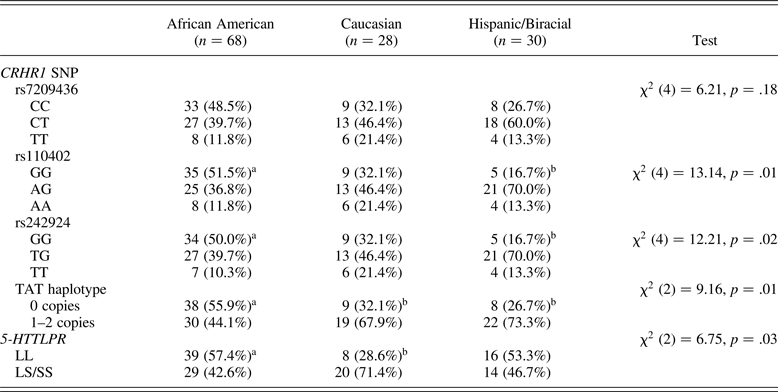
Baseline demographic, genotype, and depression variables for IPT and ECS groups are presented in Table 1. As expected and consistent with randomization, there were no statistically significant differences between intervention groups on any baseline demographic characteristics or baseline depressive symptoms. As illustrated in Table 2, self-identified African American and Caucasian women varied in their 5-HTTLPR LL allelic frequency, with LL being more common among African American women and SS/SL being more common among Caucasian women. Regarding CRHR1, African American and Hispanic/biracial women differed in their allelic frequencies for SNPs rs110402 and rs24292. Moreover, African American women varied from Caucasian and Hispanic/biracial women in the number of copies of the CRHR1 TAT haplotype such that 0 copies of the haplotype are more common among African American women.
CRHR1 and 5-HTTLPR genotypes among self-identified racial/ethnic groups
Note: Groups with different superscripts are statistically significantly different (p < .05). SNP, Single nucleotide polymorphism.
CRHR1 as a moderator of IPT effects on depressive symptoms
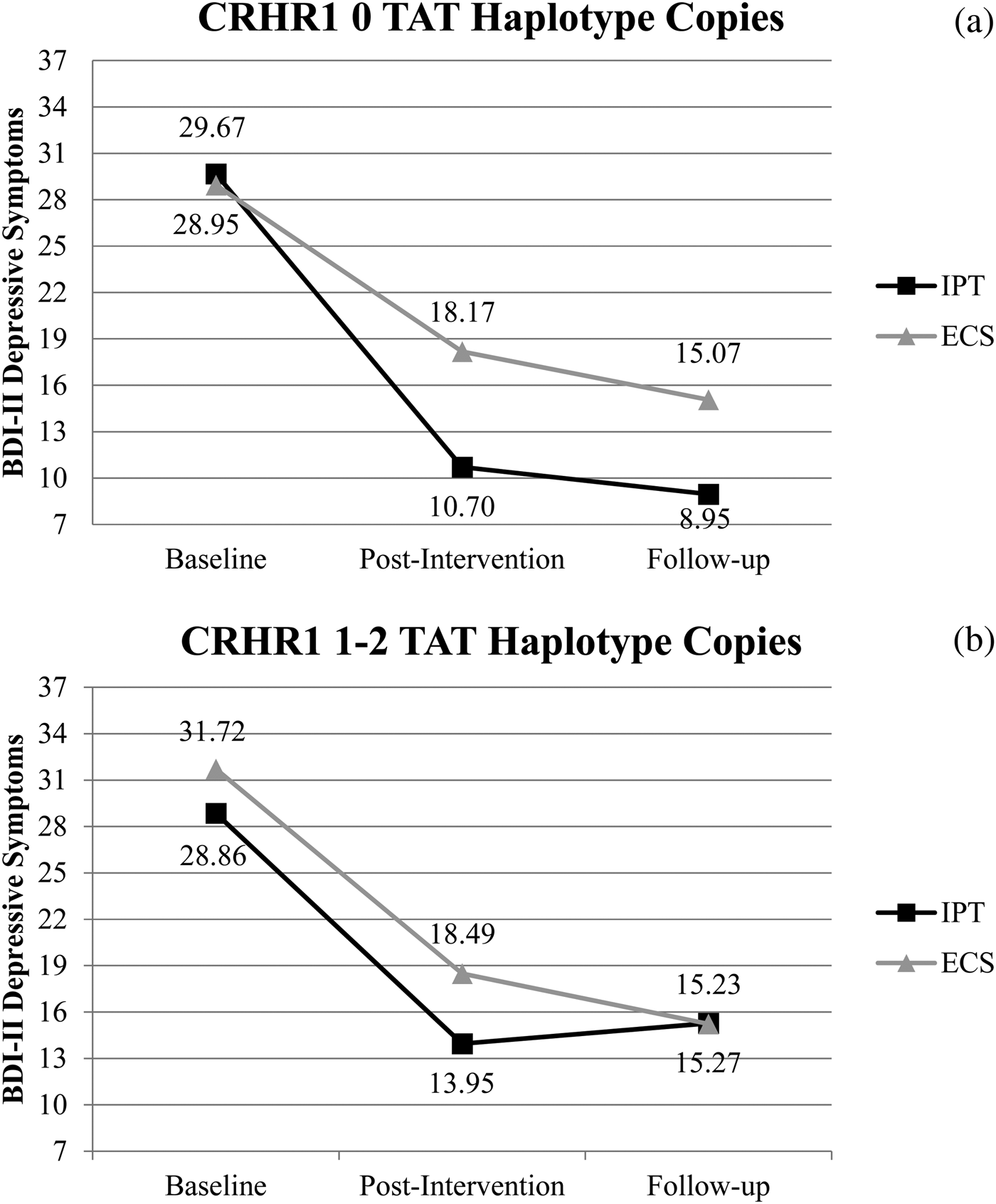
To examine whether CRHR1 moderated the effect of IPT on change in depressive symptoms over time a 3 (baseline, postintervention, or follow-up) × 2 (IPT vs. ECS) × 2 (CRHR1 TAT haplotype: 0 copies vs. 1–2 copies) repeated measures ANCOVA was conducted with ancestry (three proportion scores: African, European, and Native American) included as covariates. There was not a significant main effect of time, ancestry, or CRHR1 in this model; and the interactions of time by ancestry were also nonsignificant. Although the Time × Intervention effect on depressive symptoms was statistically significant, F (1.78, 205.19) = 3.35, p = .04, this was qualified by a three-way interaction. Specifically, the significant interaction of Time × CRHR1 × Intervention Group, F (1.78, 205.19) = 3.27, p = .046, indicated that depressive symptoms varied over time depending on intervention group and the number of copies of the CRHR1 TAT haplotype. Additional ANCOVAs indicated that among women with 0 copies of the TAT haplotype, those who participated in IPT reported significantly fewer depressive symptoms at postintervention, F (1, 48) = 5.26, p = .03, and follow-up, F (1, 48) = 5.56, p = .02, compared to those who participated in ECS. Among women with 1 or 2 copies of the TAT haplotype, no differences in depressive symptoms between intervention groups (IPT vs. ECS) were found at postintervention, F (1, 64) = 2.43, p = .12, or follow-up, F (1, 64) = .001, p = .98. See Figure 1 for a graphical representation of the interaction.
Change in depressive symptoms over time among (a) the CRHR1 0 TAT copies haplotype copy group and (b) the CRHR1 1–2 TAT copies haplotype group.
To address Keller's (Reference Keller2014) argument concerning covariate inclusion in G × E studies, we reanalyzed the above repeated measures ANCOVA with the following interactions: ancestry (three proportion scores: African, Native American, and European) × CRHR1 and Ancestry × Intervention Group. None of the interactions were statistically significant, and the pattern of results was the same as above. Specifically, the three-way interaction of primary interest for this investigation (i.e., Time × CRHR1 × Intervention Group) remained statistically significant in this model, F (1.78, 194.35) = 3.68, p = .03. Therefore, with the inclusion of covariate by environment and covariate by gene interactions, the results continued to demonstrate that change in depressive symptoms over time varied not only by intervention group but also by the presence of the CRHR1 TAT haplotype.
5-HTTLPR as a moderator of IPT effects on depressive symptoms
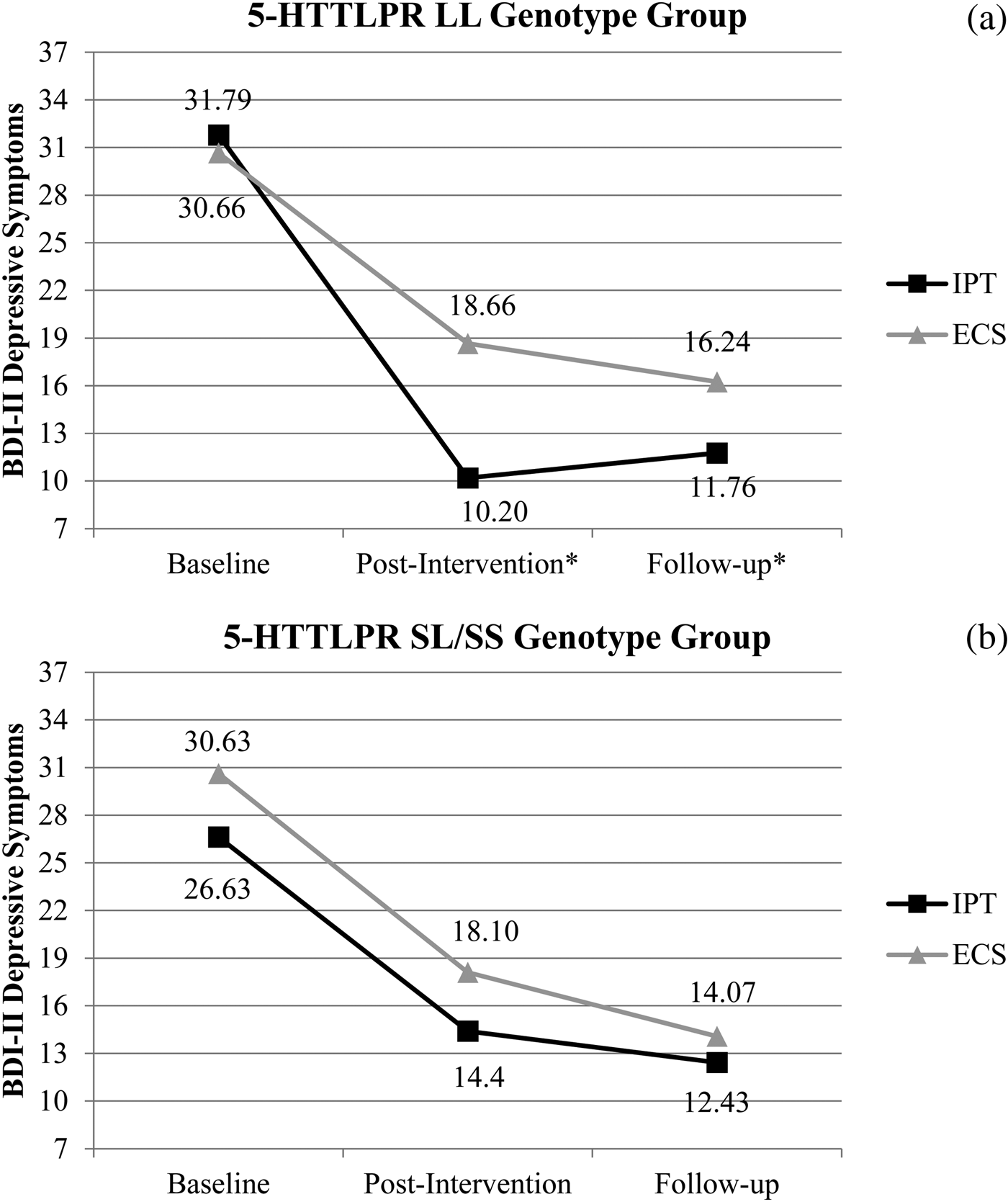
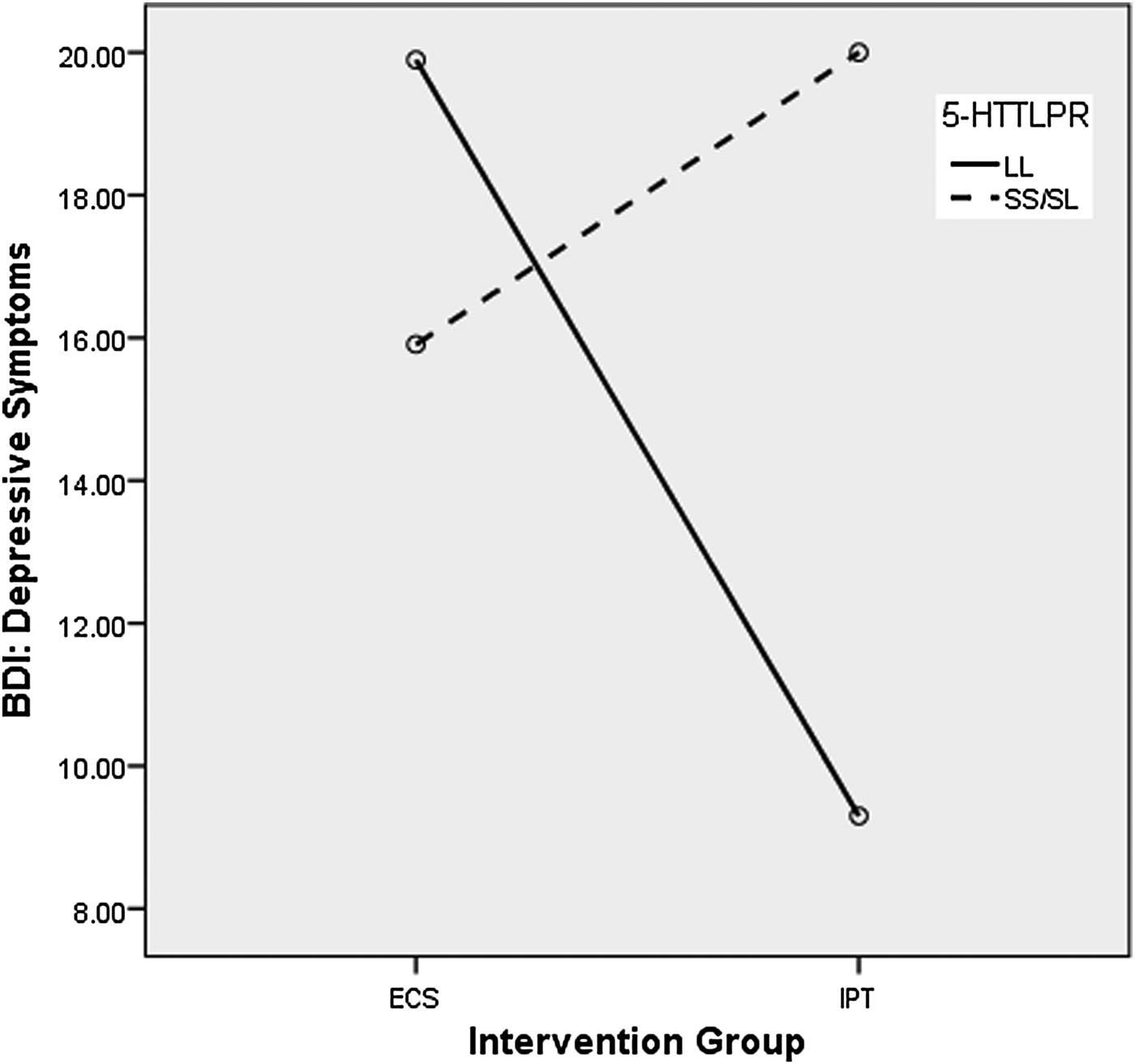
To examine whether 5-HTTLPR moderated the effect of IPT on change in depressive symptoms over time a 3 (baseline, postintervention, follow-up) × 2 (IPT vs. ECS) × 2 (5-HTTLPR LL vs. SL/SS groups) repeated measures ANCOVA was conducted with three ancestral proportion scores included as covariates. There was not a significant main effect of time or 5-HTTLPR in this model. The significant effect of intervention group, F (1, 115) = 4.58, p = .03, and significant Time × Intervention Group interaction, F (1.82, 209.17) = 3.26, p = .045, were clarified by the significant three-way interaction of Time × Intervention Group × 5-HTTLPR Genotype Group, F (1.82, 209.17) = 3.68, p = .03. The results demonstrated that changes in depressive symptoms over time depended on both intervention group (IPT vs. ECS) and 5-HTTLPR genotype (LL vs. SL/SS). Additional ANCOVAs indicated that among women with LL genotype, those who participated in IPT reported significantly fewer depressive symptoms at postintervention, F (1, 57) = 8.62, p = .005, but not at follow-up, F (1, 57) = 2.79, p = .10, compared to those who participated in ECS. Among women with SL/SS genotypes, no differences in depressive symptoms between intervention groups (IPT vs. ECS) were found at postintervention, F (1, 55) = 1.19, p = .28, or follow-up, F (1, 55) = .26, p = .61. See Figure 2 for graphical representation of this interaction.
Change in depressive symptoms over time among (a) the 5-HTTLPR LL genotype group and (b) the 5-HTTLPR SL/SS genotype group.
To again address Keller's (Reference Keller2014) argument concerning covariate inclusion in G × E studies, we reanalyzed the above repeated measures ANCOVA with the following interactions: ancestry (three variables: African, Native American, and European) × 5-HTTLPR and Ancestry × Intervention Group. None of the interactions were statistically significant, and the pattern of results was the same as above with the following exceptions: the interaction of time and intervention was nonsignificant in this model and the three-way interaction of Time × 5-HTTLPR × Intervention Group was marginally significant, F (1.83, 199.23) = 2.95, p = .06.Footnote 2
Genetic moderation of mechanisms of IPT
We next tested whether perceived stress and social adjustment mediated IPT effects on depressive symptoms and whether CRHR1 and 5-HTTLPR moderated these intervention effects on the proposed mediators. Separate sets of longitudinal path models were investigated; one set for CRHR1 and another for 5-HTTLPR. Path models were tested using Mplus Version 7.0 (Muthén and Muthén, Reference Muthén and Muthén1998–2012). Missing data were handled using full information maximum likelihood. Model fit was estimated with the chi-square statistic, comparative fit index (CFI), root mean square error of approximation (RMSEA), and standardized root mean square residual (SRMR).Footnote 3
Baseline (preintervention) depressive symptoms, perceived stress, social adjustment, and intervention group (IPT vs. ECS) were entered as correlated exogenous variables. Depressive symptoms, stress, and social adjustment at postintervention were entered as mediators, and residual covariances were modeled. All exogenous variables and mediators were modeled to predict depressive symptoms at follow-up (endogenous variable). Ancestral proportion scores (three variables: proportion African, European, and Native American) were included in preliminary models as covariates but did not uniquely predict mediators or the outcome and did not interact with genotype or intervention to predict mediators or the outcome. To maintain the most parsimonious model, ancestry was trimmed from the final models. The pattern of results did not vary with or without the inclusion of each ancestry variable and respective interactions.
CRHR1
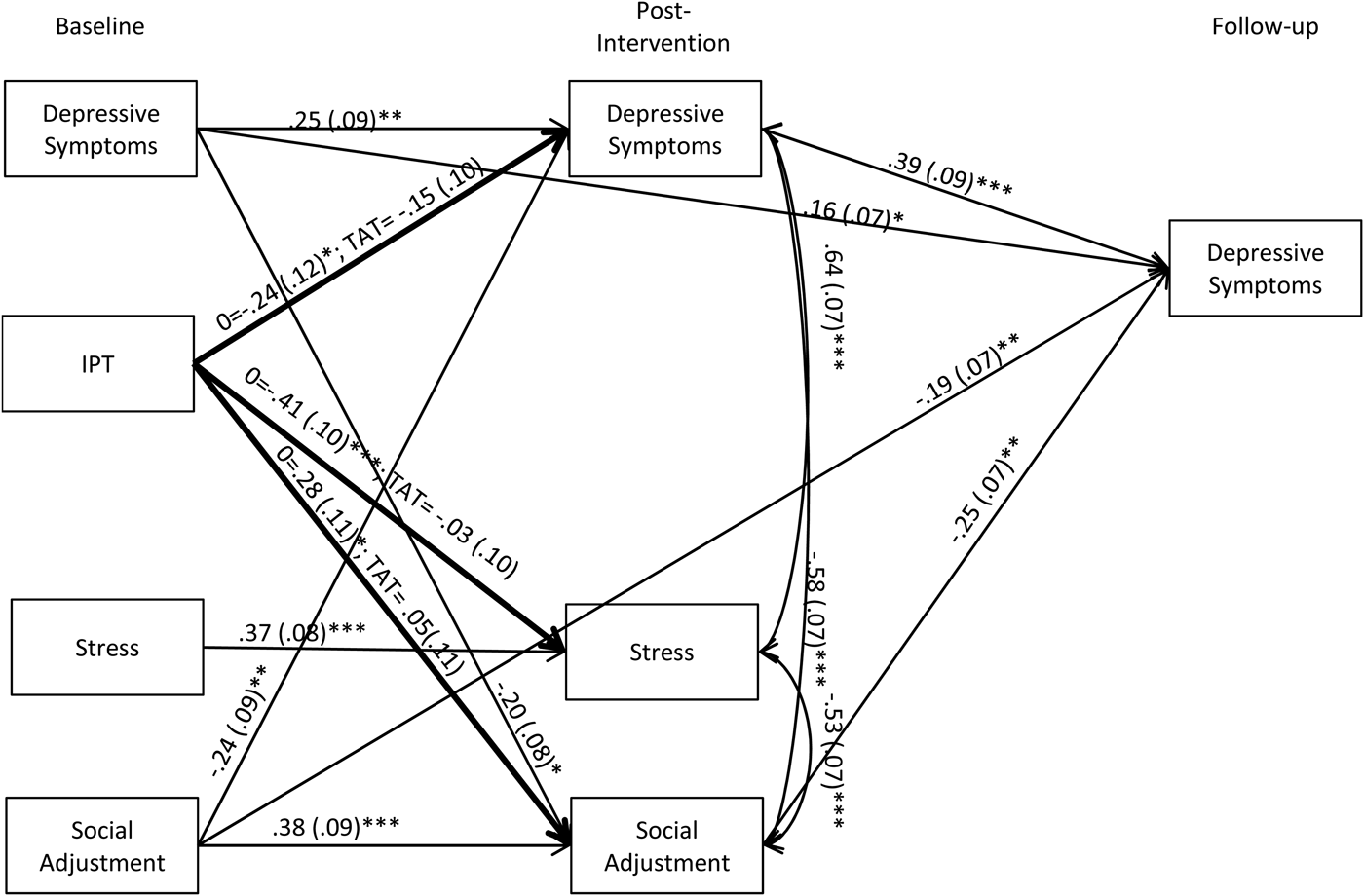
To test for moderated mediation with CRHR1, a model that fully constrained all paths to be equal across CRHR1 groups (0 copies of TAT haplotype n = 53, 1–2 copies n = 70) was tested. This model evidenced fair fit to the data, χ2 (22) = 34.92 p = .04, CFI = 0.96, RMSEA = 0.10, SRMR = 0.09. A partially unconstrained model was tested next, which relaxed the constraints between groups for the paths from IPT to the three mediators (depressive symptoms, stress, and social adjustment). This partially unconstrained model was a good fit to the data, χ2 (19) = 26.07, p = .13, CFI = 0.98, RMSEA = 0.08, SRMR = 0.08, and was significantly better than the fully constrained model, Δχ2 (3) = 8.85, p < .05. This indicates that when paths from IPT to mediators were allowed to be different across CRHR1 genotype, the model fit was significantly improved and is, therefore, indicative of significant moderation by genotype. The results of the partially unconstrained model are presented in Figure 3. Participation in IPT predicted fewer depressive symptoms (b = –0.24, p < .05), less perceived stress (b = –0.41, p < .001), and greater social adjustment (b = 0.28, p < .05) at postintervention for individuals with 0 copies of the CRHR1 TAT haplotype only. IPT was unrelated to these mediators for individuals with 1 or 2 copies of the TAT haplotype. Thus, findings are indicative of genetic moderation of IPT intervention on three mechanisms (depressive symptoms, stress, and social adjustment). Moreover, higher levels of social adjustment at postintervention uniquely predicted fewer depressive symptoms at follow-up (b = –0.25, p < .01).
Moderated mediation of interpersonal psychotherapy (IPT) effects on depressive symptoms. Only significant paths are depicted. Standardized path coefficients are presented. Bold paths are moderated by CRHR1 TAT Haplotype (0 = no copies; TAT = 1 or 2 copies of CRHR1 TAT haplotype). IPT coded 0 = ECS; 1 = IPT. Depressive symptoms, stress, and social adjustment are coded such that high values indicate high levels of the constructs. *p < .05, **p < .01, ***p < .001.
To examine whether social adjustment mediated the effect of IPT on depressive symptoms at follow-up differently for individuals with and without copies of the CRHR1 TAT haplotype, 95% asymmetrical confidence intervals were utilized (Tofighi & MacKinnon, Reference Tofighi and MacKinnon2011). Confidence intervals that do not include the value zero indicate significant mediation. The results indicated that improved social adjustment significantly mediated the effect of IPT on depressive symptoms for individuals with 0 copies of the CRHR1 TAT haplotype, 95% confidence interval (0.18, 3.67), only.
5-HTTLPR
A model fully constraining all paths to be equal across 5-HTTLPR allelic groups was tested first (LL allelic group n = 62, SS/SL allelic group n = 61) and evidenced good model fit, χ2 (22) = 22.26, p = .44, CFI = 1.00, RMSEA = 0.01, SRMR = 0.09. A partially unconstrained model was tested next, which relaxed the constraints between groups for the paths from IPT to the three mediators (depressive symptoms, stress, and social adjustment). This model was also a good fit to the data, χ2 (19) = 19.61, p = .42, CFI = 1.00, RMSEA = 0.02, SRMR = 1.0. The partially unconstrained model was not a significantly better fit to the data than the fully constrained model, Δχ2 (3) = 2.65, p = ns. Thus, results did not support moderation by 5-HTTLPR genotype.
The results of the fully constrained model indicated that participation in the IPT intervention predicted fewer depressive symptoms (b = –0.24, p < .05), less perceived stress (b = 0.40, p < .001), and greater social adjustment (b = –0.28, p < .05) at postintervention. Higher levels of social adjustment at baseline and postintervention uniquely predicted fewer depressive symptoms at follow-up (b baseline = 0.20, p < .01; b post = 0.24, p < .01). Perceived stress at postintervention did not uniquely predict depressive symptoms at follow-up (b = 0.04, p = ns). Moreover, significant stability was found for stress (b = 0.37, p < .001) and social adjustment (b = 0.38, p < .001) from baseline to postintervention, and depressive symptoms from baseline to postintervention (b = 0.18, p < .01) and baseline to follow-up (b = 0.38, p < .001).
Post hoc analyses
The following analyses were conducted post hoc to further clarify our results regarding 5-HTTLPR. Specifically, we were interested in further understanding how the racial and ethnic heterogeneity of our sample may influence our findings. We present these results as tentative given the small cell sizes. Caution is warranted when interpreting the findings, and replication is necessary with much larger samples more well equipped to examine these issues thoroughly.
In order to explore racial/ethnic group differences in 5-HTTLPR moderation of IPT effects, we substituted the ancestral proportion scores from the previous models (ancestral proportion scores are continuous variables that do not easily allow for group comparisons) with a self-reported race/ethnicity variable consisting of three groups: African American, Caucasian, and Hispanic/biracial. A 2 (intervention group: IPT vs. ECS) × 2 (5-HTTLPR: LL vs. SL/SS allele groups) × 3 (self-reported race/ethnicity: African American, Caucasian, and Hispanic/biracial) analysis of variance (ANOVA) was conducted to examine differences in depressive symptoms at postintervention among groups. The results supported a significant three-way interaction of Intervention × 5-HTTLPR × Self-Reported Race/Ethnicity, F (2, 114) = 3.90, p = .02.
Follow-up ANOVAs and t tests clarified the three-way interaction. The results showed a significant interaction between 5-HTTLPR and intervention group among African American women only, F (1, 64) = 6.40, p = .01. Moreover, t tests revealed that among African American women, those with the LL genotype who participated in IPT evidenced significantly fewer depressive symptoms at postintervention compared to African American women with the LL genotype who participated in ECS, t (37) = 3.11, p = .004. Among African American women with the SS/SL genotype, there were no differences between intervention groups. See Figure 4 for a graphical representation of 5-HTTLPR × IPT Interaction among African American women only. Among Caucasian women, we did not find a significant interaction between 5-HTTLPR and intervention group. Similarly, among Hispanic/biracial women, we also did not find a significant interaction between 5-HTTLPR and intervention group. However, given small cell sizes for Caucasian and Hispanic women when divided by genotype group and intervention group, we lacked sufficient power to test these interactions adequately and therefore do not present them graphically.
Depressive symptoms at postintervention among African American women.
The above 2 × 2 × 3 ANOVA was repeated to examine group differences in depressive symptoms at the 8-month follow-up. The three-way interaction of Intervention × 5-HTTLPR × Race/Ethnicity was marginally significant, F (2, 114) = 2.70, p = .07, at this time point. The pattern of results was the same as at postintervention.
Discussion
Recent research has underscored the role of genotypes and epigenetic processes in the emergence of depression in individuals who have experienced childhood trauma (Hornung & Heim, Reference Hornung and Heim2014). Moreover, in conjunction with recent research on genetic moderation of interventions outcomes, the current investigation provides a foundation on which to build future research on the efficacy of interventions for individuals with MDD. Given the prevalence of early trauma in the current sample of mothers with MDD, the demonstrated efficacy of IPT in reducing depressive symptoms is particularly compelling (Toth et al., Reference Toth, Rogosch, Oshri, Gravener, Sturm and Morgan-Lopez2013). As such, an important next step involved the examination of potential genetic moderation of treatment effects. To our knowledge, this is the first investigation of genetic moderation of depression in response to the provision of IPT in low-income racially and ethnically diverse mothers with extensive trauma histories.
Two candidate genes, CRHR1 and 5-HTT, were chosen to elucidate individual variation among depressed mothers who were randomly assigned to either the IPT or the ECS interventions group. The inclusion of the molecular genetic level is consistent with one of the principles of a developmental psychopathology perspective, namely, that a multiple levels of analysis approach provides a more comprehensive understanding of developmental processes than does a single level of analysis (Cicchetti, Reference Cicchetti, Cicchetti and Cohen2006; Cicchetti & Dawson, Reference Cicchetti and Dawson2002; Cicchetti & Toth, Reference Cicchetti and Toth2009).
Contrary to the extant literature where risk alleles have been found to moderate responsivity to intervention, depressed women with protective genotypes evinced the greatest reduction in depressive symptoms following IPT compared to women with risk genotypes. Specifically, for CRHR1, a three-way interaction was obtained among time, CRHR1 number of copies of TAT haplotype (0 vs, 1, 2), and intervention of group (IPT vs. ECS). Change in depressive symptoms was found to be dependent upon intervention group and the number of CRHR1 TAT haplotypes, such that among women with 0 copies of the TAT haplotype, those who received IPT experienced a greater reduction in depressive symptoms at postintervention and follow-up compared to those in the ECS condition. However, among women with 1 or 2 copies of the TAT haplotype, there were no differences between intervention groups at either time point. These findings remained significant with the inclusion of Ancestry × Gene and Ancestry × Intervention interactions, thus meeting Keller's (Reference Keller2014) recommendation for covariate interaction inclusion in G × E studies. Figure 1 denotes that women with 0 copies of the CRHR1 TAT haplotype who received IPT had depression scores in the nonclinical range (adjusted mean = 8.95) at the 8 month follow-up assessment of the intervention, whereas women with 1 or 2 copies of the CRHR1 TAT haplotype who received IPT evinced higher depressions scores (adjusted mean = 15.27; BDI-II clinical depression cutoff = 19).
Likewise, for 5-HTTLPR, a 3 (time: baseline, postintervention, follow-up) × 2 (intervention group: IPT vs. EPS) × 2 (5-HTTLPR Genotype: LL vs. SS/SL) repeated measures ANCOVA with ancestral proportion scores as covariates revealed a statistically significant Time × Intervention Group × 5-HTTLPR interaction. Specifically, depressed women with the LL genotype of 5-HTTLPR who received IPT experienced greater reductions in their depressive symptoms at postintervention compared to those who received ECS. No differences between intervention conditions were found in depressive symptoms at either time point for women with SS/SL genotypes. These findings, contrary to those found in investigations conducted with Caucasian individuals, suggest that identification of risk versus protective genotypes may vary among diverse racial and ethnic groups (Cicchetti et al., Reference Cicchetti, Rogosch, Hecht, Crick and Hetzel2014). In other words, a genotype that operates as a risk allele in a Caucasian sample may operate as a protective allele in an African American sample, and vice versa.
Next we examined whether previously identified mechanisms of IPT effects (i.e., improved social adjustment and decreased perceived stress; Toth et al., Reference Toth, Rogosch, Oshri, Gravener, Sturm and Morgan-Lopez2013) also were moderated by genotype. In other words, in addition to exploring genetic moderation of IPT effects on depressive symptoms, we also investigated whether genotype moderated identified mediated mechanisms of this intervention. Again, contrary to findings obtained with more ancestrally homogeneous Caucasian samples, the depressed women in this ethnoracially diverse group who experienced the largest decrease in their depressive symptoms were those who had protective genotypes and who had experienced improvements in the mediating mechanisms of perceived stress and social adjustment.
Specifically, the efficacy of IPT at reducing depressive symptoms, decreasing stress, and improving social adjustment varied depending on CRHR1 genotype, such that improvements in these domains were found only for women in the IPT condition with 0 copies of the TAT haplotype. These results demonstrate a genetic moderation (i.e., CRHR1 TAT haplotype moderated IPT effects on three mechanisms: depressive symptoms, perceived stress, and social adjustment). Furthermore, improvements in social adjustment at postintervention mediated the effects of IPT on depressive symptoms at the 8-month follow-up for those women with 0 copies of the TAT haplotype. Overall, women who received the IPT intervention and who possessed 0 copies of the CRHR1 TAT haplotype were significantly more likely to have fewer depressive symptoms, and to report less perceived stress and greater social adjustment at postintervention than were women with 1 or 2 copies of the TAT haplotype of CRHR1. In contrast, statistical analyses that examined whether the LL or SS/SL genotypes of 5-HTTLPR served as a moderator of the mediating mechanisms that demonstrated improvements following participation in IPT (i.e., reduction of depressive symptoms, less perceived stress, and greater social adjustment) were not substantiated.
Differential susceptibility theory has focused on individual differences to both negative and positive experiences as a function of their interaction with risk genotypes and developmental outcomes (Belsky et al., Reference Belsky, Bakersman-Kranenburg and van Ijzendoorn2007; Belsky & Pluess, Reference Belsky and Pluess2009). The findings of the current investigation are consistent with differential susceptibility theory, but only for African American women. This finding is critically important because it raises the possibility that differential susceptibility in G × E studies may operate differently in racially and culturally diverse groups. Moreover, it highlights the necessity of conducting intervention efficacy and effectiveness studies with diverse groups in order to more cogently understand which interventions are most likely to be beneficial for particular individuals.
Although the current investigation makes an important contribution to the burgeoning body of research on the genetic moderation of intervention outcome studies, it is not without limitations. First, random assignment in this non-treatment-seeking sample proved to be challenging because a not insignificant number of women who were assigned to the IPT intervention refused to participate in treatment. Therefore, in order to retain the largest number of participants possible, our analyses were conducted on treatment as received and did not meet the “gold standard” of more traditional randomized control trials. Second, the sample size limited our ability to thoroughly assess differential susceptibility by each ethnic and racial group. Given the cost and time commitment inherent in intervention efficacy studies, smaller than ideal samples are likely to remain a reality, thereby underscoring the criticality of conducting cross-sample and cross-site replications. Third, although not necessarily a limitation, it is important to note that because considerable effort was expended to ensure that women in the ECS group were able to access services for their depression, the magnitude of the efficacy of IPT actually may have been reduced.
Despite promising insights, our understanding of the genetic moderation and moderated-mediation of intervention outcome remains in its nascent stages. Future research on G × E and on epigenetic moderation and mediation would do well to emphasize and incorporate a developmental perspective (G × E × Development). Genetic variation may affect the ways in which individuals vary in their responsiveness to positive and negative experiences. These individual differences may operate differently at different developmental periods. Moreover, the effects of prior development may influence the effects of genes and experience during a particular developmental period. In addition, environmental experiences may affect the timing of genetic effects and gene expression. For example, outcomes might vary as a function of factors such as when in the developmental period a depressive episode first occurred and the severity and chronicity of depression. Consistent with prior research (Heim & Binder, Reference Heim and Binder2012), genetic moderation of outcome also might be expected to vary due to the presence or absence of trauma. Furthermore, experience exerts effects on the epigenome, and these also would be likely to operate differently across the course of development.
There appear to be many ways whereby there can be genetic effects on intervention efficacy. For example, as demonstrated here, some individuals may be more susceptible to the positive effects of intervention. Alternatively, different interventions may be more efficacious with different individuals as a function of their genetic makeup. This suggests that specific interventions may be able to be matched to an individual's genotype group. Intervention also may affect DNA methylation, resulting in changes in gene expression that may differ across developmental periods. Perhaps DNA methylation changes in response to intervention could eventuate in the design of both prevention and intervention strategies that alter the expression of genes to optimize and promote healthy physical and mental health outcomes.
Because this study is the first demonstration of a three-way interaction involving genes, intervention group, and time, it will be important to replicate these findings in future research (Duncan & Keller, Reference Duncan and Keller2014). The inclusion of ancestry-informative markers, also known as ancestral proportion scores, in the present study enables us to estimate the geographical origins of an individual's ancestors and to discern the proportion of ancestry that is derived from each geographical region. Because our sample is ancestrally heterogeneous, unlike many samples in the extant G × E literature, we were able to obtain a more accurate portrayal of race and racial admixture than that available via self-report of race alone. The utilization of these ancestry-informative markers represents an increase in methodological sophistication and addresses concerns raised by Duncan and Keller (2011) regarding the absence of these ancestry-informative markers in G × E research with ancestrally heterogeneous samples.
In addition, we controlled for potential covariate interactions in the models. Keller (Reference Keller2014) noted that few G × E investigations had entered relevant covariate interaction terms in the same model with the G × E term. Therefore, we computed Ancestry × Gene and Ancestry × Intervention interactions as Keller (Reference Keller2014) suggested. With the exception of the three-way interaction of Time × 5-HTTLPR × Intervention, which was reduced to marginal significance with the inclusion of all covariate interactions (p = .06), our results held with the incorporation of these interaction terms, thus eliminating potential alternative explanations of our G × E findings.
Implications for differential susceptibility and future directions
The findings of the current investigation proffer some fascinating implications with respect to their relevance for addressing questions related to differential susceptibility theory and the provision of intervention for racially and ethnically diverse groups. Because we did not compare IPT with another evidence-based intervention, but rather with a non-evidence-based model comprising services generally available in the community, we cannot determine whether individuals with particular genotypes who benefited from IPT would not benefit equally from another evidence-based intervention such as CBT. Answers to this question are particularly important with respect to determining whether individuals with certain genotypes are more likely to derive benefit from one versus another model of treatment. If so, then important strides can be made with respect to ascertaining a seminal question in the intervention literature, namely, what works for whom (Fonagy, Target, Cottrell, Phillips, & Kurtz, Reference Fonagy, Target, Cottrell, Phillips and Kurtz2002)? The provision of randomized control trials that include competing models of evidence-based interventions (e.g., IPT vs. CBT) would hold great promise for addressing this issue.
In a related sense, individuals with the same diagnosis often vary with respect to their responsivity to the same therapeutic intervention, which further highlights the roles that genetic variation and different environmental stressors play in contributing to intervention efficacy. In accord with a developmental psychopathology perspective, we also maintain that a consideration of developmental factors will enhance the ascertainment of interventions that are differentially effective for individuals with differing genotypes and experiences of adversity (G × E × Development). Although the burgeoning research on the genetic moderation of intervention outcome might lead the overly zealous to conclude that we are poised to begin to provide interventions based on different genetic profiles, we caution against this premature conclusion. Given the complexity of mental illness and the methodological challenges that accompany G × E investigations of intervention efficacy, extensive replications and carefully designed studies that clearly define the characteristics and risk environments of participants are needed. Even in the absence of genetic moderation, we know far too little about mediators of intervention outcome. We share the belief that the conduct of high-quality research that incorporates progress in genetic and epigenetic technology has the potential to inform a more person-specific approach to the provision of intervention, but that it is unlikely, or even advisable, that this goal will be achieved in the short term (Uher, Reference Uher2011). It is important that the research suggesting that individuals with a particular genotype are less likely to respond positively to certain interventions should impel us to continue to develop and evaluate interventions that are more likely to help those who have not yet benefitted, ultimately contributing to reductions in the overall burden of mental illness for individuals, families, and society.