Since Bowlby’s (Reference Bowlby1969) first formulation of attachment theory in childhood, much research has been conducted in different developmental stages, and so nowadays it is an unquestionable fact that individuals of all ages benefit from the development of secure bonds with other significant ones (Allen, Reference Allen, Cassidy and Shaver2008; Mikulincer & Shaver, Reference Mikulincer, Shaver, Cassidy and Shaver2008). Specifically in adolescence, the perception of a secure attachment with parents has been associated with higher levels of self-esteem (Gomez & McLaren, Reference Gomez and McLaren2007), higher emotional and social competence (Laible, Reference Laible2007), higher emotion regulation (Allen & Miga, Reference Allen and Miga2010), and lower levels of aggressiveness and shyness (Dykas, Ziv, & Cassidy, Reference Dykas, Ziv and Cassidy2008). Individuation and identity formulation processes also take place during adolescence; adolescents start becoming differentiated from their parents and being closer to their peers (Shaffer & Kipp, Reference Shaffer and Kipp2007). Quality of both types of relationships, with parents and with peers, will be relevant for adolescents’ development and adjustment (Allen, Reference Allen, Cassidy and Shaver2008).
In Spain, there are few valid and reliable assessment tools of the quality of emotional bonds. One of them is the Parental Bonding Instrument (Parker, Tupling, & Brown, Reference Parker, Tupling and Brown1979; Spanish version: Ballús-Creus, Reference Ballús-Creus1991), which assesses the perception of parents’ behavior and attitudes through Care (Affect vs. Rejection) and Overprotection (Overprotection vs. Stimulation of Autonomy) dimensions. Although this questionnaire enables the assessment of attachment towards parents, it is not applicable for the assessment of the quality of the bonds developed towards friends/peers. There are also some studies in which instruments targeted to assess the attachment towards friends or peers have been used (e.g., Sanchez-Queija & Oliva, Reference Sanchez-Queija and Oliva2003). Unfortunately, as relevant and informative the studies have revealed, these questionnaires have not undergone a thorough psychometric analysis, and neither do they inform about the adaptation process carried out before the administration. Therefore, no valid and reliable measure of adolescents’ attachment to parents and peers are available in Spanish.
One of the most widely used methods for the assessment of attachment in adolescence is the Inventory of Parent and Peer Attachment (IPPA), developed by Armsden and Greenberg (Reference Armsden and Greenberg1987). Even though IPPA adequately incorporates the theoretical underpinning of attachment theory and, therefore, evaluates the perceived bonds with parents and peers in adolescence in a valid way, its factor structure still remains unclear, with one-factor (e.g., Günaydin, Selçuk, Sümer, & Uysal, Reference Günaydin, Selçuk, Sümer and Uysal2005), two-factor (e.g., Johnson, Ketring, & Abshire, Reference Johnson, Ketring and Abshire2003), and three-factor (e.g., San Martini, Zavattini, & Ronconi, 2009) structures having been observed. Thus, in this study we responded to the need to: (a) develop the Spanish version of the IPPA, since there is not a single measure for the assessment of the attachment toward parents and peers in adolescence; and (b) elucidate whether its factor structure is actually three-dimensional, as proposed by the authors, or whether other underlying structures would apply instead. For that purpose, we first adapted IPPA into Spanish, and afterwards we analyzed the structure of IPPA in a series of studies with different community samples of adolescents.
Content Validity of IPPA
Based on Bowlby’s (Reference Bowlby1969) seminal work, Armsden and Greenberg (Reference Armsden and Greenberg1987) suggested that it is possible to evaluate internal working models of attachment figures. It would be necessary to evaluate the core of the internalized experience of attachment. Two elements are mentioned: One, the positive affective/cognitive experience deriving from the trust in attachment figures (i.e., in their accessibility and response); two, the negative affective/cognitive experience deriving from the anger and loss of hope due to the lack of response or inconsistency of responses from attachment figures. Capturing these elements, Armsden and Greenberg established that the quality of perceived attachment towards parents and peers may be inferred with IPPA from the scores of three independent factors referred to as ‘communication’, ‘trust’, and ‘alienation’. Although in an initial version of the questionnaire, both parents were assessed together with a total of 28 items, in the revised version of IPPA the authors divided the parents’ scale into two: mother version and father version. Then both scales were reduced to 25 items each, with equal wording but with the only exception of the parental figure.
Since the development of IPPA, the studies conducted to evaluate its construct validity have suggested that the questionnaire satisfactorily taps the contents of attachment bonds. Armsden and Greenberg (Reference Armsden and Greenberg1987) found that IPPA correlated positively with levels of family self-concept, support, expressivity and family cohesion, and negatively with conflict and control. They also observed that IPPA scores could predict self-esteem, life satisfaction, depression, anxiety, resentment and alienation. In more recent studies, other authors have also found empirical support for similar relationships. IPPA scores have been positively associated with self-esteem (Gomez & McLaren, Reference Gomez and McLaren2007), expressivity and family cohesion (Gullone & Robinson, Reference Gullone and Robinson2005), and care (Pardo, Pineda, Carrillo, & Castro, Reference Pardo, Pineda, Carrillo and Castro2006); and negatively associated with aggression (Gomez & McLaren), depression and social anxiety (Papini, Roggman, & Anderson, Reference Papini, Roggman and Anderson1991), and overprotection (Pardo et al., Reference Pardo, Pineda, Carrillo and Castro2006).
Nevertheless, a doubt cast over the structural features of IPPA since the existence of the three factors suggested by Armsden and Greenberg (Reference Armsden and Greenberg1987) has not been sufficiently corroborated hitherto. The authors themselves acknowledged the need to carry out a further in-depth study of the structure of the questionnaire because they observed that, due to the high inter-correlations among the three subscales, the independence of these subscales may not be clear (M. Greenberg, personal communication, August 23, 2008). Moreover, the suggestion of taking a composite of the three factors for the calculation of the total score of attachment also helps to call into question the independence of these factors.
Factorial Structure of IPPA in Different Versions
Over the last 20 years, the IPPA has been adapted into other cultures in several studies, enabling the suitability of the three-factor model proposed by Armsden and Greenberg (Reference Armsden and Greenberg1987) to be examined. For instance, IPPA has been adapted into Spanish in a sample of Colombian students (Pardo et al., Reference Pardo, Pineda, Carrillo and Castro2006). In that study, the proposed three-factor structure seemed to emerge when an analysis of principal components was conducted. However, the subscale of alienation had low reliability indexes and the loadings for each factor are not offered. Moreover, since different possible structures are not compared, nor even examined, it is unclear as to what extent the observed factors structure is such because it is the only one analyzed.
The underlying structure of IPPA has been also examined in several studies in Italy. Conducted analyses, however, do not enable unequivocal conclusions to be drawn. For example, San Martini and colleagues’ (2009) findings show, on the one hand, that the exploratory factor analysis conducted in an initial stage suggests a one-factor structure for each scale (father, mother, and peer versions). However, on the other hand, the fit indexes support the three-factor structure proposed by the authors of the original American version, although the alienation factor shows low reliability indexes. Another study seems to identify one only factor for each scale (parents and peers) in a sample of 1,000 Italian adolescents (Baiocco, Laghi, & Paola, Reference Baiocco, Laghi and Paola2009). Recently, also in Italy, Pace, San Martini, and Zavattini (2011) have found that the three-factor structure has the best fit, although the three dimensions are strongly interrelated.
Vignoli and Mallet (Reference Vignoli and Mallet2004) adapted the original version of 28 items in a sample of French adolescents. Using an analysis of principal components, they selected the items that loaded highly in their theoretically expected factor in both father and in mother versions. After doing this, they tested to see whether the selection of 14 items actually fit the three-factor structure with a confirmatory analysis in a different sample.
Johnson and associates’ (2003) work also deserves a mention. These authors developed from IPPA a version to be completed by the parents themselves (referred to as Revised Inventory of Parent Attachment or R-IPA) in order to gain a wider, or circular, perspective of relationships between adolescents and their parents. From their results, they concluded that the original three-factor factor structure does not fit with data of R-IPA. By using a confirmatory analysis with the IPPA, they observed that its structure did not fit the three-factor model either. After conducting exploratory factor analyses (both with R-IPA and IPPA), the authors concluded that the underlying structure is two-dimensional (i.e., on the one hand, alienation, and on the other hand, a positive aspect linking both trust and communication).
Finally, two efforts made to give rise to a shortened version of the questionnaire may be mentioned. Raja, McGee, and Stanton (Reference Raja, McGee and Stanton1992) reduced each scale of IPPA (parents and peers) to 12 items. Reliability indexes of two factors of this short version —of communication and trust— are adequate; those of alienation factors are not. In a more recent study with Turkish students, Günaydin and colleagues (2005) could not replicate the three-dimensional structure proposed by Raja and collaborators, because the results pointed out a one-factor structure of the questionnaire. This one-factor structure has also been mentioned as the most optimal in a work with the long IPPA version with a Spanish sample of Basque-speaking adolescents —geographically closer to the samples examined in our study— (Alonso-Arbiol et al., in press).
In short, the evidence as to which attachment elements are covered by IPPA is still inconclusive. The three-dimensional structure had to be corroborated before further research in adolescence attachment with this instrument, understood as fitting three attachment features, might be done. In this work, we conducted several studies with two aims in mind. First and foremost, we tried to pinpoint the underlying factor structure of the IPPA questionnaire. A second aim involved the development of its Spanish version by analyzing its psychometric properties. We first adapted the questionnaire into Spanish and analyzed content validity of items using cognitive interviews. In a second study, first we examined the three-dimensional structure of IPPA, and, since the factor structure was not confirmed, in a second phase we used principal component analysis yielding a one-dimensional structure. Convergent validity and internal consistency of the scale were also examined. Finally, a third study was conducted in order to corroborate the structure observed in the second study.
Study 1
The aim of this study was to evaluate the content validity of the IPPA questionnaire and its understandability in the target sample. First, we define the process involving the translation of items. Second, we describe the examination of content validity.
The translation of IPPA into Spanish was carried out independently by a team made up of four people, including two linguists and two psychologists who are familiarized with research on emotional bonding. This first step of the adaptation process was conducted using a back-translation design, and in accordance with the milestones suggested by Balluerka, Gorostiaga, Alonso-Arbiol, and Haranburu (Reference Balluerka, Gorostiaga, Alonso-Arbiol and Haranburu2007). Each of the 75 items of the original version —25 items on each scale (mother, father, and peers) —was translated into Spanish independently by two people (a psychologist and a linguist). Once both translations had been compared and analyzed, an agreed version was obtained for each item. Stemming from this version, a further two members of the translation team (a psychologist and a linguist) independently translated into Spanish the items of the Spanish version back to English and obtained an agreed version of it. Finally, all participants in the process compared each item of the original version and the inversely adapted English version in order to examine the possible non-equivalence in meaning, so as to make any modifications accordingly in the final Spanish version later.
Cognitive interviews were conducted for the examination of content analysis of items. With the aim of evaluating the understanding level of items of the Spanish adapted version, 24 adolescents of both genders (not using randomization) were drawn from a selected school and they answered the 75 items of IPPA. After completing the questionnaire, they also answered some questions in order to analyze the meaning they had derived from some words and expressions in some items that may be confusing. Some of the questions are as follows: ‘Would you use another word (or words) instead of the word “disgustado/a” (distressed) in this sentence? (If so, which one?)’, ‘Could you think of another way in which you would say “tiene en cuenta” (take into account) in this sentence?’, ‘What do you understand by “siento enfado” (I feel angry) in this sentence?’, or ‘What do you think the sentence “Mi madre no me presta mucha atención” (My mother does not pay too much attention to me) means?’ Participants were also given the opportunity to say that they did not clearly understand the meaning of a word. There were two aims in this phase: (a) to see whether the proposed items of the Spanish version keep the semantic content of the original English version; and (b) to check whether items fit the understanding level of the sample in which they would be used. To ensure that both objectives were met, the students who participated in this pilot phase were at an academic level lower (i.e., 14–15 years old) than the ones who would be included in the sample of the subsequent empirical phase.
The first author, a researcher expert in adolescent attachment, analyzed the responses given by the participants to the questions designed for clarification of items. The qualitative analysis of the content of these answers led to the conclusion that the understanding level was adequate, and the semantic level of items were according to attachment theory postulates. Therefore, all items remained unchanged from the first formulation agreed by members of the translation team.
Study 2
This study has two different phases. The aim of the first phase was to test the three-dimensional structure proposed initially by authors of the IPPA (Armsden & Greenberg, Reference Armsden and Greenberg1987). Since the three-dimensional structure was not corroborated, the aims of the second phase were: (a) to analyze the dimensional structure of IPPA-S using an exploratory factor analysis; (b) to examine the internal consistency of the possible subscale(s); and (c) to analyze the construct validity of the questionnaire based on the extracted factor(s). The Spanish version described in Study 1 was used for these purposes.
Method
Participants
The sample consisted of 417 secondary school students and of first four semesters at university (270 girls and 147 boys). Mean age (in years) was 17.9 (SD = 1.64). Although ethnicity was not recorded, not more than 5% of the sample was presumably different from the mainstream (Caucasian) Spanish group.
Procedure
Students filled in the Spanish IPPA (which we will call IPPA-S) in their classrooms during class time. They were informed about the aim of the study, the way they had to answer the questions, and their free choice of taking part in the study, as it is specified in ethical regulations of the Spanish Psychologists’ Board (COP).
Instruments
Family Environmental Scale (FES; Moos & Trichett, 1974; in its Spanish version, Moos, Moos, & Trichett, Reference Moos, Moos and Trickett1984). This self-report instrument assesses the main socio-environmental features of family. The complete scale comprises a total of 90 dichotomous items (true-false), grouped into 10 subscales of 9 items each; they tap three main dimensions: Relationships, Personal Development or Personal Growth, and Family Structure or Organization. In this study, we only used the Relationships dimension, whose subscales are: cohesion, expressiveness and conflict. Based on a previous factor analysis, we decided to unify the subscales of cohesion and expressiveness, because such analysis did not show the existence of three factors in our sample. Therefore, a composite was created for communication and family cohesion (Cohesion/Expressiveness) from the total sum of 18 items (e.g., “In my family there is a strong feeling of union”), and the score for Conflict was calculated from the total sum of 9 items (e.g., “In our family we quarrel a lot”). In our study Cronbach’s alphas were acceptable: .80 for Cohesion/Expressiveness; and .62 for Conflict.
Parental Bonding Instrument (PBI; Parker et al., Reference Parker, Tupling and Brown1979; in its Spanish version, Ballús-Creus, Reference Ballús-Creus1991). This self-report instrument assesses the perception children have of their parents’ behavior and attitudes to them in childhood and adolescence. The adolescent is asked about the recollection s/he has about her/his relationships with her/his father and her/his mother during childhood with 25 Likert-type items ranging from 1 (never) to 5 (always). Two dimensions derive from this: Care (Affect vs. Rejection) and Overprotection (Overprotection vs. Stimulation of Autonomy). Care includes 12 items related to care, love, closeness, and perceived attention (e.g. “S/he often smiled at me”), whereas Overprotection refers to the perception of control related to the lack of fostering individuation with 13 items (e.g. “S/he tried to make me dependent on her/him”). In our study Cronbach’s alphas were all acceptable: .90 and .83 for Care (father and mother respectively), and .82 and .76 for Overprotection (father and mother respectively).
Rosenberg Self-Esteem Scale (RSES; Rosenberg, Reference Rosenberg1989; in its Spanish version, Martin-Albo, Núñez, Navarro, & Grijalvo, Reference Martin-Albo, Núñez, Navarro and Grijalvo2007). The RSES is a self-report instrument made up of 10 items that assesses self-respect or acceptance. The scale rated on a 4-point Likert-type scale ranging from 1 (totally disagree) to 4 (totally agree) in which there are 5 positively worded items (e.g. “I feel that I have a number of good qualities”), and 5 negatively worded items (e.g. “All in all, I am inclined to feel that I am a failure”). The scale gives a total score for self-esteem. In our study Cronbach’s alpha was good: .80.
Results
Phase 1
Structural equation modeling was used to test the confirmatory factor analysis (CFA) model with AMOS (Arbuckle, Reference Arbuckle2008). The fit of the model was tested in a multiple-group structural equation model, using maximum likelihood estimates, and where girls and boys were taken as two different groups. An unconstrained model in which all parameters were allowed to vary formed the baseline. From here, subsequent analyses were made by constraining parameters to being invariant so that the most parsimonious model that still showed an acceptable fit was chosen.
The sample size of this study was large enough so as to ensure that the conventional chi-square statistic would not appear as an optimal good index for the model (Schumacker & Lomax, Reference Schumacker and Lomax2004). Instead, other indexes to test the goodness of fit of the model were used. The relative chi-square is the chi-square fit index divided by its degrees of freedom (χ2 /df); here values of three or less are considered as indications of a good fit (Kline, Reference Kline1998). Based on Hoyle’s (Reference Hoyle1995) suggestion, adjusted goodness of fit index (AGFI), Tucker-Lewis index (TLI), and comparative fit index (CFI) fit-indexes greater than .90 would be considered as indicating a good fit. Values of root-mean-square error of approximation (RMSEA) lower than .05, and values of root-mean-square (RMR) residual lower than .08 would be acceptable (Byrne, Reference Byrne2010). None of the fitness indexes were adequate. Thus, the three-dimensional structure proposed by the authors seems to not adequately fit the data (see Table 1), in any of the three scales (mother, father and peers).
Fit Indexes for the Three Subscales of IPPA-S in the Three-Dimensional Model

Note:
IPPA-M = IPPA Mother version; IPPA-F = IPPA Father version; IPPA-P = IPPA Peer version.
Phase 2
This second phase derives from the impossibility of obtaining an optimal fit for the three-dimensional factor structure of the questionnaire. Therefore, we analyzed the dimensional structure of IPPA-S with an exploratory factor analytic strategy, examined the internal consistency of the subscale(s), and analyzed the construct validity of the questionnaire.
Construct validity was examined calculating Pearson correlations with three different measures tapping constructs related to attachment. Specifically, family climate, parental bonding and self-esteem variables were used for this analysis. Regarding the links of our instrument to family climate, we expected to find: (a) moderate to high positive correlations with Cohesion and Expressiveness dimensions of family climate, and (b) moderate to high negative correlations with Conflict dimension of family climate. As for the relationship with parental bonding, we hypothesized moderate to high positive correlations between Care dimension and IPPA, and moderate to high negative correlations between Overprotection dimension and IPPA. Finally, we expected to find positive correlation with self-esteem.
Exploratory Factor Analysis and Internal Consistency
For the examination of the general structure of IPPA-S, a principal component analysis with oblimin rotation was conducted. Prior to the analysis, we calculated the Kaiser-Meyer-Olkin (KMO) index as well as a sphericity test for each scale (mother, father and peers). All KMO indexes were .95 which can be considered good. Bartlett test was statistically significant for all scales: χ2(120) = 4093.55 p < .0001, in mother scale; χ2(120) = 4488.89 p < .0001, in father scale; and χ2(120) = 3870.27 p < .0001, in peer scale.
In order to establish how many factors to extract, two criteria were considered: (a) The sedimentation graph with its scree-plot was examined; and (b) the semantic and psychological content were taken into account in the search for clearly interpretable factors. We considered these criteria for three-, two- and one-factor solutions, and we concluded the one-factor solution to be the most optimal. The solution for three factors was not easily interpretable because there were many cross-loadings with most items loading high not just in one factor, but in two or even three. On the other hand, although the two-factor solution showed good factor loadings, after evaluating each item in each factor, we realized that the two-factor solution involved separating positive from negative items, more than distinguishing between different attachment-related concepts. Therefore, we decided to take the one-factor as the most optimal solution, also supported by the scree-plot figure.
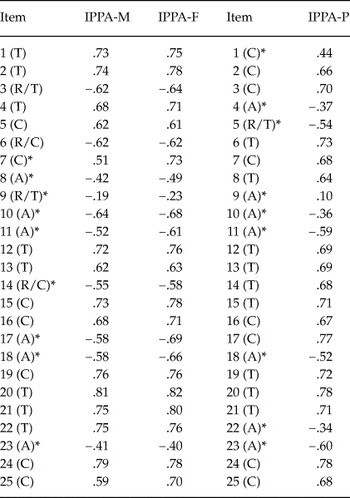
Taking into account that the one-factor structure was the most optimal (see Table 2 to see factor loadings of 25 items in one factor structure), we decided to reduce it in order to optimize the questionnaire (in terms of applicability and reliability). We considered these criteria in order to decide which items will be retained for a shorter version: (a) items with |.50| or higher loading in the factor; and (b) items with |.50| or higher scores in the corrected element-total correlation were kept.
Factor Loadings of Mother, Father and Peer Scale Items from the Principal Component Analysis

Note:
IPPA-M = IPPA Mother; IPPA-F = IPPA Father; IPPA-P = IPPA Peer. T = Trust subscale in the original American version; C = Communication subscale in the original American version; A = Alienation subscale in the original American version. R = Reverse item.*Dropped out items.
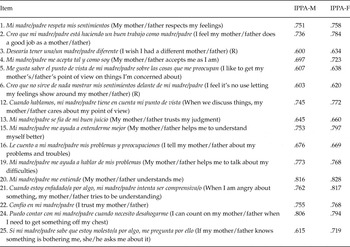
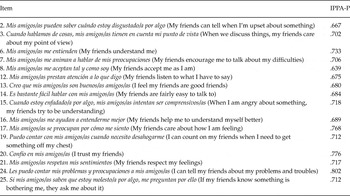
Thus, some items were eliminated for loading lower than |.50|: #8 (“Talking over my problems with my mother/father makes me feel ashamed or foolish”), #9 (“My mother/father expects too much from me”), and #23 (“My mother/father doesn’t understand what I’m going through these days”). The following items were dropped for having scores lower than |.50| in the corrected element-total correlation: #7 (“My mother/father can tell when I’m upset about something”), #10 (“I get upset easily around my mother/father”), #11 (“I get upset a lot more than my mother/father knows about”), #14 (“My mother/father has her/his own problems, so I don’t bother her/him with mine”), #17 (“I feel angry with my mother/father”), and #18 (“I don’t get much attention from my mother/father”). Therefore, and taking into account the four criteria mentioned above, (the same) 16 items in each version (mother, father, and peer) were selected, which accounted for 50.8%, 54.3%, and 50.8% of the variance in mother, father, and peer scales respectively. The specific weights for each scale of the 16 items retained are given in Table 3 (father and mother versions) and Table 4 (peer version).
Factor Loadings of Mother and Father Scale Items from the Principal Component Analysis
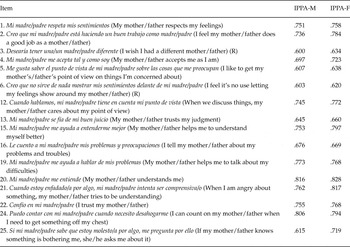
Note:
IPPA-M = IPPA Mother; IPPA-F = IPPA Father. R = Reverse item.
Factor Loadings of Peers Scale Items from the Principal Component Analysis

Note:
IPPA-P = IPPA Peer.
Following the deletion of the items mentioned, internal consistency values were calculated for the three scales (mother, father and peers). Cronbach alpha coefficients were all good and somehow higher than with 25 items: .88 for mother scale (.77 with 25 items), .91 for father scale (.77 with 25 items), and .93 for peer scale (.79 with 25 items). Since the items for the shorter version have been selected based on the factor analysis, one would assume that there may be somewhat inflated. Therefore, for unbiased estimates, the alpha coefficients were again calculated with a new sample in Study 3.
Analysis of Construct Validity
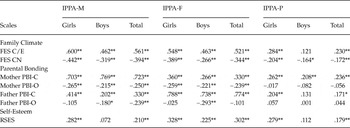
Construct validity of IPPA-S was examined through the correlations with the Relationships dimension of FES, with PBI, and with RSES, with a distinction being drawn between girls and boys in all cases. All correlations are shown in Table 5. As expected, scores of mother and father scales of IPPA-S are highly and positively correlated with the Cohesion/Expressiveness subscale of FES, whereas the size of the correlations are medium and negative with the Conflict subscale. All these correlations were higher for girls than for boys. Correlations of these FES subscales with the peer version are low, and almost non-existent in boys.
Correlations among IPPA-S Three Versions and FES, PBI and RSES Scales

Note:
IPPA-M = IPPA Mother version; IPPA-F = IPPA Father version; IPPA-P = IPPA Peer version; FES C/E = Family Environment Scale - Cohesion/Expressiveness; FES CN = Family Environment Scale - Conflict; PBI-C = Parental Bonding Instrument - Care; PBI-O = Parental Bonding Instrument - Overprotection; RSES = Rosenberg Self-Esteem Scale.* p < .05; ** p < .01.
On the other hand, and also according to what could be expected, both the mother and father Care dimension of PBI correlated highly with girls’ and boys’ scores of IPPA-S, whereas Overprotection dimension correlated negatively and to a lower extent (correlations of small size). Moreover, in the specific case of father overprotection, only boys’ attachment to father was considerably related to it, albeit of small size again. Lastly, the relationship between IPPA-S scores and self-esteem with RSES was observed, although correlations were not as high as could be expected. For this variable, scores are positively, but not to a major extent, correlated with perceived attachment to mother, father, and peers in girls (somewhat higher for father); however, in boys, such positive correlation can only be observed in relation to perceived attachment to father, and are even of small magnitude in that case.
Study 3
The objective if this last study was to confirm the factor structure observed in Study 2. Thus, here we intended to analyze the goodness of fit of the one-dimensional model of IPPA-S.
Method
Participants
The sample comprised 604 adolescents (335 girls and 269 boys), studying in secondary schools or at university in the first four semesters. Mean age (in years) was 17.8 (SD = 1.49) Footnote 1 . Although ethnicity was not recorded, like in the sample used for Study 2 and Study 3, here too no more than 5% of the sample was presumably different from the mainstream (Caucasian) Spanish. The procedure for the administration of the questionnaire followed here was the same as in Study 2.
Results
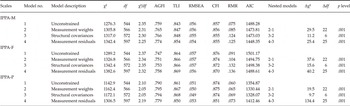
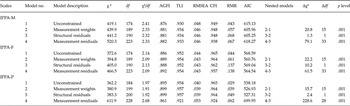
Like in Study 2, structural equation modeling was used here (Arbuckle, Reference Arbuckle2008) and the fit of the model was tested in multiple-group structural equation models (using maximum likelihood estimates), considering girls and boys as two different groups. For the evaluation of the fit of the model, we relied on the same indexes as in Study 2: The relative chi-square (χ2/df), AGFI, TLI, CFI, RMSEA, RMR, and AIC.
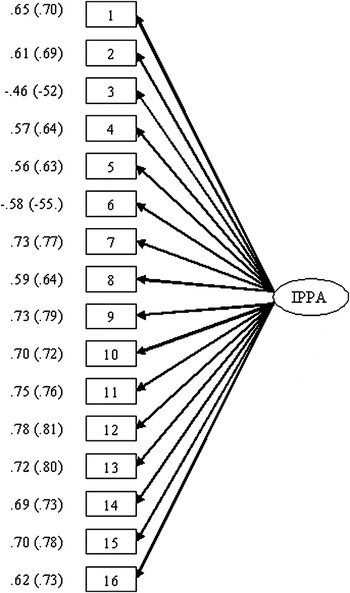
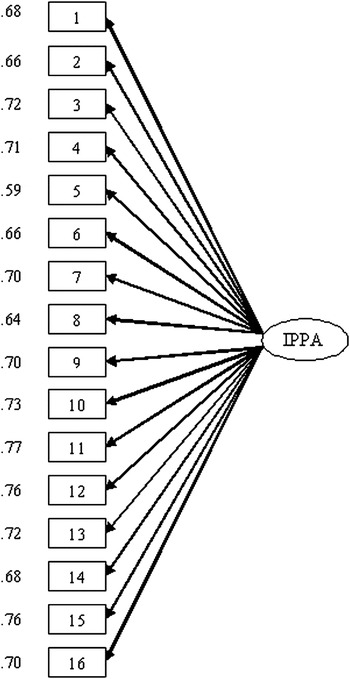
As can be seen in Table 6, all fitness indexes were adequate in all of the three scales (mother, father and peers), and so one-dimensional structure seems to fit the data adequately. The measurement weights model showed the most adequate fit statistics and was the most parsimonious one for all three versions. This finding indicates that the one-factor structure was common for the two groups, and that equal parameter estimates and error variances for males and females are acceptable. The standardized coefficients for the item loadings in each scale are displayed in Figure 1 (mother and father versions) and Figure 2 (peer version). Cronbach alpha coefficients were all good: .87 for mother scale, .88 for father scale, and .93 for peer scale.
Standardized regression coefficients of IPPA mother and IPPA father scales. IPPA father scale indexes are in brackets; values without brackets refer to mother scale. All the parameters are significant at the level p < .001.

Standardized regression coefficients of IPPA peer scale. All the parameters are significant at the level p < .001.

Fit Indexes for the Three Subscales of IPPA-S in the One-Dimensional Model

Note:
IPPA-M = IPPA Mother; IPPA-F = IPPA Father; IPPA-P = IPPA Peer.
Discussion
This study had the dual aim of: (a) adapting IPPA into Spanish (IPPA-S), and (b) examining its factor structure. The empirical examination of the structure with both exploratory and confirmatory analyses has revealed a one-factor structure of IPPA, refuting a long tradition of suggested three-dimensionality. We may conclude that the IPPA-S has 16 items in each of the three scales or versions —mother, father, and peers— grouped into one factor. When the three versions are used, three independent scores may be obtained which are always referred to in terms of (in)security of attachment perceived by the adolescent and in relation to mother, father and peers. IPPA-S shows good indexes of validity and reliability.
Our results point to a one-dimensional structure of IPPA-S. This finding responds to the authors’ demand of analyzing the structure of the questionnaire more in-depth, and it sheds light into the question of how many factors could be distinguished, as one, two and three factors had been claimed. On the one hand, our results go in the direction recently pointed out by Günaydin and colleagues (2005), by Baiocco and colleagues (2009), and by Alonso-Arbiol and associates (in press), who anticipated such one-factor structure in Turkish, Italian and Basque versions of IPPA. On the other hand, our findings do not match those of Johnson and associates (2003), who distinguished two factors called trust and alienation, nor the ones linked to the Italian adaptation (2009, 2011), which had three factors.
As for the structure observed by Johnson and colleagues (2003), a closer examination of factor loadings of 25 items of IPPA in the two factors suggests that other circumstances than just separate constructs may also explain the underlying structure. In fact, all items with positive meaning (referred to both trust and communication, as in the original formulation) (i.e. “My mother respects my feeling” or “I like to get my mother’s point of view on things I’m concerned about”) fall within the first factor, whereas the second factor gathers all items capturing a sense of alienation as well as four reversed items referring to trust and communication (i.e. “I get upset easily around my mother” and “I feel it’s no use letting my feelings show around my mother”). Therefore, more than distinguishing between trust and alienation, one may wonder to what extent this structure does not resemble a classical phenomenon of factor analysis procedures which involve ending up separating items whose contents are located in two extremes of a continuum (Marsch, Reference Marsch1996).
Regarding San Martini and associates’ (2009) observation of a three-dimensional structure, neither the exploratory analysis conducted first, nor the confirmatory factor analysis carried out later seem to support such structure unequivocally. First, the sedimentation graph of the exploratory analysis shows a one-dimensional structure. Second, the goodness-of-fit indexes of the confirmatory analyses were not sufficiently good for any of the three options analyzed. Although the indexes for the three-factor models are better than the other competing ones for all versions (mother, father, peer), GFI and AGFI are not over .90, and RMSEA is not under .05. On the other hand, in the recent study also carried out in Italy (Pace et al., Reference Pace, San Martini and Zavattini2011) the authors concluded that the three-factor structure shows the best fit in all three forms (mother, father and peers). However, for all versions of IPPA (mother, father, peer), CFI is not over .90, and RMSEA is not under .05. Furthermore, in the EFA carried out initially, the one-factor structure showed good levels of accounted variance and high loadings for almost all the items. Moreover, due to the high correlations between the three factors, authors warned about the weak differentiation of the factors, and therefore, about the usefulness of the segmentation of the inventory on a practical level.
Therefore, so far only Vignoli and Mallet (Reference Vignoli and Mallet2004) have been able to more rigorously corroborate the three-factor structure originally proposed. However, a closer inspection of the correlation indices between socialization styles and three factors of IPPA reveals that those indexes are very similar for trust and communication. In fact, in that study correlations between these two factors are of .72 for mother scale and of .68 for father scale, which denotes a high correspondence between them. Furthermore, it seems that authors needed to link some errors in order for the three-factor model to obtain acceptable indexes, because without those covariances only the father scale would get close to being acceptable. For these reasons, this three-dimensional observation claimed by Vignoli and Mallet should be interpreted with caution.
Consequently, although the initial objective of Armsden and Greenberg (Reference Armsden and Greenberg1987) was to assess elements of positive experience deriving from closeness and trust in attachment figures, as well as negative experience deriving from the attachment figures’ lack of (or inconsistent) response; it seems that such a distinction is not completely defined or captured by respondents’ answers to the instrument. In this study, the final 16 items deriving from the adaptation process into Spanish retain the main feature of attachment, namely, the perceived security established in relationships with the most important figures. Bowlby (Reference Bowlby1969) explained how the fundamental function of attachment behavior is to seek and maintain proximity with attachment figures. This search for proximity is a device used to regulate emotion designed with the aim of protecting the individual from possible external threats. If these strategies work out—i.e., they accomplish their regulatory role— a feeling of security in relation to attachment figures is developed, based on which the world and people living in it are perceived as secure (see Cassidy & Shaver, Reference Cassidy and Shaver2008; and Mikulincer & Shaver, Reference Mikulincer and Shaver2007, for reviews). Therefore, it makes sense that a main underlying dimension of attachment security vs. insecurity emerges here.
On another issue, and as expected, high positive correlations between IPPA scores and the FES cohesion/expressiveness subscale, PBI care subscale, and self-esteem were observed. Besides, although not sought in the validity analysis, negative correlations with the PBI overprotection subscale, and to less extent with the FES conflict subscale, were also found. This last result would be in keeping with the observation that adolescent aggressiveness is related to insecure attachment to parents (e.g., Gallarin & Alonso-Arbiol, Reference Gallarin and Alonso-Arbiol2012; Gomez & McLaren, Reference Gomez and McLaren2007).
Moreover, unlike previous studies (Armsden & Greenberg, Reference Armsden and Greenberg1987; Gullone & Robinson, Reference Gullone and Robinson2005; Günaydin et al., Reference Günaydin, Selçuk, Sümer and Uysal2005; Pardo et al., Reference Pardo, Pineda, Carrillo and Castro2006), in this work boys and girls’ scores have been taken into account separately, which allows for a more detailed analysis of inter-correlations between IPPA and the other variables. While Günaydin and colleagues found that self-esteem and attachment to father and to mother were associated, our study allows for a finer observation. Whereas in girls scores of the three IPPA scales are correlated to self-esteem, in boys only attachment to father is correlated with self-esteem. These results go in the same direction as those obtained in previous studies (e.g., Gullone & Robinson, Reference Gullone and Robinson2005; Raja et al., Reference Raja, McGee and Stanton1992), where it seemed that peer attachment is more relevant for girls, because girls’ development of identity is more related to the establishment of intimate relationships than boys’.
Another difference can be found regarding correlations between IPPA and PBI. Although taking into account the values of the total sample, we obtained similar results as those reported by Gullone and Robinson (Reference Gullone and Robinson2005) —care positively associated with IPPA, and overprotection negatively associated—, when we differentiated between boys and girls, on one hand, and mothers and fathers, on the other hand, the results change. While in girls none of the IPPA scales was significantly correlated with father’s overprotection, in boys attachment to mother and specially attachment to father were significantly and negatively correlated with this subscale. This finding may indicate that in boys an overprotective father would be associated with a higher perception of insecurity. A possible explanation could be that this is so because boys’ development is more closely linked to individuation and to a higher distance towards others (Raja et al., Reference Raja, McGee and Stanton1992); an overprotective father does not resemble this identification pattern.
One limitation of this study is the lack of more specific measures for the analysis of convergent validity of attachment peer scale. Our results have shown considerable differences between parent two scales and peer scale when these were correlated with the other measures. The use of other measures to assess the quality of friendship quality might have resulted in better comparison indexes.
On another issue, the factor structure has been analyzed here with a Spanish version. Therefore, results should be taken with caution before they can be generalized to include non-Spanish adolescents. For this reason, future research may address the replicability of the structure of the questionnaire in different cultures. The examination of factor structures in different languages/cultures has been indirectly analyzed here. However, it should be noted that not all the versions revised here contain the same items, some being shorter or modified versions with different wording of items. A more rigorous procedure involving an examination of structure equivalence of the same (adapted) version should be conducted before we can confirm or reject that the dimensionality across language/cultures is comparable (Van de Vijver & Leung, Reference Van de Vijver and Leung1997). Based on this analysis and design, we could more confidently study whether the underlying one-dimensional structure of the Spanish IPPA is culture-dependent or reflects a more universal pattern.
In conclusion, the Spanish IPPA or IPPA-S is a valid and reliable measure for the assessment of the perceived security (or insecurity) of attachment to parents and peers in adolescence. IPPA-S, therefore, may be a good assessment tool to be confidently used with Spanish populations both in applied and research domains.