INTRODUCTION
Australia, like many other Western countries, has an increasingly diverse population that includes many cultural and linguistic backgrounds. Current national data indicate that 27% of Australians were born overseas, 18% of whom were born in a country where English is not the predominant language (AIHW, 2013). People from ethnic minority groups, including citizens born overseas and those who cannot speak the national language, may experience higher cancer incidence and poorer survival outcomes relative to the majority groups (Du et al., Reference Du, Meyer and Franzini2007). It is evident that cancer services need to provide quality care that is both culturally relevant and responsive to the needs of people with limited proficiency in English.
A recent metaanalysis looking at psychological outcomes of cancer patients suggested that minority groups experience significantly worse distress, depression, and overall health-related quality of life compared to majority groups (Luckett et al., Reference Luckett, Goldstein and Butow2011). It is not clear, however, how cultural and other language-related factors may have an impact on patient experiences, including their coping mechanisms and psychological morbidity. Practical barriers such as the need for bilingual researchers and the difficulty of recruiting non-English-speaking patients into clinical research have limited our understanding of this increasingly important area. Studies that have been conducted have mostly utilized cancer cohorts from mixed migrant backgrounds (Butow et al., Reference Butow, Bell and Goldstein2011; Reference Butow, Sze and Dugal-beri2010; Mitchison et al., Reference Mitchison, Butow and Sze2012), making interpretation of the specific needs of cultural groups difficult.
In 2011, the most common language spoken at home in Australia (other than English) was Mandarin (Australian Bureau of Statistics, 2012), suggesting that Mandarin-speaking cancer patients (MSCPs) may be an important minority group with whom experiences of cancer care could be explored. Attention to the psychosocial well-being of cancer patients in Chinese regions has significantly increased over the last decade (Chambers et al., Reference Chambers, Hyde and Au2013). However, equal attention needs to be given to the experiences of those who are diagnosed and treated outside their country of origin. These patients may experience disparities in their care due to unfamiliarity with the health system, discrimination, or cultural differences with respect to medical and other health professionals.
The current study aimed to explore and understand the experiences of MSCPs after the diagnosis of and treatment for cancer in a predominantly English-speaking country, with a view to delineate whether cultural or language barriers affected the quality of care provided.
METHODOLOGY
This study utilized an exploratory qualitative design involving interviews with MSCPs who were treated during 2009 at the Peter MacCallum Cancer Centre (PMCC) in Melbourne, Australia. The study was approved by the PMCC research ethics committee in 2010.
Participants
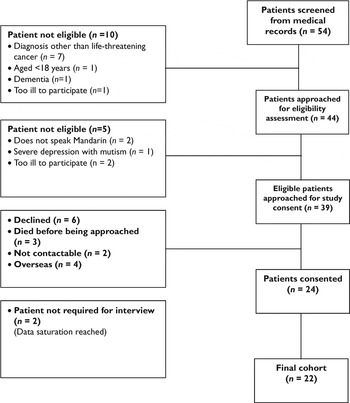
Participants included consecutive MSCPs who had been admitted as an inpatient or attended an outpatient clinic at PMCC during 2009 (see Figure 1). Potentially eligible patients were identified from the medical records, including those patients: (1) aged 18 years and above, (2) with a diagnosis of life-threatening cancer (nonmelanoma skin cancers excluded) on or after January 1, 2008, and (3) who indicated at hospital registration that Mandarin was their preferred language (professional interpreters were available at the request of the clinical team at no cost to the patient via an external agency). Patients were excluded if they had cognitive impairment, psychotic illness, severely debilitating physical illness, or were too ill to participate. Written consent for all participants was obtained at the time of the interview.
Flowchart of the patient cohort.

Data Collection
Subject to confirmation of eligibility by the patient's treating physician, patients were phoned by a Mandarin-speaking researcher to invite participation. Willing participants were then interviewed (in Mandarin) at home or at the PMCC by one of the authors (YC), who is a Mandarin-speaking psychiatrist. Interviews continued over 12 months during 2010 until data saturation was reached.
Interviews were semistructured around participants' views of the health system and their experiences of being diagnosed and treated for cancer outside their native country, where Mandarin was not the predominant language. An interview schedule with standard probes was employed to guide the dialogue and encourage MSCPs to elaborate on their responses, but remained sufficiently flexible to follow new lines of inquiry raised by participants.
All interviews were audiotaped, transcribed verbatim into Mandarin, and then translated from Mandarin to English by two independent bilingual typists for analysis. The accuracy of these transcripts was independently verified by one of the authors (ET), who is a bilingual (English- and Mandarin-speaking) senior psychiatrist.
Data Analysis
Key themes present in the data were identified from the interview transcripts using thematic analysis. The analysis was undertaken by two of the authors (YC, AC), including a bilingual psychiatrist and an English-speaking researcher. Themes identified were discussed between authors, ensuring that the meaning derived was consistent with the interviewers' understanding of participants' experience. Key themes were progressively grouped, coded, and refined (Booth & Booth, Reference Booth and Booth1994; Fossey et al., Reference Fossey, Harvey and McDermott2002; Patton, Reference Patton2002; Rice & Ezzy, Reference Rice and Ezzy1999), until agreement was reached. When no new additional codes were emerging, the cohort was considered complete.
RESULTS
Participant Characteristics
Participants included 22 MSCPs (11 male) of 39 people approached for study inclusion (56%). MSCPs were aged from 37 to 81 years (median = 54 years). Most were born in China (n = 17), married (n = 16), and had breast (n = 7), gastric (n = 3), prostate (n = 2), or lung (n = 2) cancer. Other malignancies represented included plasmacytoma, nasopharyngeal, testicular, cervical, parotid gland, and lymphoma. The majority of participants were retired (n = 7), though a notable number were employed at the time they were interviewed (n = 6). Half the cohort (n = 10) had university-level education and an annual household income of less than $36,400 AUD.
Overview of Findings
Participants in this study revealed the inherent difficulties associated with being diagnosed and treated for a life-threatening cancer outside their country of origin, where English was not the predominant language. Notably, while MSCPs demonstrated great resilience, often prioritizing a holistic approach to their cancer recovery and seeking support where possible, language barriers were noted to significantly impact the quality of care provided. Additionally, the specific cultural approaches to cancer were expressed, such that MSCPs were often unable to disclose their diagnosis to family members and experienced some stigma associated with being identified as a ”cancer patient.”
1. Impact of Language Barriers on the Quality of Care
Difficulties Understanding Medical Terminology Leading to Uncertainty Regarding Diagnosis, Prognosis, and Treatment
The MSCPs in our study expressed several challenges associated with understanding medical terminology. Much confusion resulted from misunderstanding the meaning or implication of medical terms typically used in oncology settings. As a result, MSCPs were often not clear about their expected prognosis, even when this information had been communicated to them via an interpreter or English-speaking family member. Of note, such misunderstandings also applied to MSCPs who could usually undertake day-to-day communication using their limited English:
I did not understand what “advanced” meant. I thought “advanced” meant [the cancer was in] early stage. I told my daughter it doesn't matter; it's “advanced,” but my daughter said “advanced” meant it was in late stage (. . .) I had felt I could be cured. (P01)
If it is ordinary daily conversation, it is not a big problem. The problem is at hospital. When you talk in hospital, it is about some sort of medication or some part of the body. I don't know these terms. (P19)
Language barriers also limited the ability of MSCPs to advocate for themselves or to seek explanation surrounding issues related to their prognosis or treatment plan. Importantly, this was not overcome by the use of interpreters, since uncertainty most often arose at home after information was digested and considered. Outside of the arranged medical consultation when their prognosis and treatment plan were communicated, MSCPs had few avenues through which to seek further clarification regarding their uncertainties due to their limited proficiency in English:
I still have no idea about my condition. Is it normal? Is it serious? If I am back home in China, I would have made an appointment with a doctor myself, but I can't do it here because of my poor English. (P10)
Difficulties Associated with Indirect Communication with Medical Professionals
Language barriers and the resulting indirect communication with medical professionals through an interpreter or bilingual family member or friend restricted the ability of MSCPs to access basic quality care. While most MSCPs expressed overall satisfaction and gratitude with being given the opportunity to have access to an interpreter, significant limitations were noted. In particular, communication with medical professionals was perceived to be impeded by variability in the quality of interpreters and the use of family members and friends in the absence of interpreters:
Some [interpreters] are good, and some are not.. The first time was not good, for his English is almost the same as me. He was not familiar with those medical terms; but the second one interpreted very well. (P16)
Sometimes the surgeon spoke to my son instead of me, and my son did not tell me in the end. My son understood, but he did not explain it to me. (P10)
Given the indirect nature of their communication with medical professionals, MSCPs revealed they were less likely to ask questions about their cancer and its treatment, limiting their understanding of the disease and its likely course. Again, this issue was not overcome through the use of interpreters, as MSCPs did not want to be a burden to the medical professional and the interpreter, to whom they were grateful:
They did not tell me why [there] were three holes made in the abdomen. I think that was to detect any metastasis in my abdomen. To ask the original doctor, he will definitely need to ask for an interpreter. (. . .) So I didn't ask. (P03)
I don't normally discuss my illness with my doctor. I only answer what the doctor asks me. After all, English is not my first language. Whenever I say something, I need the interpreter to interpret for me. It is so troublesome, so I do not ask much unless I have to. (P17)
MSCPs also perceived that this indirect communication affected their care, and in some instances the efficacy of the treatment provided. MSCPs who had received inpatient care revealed that they were unable to communicate with nursing and medical staff about what they perceived to be important information such as the experience of symptoms or pain. Participants also revealed their feelings of helplessness in feeling pain, yet not having adequate communication surrounding its cause, or not having the language to express it:
Sometimes I felt a little helpless. (. . .) I asked my son to write down some simple sentences that I would like to communicate, such as here is hurt, I want to drink! I want to defecate, or urinate. (P03)
I was in terrible pain after chemotherapy, and the doctors cannot speak clearly to me what's going on. During the ward round, they all speak English. (. . .) I cannot speak [English] and so I cannot tell them. (. . .) I didn't know why it's so painful. (. . .) I was starving but could not eat. And I cannot tell. (P12)
Restricted Capacity to Access Support Services
MSCPs revealed that language barriers also had a negative impact on their capacity to access the support necessary to assist them to cope with their cancer. Support services were said to be unhelpful as they either consisted of predominantly Western people who were perceived to be culturally dissimilar, or they were only offered in English, meaning MSCPs were unable to participate. Notably, this applied to seeking assistance both from professionals such as psychologists and from other social support and community services:
He said if you have had difficulties or mental problems, you can go to them [the psychologist]. But it is all in English, so no one can help, right? You cannot express, even when they are counseling you, you do not understand. (P11)
People called me to join some [support] group, I cannot go. (. . .) My English is not good. Sometimes the hospital has sent me the letter, like a cancer group or club. They are all Western [people], no Chinese, so I cannot join. (P12)
Moreover, MSCPs also noted the impact of isolation from the general community and peer supports, including the support garnered from seeing other “similar” people in the hospital waiting rooms. They expressed limited opportunities to share their experiences and learn from other MSCPs in a position similar to theirs:
If I were in China, I could meet a lot of patients with this disease, and go ask other people. But here, I cannot know other patients, and not knowing how are other patients. (P13)
2. Impact of Differing Cultural Approaches to Cancer
Nondisclosure of Cancer Diagnosis to Family and Friends
MSCPs revealed they placed notable value on confidentiality surrounding their diagnosis, often choosing to not disclose their cancer to other family members and friends. This related specifically to the fact that relatives were mostly living overseas, and they were therefore unable to be there in person to comfort them. Additionally, MSCPs expressed a desire to protect family members from distress, particularly elderly parents who may not understand the cancer diagnosis:
My parents still do not know even now. I cannot tell them because we are not in the country. If you told them, they cannot do anything but worry. So simply just don't say it. Telling them will not help; instead it makes them worry. (P07)
I still have not told [my parents]. My brother asked my uncle what to do. My uncle said not to tell my parents because they will be very upset. So he didn't tell my parents. They still do not know this now. (P19)
Stigma Associated with the Illness of Cancer
Some MSCPs in this cohort revealed the stigma surrounding the cancer illness, as perceived by particular family and friends with traditional cultural beliefs. The underlying stigma forced some MSCPs to not disclose the details of their cancer illness. This also served to protect their loved ones from scrutiny, should their diagnosis be made public. One MSCP spoke of the concern her family had expressed about her joining a cancer support group, given it would identify her as a cancer patient:
[When talking about joining a cancer support group]: Families and friends said in Shanghai slang, you are joining “them” with wearing a “cancer” hat! They wish me to join normal people, and they advised me this way. (P11)
Last year I went back to Shanghai. (. . .) My friends asked about my illness and I told them.. My sister said why I am so open and told everyone about my illness. I said why should I be afraid. It is good to tell them about my experience. (. . .) Why can't I tell my friends? It is an illness. What is there so secret about an illness? (P06)
Differing Cultural Expectations of Medical Care
The MSCPs in this study revealed the importance of alternative therapies and valued an integrated holistic mind/body approach to cancer care. Most MSCPs commonly used both Western and traditional Chinese treatments, and had sought opinions related to both approaches. As a result, MSCPs commonly expressed confusion regarding conflicting advice from professionals involved in both traditional Chinese medicine and Western medicine:
The [Western] doctors said I can eat anything, but the Chinese doctors said no chicken, prawn, crab. (P10)
In China, people said do not eat seafood. (. . .) But here what the doctor said also makes sense. He said seafood can increase protein and immunity. It's contradictory to me, whether I should eat it or not. (P12)
Differences emerged in the reactions of MSCPs to the conflicting advice and treatment received. While some MSCPs developed a mistrust of the medical professionals involved in the Western care philosophy, others disclosed their Chinese medicine use to the Australian medical professionals and opted to wholly follow that advice:
The Western doctor told us we should not use Chinese medicine when we are having chemo. I think it is very simple. They hope to see the effects of the medication they prescribed and do not want any other medication to go into the body. So we would totally rely on Western medicine, listened to my doctor totally and used what he told me to use. (P19)
Additionally, MSCPs revealed the differing cultural expectations that existed in Australia and China regarding the benefits of medications and treatments, which was very confusing for MSCPs. For example, one MSCP explained that, while Western doctors in Australia were unable to offer him any curative treatment, doctors in China had offered drugs. Limited support was available to MSCPs to mediate or resolve these differing approaches to cancer treatment:
I do have the cancer, but there is no treatment. I cannot understand. Was I in China, they would have treated me. I asked the specialist [in China], and he also gave me some drugs. (. . .) He said these drugs can cure you, (. . .) but in Australia nothing. (P07)
DISCUSSION
This study provides novel data on the experiences and perspectives of a minority MSCP population who were diagnosed with cancer outside their native country in an unfamiliar system of health care, amid English-speaking medical professionals and a predominantly Western patient population. The patients in our study revealed notable challenges as a result of both language difficulties and different cultural approaches, which often limited their understanding of their disease and its treatment and impeded their ability to access quality care and support. MSCPs reported poor perceptions of their medical care, noting that it did not give priority to a holistic approach and did not assist them in navigating conflicting medical advice. Given the disparities that exist between minority and majority groups across a number of patient outcomes including survival and psychological morbidity (Luckett et al., Reference Luckett, Goldstein and Butow2011), identifying barriers to the receipt of quality medical and supportive care for MSCPs is indeed important.
Consistent with earlier research (Butow et al., Reference Butow, Sze and Dugal-beri2010), language difficulties and issues with interpreters were a common challenge encountered by MSCPs despite the widespread use of and access to interpreters. Prior research has shown that doctors spend proportionally less time speaking about cancer-related issues with immigrants who require interpreters than with Anglo-Australians (Butow et al., Reference Butow, Bell and Goldstein2011). MSCPs in this study confirmed that, due to their poor understanding of their illness, more time had to be given to describe the meaning of complex cancer terminology, and to openly invite questions, despite MSCPs' reluctance to burden doctors and interpreters. Providing written information in their native language and including options for culturally relevant community groups are recommended to allow MSCPs the opportunities to better understand their illness and its treatment and to garner support. Phone interventions delivered by trained facilitators in the patients' native language may also help to bridge this gap in their care (Shaw et al., Reference Shaw, Butow and Sze2013), though more research is required.
The limitations in care highlighted by MSCPs in our study also reveal the importance of developing education modules and communication tools to facilitate service improvements. Such modules should be aimed at training clinical staff to use interpreters more effectively and to facilitate culturally appropriate consultations. Additionally, interpreters could be trained to more effectively explain specific oncology terms to MSCPs. Bilingual written communication aids could also be developed for use with inpatients, involving simple statements and pictures expressing common nursing care needs, such as calling for a commode or reporting pain, hunger, thirst, loss of appetite, or nausea. Patients could be orientated to the communication aids by trained interpreters on their admission to hospital. Such initiatives might help to bridge the gaps in care related to the language difficulties noted by MSCPs.
Importantly, some MSCPs in our study suggested that the stigma within their own community related to cancer also hindered their ability to access support. This applied to both formal support groups and informal peer and family support. This stigma may be unique to the cultural experience of MSCPs, as highlighted by others (Lui et al., Reference Lui, Ip and Chui2009; Yeo et al., Reference Yeo, Meiser and Barlow-Stewart2005). This would suggest that MSCPs in particular may require additional supportive services, since the general community supports offered may be insufficient or inappropriate. Such services should assist MSCPs to navigate complex cultural issues, such as dealing with issues of disclosure with extended family and friends (including those living overseas), and providing strategies for resolving conflicting advice provided through traditional Chinese and Western approaches to care.
LIMITATIONS
The impact of the immigration and acculturation experience of MSCPs has not been addressed in our study, and the perspectives of the MSCPs reported here may not be representative of the wider Chinese-Australian community. Despite this, consecutive patients were sampled and recruitment continued until data saturation was reached, suggesting that the ideas for service improvements raised are important and generalizable to other MSCPs in Australia. However, further research is needed to understand how these suggestions for care may meet the needs of other cultural minorities, and to assess whether they can improve the experiences of MSCPs in the future.
CONCLUSIONS
Mandarin-speaking cancer patients are a large minority group in Australia who experience significant language and cultural barriers when in need of accessing cancer care. Australia, and other Western countries with increasingly diverse populations, must consider how cancer care can be modified to better support people from minority groups to effectively cope with their diagnosis and treatment. For MSCPs in Australia, this may involve: (1) introduction of bilingual written and illustrated communication aids that could be readily available for inpatients; (2) improved training for clinical staff to aid in their mastery of cultural issues and their use of interpreters; (3) training for interpreters to increase familiarity with oncology terminology; and (4) improved access to culturally appropriate supportive services.
ACKNOWLEDGMENTS
We are grateful to Dorothy Yiu, President of the Chinese Cancer Society of Victoria, and Anne C.H. Yi, who assisted with translations.