Background
The construction of a meaningful life depends upon satisfying interrelated ontological needs, described by Max-Neef, Elizalde and Hopenhayn (Reference Max-Neef, Elizalde and Hopenhayn1991) as fundamental human needs (FHNs). While a number of theorists have explored the nature of FHNs (notably Andersen, Reznik and Chen Reference Andersen, Reznik, Chen, Snodgrass and Thompson1997; Berkman et al. Reference Berkman, Glass, Brissette and Seeman2000; Maslow Reference Maslow1943; Maslow and Frager Reference Maslow and Frager1987; Max-Neef, Elizalde and Hopenhayn Reference Max-Neef, Elizalde and Hopenhayn1991), most agree that they are broadly divided into three categories, namely physical, social and self-actualisation needs. Fulfilment of physical needs ensures that the physical entity is protected. These needs include food, accommodation, physical security, physical safety and health care. When social needs are satisfied, informational, functional, decision-making and emotional support is ensured. Social needs include association, participation, co-operation, belonging, affection and intimacy. Fulfilment of self-actualisation needs enables the construction of the ‘self’, and promotes self-esteem. Self-actualisation needs include freedom, choice, autonomy, control, privacy, productivity, self-expression and biography.
Max-Neef, Elizalde and Hopenhayn (Reference Max-Neef, Elizalde and Hopenhayn1991) argue that some FHN satisfiers are synergic (one satisfier fulfils numerous FHNs), and suggest that, if a synergic satisfier is removed or compromised, quality of life can be severely damaged. Literature that explores the topic of housing explains that one of the most significant methods of addressing multiple FHNs is to occupy a house as a property-owner or tenant, thereby creating a ‘home’ for the self. Having a home contributes to the ‘ontological security’ so necessary to our being in the world. As well as providing a protective environment and a spatial context for the performance of day-to-day interests and routines, home is a place where people feel in control of their lives, free from surveillance and external expectations. It is a secure base for construction of identities and relationships, and provides a means for coping with and addressing the practical problems that arise in everyday life (Dahlin-Ivanoff et al. Reference Dahlin-Ivanoff, Haak, Fange and Iwarrson2007; Dupuis and Thoms Reference Dupuis and Thoms1998; Exley and Allen Reference Exley and Allen2007; Mallet Reference Mallet2004; Molony Reference Molony2010; Saunders Reference Saunders1989). In other words, home is an immensely important synergic satisfier.
During crises, many social and self-actualisation FHNs are abandoned, and synergic definitions of FHN satisfiers discarded, as we strive to maintain a physical existence. For example, when we are acutely ill, home may become no more than a warm, secure shelter in which to recover. Sometimes, hospitalisation occurs, and during this period, residential status changes from property-owner/tenant to cared-for person (there are no direct rights of tenure for occupancy of a bed whilst receiving care in many hospital services internationally). For example, a person requiring in-patient care in a UK NHS Trust has a right to access and receive care and treatment (Department of Health 1993, 2006; National Health Service Act 1946; National Health Service Reorganisation Act 1973) but the occupancy of the bed in the Trust is a consequence of receiving care, and ownership of the bed is retained by the Trust. Often, the threat to physical existence is temporary. When health improves, all categories of FHNs again become essential to living a biographical life. Home is once more integral to self-actualisation and social contexts, as well as to physical fitness (Exley and Allen Reference Exley and Allen2007; Molony Reference Molony2010).
For older people who live in residential and nursing homes (now on referred to as care homes) the situation becomes complex. On the one hand, they are long-term tenants requiring the synergic ontological security that ‘home’ provides. On the other hand, they are ‘cared-for’ persons who have entered into contractual arrangements that focus on their care needs and the ability of the care home to meet those needs (Howe, Jones and Tilse Reference Howe, Jones and Tilse2013; Office of Fair Trading 1998). In this context, ontological security is sacrificed in favour of physical security only.
The ambiguous status of the care home resident is first evident during transition from home to care home. When an older person makes a choice to move to a care home, he or she is exercising the right of an autonomous individual to select their place of residence and agree the terms of occupancy (Nolan, Davies and Grant Reference Nolan, Davies, Grant, Nolan, Davies and Grant2001; Reed et al. Reference Reed, Cook, Sullivan and Burridge2003). This is similar to securing tenancy in other situations. However, in many situations, the decision to move to a care home is made for the older person by relatives or health/social care professionals on the grounds that personal or nursing care is required. In some cases, the older person may not visit, or receive information about the home, prior to moving (Bland et al. Reference Bland, Bland, Cheetham, Lapsley and Llewellyn1992; Booth Reference Booth, Johnson and Slater1993; Johnson, Schwiebert and Rosenmann Reference Johnson, Schwiebert and Rosenmann1994; Nay Reference Nay1995; Neill Reference Neill1989; Office of Fair Trading 2005). Such circumstances demonstrate that relocation decisions can be based only on care needs, thus reducing the older person's autonomy and choice regarding living environment.
Legislation and good practice recommendations attempt to resolve the incongruous nature of care homes. While the primary purpose of legislation and regulations is to direct the categorisation, provision and standardisation of care, these documents nevertheless recognise that care homes are permanent residences for many people. Consequently, these policies stipulate or recommend practices that acknowledge the notion of ‘homeliness’, emphasising the importance of supporting and creating levels of privacy, dignity, choice and fulfilment in care home life to match those enjoyed in an individual's own home. The resultant environment, borne out of the attempted integration of ‘care setting’ and ‘home’, is customarily described as ‘home-like’ or ‘domestic-like’ (Care Quality Commission 2010; Care Standards Act 2000; Centre for Policy on Ageing 1984, 1996; Department of Health 2001; Department of Health and Social Service Inspectorate 1989). Evidence clearly indicates, however, that for care home residents, the residential status and experiences of living at home and living in a ‘home-like’ care home, are very different, indicating that strategies to resolve incongruities in concepts of ‘care’ and ‘home’ remain unsuccessful (Cooney Reference Cooney2012; Cooney, Murphy and O'Shea Reference Cooney, Murphy and O'Shea2009; Davies Reference Davies, Nolan, Davies and Grant2001; Diamond Reference Diamond1992; Eyers Reference Eyers2003; Eyers et al. Reference Eyers, Arber, Luff, Young and Ellmers2012; Heywood, Oldman and Means Reference Heywood, Oldman and Means2002; Higgins Reference Higgins1989; Kahn Reference Kahn1999; Lee Reference Lee2002; Lee-Treweek Reference Lee-Treweek, James and Gabe1996; Murphy, O'Shea and Cooney Reference Murphy, O'Shea and Cooney2007; Nolan, Davies and Grant Reference Nolan, Davies, Grant, Nolan, Davies and Grant2001; Oldman and Quilgars Reference Oldman and Quilgars1999; Peace and Holland Reference Peace and Holland2001; Tuckett Reference Tuckett2007; Willcocks, Peace and Kellaher 1997).
A significant difficulty in reconciling ‘care’ and ‘home’ concepts is the necessity of routine to the operational success of care homes. Residents may encounter restrictions in their lives as a direct result of routine. Willcocks, Peace and Kellaher (Reference Willcocks, Peace and Kellaher1987) highlighted the paradox of creating ‘home-likeness’ in group care environments in their analysis of the life of 1,000 residents in supportive care settings in the United Kingdom (UK). These authors proposed that the image of the homely setting is a genteel facade behind which institutional patterns, not domestic ones, persist. Kahn's (Reference Kahn1999) ethnographic study of Jewish elders living in a nursing home in the United States of America (USA) identified that residents experience ambivalence concerning the nature of their living environment. On the one hand, the nursing home is their home – the residence that satisfies physical FHNs such as security and care. Yet the restrictive nature of daily life that revolves around institutional processes led residents to conclude that it was not like home. It was a communal living and a work environment, where features of institutional life dominated daily experience. In a recent study of activities of daily living (ADLs) and organised activities in English care homes, Eyers et al. (Reference Eyers, Arber, Luff, Young and Ellmers2012) found that care home life was restricted by the continuance of a reductionist approach to care, that maintained an emphasis on supporting ADLs, rather than individuality and autonomy, thus leading to a homogeneous existence for residents. The study concluded that policy directives that prescribe facilitation of an autonomous life consistent with ‘living at home’ is nothing more than rhetoric.
Understanding of the negative impact that institutional processes can have on residents' quality of life has motivated researchers and service providers to explore alternative strategies for the development of care environments that fulfil the range of FHNs. One approach, the Eden Alternative, is being implemented in care homes in the USA, Australia, UK and Ireland. Within this approach, care home services are underpinned with a person-directed care philosophy that empowers all care partners to transform institutional approaches to care into caring communities where life is worth living (Thomas Reference Thomas1996, Reference Thomas2003). This focus on the person in what are essentially communal living care environments has prompted interest in relation-based care (Davies Reference Davies, Nolan, Davies and Grant2001; Nolan, Davies and Grant Reference Nolan, Davies, Grant, Nolan, Davies and Grant2001). Within the care triangle in long-term care settings, relationships exist between older people, families and staff. Every stakeholder in this care triangle has FHNs. If these needs are met through fulfilment of their sense of security, belonging, continuity, purpose, achievement and significance, Nolan, Davies and Grant (Reference Nolan, Davies, Grant, Nolan, Davies and Grant2001) argue that communication and partnership working is facilitated. This, in turn, improves quality of care and tempers the influence of institutional processes, thereby enhancing the quality of life experienced by the resident.
An association is emerging in the practice literature between providing an environment that is person-orientated and relational, and quality of life. However, few studies have explored the complex issues surrounding the residential status of care home residents in terms of FHNs. By approaching this topic via the use of the FHN organising framework, this study sought to explore the meaning and meaningfulness that older people attribute to their everyday experiences in a care home and how these experiences define their status as residents. Utilising this framework also enabled an exploration of what older people want to achieve, and are able to achieve, when living in care homes.
Methodology
Study design
This study was a biographical investigation that sought to explore the meaning and meaningfulness that older people attribute to their experiences of living in a care home. The research design followed Gadamer's (Reference Gadamer1975, Reference Gadamer1976, Reference Gadamer, Weinsheimer and Marshall1989) hermeneutic dialogical process, in which a dialogue is created between the researcher's and the participant's understandings of particular phenomena, with a view to attaining a greater appreciation of the participant's stance.
This research design supported the study's aim to facilitate older people to tell their stories of life in a care home. A multiple interview approach was adopted to explore the narratives in depth. Few studies in care homes have prolonged engagement with residents to explore their perspectives, and much of the existing research has focused on the move to a care home, rather than living in a care home. Hence this study provides a novel approach within the body of care home research. The proposal was reviewed and approved by both University and NHS research ethics committees where, in particular, issues relating to confidentiality and the obtaining of informed consent were assessed.
Data collection
In keeping with the research design, a specific form of narration known as episodic interviewing was adopted as the data collection method (Flick Reference Flick1998, Reference Flick, Bauer and Gaskell2000). This technique combines narrative interviewing and more direct forms of questioning to enable the researcher to access both episodic (knowledge of direct experiences) and semantic knowledge (knowledge of concepts and assumptions). According to Flick (Reference Flick1998, Reference Flick, Bauer and Gaskell2000), this method of data collection is relevant when the aim of the investigation is to explore routines and normal everyday phenomena.
The sequence of interviews commenced with invitations to participants to narrate their life histories. During subsequent interviews, participants were asked to give accounts of their lives since the previous interviews. In addition, specific issues about communal living and the meaning of ‘home’ were introduced by generative questions such as: ‘Could you tell me about living with others in this care home?’ and ‘How are you involved in decisions that affect your daily home life?’ An advantage of this approach to data collection was the introduction of new topics to the interview schedule based on the stories that participants told, and having the opportunity for clarification of inconsistencies in individual interviewees' responses through revisiting topics (Cohen, Khan and Steeves Reference Cohen, Khan and Steeves2000; Dumay Reference Dumay2010).
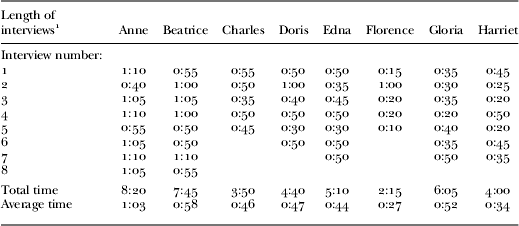
The interviews were scheduled to take place at two-weekly intervals. However, as data collection proceeded, the residents themselves determined subsequent interview appointments in order to allow for fatigue and illness, and to ensure social schedules were not disrupted. As the interview sequence progressed, it was clear that the participants engaged with the process of telling their story. Rather than opening their narration with comments like ‘there is not much to tell’, they would begin with ‘When we last met I told you about…, and now the situation has changed…’ Participants and researcher became familiar with each other and with this trust developed. This was conducive to comprehensive exploration of sensitive topics such as personal losses, breaches of dignity when queuing to use the toilet, and death. Sequences of up to eight interviews per participant were carried out over a period of six months. Collectively, the eight participants generated 42 hours and 5 minutes of interviews (N=53 interviews; see Table 1).
Number and length of resident interviews
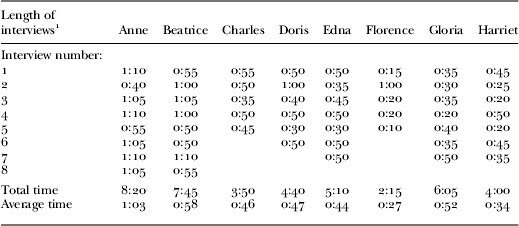
Note: 1. Time in hours and minutes.
Sample
The first stage of recruiting the resident sample was to approach care home managers and attain agreement for participation in the study. Every care home has a unique social milieu and culture that has the potential to influence the experience of those who live and work in that environment. For this reason, the sampling strategy aimed to recruit diverse environments through the use of a sampling matrix (Reed, Procter and Murray Reference Reed, Procter and Murray1996). The characteristics assessed in the selection of care homes included registration category, number of residents, proprietor arrangements, philosophy and organisation of care, the social activities programme and type of living areas in the home. The sample included one 20-bed nursing home, a 40-bed dual-registered home, a 78-bed dual-registered home, and a 40-bed nursing/residential and high-dependency elderly care home. All of the managers indicated that they provided individualised care in the home, which was delivered through a comprehensive assessment at the point of admission to the care home and facilitated through a key worker system to optimise continuity in the delivery of care (further details of the staff's perspective concerning the delivery of care is provided in Cook Reference Cook2007).
Eight older people (seven female and one male resident between the ages of 52 and 95) volunteered to take part in the study. They had resided in these homes for one and a half to six years. The interviewees had had the study explained to them, and had agreed to be interviewed. Informed consent was re-visited at the beginning of each interview to ensure ongoing consent. Compliance with the directives of University and NHS Local Research Ethics Committees ensured participants' rights to confidentiality were maintained via anonymisation of data and use of pseudonyms.
Analysis
Narrative analysis was used to interpret how participants viewed their experiences and environment. Following each interview, audio recordings were transcribed verbatim, and open coding undertaken to identify what stories were told, and the topics/issues raised by the respondent. This method facilitated interaction with individual resident's stories. Consequently, a dialectic movement between the whole and the parts of interviews and interview sequences was initiated, allowing for shifts between description and interpretation. The initial interpretation began with developing a surface understanding of the data that aimed to acquire a sense of the whole. This was followed by a structural analysis in which the dialogue was examined to explain ‘what it says’ and ‘how it was said’. The third phase consisted of a critical in-depth interpretation using the FHN framework in order to analyse narratives in terms of what they said about participants' experiences and aspirations regarding the physical, social and self-actualisation needs that ‘home’ should fulfil. This provided a broader frame of reference than the ADL framework that dominates practice in the care home sector.
Findings
Living with care
The stories the participants told about their lives in care homes were unique to each individual. One woman, however, summarised what was most important to these eight people. They wanted to ‘live with care’ rather than ‘exist in care’. Few narrations focused on care episodes or the quality of care – they wanted home to be a place where they were more than a recipient of care. They wanted to ‘live a full life’, in addition to receiving good quality care that provided a supportive framework for their life. A unifying theme across all of the stories was the importance of the individual being able to determine what they valued and being able to achieve the things that mattered to them.
Staff, family and friends suggested that the place they had moved to was ‘now their home’, yet everyday experiences indicated otherwise: they were living in a home, a communal residence. Following the move, they became acutely aware of the ‘public self’. Dependency on care practices, organisational structures and routines, communal activities, communal environments, and relationships with staff and other residents contributed to participants' perception of their public ‘self’. While participants' tolerated and ‘made the best’ of their public identity, they all valued and appreciated opportunities ‘to be themselves’.
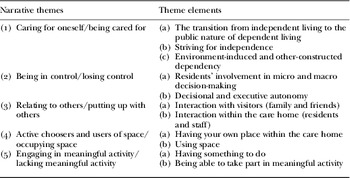
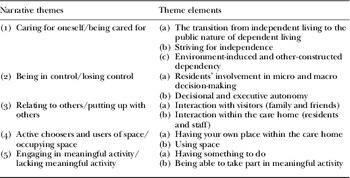
In the communal environment, and in their private space, these older residents experienced different elements of care home life – care, decision-making, relationships, personal environment and activities. These narrative themes related to experiences of change to their residential status after the move from home to care home (Table 2). These themes will be discussed in the following sections to give insight to the manifestation of these narratives in care homes and how the interaction between individual, context and circumstance contribute to the life that is experienced by a resident.
Narrative themes and theme elements
Narrative theme 1: Caring for oneself/being cared for
The transition from independent living to the public nature of dependent living
Managing acute and chronic illness, disability and increased frailty were key factors that contributed to the inability of participants to perform one or more self-care or health-care need and the decision to move to a care home. The move was a major life transition that involved loss of independence and increased dependence on staff for support. This was a new experience for Beatrice, Charles, Doris, Edna and Florence. They had ‘managed fine by themselves up until now’. In contrast, Anne, Gloria and Harriet had experienced declining health and disability for some time. The move to a care home occurred when their levels of home care were no longer adequate to meet their increasing health and social needs.
Most participants suggested that being dependent on others in the care home environment was difficult. They could be cared for by staff who lacked detailed knowledge of their preferences and aversions. Beatrice found this particularly upsetting:
They put things on me and I haven't seen them for months and months. I don't know where they get them from. One day you have a vest on and the next day you haven't. I had no vest on today. She was just going to put my blouse on and I said, ‘Oh I have to have something on inside my blouse, you can see right through this’.
All participants felt that some care procedures such as assistance with bathing and going to the toilet were intrusive. In addition, in this communal environment they were aware that other residents knew what was happening to them. Gloria, for instance, spoke of her dislike of a fellow resident counting how many times that she went to the toilet during the day. ‘Turn-taking’ was a feature of care that involved waiting for assistance, which resulted in aspects of private bodily functions being widely known by staff, other residents and visitors. The public nature of being cared-for was stressed by Beatrice:
Beatrice: The toilet is bad here, because everyone has to be taken to the toilet you know. When you are waiting to go oh dear it is awful.
Researcher: Is that waiting while other people go to the toilet?
Beatrice: Well yes most people go in chairs you see, and you have to wait until someone can take you. It is not very nice having someone standing over you while you are having something. You are never, never on your own. Never, never.
Some care workers' methods of adhering to care policies meant that private customs were made open to public scrutiny. The regular routine of ‘the weighing’ that Florence experienced is illustrative of these practices:
They weigh me and they weigh everybody in the home about once a month. It is rather nasty.
At home, weighing oneself is a matter of choice and is associated with self-image as well as physical health. For many people, weight is a very personal, almost taboo subject. Being weighed in a public lounge in a care home demonstrates how residents were subject to a range of institutional practices that restricted autonomy and ignored personal feelings.
Striving for independence
Though the participants acknowledged that they needed assistance and support, they made continuous reference to the importance that they attached to ‘doing as much as possible for themselves’. Charles indicated that maintaining a level of independence enhanced the quality of his life:
Oh I can control my own life … and that is a big thing. You know I wouldn't like to keep having to ask the staff to take me here or to do this for me or do that. When you can do it yourself it is much better. It makes it, it makes your life more pleasant.
The participants feared that their abilities would decline, resulting in increased need for support. This motivated individuals to develop strategies to maintain existing abilities. Strategies included the design and use of gadgets and tools to aid independence, and exercises to maintain mobility. In contrast to the public spectacle of care that took place throughout the day, these activities often took place within the privacy of participants' own rooms, unbeknown to others in the home. Edna, for example, developed an exercise routine that she followed every morning prior to staff assisting her out of bed. The routine consisted of hand, elbow and shoulder exercises. She genuinely feared that further loss of movement in her arms and hands would limit her ability to feed herself. If this happened she would be moved to the table in the dining room that was set aside for those residents who required assistance to eat and drink:
Edna: Well Mrs. J. has had to move. I think I may have told you, but she is not so good with her knife and fork and she has gone to another table where they can't manage by themselves.
Researcher: Who makes those choices about tables?
Edna: Well the nurses or matron. I am going to have to be very careful because I am beginning to have problems and I don't want to move. I think that I am alright but if you can't do it alone you have to go down on the other table. That of course is sensible.
The formulation of self-care strategies resulted from participants' desires to remain as independent and private as they could within a supported living environment. Such strategies would not have been necessary in their own home where the entire environment would have been transformed to accommodate their needs.
Environment-induced and other-constructed dependency
The participants were frustrated and annoyed when the environment and practices in the home undermined their efforts to self-care. They were rarely consulted about the furnishing, decor or design of the building where they lived. In the following story, Anne spoke about the refurbishment of her care home and the impact that the new deep-piled carpet had had on her routines:
Well I have lost a little bit of independence again, haven't I? I am used to losing a little bit every now and again. Now I have to ask somebody to push me back [from the front door to her room]. Well before on the other carpet I could just wheel my chair down and wheel back with about five minutes rest at the other end. I used to like to go down and collect any post like tapes and things that were down there for me in the mornings. And sometimes they are too busy to bring them up and I used to enjoy that because it was something that I could do for myself. But now I can only manage one way.
Anne had voiced her concerns about the new carpet to staff, and in response they offered to push her chair to the front door whenever she needed assistance. Their reply indicated to Anne that staff did not recognise the loss of independence that she experienced, and the value that she attached to doing things independently. This example also demonstrates how the living environment itself created new handicaps that limited residents' independence even further.
Narrative theme 2: Being in control/losing control
Residents' involvement in micro and macro decision-making
The participants described situations and events where they made decisions and acted on them. Charles, for instance, spoke in detail of the way that he had planned and organised his days:
I have breakfast and after my breakfast I go downstairs to about 10.30 … and then I just have a look around to see if everybody is working alright and keep my eye on things … oh they keep on saying if there was a union around here I would be the shop steward. And then I am back here about 10.30 am ready for my 11.00 am cup of tea and whatever. And then I get ready for my daily newspaper [an audio-taped newspaper] … I get it about four times per week so I get to know what is generally going on. And then I go downstairs and talk to a bloke downstairs till about 12.00 pm and then it's dinnertime. That is my morning. Well afternoons. Well invariably I have someone in so that is that. Then in the evening it is TV time except on a Tuesday night. I go out with friends on a Tuesday night.
Charles was able to determine many aspects of his life, and he adapted his behaviour to fit in with the routines of the home. This indicated that he perceived there were limits to what he could, and could not, influence.
Narratives also demonstrated that participants did not feel able to voice their opinions about the day-to-day management of the care homes, so often tolerated organisational systems that were staff-centred rather than resident-centred. For example, Florence was unhappy with the dining room seating arrangements, but resigned herself to having to accept the situation:
I sat at a good table once where they were very nice and friendly. We have single tables now. We used to have a long table where everyone sat down. Now we have tables of four all over and it depends on the table that you sit on … it is not as much fun as before.
All the care homes that participated in this study had organisational structures (e.g. residents' committees and quality improvement activities) and care management practices (e.g. key worker systems) that encouraged and supported residents to participate in a range of decisions. Despite these structures, the above examples demonstrated that participants could be marginalised from decision-making processes. Participants tended to focus decision-making on aspects of their lives that they felt able to control. Invariably these involved micro-decisions (regarding individual lifestyle and care choices). Participants did not give primacy to situations that they felt they could not change. These situations usually involved macro-decisions (regarding the operation and management of the home).
Decisional and executive autonomy
A number of the study's narratives demonstrated how the presence or absence of adaptable resources and amenable supporters impacted on autonomy. For example, Anne's disability meant that she was dependent upon her wheelchair to mobilise, but the difficulty of tackling the new deep-pile carpet hampered her ability to control her mobilisation. In contrast, despite her limited functional abilities, the flexible and willing attitudes of staff and friends allowed her to negotiate her preferred outcome for some of her other requests. For instance, her long-term friend initially visited her three times a week following the move to the care home. As the years passed, her friend's mobility deteriorated as a consequence of Parkinson's disease. Anne decided that the current visiting arrangements were too fatiguing for her friend, so suggested that alternative arrangements should be made for a weekly ‘night in’:
I said, ‘Now look, you are doing far too much’. [She was trying to help her grand-daughter with the new baby and continue visiting]. It wasn't doing her any good so we cut it down to one night per week. So she comes on a Thursday night. But she is always there at 6.30 on the dot.
In spite of Anne's physical limitations to execute many decisions, she retained cognitive and negotiation abilities that supported decisional autonomy.
In contrast, Beatrice felt that she had little control over her life. Her routines were determined by care staff and she had little say in deciding her daily routine, with whom she interacted or how she was dressed:
I get woke up and then they come and dress me and I go for my breakfast. I have breakfast and I am all spick and span, and prepared for the day by 9.30 am. Then we sit in there [in the public lounge] until they come to get us for lunch. Well I never used to look at television, but I know everything now on television.
This narrative suggests that routines and care practices can marginalise residents from decisions that affect their lives in the care home. One consequence is loss of decisional autonomy. The more positive life experiences were those where individuals were enabled to make, and be supported to act on their choices and decisions. Enabling practices transformed the participants' latent potential to contribute to decisions into a real manifestation of their autonomy and self-expression.
Narrative theme 3: Relating to others/putting up with others
Interaction with visitors (family and friends)
While they were living in their own homes, the participants could control contact with others, sometimes by limiting, or refusing, contact. The move to a care home inevitably led to changes in these relationships. For example, Doris’ former contribution to family life, when she provided day care for her grandchildren in her own home, was now not possible.
Nevertheless, participants were able to redefine their contribution to, and interaction with, their families and friends in order to maintain links with their personal history, keep up-to-date with family events, remain intimate and affectionate with people they trusted, and enjoy companionship. For example, Anne received weekly phone calls from her son, during which she was updated about family news, and she informed the family of her circumstances. Participants particularly valued interacting with friends. Rather than developing from familial ties, their friendships emerged from intimacy, mutual understanding and reciprocity with the other person. Anne experienced considerable delight during her ‘nights in’ with her friend, and Charles looked forward to the ‘Tuesday night out’ when he had ‘banter over a pint’ with life-long friends. These friendships resulted in pleasure, fun and enjoyment, thereby satisfying emotional needs.
Interaction within the care home (residents and staff)
Living in a care home involves establishing relationships within a community where older people live and staff work. Interactions with staff were broadly categorised as functional and relational. Functional interaction, which accounted for the majority of the exchanges between participants and staff, emerged from care practices and served the purpose of identifying and responding to residents’ needs, and facilitating the efficient operation of the care home. Relational interaction between participants and staff involved sharing personal or topical information that was of mutual interest. Importantly, relational interaction with staff provided opportunities for residents to experience companionship and reciprocity within the routine of their daily lives. Factors such as high staff turnover and intense staff workload, however, mitigated against the development of these relationships. For example, Harriet described how sometimes, staff worked in the home for short periods of time. This had a marked impact on her, making her feel ill at ease in the home. She felt:
Very upset. You never know who is going to walk through the door when you wake up in the morning and when they bring your breakfast in. You ask their name and you ask that half a dozen times during the day because you have forgotten and the next thing you know they have gone and they don't even say goodbye – they just disappear.
Living in a communal environment involved continuous contact with other residents. Even within the privacy of their rooms, participants were aware of the comings and goings of their neighbours. The lack of sound proofing in the care homes ensured that participants could hear televisions and conversations taking place in adjacent rooms and corridors. This background noise reinforced their awareness of the communal nature of the care setting. This was ‘comforting’ to those who, like Doris, had previously lived alone and were lonely:
I used to live on my own you know. I have always liked company. When I was younger I always went to dances and I have always liked to be among people. But I have my likes and dislikes, but it is a funny thing to say for sure but I am really happy when I am amongst people. I hadn't realised but I must admit the truth to myself because it is that I am happy among people and I am not on my own.
For other participants, background encounters and disturbances were accepted as part of life, and as such were usually tolerated. However, Beatrice commented that disturbances could be irritating, and impose upon private activities and interaction:
I used to read a lot, but you cannot do that when people are chattering. I cannot concentrate; it was very hard at first. You cannot concentrate talking to anyone.
Contact with other residents was often welcomed as it provided an opportunity for talking. As Florence explained:
What I was meaning is I like to talk to everyone in my corridor but they are not necessarily my friends, they are neighbours. But I value them and think highly of them.
Rarely, however, did these interactions develop further. Disabilities, such as hearing, vision, speech, mobility and cognitive impairments, restricted residents’ abilities to interact, identify common interests and foster friendships. Difficulties were exacerbated because all individuals living in the care settings were infirm or disabled so were unable to compensate for each other's limited abilities. Thus, because Anne's poor vision impeded her recognition of fellow residents, she often did not acknowledge them, and was therefore regarded by others as ‘rude’. Charles also expressed frustration, because he felt none of the other residents were capable of engaging in ‘hearty discussions’. Consequently, residents retreated to the sanctuary of their own rooms as a way of avoiding potentially awkward encounters.
Participants with restricted mobility had limited choice regarding contact with other residents. They relied heavily on staff to take them to public areas of the home. Also, because staff often decided the seating arrangements in these areas, participants had little control over opportunities for interaction. This could be unpleasant. For example, although meal times were important daily social events, Beatrice felt meals were a constant source of aggravation because she sat next to a woman who drank and ate from other people's cups and plates.
The above examples illustrate that participants’ relationships were generally based on ‘living alongside each other’, rather than on intimacy and friendship. However, the relationships were not without a level of emotional investment. There was concern for the wellbeing of others. For example, residents inquired about each other's welfare, particularly when it was observed that an individual's regular routines had changed or discontinued.
Narrative theme 4: Active choosers and users of space/occupying space
Having your own place within the care home
The provision of individual rooms meant that participants were able to develop private lives within an environment that was largely public. These rooms were highly instrumental in enhancing participants’ autonomy and choice, and facilitating intimate relationships with family and friends. By fulfilling these social and self-actualisation needs, participants were able to continue to pursue their interests and maintain connections with their past lives. For example, the privacy afforded by Anne's room meant she could enjoy watching television in the company of her close friend:
On a Thursday night when my friend comes we watch the TV together, as she likes her Emmerdale and Who Wants to Be a Millionaire … I like that one also. We chat and she says oh you have won such and such, and I go alright and I have £500 – shall we halve it. Get to the £1,000. That's £500 each we've got. Silly old biddies. But it is a good programme.
The limited dimensions of participants’ living spaces restricted their options regarding furnishings and fittings. Participants carefully selected furniture, equipment and appliances in order to make optimal use of their rooms. Furthermore, some appliances and services were unavailable to residents (e.g. private telephone lines and internet). This meant that some activities which participants would have preferred to perform in private had to be discounted, or carried out in more public areas (e.g. telephone conversations using the care home's line).
Some participants were able to extend their territory within the property. For example, Florence utilised the external area outside her room. Before moving to the home, Florence had been a keen gardener, so following the move, she enlisted the support of staff and friends to transform the small terrace area outside her window into a private garden which included a bird table. The garden and the visiting wildlife gave her much pleasure, and added another dimension to her life:
Florence: Can you see the birds?
Researcher: Oh yes, do the plants attract the birds?
Florence: And the seed.
Researcher: Oh I had not noticed that.
Florence: My carer, Mrs T., brings the seed and nuts. When the pigeons come they all go away.
Researcher: There are half a dozen up there now.
Florence: There are certain times for feeding – about 3.30 pm.
In contrast to Florence, who spent a large proportion of each day in her room, other participants tended to spend most of their time in public areas of the home. These participants made frequent references to their ‘places’ in the lounge and dining area. They attempted to modify these areas from being spaces that they occupied, to places that had some meaning for them. They positioned personal possessions on the tables and window sills near to their chairs. These objects both indicated the boundaries of their spaces, and transformed the spaces into aesthetically pleasing and functional locations.
Staking out boundaries of personal space was an important method of expressing identity and asserting social position, so any intrusion into this space risked causing distress and conflict. For example, Beatrice became upset and indignant when someone else attempted to occupy her usual chair:
J. was sitting around the corner in a chair. A red chair. My chair is black. I told her that she's got my chair and she said, ‘Nobody has got anybody's chair.’ She said, ‘That is my chair.’ Well I said, ‘Ask and we won't have any shouting like that.’ I said, ‘Go to the office and ask if you have got the right chair.’ And she said, ‘Oh you. You are always like that.’
Care homes are essentially public environments, therefore boundaries of space contribute towards privacy. None of the participants had locks on their rooms, so the only barrier between them and the outside world was their doorways. It emerged from interviews that staff often entered residents’ rooms without invitation, but participants felt that this was an inherent part of living in the home, so accepted the practice.
The same reaction was not afforded to the uninvited intrusion of other residents. Anne gave an account of a situation where temporary boarders wandered into her room. She disliked this, and at times was frightened by their behaviour:
Oh I didn't like that at all, I thought that was very rude of them. It was nasty people just wandering in and out of your house without being invited … this is the only space that I have got and I am going to keep it. I don't see why I shouldn't either.
Using space
The display of personal objects was central to self-expression and represented significant relationships and events. For example, the paintings on Florence's walls were images of relatives who had since died, and the chair in Beatrice's room was the only piece of furniture that she had been able to keep with her after her relocation from home to sheltered housing, and finally, to nursing home. Participants were encouraged by staff to bring cherished possessions with them, and in the context of the care home, these items took on a particular significance. The objects embodied memories of past life histories, and offered insights into individuals’ personal identities.
By introducing their own objects and furnishings into their spaces, participants actively transformed neutral spaces into personal and meaningful spaces. As environments developed, they acquired functional, social, experiential and metaphysical dimensions. For example, Florence's garden allowed her to engage in creative activity, became a focus for her social interaction, indulged her passion for wildlife, and expressed her identity and personality.
Narrative theme 5: Engaging in meaningful activity/lacking meaningful activity
Having something to do
Many of the narratives focused on the subject of activities. It was apparent that residents’ days were largely shaped by routines and personal care issues. For Beatrice, Gloria and Harriet, life in a care home was dominated by relentless routines which resulted in inexorable boredom. These individuals spoke of the ‘sameness of it all’, and felt they did nothing but sleep and wait, waiting for the next stage of the day to occur. Gloria described the pattern of her day:
I get up, helped to get ready, have breakfast and then I would be taken to the day lounge. Then lunch, then tea and then back to bed. That is how it is, every day!
When describing what they did in the care home, the participants suggested that many activities merely served the purpose of ‘passing time’. Anne explains:
I go down the corridor in the mornings to see if there is any mail or tapes left in the post. They come about 11.00 am and I go about then. And that fills the morning up and I chat to whoever is passing by in the staff … You are just looking at passing the time I suppose.
What the participants really wanted was to take part in purposeful activities and not ‘just doing something, just anything to fill in the day’.
Being able to take part in meaningful activity
The participants attached most value to activities that provided them with a goal or purpose, or resulted in a sense of fulfilment or achievement. For instance, some participants enjoyed activities with family and friends (e.g. Beatrice's monthly Sunday dinner with her nephew and his family). Others engaged in activities that represented the continuity of life-long interests (e.g. Charles negotiating with his friends to place a bet and then watching the race together), and contribution to society (Edna used her room as a meeting room to discuss missionary work with her friends, thus continuing to support the aid organisations that she had been involved with prior to her move to the care home). Some engaged in activities that supported the maintenance of abilities (e.g. Edna's morning exercise routine).
Although diverse, these activities had an analogous element in that they all fulfilled objectives that the individuals had determined themselves, and that they considered to be important. The role of activities co-ordinator, and support of staff, were identified as instrumental in facilitating activities that were tailored to residents’ preferences and interests. Edna, for example, expressed a preference for competitive games, and found staff obliging in their efforts to cater for her choices:
Sometimes we have the bingo. We have a very nice quiz. They are very good with the quiz – it is very good indeed.
There were considerable restrictions on what some of these older people could do, however, due to disability and communication problems. For example, Harriet wanted to knit baby clothes for a member of staff. Although her sister provided the necessary equipment and materials, she lacked the physical dexterity to make the garment.
Factors relating to resources also limited the range of activities taking place in a care home. For example, transport problems and staffing issues restricted excursions and outings with friends and family.
Discussion
Primarily, older people relocate to care homes because they are no longer able to independently satisfy their physical FHNs. Because of an inability to independently maintain personal care needs, adequate nutritional nourishment or physical health integrity, life in their own homes is rendered unsafe. In effect then, by moving to a care home, these people are sacrificing ontological security in favour of physical security only.
Despite this, evidence shows that older people are not merely passive recipients of care. Reed and Payton (Reference Reed and Payton1996) and Davies (Reference Davies, Nolan, Davies and Grant2001) instigated the idea that older people work hard to become members of the care community, while Murphy, O'Shea and Cooney (Reference Murphy, O'Shea and Cooney2007), Bowers et al. (Reference Bowers, Clark, Crosby, Easterbrook, Macadam, MacDonald, Macfarlane, Maclean, Patel, Runnicles, Oshinaike and Smith2009), Cooney, Murphy and O'Shea (Reference Cooney, Murphy and O'Shea2009) and Cooney (Reference Cooney2012) demonstrate that residents hope to ‘find a home’ within that community. This study, however, reveals that residents not only try to ‘find a home’, but strive to establish a ‘home’ for themselves, and ‘live’, rather than ‘exist’, within it. The study's themes revealed participants to be active agents attempting to shape their lives in order to satisfy all FHNs. In other words, they aspired to construct care home lives (as residents) that were a continuity of their past lives. Of course, achieving this aim was difficult because of the tensions involved in trying to live an autonomous, private life, within a public environment dominated by routine and organisational structure. In such circumstances, it remained unclear whether the home belonged to the individual, the resident group, the staff, or a mixture of all. For the participants, occupancy became a continuous and complex process of negotiation and compromise.
‘Existing in care’
For some participants, occupancy in a care home completely revolved around the routines associated with physical dependency. Their biological functioning was maintained, but they believed that they were no longer living life in its fullest sense. This supports the findings of previous studies which explore ‘routine’ in care homes (Eyers et al. Reference Eyers, Arber, Luff, Young and Ellmers2012; Jensen and Cohen-Mansfield Reference Jensen and Cohen-Mansfield2006; Lee Reference Lee2000). This study, however, revealed that participants were particularly disconcerted by the public nature of their physical dependency, and felt that dependency correlated with loss of privacy and dignity. For these participants, residential status was defined by their care needs.
Some participants felt they had little influence in decision-making processes, so resigned themselves to a life of compliance. Bergland and Kirkevold (Reference Bergland and Kirkevold2006), Bradshaw, Playford and Riazi (Reference Bradshaw, Playford and Riazi2012) and Riazi, Bradshaw and Playford (Reference Riazi, Bradshaw and Playford2012) report that acceptance enables residents to look forward to care home life with a positive attitude. However, the ‘accepting’ participants in this study suggested that acceptance is a negative sentiment that arises from a feeling of loss of control over their own lives.
For some participants, interactions with others were at best functional and at worst imposed, thus limiting the construction of meaningful relationships. The influencing factors were similar to those reported in studies by Doyle (Reference Doyle1995) and Sherer (Reference Sherer2001), and include routine and environmental restrictions which hindered relations with family and friends; intense staff workload and turnover which rendered communications with staff practical rather than relational; and sensory and physical disabilities, which deterred meaningful interaction between residents themselves. In effect, these participants experienced social death.
Privacy and personalisation of space are important features of feeling ‘at home’ (Cooney Reference Cooney2012; Sherman and Dacher Reference Sherman, Dacher, Rowles and Chaudhury2005). This study particularly highlights that these features are compromised by dependency. Dependent participants spent much of their time in public areas where staff were on hand to attend to their physical needs. Many of these participants felt that this practice was an innate part of living in a care home, and so resigned themselves to it.
Harper Ice (Reference Harper Ice2002), Timonen and O'Dwyer (Reference Timonen and O'Dwyer2009), Cooney, Murphy and O'Shea (Reference Cooney, Murphy and O'Shea2009) and Cooney (Reference Cooney2012) report that ‘having nothing to do’ has a negative impact on the wellbeing of residents. This study confirms these findings. Devoid of opportunities to participate in meaningful activities, some interviewees felt that the monotony of daily routines perpetuated their existence, rather than enhanced life.
‘Living with care’
Participants who defied dependency and required less personal support reported that life was ‘pleasanter’. These individuals were able to resist routine to some extent, and exert more control over their daily activities. This corroborates the findings of Eyers et al. (Reference Eyers, Arber, Luff, Young and Ellmers2012), who conclude that the lives of more dependent individuals are likely to be more subject to routine which negatively impacts on quality of life. By asserting independence, the participants in this study were liberating themselves from the ‘care’ element of the care home, and realising the social and self-actualisation FHN possibilities that ‘home’ signifies.
Participants who successfully accessed support systems that assisted them to fulfil social and self-actualisation needs appeared more satisfied with care home life. These people benefited from organisational structures that incorporated care management practices aimed at encouraging residents’ participation in decision-making processes. Similarly, Kahn (Reference Kahn1999), Lee (Reference Lee2002) and Jensen and Cohen-Mansfield (Reference Jensen and Cohen-Mansfield2006) found that organisations which supported the continuity of residents’ pre-admission routines and self-care decisions enabled residents to feel more in control of their lives. In this study, although these practices usually only led to micro-level decision-making, they nevertheless supported a level of autonomy for the residents. The success of these structures, however, depended heavily upon the support from staff, family and friends. Their flexibility and willingness enabled participants to make and act upon decisions, pursue interests and enjoy intimacies.
Participants who enjoyed positive social interactions were those who were able to preserve their existing relationships by redefining them. This involved planning, and again, accessing support of staff, family and friends to enable ‘get togethers’ to take place at mutually convenient times in suitable environments. This enhanced connectedness with past histories and past lives. This reiterates Davies’ (Reference Davies, Nolan, Davies and Grant2001) argument that staff need to recognise the importance of their role in assisting care home residents to maintain and develop relationships.
Some participants enjoyed supportive environments which provided privacy and space to enable self-expression and productivity. These participants were able to establish a ‘home’ within the care home by modifying and individualising personal rooms and areas, and setting boundaries around their spaces. The importance to residents of having opportunities to transform and personalise space is also reported by Cooney (Reference Cooney2012). However, the participants in this study also wanted to protect their personal space from unwanted intrusion because the preservation of privacy was an important aspect of maintaining autonomy.
Previous literature concludes that activity is crucial to the development and maintenance of a stimulating life (Cooney Reference Cooney2012; Cooney, Murphy and O'Shea Reference Cooney, Murphy and O'Shea2009; Harper Ice Reference Harper Ice2002; Timonen and O'Dwyer Reference Timonen and O'Dwyer2009). The findings of this study highlight the distinction between activity and meaningful activity. Participants suggest that negotiating and acquiring the support and resources necessary to facilitate participation in meaningful activity was imperative to the promotion of self-actualisation.
Strengths and limitations of the methodology
The study reported on the experiences of a small number of individuals who lived in four different care environments. Little was known about the care home culture and environment and it should be acknowledged that this may have had an influence on how residents represented their priorities and living with care. The small number of participants could be held as a criticism and may raise questions about the potential for generalising from limited data. This has been balanced by in-depth and prolonged engagement with these individuals. In the wider care home literature, the majority of data collection strategies involves minimal contact with participants and often through a single interview. Prolonged engagement with the participants provided new insights into their lives and the challenges that older residents face in their daily life. It was only during the later interviews that participants discussed their views of waiting to go to the toilet or talked about sensitive issues such as their anticipated death. These were disclosures that required the development of trust between the researcher and the researched. The participants required assurance that their disclosures would be treated with sensitivity and respect; which is not achievable in the context of a single interview.
Conclusion
By using the FHN framework, this study adds to previous literature regarding quality of life for care home residents, and offers new insights into the meaning of ‘home’ for these individuals. Participants regarded home as a place in which they could assert their autonomy; make decisions about their own lives and their daily habits and practices, and maintain and develop relationships. Home was a space in which participants could stamp their individuality and personal identities; which afforded them privacy, and control regarding socialising; and where they could engage in meaningful activity. The participants who were most satisfied with their home life were those that had access to support systems which maximised autonomy and relationships, in the face of physical dependency. The availability of strong organisational and environmental support systems meant that these participants were able to reap the synergic benefits of ‘home’ within the care home setting. Current health and social care policies continue to view care home residents as ‘recipients of care’ who require ‘home-like’ environments. The results of this study confirm Peace and Holland's (Reference Peace and Holland2001) suggestion that these views are ultimately inappropriate. This study found that participants wanted their residential status to be based upon ‘living with care’ (that is, have a biographical life in addition to care that is provided within a care home), and occupy a ‘home’ environment. Although subtle, the distinction is enormously significant, as it indicates a move away from a model of care (which satisfies physical FHNs only), to a model of tenancy (which satisfies all FHNs). This study indicates that if care homes are to achieve synergic qualities so residents are able to regard care homes as ‘home’, then care home staff may need to be more focused on recognising, acknowledging and supporting residents’ aspirations regarding their future lives and their status as residents.
Acknowledgements
We express our gratitude to the eight older people who freely gave of their time to tell stories of their life as a resident in a care home.