Introduction
Lygus hesperus Knight (Hemiptera: Miridae) is an economically important agricultural pest that is native to western North America (Kelton, Reference Kelton1975). This polyphagous and multivoltine insect is highly mobile and can be a pest on a wide array of crops, including vegetables, fruit, root crops, forage, fibre, nut, and conifer (Allen and Gaede, Reference Allen and Gaede1963; Beede et al., Reference Beede, Bentley, Daane and Haviland2014; Jeppson and MacLeod, Reference Jeppson and MacLeod1946; Joseph et al., Reference Joseph, Ahedo and de la Fuente2016; Leigh et al., Reference Leigh, Kerby and Wynholds1988; Schowalter et al., Reference Schowalter, Overhulser, Kanaskie, Stein and Sexton1986; Shrestha and Rondon, Reference Shrestha and Rondon2024).
Given the prominence of L. hesperus, growers face several challenges concerning its management. First, various populations have exhibited resistance to insecticides. For instance, California coastal populations have demonstrated resistance to organophosphates (Zalom et al., Reference Zalom, Bolda, Dara and Joseph2018). Second, mechanical management costs have recently increased due to rising labour and fuel expenses. For example, by 2022, the seasonal cost of using a tractor-mounted vacuum to remove L. hesperus from strawberry (Fragaria ananasa Duch) had increased by 49% (since 2014) and stood at $4,057 per ha (Bolda et al., Reference Bolda, Murdock, Goodrich and Sumner2022, Reference Bolda, Tourte, Klonsky, De Moura and Tumber2014). Third, intensive chemical and mechanical management efforts can diminish natural enemy populations (Lu et al., Reference Lu, Gonthier, Sciligo, Garcia, Chiba, Juárez and Kremen2024), which hinders biological control.
Accurate pest monitoring programs can improve management precision and thus mitigate associated economic and ecological challenges. The use of pheromone-baited traps can provide a targeted and expedient method for monitoring pests, particularly when convenient sampling procedures (e.g. sweep netting) are not feasible. Pheromone lures have been successfully developed and commercialized for monitoring pestiferous moths, beetles, and flies (Andersson et al., Reference Andersson, Haftmann, Stuart, Cambron, Harris, Foster, Franke, Francke and Hillbur2009; Tóth et al., Reference Tóth, Furlan, Xavier, Vuts, Toshova, Subchev, Szarukán and Yatsynin2008; Wall et al., Reference Wall, Garthwaite, Smyth and Sherwood1987; Witzgall et al., Reference Witzgall, Kirsch and Cork2010). However, in the case of true bugs, the development of pest-specific pheromone lures has proven challenging. This is due, in part, to the emission of volatile defensive compounds in high ratios relative to sex pheromones (Ho and Millar, Reference Ho and Millar2002; Moreira and Millar, Reference Moreira and Millar2005).
There have nonetheless been substantial recent advancements in the development of lures for monitoring economically important Lygus species, including Lygus rugulipennis in the United Kingdom (Fountain et al., Reference Fountain, Jåstad, Hall, Douglas, Farman and Cross2014), Lygus pratensis in China (Zhang et al., Reference Zhang, Zhang, Wyckhuys, Yao, Li, Lu and Lu2021), and Lygus lineolaris in the United States (George et al., Reference George, Reddy, Little, Arnold and Hall2023a). Recently, a L. hesperus-specific pheromone lure was also developed (Hall et al., Reference Hall, Serrano, Yokota, Nieto, Farman, McElfresh, Del Pozo-Valdivia, Millar and Daane2024). However, relatively few L. hesperus were captured by Hall et al. (Reference Hall, Serrano, Yokota, Nieto, Farman, McElfresh, Del Pozo-Valdivia, Millar and Daane2024) using lure-baited white delta sticky traps when compared with the other Lygus spp. (e.g. George et al., Reference George, Glover, Reddy, Johnson and Hall2023b). Given the potential benefit, there is substantial impetus to improve the capture rates of L. hesperus by using a different trap design that enhances the monitoring capacity of this pheromone lure. We examined the effectiveness of an alternative trap design baited with a pheromone lure in both California strawberry and Arizona cotton fields.
Materials and methods
Study sites
The strawberry study was conducted on three commercial strawberry ranches in Salinas, CA, ranging in size from 15.1 to 18.4 ha. These fields all contained the same fall-planted proprietary variety and were separated from one another by a distance of at least 7 km. Ranches followed standard growing practices used in the Monterey Bay growing region, such as using two-row beds with 122-cm centres, plastic mulch, and subsurface drip tape. L. hesperus management included routine use of tractor-mounted vacuums and insecticide applications.
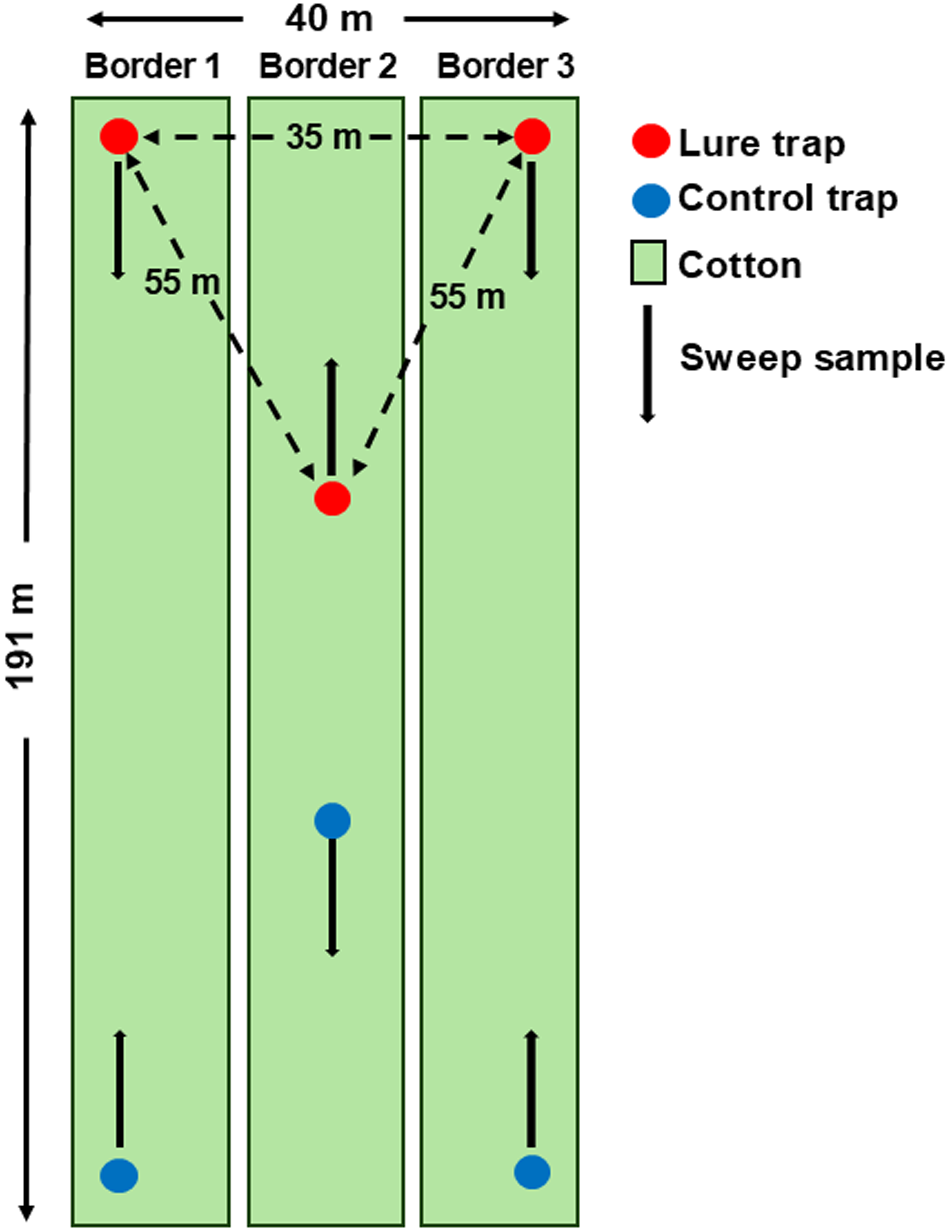
The cotton study was conducted using upland cotton (Gossypium hirsutum L.) at the University of Arizona Maricopa Agricultural Center in Maricopa, AZ (latitude 33°04′21.7″N, longitude 111°58′28.7″W). Cottonseed (NG3195 B3XF, Americot Inc., Lubbock, TX) was planted on 30 May 2024 using standard agronomic practices. Perimeter plantings of cotton, which were adjacent to three larger fields of cotton, were used to examine the attraction of L. hesperus to the pheromone lure. Two cotton fields were 0.76 ha in size, while the third was 0.70 ha. Cotton fields were separated by at least 0.5 km. Each cotton field included three adjacent perimeter plantings of cotton (Fig. 1). Each perimeter planting consisted of 12 cotton rows spaced 1.02 m apart. The three perimeter plantings, associated with a single field, were separated by 2.04 m of fallow soil. Two sets of perimeter plantings were 191 m long, while the third was 174-m long. Lygus hesperus was not managed in either the field or perimeter cotton.
A diagram of the plot plan and sampling areas in the three perimeter plantings (36 rows) of cotton, which were adjacent to each field of cotton. Note that one of the fields was 174 m in length.

Sticky traps
Two sticky trap designs were evaluated in this study. First, a red cylindrical trap was examined in both the strawberry and cotton studies (Fig. 2A, B). A similar cylindrical trap was used by Blackmer et al. (Reference Blackmer, Byers and Rodriguez-Saona2008) to collect L. hesperus in alfalfa. Red double-sided sticky cards (Pherocon SWD Adhesive Sticky Traps, Trécé Inc., OK), which were shown to effectively capture L. lineolaris when paired with a lure (George et al., Reference George, Reddy, Little, Arnold and Hall2023a), were used to construct each cylinder trap. Two 11.4 × 25.4 cm red sticky cards were stapled together lengthwise to form a cylinder so that both the outward- and inward-facing sides of the trap could capture L. hesperus. Second, a white three-sided sticky trap, originally used to validate the L. hesperus lure (Hall et al., Reference Hall, Serrano, Yokota, Nieto, Farman, McElfresh, Del Pozo-Valdivia, Millar and Daane2024), was also evaluated in the strawberry study (Fig. 2C). Specifically, Pherocon VI Delta sticky trap liners (19.1 × 36.8 cm) were used to create a modified or pseudo-delta trap that was similarly sticky on both outward- and inward-facing sides of the trap. In this case, four such liners (three facing outward and one facing inward) were used to construct each trap.
Sticky traps baited with the Lygus hesperus pheromone lure, including the red cylinder trap in strawberry (A), red cylinder trap in cotton (B), and white delta trap in strawberry (C). The inserted photo within each captioned image displays lure attachment within a sticky trap.

Both types of sticky traps were stapled to a wooden stake that was 4 cm wide and 2 cm thick. Stakes were 45 and 120 cm tall in the strawberry and cotton studies, respectively. For the strawberry study, the bottom of each trap was lowered so that it was flush with the raised bed to avoid being damaged by tractor-mounted vacuums. For cotton, each stake was hammered into the soil until the bottom of the trap was approximately 1 m above the soil.
Lygus pheromone lure
The number of L. hesperus males captured on traps with and without a pheromone lure was compared on both trap types. In the strawberry study, four trap treatments included baited and unbaited red cylinder traps and baited and unbaited white delta traps. The cotton study had two treatments consisting of baited and unbaited red cylinder sticky traps. Each baited sticky trap included a lure containing a pheromone blend of hexyl butyrate (HB) and (E)-4-oxo-2-hexenal (E4OH) at a ratio of 100:60, as described by Hall et al. (Reference Hall, Serrano, Yokota, Nieto, Farman, McElfresh, Del Pozo-Valdivia, Millar and Daane2024). The compounds were impregnated on a cigarette filter contained in a 1 mL polypropylene disposable pipette tip (Fisher Scientific, Loughborough, UK), which served to regulate the rate of pheromone emission from the distal opening (Hall et al., Reference Hall, Serrano, Yokota, Nieto, Farman, McElfresh, Del Pozo-Valdivia, Millar and Daane2024). The pipette tip was wrapped in duct tape to exclude sunlight. In strawberry, the lure was attached to the red trap by using a 11 × 3 cm section of removed sticky card so that the top of the lure was positioned in the centre of the sticky card (Fig. 2A). In cotton, the lure was attached to the wooden stake with 22-gauge electrical wire (Belden Inc., St. Louis, MO, USA) that hung inside the trap. The lure was positioned approximately 5 cm below the top of the trap (Fig. 2B). With respect to the white delta trap, the lure was attached to the sticky card using a 46 cm twist tie that wrapped around a hair sectioning clip (Section and Set, Conair LLC, Stamford, CT, USA) so that the lure was positioned halfway down the inside of the trap (Fig. 2C). Lures and sticky cards were replaced every 2 weeks, based on laboratory and field measurements of lure emission rates, which persisted for 2–3 weeks, as reported by Hall et al. (Reference Hall, Serrano, Yokota, Nieto, Farman, McElfresh, Del Pozo-Valdivia, Millar and Daane2024).
Placement of sticky traps
In strawberry, all four treatments were compared at each of the three ranches included in the study. At each ranch, traps were set up approximately 3 m from the field edge. Treatment positions were randomized during trap deployment every 2 weeks and spaced 40 m apart. Each treatment included three traps that were spaced 12 m apart.
In cotton, each of the three sets of perimeter plantings contained three baited traps and three unbaited traps (i.e. one trap of each type per planting). Each perimeter’s north and south ends contained one trap treatment. The direction of the trap treatments was randomized between plantings: baited traps were on the south end of two of the perimeters and on the north end of the other. The traps were further arranged among the three perimeters to maximize the distances between the traps, as shown in Fig. 1.
Sampling procedure
The strawberry study was conducted in three intervals: 14 May to 11 June, 16 July to 13 August, and 10 September to 8 October 2024, representing the spring, summer, and fall seasons, respectively. Lygus adults were collected 1 week after the traps were deployed by picking all the adults off the traps with a toothpick directly in the field. A week later, the same traps were resampled in a similar manner. The specimens were taken to the laboratory and positively identified by species (e.g. L. hesperus, L. lineolaris (Palisot de Beauvois), or L. elisus Van Duzee) and gender (Mueller et al., Reference Mueller, Summers and Goodell2003). This sampling method allowed us to compare trap effectiveness 1 and 2 weeks after the lures and traps were deployed. Each seasonal interval included two such 2-week deployments of traps and lures.
The cotton study was conducted continuously from 1 July to 26 August 2024. The collection of adults from the traps followed a similar sampling scheme as described above for strawberries. However, for the cotton study, data collection was divided into four 2-week intervals: 1 July to 15 July, 15 July to 29 July, 29 July to 12 August, and 12 August to 26 August. In each interval, fresh traps and lures were deployed on the first date listed above. The collection of Lygus species and the deployment of new traps and lures were identical to those in the strawberry study described above.
Also, the diversity, density, and gender of the Lygus species population inhabiting the cotton fields were estimated by sweep sampling (50 sweeps per sample) adjacent to each sticky trap location (Fig. 1), which coincided with the collection of trap samples. This sampling effort was done to determine if: (1) the lure’s presence created patchy distributions of Lygus that were concentrated around trap locations and (2) the Lygus adults captured on sticky traps reflected the community dynamics found in cotton. A similar comparison between the Lygus adults captured in sticky traps and collected in strawberry across four field seasons is reported in Hall et al. (Reference Hall, Serrano, Yokota, Nieto, Farman, McElfresh, Del Pozo-Valdivia, Millar and Daane2024).
Statistical analyses
For the strawberry study, none of the data sets (e.g. spring, summer, and fall) met the assumptions needed for a valid parametric analysis, as determined by Levene’s test of homogeneity of variances and the Shapiro–Wilk test of normality. As such, the non-parametric Mann–Whitney U-test was used to compare differences in the number of captured L. hesperus males in traps with and without a pheromone lure, as well as 1- and 2-week-old baited red cylinder traps. Note that similar pairwise comparisons between sample weeks were not warranted when using the other trap treatments, due to numerous zero or near zero counts. The non-parametric Kruskal–Wallis rank sum H-test was used to identify differences in male captures between the four trap types (e.g. unbaited and baited red cylinder traps and unbaited and baited white delta traps). Dunn’s multiple comparison test was used to distinguish post-hoc differences between the various trap treatments.
For the cotton study, neither trap count nor sweep sample data sets met the assumptions needed for a valid parametric analysis. The Mann–Whitney U-test was thus used to identify differences in male captures between (1) unbaited and baited red cylinder traps, (2) 1- and 2-week-old baited cylinder traps and (3) sweep samples taken in cotton adjacent to the unbaited and baited red cylinder traps. The results (here and below) are expressed by the mean ± standard error (SEM) of the number of L. hesperus males collected 1 and 2 weeks after the deployment of the trap treatments. The Mann–Whitney U-test was performed using Intellectus (Intellectus Statistics, LLC, Palm Harbor, FL). All other analyses were conducted using JMP 16.2 (SAS Institute, Inc., Cary, NC).
Results
Strawberry
All 397 Lygus sp. males that were captured on a sticky trap over the course of the study in strawberries were L. hesperus. Only six female Lygus sp. were collected: two on baited white delta traps and four on unbaited red cylinder traps. Field location significantly influenced L. hesperus male captures on sticky traps (χ 2 = 10.97, df = 2, P = 0.004). Specifically, more males were captured per week from ranches ‘A’ and ‘B’ (1.33 ± 0.29 and 1.13 ± 0.24, respectively) than from ranch ‘C,’ whose traps captured 0.32 (± 0.07) males.
The presence of the pheromone lure had a strong effect on L. hesperus male captures in strawberries. Baited traps captured more males compared with unbaited traps in the spring (U = 1320, z = −6.62, P < 0.001), summer (U = 1128, z = −7.08, P < 0.001), and fall (U = 1856, z = −4.53, P < 0.001). Respectively, mean ranks for baited and unbaited traps were 90.17 and 54.83 in the spring, 92.83 and 52.17 in the summer, and 82.72 and 62.28 in the fall. Overall, baited traps captured 1.80 ± 0.24 males per week, while unbaited traps captured 0.04 ± 0.02 males per week.
Trap type also contributed to the capture of L. hesperus males. Across all three seasons, red cylinder traps captured more males than white delta traps (U = 19135, z = 4.27, P < 0.0001). Mean ranks for red cylinder traps and white delta traps were 235.91 and 197.09, respectively. Overall, cylinder traps captured 1.54 ± 0.24 males per week, while delta traps captured 0.30 ± 0.05 males per week. More specifically, baited red cylinder traps also captured more males relative to baited white delta traps across all three seasons (U = 3378, z = 5.82, P < 0.0001). During spring, summer, and fall, baited red cylinder traps captured 3.07 ± 0.44 males per week and baited white delta traps captured 0.54 ± 0.10 males per week.
During the spring season, there were significant differences in the number of males captured between the four trap types after 1 week in the field (H (3) = 33.64, P < 0.001). The baited red cylinder trap captured significantly more (P < 0.001) males than either the unbaited red cylinder trap or the unbaited white delta trap (Fig. 3A). However, there was not a significant difference (P < 0.090) between the baited red cylinder and baited white delta traps. There was a similar pattern of efficacy between the trap types after 2 weeks of field exposure (H (3) = 20.43, P < 0.001). Again, the baited red cylinder trap captured significantly more (P < 0.001) males than either unbaited trap type, and there was no significant difference (P < 0.37) between the two baited trap types. The number of males captured using the baited red cylinder traps after 1 and 2 weeks of field exposure was not significantly different (U = 211, z = 1.59, P = 0.115). The 1- and 2-week-old traps captured 4.22 (± 1.35) and 1.78 (± 0.69) males, respectively (Fig. 3A). The mean ranks for 1- and 2-week-old baited red traps were 21.22 and 15.78, respectively.
Mean (± SEM) number of male Lygus hesperus adults captured on four trap types during the (A) spring, (B) summer, and (C) fall strawberry growing seasons. Each graph’s left and right plots depict the number of captured males on 1- and 2-week-old traps, respectively. The letters above the error bars indicate significant differences as determined by the Dunn’s multiple comparison test (P = 0.05, n = 18 traps). The numbers below the x-axis show the mean rank for each trap type as determined by the Kruskal-Wallis rank sum test.

There were also significant differences in trap captures in the summer for the 1-week-old traps (H (3) = 52.00, P < 0.001). The baited red cylindrical traps captured significantly more (P < 0.0001) males after 1 week of field deployment than all the other trap types (Fig. 3B). There was a similar pattern of efficacy among the 2-week-old trap types (H (3) = 33.39, P < 0.001); i.e. the baited red cylindrical trap captured significantly more (P < 0.001) males than the other trap types (Fig. 3B). When trap captures during the summer were tested among the baited red cylindrical traps after 1 and 2 weeks, the 1-week-old traps captured significantly more males (U = 250, z = −2.82, P = 0.005) (Fig. 3B). The mean ranks for 1- and 2-week-old red lure traps were 23.39 and 13.61, respectively.
During the fall season, there were significant differences in trap captures between 1-week-old trap types (H (3) = 13.32, P < 0.004: Fig. 3C). The baited red cylindrical traps captured significantly more males than the unbaited red (P < 0.008) and unbaited white delta (P < 0.027) traps, but not more (P < 1.0) than the baited white delta traps (Fig. 3C). While the number of captured males was low for all 2-week-old trap types, there was nonetheless a significant difference in male capture rates (H (3) = 10.40, P < 0.015). Again, the baited red cylindrical traps collected more males than all other trap types. However, the only statistically significant difference (P < 0.022) was between the baited red cylindrical and unbaited white delta traps (Fig. 3C). The number of captured males between the 1- and 2-week-old red baited traps were not significant (U = 186, z = −0.88, P = 0.377). The mean ranks for 1- and 2-week-old red lure traps were 19.83 and 17.17, respectively.
Cotton
During this study period, mean and maximum daily temperatures averaged 34.0°C and 41.3°C, respectively, with a mean relative humidity of 31.6% and total precipitation of 8.4 cm (AZMET, 2025). The overall Lygus spp. census in cotton (i.e. combining all study intervals and including males and females) yielded a mean density of 3.94 ± 0.29 (n = 144) adults collected per sweep net sample. Of the 574 adults collected, 99% were L. hesperus (four L. lineolaris and two L. elisus were also collected). The average number of adult male and female L. hesperus collected per sample was 2.42 ± 0.20 and 1.52 ± 0.14, respectively, thus yielding a male-to-female sex ratio of 1.6 to 1.0. The L. hesperus census data yielded by the sweep samples showed an even distribution (e.g. ca. one to four specimens per sample) of adult males in the cotton fields during all study intervals. There were no significant differences in L. hesperus density based on the sweep samples’ proximity to the baited or unbaited trap locations (Fig. 4).
Mean (± SEM) number of male Lygus hesperus adults captured per 50-sweep sample near the unbaited and baited red cylinder traps during (A) interval I, (B) interval II, (C) interval III, and (D) interval IV of the cotton growing season. Each graph’s left and right plots depict the mean number of males captured near 1- and 2-week-old traps, respectively. The P-values yielded for each paired comparison test are above the bars (n = 9 sweep samples taken per treatment). The numbers below the x-axis show the mean rank for each trap type as determined by the Mann–Whitney rank sum test.

Overall (i.e. combining all study intervals and including all the males and females), the baited and unbaited red cylinder sticky traps captured an average of 6.3 ± 0.68 (n = 144) adult Lygus spp. per trap. Of the 912 captured Lygus spp., all but two specimens (one L. lineolaris and one L. elisus) were L. hesperus. The average number of adult L. hesperus males and Lygus sp. females captured per unbaited sticky trap was 3.76 ± 0.77 and 0.71 ± 0.11, respectively, thus yielding a male-to-female sex ratio of 5.3 to 1.0. In baited traps, an average of 7.43 ± 0.97 L. hesperus males and 0.76 ± 0.13 Lygus sp. females were captured, producing a sex ratio of 9.7 to 1.0.
The presence of the pheromone lure significantly increased L. hesperus male captures on 1-week-old red cylindrical sticky cards during the first three intervals of the study (Fig. 5). Across all four intervals, baited traps captured 2.6 times more males than unbaited traps after 1 week of field exposure. However, trap age had a dramatic effect on the effectiveness of the baited traps, as the differences in captured males between baited and unbaited traps were not significant during the second week of each study interval (Fig. 5).
Mean (± SEM) number of male Lygus hesperus adults captured on unbaited and baited red cylindrical traps during (A) interval I, (B) interval II, (C) interval III, and (D) interval IV of the cotton growing season. Each graph’s left and right plots depict the mean number of males captured after 1 and 2 weeks of field exposure (n = 9 sticky traps per treatment). The numbers below the x-axis show the mean rank for each trap type as determined by the Mann–Whitney rank sum test.

Discussion
Sticky traps baited with the pheromone lure generally captured more L. hesperus males than unbaited traps in coastal strawberry, supporting the findings of Hall et al. (Reference Hall, Serrano, Yokota, Nieto, Farman, McElfresh, Del Pozo-Valdivia, Millar and Daane2024). In the comparatively harsh conditions of the Arizona desert, baited sticky traps were also effective at capturing males, albeit only during their first week of deployment in the field. Baited sticky traps also captured more males than either sweep net samples taken from cotton or vacuum samples taken from strawberry (Hall et al., Reference Hall, Serrano, Yokota, Nieto, Farman, McElfresh, Del Pozo-Valdivia, Millar and Daane2024). Given the varied climates and agroecosystems found throughout this pest’s host range in western North America, it is encouraging that this lure has been shown to attract L. hesperus across such contrasting production systems.
While L. hesperus was attracted to baited traps, the temporal steadfastness of male captures during the 2-week sample period was inconsistent. In strawberry, the number of captured males from baited cylinder traps remained statistically similar through the second week of field exposure in two out of three seasons. Nonetheless, male captures from 2-week-old traps across all three seasons were on average 64% lower compared to captures from 1-week-old traps. Furthermore, in cotton, trap captures were heavily skewed in favour of the lure’s first week of field deployment, during which time 91% of L. hesperus males were captured.
The general decrease in captured males over time reported in this study is not in agreement with findings from prior Lygus spp. monitoring studies. The pipette tip dispenser used here helps maintain the intended ratio of a pheromone blend and regulates (i.e. prolongs) the consistent emission of these compounds for at least one month under laboratory conditions (Fountain et al., Reference Fountain, Jåstad, Hall, Douglas, Farman and Cross2014). As a result, the continued capture of Lygus spp. males on traps baited with this dispenser in the field has previously persisted during its second week of deployment (Fountain et al., Reference Fountain, Jåstad, Hall, Douglas, Farman and Cross2014; Hall et al., Reference Hall, Serrano, Yokota, Nieto, Farman, McElfresh, Del Pozo-Valdivia, Millar and Daane2024). George et al. (Reference George, Glover, Reddy, Johnson and Hall2023b) observed consistent capture rates of L. lineolaris for 3 weeks (using the same dispenser) when red sticky cards were replaced weekly.
In Arizona, high maximum daily temperatures, which ranged from 33.6°C to 46.7°C during this study, may have accelerated the dispenser’s emission rate and/or increased the degradation rate of the lure constituents, consequently shortening the longevity of this lure. The diminished temporal capture rate of L. hesperus could alternatively be attributed to the sticky card’s adhesive being compromised during a second week of exposure to field conditions (i.e. the glue being obstructed by dust, leaves, etc.). Windy conditions were common in the strawberry and cotton fields and likely exacerbated this effect. A follow-up study that distinguishes trap captures per day (rather than per week) and accounts for aging lures and adhesive under various environmental conditions would better describe the temporal efficacy of these baited traps.
In strawberry, red cylinder traps captured significantly more males compared to white pseudo delta traps. In Mississippi cotton, this (baited) red sticky trap captured the most L. lineolaris when comparing four types of sticky traps (George et al., Reference George, Reddy, Little, Arnold and Hall2023a). The modest number of L. hesperus males captured from baited white delta traps in this study is consistent with findings reported by Hall et al. (Reference Hall, Serrano, Yokota, Nieto, Farman, McElfresh, Del Pozo-Valdivia, Millar and Daane2024) and suggests that this trap type is not optimal for monitoring L. hesperus. Specifically, multi-ranch studies using baited delta traps conducted during May and June yielded mean weekly L. hesperus capture rates of 0.69 (±0.19) males in 2024, 0.64 (±0.27) males in 2023, and 1.14 (±0.32) males in 2020.
The extent to which trap colour influenced this result is difficult to distinguish, given that neither adhesive nor trap shape were standardized. When trap design has been standardized in previous field studies to assess colour independently, L. hesperus preferred alternative colours to red sticky traps (Blackmer et al., Reference Blackmer, Byers and Rodriguez-Saona2008) and red pan traps (Landis and Fox, Reference Landis and Fox1972). In strawberry, only one L. hesperus male was captured on unbaited red sticky traps over the course of the study, which was not significantly different from male captures on unbaited white sticky traps. Additional research comparing L. hesperus preference among different colour hues (e.g. spectroscopy) is warranted once other elements of trap design are optimized.
Another critical element of trap design is the type of adhesive used, which can influence the types of insects captured (Lo et al., Reference Lo, Wallis and Bellamy2019). The red and white sticky traps used in this study were coated with hot-melt and cold-melt glues, respectively. Hot melt glues appear to more effectively retain L. hesperus after capture, as Lygus spp. have been observed walking across a cold melt glue card and thus freeing itself from capture (Fountain et al. Reference Fountain, Baroffio, Borg-Karlson, Brain, Cross, Farman, Hall, Ralle, Rendina, Richoz and Sigsgaard2017, personal observation, DJN).
A trap’s shape can also influence the likelihood of insect capture (Mainali and Lim, Reference Mainali and Lim2010). Unfortunately, the use of different adhesives on cylindrical and delta traps used in the present study precludes direct comparisons of trap shape. Nonetheless, if red sticky cards were to be used to monitor L. hesperus, prior work indicates that a cylinder-shaped trap may be more effective at capturing target insects than a two-dimensional or ‘flat’ rectangular trap (Byrne et al., Reference Byrne, Von Bretzel and Hoffman1986). Specifically, L. hesperus were more successfully captured using a cylindrical trap relative to a flat trap when other elements of trap design were standardized (unpublished data, JRH).
In summary, we compared the ability of the pheromone lure and two different sticky traps to capture L. hesperus. Baited sticky traps generally captured more males compared to unbaited traps, particularly during the first week of field deployment. Using the red cylindrical sticky trap improved L. hesperus trap captures relative to the previously used white delta sticky trap and further illustrated L. hesperus’s attraction to this pheromone lure under different cropping and weather conditions. The diminished number of L. hesperus captured during the second week of monitoring, particularly in cotton, suggests that additional refinements to both trap and lure design may extend trap longevity and further improve L. hesperus’s attraction to pheromone-baited traps.
Acknowledgements
The authors are thankful for the assistance provided by Alberto Parra and Juan Alonso Salas in executing field trials. Jocelyn Millar reviewed this manuscript and provided insightful feedback. We also thank collaborating strawberry growers for hosting these trials. Mention of trade names or commercial products in this publication is solely to provide specific information and does not imply recommendation or endorsement by the United States Department of Agriculture. USDA is an equal opportunity provider and employer.
Author contributions
Diego Nieto – conceptualization, methodology, data collection and curation, writing – original draft, review and editing; James Hagler – conceptualization, methodology, statistical analysis, writing, review and editing; Scott Machtley – data collection and curation, review and editing; Gabriel Zilnik – data collection and curation, statistical analysis, writing, review and editing; David Hall – conceptualization, review and editing.
Competing interests
None.