Mind–mindedness (Meins, Reference Meins1997) indexes the extent to which caregivers are able to take the intentional stance and interpret infants’ behavior in terms of their underlying internal states. Mind–mindedness is assessed in the first year of life on the basis of the caregiver commenting appropriately on (i.e., appropriate mind-related comments) versus misinterpreting (i.e., nonattuned mind-related comments) the infant's internal states (Meins et al., Reference Meins, Fernyhough, de Rosnay, Arnott, Leekam and Turner2012; Meins, Fernyhough, Fradley, & Tuckey, Reference Meins, Fernyhough, Fradley and Tuckey2001). Longitudinal studies show mind–mindedness is a positive predictor of core aspects of children's development. Caregivers’ appropriate mind-related comments in the first year of life predict secure attachment (Lundy, Reference Lundy2003; Meins et al., Reference Meins, Fernyhough, Fradley and Tuckey2001, Reference Meins, Fernyhough, de Rosnay, Arnott, Leekam and Turner2012), superior executive function (Bernier, Carlson, & Whipple, Reference Bernier, Carlson and Whipple2010), theory of mind (Laranjo, Bernier, Meins, & Carlson, Reference Laranjo, Bernier, Meins and Carlson2010, Reference Laranjo, Bernier, Meins and Carlson2014; Meins et al., Reference Meins, Fernyhough, de Rosnay, Arnott, Leekam and Turner2012; Meins, Fenough, Arnott, Leekam, & de Rosnay, Reference Meins, Fernyhough, Arnott, Leekam and de Rosnay2013), and emotion understanding (Centifanti, Meins, & Fernyhough, Reference Centifanti, Meins and Fernyhough2016), and fewer behavioral difficulties in children from low socioeconomic status backgrounds (Meins, Centifanti, Fernyhough, & Fishburn, Reference Meins, Centifanti, Fernyhough and Fishburn2013). In contrast, caregivers’ nonattuned mind-related comments are negatively related to children's early language acquisition and symbolic play (Meins, Fernyhough, et al., Reference Meins, Fernyhough, Arnott, Leekam and de Rosnay2013).
Although all of these studies have demonstrated considerable individual differences in caregiver mind–mindedness, previous research has so far shed little light on why some caregivers are more mind-minded than others. Mind–mindedness is unrelated to maternal characteristics such as socioeconomic status (Meins et al., Reference Meins, Fernyhough, Arnott, Turner and Leekam2011), and to infant characteristics such as general cognitive ability (Meins et al., Reference Meins, Fernyhough, Fradley and Tuckey2001) and temperament (Meins et al., Reference Meins, Fernyhough, Arnott, Turner and Leekam2011). Meins, Fernyhough, and Harris-Waller (Reference Meins, Fernyhough and Harris-Waller2014) thus argued that mind–mindedness is a quality of relationships rather than being driven by the characteristics of the individual caregiver or child.
The initial aim of the present study was to investigate how severe maternal mental health difficulties relate to mind–mindedness. Only one study has addressed this question. Pawlby et al. (Reference Pawlby, Fernyhough, Meins, Pariante, Seneviratne and Bentall2010) sought to investigate how different types of severe mental illness (SMI) related to mind–mindedness in a sample of hospitalized mothers. No differences in mind–mindedness were found among the different diagnostic groups (depression, schizophrenia, or mania). Moreover, no statistically significant differences emerged for comparisons between each of the diagnostic groups and psychologically well controls, although there was a trend for depressed mothers to be less likely to comment appropriately on their infants’ internal states on admission.
However, Pawlby et al. (2010) were concerned only with differences in mind–mindedness among the separate diagnostic groups and did not compare mothers with SMI as a group against psychologically well mothers. Consequently, we do not know whether SMI in general relates to lower levels of mind–mindedness. The aim of Study 1 was thus to reanalyze Pawlby et al.’s data. We also collected mind–mindedness data from a new group of mothers hospitalized for SMI in Study 2. We hypothesized that mind–mindedness would be lower in mothers with SMI than in psychologically well mothers because the social withdrawal, impaired concentration, low mood, and fatigue associated with mood and anxiety disorders and the theory of mind deficits associated with psychotic illness (Brüne, Reference Brüne2005) are likely to impede mothers’ attunement to their infants’ internal states.
Our second aim was to design an intervention to facilitate mind–mindedness in mothers hospitalized for SMI and, in a preliminary fashion, evaluate its efficacy in terms of both increasing mind–mindedness (Study 2) and improving the quality of the infant–mother attachment relationship (Study 3). We chose to deliver the intervention using video-feedback, whereby the mother views a video of herself interacting with her infant and is provided with structured feedback on her caregiving from a trained researcher or clinician. Video-feedback interventions generally take two approaches, either individually or in combination, with the aim to (a) increase behavioral parental sensitivity (e.g., Juffer, Bakermans-Kranenburg, & van IJzendoorn, Reference Juffer, Bakermans-Kranenburg and van IJzendoorn2008), or (b) change parents’ negative or distorted internal representations of their children (e.g., Schechter et al., Reference Schechter, Myers, Brunelli, Coates, Zeanah, Davies and Leibowitz2006). Fukkink's (Reference Fukkink2008) meta-analysis showed that both approaches are equally effective in improving parental sensitivity and increasing positive perceptions of parenting, often within a period of a few months.
The procedure developed by Juffer et al. (Reference Juffer, Bakermans-Kranenburg and van IJzendoorn2008) is the form of video-feedback that has been used most widely. Caregivers are filmed interacting with their infants in various standardized everyday activities (e.g., bathing) during four home visits, spaced 3 to 4 weeks apart. The intervention is delivered during the last three sessions using preselected clips from the interaction filmed on the previous home visit. The video-feedback for each of the intervention sessions is focused on a specific theme (e.g., the infant's contact-seeking and exploratory behavior), with instances of sensitive caregiving being highlighted for and discussed with the mother. The video-feedback procedure can also be combined with discussion of mothers’ own attachment experiences and their potential influence on parenting. Both forms of this procedure have proved effective in facilitating maternal sensitivity (Bakermans-Kranenburg, Juffer, & van IJzendoorn, Reference Bakermans-Kranenburg, Juffer and van IJzendoorn1998; Kalinauskiene et al., Reference Kalinauskiene, Cekuoliene, van IJzendoorn, Bakermans-Kranenburg, Juffer and Kusakovskaja2009; Velderman, Bakermans-Kranenburg, Juffer, & van IJzendoorn, Reference Velderman, Bakermans-Kranenburg, Juffer and van IJzendoorn2006).
In designing the mind–mindedness intervention, we focused solely on the mother's interpretation of the infant's experience, rather than encouraging mothers to reflect on their own attachment representations or their behavior and feelings toward their infants. We reasoned that such reflections might overwhelm the attentional and emotional capacities of mothers who are currently experiencing an episode of SMI while endeavoring to care for a young infant. Moreover, encouraging a mother to think about her own attachment experiences or caregiving behaviors may have the unintended consequence of diverting her attention from her infant and decreasing her self-confidence.
It was important to test the efficacy of the intervention when health professionals who typically work with mothers with SMI delivered it under normal working practices. In the United Kingdom, women suffering from SMI in the first year postpartum can be admitted to a specialized residential mother-and-baby unit (MBU) with their infants. There are only 17 MBUs with a total of 125 beds to serve the entire population of the United Kingdom, so women with SMI admitted to these units are those who are most critically ill and in need. Working with this population of mothers thus provides a unique insight into the caregiver–child relationship in the context of extreme maternal mental illness. The MBU provides the mothers with inpatient treatment and supports them in caring for their infants. Mothers were filmed interacting with their infants shortly after admission to the MBU; these interactions were then used to administer the mind–mindedness intervention.
The intervention involved a single session of individual video-feedback, delivered by a psychologist working on the MBU. The psychologist selected three relevant moments from the admission interaction that would be the focus of the video-feedback session. The intervention feedback focused on increasing appropriate mind-related comments by directing mothers’ attention to what their infants might be thinking, feeling, wanting, or experiencing in the three particular moments in the interaction. The intervention feedback also sought to lower the number of nonattuned mind-related comments: the psychologist offered an alternative perspective on the infant's internal states if she believed the mother had misinterpreted them.
Mothers’ mind–mindedness was assessed from the footage filmed on admission to hospital (preintervention), and mothers were filmed interacting with their infants on discharge to assess mind–mindedness postintervention. We expected the intervention to facilitate mothers’ mind–mindedness and result in an increase in appropriate mind-related comments and a decrease in nonattuned mind-related comments from admission to discharge.
In order to establish whether the intervention had a positive impact on infant–mother interaction postdischarge, Study 3 followed up dyads in the second year of life to assess the security of the infant–mother attachment relationship. Attachment is usually assessed in infants aged 1 to 2 years using the Strange Situation Procedure, which assigns infants to one of four categories: secure, insecure–avoidant, insecure–resistant, and insecure–disorganized (Ainsworth, Blehar, Waters, & Wall, Reference Ainsworth, Blehar, Waters and Wall1978; Main & Solomon, Reference Main, Solomon, Brazelton and Yogman1986, Reference Main, Solomon, Greenberg, Cicchetti and Cummings1990). Study 3 also included a second group of mothers who had been hospitalized for SMI on the same MBU but had not received the intervention and thus acted as a comparison group. If the intervention had a sustained positive impact on the infant–mother relationship, higher rates of secure attachment would be observed in the intervention group compared with the comparison group.
In summary, we aimed to investigate whether mothers with SMI showed lower levels of mind–mindedness than psychologically well mothers (Studies 1 and 2), and to test the feasibility and effectiveness of a video-feedback intervention to increase mind–mindedness (Study 2). In Study 3, we aimed to investigate whether participating in the intervention was related to higher levels of secure attachment compared with a comparison group of mothers who had previously been hospitalized for SMI.
Study 1: Reanalysis of Pawlby et al.’s Data
Participants
The participants were 99 infants and their mothers. In 49 dyads (53% boys; 56% first-born), mothers were psychologically well; in the remaining 50 dyads (60% boys; 42% first-born), the mother had been hospitalized for SMI. Psychologically well controls were drawn from a sample recruited via local health care professionals onto a separate longitudinal study. Exclusion criteria for mothers included current treatment for a psychiatric condition or a history of mental illness. All control mothers were White, and these dyads were observed on a single occasion when infants were aged 12 weeks.
The mothers with SMI were resident on a 13-bedded, publicly funded MBU, which provides inpatient treatment for mothers experiencing SMI in the first year postpartum and supports them in caring for their infants. Mothers are admitted on an informal (voluntary) basis, or by sectioning under the Mental Health Act (2007). DSM-IV diagnoses were given retrospectively to each mother by a consultant perinatal psychiatrist, based on International Classification of Diseases (10th edition) diagnoses and details from the discharge summaries. Mothers’ diagnoses were schizophrenia (n = 15), depressive mood disorders with or without psychosis (n = 23), and mood disorders where mania was the predominant feature, with or without psychosis (n = 12). Of participating MBU women, 50% were White, 34% were Black/Black British, 16% Asian/Asian British, and 2% Latin American. Mean infant age at the admission observation was 10.6 weeks (SD = 8.8, range = 2–39, and 19.1 weeks, SD = 9.8, range = 5–45) at the discharge observation. Mean length of admission was 13.2 weeks (SD = 7.7, range = 1–33). The MBU dyads were observed on two occasions (within a week of admission when they were unwell and shortly before discharge). These mothers were admitted to the MBU between April 2000 and July 2002.
Mothers are discharged from the unit when psychiatric assessments and clinicians involved in their care have confirmed mothers are not a risk to their infants and are well enough to return home under the care of a community psychiatric team. In rare cases, mothers who do not recover sufficiently to care for their infants safely are discharged to their homes independently, while their infants are placed in alternative care (foster care or with relatives).
Full ethical approval was obtained, and mothers gave informed consent for their observations to be used for research. Mothers with SMI were informed that they could withdraw from the study at any time without implications for their treatment. All procedures were conducted in accordance with British Psychological Society and American Psychological Association ethical guidelines.
Materials and methods
MBU mothers
In the first week after admission to the unit, or as soon as they were well enough to give informed consent, mothers were filmed for 5 min while engaging in unstructured play with their infants. Infants were seated in a baby seat with their mothers facing them, and a mirror was angled so that the camera simultaneously captured both mother and infant faces. Mothers were instructed to play and talk with their infants as they normally would. Prior to discharge from the unit, mothers and infants were again filmed in a session of face-to-face interaction identical to the admission session.
Psychologically well mothers
The 49 mothers who were psychologically well were observed once using the exact same procedure described above. However, for this group, split screen recording was used instead of a mirror in order to see both mother and infant faces.
Mind–mindedness
The admission and discharge observations for the MBU dyads and the single observation for the psychologically well mothers and their infants were transcribed verbatim into distinct comments. All comments that contained an internal state term referring to the infant or where the mother spoke on the infant's behalf (mind-related comments) were identified. The coder watched the entire observation in conjunction with the transcript and coded each mind-related comment dichotomously as appropriate or nonattuned. Each mind-related comment was then classified as appropriate or nonattuned.
A comment was appropriate if (a) the coder agreed with the mother's interpretation of the infant's internal state, (b) the comment linked the infant's current internal state with past or future experiences, (c) the comment attempted to clarify how the infant wanted to proceed after a lull in the interaction, or (d) the mother voiced what the infant might say if she/he could speak.
Mind-related comments were classified as nonattuned if (a) the coder disagreed with the mother's interpretation of the infant's internal state, (b) the comment referred to the infant's thoughts or feelings about a past or future event unrelated to his/her current activity, (c) the mother suggested the infant wanted to become involved in a new activity when she/he was already engaged in something else, (d) the comment appeared to be a projection of the mother's own internal state onto the infant, or (e) the referent of the comment was not clear. Scores for both appropriate and nonattuned comments were calculated as a proportion of the total number of maternal comments made during the interaction.
The interactions were coded by two raters who were blind to all measures and the study's hypotheses, as well as being unaware that some mothers had a diagnosed mental illness. A randomly selected 20% of observations were coded by both raters to establish agreement. For coding comments into the dichotomous appropriate versus nonattuned categories κ = 0.80, which represents “substantial” (Landis & Koch, Reference Landis and Koch1977) or “strong” (McHugh, Reference McHugh2012) agreement.
Study 1 results
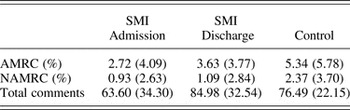
Table 1 shows the mind–mindedness data for the MBU and psychologically well mothers. MBU mothers had lower scores for appropriate mind-related comments on admission compared with psychologically well mothers, t (97) = 2.57, p = .012, d = 0.53, with this difference at trend level at discharge, t (97) = 1.72, p = .088, d = 0.36. MBU mothers also had lower scores for nonattuned mind-related comments on admission compared with psychologically well mothers, t (97) = 2.21, p = .030, d = 0.45, with this difference at trend level at discharge, t (97) = 1.91, p = .059, d = 0.39.
Maternal mind-mindedness data for mothers with severe mental illness (SMI) and psychologically well controls

Note: AMRC, Appropriate mind-related comments; NAMRC, nonattuned mind-related comments.
Change in the mind–mindedness indices in the MBU mothers from admission to discharge was investigated using repeated measures analysis of variance (ANOVA). There was no change over time for appropriate mind-related comments, F (1, 48) = 1.82, p = .184, η2 = 0.048, or nonattuned mind-related comments, F (1, 48) = 0.07, p = .788, η2 = 0.002.
Study 1 discussion
The reanalysis of Pawlby et al.’s (2010) data showed the expected lower levels of appropriate mind-related comments in mothers with SMI compared with psychologically well controls. This difference was significant when mothers were admitted to the MBU and approached significance when mothers had recovered sufficiently to be discharged. In contrast, the pattern of findings for nonattuned mind-related comments was contrary to expectations: mothers with SMI made fewer nonattuned mind-related comments compared with their psychologically well counterparts on admission and (at trend level) at discharge. No change was seen in either appropriate or nonattuned mind-related comments between admission and discharge.
These results show that this sample of women with SMI tended not to comment on their infants’ internal states and that, despite improving their mental health, the period of hospitalization did not lead to an increase in their attunement to their infants’ internal states. These findings thus suggest that intervening to facilitate mind–mindedness in mothers hospitalized for SMI might be beneficial. The aim of Study 2 was thus (a) to attempt to replicate the results on mind–mindedness in mothers with SMI and (b) to design and evaluate a mind–mindedness intervention that could be delivered to women on the MBU in order to increase their mind–mindedness.
Study 2
Participants
Participants were mothers who had experienced an episode of SMI following childbirth and had been admitted to the MBU with their infants. The MBU in Study 2 was the same unit via which mothers were recruited onto Pawlby et al.’s (Reference Pawlby, Fernyhough, Meins, Pariante, Seneviratne and Bentall2010) study, reported in Study 1. In total, 36 women participated in the mind–mindedness intervention, but 10 were discharged from the unit before outcome interactions could be filmed, and 4 women spoke to their infants in languages for which there was no readily available translation. There were therefore data from 22 women who had completed the intervention. Mothers were admitted to the MBU between February 2013 and March 2014. Data from the 49 psychologically well mothers who had participated in Study 1 were used for comparison.
Women in the intervention group were ethnically, culturally, and socioeconomically diverse, reflecting the population the MBU served: 59% of mothers were White. Mean maternal age was 33 years (range = 23–40, SD = 5.10), 23% were single, 55% of infants were girls, 59% were first-born, and mean infant age at Time 1 was 13 weeks (SD = 8.2, range = 3–33 weeks). Women's diagnoses were as follows: major depressive disorder (n = 14), obsessive compulsive disorder (n = 3), bipolar affective disorder (n = 2), general anxiety disorder (n = 1), schizoaffective disorder (n = 1), and postpartum psychosis (n = 1). Admission to the MBU was voluntary for 17 of the women. Women were resident on the MBU for 11.4 weeks (SD = 4.67, range = 6–25 weeks).
Ethical approval for the use of the filmed interactions for research purposes was obtained from the NRES Committee London–Camberwell St. Giles (REC No. 08/H0807/14), and all procedures were carried out in accordance with British Psychological Society and American Psychological Association ethical guidelines. All mothers who were judged by staff to be well enough were invited to participate in the video-feedback session but could decline the invitation. Prior to being filmed, all mothers gave verbal consent to participate in video-feedback and provided informed written consent for the recordings of their interactions to be used for research purposes. Participants were aware they could request termination of recording or data to be destroyed. They were also informed that participation in or withdrawal from the video-feedback session would not impact on their treatment. Ethical approval for including control participants was gained from the relevant university ethics committees, and control participants gave informed consent for participation when they attended the testing session.
Materials and methods
In the first week after admission to the unit, or as soon as they were well enough to give informed consent, mothers were filmed for 3 min while engaging in unstructured play with their infants. Infants were seated in a baby seat with their mothers facing them, and a mirror was angled so that the camera simultaneously captured both mother and infant faces. Mothers were instructed to play and talk with their infants as they normally would. At a later date during the admission period, mothers were invited to review their admission video with the developmental psychologist on the unit. The video-feedback reviews generally lasted about 20 min for each mother.
The psychologist was trained in identifying and coding mind-related comments (see below); thus, she selected appropriate moments from the video observation that were most useful to draw attention to in the mind–mindedness intervention. The psychologist viewed the admission observation in advance of the intervention session and selected three moments that would be the focus of the feedback session. These moments were points at which (a) the infant shifted his/her attention or focus of interest, (b) there was a state change (e.g., from smiling to crying), (c) the mother made a mind-related comment (appropriate or nonattuned), or (d) the psychologist felt there was a “missed” opportunity for the mother to comment on the infant's internal state.
In the intervention session, the psychologist paused the film at each of the three moments and asked the mother to think about the infant's desires, cognitions, emotions, or epistemic states. The psychologist used a scripted protocol during the intervention. All mothers were asked: “What is your baby thinking here?” and “What do you think your baby would be saying to you right now if she/he could talk?” Mothers were also asked additional questions that were tailored to the content of the particular interaction (e.g., “Is he interested in the song you're singing?” and “What do you think his crying means about how he's feeling?”). If the psychologist disagreed with the mother's interpretation of the infant's internal state, this was discussed further; she offered her own ideas about the infant's thoughts and feelings and tried to arrive at a shared agreement with the mother. After all three moments had been discussed, the psychologist asked each mother to talk about a time outside the filmed interaction when she felt she had “tuned in” to what her infant was thinking or feeling, and a time when she felt she had misread her infant's thoughts or feelings. Mothers were encouraged to practice what they had learned during the session: taking the infant's perspective and talking to their infants about their thoughts or feelings. Prior to discharge from the unit, mothers and infants were again filmed in a session of face-to-face interaction identical to the admission session.
Measures
Mind–mindedness
The admission (preintervention) and discharge (postintervention) interactions were transcribed verbatim and coded for mind–mindedness using procedures outlined by Meins and Fernyhough (Reference Meins and Fernyhough2015). As described above in Study 1, maternal comments that contained an internal state term that referred to the infant's thoughts, experiences, or feelings, or where the caregiver spoke on the infant's behalf (mind-related comments) were identified. Each mind-related comment was then classified as appropriate or nonattuned.
The interactions were coded by a rater who was blind to whether the observations were on admission or discharge, with a second blind rater coding a randomly selected 20% of observations; interrater reliability was κ = 0.82, representing “almost perfect” (Landis & Koch, Reference Landis and Koch1977) or “strong” (McHugh, Reference McHugh2012) agreement.
Study 2 results
Descriptive statistics and preliminary analyses
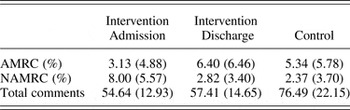
Mind–mindedness scores for the intervention group on admission and discharge are shown in Table 2. Scores for the psychologically well control group are also shown in Table 2.
Mean (standard deviation) mind-mindedness scores for the intervention and control groups

Note: AMRC, Appropriate mind-related comments; NAMRC, nonattuned mind-related comments.
Change in mind–mindedness over time in the intervention group
Changes in appropriate mind-related comments in intervention group mothers from admission to discharge were investigated using a repeated measures ANOVA. There was a marginally significant increase in appropriate mind-related comments, F (1, 21) = 3.95, p = .06, η2 = 0.188.
Changes in nonattuned mind-related comments in intervention group mothers from admission to discharge were investigated using a repeated measures ANOVA. There was a significant decrease in nonattuned mind-related comments, F (1, 21) = 13.72, p = .001, η2 = 0.653.
Mind–mindedness in intervention versus control group
Mean mind–mindedness scores for the intervention and control groups are shown in Table 2. On admission, there was no significant difference between the groups with respect to appropriate mind-related comments, t (69) = 1.56, p = .123, d = 0.41, but intervention group mothers made more nonattuned mind-related comments compared with psychologically well control mothers, t (69) = 5.03, p < .001, d = 1.21.
At discharge, intervention group mothers did not differ from control group mothers with respect to appropriate mind-related comments, t (69) = 0.59, p = .561, d = 0.15, or nonattuned mind-related comments, t (69) = 0.67, p = .506, d = 0.17.
Study 2 discussion
The results of Study 2 provide evidence that the video-feedback intervention was effective in increasing mothers’ mind–mindedness. Despite the fact that mothers with SMI did not differ on admission from psychologically well controls with respect to appropriate mind-related comments, there was a marginally significant increase in their appropriate comments between admission and discharge. Levels of nonattuned comments on admission in mothers with SMI were higher than those seen in psychologically well mothers, but these had reduced to a level no different from controls by the time mothers were discharged from the MBU.
The aim of Study 3 was to investigate whether the mind–mindedness intervention was associated with the quality of the mother–child relationship postdischarge. Intervention group dyads were followed up in the second year of life, and infant–mother attachment security was assessed. A second group of mothers who had been hospitalized on the same MBU but had not participated in the intervention were also followed up in order to provide attachment data on a clinical comparison group.
Study 3
Participants
Mothers who had participated in the intervention described above consented to be contacted for research purposes following discharge. Of the 22 mothers who had completed the intervention, all had retained custody of their infants at follow-up, and 9 agreed to participate. Intervention group mothers who participated at follow-up did not differ from those who were lost to the study with respect to appropriate or nonattuned mind-related comments (ts < 1.51, ps > .148, ds < 0.49). A further 81 mothers who had been hospitalized on the MBU but had not taken part in the mind–mindedness intervention were approached for participation as a standard care comparison group, 30 of whom agreed to take part. Mothers in the standard care group had been resident on the MBU at a different time period to mothers in the intervention group. Women in the mind–mindedness intervention group were admitted between February 2013 and March 2014; women in the standard care group were admitted between October 2009 and January 2013.
The 39 mothers had a mean age of 33.84 years (range = 18–43 years; SD = 5.04) at follow-up. Of these mothers, 22 (56.4%) were White, 12 (30.8%) were Black, and 5 (12.8%) were Asian. On average, their infants were 2.7 months when their mothers were admitted to the MBU (range = 1 day–10 months; SD = 3.5 months) and 17.1 months old (range = 15–23 months; SD = 2.1) at the follow-up assessment. Of the infants, 21 (53.3%) were girls and 24 (61.5%) were first-born. Intervention and standard care group mothers did not differ with respect to maternal age, t (37) = 0.65, p = .52, d = 0.22, and length of inpatient stay on the MBU, t (37) = 1.69, p = .10, d = 0.53, but there was a trend for intervention group infants to be older when their mothers were admitted to the MBU, t (37) = 1.80, p = .08, d = 0.69.
Mothers were given a diagnosis on discharge from the MBU. Given the small numbers participating in the present study, diagnoses were collapsed into three broad categories: mood disorders (major depressive disorder with and without psychosis, obsessive–compulsive disorder, and mixed anxiety and depressive disorder), psychotic disorders (schizophrenia, schizoaffective disorder, and postpartum psychosis), and bipolar illness (bipolar disorder with and without psychosis and manic episode associated with the puerperium). In the standard care group, 12 mothers were diagnosed with a mood disorder, 9 were diagnosed with a psychotic disorder, and 9 with a bipolar illness. In the intervention group, 7 were diagnosed with a mood disorder, 1 with a psychotic disorder, and 1 with a bipolar illness.
Full ethical approval was granted by the relevant research ethics committees, and the study was conducted in line with ethical guidelines as described in Study 2 above. Informed consent was obtained for the video recordings to be made and used for the purposes of research. Mothers were informed that they could withdraw from the study at any time without giving a reason, and without implications for any treatment they may have been receiving. Mothers were not provided with any incentive to participate in this study apart from reimbursement of their travel expenses to and from the MBU for the follow-up assessment.
Materials and methods
Standard care group procedure
While hospitalized on the MBU, mothers in the standard care group received a session of video-feedback with the psychologist on the MBU. Unlike the mind–mindedness video-feedback intervention, the standard care procedure focused on increasing mothers’ awareness of infant behavior and their own self-confidence, and there were no prompts to appreciate the infant's internal states or see things from the infant's perspective. During the feedback session, the psychologist highlighted different infant behaviors (e.g., gaze direction, vocalization, and gesture) and praised mothers for the skills and strengths demonstrated in interactions with their infants. Mothers were also encouraged to practice “turn taking,” leaving space for their infants to respond verbally to the mother's vocalizations.
Follow-up procedure
When infants were 15 months old, mothers who had given consent to be contacted for research purposes postdischarge were invited to participate in the follow-up assessment by mail and a subsequent telephone call. This time point was chosen for the assessment to give mothers and infants some time to settle back into their home routine following their hospitalization, as some mothers had been resident on the MBU until their infants were 12 months old. In the telephone call, mothers were told that the purpose of the study was to assess maternal well-being since leaving the unit, and children's reactions to the mother leaving them briefly with a stranger or leaving them alone.
The follow-up assessment was completed at the MBU, as it was both a centrally convenient location for most participants and because it had camera rooms appropriate for administration of the Strange Situation Procedure to assess attachment. At the assessment, mothers confirmed basic demographic details and provided information about current medication and mental health treatment.
Clinician-rated mental health
A qualified clinical psychologist interviewed mothers using the Structured Clinical Interview for DSM-IV Axis I Disorders, Research Version, Patient Edition (First, Spitzer, Gibbon, & Williams, Reference First, Spitzer, Gibbon and Williams2002) to assess mental health since discharge. Mothers were given a diagnosis, and diagnoses were then collapsed into three broad categories: mood disorders (major depressive disorder with and without psychosis, obsessive–compulsive disorder, and mixed anxiety and depressive disorder), psychotic disorders (schizophrenia, schizoaffective disorder, and postpartum psychosis), and bipolar illness (bipolar disorder with and without psychosis and manic episode associated with the puerperium).
The clinical psychologist used information from the Structured Clinical Interview for DSM-IV Axis I Disorders and observations of mothers’ behavior during the assessment to rate current maternal mental health on the Brief Psychiatric Rating Scale (BPRS; Overall & Gorham, Reference Overall and Gorham1962). The BPRS rates 16 psychiatric symptoms on scale ranging from 1 = not present to 7 = extremely severe.
Stressful life events experienced since discharge
Mothers completed the List of Threatening Experiences Questionnaire (Brugha, Bebbington, Tennant, & Hurry, Reference Brugha, Bebbington, Tennant and Hurry1985) in order to account for any additional stressful experiences postdischarge. This is a 12-item questionnaire covering life events in 11 different areas (e.g., health, work, love and marriage, and financial). Participants first note which of the listed events they have experienced and then rate each experienced event on a 4-point scale denoting how distressing the event was for them from 0 = not at all to 3 = severely distressing. The distress scores were summed to give a score for stressful life events (Cronbach α = 0.82).
Infant–mother attachment security
After a short break, mother–infant attachment security was assessed using the Strange Situation Procedure (Ainsworth et al., Reference Ainsworth, Blehar, Waters and Wall1978). Infants were classified into one of four categories: secure, insecure–avoidant, insecure–resistant, and insecure–disorganized (Ainsworth et al., Reference Ainsworth, Blehar, Waters and Wall1978; Main & Solomon, Reference Main, Solomon, Brazelton and Yogman1986, Reference Main, Solomon, Greenberg, Cicchetti and Cummings1990). All of the strange situations from the intervention group were double coded, and 16 of the 30 standard care group strange situations were double coded. One of the trained and reliable coders was unaware that any of the mothers had diagnoses of SMI and that some mothers had participated in an intervention; this coder was additionally blind to the hypotheses of the study and all other measures. The second coder was blind only to group status (intervention vs. standard care). Interrater reliability using the four-way classification system was κ = 0.85, representing “almost perfect” (Landis & Koch, Reference Landis and Koch1977) or “strong” (McHugh, Reference McHugh2012) agreement; a consensus was reached on all disagreements.
Data analysis
We tested differences between dichotomous secure versus insecure and organized versus disorganized groups using chi-square. Given the small cell sizes, a Fisher exact test was used to calculate the probability level. We also used Bayes as an estimator using JASP 0.7.5 Beta 2 (JASP Team, 2016). One advantage to using Bayes estimators is they are less susceptible to variations based on sample size: either extremely large or small. Bayesian statistics are presented in a different way to standard frequentist statistics. That is, one reports the strength of the evidence either for the null model (here specified as no effect) or for the alternative model (i.e., that the intervention and standard care groups differ with respect to attachment). As is the convention, values over 3 were taken as substantial evidence that no effect existed and values under 1/3 were taken as substantial evidence that the groups differed. Values between 1/3 and 3 were taken as equivocal and not in favor of either model of direction of effect.
Study 3 results
Descriptive statistics and preliminary analyses
In the sample as a whole, 12 infants (31%) were classified as securely attached, and 27 were classified as insecurely attached: 4 (10%) insecure–avoidant and 23 (59%) insecure–disorganized (forced classifications: 9 secure; 12 avoidant; 2 resistant).
Dichotomous secure/insecure attachment was not significantly related to (a) infant age at admission to the MBU (secure M = 2.27, SD = 2.72; insecure M = 2.82, SD = 3.77), t (37) = 0.44, p = .50, d = 0.17, (b) maternal age at admission (secure M = 33.36, SD = 6.33; insecure M = 32.18, SD = 4.20), t (37) = 0.91, p = .37, d = 0.22, and (c) length of inpatient stay (secure M = 9.82, SD = 4.54; insecure M = 12.79, SD = 5.57), t (37) = 1.57, p = .13, d = 0.59.
Dichotomous organized/disorganized attachment was not significantly related to (a) infant age at admission to the MBU (organized M = 1.92, SD = 2.63; disorganized M = 3.04, SD = 3.83), t (37) = 0.94, p = .35, d = 0.35, (b) maternal age at admission (organized M = 33.15, SD = 5.86; disorganized M = 32.19, SD = 4.33), t (37) = 0.74, p = .46, d = 0.19, and (c) length of inpatient stay (organized M = 10.46, SD = 4.72; disorganized M = 12.69, SD = 5.67), t (37) = 1.22, p = .23, d = 0.43.
Maternal mental health in the intervention and standard care groups
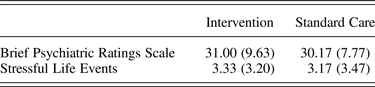
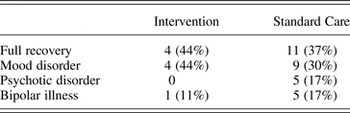
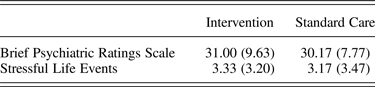
The data on admission to the MBU and mothers’ self-reported psychiatric symptoms and distressing life events since discharge for the intervention and standard care groups are shown in Table 3. Intervention and standard care group mothers did not differ with respect to BPRS scores, t (37) = 0.79, p = .79, d = 0.10, and stressful life events, t (37) = 0.12, p = .90 d = 0.05. The diagnoses at follow-up for mothers in the intervention and standard care groups are presented in Table 4. Mothers in the intervention and standard care groups did not differ with respect to whether they had recovered fully or were unwell at follow-up, χ2 (1) = 1.02, p = .32, w = 0.16.
Mean (standard deviation) scores for clinician-rated psychiatric ratings, and self-reported negative life events for mind–mindedness intervention and standard care groups
Clinician-rated maternal mental health at follow-up

Attachment and participation in the mind–mindedness intervention
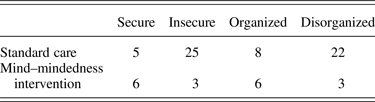
In the intervention group, classifications were as follows: 6 secure, 3 insecure–disorganized, and no infants classified as insecure–avoidant or insecure–resistant. In the standard care group, classifications were 5 secure, 2 insecure–avoidant, 23 insecure–disorganized, and no insecure–resistant.
The numbers of infants falling into the two dichotomous attachment categories are shown in Table 5. Given the small cell sizes, Fisher's exact test was used to calculate the probability level. Mothers who received the mind–mindedness intervention were more likely to have infants classified as securely attached compared with mothers in the standard care group, χ2 (1) = 8.55, Fisher exact p = .008, w = 0.47. Mothers who received the mind–mindedness intervention were also less likely to have infants whose attachment was insecure–disorganized compared with their standard care counterparts, χ2 (1) = 5.85, Fisher exact p = .039, w = 0.39.
The relation between infant–mother secure/insecure and organized/disorganized attachment and maternal participation in the mind–mindedness intervention
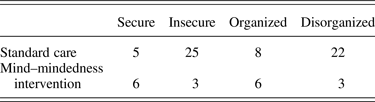
Bayesian analyses indicated that there was strong evidence that, compared with standard care, the mind–mindedness intervention related to higher rates of secure attachment (B 01 = 0.05) and higher rates of organized attachment (B 01 = 0.23).
General Discussion
The studies reported here aimed to investigate how SMI related to mothers’ mind–mindedness and to test the feasibility and efficacy of a video-feedback intervention for increasing mind–mindedness and facilitating secure infant–mother attachment in mothers hospitalized for SMI. Study 1's reanalysis of Pawlby et al.’s (Reference Pawlby, Fernyhough, Meins, Pariante, Seneviratne and Bentall2010) data showed that mothers with SMI had lower levels of appropriate mind-related comments on admission compared with psychologically well controls, with a trend for lower scores for appropriate mind-related comments at discharge. These depressed levels of appropriate mind-related comments suggest that SMI may impede mothers’ mind–mindedness. However, mothers with SMI also had lower levels of nonattuned mind-related comments on admission compared with controls, with this difference being maintained at trend level at discharge. Given that mind–mindedness is defined as high levels of appropriate mind-related comments coupled with low levels of nonattuned comments, the results regarding nonattuned comments therefore do not fit with SMI impairing mind–mindedness. Rather, these results suggest that SMI was associated with a general tendency for mothers not to comment on their infants’ internal states.
The mothers hospitalized for SMI who participated in Study 2 presented a different mind–mindedness profile. These mothers did not differ from psychologically well controls in terms of appropriate mind-related comments at either admission or discharge, but the hospitalized mothers scored higher on admission for nonattuned mind-related comments. In this sample, the elevated level of nonattuned mind-related comments, but not the typical level of appropriate mind-related comments, is in line with SMI impeding mothers’ mind–mindedness. Thus, although both samples of mothers with SMI differed from psychologically well controls with respect to mind–mindedness, the samples differed in their profiles of appropriate and nonattuned mind-related comments. One possible explanation for the differences between the two groups of mothers is the period over which their hospitalization occurred. Mothers in Study 1 were admitted between April 2000 and July 2002, whereas mothers who participated in the mind–mindedness intervention were admitted between February 2013 and March 2014. The consultant psychiatrist on the MBU and the treatment practices changed between these time periods. The practice in the earlier period was to rely primarily on medication and use fewer psychological procedures, whereas medication was typically used less for the mothers admitted more recently. The heavier medication regime of the Study 1 mothers may thus explain their general tendency not to comment on their infants’ internal states.
With respect to changes in mind–mindedness between admission and discharge, reanalysis of Pawlby et al.’s (Reference Pawlby, Fernyhough, Meins, Pariante, Seneviratne and Bentall2010) data showed no change over time in either appropriate or nonattuned mind-related comments. Thus, although these mothers had recovered sufficiently to be discharged from the MBU with their infants, the period of hospitalization and improvement in mental health did not impact on their mind–mindedness. The results were very different for mothers who had participated in the mind–mindedness video-feedback intervention in Study 2. Despite their high levels of nonattuned mind-related comments on admission, these comments decreased dramatically over time such that intervention group mothers did not differ from psychologically well controls when they were discharged. There was also a trend for appropriate mind-related comments to increase from admission to discharge. This increase is noteworthy because intervention group mothers did not differ from control mothers on admission, and yet their appropriate mind-related comments still increased. Given Bakermans-Kranenburg, van IJzendoorn, and Juffer's (Reference Bakermans-Kranenburg, van IJzendoorn and Juffer2003) finding that interventions with fewer sessions and a clear focus appear more effective than longer interventions for parents with young children, the observed positive impact of our single-session intervention is not unexpected.
Turning to the results at follow-up in the infants’ second year of life, participation in the mind–mindedness intervention was found to relate to infant–mother attachment security. Mothers who had received the mind–mindedness intervention were more likely to have securely attached infants compared with their counterparts in the standard care group. Two-thirds of the infants in the intervention group were classified as securely attached, compared with only 17% of infants in the standard care group. Intervention-group mothers were also less likely to have infants classified as insecure–disorganized compared with their counterparts in the standard care group. These differences do not appear to be due to mothers’ mental health difficulties at follow-up given that the intervention and standard care groups did not differ on clinician-reported levels of mental illness in the infants’ second year of life. However, rates of insecure–disorganized attachment were elevated in both the intervention (33%) and standard care (77%) groups compared with van IJzendoorn, Schuengel, and Bakermans-Kranenburg's (Reference van IJzendoorn, Schuengel and Bakermans-Kranenburg1999) meta-analytic data for nonclinical middle-class (15%) and maternal depression (19%) samples. The standard care group's level of disorganization was higher than levels reported in this meta-analysis for maternal drug and alcohol abuse (43%) and maltreatment (48%).
The results of Studies 2 and 3 highlight the potential usefulness of our mind–mindedness video-feedback intervention for facilitating mind–mindedness in mothers with SMI and for fostering secure infant–mother attachment postdischarge. That said, a serious limitation of these studies is the small sample sizes, particularly the numbers of women in the intervention group who completed the follow-up study. It is therefore important to investigate the efficacy of the intervention and the relation between receiving the intervention and subsequent infant–mother attachment in larger samples.
In outlining the direction of such future research, potential reasons for mothers declining to participate at follow-up should be considered. First, for practical reasons, the follow-up assessment was conducted at the MBU. Some mothers may have been reluctant to return to the MBU given that it was associated with a particularly difficult time of their lives. Second, it is possible that attrition was due to mothers wishing to draw a line under their hospitalization, resulting in them deciding not to participate in activities that would serve to remind them of their acute psychiatric episode. Mothers who were feeling that they had made good progress when contacted for follow-up may have declined participation for similar reasons. Alternatively, mothers who were still experiencing psychiatric symptoms may have been reticent to take part for fear that participation might result in further hospitalization or risk their relationship with their child. Conducting follow-up assessments in future research at a neutral venue may therefore help to mitigate attrition.
Our findings thus provide proof of concept for a mind–mindedness video-feedback intervention, showing its feasibility for use with mothers who are experiencing severe mood disturbances or psychotic symptoms. Future research should attempt to replicate these findings in different settings and on larger samples of participants to provide convincing evidence that facilitating mind–mindedness in mothers with SMI continues to have a positive impact on the quality of the mother–infant relationship into the child's second year of life.