INTRODUCTION
The idea of converting the energy of nuclear reactions into laser radiation appeared immediately after the first optical quantum generators were introduced (Herwig, Reference Herwig1964). The high specific power and compactness of nuclear energy sources, along with other advantages compared with the other traditional methods for ionization and excitation of active laser media, have sufficiently stimulated the interest in the creation and study of nuclear-pumped lasers. Extensive opportunities for the application of nuclear-pumped lasers, especially in the cases where powerful lasers have to be placed on stand-alone remote platforms, have also stimulated research activities in this area.
There are two possible ways to convert nuclear energy into laser radiation: direct and combined nuclear pumping (CNP). Direct nuclear pumping (DNP) is a method of converting nuclear energy, in which the energy of nuclear reactions is directly transferred to be employed in the ionization and excitation of buffer gas atoms and molecules, and is then, within a sequence of plasma-chemical processes, transformed into population inversion and coherent radiation. During CNP, the energy of nuclear reactions is spent for pre-ionization of an active laser medium followed by electric discharge pumping; so electrical energy can be generated in the same nuclear reactor.
The aim of this paper was to summarize research results related to the conversion of nuclear energy into the energy of coherent light radiation, both by DNP and CNP, as well as to provide information on research activities in this field being performed in Kazakhstan.
There are two possible conventional ways to utilize the energy from nuclear reactions for the ionization and excitation of active media in lasers: by employing surface or volume sources of charged particles (see Fig. 1).
Volume (а) and surface (b) sources of charged particles.

The surface sources are solid coatings of laser tubes' internal surfaces emitting charged reaction products for laser medium excitation or ionization under the influence of neutron flux or due to radioactive decay (where FFh and FFl are heavy and light fragments of fission):
 $$_{92} {\rm U}^{235}+_0 {\rm n}^{1} \rightarrow {\rm FF}_{\rm h} \lpar {65}\, {\rm MeV}\rpar +{\rm FF}_{1} \lpar {97}\, {\rm MeV}\rpar \comma \;$$
 $$_{7} {\rm B}^{10}+_0 {\rm n}^{1} \rightarrow _{3}{\rm Li}\lpar {0.855}\, {\rm MeV}\rpar +_{2}{\rm He}^{4} \lpar {1.495}\, {\rm MeV}\rpar \comma \;$$
 $$_{3} {\rm Li}^{6}+_0 {\rm n}^{1} \rightarrow _{1}{\rm H}^{3}\lpar {2.73}\, {\rm MeV}\rpar +_{2}{\rm He}^{4} \lpar {2.05}\, {\rm MeV}\rpar \comma \;$$
 $${\rm Po}^{210} \rightarrow {\rm He}^{4}\lpar {5}\, {\rm MeV}\rpar +{\rm Pb}^{206}.$$
The cross-sections of such reactions for thermal neutrons are sufficiently large and comprise 582 barns (U235), 3837 barns (B10), and 945 barns (Li6).
Lasing at CO, He-Hg, Ar-Xe, He-Cd, and other laser media has been employing surface sources (Batyrbekov, Reference Batyrbekov2008a). However, significant energy loss (>50% of the energy released in nuclear reactions) due to the geometrical factor and the passage of particles through the source itself decreases the overall system efficiency. Surface sources are inefficient at high pressures and at large volumes of laser active media, since the penetration depth for fission fragments in a laser medium is limited in this case, causing heterogeneous ionization of the active medium. Unevenness of active medium ionization leads to a temperature gradient along the diameter of the laser tube, and as a consequence, unevenness of the density of the gas active medium. As a result, a wide angle or focusing lens can appear depending on the ratio of the mean free path of the charged particles and the laser tube diameter, which adversely affects the lasing conditions (Batyrbekov et al., Reference Batyrbekov, Miley, Petra, Poletaev and Suzuki1994a). Despite this, the surface sources are used quite often for nuclear pumping of lasers, especially in the case where it is necessary to avoid the presence of a charged particles volume source in a laser active medium to eliminate the negative effects on population inversion kinetics.
Volumetric sources of charged particles are introduced homogeneously into gaseous working media of lasers. UF6 can be used as the source; the fission reaction in this case results in high-energy fission fragments for excitation and ionization of the laser medium. However, UF6 has some negative features, such as strong deactivation of the excited states, a large capacity for absorption of electrons with negative ions formation, chemical activity of atomic fluorine, etc. The gas isotope He3 that emits protons and tritium after neutron capture can be used most effectively for this purpose:
 $$_{2} {\rm He}^{3}+_0 {\rm n}^{1} \rightarrow _{1}{\rm H}^{3}\lpar {0.19}\, {\rm MeV}\rpar +_{1}{\rm H}^{1} \lpar {0.57}\, {\rm MeV}\rpar .$$
The cross-section for this reaction is sufficiently large, about 5,400 barns, and the reaction is very successfully used for lasing in certain active media (Не3-Хе, Не3-Cd, Не3-Zn, and others) where He3 plays the role of a buffer gas, assuring a uniform volumetric excitation of the active medium.
Volume and surface sources of charged particles can both be used simultaneously. For example, the joint use of Не3 and U2O3 at the optimum ratio of the laser tube diameter and the active medium pressure provides a more uniform energy distribution in the gas and eliminates the “gas lens” problem. Moreover, arranging the charged particles surface source in staggered order along the laser tube eliminates the problems resulting from distortion of the beam directionality along the laser axis (DeYoung et al., Reference De Young, McArtur, Miley, Prelas, Behrens and Carlson1989).
PECULIARITIES OF NUCLEAR PUMPED LASERS ACTIVE MEDIA
The only type of laser with successfully implemented nuclear pumping is still the gas laser (DeYoung et al., Reference De Young, McArtur, Miley, Prelas, Behrens and Carlson1989; Mis'kevich, Reference Mis'kevich1991; Miley, Reference Miley1993; Batyrbekov, Reference Batyrbekov2008a). The use of nuclear energy for pumping liquid and solid-state lasers is limited by the radiation damages problem. At the same time, the gas lasers have features. First, only gas lasers can be transparent in the wide spectral range (from the vacuum UV region to the far-infrared region of the spectrum), and as a consequence, they have a large working range of wavelengths. Second, the operating levels in the gas are the levels of almost isolated particles (atoms, ions, and molecules), which determines the narrowness of laser transitions and makes it possible to achieve a high monochromaticity of laser radiation. Third, the gas atmosphere has much lower density and higher optical homogeneity, so the losses for diffraction and scattering are minimal in it, making it easier to reach the diffraction limit. Gas laser emission has the lowest divergence compared to the liquid and solid-state lasers. However, the relatively low density of gas environments requires sufficient extension of the lasers to meet the amplification conditions, which is not always feasible at the excitation by nuclear reactor energy. Utilization of a multiple-pass resonator makes it possible to eliminate this disadvantage, but introduces additional negative reactivity and some technical difficulties.
There are some publications covering the study of possible applications of solid-state lasers nuclear pumping. In particular, the possibility of using a nuclear-excited lamp for pumping solid-state laser is shown (Miley, Reference Miley1993; Prelas, Reference Prelas1995; Batyrbekov, Reference Batyrbekov, He, Lin and Prelas1993a). The possibility of using a mixture of alkali metals with Не3 as an active medium of the nuclear-excited plasma is considered. In particular, the coefficient of nuclear energy conversion into radiation of Nа2* excimer molecule can theoretically reach 40%. To resolve the problem of radiation damage in solids, it was proposed to use optical fibers to take nuclear-induced lamp radiation away from the radiation field of the nuclear reactor. Studies with solid-state converters, pumped by radiation from a DNP laser, were performed by All-Russian Scientific Research Institute of Technical Physics, Snezhinsk (VNIITF) (Magda, Reference Magda2007).
A series of works on the possibilities to use liquids as an active medium in nuclear pumping lasers have been published by the Institute of Physics and Power Engineering, Obninsk (IPPE) (Dobrovolskiy et al., Reference Dobrovolskiy, Dyachenko and Seregina2003; Kabakov et al., Reference Kabakov, Kiselev and Tikhov2007). In one of the options, it was proposed to use inorganic liquids activated by rare earth and actinide elements as the active medium. However, until now there has been no information about obtaining lasing by direct pumping in liquids. Thus, the most promising is the study of gaseous media as active media for nuclear-pumped lasers.
DIRECT NUCLEAR PUMPED LASERS
The first experimental confirmation of the possibility to create a laser with DNP came in 1975, when MacArthur and Tollefsrud succeeded in lasing on vibrational transitions of the CO molecule with λ = 5.1–5.6 µm using U2 coatings and a fast pulse reactor of the Sandia-II pool type (McArthyr & Tollefsrud, Reference McArthyr and Tollefsrud1975). Soon, there were reports on lasing with DNP in He-Xe (Fuller et al., Reference Fuller, Helmick and Schneider1975) and Ne-N2 (De Young, Reference De Young1976) mixtures.
There are currently more than four dozen lasers capable of operating in excitation by the energy of pulsed nuclear reactors and emitting in a wide spectral range from 391 nm to 5.6 µm (Batyrbekov, Reference Batyrbekov2008a).
The geography of the studies has also expanded. While in the 1980s lasers with DNP were studied only in the Soviet Union and the United States, Germany (De Young, Reference De Young1976; Adonin et al., 2006; Reference Adonin, Hoffmann, Jacoby, Turtikov, Ulrich and Wieser2009; Krucken et al., Reference Krucken, Ulrich and Wieser2007), China (Han-De et al., Reference Han-De, Hua-Ming and Kai-shu1993; Chengde et al., Reference Chengde, Xiaobo and Xiaoqiang2007), Japan (Hayashida et al., Reference Hayashida, Nakamura, Nakazava, Okumura and Soramoto1991; Kakuta et al., Reference Kakuta, Nakazawa and Sakasai1998; Obara & Takezawa, Reference Obara and Takezawa2007), Brazil (Campus & Shaban, Reference Campus and Shaban1997a, Reference Campus and Shaban1997b), and other countries are active in this area today.
The Direct Nuclear Pumped Lasers Program (lasers with DNP) has being successfully developed in the United States of America for many years, with the participation of scientists from Sandia and Los Alamos National laboratories, University of Illinois, Missouri, North Carolina, and others. In the former Soviet Union, the studies of direct nuclear pumped lasers were performed in All-Russian Research Institute of Experimental Physics, Sarov (VNIEP), VNIITF, Moscow Engineering Physics Institute (MEPI), IPPE, Institute of Nuclear Physics of National Nuclear Center of the Republic of Kazakhstan (INP NNC RK), Institute of Atomic Energy of National Nuclear Center of the Republic of Kazakhstan (IAE NNC RK), etc. The first lasing with DNP was achieved in Arzamas-16 (Sarov) in May 15, 1973 (Melnikov et al., Reference Melnikov, Podmoshenskii, Sinyanskii and Voinov2007), two years before the first announcement made by U.S. scientists, but considering the secrecy of the research the first publication on this topic appeared only in 1979 (Dovbysh et al., Reference Dovbysh, Kazakevich, Krivonosov, Melnikov, Podmoshenskii, Sinyanskii and Voinov1979a; Reference Dovbysh, Kazakevich, Krivonosov, Melnikov, Podmoshenskii, Sinyanskii and Voinov1979b). It was the He-Xe laser with the following parameters: wavelength 2.6 µm, efficiency ≈0.45%, average radiation power ≈25 W, pulse energy ≈60 mJ.
All currently existing direct nuclear pumped lasers can be classified into three main groups: vibrational transitions of molecule lasers; metal vapor ion lasers; and lasers based on neutral atom transitions. It should be noted that this corresponds to the traditional classification of gas lasers into molecular, ion, atomic, and excimer lasers. Lasing with DNP on excimer molecule transitions has not been obtained so far.
DNP LASERS ON VIBRATIONAL TRANSITIONS OF MOLECULES
The characteristic feature of lasers on molecular vibrational-rotational transitions due to the small difference in energy between the working levels is lasing in the mid- and far-infrared range. The typical example of this laser class is CO laser operating on vibrational-rotational transitions in the main electronic state within the 5–6.5 µm wavelength range. A high efficiency, a high output power, and the ability to work in continuous and pulsed modes with different methods of achieving inversion (pumping by an electric beam and electric discharge, gas-dynamic pumping and chemical pumping) naturally stimulated interest in developing CO laser with direct nuclear-pumping.
As is noted above, the laser on vibrational transitions of a CO molecule was one of the first lasers with DNP (McArthyr & Tollefsrud, Reference McArthyr and Tollefsrud1975). However, in contrast to other methods of excitation, in the case of DNP it was not possible to achieve a high efficiency of input energy conversion into coherent electromagnetic radiation. The maximum experimental values of output energy 0.1–0.3 mJ and efficiency 0.1–0.3% from the energy delivered into the gas were obtained at 50 ms duration of generation. Moreover, a high lasing threshold (Фthresh = 5 × 10¹⁶ n/cm2s), pressure limits, and strict requirements for active medium cooling (laser was operated at 77 K temperature and 100 mTorr active medium pressure) made the direct nuclear pumped CO-laser not interesting in terms of practical applications. A detailed analysis of CO molecule excitation processes was provided in Gudzenko et al. (Reference Gudzenko, Malishevskiy and Yakovlenko1978) taking into account the function of electron distribution in conditions of nuclear pumping. According to calculations there, the maximum efficiency of the CO laser with DNP does not exceed 0.5% of the energy deposited into gas, which is consistent with the experimental results.
Attempts to obtain lasing on vibrational-rotational transitions of the CO2 molecule with DNP by analogy with the CO laser were not successful (Batyrbekov, Reference Batyrbekov2008a). A detailed explanation of this fact is given in Andriyahin (Reference Andriyahin1972) based on the calculation of the electron distribution function in nuclear-induced plasma of a molecular laser. Kinetics of the CO2 laser with DNP showed that with the compositions of the mixtures, which are traditionally used in electric-discharge CO2 lasers, the amplification factors on the vibration–rotation systems of the CO2 molecule are too small to achieve lasing, primarily due to the significant difference of excitation mechanisms in these two systems. According to Hasan (Reference Hasan1980), the CO2 laser with nuclear pumping can operate at low pressure and low concentrations of CO2 and N2. Under these conditions, the CO2 laser with DNP is not effective, and its conversion to other scales is not possible.
Although a dense Не-N2 mixture was proposed as an active medium for lasers with DNP in 1980, lasing was achieved only in 1996 primarily due to effective population of the B-states N2+ in the processes of helium molecular ions recharging on nitrogen molecules. In Grebyonkin & Magda (Reference Grebyonkin and Magda1991), lasing on the B-X transition (0–0) of a nitrogen molecular ion with λ = 391 nm has been reported. To our knowledge, this is the shortest-wavelength laser with DNP. The experiments were performed on the pulsed nuclear reactor EBR-L with a thermal neutron flux of ~1017 n/cm2s with 250 microseconds pulse half-width. The mixture of He-N2-H2 was used as the laser active medium. It was possible to achieve laser radiation by selective population of the lower laser level N2+(X).
Metal Vapor DNP Ion Lasers
Current DNP ion lasers are lasers in which transitions between the energy levels of metal ions are used as working transitions. This group includes lasers on atomic transitions of Нg+, Cd+, and Zn+ ions. The characteristic feature of this group is the many resonances between the levels of excited buffer gas atoms and the levels of metals ions (since ionization potentials of metals atoms are quite below the ionization potential of He atoms). Therefore, the upper working level is populated at collision processes with excitation energy transferred from metastable helium atoms to metal atoms, followed by ionization of this atom and ion excitation.
These lasers do not require exact resonance of excited He atoms and excited metal ions (M+)*, like in the case of He-Ne lasers, since the energy excess is carried away by the electron. The ionization process with recharging can also provide population of the upper working levels.
An advantage of metal vapor ion lasers that attracts much interest of researchers in these lasers is the wide range of wavelengths and relatively low threshold of lasing. The He-Hg laser with wavelength λ = 615 nm (Akerman, Reference Akerman1976; Akerman & Miley, Reference Akerman and Miley1977) was the first laser with DNP in the visible range. A laser radiation with wavelength λ = 441.6 nm achieved in the Не3-Cd laser (Dmitriyev et al., Reference Dmitriyev, Ilyashenko, Miskevich, Salamakh and Sipailo1980; Reference Dmitriyev, Ilyashenko and Miskevich1982) has been for a long time the shortest one for direct nuclear pumped lasers. However, there are many technical difficulties imposed by metal vapor lasers due to the high temperature for metal evaporation, corrosion issues and increased requirements on the purity of the used gases. The highest efficiency rates achieved for metal vapor ion lasers with DNP are as follows: Не-Hg 10−6% (Akerman, Reference Akerman1976; Akerman & Miley, Reference Akerman and Miley1977); Не-Cd 0.5% (Dmitriyev et al., Reference Dmitriyev, Ilyashenko, Miskevich, Salamakh and Sipailo1980); He-Zn 0.06% (Dmitriyev et al., Reference Dmitriyev, Ilyashenko and Miskevich1982) of the input in gas energy.
DNP Lasers on Neutral Atom Transitions
The typical example of this class of lasers is the He-Ne laser on atomic transitions of neon with λ = 632.8 nm. However, the low output characteristics of the He-Ne laser have limited the possibilities for its application. The He-Ne laser is used mainly in laboratory conditions and, as a rule, for adjustment purposes.
There is a report available on the creation of a He-Ne laser with DNP (Carter et al., Reference Carter, Rowe and Schneider1980). The paper reported that a continuous laser on the transition of 3р′[3/2]2–5s′[1/2]10 neon atom with 632.8 nm wavelength was achieved. The measured value of a small-signal amplification factor in the mixture of He3:Ne = 5:1 at 300 Torr pressure and Φ ≈ 6 × 10¹¹ n/cm2s was 9.81 dB/m. The laser threshold when using the resonator with low Q-factor (50% loss per pass) was obtained at Φ ≈ 2 × 10¹¹ n/cm2s. Attempts of other authors to confirm this result have failed (Prelas & Schlapper, Reference Prelas and Schlapper1981; Krucken et al., Reference Krucken, Ulrich and Wieser2007). In particular, in experiments conducted in the active zone of the stationary nuclear reactor WWR-K at the flows exceeding neutron fluxes for more than two orders of magnitude used in Carter et al. (Reference Carter, Rowe and Schneider1980), generation has not been achieved even at high Q-factor of the resonator.
In 1990, several research groups simultaneously reported on generation with DNP on atomic neon transitions (Hays & Hebner, Reference Hays and Hebner1990; Kopai-Gora et al., Reference Kopai-Gora, Miskevich and Salamaha1990; Grebyonkin & Magda, Reference Grebyonkin and Magda1991; Sinyanskiy, Reference Sinyanskiy1995). The lasing was obtained on the transitions 3р′[1/2]0-3s′[1/2]1 NeI with λ = 585.2 nm wavelength (“yellow” neon laser) and 3p[1/2]1-3s[3/2]1 and 3s[3/2]2 NeI with λ = 724.5 and 703.2 nm wavelengths (“red” neon lasers), respectively.
The maximum output characteristics of 40 and 9 mJ and 140 and 30 W with an efficiency of 0.16 and 0.02% were obtained for the “yellow” and “red” lasers, respectively. Low threshold characteristics 1.5 × 10¹³ n/cm2s) have been reported in Miley and Shaban (Reference Miley and Shaban1993), which corresponds to the capabilities of existing stationary nuclear reactors. However, there is still no experimental confirmation of continuous lasing with DNP in the conditions of the stationary nuclear reactor.
Detailed studies of the kinetics of laser active media based on 3p-3s NeI atom transitions pumped by the weak source of external ionization were first conducted by the staff of the Laboratory of Nuclear Power Installation Physics (LNPIP) of the INP NNC RK (Batyrbekov, Reference Batyrbekov1990; Reference Batyrbekov2008b; Reference Batyrbekov2008c; Batyrbekov & Danilychev, Reference Batyrbekov and Danilychev1992; Batyrbekov et al., Reference Batyrbekov, Batyrbekov, Danilychev and Nazarov1990; Reference Batyrbekov, Batyrbekov, Danilychev and Hasenov1991; Reference Batyrbekov, Batyrbekov and Danilychev1994b). Spectral studies of an neon plasma were performed in the central channel of the stationary nuclear reactor and in the laboratory using α-particles. The spectral research made it possible to study the effectiveness of population for the upper 3p levels of the neon atom, the processes in the bulk and intermultiplet relaxation of the working laser levels at ionization of the mixture by the products of nuclear reactions. The effect of He and Ne on the effectiveness of neon 3p levels population was studied. It was shown that neon 3p levels population effectiveness in the process of dissociative recombination depends on the degree of vibrational excitation of Ne2+ ions.
The subthreshold spectral diagnostics of nuclear excited plasma made it possible to measure the rate constants in the key processes and to understand the mechanisms of inverse population. As seen in Figure 2, the threshold values of thermal neutrons fluxes, that is, the flux at the condition of α0 = αampl − Р − αabs = 0 (where αampl is the small signal amplification factor, Р is the coefficient of useful losses, and αabs is the non-resonant absorption of laser radiation) are Фthresh ≈ 4 × 10¹⁴, 7 × 10¹⁴, and 8 × 10¹⁴ n/cm2s, respectively, for the transitions with λ = 585.2, 703.2, and 724.5 nm. The obtained values confirmed previous findings that lasing at the flux typical of currently existing stationary nuclear reactors is not possible.
Dependence of α0 = αampl − Р − αabs value for the transitions with λ = 585.2 nm (He3 (3 atm) + Ne (30 Torr) + Ar (8 Torr)) (1), 703.2 nm (Ne (1 atm) + Kr (15 Torr)) (2), 724.5 nm (Ne (1 atm) + Kr (35 Torr), (3) from the flow of thermal neutrons.

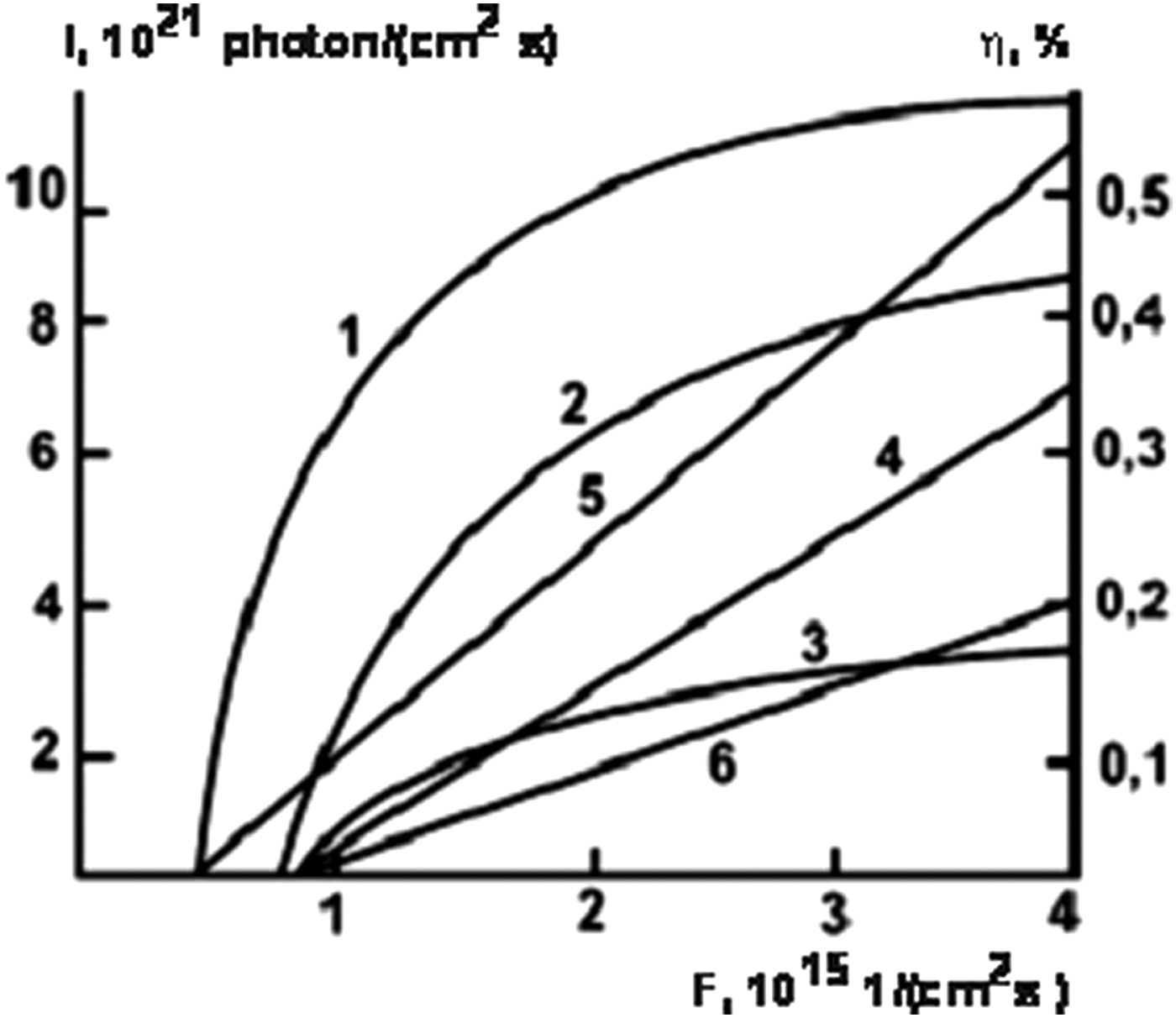
The design values of laser radiation and the efficiency of lasers on NeI transitions, such as the functions of thermal neutrons flux value, are shown in Figure 3. The calculations performed for the flux typical of pulsed nuclear reactors are in good agreement with the experimental results.
Dependence of laser radiation density (4,5,6) and efficiency (1,2,3) for λ = 585.2 (1,4), 703.2 (3,6), and 724.5 (2,5) for the mixtures: He (3 atm) + Ne (30 Torr) + Ar (9 Torr) (1,5), Ne (1 atm) + Kr (20 Torr) (2,4), Ne (1 atm) + Kr (40 Torr) (3,6).

Lasing with DNP was also obtained on the atomic transitions of other noble gases: Ar, Kr, and Xe. The active laser media are of interest in terms of practical application with significant efficiency at low pumping powers. The mixtures of gases (Не, Ne)-Ar-Xe with λ = 1.73, 2.026, and 2.65 µm wavelength 5d-6p transitions of xenon atom are referred to such media.
Lasing with DNP on xenon atom IR transitions was achieved for the first time in 1975 in the University of Florida in collaboration with the Los Alamos National Laboratory (Fuller et al., Reference Fuller, Helmick and Schneider1975). Lasing was produced at the transition 5d [7/2]3-6p[5/2]2 XeI with λ = 3.508 µm wavelength in the He-Xe mixture. The products of nuclear U238(n,f)F reaction were used as the pumping source.
Since it was one of the first demonstrations of lasing with DNP, relatively low output characteristics (efficiency of ~0.01%) and high threshold (~3 × 10¹⁵ n/cm2s) have been achieved. To date, the maximum output power W ≈ 2600 W (Koshelev et al., Reference Koshelev, Melnikov, Sinyanskii and Voinov1990) and the efficiency ŋ ≈ 2.2–3% (Grebyonkin & Magda, Reference Grebyonkin and Magda1991; Alford & Hays, Reference Alford and Hays1990) were obtained at the transition 5d [3/2]1-6p[3/2]1 ХеI with λ = 1.732 µm wavelength. The low threshold flux of thermal neutrons (3.7 × 10¹³ n/Cm2s) was detected by Voinov and co-workers (Koshelev et al., Reference Koshelev, Melnikov, Sinyanskii and Voinov1990) for the transition 5d[3/2]01-6p[3/2]1XeI with λ = 2.026 µm wavelength, which indicates the possibility of achieving a continuous steady-state generation in the conditions of the stationary nuclear reactor. In total, lasing was achieved at six atomic 5d-6p xenon transitions (Fig. 4).
The diagram of Хе atom transitions.

A significant contribution to the understanding of the kinetics of physical-and-chemical processes occurring in xenon plasma was made by Kazakhstani scientists. The staff of the LNPIP performed comprehensive studies of nuclear-induced plasma of xenon mixtures with noble gases (Batyrbekov, Reference Batyrbekov, Batyrbekov, Hasenov and Tleuzhanov1987a, Reference Batyrbekov2008a). Using the results of the spectral investigations, mathematical simulation of the main plasma-chemical processes in nuclear-induced plasma of Не-Ar-Xe and Ar-Xe laser mixtures has been performed.
In collaboration with the University of Illinois, for the first time we have achieved lasing at the transition 5d [3/2]1-6p[3/2]1 ХеI with λ = 1.732 µm wavelength pumped by the products of the В10(n,α)Li7 nuclear reaction (Batyrbekov, Reference Batyrbekov2008d; Reference Batyrbekov2009; Batyrbekov et al., Reference Batyrbekov, Miley, Poletaev and Suzuki1993b; Reference Batyrbekov, Miley, Poletayev and Sudzuki1995; Reference Batyrbekov, Miley and Poletaev1994c). The experiments were performed at the TRIGA reactor in the University of Illinois. TRIGA is a pressurized water-type reactor capable of operating either in stationary or pulsed (high pulse repetition frequency) modes. The experiments were performed at the reactor in the pulsed mode with the following parameters: peak power 1600 MW, peak value of thermal neutrons flux 2.5 × 10¹⁵ n/cm2s, and half-height neutron pulse duration 12.1 ms. The scheme of the experiment is shown in Figure 5.
The scheme of the experiment at the TRIGA reactor (USA).

The oscillogram of the laser signal and neutron impulse is shown in Figure 6. A resonator with dielectric mirrors with reflection coefficients of 99.9 and 90.0% at 1.732 µm wavelength was used in the experiments.
The oscillogram of generation and neutron impulses. Temperature change of the gas medium (right scale). (1) generation; (2) neutron impulse (maximum power 523 MW).

The lasing was produced by a thermal neutron flux of 7 × 10¹⁴ n/Cm2s, which corresponds to the specific pumping power of 2.6 W/cm3. When using the resonator with “zero” losses (99.9%) the value of the threshold thermal neutrons flux is 1 × 10¹⁴ n/cm2s or 0.44 W/Cm3, which agrees well with the experimental results of other researchers who used U235 fission fragments as a pumping source (Grebyonkin & Magda, Reference Grebyonkin and Magda1991), and indicates weak dependence of the mechanism of inverse population on the source of primary ionization (Batyrbekov, Reference Batyrbekov2008d).
The relatively high efficiency of lasers on atomic transitions of neon and xenon with DNP stimulated interest in finding new collisional lasers employing the allowed bound–bound (stimulated transition cross-section σ ≈ 10−13–10−14cm2) electron transitions.
Scientists in Kazakhstan have attained significant progress in this area (Batyrbekov et al., Reference Batyrbekov, Batyrbekov, Bekmurzayeva, Hasenov and Soroka1987b; Reference Batyrbekov, Batyrbekov, Hasenov and Tleuzhanov1987c; Reference Batyrbekov, Batyrbekov, Dolgih and Ruddoi1987d; Reference Batyrbekov, Batyrbekov, Dolgih and Ruddoi1988; Reference Batyrbekov, Batyrbekov, Dolgih, Hasenov and Rudoi1997). We showed that the triplet transitions of the mercury atom are promising for lasing in the visible range. In particular, the high efficiency of population of 73S1 upper working level of the mercury atom was revealed in dissociative recombination of molecular ions formed in the following reaction chain:
 $${\rm Xe}+{\rm ff}\rightarrow {\rm Xe}^{+}+{\rm ff}+{\rm e}\comma \;$$
 $${\rm Xe}^{+}+{2}{\rm Xe}\rightarrow {\rm Xe}_2^{+}+{\rm Xe}\comma \;$$
 $${\rm Xe}_{2}^{+}+{\rm Hg}\rightarrow {\rm Hg}^{+}+{2}{\rm Xe}\comma \;$$
 $${\rm Hg}^{+}+{2}{\rm Xe}\rightarrow {\rm XeHg}^{+}+{\rm Xe}\comma \;$$
 $${\rm XeHg}^{+}+{\rm Hg}\rightarrow {\rm Hg}_{2}^{+}+{\rm Xe}\comma \;$$
 $${\rm Hg}_{2}^{+}+{\rm e} \rightarrow {\rm Hg}\left(7^{3}{\rm S}_1\semicolon \; 7^3{\rm P}\right)+{\rm Hg}.$$
The measured factor of nuclear energy conversion into radiation at the mercury triplet lines is close to the quantum one, which shows the high selectivity (δ = 0.8 ± 0.2) of the process (probably by cascade transitions from the 73Р level). To obtain inverse population, it was proposed to use H2 or D2 selectively depleting the lower working 6P-states. The rate constants for the key processes involved in the formation of inverse population were measured (Batyrbekov et al., Reference Batyrbekov, Batyrbekov, Bekmurzayeva, Hasenov and Soroka1987b; Reference Batyrbekov, Batyrbekov, Hasenov and Tleuzhanov1987c; Reference Batyrbekov, Batyrbekov, Dolgih and Ruddoi1987d; Reference Batyrbekov, Batyrbekov, Dolgih and Ruddoi1988). The calculations of the main plasma components, threshold and output characteristics of laser radiation indicated the possibility of lasing with DNP at triplet transitions of the mercury atom.
Figure 7 shows the calculated values of the amplification factor excluding the coefficient of useful losses on the resonator and non-resonant absorption of laser radiation. It can be seen that the rated value of the threshold thermal neutrons flux is Фthresh = 1.5 × 10¹⁴ n/Cm2s for the optimal mixture He3(2 atm)-Xe(1 atm) Hg(7 Тorr)-H2(40 ТTrr) for λ = 546.1 nm, in terms of the maximum amplification factor.
α0 = α− Р − αabs value versus the flux of thermal neutrons Фt for the λ = 546.1 nm (1), 435.8 nm (2) transitions for the mixture: He3 (2 atm) + Хe (1 atm) + Hg (7 ТTrr) + H2(40 Torr), He3 (2 atm) + Хe (1 atm) + Hg (7 ТTrr) + H2(33 Torr).

These conclusions were outstandingly verified in VNIITF (Bochkov et al., Reference Bochkov, Kryzhanovskii and Magda1992). They have achieved generation in the He-Xe-Hg-H2 mixture excited by the products of the U235(n,f)F nuclear reaction at the 73S1-63P2 transition with λ = 546.1 nm. In particular, the threshold value was Фthresh = 5 × 10¹⁴ n/Cm2s for the optimal mixture of He(119ТTrr)–Xe(119 ТTrr)-Hg(6.8 ТTrr)-H2(58.9 ТTrr) excited by the products of the U235(n,f)F nuclear reaction. The small difference between the theoretical and experimental values of the Н2 optimal content can possibly be explained by the need for additional cooling of the secondary electrons in the experimental conditions (Bochkov et al., Reference Bochkov, Kryzhanovskii and Magda1992). Gases of the same purity used in the experiments have a significant impact on the energy parameters of the laser (Korzenev et al., Reference Korzenev, Garanin and Turutin2008). In the above kinetic model of the laser, impurities in the active gas mixture were not taken into account.
This is the first and until now the only laser with DNP evolved under the classical sequence of events, that is, preliminary experimental studies, the study of the inverse population mechanism, the creation of the kinetic model, calculations of plasma parameters, the conclusion on the possibility of generation, and only after all these – experimental confirmations — generation. In all other lasers with DNP, transitions verified with other sources of hard ionization, such as an electron beam, were used as laser transitions (Fedenev et al., Reference Fedenev, Karelin, Tarasenko and Yakovlenko1995).
COMBINED NUCLEAR-PUMPED LASERS
Employing electric discharge for the pumping in lasers with CNP, when the energy of nuclear reactions is spent only for ionization of the laser active medium, it is possible to achieve high power transferred into the active medium — several orders of magnitude higher than in the case of DNP at the same flux of thermal neutrons. The increase in power delivered to the laser active medium makes it possible to achieve lasing with a shorter wavelength and at the transitions with “short life” upper laser levels, as in the case of excimer molecules.
When the neutron flux of the stationary nuclear reactor is used to stabilize the discharge, no problem related to separating foil mechanical strength appears; such problems are typical of discharge lasers stabilized by electron beams. The sources of ionizing particles are arranged in the working volume of the laser, and the penetrating power of neutrons through the walls of the laser chamber is high. Accordingly, the structural strength imposes no restriction on the pulse repetition rate. Volumetric ionization sources such as He3 or 235UF6 in the working gas would homogeneously ionize large volumes of working mixtures (tens to hundreds of liters) at high pressures. The continuous ionization of the working mixture in the nuclear reactor eliminates the need to harmonize the ionizer pulse with the pulse of discharge and facilitates accumulation of negative ions useful for discharge stabilization (increase of volume discharge time and, consequently, the value of energy deposited in the volume discharge). The negative ions and electrons are continuously present in the reactor plasma in the maximum possible (for the given ionization rate) concentration.
As in the case of DNP, the lasers with CNP can be subdivided in accordance with the traditional division of all gas lasers into molecular, atomic, and excimer lasers. Lack of information about lasing on transitions of metal vapor ions for CNP is primarily due to technical difficulties in maintaining the required temperature control of the active medium and, correspondingly, optimal concentration of the metal vapor.
There are other proposals for a CNP. In particular, Prelas and co-workers suggested using a nuclear pumped source of UV radiation for pumping of active laser media. However, there is no information about lasing with this way of CNP (Andriyahin et al., Reference Andriyahin, Golubev, Krasilnikov, Pismenyi, Rakhimov and Velihov1969).
CNP Lasers on Vibrational Transitions of CO2 and CO Molecules
Utilization of pulsed nuclear reactor for lasers active media ionization was first proposed in 1969 (Andriyahin et al., Reference Andriyahin, Golubev, Krasilnikov, Pismenyi, Rakhimov and Velihov1969). Doubling of CO2 laser output power was achieved by the proton beams used for laser active medium ionization, simulating the products of the He3(n,p)T nuclear reaction (Andriyahin et al., Reference Andriyahin, Krasilnikov, Pismenniy and Vasiltsov1972; Reference Andriyahin, Kovalev and Velihov1973). The use of the products of the B10(n,α)T nuclear reaction for ionization of the CO2 laser active medium was demonstrated by Professor George Miley of the University of Illinois and his co-workers (Gauley et al., Reference Gauley, Miley and Verdeyn1971).
The development of the electron beam-controlled laser pumping electric-ionization method (Basov, Reference Basov1971; Danilyzhev et al., Reference Danilyzhev, Kerimov and Kovsh1976) inspired its implementation in the radiation field of stationary nuclear reactors. The principle of the electric-ionization method of excitation can be presented as follows. Compressed gas is placed between two electrodes under a voltage. Ionizing radiation through the gas creates conductivity and generates an electric current. The concentration of free electrons in this case depends only on the intensity of ionizing radiation and is independent of the applied electric field strength.
That is, unlike the gas-discharge laser where the electrons are not only involved in gas conductivity, but also create conductivity itself by direct ionization, these functions are separated in electric ionization lasers. Free electrons are generated by the external ionizer, and the value of the current increases with electric field intensity, increasing only due to an increase of the electron drift velocity. This helps us to eliminate some significant deficiencies occurring in gas-discharge lasers. First, the electric-ionization method removes restrictions for working gas pressure and the size of the system. This circumstance is an essential feature of the electric-ionization method of energy introduction in the laser active medium, fundamentally distinguishing it from other methods of combined pumping. Second, it becomes possible to achieve the ultimate efficiency of the laser using the electric-ionization method of pumping. In the self-sustained discharge, the operating value of the reduced field strength E/P is determined by the condition of the self-sustaining discharge, and it is significantly higher than the optimum one for the excitation of molecule vibrational levels. Using the electric ionization method of excitation, it is possible to consider the E/P value optimum when the energy released in the gas is converted into the energy of molecules vibration with an efficiency rate close to 100%, since the conductivity is formed by ionizing radiation. Third, the electric-ionization method provides a high level of specific power of the discharge.
Despite the encouraging results obtained in the studies of electric-ionization lasers with different sources of external ionization, the issue of feasibility of this pumping method in the conditions of the stationary nuclear reactor remained to be addressed.
For this purpose, the INP NNC RK and the Lebedev Physical Institute of the Academy of Sciences (PIAS) of the USSR conducted comprehensive studies of nuclear-excited plasma in the active zone of the stationary nuclear reactor (Batyrbekov et al., Reference Batyrbekov, Danilychev, Hasenov, Ionin, Komarov, Kunakov, Mardenov and Pertrov1979a, Reference Batyrbekov, Hasenov and Kostritsa1983). In particular, the probe diagnostics of plasma in a CO2:N2:He3 = 1:4:5 gas mixture at 10 atm pressure showed that electron concentration in the mixture is equal to 2 × 10¹²/Cm3 at 2 × 10¹⁴ n/Cm2s thermal neutrons flux (Batyrbekov et al., Reference Batyrbekov, Danilychev, Hasenov, Ionin, Kovsh, Kunakov and Mardenov1978b). The achieved ionization rate provided the input of power at the level of ~0.5 kW/cm3 and evidence for the possibility of the electric-ionization method of pumping.
Generation with the electric-ionization pumping method was obtained for the first time in 1976 (Batyrbekov et al., Reference Batyrbekov, Kunakov and Mardenov1977a; Reference Batyrbekov, Danilychev and Mardenov1977b; Reference Batyrbekov, Danilychev, Hasenov, Kovsh and Mardenov1977c). The generation was produced on the vibrational transitions of a CO2 molecule with ionization of a CO2:N2:Не = 1:4:5 laser mixture by the products of Не3(n,p)T nuclear reactions in the active zone of the stationary WWR-K nuclear reactor.
The same research group conducted the study of CO-N2-Не3-induced plasma in the active zone of the stationary nuclear reactor (Batyrbekov et al., Reference Batyrbekov, Danilychev, Hasenov, Ionin, Komarov, Kunakov, Mardenov and Pertrov1979a; Reference Batyrbekov, Hasenov and Kostritsa1983) and obtained the pulse-periodic and stationary generations on the vibrational transitions of the CO molecule in 1978 (Batyrbekov et al., Reference Batyrbekov, Danilychev, Hasenov, Ionin, Kovsh, Kunakov and Mardenov1978b).
The output characteristics of the electric-ionization lasers with ionization of active media by the products of He3(n,p)T nuclear reactions on the vibrational transitions of CO2 (Batyrbekov et al., Reference Batyrbekov, Haritonova, Kunakov, Klyukin, Komarov, Mardenov, Petrov and Takibaev1978a; Reference Batyrbekov, Danilychev, Hasenov, Ionin, Kovsh, Kunakov and Mardenov1978b; Reference Batyrbekov, Hasenov and Kostritsa1983) and CO (Batyrbekov et al., Reference Batyrbekov, Danilychev, Hasenov, Ionin, Kovsh, Kunakov and Mardenov1978b; Reference Batyrbekov, Beisebayev, Gizatulin, Danilychev, Hasenov, Ionin, Kovsh and Kostritsa1982a; Reference Batyrbekov, Hasenov and Kostritsa1983) molecules are shown in Table 1.
Output characteristics of CO2 and CO CNP lasers

CNP Excimer Lasers
Excimer molecules are those molecules existing only in the excited state. The main state of such molecules is either dissociable or has a very small well on the curve of the potential energy. Thus, the lower state of excimer molecules is practically unpopulated, and an inverse population is determined only by the population of the upper laser level (Rhodes, Reference Rhodes1979). The interest in these molecules is caused by the possibility to obtain powerful radiation in the VUV, UV and visible spectral regions and high quantum yields up to 50% (luminescence of Хе2* excimer molecules).
Excimer lasers emit in the range from Ar2* molecules radiation with a wavelength of λ = (127 ± 4) nm to ZnI with λ = (600 ± 4) nm. The essential properties of the excimer lasers include: high efficiency (1–10%), high specific energy (up to 40 J/l per pulse), and the possibility, due to a wide radiation band, of smooth laser frequency tuning in the range of 10–100 nm. These advantages of excimer lasers offer the possibility of their use in communication and location, isotope separation and medicine, laser thermonuclear synthesis and nonlinear optics.
On the other hand, the short wavelength and very short lifetime of excimer molecules (~10 ns) necessitate a high density of the excimer molecules for lasing, that is, the need for a considerable amount of energy in a very short time. This is due to the fact that the amplification factor of the laser is proportional to the square of the laser wavelength and is inversely proportional to the line width of spontaneous transition.
The relatively flat rise front and the long duration of pumping neutrons pulses make practical application of the pulsed reactors impossible for the pumping of excimer lasers with emission in the UV spectrum. However, we should note the unsuccessful attempts made by some researchers to reach excimer laser radiation (XeF*) with DNP (Body et al., Reference Body, Miley, Nagalingam and Prelas1978; Hohl, Reference Hohl1978).
Also, it was proposed in Aleksandrov et al. (Reference Aleksandrov, Basov and Danilychev1981) to use the effect of negative ions accumulation in plasma of excimer lasers working media to reduce the external ionizer power. Such a reduction of the ionizer power to a level typical of continuous sources of ionizing radiation (stationary nuclear reactors, continuous electron beams, radionuclides, etc.) is necessary for lasers with high pulse repetition frequency.
The first excimer lasing in the steady state nuclear reactor was achieved in the INP NNC RK together with scientists from FIAS (Basov et al., Reference Basov, Danilevich, Kerimov and Milanich1981; Batyrbekov et al., Reference Batyrbekov, Hasenov, Kostritsa, Kuzmin and Tleuzhanov1982b; Batyrbekov, Reference Batyrbekov1994).
Lasing was achieved at the transition of the XeF* molecule in the 3He-Xe-NF3 mixture. It should be noted that high specific characteristics were not achieved in these experiments due to the influence of neutrons and gamma radiation on elements of laser installation, such as a resonator, capacitors, etc.
The first reactor experiments were done with the 3He:Xe:NF3 = 300:1.5:1 mixture at a pressure of 0.9 atm. Under these conditions, the maximum power density of discharge energy put into the gas is ~50 J/l. Figure 8 shows the dependence of the threshold of charging voltage on the battery of reservoir capacitors from thermal neutrons flux.
Dependence of the intensity threshold value on the flux of thermal neutrons.

The results obtained confirmed the conclusion that the excimer laser with CNP can operate at low temperatures (~1012 n/Cm2s) of thermal neutrons flux. Thus, the ability to produce an excimer laser with a working volume of tens of liters and a pulse repetition frequency up to 10 kHz was demonstrated.
CNP Infrared Laser at Xenon Atomic Transitions
The interest in CNP lasers on the transitions of xenon atom is primarily due to the record output characteristics of DNP lasers obtained today on xenon atomic transitions.
The first laser with a CNP on atomic transitions of xenon was produced in the INP NNC RK (Batyrbekov et al., Reference Batyrbekov, Batyrbekov, Danilychev and Hasenov1989a) at the WWR-K nuclear reactor.
The experiments were performed in three laser units (LU). Each of the three tested LU had its own design features defined by its function in the experiment. Aggravating capacitors were not used in LU No. 2 and No. 3, which allowed working with large (up to 1014 n/Cm2s) neutron fluxes and high temperatures. In LU No. 1 and No. 3, a gas mixture was ionized by the products of 3Не(n,р)Т + 0.76 MeV nuclear reaction. In LU No. 2, experiments were performed with no-helium gas media, so the fission products of 235U(n,f)FF were used for active medium ionization. A uniform layer of U-235 oxide was deposited on additional electrodes with ~10 mg/Cm2 density. The temperature of the laser medium in LU No. 3 was controlled by varying the 4Не pressure between the two casings: the external casing was cooled by reactor water, and the internal side was radiation heated. The temperature was measured with a chromel-alumel thermocouple, which was caulked in the bottom of the inner LU casing and taken out to the reactor cover through a 10 mm diameter pipe, which was also used for helium supply and pumping.
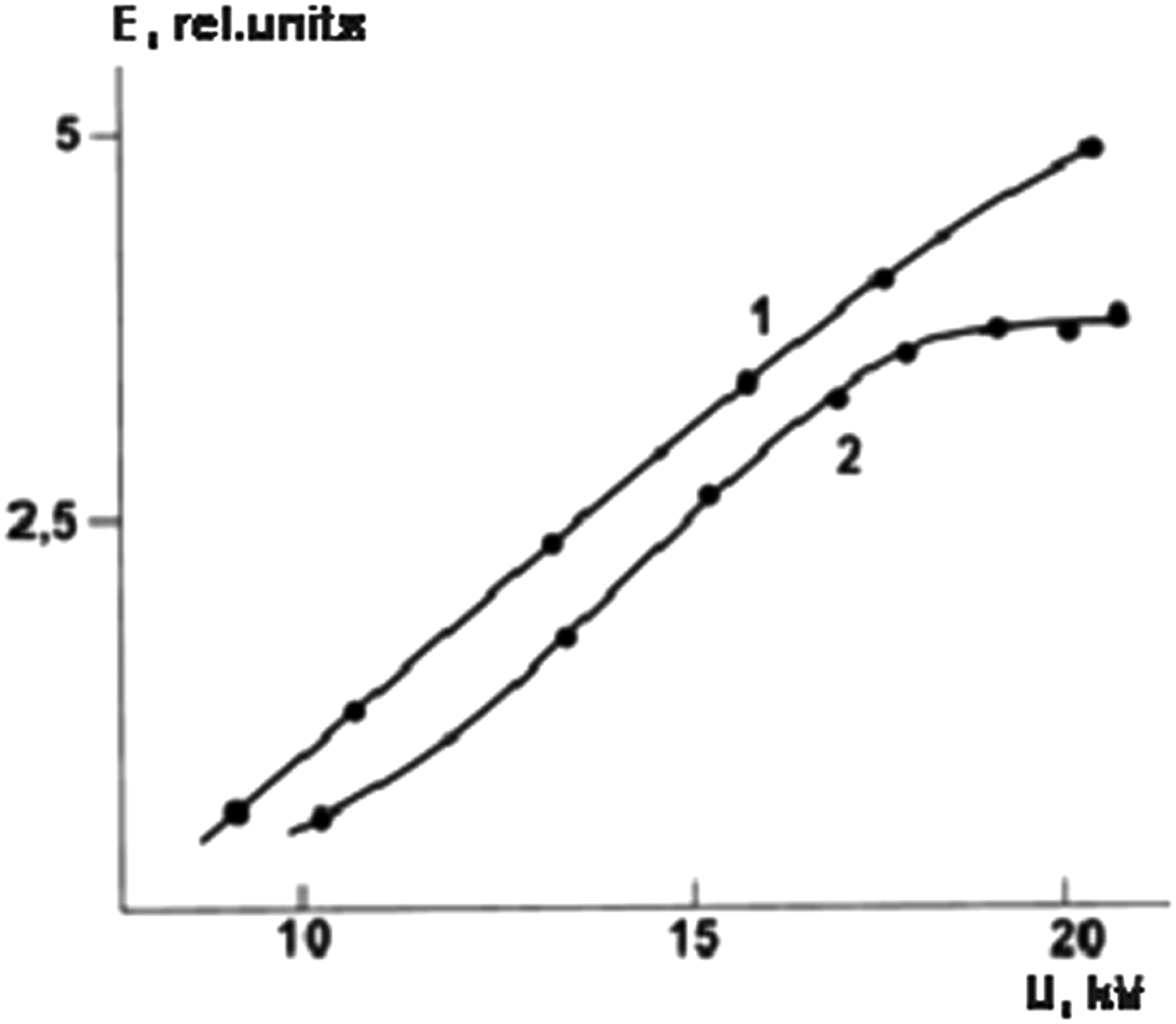
Figure 9 shows the dependence of the output laser energy E (LU No.1) on the voltage U on reservoir capacitors at various Фt thermal neutron fluxes. The minimum value of thermal neutrons flux is Фt = 1011 n/Cm2s for laser operation. The decrease of laser output parameters (~15%) observed in the Figure with an increase of Фt from 1012 to 1013 n/Cm2s is associated with deterioration of LU parameters (in particular, capacitors) as a result of radioactive heating in the active zone of the nuclear reactor (Batyrbekov, Reference Batyrbekov2008e).
Dependence of laser radiation output energy (1–3) and efficiency (4) of the laser on the voltage value on reservoir capacitors for various flows of thermal neutrons Фt (n/Cm2s): 1, 1011; 2 and 4, 1012; 3, 1013.

Figure 10 shows the results of laser tests on an Ar:Xe = 100:1 mixture at 2 atm total pressure with ionization by the products of U235(n,p)T nuclear reaction (LU No. 2). The maximum values of specific energy have been achieved at 20 kV charging voltage and 1014 n/Cm2s thermal neutrons flux. The use of an active mixture on He and a longer pumping time made it possible to increase the laser output parameters for 1.5 orders of magnitude.
Energy of laser radiation as a function of charging voltage at Фt = 3 × 10¹³ (1) and 1014 (2) n/Cm2s.
The same paper reported on studies of laser operation at high temperatures of the active medium. It was established that increasing the temperature of the active medium up to 650°C within the measurement error did not affect the laser output parameters.
The CNP laser on atomic XeI transitions, unlike the previously studied CO, CO2, and CNP excimer lasers, employs as an active medium a mixture of inert gases only; that is, the problem of active medium degradation does not exist. Lasing was produced on high electronic transitions allowing operation at high temperatures (>650°C) of the active medium (Batyrbekov, Reference Batyrbekov2008f; Reference Batyrbekov2008g).
Lasers with Radioisotope Ionization
The first attempt to create a non-self-sustained electrical discharge laser was made in 1978 (Bigio, Reference Bigio1978), but the use of low-activity Am245 sources, located on one side of the electrode, did not allow lasing at gas pressures above 0.5 atm. The creation of a pulsed CO2 laser with active medium ionization by plutonium α-radiation was also reported previously (Lavrenuyk et al., Reference Lavrenuyk, Podmoshenskiy and Rogovtsev1983; Glushchenko & Lavrenyuk, Reference Glushchenko and Lavrenyuk1986).
Lasing on Xe and Ne atomic transitions with active medium ionization by α-particles was first achieved in the INP NNC RK (Batyrbekov et al., Reference Batyrbekov, Batyrbekov, Hasenov and Tleuzhanov1987e; Reference Batyrbekov, Batyrbekov, Danilychev and Nazarov1989b). The scheme with transverse excitation with discharge of low inductance capacity through the ionized gap was used in the laser. Twenty sources of РT210 were used as the ionization sources, with 3 × 10¹⁰ Bq total activity. For the mixture of He(1.5 Atm)-Ar(0.5 Atm), the ionization rate was 2 × 10¹²/Cm3/s, and the electron density was n e ~ 2 × 10⁹/cm3. The unit allowed using UV radiation for ionization purposes.
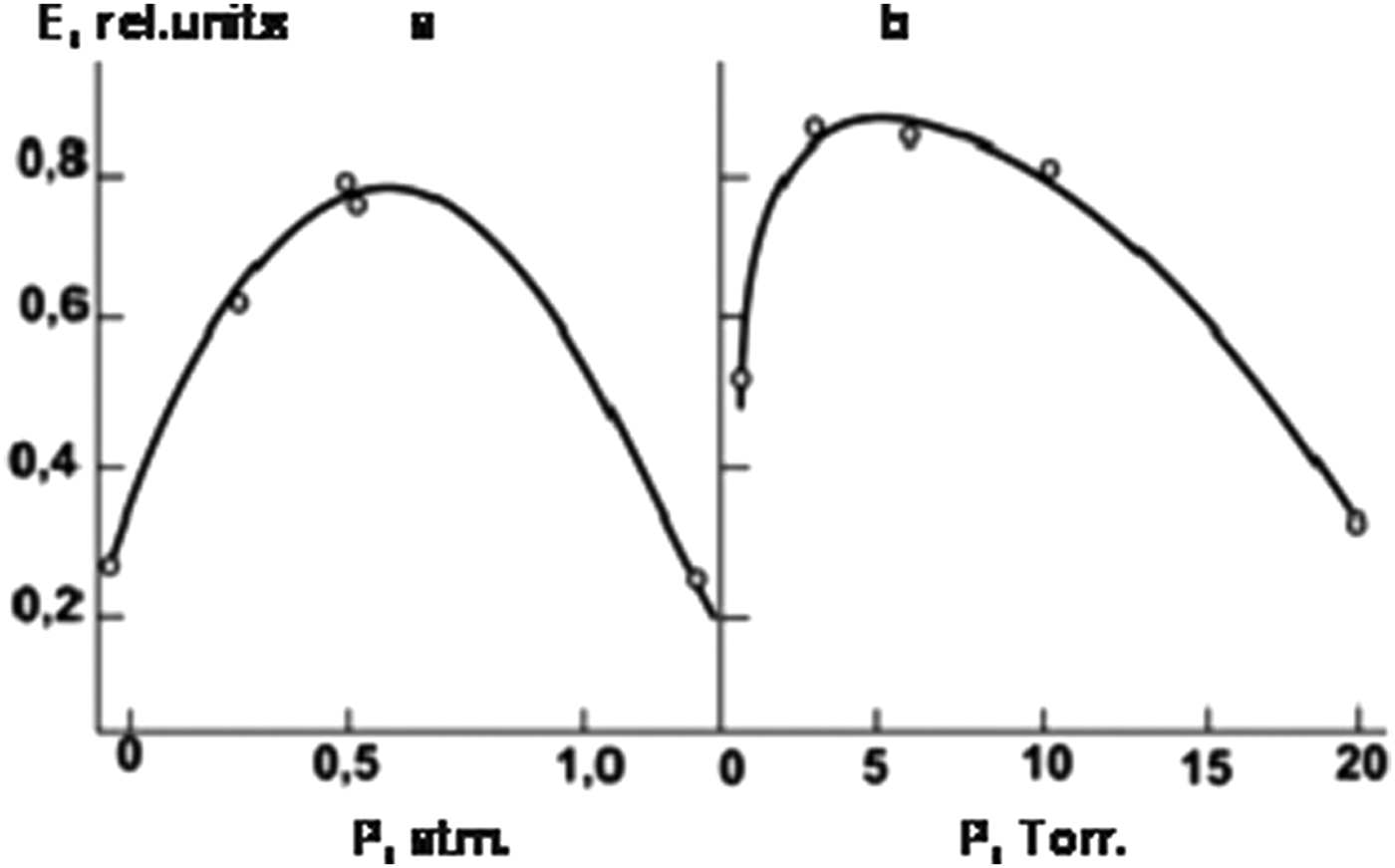
Lasing was produced on the XeI 5d-6p transition in the He-Ar-Xe mixture (>40% of the energy was for λ = 1.73 µm). The results of the mixture optimization are shown in Figure 11. The mechanical strength of the chamber did not make it possible to obtain the maximum output parameters of the laser at pressure rates above 2 atm.
Dependence of laser radiation energy on argon partial pressure in the Не–Ar–Xe (5 ТTrr) mixture (full pressure of the mixture is 1.8 atm (а) and xenon partial pressure in the mixture He(1.3 atm)–Ar(0.5 atm)–Xe (b).
Lasing with λ = 595.2 nm on the 3p′[1/2]0-3s′[1/2]1 NeI transition was produced only in the mixture with neon and hydrogen (Batyrbekov et al., Reference Batyrbekov, Batyrbekov, Danilychev and Nazarov1989b). The influence of additives H2, Ar, D2 on the output energy of laser radiation is shown in Figures 12 and 13. The need for the presence of hydrogen in neon mixtures with argon (which, like H2, is selectively involved in emptying the lower laser level) in addition to cooling of the electrons involved in dissociative recombination of molecular ions is explained by the influence of H2 on the degree of vibrational excitation of Ne2+ molecular ions, which affects the population of the 3p′[1/2]0 (Kopai-Gora et al., Reference Kopai-Gora, Miskevich and Salamaha1990; Sinyanskiy, Reference Sinyanskiy1995) state.
Dependence of laser radiation energy with λ = 585.2 nm on the additives Ar (1,2), D2 (3,4), and Н2 (5) to the mixtures 190 Torr Не+ [75 Torr Ne + 15 Torr (H2 + Ar) (1), 15 Torr (H2 + D2) (3), 15 Torr H2 (2,4,5)].

Dependence of laser radiation energy with λ = 585.2 nm on additives H2, 1; D2, 3; and Ar, 2 in the mixture of He:Ne:H2 = 190:75:10 Torr.

These experiments with radioisotope ionization failed to obtain lasing on transitions of excimer molecules, although using UV ionization helped in obtaining lasing on XeF and XeCl transitions. This is due to an insufficient degree of ionization of the working medium.
The experiments performed with the excimer lasers with ionization by radiation of the stationary nuclear reactor showed that the minimum required value of thermal neutrons flux is 1012 n/Cm2s, which corresponds to the density of negative ions n n ≈ 1010/Cm3 (Batyrbekov, Reference Batyrbekov1994). In order to produce such a degree of ionization, it is necessary to have Po210 of ~1010 Bq/Cm2 specific activity.
Table 2 presents the calculated S ionization rates and concentrations of electrons and negative ions n e and n n during the use of gaseous β-emitters, Kr85 and Ar42, for volume ionization of electric discharge lasers active media. Some advantages of the proposed continuous volume source of laser mixtures ionization are the following:
(1) a high homogeneity of gas ionization, even higher than in the case of using nuclear reactions of the He3(n,p)T or U235(n,f)F type;
(2) no restrictions on system size and gas pressure, because the larger they are, the higher the ionization homogeneity;
(3) the maximum efficiency (~60%) for electric discharge lasers was obtained for CO-Ar (Mann, Reference Mann1976).
Calculations for the gaseous β-emitters Kr85 and Ar42 used for volume ionization of laser active media

CONCLUSION
Current progress in the field of direct conversion of the energy of nuclear reactions into the energy of laser radiation indicates the possibility of nuclear-excited high-power laser systems with 0.3–1 MJ per pulse and 0.25–0.3 Hz pulse repetition rate (Batyrbekov, Reference Batyrbekov2008a). Further improvement of the characteristics of the nuclear-optical converter is primarily dependent on the achievement of corresponding efficiency of nuclear energy conversion into laser radiation, that is, it implies a further search and study of highly productive active media for nuclear-excited sources of non-equilibrium optical radiation – direct nuclear pumped lasers. An obvious way to increase the efficiency of such a transformation is by the reduction of the wavelength and the potential of buffer gas ionization.
The kinetics study of the main plasma-chemical processes occurring in nuclear-excited laser plasma is of equal importance. The most promising, in terms of nuclear energy conversion efficiency, are the atomic recombination lasers on allowed bound–bound electronic transitions; this is primarily determined by the low temperature involved in recombination of molecular ions, secondary electrons in nuclear-induced plasma and large sections of stimulated transitions.
However, the above-mentioned shortcomings in systems with direct conversion of nuclear energy into laser radiation encourage further parallel investigations of lasers with CNP; the presence of active media capable of working in the conditions of both DNP and CNP also remains very important.
Traditionally, the study of lasers with DNP and CNP was performed independently by different research groups. Therefore, the concept developed in Kazakhstan for studies of the active media for lasers capable of working both with DNP and CNP is of interest. This approach allows utilizing the advantages and eliminating the disadvantages of both the nuclear pumping methods. The need for the simultaneous use of either DNP or CNP is determined by their various practical applications.