Istanbul is a large metropolitan city, with a population estimated at 15 million. The city is located in both Europe and Asia, and extends to both sides of the Bosporus strait and the shore of the Sea of Marmara. 1 The city’s main airport was previously the Istanbul Atatürk Airport; this was closed on April 6, 2019, and its function was taken over by the new Istanbul Airport, which can accommodate 200 million passengers a year. Reference Karadoğan2 This new airport is relatively far from the center of the city, and is close to the Black Sea, thus opening up space for the development of new parts of the city. It can, therefore, be expected that the population of the city will increase by several million before long.
Turkey is tectonically active, and this includes the Marmara Sea region, one of the most active regions in Eurasia, which is home to one-third of the Turkish population. The long North Anatolian Fault (NAF) has a branch under the Marmara Sea. The NAF is located in the northern territory of Turkey and is over 1000 km long from east to west, and there have historically been many strong earthquakes along the line of this fault. Following 2 destructive earthquakes in 1999, seismic activity in the western extension of the NAF system has increased over the past decade. These earthquakes, in Kocaeli and Düzce, resulted in major stress drops in the NAF’s western segment, where it spreads under the Marmara Sea. Reference Kalkan, Gülkan and Öztürk3,Reference Picozzi, Strollo and Parolai4
An earthquake in Istanbul could cause very serious damage, 5 and an estimate of the numbers of collapsed houses, seriously injured people and deaths in many scenarios is very high. Thus, both the transportation of patients and the running of hospitals, including operating rooms, require good organization and management. This study presents an analysis of the capacity of the emergency transportation system on the Asian side of Istanbul.
There are several large cities in a situation similar to Istanbul, and San Francisco, Los Angeles, Tehran, and Tokyo are good examples, as they all face the possibility of a serious earthquake. Reference Naghii6 Hence, if certain principles and methods can be applied to Istanbul, then similar approaches can be applied in other cities.
An earthquake is a natural disaster that has a known location; however, its time is unknown, and its occurrence is sudden, meaning that both the predisaster and postdisaster periods are essential. 7 It is possible to implement measures in the predisaster period that can decrease the effects of a disaster. In addition, the postdisaster period is a very busy time for emergency and relief organizations, and they need to be able to apply policies that have been developed much earlier, in the predisaster period, and to rely on actions that have been taken in this period.
If human lives need to be saved but it is not possible to save everybody, then this presents a serious problem to which ethical principles should be applied. The main ethical principles that apply to the provision of health services in postdisaster periods are nonmaleficence, beneficence, justice, and respect for autonomy. Reference Karadag and Hakan8 According to the World Medical Association’s Statement on Medical Ethics in the Event of Disasters, “In selecting patients who may be saved, the physician should consider only their medical status, and should exclude any other consideration based on nonmedical criteria.” 9 The underlying technical problem is that the capacity of the emergency services is smaller than the demand for health care. The ethical principle of justice applied in this study involves maximizing the number of lives saved. Life-saving medical care has 2 main phases: transportation to the hospital, and application of medical treatment. This study is devoted to the first of these phases, ie, transportation, and maximizing the number of working operating rooms is the topic of another study. Reference Shavarani, Golabi and Vizvari10 A further ethical principle applied in this study is beneficence, which means ensuring that there is no region without services. Furthermore, it must be clear which unit is responsible for which patient, at the level of both hospitals and ambulance vehicles.
The International Federation of Red Cross and Red Crescent Societies has defined disaster management as “the organization and management of resources and responsibilities for dealing with all humanitarian aspects of emergencies, in particular preparedness, response and recovery to lessen the impact of disasters.” 11 Hence, humanitarian logistical activities include both the periods before and after the disaster. According to the World Health Organization (WHO), a disaster is an incident that disrupts standard living situations and leads to a level of agony that surpasses the ability of a community to conform. 7
Disaster management (DM) is primarily the responsibility of the state. Many countries and states have published DM plans, including California, whose plan can be considered one of the best, 12 and master plans for earthquakes have been studied by a group of universities. Reference Ansal, Özaydın and Edinçliler13 National or state-level DM plans apply a top-down approach, and cover all kinds of disasters that can occur in a country or state. They define the mechanism and panels for decision making in case of disaster; however, these plans do not deal with the particular methods (including algorithms) that should be applied in postdisaster periods during which emergency activities take place. In view of this, we suggest a method for scheduling the transportation of seriously injured persons to hospital.
Every country, state, and city must be prepared for disasters, and this is especially important if a particular place is very likely to experience a disaster. Preparation includes assigning rescue services, building up stock of relief items, and introducing and practicing the methods that will be applied in the predisaster period. The postdisaster period of an earthquake generates many different problems that need to be solved. Immediate important tasks include the distribution of relief items, saving people trapped under the ruins of collapsed buildings, assessment of the damage in the city, communication between people, debris collection, etc.
Several publications have focused on the processes of life-saving and evacuation of patients in a postdisaster period. A recent study by Jin et al. (2014) developed a logistical model to transport injured people with various injuries and survival probabilities. Reference Jin, Jeong and Kim14 Liu et al. (2011) proposed a mathematical model for vehicle scheduling to rescue victims from terrorist attacks by choosing the most suitable available hospital for each victim based on the rescue priority. Reference Liu, Yu and Sui15 Amadini et al. (2013) proposed an algorithm and a software tool to assign the victims of a disaster to hospitals and schedule emergency vehicles for their transportation, although without addressing any of the ethical issues involved. Reference Amadini, Sefrioui and Mauro16 Ozdamar (2011) described an efficient planning system for helicopter operations in the postdisaster medical care and evacuation of injured persons. Reference Ozdamar17 The problem of transporting seriously injured people to hospital is one of the most important tasks in a postdisaster period. This problem was raised by Shavarani and Vizvari (2018), who presented some models and discussed their mathematical properties, Reference Shavarani and Vizvari18 although no general solution was provided. This study analyses the capacity of such a system.
The main modeling and algorithmic tool used in this study is scheduling on identical parallel machines. Scheduling is mainly used to determine the time or order of operations, but can also be used to assign tasks to machines.
In the case of parallel machines, a single machine processes each task. If the machines are identical, then the processing time of each job is the same on each machine. The most famous problem in the area of identical parallel machines is minimization of the makespan,
Reference Pinedo19
ie, the completion time of the last job. Another quantity that is also important in the transportation of injured people is the total waiting time, which is referred to as the work-in-process (WIP) in scheduling theory.
Reference Conway, Maxwell and McClain20
These problems are denoted by
 $P||{C_{max}}$
and
 $P||\sum {C_j}$
in the usual notation of scheduling theory, where P stands for identical parallel machines, and Cmax and Cj are the makespan and completion time of job j, respectively.
Reference Pinedo19
These problems are NP-complete, which in practice means that fast methods give only good approximate solutions, rather than guaranteed optimal ones.
Intensive investigations of the use of identical parallel machines were first carried out by Graham in 1969.
Reference Graham21
This study introduced list scheduling (LS) heuristics for
$P||{C_{max}}$
and presented performance ratios for the general LS and the longest processing time (LPT) heuristics with the objective of minimizing the completion time. Another popular heuristic, called multi-fit, was also introduced,
Reference Coffman, Edward and Garey22
based on the first-fit decreasing (FFD) method, which was used to fit jobs to bins with fixed capacity. For scheduling problems, the multi-fit approach has been implemented to determine the minimum machine capacity using a binary search to assign all n jobs to m machines, ie, to assign the available jobs to the minimum number of machines.
Although these scheduling optimization strategies have performed well in terms of improving transportation performance, they are rarely applied in the context of humanitarian relief.
Population
The city of Istanbul has been a major population center, with a prominent role in cultural and commercial activities, for at least 2 millennia. Although Istanbul is a very old city, with a history of approximately 2500-3000 years, it has grown very rapidly, especially since the 1950s, when the population was 6.6 million; this had increased by approximately 127% by the end of 2015. Reference Sevimoğlu23
Rapid population growth has several negative effects. Population density and crowding cause environmental, noise, image, and light pollution, while squatters and unplanned urbanization can cause problems with infrastructure, transportation, health services, etc. Reference Saritas24
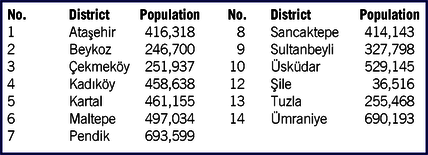
The Adalar district consists of small islands in the Marmara Sea, meaning that ambulance vehicles cannot reach it from other parts of the city. However, its population is small, and it was, therefore, excluded from this analysis. Table 1 lists the populations of the main districts in Istanbul. 25
Data for Districts Within Istanbul

Hazards and Vulnerabilities
Throughout history, the Marmara region has been the site of numerous destructive earthquakes in Northwestern Turkey. The occurrence of the 1999 Kocaeli and Düzce earthquakes at the eastern end of the Marmara region underscored the need for a state-of-the-art earthquake hazard assessment. Reference Erdik, Demircioglu and Sesetyan26 The presence of a single major tectonic entity crossing the Marmara Sea has been clearly delineated by recent extensive geophysical studies.
Geologically, Turkey is located in the boundary area, where the Arabian and African Plates run north toward the Eurasian Plate. There are several factors affecting the earthquake hazard in Istanbul, including the presence of the NAF, which forms a complex fault system in the Marmara Sea region. Reference Hubert-Ferrari, Armijo and King27
Tsunamis are unpredictable events, and may be caused by any large-scale sea floor disturbance, such as a fault, landslide, or volcanic eruption. A tsunami can spread in any direction and, thus, pose a risk to any vulnerable coastline, depending on the location of the source, the path of propagation, and the near-shore morphology of the sea bed, which determines both the shore wave path and the characteristics of the wave run-up. Although historical records of near-field tsunamis are often incomplete due to inadequate data and data of questionable quality, particularly for older events, it is known that, over the past 1600 years, at least 21 tsunamis have been observed in the region of Istanbul, almost half of which have affected its coasts. Reference Alpar, Altınok and Gazioğlu28
Historical studies show that more than 90 tsunamis have occurred in Turkey in the past 3000 years, over more than 8300 km of coastline. They have been observed in all of the seas surrounding the country, and especially in the Marmara Sea. In addition, over the past 4100 years, more than 300 destructive earthquakes have occurred in the Sea of Marmara, 40 of which have caused tsunamis. 29
Current Situation
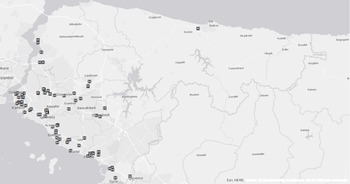
At present, there are a total of 219 active emergency vehicles in Istanbul, and the mission time for an emergency vehicle is approximately 20 min, Reference Yilmaz, Karakuş and Çevik30 although this time is expected to increase in an emergency. The total number of hospitals on the Anatolian side of Istanbul is 74. Figure 1 shows the locations of these hospitals on a map of using Universal Transversal Mercator (UTM) projection, where distances are registered using WGS84 (World Geodetic System) spheroid and datum, UTM Zone 35 North. ArcGIS software was used for the coordination.
Hospitals on the Anatolian Side of Istanbul.

Problem Definition and Basic Assumptions
The primary aim of this study is to analyze the capacity of the emergency transportation system on the Asian side of Istanbul in the case of a serious earthquake. The 2 sides of the city have few connections and are relatively far apart, meaning that it is not reasonable to transport injured people by means of bridges. The Asian side alone is equivalent in size to a metropolitan city.
Two ethical principles are applied, as follows: (i) The number of people saved should be maximized; and (ii) There should be no part of the city without emergency services.
There are several possible approaches to this problem. If a single exact model is developed, then the numerical version of this model for a real case becomes extremely large and unpractical. The problem must, therefore, be decomposed into smaller problems. The main features of the approach applied in this study are as follows: (a) Each hospital has a particular region of responsibility, and all injured people within this region are transported to this hospital; (b) Emergency vehicles are assigned to particular hospitals; and (c) Each hospital is responsible for controlling transportation within its region of responsibility.
METHOD
The regions of responsibility of the hospitals are determined using a Voronoi diagram, Reference Aurenhammer and Klein31 and transportation within a given region is arranged using scheduling methods on identical parallel machines. These methods are discussed in the “Scheduling Background for the Transportation of Patients” section.
Voronoi Diagram
The concept of Voronoi diagrams dates back to the 17th century, and is different from other forms of computational geometry. It was first used in astronomy; space was partitioned into convex regions, each consisting of matter revolving around a particular fixed star.
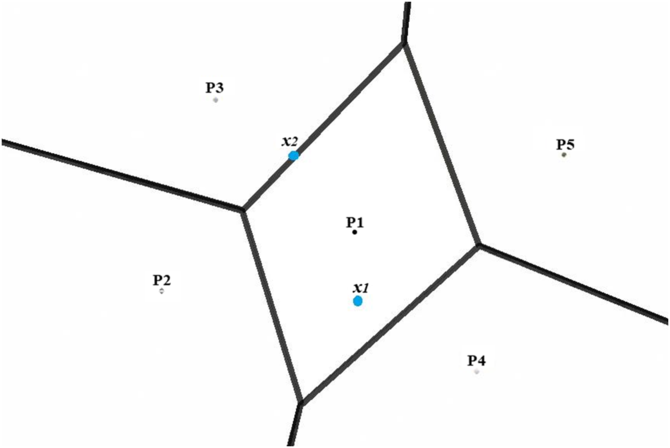
The general notion of a Voronoi diagram is as follows: let M be a space, and S ⊂ M a finite set of points. The space M is partitioned among the points S such that the region p ∈ S consists of the points in M closest to p among the points in S . Notice that the Voronoi diagram depends on the distance used; thus, a set S may have several Voronoi diagrams. Voronoi was the mathematician who originally defined this concept. A dual structure is one with a connection between the locations of any 2 points with regions sharing a boundary. Reference Aurenhammer and Klein31
In the present application, the Voronoi diagram is a collection of regions that divide up the plane. Each region corresponds to one of a finite number of points, and all the space within a given region is closer to the matching point than to any other point. In the event that there is no single nearest point in the set S, this indicates the location of a boundary. As shown in Figure 2, point x 1 is closer to p 1 than to any other of the enumerated points, while x 2 , which is on the boundary between p 1 and p 3, is equidistant from both of these points.
A Basic Voronoi Diagram. ArcGIS software32 was used to divide a map of the Anatolian side of Istanbul into regions to create a Voronoi diagram. Seventy-four regions were obtained from the map.

Scheduling Background for the Transportation of Patients
The concept of scheduling on identical parallel machines will be used for the transportation of patients to hospitals. In the basic model of parallel machine scheduling, there are n jobs and m machines, and each job is processed by only 1 machine. The machines are identical if and only if the processing times are independent of the machines and are dependent only on the job. A feasible solution to a given problem instance assigns jobs to machines and determines the time interval of the process of each job. These time intervals may not overlap on the same machine. If Cj is the point in time by which job j has finished processing, then the makespan or length of the schedule is Cmax = Cj. Reference Pinedo19,Reference Sabti33,Reference Shmoys, Wein and Williamson34
All the machine scheduling terms given below are explained in Pinedo (2015) Reference Pinedo19 : Completion time (Cj): The time by which job j is complete; Makespan: The total amount of time required to complete a group of jobs. In the literature, makespan is denoted by Cmax = maxCj; and Processing time (pij): The time required for the processing of job j to be complete on machine i.
The dispatching rule Reference Haupt35 is the method by which the next job/operation is selected when 1 job/operation is complete. Several rules are used in this study, as follows: Longest processing time first (LPT): This rule orders the jobs in decreasing order of processing time. Saving jobs with short processing times for later is advantageous, because these jobs are useful in creating a balanced workload toward the end of the schedule. Shortest processing time first (SPT): Jobs are ordered in increasing order of pj. And Earliest due date first (EDD): This rule aims to minimize the maximum lateness among the jobs waiting for processing. The job with the earliest due date is selected to be processed next. In a single machine setting, with N jobs available at time zero, the EDD rule minimizes the maximum lateness.
LPT List SchedulingReference Graham21
List scheduling is a method of assigning jobs to machines. LPT list scheduling on identical parallel machines assigns jobs to machines using LPT order, and each job is assigned to the machine that is currently least loaded. The method can be illustrated with a small example. We assume that there are 2 machines, M1 and M2, and 5 jobs with processing times 7, 6, 5, 3, and 1, respectively. The LPT list scheduling solution is as follows: the load on M1 is 7, 3, and 1; and the load on M2 is 6 and 5. Notice that the job with processing time 5 is the third in the LPT order; when it was assigned by the algorithm, the loads on M1 and M2 were 7, and 6, respectively. Because M2 had the smaller load, the job was assigned to M2. The performance ratio of LPT list scheduling is Reference Graham21
 $${{{C_{max}}\left( {LPT} \right)} \over {{C_{max}}\left( {OPT} \right)}} \le \;{4 \over 3} - \;{1 \over {3m}}$$
where m denotes the number of machines.
WIP QuantityReference Conway, Maxwell and McClain20
WIP Reference Conway, Maxwell and McClain20 represents the total waiting time of the jobs. Each job waits until it is completed; hence, the total waiting time is the sum of the completion times. Let p(j) denote the processing time of the job in the jth position in the sequence of jobs on a single machine. The total completion time on a single machine can be expressed as
 $$WIP = \mathop \sum \nolimits_\;^\; {C_j} = n{p_{\left( 1 \right)}} + \left( {n - 1} \right){p_{\left( 2 \right)}} + \ldots + 2{p_{\left( {n - 1} \right)}} + {p_{\left( n \right)}}$$
This suggests that there are n coefficients n, n−1, …, 1 to be assigned to n different processing times. The highest coefficient n is assigned the first processing time, n−1 the second processing time, and so on. This suggests that SPT gives the minimal WIP quantity on a single machine. Reference Pinedo19
Model and Solution Method
This study analyzes the performance of the emergency system on the Asian side of Istanbul. The available current and future capacities are smaller than the potential demand, and in the case of a real earthquake, the situation is dynamic, with calls for transportation arriving randomly at the center. This means that there is no optimal solution, because the constraints are constantly changing; a solution that was optimal a short time ago quickly becomes nonoptimal. It is, therefore, not appropriate to develop a very large-scale mathematical model, because the model would need to be changed when the constraints changed, and the numerical solution of the model would have to be restarted, thus wasting time.
The decisions that must be made are as follows: (1) Which hospital is responsible for an injured person? (2) Which vehicle is responsible for transportation? and (3) At what time will transportation take place?
The capacity of the system is analyzed in a static situation, meaning that all of the demands are known at time zero; because the decision-maker has more information than in the dynamic case, better decisions can be made. However, even the static version of the problem is too large for exact optimization, and a decomposition method must be applied. Additional methods are needed to solve the resulting sub-problems.
The following assumptions are made: (a) The vehicles are identical; (b) The vehicles work independently of each other, even in the case where they belong to the same hospital; (c) The jobs are nonidentical (ie, jobs have different transportation times for each vehicle); (d) Each vehicle can process only 1 job at a time; (e) Each vehicle is available at the time when the disaster occurs (ie, at time zero in the language of scheduling theory); (f) Preemption of a job (ie, temporary stopping of transportation), and vehicle breakdowns are not allowed; and (g) Setup times are independent of the job sequence and are included in the transportation times.
Decision (1) involves decomposition, which is achieved using a Voronoi diagram. Each hospital has a region of responsibility, consisting of that part of the city that is closest to the hospital in question. Hospitals have emergency vehicles, also called ambulances, and each mission starts and finishes at the hospital. If a hospital has more than 1 vehicle, then decision (2) means that cases must be assigned to vehicles. Because the vehicles are assumed to be identical, this is a special case of the problem of assignment of jobs to identical parallel machines, and scheduling theory can be used. Here, we use LPT list scheduling. Vehicles work independently of each other, and the order of transportation of patients is determined by the SPT rule. In the case of a large earthquake in Istanbul, patients will need to be taken to hospital as soon as possible. This method uses a bi-objective approach in which the makespan is minimized using LPT list scheduling, and the WIP, Reference Conway, Maxwell and McClain20 ie, the total waiting time of patients, is minimized using the SPT rule.
Istanbul
According to a study by the Japanese International Cooperation Agency 5 in coordination with the Istanbul Metropolitan Municipality (IMM), the human toll is likely to be (model A) 73,000 deaths and 120,000 severely injured. The same study suggests that the total number of heavily damaged buildings is likely to be 51,000, ie, 7.1% of the total number of buildings in the area under study. The number of moderately and heavily damaged buildings that will need to be repaired before they are reoccupied is 114,000. The results show that the southern area of Istanbul will be more heavily damaged than the northern area, due to the distribution of the earthquake’s motion. 5
Voronoi Diagram
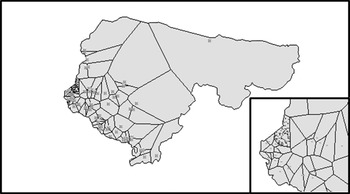
The Anatolian side of Istanbul is divided into 74 regions using a Voronoi diagram. In other words, each hospital is assigned a particular region to serve patients (Figure 3).
Voronoi Diagram of Hospitals on the Anatolian Side of Istanbul.

As can be seen from Figure 3, Başkent University Hospital is chosen as the area under study. The reason for this is that Başkent University Hospital is located in Üsküdar, which has a high population. This region is also larger than most of the other regions.
Following division into regions, 100 patients were randomly assigned to each region (Figure 3). Each patient was located at a certain distance from the hospital, which was calculated based on the coordinates provided by ArcGIS.
After calculating the distances, the processing times were obtained for each patient. To determine the WIP, 2 rules were used, as follows: Patients were assigned to vehicles using LPT list scheduling; and SPT ordering was applied to each vehicle.
RESULTS
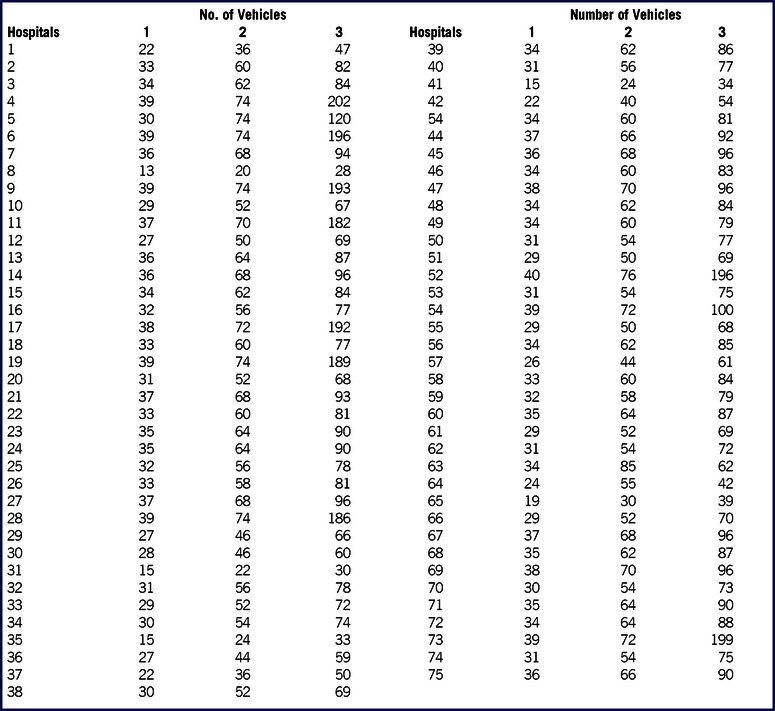
Başkent University Hospital can be considered a typical example. Table 2 shows the results for the region of responsibility for each hospital, where 100 patients were randomly allocated to each region using ArcGIS software and the processing times were calculated.
Number of Patients Transported to Hospital Within 3 h

Single Vehicle
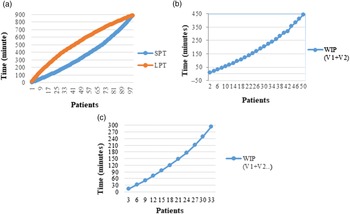
In this case, a single vehicle was put into service for 100 patients, and the SPT and LPT transportation orderings were compared (Figure 4 a). The values for the WIP using SPT and LPT ordering were 36,448.13 and 52,995.05 min, respectively, meaning that the value of the WIP for LPT was higher than for SPT. For instance, using the SPT rule, 68 people could be saved in 481.558 min, while 697.118 min would be required to save 68 people using the LPT rule. SPT gives a better solution than LPT for a single vehicle, as expected.
Value of WIP for 100 Patients Based on LPT Ordering for (a) Single Vehicle; (b) 2 Vehicles; and (c) 3 Vehicles.

Two Vehicles
In this case, 2 vehicles were used to transport 100 patients to the hospital. The LPT rule was applied for the assignment of patients to vehicles (Figure 4b). Values for the WIP were found to be 9210.8 and 9236.3 min for the first and second vehicles, respectively. The time required to transport all the patients to the hospital was reduced.
For example, 90 patients can be saved by 2 vehicles in 369.798 min. It is worthwhile to compare this result with the transportation time of the first 45 patients with 1 vehicle, which needs 285.1 and 518.4 min for SPT and LPT orders, respectively.
Three Vehicles
The LPT rule was applied to the processing times, and the values for the WIP for the 3 vehicles were found to be 4396.8, 4399.0, and 4240.8, respectively (Figure 4c).
For instance, 84 patients could be saved by 3 vehicles in 223.460 min, although 331.036 min were required for 2 vehicles. On the other hand, 661.5 min are required in SPT ordering in the case of a single vehicle.
The loads on the vehicles were 293.9, 293.9, and 297.9 min. These loads are also close to one another in the case of 2 vehicles. The loads were determined by LPT list scheduling. Based on the performance ratio of this method, we could expect much higher differences in the loads.
DISCUSSION
Table 2 shows the number of patients transported to hospital within 3 h for each number of ambulances assigned to the hospitals (ie, 1, 2, and 3 ambulances).
It can be seen from Table 2 that as the region becomes larger, fewer patients can be transported within 3 h. In addition, the more vehicles used, the higher the number of patients that can be transported.
The total waiting time depends on the size of the region, the number and capacity of the vehicles, and the number of patients. In the case of 3 vehicles with single-patient capacity and 100 patients, the total waiting time in the region of Başkent University Hospital was 13,036 min. The average waiting time was 2 h and 10 min, and the maximal waiting time was 2 h and 58 min.
The number of available emergency vehicles in Istanbul is low, Reference Yilmaz, Karakuş and Çevik30 as mentioned in the “Current Situation” section, and it is, therefore, important to use this limited capacity in an effective way. In the following, a new model is presented for the distribution of emergency vehicles among hospitals. The second ethical principle, in which all regions should be served, is applied in this model, and each hospital is allocated at least 1 vehicle. The results of the model are shown in Table 2. Similar results of the simulation of the postdisaster situation can be generated if more data are available.
The model is based on the following assumptions: Each vehicle is assigned to a hospital; A hospital may have at least 1 and at most 3 vehicles; and The objective is to maximize the number of people who are transported to hospital within the first 3 h.
The notation used for the coefficients and variables is as follows: tij number of injured persons transported to hospital within the first 3 h if hospital i has j vehicles (as shown in the elements of Table 2); V total number of vehicles; xij binary variable that takes the value 1 if and only if hospital i has j vehicles.
The objective is to maximize the number of people transported:
 $$\max \mathop \sum \limits_{i:} \left( {{t_{i1}}{x_{i1}} + {t_{i2}}{x_{i2}} + {t_{i3}}{x_{i3}}} \right)$$
All vehicles are used:
 $$\mathop \sum \limits_{i:} \left( {{x_{i1}} + 2{x_{i2}} + 3{x_{i3}}} \right) = V$$
The number of vehicles allocated to each hospital is between 1 and 3:
 $$\forall i:\;{x_{i1}} + {x_{i2}} + {x_{i3}} = 1$$
For the sake of completeness, the binary property is mentioned once more:
 $$\forall i\forall j:\;{x_{ij}} = 0\;{\rm{or}}\;1$$
This model needs to be solved in the predisaster period, as the application of the optimal solution is an important part of disaster preparation. The values tij can be taken from Table 2 or its equivalent. The time limit (ie, the 3-h parameter in Table 2) can be changed to find the best policy for a city. Similarly, the value V can be changed to determine the optimum value for the number of vehicles.
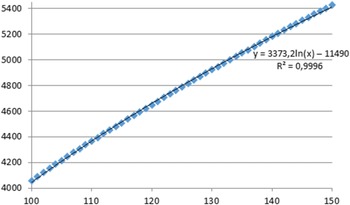
Calculations were carried out based on Table 2, and the locations of the injured persons were allocated randomly. If the total number of ambulances is 100, then 4060 people can be transported to hospital within the first 3 h; if the number of vehicles is increased to 150, then 5427 persons can be saved (see Figure 5).
Number of People Transported to Hospital for Varying Vehicle Numbers.

CONCLUSIONS
The emergency transportation capacity on the Asian side of Istanbul was analyzed for the case of a serious earthquake, and was shown to be much lower than the expected demand. It is, therefore, important to use this capacity in an efficient way. The transportation capacity and the total operating capacity of the hospitals should be approximately equal, because if one is significantly higher than the other, then the efficiency will be reduced. Transportation technology is expected to change in the near future; unmanned aerial vehicles will be able to transport injured persons, 36 and these will be faster than traditional ambulances and will be able to use more direct routes. However, the same methods can be applied to these vehicles.
Another important conclusion is that methods for decreasing the demand for transportation must be developed and applied. There are many ways to achieve this; for instance, mobile medical teams can be used to take care of injured people on the spot, meaning that they do not need transportation.
If the measures suggested in this study can be realized, then the people of Istanbul will be in a safer position. These are important considerations, because Istanbul is situated in a region where a serious earthquake is possible at any moment. In addition, the European side of Istanbul and the other towns surrounding the city cover a large area, and the total area of the city is expected to increase in the near future, because the main airport has been moved further away, and these aspects require further investigation.