Direct-to-consumer advertising (DTCA) of healthcare products refers to a variety of marketing practices based on a combination of information and promotion strategies directed at consumers through different media such as radio and television broadcasts, newspaper and magazine ads, and, more recently, through the Internet. The principal form of marketing used by the pharmaceutical industry is the distribution of free samples to physicians1
Ma J, Stafford RS, Cockburn IM, Finkelstein SN. A statistical analysis of the magnitude and composition of drug promotion in the United States in 1998. Clinical Therapeutics 2003;25:1503–17.
Gahart MT, Duhamel LM, Dievler A, Price R. Examining the FDA's oversight of direct-to-consumer advertising. Health Affairs 2003;Suppl Web Exclusives:W3-120-3.
See note 1, Ma et al. 2003; see note 2, Gahart et al. 2003; Hollon MF. Direct-to-consumer advertising: A haphazard approach to health promotion. JAMA 2005;293:2030–3.
Psychiatric and neurological illnesses are currently one of the main targets of prescription-drug DTCA, and, generally speaking, the Internet is having a substantial impact on the practice of psychiatry and neurology.4
Styra R. The Internet's impact on the practice of psychiatry. Canadian Journal of Psychiatry 2004;49:5–11; Hollon MF. Direct-to-consumer marketing of prescription drugs: A current perspective for neurologists and psychiatrists. CNS Drugs 2004;18:69–77.
Weissman JS, Blumenthal D, Silk AJ, Newman M, Zapert K, Leitman R, et al. Physicians report on patient encounters involving direct-to-consumer advertising. Health Affairs 2004;Suppl Web Exclusives:W4-219-33.
Berger M, Wagner TH, Baker LC. Internet use and stigmatized illness. Social Science and Medicine 2005;61:621–7.
See note 4, Hollon 2004; see note 5, Weissman et al. 2004.
Although DTCA has been most extensively discussed in the context of prescription drugs, the impact of DTCA promotion of healthcare products stretches well beyond traditional pharmaceuticals to medical devices,8
Illes J, Kann D, Karetsky K, Letourneau P, Raffin TA, Schraedley-Desmond P, et al. Advertising, patient decision making, and self-referral for computed tomography and magnetic resonance imaging. Archives of Internal Medicine 2004;164:2415–9.
New York State Task Force on Life & the Law. Dietary Supplements: Balancing Consumer Choice & Safety. Albany, NY: Department of Health; 2005.
Katsnelson A. Big biotech embraces direct-to-consumer advertising. Nature Biotechnology 2005;23:1193.
Gollust SE, Hull SC, Wilfond BS. Limitations of direct-to-consumer advertising for clinical genetic testing. JAMA 2002;288:1762–7; McCabe LL, McCabe ERB. Direct-to-consumer genetic testing: Access and marketing. Genetic Medicine 2004;6:58–9; Centers for Disease Control and Prevention. Genetic testing for breast and ovarian cancer susceptibility: Evaluating direct-to-consumer marketing—Atlanta, Denver, Raleigh-Durham, and Seattle. Morbidity and Mortality Weekly Report 2004;53:603–6; Editorial. Unapproved tests on a chip. Nature 2005;438:71.
Methods
Search Strategy
We performed Internet searches in June 2005 to identify Web sites advertising neuropharmaceuticals, neuroimaging services, and natural neuroproducts. Our search strategies were developed to capture the most relevant Web sites as defined below, and this goal was achieved using different approaches for the three categories of products. Exclusion criteria for all searches were: Web sites featuring research activities only, sites offering a service only available for physician or clinical laboratory use, and sites not appearing in English.12
See note 11, Gollust et al. 2002.
- Neuropharmaceuticals: Using RXList.com, we identified the 15 most
prescribed neuropharmaceuticals in the United States for 2004.13Using the name of the products, we then searched the Google search engine for the official Web site for each of the identified neuropharmaceutical.
NDCHealth. 2004. RxList, The top 300 prescriptions for 2004 by number of US prescriptions dispensed; c2005 (cited Dec 8). Available at: http://www.rxlist.com/top200.htm.
- Neuroimaging: For neuroimaging products, no list-equivalent to the
RxList exists. We therefore searched the first 200 results yielded by the
advanced search functions of Google, Yahoo, and AltaVista14for the following keywords without Boolean operators or quotation marks15
See note 11, Gollust et al. 2002; Illes J, Fan E, Koenig B, Raffin TA, Kann D, Atlas SW. Self-referred whole-body CT imaging: Current implications for health care consumers. Radiology 2003;228:346–51.
: brain scan, brain imaging, neuroimaging service, and SPECT (single photon emission tomography).See note 14, Illes et al. 2003.
- Natural neuroproducts: For natural neuroproducts, we used a similar strategy given that no official list of most used natural neuroproducts exists. However a single round of searches with the three search engines with the keywords “brain and natural product” yielded ample hits.
Coding
We developed a coding strategy that would yield an in-depth qualitative assessment of the Web sites. The strategy was adopted from previous studies of Internet DTCA of healthcare products16
See note 11, Gollust et al. 2002; see note 14, Illes et al. 2003; Bell RA, Kravitz RL, Wilkes MS. Direct-to-consumer prescription drug advertising, 1989–1998. A content analysis of conditions, targets, inducements, and appeals. The Journal of Family Practice 2000;49:329–35; Cho MK, Arruda M, Holtzman NA. Educational material about genetic tests: Does it provide key information for patients and practitioners? American Journal of Medical Genetics 1997;73:314–20.
See note 2, Gahart et al. 2003; U.S. General Accounting Office. Prescription Drugs: FDA Oversight of Direct-to-Consumer Advertising has Limitations (GAO-03177). Report to Congressional Requesters. Washington, D.C.: U.S. General Accounting Office; 2002; Food and Drug Administration. C.F.R. 21 vol. 4, Part 202. Washington, D.C.: U.S. Government Printing Office, 2001:72–81.
The Web sites were analyzed for
- Basic features: company name, name of product, language(s) used, type of product (neuropharmaceutical, neuroimaging, natural neuroproduct);
- Sections: sections specifically for patients, healthcare providers, caregivers;
- Components: company description, resource center, subscription to news, testimonial, news archives, self-evaluation tool, video, brochure, patient journal, polling;
- Product information such as use of product (health-related use or non-health-related use) and explanation of related diseases;
- Product presentation: cost of service, online purchase,
incentives18;
See note 11, Gollust et al. 2002; see note 14, Illes et al. 2004.
- Risks, safety, and confidentiality information: confidentiality
statement, privacy policy, statement on patient/consumer rights, risk
information19;
See note 16, Cho et al. 1997.
- Role of healthcare providers: reenforcing or minimizing20;
See note 17, U.S. General Accounting Office 2002.
- Referral: needed or not needed.
To test for statistical significance between neuropharmaceutical, neuroimaging, and natural neuroproduct Web sites for variables in categories 2–8 listed above, we first used Pearson chi-square tests to see whether there were any differences between the three groups (p < .05). Where the difference was significant, we used Fisher's exact tests to test for pairwise differences (p < .05) by group. Specific company names are withheld in the results and only the category of Web site is identified (e.g., neuropharmaceutical Web site, neuroimaging Web site, natural neuroproduct Web site).
Results
Search Yield
Our search methods yielded 15 Web sites for the most prescribed neuropharmaceuticals21
Three top neuropharmaceuticals from the RXList had no identifiable Web site and were discarded in favor of the next mostly prescribed pharmaceutical with a Web site on the RXList.
Web Site Sections and Components
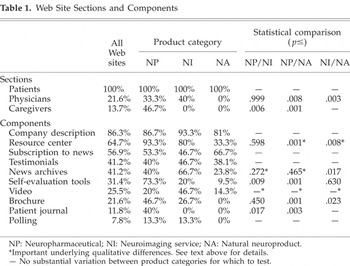
All Web sites were presented in English and 8% offered other language options, mostly Spanish. All Web sites had a section geared for patients and consumers, but 33% of neuropharmaceutical Web sites (n = 5/15) and 40% of neuroimaging Web sites (n = 6/15) also included a specific section for physicians. For neuropharmaceutical Web sites, this section typically included details on prescription, product information, scientific references, and physician support. For neuroimaging Web sites, this section included referral forms, patient preparation information, and the possibility of viewing patient scans online. Some neuropharmaceutical Web sites also had a section for caregivers (e.g., parent information for children with ADHD, tips on how to deal with a friend or family member with depression, neuralgia, obsessive–compulsive disorder or anxiety; see Table 1).
Web Site Sections and Components

Natural neuroproduct Web sites offered the least resources, and notably fewer “resource centers” (Table 1). Resource centers were comprehensive clusters of tools and information for consumers and patients. They included items such as frequently-asked-questions sections, lists of advocacy and support groups, lists of articles and books and Internet links, downloadable talks, guides to help patients in their discussions with health professionals and/or employers, education and support programs for patients, disease management kits for patients and families of patients, brochures describing products or services to patients, glossaries, tips on choosing a physician, and patients' journals.
Fifty-seven percent (n = 29/51) of Web sites provided viewers with the opportunity to subscribe to newsletters or news updates on their products and company (Table 1). Forty percent also had archived news pieces or newsletters available online. For neuropharmaceutical Web sites, this content contained tips on handling the health condition and disease information as well as new FDA approvals. For neuroimaging and natural neuroproduct Web sites, news articles were favorable pieces cited to support the company products and services (e.g., “Five Tests Worth Paying For” from The Wall Street Journal and “Letting CT Scans Out of the Bag” from the World Net Daily). Some of the news pieces appeared in news section of the Web sites but were actually written by company personnel. Videos in neuropharmaceutical Web sites tended to have a biochemical explanation of the action of the neuropharmaceutical for topic whereas videos in neuroimaging Web sites had company profiles and disease and product explanation. Natural neuroproduct videos typically featured company-related information and related topics (e.g., on alternative and holistic medicine).
Most Web sites (n = 44/51; 86%) featured a company description and 41% (n = 21/51) included testimonials related to the products or the targeted disease(s) (Table 1). These testimonials varied greatly in length and style: Some were a few sentences; others were full-length patient narratives. Several favorable testimonials were written by self-identified healthcare providers, attorneys, and educators. Two general characteristics of testimonials emerged in qualitative analysis: (1) untempered enthusiasm based on the claimed efficacy of the product or service and (2) criticisms of current healthcare practices and disappointing patient–provider relationships.
Examples of testimonials with positive emotional valence are the following:
P.S. as for my Mother, she is still taking X to this day and refuses to live without it (neuropharmaceutical Web site).
This is the beginning of an exciting new age for practitioners…. [T]he information these brain scans provide is very impressive (neuroimaging Web site).
One day, the mother of a child in my sons school, told me about a new product she had found and what it had done for her child, who also had ADHD, and her husband. The product was your X. I started taking the capsules and I started giving them to my son. Within a week, I was totally off of all Ritalin and I have never felt better in my life (natural neuroproduct Web site).
A few neuropharmaceutical Web sites included testimonials that mentioned side effects of their products:
The most annoying of the side effects was increased anxiety, which sometimes turned into paranoia, I would get quite worried about aspects of my health, I convinced myself after reading various medical and biology textbooks that I had some form of drug induced Parkinsons, pre-symptomal tuberculosis, joint problems (neuropharmaceutical Web site).
Criticisms of current healthcare were also frequent in testimonials and represent the other main qualitative feature found in testimonials:
I have been through a multitude of unsuccessful treatments for my mental illness since the fall of 1996…. My visit to the X imaging clinic was an invaluable milestone in my life. With the SPECT scan images, my clinician and I were finally able to properly diagnose my condition. In addition to a proper diagnosis, the SPECT imaging also provided essential information that was used to make treatment recommendations (neuroimaging Web site).
So finally I went to the doctor and she said that I was having trouble with my nerves—too much stress—just calm down…. I knew something else was going on. But that was the part that was frustrating—you can't get anybody to believe you (neuropharmaceutical Web site).
Neuropharmaceutical Web sites tended overall to provide more evaluation tools and patient journals than neuroimaging and natural neuroproduct Web sites (Table 1). Patient journals found in neuropharmaceutical Web sites provided a checklist or a calendar to track evolution of symptoms and/or effects of the neuropharmaceutical. These tools included company contact information, safety reminders, and general healthcare tips. Evaluation tools included self-tests for depression, anxiety, social anxiety disorder, panic disorder, pain, attention deficit disorder (ADD) and ADHD, post-traumatic stress disorder, and insomnia. Most included an option for the patient to print the completed evaluation and bring it to his or her physician. A few Web sites had interactive evaluation tools (n = 4/16) that allowed the viewer to obtain an assessment of his results. Typically, a positive result such as “Your answers suggest that you may have experienced panic attacks” (neuropharmaceutical Web site) or “Your answers to the self test indicate you have Generalized Anxiety Disorder” (neuropharmaceutical Web site) would insist on the need to seek physician help: “This self test does not substitute for a diagnosis by a healthcare professional. A healthcare professional is the only person who can appropriately diagnose you. We encourage you to make an appointment with a qualified healthcare professional to discuss your symptoms” (neuropharmaceutical Web site).
Brochures provided lay summaries about products (e.g., explanation of the disease, uses and efficacy of the product, side effects, managing the disease, support program, tips on how to discuss with your physician). None were found on natural neuroproduct Web sites. One neuropharmaceutical Web site had multiple (N = 6) versions of essentially the same brochure for different target populations (e.g., guide to depression for men, for women, for older adults, for family and friends).
Four Web sites (8%) polled their viewers directly or indirectly (e.g., answering medical questions to obtain a US$10 rebate on a next prescription; querying about the plans viewers had to consult their doctor about the product; requiring that viewers provide personal data before obtaining a free management kit for ADHD; Table 1).
Product Information and Presentation
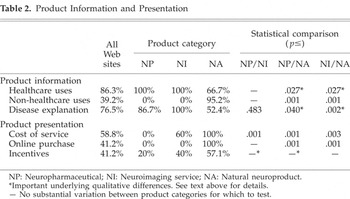
Most products and services were promoted for healthcare related to the treatment and diagnosis of neurological and psychiatric illnesses. However, healthcare uses were less frequent in natural neuroproduct Web sites (Table 2). Healthcare uses were also qualitatively different in natural neuroproduct Web sites with usually very brief statements and little explanation of the disease mechanism and the action of the product. An example of one striking natural neuroproduct Web site explanation of healthcare use is
X is an 100% all natural product that effectively addresses the diverse and debilitating symptoms of stress, anxiety, and depression. X is not a prescription antidepressant like Prozac, Paxil, Zoloft, Wellbutrin and Effexor. X is designed to treat you safely and naturally without the worries you may find with prescription medications and their unwanted side effects. X also helps you loose that stubborn excess weight around your waist caused by high levels of the cortisol stress hormone (natural neuroproduct Web site).
Product Information and Presentation

In stark contrast with this example, 13 neuropharmaceutical Web sites provided complete prescription information and the two other remaining neuropharmaceutical Web sites gave detailed specifications on use, safety, and side effects (Table 2). Some natural neuroproduct Web sites provided contradictory statements on healthcare uses, claiming, for example, that their product “contains the key ingredients discovered by science to help your body repair those essential neurotransmitters and help alleviate those feelings of depression, anxiety or stress.” Nonetheless, they could feature the following disclaimer:
All content of this Web site is provided for informational purposes only, and is not a substitute for professional medical advice. The products on this Web site are dietary supplements, not medication, and are not intended to diagnose, treat, cure, or prevent any disease or illness. Neither the products nor the content of this Web site have been subject to analysis or approval by the Food and Drug Administration. Should you suffer any side effects after ingesting these products, discontinue use and consult your licensed medical practitioner. These products are to be used in conjunction with, and not as a substitute for, a balanced, healthy diet and lifestyle. Please consult with your licensed medical practitioner if you have, or suspect you may have, a health problem (natural neuroproduct Web site).
Only natural neuroproduct Web sites claimed non-healthcare uses (see Table 2). The expressions used to present these uses included “short-term memory improvement,” “mental clarity,” “support and enhance brain function,” “mental alterness,” “mind and body performance enhancement,” “preserve and protect memory function and structure,” “braincare,” boosting “the brain and immune functions,” “help focus attention and improve concentration,” “improved sense of well being.” In contrast, one neuropharmaceutical website formally discouraged non-healthcare-related lifestyle uses: “Never think of or use a prescription as a ‘party drug.’ Don't think of it as a means to ‘get high’ or as a way to ‘enhance’ the effects of alcohol.” Natural neuroproduct Web sites also provided a lesser proportion of disease explanation, and, when they did, explanations were sometimes of questionable value in comparison to neuropharmaceutical and neuroimaging Web sites (Table 2). An example is
X is a nutritional supplement that gives the brain-targeted nutrients to aid in the balancing of neurotransmitters. Problems such as mental and emotional focus, or substance abuse may be caused by an imbalance of neurotransmitters in the brain (natural neuroproduct Web site).
All natural neuroproduct Web sites offered cost information and online purchase options (Table 2). Incentives for consumption were found in all categories of Web sites, but qualitative data shows differences, mainly between neuropharmaceutical Web site incentives on the one hand (e.g., program to offer free medication through physician consultation, savings program on brand-name medicines, rebate on related products when mentioning the consulted Web site) and, on the other hand, neuroimaging Web site incentives (e.g., family discounts, group rates, prize drawing, rebates, payment plan, credit application, complementary copy of scans) and natural neuroproduct Web sites (e.g., free samples, discounts, first-time buyer rebate, free t-shirt, certificate for members, volume discounts, free journal or audiotapes).
Regulatory and Patient–Provider Issues
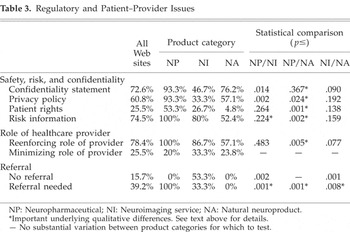
We surveyed Web sites for regulatory and ethical issues. We found the most contrast between neuropharmaceutical and natural neuroproduct Web sites in matters of privacy policies, statements on consumer and patient rights, risk information, reinforcement of the role of healthcare providers, and need for referral (Table 3). Statements on data confidentiality and consumer rights discussed the use of information collected by the company through its Web site.
Regulatory and Patient–Provider Issues

We found qualitative differences in the type of risk information provided by neuropharmaceutical and natural neuroproduct Web sites. All neuropharmaceutical Web sites had extensive information, including specific risks, severity, and frequencies supported by scientific references, whereas some natural neuroproduct Web sites provided short and vague statements such as “X has no known contraindications … X is completely safe and nontoxic. In fact, clinical trials have been conducted in which pregnant women … safely used X” (natural neuroproduct Web site). Neuroimaging Web sites represented the intermediate case in terms of the frequency for several regulation-relevant items such as risk information and need for referral as well as the qualitative aspects of risk description.
Contrary to the statements reinforcing the role of healthcare providers, we also found—often within the same Web site—statements that minimized or criticized the role of providers. These statements were often voiced in patient testimonials. Their content revolved around difficulties in diagnosis and treatment as well as the provider's unawareness of new products or technologies. For example, “TCAs [tricyclic antidepressants] are effective if dosed properly, but many physicians do not prescribe adequate dosages” (neuropharmaceutical Web site).
One neuroimaging Web site stated that
SPECT is being used more widely in certain traditional areas such as assessing the remote effects of traumatic brain injury and in Alzheimer's disease. One reason it isn't used more widely is that most referral physicians have minimal training in neuroimaging modalities…. And as these advancements in other areas of medicine become increasingly more sophisticated and effective, the void of such diagnostic advancements in the psychiatric practice of medicine grows larger and more noticeable (neuroimaging Web site).
Web sites promoted different attitudes about physician referral. Neuropharmaceutical Web sites insisted on the need for physician consultation, natural neuroproduct products did not make this a requirement, and neuroimaging Web sites emphasized the possibility of neuroimaging without referral (Table 3). Neuropharmaceutical Web sites insisted on the physician as the gatekeeper to diagnosis, treatment, and medical information and even provided tips on how to discuss with physicians. Neuroimaging Web sites often presented the physician as the final judge for diagnosis and interpretation of brain scans. Both neuropharmaceutical and neuroimaging Web sites positioned their products and services in the context of the patient–provider relationship. In contrast, natural neuroproduct Web sites frequently provided minimal reinforcement of provider roles in the form of “legal disclaimers” such as
Information on this site is provided for informational purposes only and is not meant to substitute or take place of the advice of your own physician or other medical professional (natural neuroproduct Web site).
Discussion
We found abundant information on different products targeting the central nervous system on the Internet. As we predicted, advertising strategies used in Web sites promoting neuroimaging services and natural neuroproducts differ from those promoting neuropharmaceuticals in many respects. Typically, natural neuroproduct Web sites include less risk information, confidentiality statements, privacy policies, and less positive attitudes toward healthcare providers than neuropharmaceutical Web sites. Neuroimaging Web sites hold a position between neuropharmaceutical and natural neuroproduct Web sites.
It is important to note that this combined qualitative–quantitative study of Internet DTCA has a number of limitations that must be taken into account. First the sampling strategies were different for neuropharmaceutical, neuroimaging, and natural neuroproducts. This was a necessary method, but the effects of any artifacts it may have introduced are unidentified. We also recognize that the small Ns limit generalizations. Further, our research design did not allow us to capture some of the visual and dynamic aspects of Web sites that change over time, and our inability to access some limited portions of the Web sites restricted to patients are other factors that may have had an effect on the results. Finally, content analysis of Web sites cannot be a substitute for studies of the impact of Web site materials on viewers and on the patient–provider relationship.
Emerging DTCA Practices and Gaps in Current Regulation of Healthcare Products
Current regulations for DTCA apply expressly to prescription drugs and not broadly to healthcare products such as nonprescription drugs, neuroimaging services, or natural products.22
See note 17, U.S. Food and Drug Administration 2001.
Noah BA. Dietary supplement regulation in flux. American Journal of Law & Medicine 2005;31:147–53.
The observed gaps are not necessarily surprising because general FDA oversight for safety and efficacy of dietary supplements as such is limited. The Dietary Supplement Health and Education Act (DSHEA) that currently regulates vitamins, minerals, herbs, amino acids, and many other substances is based on a “default position” that presumes the safety and efficacy of dietary supplements.24
See note 23, Noah 2005.
Herb A. Off-label drug use. Annual Meeting. American Society for Bioethics and the Humanities, Washington, D.C.; 2005.
Waack KE, Ernst ME, Graber MA. Informational content of official pharmaceutical industry web sites about treatments for erectile dysfunction. The Annals of Pharmacotherapy 2004;38:2029–34.
The trends we observed in Internet DTCA also raise specific concerns for patients with psychiatric and neurological illnesses. For example, the resources and tools offered online represent opportunities to self-diagnose, self-medicate, and delay appointments with qualified healthcare professionals. Given higher use of Internet for healthcare purposes in stigmatized health conditions (e.g., depression, anxiety),27
See note 6, Berger et al. 2005.
See note 9, New York State Task Force on Life & the Law 2005.
Healthcare Ethics and Patient–Provider Relationships
Past discussion of DTCA of pharmaceuticals and other healthcare products has showcased two very different opinions.29
Wolfe SM. Direct-to-consumer advertising—education or emotion promotion. New England Journal of Medicine 2002;346:524–6.
Farrell J. The ethical implications of direct-to-consumer pharmaceutical advertising. Philosophy & Public Policy Quarterly 2003;23:20–3.
Mintzes B, Barer ML, Kravitz RL, Bassett K, Lexchin J, Kazanjian A, et al. How does direct-to-consumer advertising (DTCA) affect prescribing? A survey in primary care environments with and without legal DTCA. Canadian Medical Association Journal 2003;169:405–12; Gilbody S, Wilson P, Watt I. Benefits and harms of direct to consumer advertising: A systematic review. Quality & Safety in Health Care 2005;14:246–50; Hansen RA, Shaheen NJ, Schommer JC. Factors influencing the shift of patients from one proton pump inhibitor to another: The effect of direct-to-consumer advertising. Clinical Therapeutics 2005;27:1478–87; Mouchawar J, Laurion S, Ritzwoller DP, Ellis J, Kulchak-Rahm A, Hensley-Alford S. Assessing controversial direct-to-consumer advertising for hereditary breast cancer testing: Reactions from women and their physicians in a managed care organization. American Journal of Managed Care 2005;11:601–8.
Donohue JM, Berndt ER, Rosenthal M, Epstein AM, Frank RG. Effects of pharmaceutical promotion on adherence to the treatment guidelines for depression. Medical Care 2004;42:1176–85.
The general debate on DTCA takes a particular twist in the context of psychiatry and neurology. DTCA can impede the doctor–patient relationship, especially in people of low socioeconomic status,33
Murray E, Lo B, Pollack L, Donelan K, Lee K. Direct-to-consumer advertising: Public perceptions of its effects on health behaviors, health care, and the doctor–patient relationship. The Journal of the American Board of Family Practice 2004;17:6–18.
World Health Organization. The World Health Report 2001. Mental Health: New Understanding, New Hope. Geneva, Switzerland: World Health Organization; 2001.
Kravitz RL, Epstein RM, Feldman MD, Franz CE, Azari R, Wilkes MS, et al. Influence of patients' requests for direct-to-consumer advertised antidepressants: A randomized controlled trial. JAMA 2005;293:1995–2002.
See note 33, Murray et al. 2004.
Some features of the Web sites we examined highlight the need for healthcare providers in psychiatry and neurology to be prepared to deal with new healthcare products and health claims. Patients get some of the most recent updates on FDA approval of new products from neuropharmaceutical Web sites; they may read news reports on new neuroimaging services and have the opportunity to listen to convincing video talks on natural cognitive enhancers. As we observed, they may even fill in an online self-evaluation for depression and anxiety and bring it, along with product samples, to their provider. Patients may come to the clinic with enthusiastic assessments of brain imaging and its power to reveal psychiatric illnesses. All these possibilities based on real features of Internet DTCA may change the clinical presentation of disease and the description of symptoms.37
See note 4, Hollon 2004.
The DTCA challenges faced by psychiatrists, neurologists, and allied healthcare workers are not necessarily unique. For example, a study of DTCA for breast and ovarian cancer genetic tests has shown the need for proactive preparation of healthcare providers and for concerted responses to new healthcare products.38
See note 11, Centers for Disease Control and Prevention 2004.
Herculano-Houzel S. Do you know your brain? A survey on public neuroscience literacy at the closing of the decade of the brain. The Neuroscientist 2002;8:98–110.
Racine E, Bar-Ilan O, Illes J. fMRI in the public eye. Nature Reviews Neuroscience 2005;6:159–64.
The Ethics, Law and Humanities Committee of the American Academy of Neurology. Practice advisory: Participation of neurologists in direct-to-consumer advertising. Neurology 2001;59:995–6.
Conclusion
DTCA is a growing part of global promotional expenditures in the drug industry, including pharmaceuticals focused on the function of the brain. Our study suggests that current FDA guidelines for pharmaceuticals do not translate readily to other health products, and that the regulation covering the promotion of nonprescription drug healthcare products such as neuroimaging services and natural neuroproducts have significant gaps. Some new practices enabled by Internet DTCA even challenge current regulations covering prescription drugs themselves. Factors underlying these gaps include pressures from the industry and a traditional western emphasis on consumer choice and the market economy. However, as the bioethicist Eric Cassell recently argued, we should be critical of the equation quickly drawn between consumer choice, respect for autonomy, and respect for persons. If respect for persons necessarily entails respect for autonomy and consumer choice, consumer choice is not the only consideration for the respect for autonomy, and respect for autonomy is only one aspect of respect for persons.42
Cassell EJ. The Schiavo case: A medical perspective. Hastings Center Report 2005;35:22–3.