Introduction
Through international conferences, conventions, and meetings, International Consensus Frameworks have been negotiated by government and development partners, such as United Nations’ (UN; New York USA) agencies, banks, nongovernmental organizations (NGOs), and multilateral and bilateral institutions, resulting in global development goals, which are commonly called global goals. During 2015–2016, the following over-arching frameworks evolved: the Sendai Framework for Disaster Risk Reduction (SFDRR); the Addis Ababa Action Agenda for Financing Development; the Sustainable Development Goals (SDGs); the Paris Climate Agreement; the Agenda for Humanity, the outcome documents of World Humanitarian Summit (WHS); and the New Urban Agenda (NUA), the outcome document of Habitat-III. These frameworks are operationalized further through the subsequent development of different standards, guidelines, and tools.
These frameworks provide guidance to governments to define their development path, as well as providing a clear direction and space for development partners to support government in achieving these goals. Though the local and national governments in respective countries bear the primary responsibility for achieving these goals, international institutions such as the UN, the World Bank (Washington, DC USA), and bilateral and multilateral donors are also held accountable. These frameworks and the global goals demand a coherent and coordinated effort by all development actors, governments, and development partners alike to have a focused, concentrated, and strategic response on the areas of priorities to achieve the target set out by these frameworks and goals.
Mostly, these frameworks complement each other; although, their formation and adoption process took different routes led by different international agencies. The implementation of these frameworks also, in most cases, falls into the responsibilities of different ministries and departments at national/local levels within countries. This creates the risk of taking these frameworks in isolation with the potential of ministries and focal departments working in silos.
The problem statement guiding this Special Report reflects the proposition that all actors at international and national/local levels need an understanding of these recent global frameworks, as well as goals, standards, guidelines, and tools, and to comprehend the complementarity of one against others in creating a synergy, coherence, and integration to facilitate implementing the frameworks to maximize resources and opportunities.
Fowler developed a basic guidebook for NGOs on “International Development Frameworks, Policies, Priorities, and Implications.”Reference Fowler1 Since then, there have been new or renewed global foci and priorities. For example, the “Millennium Development Goals (MDGs)”2 have now been replaced by SDGs. The NUA was yet to start its formation process at the time Fowler developed the guidebook. Post-2015, there have been new sets of global policies and priorities discussed and negotiated and a number of past frameworks have been renewed to align with changed global context.
Some literature, albeit limited, has compared one framework with another. For example, UN Office for Disaster Risk Reduction (UNISDR; Geneva, Switzerland)’s paper “Disaster Risk Reduction and Resilience in the 2030 Agenda for Sustainable Development” establishes the linkage of SFDRR with SDGs.3 A need remains, however, to gather all these major frameworks at one place, not necessarily comparing them in every detail, but sufficient to allow readers to have a broader understanding of what they are and the guidance they provide.
This paper is a stocktake of the major global frameworks and core professional guidelines agreed by international communities through global processes and mechanisms. The paper discusses the principles, essence, and influence of these frameworks in development policy and practices. The paper does not present a detailed comparison between or among the frameworks. Rather, it analyses the key features common to all these frameworks.
Report
The research design for this Special Report utilized a modified narrative literature review methodology. International Consensus Frameworks known to the researchers initiated the search strategy that then included both electronic and hand searching using a snowballing technique until saturation of the frameworks was achieved. Inclusion criteria for the International Consensus Frameworks limited the scope to the core documents of the frameworks, commencing with the 2015 SFDRR and concluding in early 2019. Papers providing commentary on these frameworks were excluded. A thematic analysis of the core documents of the frameworks identified the essential elements. To reduce selection bias, two co-authors reviewed the reports located and all co-authors edited the paper. To complement this analysis of the International Consensus Frameworks, exemplars of core professional guidelines were included to provide a profile and demonstrate the scope of professional guidelines available to assist implementation of the frameworks.
The International Consensus Frameworks, standards, guidelines, and tools can broadly be classified into three groups: (1) over-arching frameworks to guide international development policies and practices; (2) global frameworks addressing specific issues; and (3) global professional standards, guidelines, and tools which explain and guide the implementation or operationalization of these frameworks on the ground.
Over-Arching Frameworks to Guide International Development Policies and Practices
These are over-arching frameworks which shape the development agenda at a global level and guide the development policies and practices on-ground. The frameworks in this category are presented in chronological order.
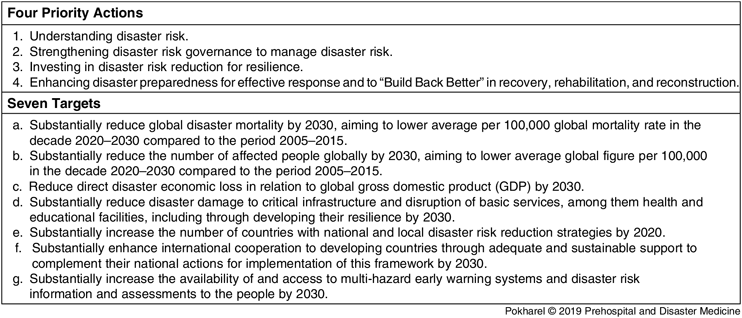
Sendai Framework for Disaster Risk Reduction 2015–2030—The SFDRR is an international framework adopted by UN members at the 3rd World Conference on Disaster Risk Reduction held in Sendai, Japan in March 2015 – hence it is also called the Sendai Framework- and endorsed by the UN General Assembly in June 2015. It is the successor agreement to the Hyogo Framework for Action 2005–2015. The SFDRR guides the global effort for disaster risk reduction. It aims for “the substantial reduction of disaster risk and losses in lives, livelihoods, and health and in the economic, physical, social, cultural, and environmental assets of persons, businesses, communities, and countries.”4 The framework recognizes the primary responsibility of the State and defines the voluntary agreement for a 15 years’ time frame. The responsibility has been shared across the international community, including private sectors, to support the government in countries to implement SFDRR. The framework has identified four priority actions and seven targets (Table 1).
SFDRR Priority Actions and Targets

Abbreviation: SFDRR, Sendai Framework for Disaster Risk Reduction.
At a global level, UNISDR leads the SFDRR process working to set a mechanism to monitor progress and provides guidance and technical support to Member States to measure and report progress against SFDRR implementation. To measure the progress in implementing the seven targets, a set of 38 indicators have been recommended for countries to report.5 The UNISDR consolidates the global progress of SFDRR and produces reports biennially.
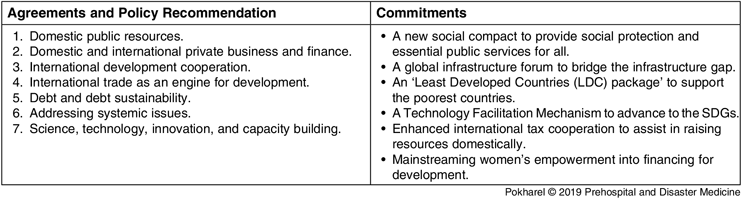
Addis Ababa Action Agenda on Financing for Development—The Addis Ababa Action Agenda on Financing for Development is the outcome document adopted at the Third International Conference on Financing for Development in Addis Ababa, Ethiopia in July 2015, and was endorsed by the UN General Assembly in the same year. The Addis Ababa Action Agenda comprises an agreement to set up policies and frameworks, at both international and national levels, to finance development. The framework aims to generate financial policies and flows in the direction of global priorities, such as on the economic, social, and environmental sectors.6 To achieve the SDGs and the financing required, the Addis Ababa Action Agenda presents a comprehensive set of policy actions, and a number of specific measures to address the issues of finance, technology, and innovation. The Addis Ababa Action Agenda can be considered as a “financing guide” for governments, international communities, and private sectors, and it includes agreements and policy recommendations in seven main areas, as well as commitments from the global community (Table 2).7
Addis Ababa Action Agenda – Policy Recommendations and Commitments

Abbreviation: SDG, Sustainable Development Goal.
Among others, the commitments by developed nations to allocate 0.7% of their gross national income to their Overseas Development Assistance will play a big role in helping developing countries to work towards achieving global goals. The Addis Ababa Action Agenda and “agreement” is an integral part and backbone of all global development frameworks and provides fuel to realize the goals, especially SDGs. Success (or failure) in achieving the global SDGs targets and goals is largely dependent on how effectively the Addis Ababa Action Agenda is being operationalized at global and national levels.
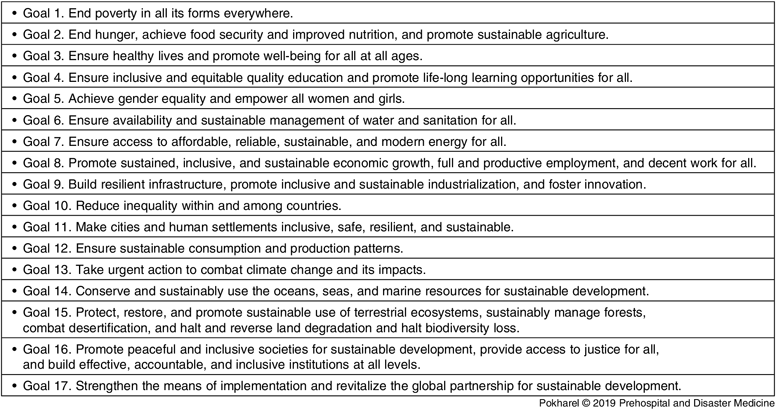
Sustainable Development Goals—In September 2015, the UN General Assembly passed the resolution “Transforming our World: The 2030 Agenda for Sustainable Development,” called “Agenda 2030.” The SDGs are a collection of 17 global goals under Agenda 2030, which all UN Members have adopted and reflect a universal call and global commitment to end poverty, to protect the planet, and to ensure that all people enjoy peace and prosperity (Table 3).8
Sustainable Development Goals

The SDGs replace the MDGs with new and specific goals in the areas of climate change, urbanization, and inequality. The goals are interconnected – often the key to success on one will involve tackling issues more commonly associated with another. The SDGs focus both on social and economic development issues including poverty, hunger, health, education, global warming, gender equality, water, sanitation, energy, urbanization, environment, and social justice and present a holistic approach for development.9
A total of 169 targets have been designed to measure the progress in achieving these goals. Achieving the 17 goals means achieving all 169 targets. A further 232 globally agreed “indicators” define the targets.10 The SDGs are truly “global” in nature. The SDGs, for the first time, bind all UN Members by a single over-arching framework where all countries are working to achieve these goals, as per their priority areas and focus. They cover both developed and developing countries. All countries always have something to work on to fully realize these goals. The SDG Index and Dash Board Reports 2018 provides a most valuable international resource in order to see the global and individual country level progress in achieving SDGs.11
Paris Climate Agreement—The Paris Climate Agreement defines the global consensus reached to combat the impact of climate change and to accelerate and intensify the actions and investments needed for a sustainable low carbon future. The 21st Conference of Parties (COP 21) of the UN Framework Convention on Climate Change (UNFCCC; Bonn, Germany) adopted an agreement in December 2015 in Paris – hence it is called the Paris Agreement – a landmark global agreement on climate change governance.12,13
The Paris Agreement brings all nations into a common objective to undertake ambitious efforts to combat climate change and adapt to its effects, with enhanced support to developing countries to deal with the problem they are facing despite their negligible contribution to the cause of climate change (ie, emission of greenhouse gases [GHGs]). As such, it charts a new course in the global climate effort.12 The main aim of the Paris Agreement is to create a coordinated global response to mitigate climate change by reducing global emission of GHGs to maintain the global temperature rise this century below two degrees Celsius above pre-industrial levels, and to put efforts to limit increase to 1.5 degrees Celsius. The agreement also aims to strengthen the capacity, especially of developing countries, to access both technical and financial resources for mitigation and adaptation actions and have established a global financing mechanism called Climate Finance.
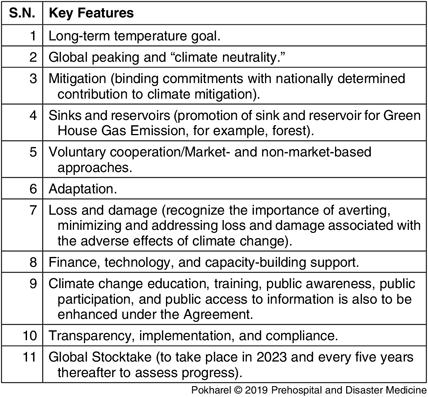
As per the UNFCCC briefing notes on “What is the Paris Agreement?,”13 the Paris Agreement addresses crucial areas necessary to combat climate change and includes key features (Table 4).
Key features of the Paris Climate Agreement

As per the agreement, all countries need to define their contributions to the global emission reduction target as well as financial and technological aspects of the Paris Agreement. These contributions, defined at a national level, are called “Nationally Determined Contributions” (NDCs). The agreement requires all parties to report against NDCs. A global stocktake of progress will be carried out every five years led by the UNFCCCC process.
Agenda for Humanity (Outcome Document of World Humanitarian Summit)—The Agenda for Humanity is the Annex to the report “One Humanity: Shared Responsibility, Report of the Secretary-General for the World Humanitarian Summit.” The WHS was a global call to governments and the international communities for better and effective response to humanitarian crises. The Summit took place in Istanbul in May 2016. The Agenda for Humanity was formally adopted during the WHS process.14
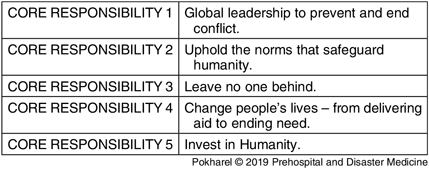
The Agenda for Humanity adopts five “core responsibilities” to guide the global action to reduce the humanitarian need, risk, and vulnerabilities and to alleviate suffering in case of humanitarian crises (Table 5). The agenda calls the global actors to put people’s safety, dignity, and right to survive and thrive at the center of decision-making processes.14 Traditionally, there has been a clear divide between humanitarian and development intervention. The agenda highlights the connection of humanitarian response to the long-term development and advocates for “community resilience” as a combined approach in providing humanitarian assistance and long-term development needs.
Five Core Responsibilities of Agenda for Humanity

To carry forward these five core responsibilities, 24 strategic and transformative actions have been identified. Global leaders, through High-Level Leaders Round Tables during the WHS, have also generated 32 core commitments to support the implementation of the agenda.14
New Urban Agenda (the Outcome Document of Habitat-III)—The UN Conference on Housing and Sustainable Urban Development (Habitat III) in Quito, Ecuador in October 2016 adopted the NUA, which was endorsed by the UN General Assembly in December 2016. The agenda provides a 20-year “roadmap” for sustainable urban development. The NUA represents a shared vision for a better and sustainable future of cities and urban living where all people have equal access to the facilities, services, and opportunities cities offer. The agenda presents the city system and urban space as a tool to manage urban life and urbanization.
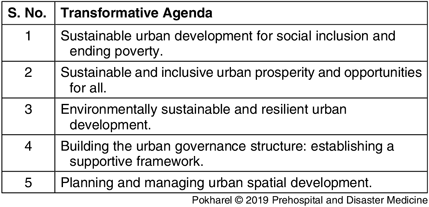
The NUA features three main guiding principles, namely: leave no one behind; sustainable and inclusive urban economies; and environmental sustainability, and it presents the transformative agendas for sustainable urban development (Table 6).15
The Transformative Agenda with in the New Urban Agenda

The NUA recognizes the correlation between urbanization and development. It underlines the role of urbanization in job creation, livelihood opportunities, and improved quality of life pre-requisites for sustainable development. In this sense, the NUA is an urban expression of SDGs, more specifically direct translation of Goal 11, which is on sustainable cities and communities. The NUA process hasn’t developed targets and action plan of its own, but it seeks the integration of the agenda into other existing global frameworks, mainly within SDGs and SFDRR. The NUA provides direction and guidance for national governments and international community to achieve the SDGs, SFDRR, and other goals set out by global frameworks in urban context.
Global Frameworks Addressing Specific Issues
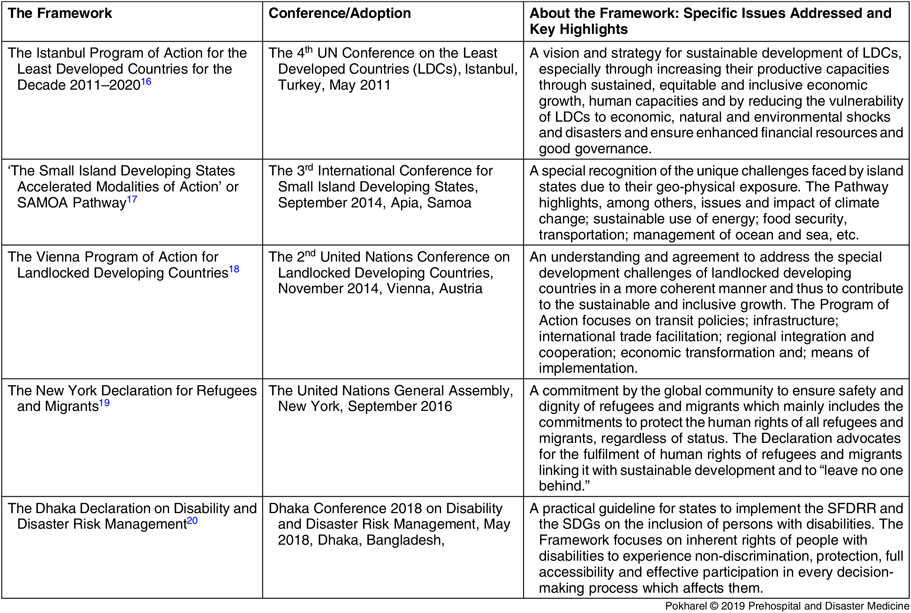
These frameworks focus on the specific areas and needs of a group of countries whose needs are specific because of their exposure to unique geo-physical conditions and/or because they are trailing behind the global development game; or, on a group of people who have a unique identity or physical status which puts them in a greater risk of being marginalized in international and national development processes (Table 7).16–20
The Global Frameworks Addressing Specific Issues

Abbreviations: LDC, Least Developed Countries; SDG, Sustainable Development Goal; SFDRR, Sendai Framework for Disaster Risk Reduction.
Global Professional Standards, Guidelines, and Tools
Various global professional standards, guidelines, and tools exist which have great influence in the international development and humanitarian sector. For the purposes of this Special Report, a selection of core professional guidelines is included to provide a profile and demonstrate the scope of professional guidelines available. For example, the Sphere (Geneva, Switzerland) handbook presents the Humanitarian Charter and Minimum Standards in Humanitarian Response.21 The handbook is widely accepted by humanitarian agencies, NGOs, the International Federation of Red Cross and Red Crescent Societies (IFRC; Geneva, Switzerland), and UN Agencies working in emergency response, including by governments, and is referred to and practiced extensively in planning, designing, and providing humanitarian response. The Core Humanitarian Standards on Quality and Accountability (CHS)22 sets out nine commitments that organizations and individuals involved in humanitarian response can use to improve the quality and effectiveness of the assistance they provide. The Code of Conduct for International Red Cross and Red Crescent Movement and NGOs in Disaster Relief23 was developed by the Steering Committee for Humanitarian Response (SCHR; Geneva, Switzerland), a voluntary alliance of nine of the world’s leading humanitarian organizations, to set ethical standards for organizations involved in humanitarian work.
As a part of the Humanitarian Reform Agenda, the Inter-Agency Standing Committee (IASC; Geneva, Switzerland) in 2005 introduced the “Cluster Approach”24 to increase the coordination and effectiveness of humanitarian response at the local level when there is an emergency. These clusters, coordinated by UN Organization for Coordination of Humanitarian Affairs (UNOCHA; Geneva, Switzerland and New York USA) working within a group, have developed many standards which guide and regulate their response in any given context. For example, the Global Water Sanitation and Hygiene (WASH) Cluster has developed the WASH Cluster Coordinator Handbook,25 which guides the overall coordination of water sanitation and hygiene-related intervention. The World Health Organization (WHO; Geneva, Switzerland), as the lead for the Global Health Cluster, has developed the Emergency Response Framework26 to guide the response to a health emergency. The Global Protection Cluster coordinated by the UN Refugee Agency (UNHCR; Geneva, Switzerland) has collection of Essential Protection Guidance and Tools.27 The Protection Cluster, among others, covers issues related to child protection and gender-based violence. Clusters at national levels, for example the National Shelter Cluster in any country, when activated, would set their own standards to reflect the local/national context, within the framework of the Global Cluster.
The Guidelines for the Domestic Facilitation and Regulation of International Disaster Relief and Initial Recovery Assistance (“the IDRL Guidelines”)28 were developed by the IFRC through extensive consultation with the governments and relief specialist and provides a set of recommendations to help governments prepare their regulatory systems for international disaster response. Likewise, the Guiding Principles on Internal Displacement,29 developed by the UN Human Rights Office of High Commissioner (UNOHCHR; Geneva, Switzerland), restate and compile human rights and humanitarian law relevant to internally displaced persons.
The Evaluation of Humanitarian Action GuideReference Cosgrave, Buchanan-Smith and Warner30 developed by Active Learning Network for Accountability and Performance (ALNAP; London, United Kingdom) and the World Association for Disaster and Emergency Medicine’s (WADEM; Madison, Wisconsin USA) Frameworks for Disaster Research and Evaluation31 are guides/frameworks which are widely used as standard methods and practices to evaluate humanitarian and development programs on-ground. These frameworks exert significant influence on how development/humanitarian programs are evaluated and how their contribution to global goals are measured. Research Evidence in the Humanitarian Sector: A PRACTICE GUIDE,32 developed by Evidence Aid (Oxford, United Kingdom), provides practical information derived from field research and evaluation that helps to minimize the risk of failure of a program. The Comprehensive Framework for Disaster Evaluation TypologiesReference Wong, Spencer, Boyd, Burkle and Archer33 provides a unified framework within which existing evaluation typologies can be structured and gives evaluators confidence to choose an appropriate strategy for their evaluation in the disaster setting. The WHO-led Emergency and Disaster Risk Management for Health (HEDRM)34 initiatives provide guidance and support to minimize the risk of and manage health emergencies.
A Global Framework for Comprehensive School Safety35 is a framework developed by UNISDR and the Global Alliance for Disaster Risk Reduction and Resilience in the Education Sector (GADRRES), which largely guides the disaster risk management processes in and around school and education systems focusing on its three pillars: Safe Learning Facilities; School Disaster Management; and Risk Reduction and Resilience Education. The WHO has developed a Comprehensive Safe Hospital Framework36 to ensure health care systems, one of the emergency life-lines, are still functioning during and after emergencies. The UNISDR has launched the “Making Cities Resilient” campaign and developed 10 Essentials for Making Cities Resilient37 as a practical guide for city planners. Arup, with support from the Rockefeller Foundation (New York USA), developed the City Resilience Framework38 and Index.39 These frameworks provide guidance and influence cities’ planning and evaluation processes, especially those cities which are part of Rockefeller Foundation’s “100 Resilient Cities” project. Arup and Plan International (Woking, United Kingdom) developed the Child Centered Urban Resilience Framework (CCURF),40 which brings children, youth, and girls to the center of the urbanization process in designing, planning, and implementing urban community-resilience programs. These programmatic frameworks help operationalize the global goals into program and implementation on the ground.
Discussion
Murray, et al, in their policy paper published in the International Council for Science and Integrated Research for Disaster Response, highlighted the importance of building “Coherence between the Sendai Framework, the SDGs, the Climate Agreement, New Urban Agenda, and World Humanitarian Summit, and the role of science in their implementation” and put forward many recommendations in that direction.Reference Murray, Maini, Clarke and Eltinay41 The UNISDR, in its policy brief, “Implementing the Sendai Framework to Achieve the Sustainable Development Goals,” discussed in detail “How the Sendai Framework Contributes to Sustainable Development Goals.”42 However, limited attempts exist to discuss all of the major frameworks in a single paper to allow greater understanding of the frameworks, and hence, to see their commonality and differences. This current review shows the over-lapping areas of priorities and focus among these frameworks and the goals. Working on the “Priority Actions” to achieve a goal set in one framework not only complements the achievement of the other goals, but also contributes in achieving the goals defined in other frameworks. For example, SDGs cannot be achieved in isolation, but must be undertaken together with working on “Priority Actions” as defined by the SFDRR and by implementing the NUA. More similarities than differences exist amongst them, which establishes the need to generate a more comprehensive and holistic approach in creating a global mechanism and design national policy, planning, and implementation to achieve the collective goals. This review identifies the key features underpinning these frameworks, which further demonstrates the necessary synergy and coherence in dealing with these frameworks and portrays an essential pre-requisite to the successful implementation of these frameworks.
Most frameworks, in their formation, and/or within the framework themselves, have defined climate change and urbanization as two main global trends largely impacting the development processes at local and international levels. Climate change and urbanization, mainly rapid and unplanned, in many low- to middle-income countries, have accelerated the frequency and intensity of disasters and can play a role in triggering humanitarian crises. The NUA stimulates a direct call to recognize the urbanization trend and to coordinate the global effort to manage urban process and progress. The SFDRR addresses the increasing risk of disaster while the Agenda for Humanity endorses a global call to respond to humanitarian crises. Likewise, the Paris Agreement endorses a global call to reduce carbon emission to mitigate climate change and action to adapt to the impact of climate change.
Sustainable development, disaster risk reduction, and resilience are key concepts for all of these frameworks. Building a “Resilient Society” is a central theme. The frameworks demand a global effort to tackle the existing problem, as well as preparing nations and communities to respond to future challenges. A clear shift from managing crises to proactively reducing their risks and building resilience transpires in all the frameworks.
All of these frameworks highlight fulfillment of human rights and rights of individuals as an ultimate goal of international development and call on the international community to uphold international conventions and treaties on human rights, rights of children, women, people with disability, and the elderly who are more vulnerable in any disaster and conflicts, and also advocates for the need to put people at the center, especially those vulnerable groups, in decision-making and planning processes. The frameworks have taken the approach of “shared but differentiated” responsibilities. The frameworks, first, identify priorities and actions, and second, define the responsibility and accountability of different stakeholders. The respective government of countries, by default, bear primary responsibility to implement the frameworks and achieve these goals. The role of the international community, UN Agencies, banks, private sectors, bilateral/multilateral donors, and NGOs is to support and assist national government in achieving these goals through the allocation of funding and access to technology, research, and development required to tackle these problems.
All the frameworks have highlighted the need and opportunity, both, of using “Science and Technology” in dealing with these global issues and encouraged national governments and the international community to exploit the use of modern technological innovation to derive the solution. For example, to enable better engagement of scientists, researchers, and technology experts in the development and implementation of regional and national disaster risk reduction strategies and plans, UNISDR has formed Global Science and Technology Advisory Group (G-STAG).43
All of these frameworks are futuristic in nature and look forward to achieving these targets and goals by a certain timeframe, mostly within and by 2030. The frameworks have acknowledged the fast-evolving nature of the modern world and the uncertainties faced by humanity and have highlighted the increasing need and urgency for actions today and for the continuous and collaborative effort required tomorrow to achieve and sustain the future desired.
Limitation
A limitation of this Special Report may be that it has confined its scope to presenting the main elements and essence of the frameworks rather than fully integrated comparative analysis. Though the review has established clear linkages, connections, and complementarity of one with the other, the detailed comparison between and among these frameworks is beyond the scope of this paper, but it can be an interesting and rich topic for future studies.
Conclusion
All of the frameworks used substantial theoretical and/or evidence-based underpinnings and evolved from structured processes. One subset, the frameworks in the first and second groups, have resulted from major political and government influences, while others have reflected applied professional influences. A desire exists to improve the quantum and quality of the science and evidence-base and accountability and the use “Resilience” as a conceptual framework. The frameworks that define global priorities and guide development policy and practice complement each other. The SDGs embrace over-arching global goals, whereas SFDRR, NUA, and other action agendas prioritize one aspect of development against others to achieve these global goals. For example, the NUA provides a delivery vehicle for the SDGs in urban settlements. Until the disaster risks are mitigated and managed through effective implementation of SFDRR, “Development Gain” cannot be sustained. Development interventions which omit consideration and integration of the issues faced by people with disabilities and other vulnerable groups are incomplete, and society cannot be a “Resilient Society.” Though the priorities and focus are different in different frameworks, the goals defined and designed are intertwined. To achieve the SDGs, all goals set out by different frameworks should also be satisfied. The very nature of the commonality and complementarity of the frameworks demands a comprehensive and holistic approach and response both locally and globally.
All of the major frameworks have been adopted by UN General Assembly, which means working to translate these frameworks on the ground becomes the responsibility of the member states (ie, national governments) and of the international community as a party to the international convention and treaties. However, apart from the Paris Agreement, all of the frameworks are non-binding in nature. Hence, success or failure in implementing these frameworks largely depends on the political will of national governments as well as delivery on their commitments from the international community. The framework highlights the need for synergy in responding to these global priorities and demands a collective, coordinated, and coherent mechanism at global, national, and local levels to achieve the targets and goals set out in these frameworks.
Conflicts of interest
none