Introduction
In 2012, the Joint Commission (JC) and independent standard-setting and accreditation group for hospitals, recommended that all patients admitted to hospitals should be screened for tobacco use, receive tobacco-cessation services during their hospitalisation, and be followed-up within 1-month after discharge (Fiore, Goplerud, & Schroeder, Reference Fiore, Goplerud and Schroeder2012; Joint Commission on Accreditation of Healthcare Organizations, 2011). Unfortunately, few hospitals have implemented opt-out treatment services where tobacco users are proactively enrolled in the service and followed-up after discharge (Cummings, Reference Cummings2016; Kotz, Reference Kotz2015; Richter & Ellerbeck, Reference Richter and Ellerbeck2015; Warren et al., Reference Warren, Marshall, Cummings, Zevon, Reed and Hysert2014).
In 2014, the Medical University of South Carolina (MUSC) implemented a tobacco-cessation service that was designed to be in compliance with the JC tobacco-cessation standard. The service requires all hospitalised adult (18 years of age and older) patients who report current tobacco use be automatically referred to a tobacco-cessation service consisting of bedside counselling and phone follow-up calls at 3, 14, and 30 days post hospital discharge (Nahhas et al., 2016). The MUSC programme is distinct from other hospital-based cessation services in that it (1) does not rely upon health care providers to refer patients into the service, (2) is initiated by a daily automated search for smoking status in the electronic medical record of every admitted patient, and (3) provides pro-active, automated follow-up phone calls using Interactive Voice Response (IVR) with patients after discharge (Duffy et al., Reference Duffy, Cummins, Fellows, Harrington, Kirby and Rogers2015). Patients can opt-out of the service by either refusing the bedside consult or by refusing follow-up phone calls. This paper reports on the characteristics of patients who opted-out of the bedside counselling and/or opted-out of the follow-up phone calls in comparison to those who accepted the service. The findings from this study will help inform ways to maximise participation in tobacco-treatment services for inpatients.
Methods
The data for this study are based on 6,684 adult current smokers who were admitted to the MUSC hospital between February 2014 and May 2015. Smoking status was obtained by health care personnel as part of the admission process. Current cigarette smokers 18 years or older were enrolled in the programme except those who (1) died during hospitalisation; (2) were receiving hospice care; (3) were unable to communicate due to language or medical conditions; (4) were not discharged home, and (5) did not have a phone number on record. Patients who were readmitted but had an active follow-up call schedule were also excluded. All eligible patients were automatically enrolled in the programme, but were given the option to ‘opt-out’ of the service. All eligible patients received a bedside consult for tobacco cessation, a follow-up IVR phone call, or both, and were given the opportunity to opt-out of the service at two points: (1) at bedside by refusing the consult or (2) at follow-up by either calling back and asking to be removed from further calls or not responding to the post-discharge phone calls. Details describing the implementation of the MUSC inpatient smoking treatment service are available elsewhere (Nahhas et al., 2016).
Opting-Out vs Opting-In
Those who explicitly refused the bedside consult when hospitalised were considered as ‘opting-out’ of the service. Those who did not respond to the multiple follow-up phone call attempts were considered non-responders, whilst those who responded to at least one call attempt were considered responders.
Predictor Variables
Predictors of opting-out at bedside tobacco-cessation consult included the patient's age, gender, race, length of hospital stay, and type of medical insurance. Predictors of non-response to follow-up phone calls included the same variables plus whether or not the patient received a bedside consult. In addition, for patients who received the bedside consult, we captured information on their smoking history (amount and duration of smoking), motivation to quit, and confidence in ability to stop smoking which were used as predictors of responding to the post-discharge phone follow-up calls. Motivation was assessed by the following question ‘On a scale of 1–5 with 5 being the strongest, how much do you intend to quit tobacco once you are discharged from the hospital?’ Confidence to quit was measured by the question ‘On a scale of 1–5 with 5 being the strongest, how confident are you to remain quit once you are discharged from the hospital?’ We combined motivation and confidence variables to categorise patients into one of three groups: (1) high in both motivation and confidence to quit, (2) discordant motivation and confidence to quit (i.e., high on one and low on the other), and (3) and low in both motivation and confidence. The cut-off score for high motivation or confidence was 3 or higher, on a 1–5 scale and was intended to allow us distinguish patients with varying levels of motivation and/or confidence in stopping smoking as a predictor of accepting and/or opting-out of the service.
Data Analysis
Opting-out of bedside consult and opting-out of follow-up phone calls were evaluated as separate outcomes. We conducted multivariable log-linear models to evaluate predictors of opting-out controlling for other variables. Adjusted risk ratios (RR) and 95% confidence intervals (CI) were reported. All statistical analyses were performed in SAS 9.4 (SAS Institute, Cary, NC).
Results
Bedside and Phone Follow-up Opt-Out Rates
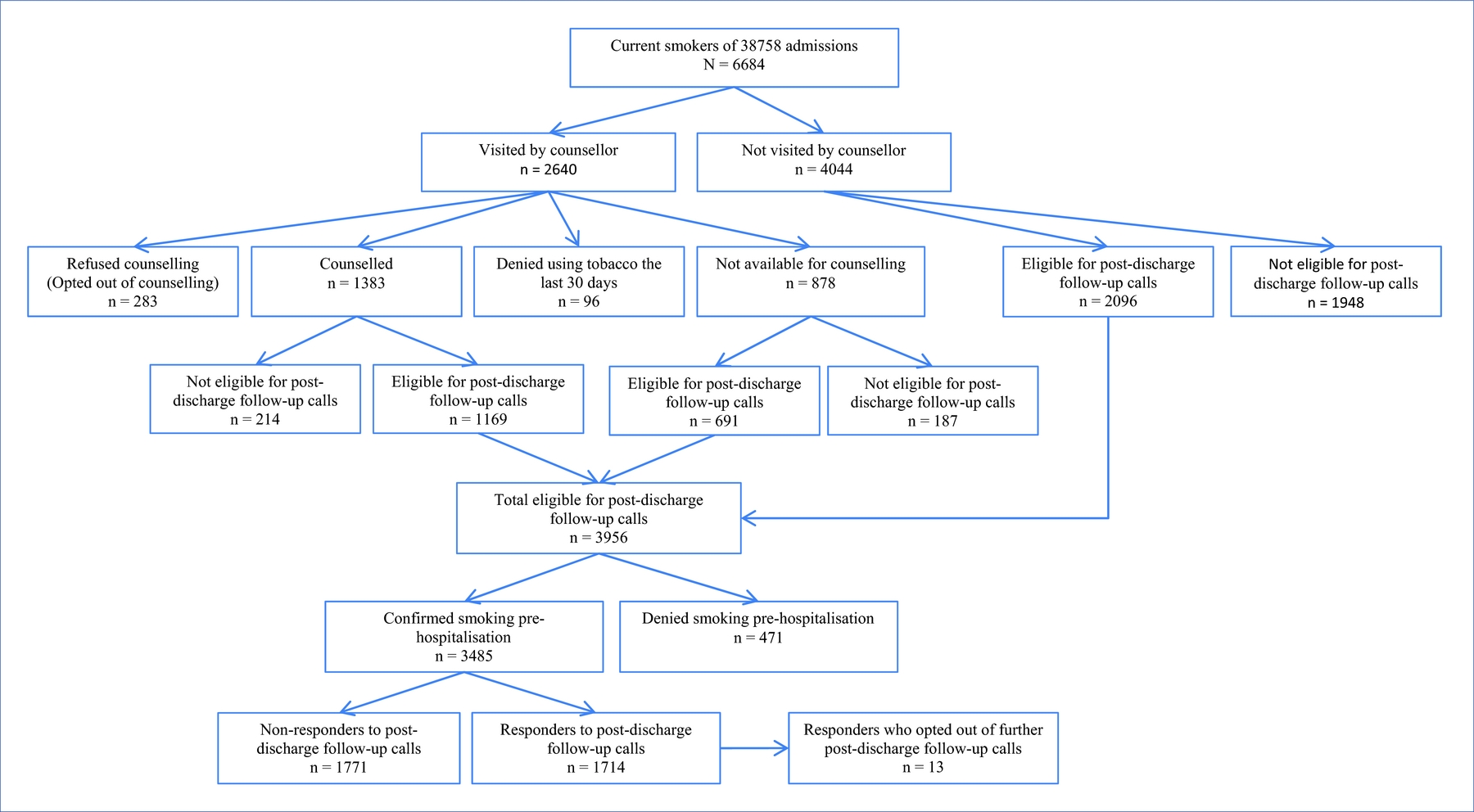
As shown in Figure 1, the bedside counsellor visited 2,640 patients, of whom 878 were not available for counselling. Of the 1,762 who were available to be counselled 96 (5.5%) denied using any tobacco in the previous 30 days tobacco and were excluded. Of the remaining group of 1,666 patients, 283 (17%) opted-out of the bedside consult whilst 1383 (83%) accepted the consult.
Flow of adult (18+) patients admitted to the Medical University of South Carolina hospital smoking-cessation service from screening to follow-up, February 2014–May 2015.

There were 3,956 patients who were eligible for phone follow-up, 471 (12%) of whom reported that they were not tobacco users (i.e., either never or long-term former smokers) when reached by phone. Of the remaining 3,485 patients, 1,714 responded to at least one of the post-discharge follow-up calls (49%), whilst 1,771 (51%) never responded to the multiple callback attempts. Those who did not respond to any of the follow-up calls were labelled non-responders. Amongst those who responded to the follow-up call, only 13 people (<1%) explicitly asked to be removed from further callbacks. The overall reach rate of the service was 65% (2,412/3,699). The 3,699 patients eligible for service was computed by adding the 3,485 patients eligible for IVR follow-up and the 214 patients who received bedside counselling, but opted-out of the follow-up service. The 2,412 counted as having received the service included 711 who received bedside consult only, 1,029 who received a post-discharge phone call only, and 672 who received both.
Predictors of Opting-Out of the Programme
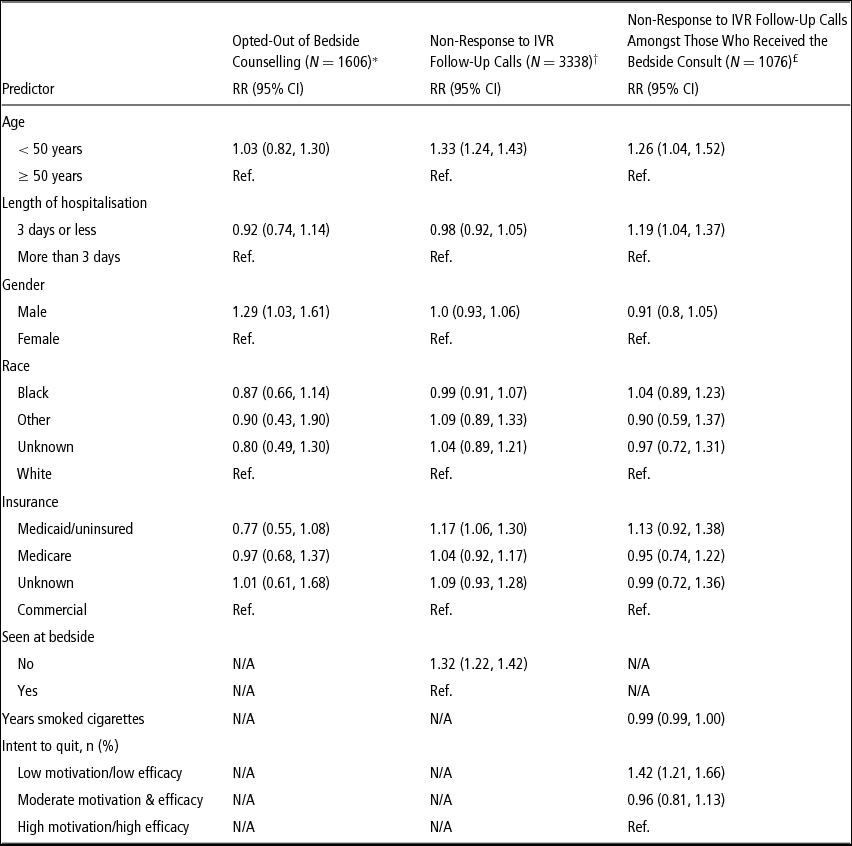
Table 1 shows the predictors of opting-out of the smoking-cessation service at different stages of the service. Those who opted-out during hospital bedside counselling were likely to be males (RR = 1.29, 95% CI: 1.03–1.61).
Predictors of opting-out at different stages of the programme

*data were complete for 274/283 who refused and 1,332/1,383 who accepted the bedside consult.
†data were compete for 1,642/1,701who responded and 1,696/1,771 who did not respond to IVR follow-up calls.
£data were complete for 1,076/1,168 who were counselled and referred for follow-up calls; 452/1,076 did not respond to the calls RR: risk ratio.
CI: confidence interval.
Ref: reference group N/A: not applicable.
Those who did not respond to the IVR calls were younger than 50 years (RR = 1.33, 95% CI: 1.24–1.43), with Medicaid/no insurance (RR = 1.17. 95% CI: 1.06–1.30) compared to having commercial insurance, and had not received a bedside consult (RR = 1.32, 90% CI: 1.22–1.42).
Those who did not respond to the follow-up calls and received a bedside consult were younger than 50 years (RR = 1.26, 95% CI: 1.04–1.52), hospitalised for 3 days or less (RR = 1.19, 95% CI: 1.04–1.37), and had low motivation/low efficacy to quit smoking (RR = 1.42, 95% CI: 1.21–1.66).
Discussion
This study demonstrates that over 80% of tobacco users will accept a bedside consult for smoking cessation when visited in the hospital and over half will respond to post-discharge follow-up calls. Males were slightly less receptive to the bedside consult, and younger patients were less responsive to the post-discharge follow-up phone calls. Response to the follow-up phone calls was higher for those who received the bedside consult. There was no difference by race in opting-out of the programme at any stage suggesting that patients of all races are receptive to the tobacco-treatment service. Our findings are consistent with the results of recent studies that found high receptivity to an opt-out smoking-cessation service for cancer patients and pregnant smokers (National Institute for Clinical Excellence, 2016; Sloan et al., Reference Sloan, Campbell, Bowker, Coleman, Cooper, Brafman-Price and Naughton2016).
A limitation of this study is that current smoking status was assessed via self-report by the patient or a next-of-kin during admission in the hospital and was not biochemically verified. Roughly 5% of identified smokers when visited by the bedside counsellor claimed to be non-smokers when asked (false positives). An additional 471 patients only reached by phone claimed they were never/long-term former smokers. These patients were excluded from the programme. Our bedside counsellor also received floor referrals from medical staff who asked us to see patients not identified as current smokers upon hospital admission (false negatives). It is impossible to know how many patients we misclassify as to their current smoking status, although the overall prevalence rate of current smoking in our patient population is consistent with the prevalence of adult smoking in South Carolina. Also, as would be expected, the rates of current smoking were higher in sub-populations of patients known to have higher rates of tobacco use from population surveys (i.e., self-insured, Medicaid insured, those with mental-health conditions) suggesting that our current screening method is generally accurate.
Getting patients to respond to any type of phone follow-up call is a challenge whether it is for smoking cessation or some other purpose. To improve efficiency, our programme utilised automated IVR technology to make phone calls. Multiple call attempts were made to patients at different times of the day to maximise reach. About half of those who we contacted responded to our calls (49%), which is higher than reported by other studies (Dillman et al., Reference Dillman, Phelps, Tortora, Swift, Kohrell and Berck2009; Rodriguez et al., Reference Rodriguez, von Glahn, Rogers, Chang, Fanjiang and Safran2006). Not surprisingly, the response to the phone follow-up was higher amongst those seen by the bedside counsellor who had the opportunity to establish a relationship and describe the IVR system for the patient, detailing how they would be called after discharge from the hospital. Predictors of response to the phone follow-up included age, gender, and insurance status. Responders to the phone calls were more likely to be female, older, and have private insurance or Medicare.
Amongst those patients who were seen by the bedside counsellor, we found that motivation and confidence in ability to stop smoking were predictive of the likelihood of responding to the post-discharge phone follow-up calls. Patients who were interested and feeling confident about their ability to stop smoking were more likely to respond to the follow-up call, whilst those who reported that they lacked confidence and/or motivation to quit were less likely to respond to the phone follow-up calls.
The lower phone response rates observed amongst our younger and less affluent respondents is not unique to our patient population (Skierkowski & Wood, Reference Skierkowski and Wood2012). Previous studies have shown that utilising multiple survey modes such as phone, text messaging, and e-mail can increase response rates, especially amongst younger respondents (Dillman et al., Reference Dillman, Phelps, Tortora, Swift, Kohrell and Berck2009; Hu, Balluz, Battaglia, & Frankel, Reference Hu, Balluz, Battaglia and Frankel2011; Rodriguez et al., Reference Rodriguez, von Glahn, Rogers, Chang, Fanjiang and Safran2006; Skierkowski & Wood, Reference Skierkowski and Wood2012). Thirteen percent of patients were excluded from phone follow-up because of invalid and/or missing phone numbers. Going forward, we are now attempting to collect secondary phone numbers and e-mail to facilitate our ability to reach patients after they have been discharged from the hospital.
Conclusion
The opt-out policy for delivering tobacco-cessation support to hospitalised tobacco users as originally recommended by the JC for treating tobacco dependence is feasible to implement and accepted by the majority of patients. In a large academic medical centre where we employed a single bedside counsellor, we were able to reach 65% (2,412/3,699) of eligible smokers by either bedside counselling and/or post-discharge IVR phone calls. Only 17% of patients who were eligible for bedside consult opted-out of the consult and less than 1% of those reached by phone, explicitly opted-out of the follow-up calls.
Acknowledgements
We would like to acknowledge support provided by Mark Daniels and Patricia Wagstaff who provided IT support for the programme and James Brook, RN, MBA Oncology Service Line Director at the Hollings Cancer Center and Danielle Bowen Scheurer, MD, MSCR, Chief Quality Officer and Hospitalists at MUSC, who provided both administrative and financial support to implement the inpatient tobacco-cessation service. We would also like to acknowledge the contribution of Danny Woodard, MS who served as the bedside counsellor for the Tobacco-Cessation Service during the period covered by this report.
Financial Support
MUSC Health provided the sole funding for the service reported.
Conflict of interest
MUSC Health provided the sole funding for the service reported. All co-authors are either employed or contracted by MUSC. KMC has received grant funding from the Pfizer, Inc., to study the impact of a hospital based tobacco-cessation intervention. He also receives funding as an expert witness in litigation filed against the tobacco industry. All other authors have no conflicts to report.
Ethical Standards
The authors assert that all procedures contributing to this work comply with the ethical standards of the relevant national and institutional committees on human experimentation and with the Helsinki Declaration of 1975, as revised in 2008.