Bilingual language interference is generally assumed to be resolved by bilingual language control, which is the inhibitory process that makes it more likely that speech occurs in the correct language (e.g., Declerck, Koch & Philipp, Reference Declerck, Koch and Philipp2015; Grainger, Midgley & Holcomb, Reference Grainger, Midgley, Holcomb, Kail and Hickman2010; Green, Reference Green1998). In the current study, we set out to examine what happens when this process fails (i.e., when a bilingual error is produced). More specifically, we investigated whether bilingual error detection is instigated by bilingual language interference, as suggested by the conflict monitoring account of error detection, or relies on language comprehension, as suggested by the perceptual loop theory.
The prominent perceptual loop theory (Levelt, Reference Levelt1989) is a monolingual model that proposes error detection to be based on language comprehension. More specifically, this account proposes that error detection occurs by monitoring one's own utterances. This information is fed into the language comprehension system, which is then inspected by a general error detector. It might be expected that bilingual error detection, similar to monolingual error detection according to the perceptual loop theory, relies on language comprehension. However, to the best of our knowledge, no evidence has been put forward to indicate that bilingual error detection relies on language comprehension, which is possibly due to a lack of research in this domain.
On the other hand, the conflict monitoring account of error detection (Nozari, Dell & Schwartz, Reference Nozari, Dell and Schwartz2011; or for a more general account of conflict monitoring, see Carter, Braver, Barch, Botvinick, Noll & Cohen, Reference Carter, Braver, Barch, Botvinick, Noll and Cohen1998) proposes that interference (i.e., conflict) between response options can be used as a signal for error detection. More specifically, Nozari et al. (Reference Nozari, Dell and Schwartz2011) proposed that interference at a specific language processing level initiates a signal that results in error detection at that level.
Several models of bilingual language processing incorporate a conflict monitoring mechanism as part of the bilingual language control system (Abutalebi & Green, Reference Abutalebi and Green2007; Green & Abutalebi, Reference Green and Abutalebi2013). However, this conflict monitoring mechanism is assumed to detect interference that might call for resolution and to give a signal to instigate interference resolution, not error detection. Yet, Branzi, Della Rosa, Canini, Costa and Abutalebi (Reference Branzi, Della Rosa, Canini, Costa and Abutalebi2015) have suggested that conflict monitoring could also play an important role during the detection of bilingual errors. Hence, conflict monitoring driven by bilingual language interference could signal for both interference resolution (to avoid errors) and error detection (once they have occurred).
Some evidence has been provided for bilingual language interference instigating error detection by Acheson, Ganushchak, Christoffels and Hagoort (Reference Acheson, Ganushchak, Christoffels and Hagoort2012). In this bilingual ERP study, error-related negativity, which is an error-driven negative going event-related potential, was examined during the naming of cognates, which are phonologically very similar words with the same meaning across languages (e.g., the word “table” with its different pronunciations in French and English), and noncognates in mixed language blocks. A larger error-related negativity was observed when producing cognates than noncognates. This finding was interpreted as evidence for the conflict monitoring account, as more interference should occur between translation-equivalent representations of cognates due to their phonological similarity. However, typically cognates are produced faster than noncognates (e.g., Costa, Caramazza & Sebastian-Galles, Reference Costa, Caramazza and Sebastian-Galles2000; Declerck, Koch & Philipp, Reference Declerck, Koch and Philipp2012), which was also the case in this study, providing evidence for facilitation during the production of cognates, not interference. Hence, it still remains to be demonstrated that bilingual language interference initiates error detection, as proposed by the conflict monitoring account.
In the current study, we set out to investigate bilingual error detection through the repair rate of language intrusions, which are involuntary utterances in the nontarget language (Gollan, Sandoval & Salmon, Reference Gollan, Sandoval and Salmon2011; Gollan, Schotter, Gomez, Murillo & Rayner, Reference Gollan, Schotter, Gomez, Murillo and Rayner2014; Ivanova, Murillo, Montoya & Gollan, Reference Ivanova, Murillo, Montoya and Gollan2016; Poulisse & Bongaerts, Reference Poulisse and Bongaerts1994), in a language switching task. While no research has focused on error detection of language intrusions, there is some evidence that they are detected and repaired. A study by Poulisse and Bongaerts (Reference Poulisse and Bongaerts1994), where Dutch–English bilinguals performed a battery of tasks in English (i.e., an abstract picture description task, a concrete picture description task, an interview, and retelling a story), showed that 0.6% out of the approximately 140,000 words were produced in Dutch, 37% of which were corrected. From this study, we can deduce that an error detection mechanism is in place that can detect and repair language intrusions.
We investigated such language intrusions in a language switching task (for a review, see Declerck & Philipp, Reference Declerck and Philipp2015) for two reasons. First of all, this kind of task is designed to induce higher levels of bilingual language interference, which is necessary for error detection according to the conflict monitoring account. Language switching studies that investigated bilingual language production have generally used digits or pictures that have to be described or named in one of two languages, depending on a language cue (e.g., differently colored squares for either language). Since two languages are present within each block, some trials are performed in the same language as the prior trial (repetition trials), whereas the other trials are performed in a different language as the prior trial (switch trials). These language switch trials typically elicit worse performance than language repetition trials (i.e., “language-switch costs”) due to an increase of bilingual language interference, and thus an increase in conflict, of the nontarget language on the target language that has to be resolved (e.g., Costa & Santesteban, Reference Costa and Santesteban2004; Declerck et al., Reference Declerck, Koch and Philipp2012; Gollan, Kleinman & Wierenga, Reference Gollan, Kleinman and Wierenga2014; Meuter & Allport, Reference Meuter and Allport1999; Peeters, Runnqvist, Bertrand & Grainger, Reference Peeters, Runnqvist, Bertrand and Grainger2014; Slevc, Davey & Linck, Reference Slevc, Davey and Linck2016).
If bilingual language interference instigates detection of language intrusions, then a higher percentage of language intrusions should be detected and repaired during switch trials than repetition trials, since the level of between-language interference, and thus conflict, will be higher in switch trials than repetition trials. So, according to the conflict monitoring account, we should find less efficient error detection, and thus a smaller repair rate of language intrusions in repetition trials than in switch trials.
We were also interested in knowing at which level of language processing error detection occurs. According to Nozari et al. (Reference Nozari, Dell and Schwartz2011), interference that occurs at a certain level initiates error detection at that specific level. Prior research suggests that bilingual language interference consists of interference between overall language representations and between translation-equivalent lexical representations (e.g., Declerck et al., Reference Declerck, Koch and Philipp2015; Van Assche, Duyck & Gollan, Reference Van Assche, Duyck and Gollan2013; see also Green, Reference Green1998). If an increase in bilingual language interference also consists of an increase in interference at the lexical level, then, according to Nozari et al. (Reference Nozari, Dell and Schwartz2011), we should not just find that the repair rate of language intrusions is affected by language switching, but also that the repair rate of lexical errors (e.g., saying “up” instead of “left”) should be affected. To this end, we investigated both language intrusions and lexical errors.
The second reason why language switching was introduced in the current study is that language comprehension performance is known to be worse on switch trials relative to repetition trials. Evidence for worse performance during switch relative to repetition trials has been provided with a semantic categorization task (Von Studnitz & Green, Reference Von Studnitz and Green2002), number categorization task (Hirsch, Declerck & Koch, Reference Hirsch, Declerck and Koch2015), lexical decision task (Grainger & Beauvillain, Reference Grainger and Beauvillain1987; Orfanidou & Sumner, Reference Orfanidou and Sumner2005; Thomas & Allport, Reference Thomas and Allport2000), and a sentence-picture matching task (Philipp & Huestegge, Reference Philipp and Huestegge2015). If error detection is based on language comprehension, as claimed by the perceptual loop theory (Levelt, Reference Levelt1983, Reference Levelt1989), and language comprehension is worse on switch trials than on repetition trials (see above), it should follow that error detection is worse on switch trials than on repetition trials. To put this differently, according to the perceptual loop theory, we should find a lower repair rate on switch trials than repetition trials, which is the opposite of what the conflict monitoring account predicts.
Moreover, all error detection occurs via language comprehension according to the perceptual loop theory. So, if language switching results in a lower repair rate of language intrusions during switch trials, a similar repair rate pattern should be observed with lexical errors.
Method
Participants
24 native speakers of French with relatively high levels of experience with English as a foreign language participated in the current study (21 female; average age of 21.7 years). Prior to the experiment, the participants filled in a questionnaire about their French and English proficiency and completed a vocabulary test for both languages: LexTALE-French (Brysbaert, Reference Brysbaert2013) and LexTALE-English (Lemhöfer & Broersma, Reference Lemhöfer and Broersma2012)Footnote 1 . In the questionnaire they indicated their age-of-acquisition, the average percentage of current language use and during childhood, and rated their level of spoken, written, and reading skills in French and English on a 7-point scale, with one being very bad and seven being very good (see Table 1).
Overview of French and English demographic information of the participants (standard deviations between brackets). The information consists of the average of French and English age-of-acquisition and the average percentage of time the participants spoke French and English during childhood and currently. Furthermore, the average self-rated scores for spoken, written and reading French and English is given, as is the average LexTALE-French and LexTALE-English scores.

Materials and task
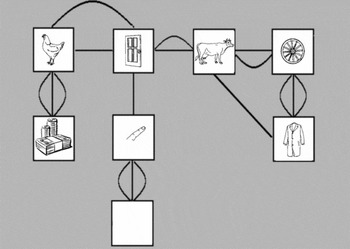
A similar network description task was used as, among others, Levelt (Reference Levelt1983), Oomen and Postma (Reference Oomen and Postma2002), Hartsuiker and Notebaert (Reference Hartsuiker and Notebaert2010), and Declerck and Kormos (Reference Declerck and Kormos2012). Each network contained seven unique pictures, all of which were noncognate words (average frequency per million for French words: 98.6; average frequency per million for English words: 162.5; Baayen, Piepenbrock & Gulikers, Reference Baayen, Piepenbrock and Gulikers1995) that were connected by lines (for an example of a network, see Figure 1). The participants were instructed to describe nine transitions of a red dot over each network, without any instructions to correct themselves. This red dot started at a blank square in each network and completed its path in 55 seconds (cf. Declerck & Kormos, Reference Declerck and Kormos2012). The description of the path, which was either in French or English, needed to consist of complete sentences that contained the direction (up, down, left, or right), the type of line (upper, lower, right or left curved line, or diagonal line, or straight line), and the picture (e.g., “The dot goes left over the straight line to the duck.”).
Example of a network

Procedure
Prior to the 18 experimental networks, a pre-recorded example of the network task was presented to the participants together with the corresponding network, to familiarize them with the task, followed by four practice networks. Unlike the experimental networks, the practice networks contained only five pictures. In each network, bilinguals had to use both French and English, with an identical number of sentences being produced in each language across all experimental networks and two-thirds of the sentences being language switch trials. The target language was indicated by a colored frame around the picture (blue vs. green), which became visible from the moment the red dot was in the middle of the previous picture, and disappeared two seconds after the next colored frame was visible. The color-to-language mapping was counterbalanced across participants.
Data analyses
Speech was recorded with a Zoom H2n Handy Recorder and the errors and repairs were coded by the first author, using the coding scheme shown in Table 2. Two types of errors were coded: language intrusions and lexical errors. Language intrusions are the result of selecting the correct concept, but incorrect selection of the language. Lexical errors are the result of incorrect selection of the concept, but correct selection of the language. The corresponding repair types (i.e., language intrusion and lexical repairs) were also coded, and consisted of errors being followed by the corrected utterance of said error.
Error and repair coding scheme

The binomial data was analyzed using a logistic mixed model (Jaeger, Reference Jaeger2008) with random effects for participants and items. All data analyses were run with the lme4 package (Bates, Maechler, Bolker & Walker, Reference Bates, Maechler, Bolker and Walker2014) in the statistical software R (R developmentCoreTeam, 2008).
Results
Overall language intrusions
We first investigated whether out of the 226 observed language intrusions, more language intrusions occurred on switch trials than on repetition trials, since this would indicate that more bilingual language interference occurred. To this end, we contrasted all language intrusions against all correctly produced words (approximately 35,000) in a model that contained the fixed effect Language Transition (switch vs. repetition). The model did not converge when letting Language Transition vary by participants and items. This issue was resolved by not allowing Language Transition to vary by participants, which resulted in a significant difference for Language Transition, b = 1.63, SE = 0.37, z = 4.42, p = .000, or by not allowing Language Transition to vary by participants, which also resulted in a significant difference for Language Transition, b = 2.61, SE = 0.57, z = 4.58, p = .000Footnote 2 . Both these analyses indicate that significantly more language intrusions occur in switch trials (0.8% of all switch trial words) than in repetition trials (0.2% of all repetition trial words).
Repair rate
To test how the repair rate of language intrusions would be affected by language switching, we contrasted all repaired errors against all nonrepaired errors. The model contained the fixed effects Language Transition (switch vs. repetition) and Error Type (language intrusions vs. lexical error). We set out to let these effects vary by participants and items (both intercepts and slopes), but the model did not converge. This issue was resolved by not allowing Error Type and the interaction to vary by participants and by not allowing Language Transition, Error Type, or the interaction to vary by itemsFootnote 3 .
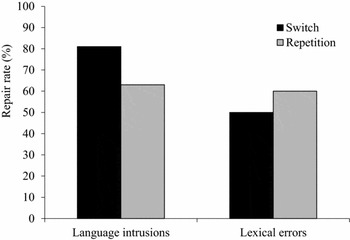
The results showed no significant main effects, as can be seen in Table 3. Yet, the interaction between Language Transition and Error Type was significant, with a higher repair rate during switch trials (81.4%) than during repetition trials (62.9%) for language intrusions (see Figure 2), b = 1.13, SE = 0.52, z = 2.19, p = .029. The lexical errors, of which 382 errors were observed across the experiment (1.1% during switch trials and 1.1% during repetition trials), showed a trend towards a lower repair rate during switch trials (50.2%) than during repetition trials (60.2%), b = 0.63, SE = 0.33, z = 1.92, p = .056.
b-, z-, and p-values, along standard errors for overall repair rate with variables: Language Transition (switch vs. repetition trials) and Error Type (language intrusions vs. lexical errors).

Positive b-values indicate a greater rate of error repair for switch trials (relative to repetition trials) and intrusion errors (relative to lexical errors).
Average repair rate as a function of language transition (switch vs. repetition) and error type (language intrusions vs. lexical errors) across participants.

However, since some participants (n = 11) only produced language intrusions on switch trials, this could have led to a larger repair rate of language intrusions during switch than repetition trials when averaging across participants, since a repair cannot be made if there are no intrusions. In order to exclude this possibility, we performed the repair rate analysis while only including the 13 bilinguals who produced language intrusions in both switch and repetition trials. This analysis revealed a similar pattern to the overall analysis with all participants, b = 1.46, SE = 0.61, z = 2.38, p = .017, with more repaired language intrusions in switch trials (86.2%) than in repetition trials (62.9%). This indicates that the observed repair rate pattern in the main analysis is not due to the fact that some participants only produced intrusions on switch trials.
Discussion
Whereas quite a lot of research has been conducted on error detection in a monolingual setting (either first or second language; e.g., Declerck & Kormos, Reference Declerck and Kormos2012; Levelt, Reference Levelt1983; Oomen & Postma, Reference Oomen and Postma2002), little research has been conducted on bilingual error detection. In the current study, we set out to investigate bilingual error detection by examining the repair rate of language intrusions in a language switching task. The results showed first that more language intrusions were observed in switch relative to repetition trials, confirming the assumption that cross-language conflict is increased in the switch trials. Second, a larger percentage of language intrusions were identified and repaired on switch trials than on repetition trials. The repair rate of lexical errors, on the other hand, showed an opposite pattern, with a trend towards more lexical errors being repaired on repetition trials than on switch trials.
The repair rate results do not seem to fit within the perceptual loop theory (Levelt, Reference Levelt1983, Reference Levelt1989), which assumes that error detection is based on language comprehension. Since language switching decreases language comprehension performance (Grainger & Beauvillain, Reference Grainger and Beauvillain1987; Hirsch et al., Reference Hirsch, Declerck and Koch2015; Orfanidou & Sumner, Reference Orfanidou and Sumner2005; Philipp & Huestegge, Reference Philipp and Huestegge2015; Thomas & Allport, Reference Thomas and Allport2000; Von Studnitz & Green, Reference Von Studnitz and Green2002), it should follow that error detection is worse during switch trials than repetition trials. Yet, our findings show the opposite. Moreover, since, according to the perceptual loop theory, all error detection occurs via language comprehension, a similar repair rate pattern was expected for language intrusions and lexical errors. This was also not the case. From these results we can conclude that our study does not provide support for bilingual error detection to occur as proposed by the perceptual loop theory.
On the other hand, our results do seem to fit well within the framework of conflict monitoring (Nozari et al., Reference Nozari, Dell and Schwartz2011), which claims that more interference, and thus higher perceived conflict, leads to enhanced error detection. In line with this account, increasing bilingual language interference, through language switches relative to language repetitions (e.g., Costa & Santesteban, Reference Costa and Santesteban2004; Declerck et al., Reference Declerck, Koch and Philipp2012; Meuter & Allport, Reference Meuter and Allport1999; Peeters et al., Reference Peeters, Runnqvist, Bertrand and Grainger2014), resulted in more language intrusions being detected and repaired. Hence, conflict monitoring of bilingual language interference led to enhanced error detection of language intrusions.
This enhanced error detection due to an increase in bilingual language interference could also explain why such a high percentage of language intrusions were repaired in the current study (switch trials: 81%; repetition trials: 63%), relative to the repair rate of language intrusions in Poulisse and Bongaerts (Reference Poulisse and Bongaerts1994; 37%). Whereas bilinguals performed in a mixed language context in the current study, the bilinguals in Poulisse and Bongaerts (Reference Poulisse and Bongaerts1994) performed in a pure language context. From the language switching literature we know that more bilingual language interference is instigated in a mixed language context than in a pure language context (e.g., Declerck, Philipp & Koch, Reference Declerck, Philipp and Koch2013; Grainger & Beauvillain, Reference Grainger and Beauvillain1987; Ma, Li & Guo, Reference Ma, Li and Guo2015). Because more bilingual language interference should lead to a higher repair rate according to the conflict monitoring account, this offers an explanation for the higher percentage of language intrusions that were repaired in the current study than in the study of Poulisse and Bongaerts (Reference Poulisse and Bongaerts1994).
An explanation for the opposite repair rate patterns of language intrusions and lexical errors can be offered on the basis that bilingual language interference occurs at multiple loci. According to the inhibitory control model of Green (Reference Green1998), bilingual language interference first occurs between language representations (e.g., language schemas) and then between translation-equivalent lexical representations (cf. Declerck et al., Reference Declerck, Koch and Philipp2015; Van Assche et al., Reference Van Assche, Duyck and Gollan2013). In turn, parallel error detection should occur for language representations and lexical representations, according to the conflict monitoring account (Nozari et al., Reference Nozari, Dell and Schwartz2011), with the former taking place first. According to the dual-task literature, parallel processes result in worse performance on the second task (e.g., Huestegge & Koch, Reference Huestegge and Koch2013; Brown & Marsden, Reference Brown and Marsden1991; for a review, see Pashler, Reference Pashler1994). Such a finding has also been obtained with first and second language error detection (Declerck & Kormos, Reference Declerck and Kormos2012; Oomen & Postma, Reference Oomen and Postma2002), providing evidence that attention during error detection is limited. Hence, it could be that due to error detection of language representations occurring first, but still in parallel with error detection at the lexical level, the latter process is impaired, and thus could account for the influence of language switching on the repair rate pattern observed for both types of error.
In sum, the current study shows that the repair rate of language intrusions is higher in switch trials than repetition trials. This fits the conflict monitoring account, in that an increase in interference on switch trials relative to repetition trials results in more efficient error detection.