1 Introduction
The perturbation growth of a material interface provoked by a shock wave is usually referred to as the Richtmyer–Meshkov (RM) instability which was first theoretically analysed by Richtmyer (Reference Richtmyer1960) and later experimentally confirmed by Meshkov (Reference Meshkov1969). Over the past decades, the RM instability has been a subject of intensive research due to its significance in scientific research, e.g. compressible turbulence, as well as a crucial role in engineering applications such as inertial confinement fusion (ICF) (Lindl et al. Reference Lindl, Landen, Edwards, Moses and Team2014). Most previous studies of RM instability were devoted to the planar shock-induced case, and several comprehensive reviews have been reported (Brouillette Reference Brouillette2002; Ranjan, Oakley & Bonazza Reference Ranjan, Oakley and Bonazza2011; Zhou Reference Zhou2017; Zhai et al. Reference Zhai, Zou, Wu and Luo2018). The convergent RM instability, which involves initial conditions relevant to ICF, has become increasingly attractive in recent years. The nature of geometric convergence brings great difficulties to experiments (Si et al. Reference Si, Long, Zhai and Luo2015), simulations (Lombardini, Pullin & Meiron Reference Lombardini, Pullin and Meiron2014) and theoretical analyses (Liu, He & Yu Reference Liu, He and Yu2012) and thus related research was scarce.
The linear development of a distorted interface subjected to arbitrary radial motion in cylindrical and spherical geometries was first analysed independently by Bell (Reference Bell1951) and Plesset (Reference Plesset1954), and the geometric convergence was found to continually modify the perturbation growth, which was later known as the Bell–Plesset (BP) effect. The compressible linear theory of Epstein (Reference Epstein2004) accounting for fluid compression suggests the considerable role of compressibility in the convergent RM instability. A fourth-order weakly nonlinear solution for the evolution of a perturbed interface at a fixed radial position in cylindrical geometry was derived by Liu et al. (Reference Liu, He and Yu2012), and the cylindrical effects in weakly nonlinear RM instability were analysed. The model validity range was then extended to the fully nonlinear stage based on the Padé approximation (Liu et al. Reference Liu, Yu, Ye, Wang and He2014), and the numerical results of Matsuoka & Nishihara (Reference Matsuoka and Nishihara2006) were recovered. Recently, a weakly nonlinear solution for the evolution of a uniformly imploding or exploding interface in cylindrical geometry was obtained, and the growths of the first three harmonics as well as the high-order feedback to the fundamental mode were discussed. In addition, the interface deceleration and reshock existing inevitably in convergent RM instability would significantly influence the instability development (Lanier et al. Reference Lanier, Barnes, Batha, Day, Magelssen, Scott, Dunne, Parker and Rothman2003; Lombardini et al. Reference Lombardini, Pullin and Meiron2014; Ding et al. Reference Ding, Si, Yang, Lu, Zhai and Luo2017). So far, the nonlinearity effect on convergent RM instability has never been thoroughly examined by experiments due to the great difficulty caused by the coupling of the RM instability, compressibility effect, BP effect, Rayleigh–Taylor (RT) effect and the reshock. The lack of understanding of nonlinear growth of convergent RM instability greatly impedes the explanation of new phenomena such as the very long linear growth of perturbation amplitude observed in previous experiments (Fincke et al. Reference Fincke, Lanier, Batha, Hueckstaedt, Magelssen, Rothman, Parker and Horsfield2005; Luo et al. Reference Luo, Zhang, Ding, Si, Yang, Zhai and Wen2018), and also hinders the development of corresponding nonlinear theories.
Shock-tube experiments have been demonstrated to be a promising and effective means to examine the convergent RM instability, in which stable converging shocks and controllable material interfaces are necessary. The coaxial shock tube, which has a natural advantage in producing converging shock waves, has been widely used in the convergent RM instability experiments (Hosseini & Takayama Reference Hosseini and Takayama2005; Si et al. Reference Si, Long, Zhai and Luo2015; Lei et al. Reference Lei, Ding, Si, Zhai and Luo2017), and the results exhibited a large difference from those in the planar geometry. Recently, a semi-annular coaxial shock tube was constructed (Luo et al. Reference Luo, Ding, Wang, Zhai and Si2015), and the first result in this facility suggested the significant influence of the BP and RT effects on the perturbation growth (Ding et al. Reference Ding, Si, Yang, Lu, Zhai and Luo2017). A gas-lens technique which refracts a planar shock into a cylindrical one was realized in a conventional shock tube, and the method exhibited a great potential for convergent RM instability studies (Biamino et al. Reference Biamino, Jourdan, Mariani, Houas, Vandenboomgaerde and Souffland2015; Vandenboomgaerde et al. Reference Vandenboomgaerde, Rouzier, Souffland, Biamino, Jourdan, Houas and Mariani2018). Inspired by the pioneering work of Dumitrescu (Reference Dumitrescu1992), an ordinary shock tube with a special wall profile gradually transforming a planar shock into a cylindrical one was established by Zhai et al. (Reference Zhai, Liu, Qin, Yang and Luo2010), and its slender test section allows a long-term instability evolution process (Si, Zhai & Luo Reference Si, Zhai and Luo2014; Luo et al. Reference Luo, Zhang, Ding, Si, Yang, Zhai and Wen2018). It has been found that the interface deceleration and the reshock were inevitable in previous converging experiments. The addition of such regimes greatly complicates the convergent RM instability, and makes the related analysis of flow regimes very difficult. Therefore, to better understand the individual influence of the BP, compressibility and nonlinearity effects on the perturbation growth, it is greatly desired to have converging shock-tube experiments of a long-term uniformly imploding interface without the interface deceleration and reshock, which motivates the present study.
In this work, a novel converging shock tube is elaborately designed such that the cylindrically imploding shock is transformed into a planar one when it is some distance away from the geometry centre. In this way, the interface deceleration and reshock are avoided and the nonlinear behaviour of the convergent RM instability becomes prominent.
2 Experimental methods
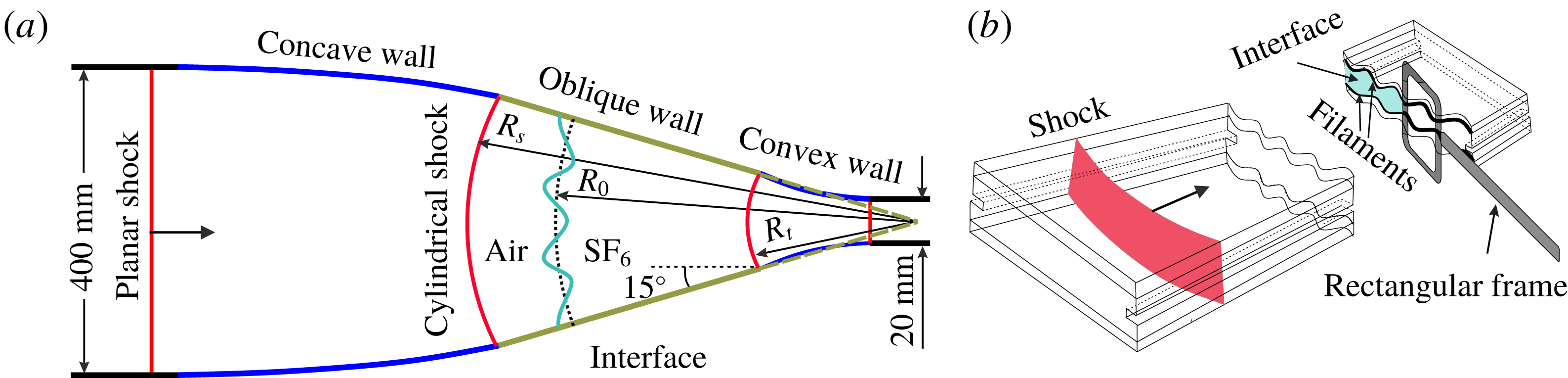
The overall structure of the converging shock tube is sketched in figure 1(a). A smooth concave–oblique–convex wall profile is elaborately designed to modify the shape of the shock wave. Specifically, a concave segment based on the shock dynamics theory (Zhai et al.
Reference Zhai, Liu, Qin, Yang and Luo2010) first transforms an incident planar shock into a cylindrical arc at a radius from the convergence centre of
 $R_{s}=300~\text{mm}$
. Then, the cylindrical shock converges along the oblique wall with an increasing strength. Later, it is transformed back into a planar one again by a convex wall connected to the end of the oblique section (
 $R_{t}=75~\text{mm}$
). Finally, the planar shock exits the tube without reflection. The present design enables a strong converging shock near the convergence centre to exit the convergent section without the shock focusing and reflecting. Thus, the interface deceleration as well as the reshock in previous converging experiments can be completely eliminated. As a result, a long-term instability development getting rid of the RT and reshock effects can be obtained. The design principles of the curved walls have been detailed and verified in previous works (Zhai et al.
Reference Zhai, Liu, Qin, Yang and Luo2010; Zhan et al.
Reference Zhan, Li, Yang, Zhu and Yang2018) focusing on the shock propagation and shock enhancement. Note that although the present facility employs a similar design principle, significant attempts and efforts are made to realize a desired flow condition: (1) the reflected shock and the interface deceleration, which are inevitable in previous convergent experiments, are completely eliminated; (2) the converging angle of the test section should be large enough for weakening the boundary layer effect; and (3) a slender test section is needed such that the flow features can be amply exhibited in a long testing time. With these requirements in mind, a systematic parametric study is conducted and eventually a set of optimal designing parameters (the converging angle, the height of the intensified planar shock,
 $R_{t}$
,
 $R_{0}$
, etc.) satisfying the above flow condition is found and realized in this new facility.
Sketches of the converging shock tube (a) and the interface formation devices (b). Measuring from the convergence centre, the converging shock is formed at
 $R_{s}=300~\text{mm}$
and is transformed at
 $R_{t}=75~\text{mm}$
gradually back to a planar one and the interface is arranged at
 $R_{0}=290~\text{mm}$
.

The soap film technique, which can successfully generate well-characterized interfaces free of small wavelength perturbations, diffusion layer and three-dimensionality in the planar geometry (Liu et al.
Reference Liu, Liang, Ding, Liu and Luo2018), is adapted to the convergent test section. As illustrated in figure 1(b), two trapezoidal transparent devices with an inner height of 7.0 mm are made using an acrylic plate (3.0 mm in thickness). Their junction surfaces are carefully engraved to possess a sinusoidal shape. Two thin filaments with the same sinusoidal shape are perpendicularly attached to the inner surfaces of the upper and lower plates, respectively, to produce a sinusoidal constraint. The filaments have a thickness of 0.25 mm and thus have a negligible influence on the flow. The sinusoidal filaments are first wetted by a soap solution (composed of 78 % distilled water, 2 % sodium oleate and 20 % glycerine in mass). Then, a rectangular frame, also wetted by a soap solution on its borders, is pulled along the sinusoidal filaments and, immediately, a single-mode soap film is formed. To form an
 $\text{air}{-}\text{SF}_{6}$
interface, the air in the test section is first squeezed out and replaced by
 $\text{SF}_{6}$
. Once the interface is formed, the shorter device with a single-mode soap film on its boundary is gently inserted into the test section and, subsequently, the longer device is gradually inserted until a perfect connection with the shorter one is achieved. During this process,
 $\text{SF}_{6}$
is slowly injected into the test section to ensure a high concentration. For each experimental run, the
 $\text{SF}_{6}$
mass fraction (detected by a gas concentration detector) exceeds 90 %, and there is only a slight variation among different runs. Note in this work the whole shock tube is placed horizontally and thus the gas interface formed in the test section is parallel to the direction of gravity, which indicates a negligible influence of gravity on the gas contamination.
A single-mode interface in cylindrical geometry can be parameterized as
 $r(\unicode[STIX]{x1D703})=R_{0}+a_{0}\cos (n\unicode[STIX]{x1D703})$
, where
 $R_{0}$
refers to the mean radius of the initial interface,
 $a_{0}$
to the initial amplitude,
 $\unicode[STIX]{x1D703}$
to the azimuthal angle and
 $n=2\unicode[STIX]{x03C0}R_{0}/\unicode[STIX]{x1D706}$
to the azimuthal mode number with
 $\unicode[STIX]{x1D706}$
being the wavelength. In the present experiments, the initial interface is fixed at
 $R_{0}=290~\text{mm}$
. The strength of the incident cylindrical shock when it meets the initial interface is
 $M_{c}=1.30\pm 0.01$
. The interface has a height of 7.0 mm, which ensures a good two-dimensionality (Luo et al.
Reference Luo, Zhang, Ding, Si, Yang, Zhai and Wen2018). A Z-fold schlieren system combined with a high-speed camera (FASTCAM SA5, Photron Limited) is used to visualize the flow field. The frame rate of the camera is set as 47 500 f.p.s. with a shutter time of
 $1~\unicode[STIX]{x03BC}\text{s}$
. The spatial resolution of the schlieren images is
 $0.23~\text{mm}~\text{pixel}^{-1}$
. The ambient pressure and temperature are 101.3 kPa and
 $298.5\pm 3~\text{K}$
, respectively.
3 Results and discussion
To obtain the background flow field, an unperturbed
 $\text{air}{-}\text{SF}_{6}$
interface located at
 $R_{0}$
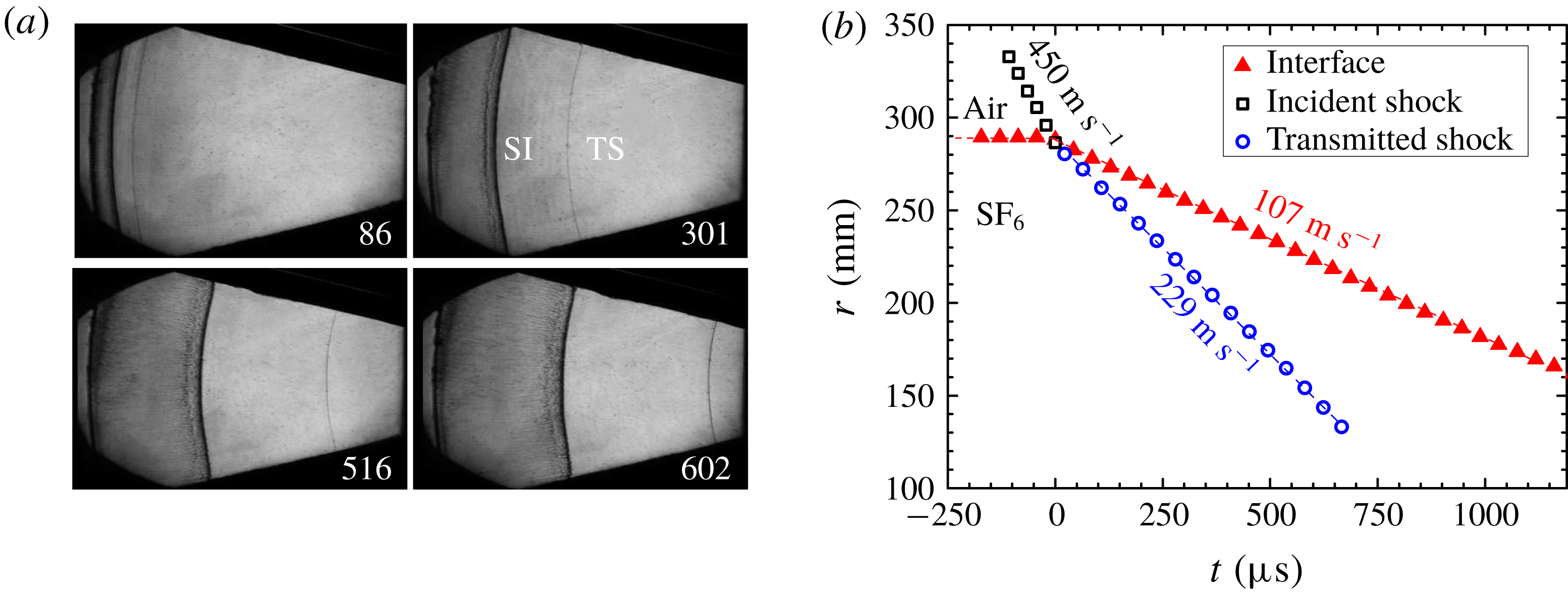
subjected to a concentric cylindrical shock is first examined for which there is no theoretical solution. Representative schlieren images illustrating the motions of the wave and the unperturbed interface are displayed in figure 2(a). As the incident cylindrical shock hits the uniform interface, it splits into a downstream-moving transmitted shock and an upstream-moving reflected shock which quickly moves away from the observation window. Afterwards, the shocked interface moves inwards and maintains a perfectly cylindrical morphology. Note there are no waves reflected from the convergence centre, and a long-term inward motion of the gas interface is available, which demonstrates the good feasibility of the present shock-tube design. An
 $r-t$
diagram depicting the trajectories of the transmitted shock and the shocked interface is plotted in figure 2(b). Accelerated by the incident cylindrical shock, the interface attains nearly a constant speed of
 $107~\text{m}~\text{s}^{-1}$
, which indicates no flow deceleration in this facility. Because the RT effect and reshock are avoided in the current facility, the shocked interface possesses a longer-term uniform motion, which provides a rare opportunity to analyse the nonlinearity effect on the convergent RM instability.
Evolution of the unperturbed interface (a), and displacements of the transmitted shock (TS) and the shocked interface (SI) (b). Numbers in the schlieren images are in
 $\unicode[STIX]{x03BC}\text{s}$
. The time when the converging shock meets the interface at
 $R_{0}$
is defined as
 $t=0~\unicode[STIX]{x03BC}\text{s}$
.

Then five single-mode interfaces with different amplitudes and wavelengths subjected to a cylindrical shock are realized in this shock tube. The detailed initial conditions for each case (denoted by
 $a_{0}-n$
) are listed in table 1. The Atwood number is defined as
 $A=(\unicode[STIX]{x1D70C}_{2}-\unicode[STIX]{x1D70C}_{1})/(\unicode[STIX]{x1D70C}_{2}+\unicode[STIX]{x1D70C}_{1})$
with
 $\unicode[STIX]{x1D70C}_{1}$
and
 $\unicode[STIX]{x1D70C}_{2}$
being the densities of gases at the right- and left-hand sides of the interface, respectively. Note the noticeable discrepancy in incident shock velocity between the unperturbed and perturbed cases is mainly caused by the different ambient temperatures.
Parameters of the initial conditions for different cases (
 $a_{0}-n$
) with
 $a_{0}$
and
 $n$
standing for the pre-shock amplitude and azimuthal mode number, respectively, and
 $A^{+}$
for the post-shock Atwood number. Here
 $v_{i}$
and
 $\unicode[STIX]{x0394}v$
are, respectively, the speeds of the incident shock and the shocked interface, and
 $v_{0}$
is the amplitude growth rate. ‘mfra(
 $\text{SF}_{6}$
)’ denotes the mass fraction of
 $\text{SF}_{6}$
.

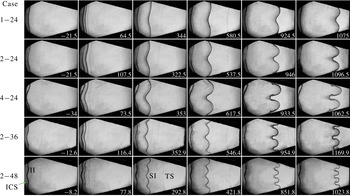
Evolutions of single-mode air-SF6 interfaces impacted by a cylindrical converging shock. Symbols are the same as those in figure 2. Numbers in the schlieren images denote time with a unit of
 $\unicode[STIX]{x03BC}\text{s}$
. The ICS travels from left to right with a Mach number of
 $1.30\pm 0.01$
.

Sequences of schlieren images are displayed in figure 3 to illustrate the complete processes of the interface deformation and wave propagation for five cases. The interfacial morphologies are remarkably clear during the experimental time for all cases, which demonstrates a good reliability of the present method. Take the Case 2–48 as an example to discuss the detailed evolution process, and define the time origin (
 $t=0$
) as the moment when the cylindrical shock arrives at the mean position of the initial interface (
 $R_{0}$
). At the beginning, the interface profile looks quite thick due to the superposition of the upper and lower sinusoidal filaments fixed on the observation windows. As the incident cylindrical shock (ICS) encounters the initial interface (II), it bifurcates into a sine-like TS propagating downstream and an upstream-moving reflected shock which quickly moves away from the visualization window. Then the SI presents a clean and clear sinusoidal configuration. This demonstrates that the initial interfacial imperfections such as short-wavelength perturbations (Vandenboomgaerde et al.
Reference Vandenboomgaerde, Souffland, Mariani, Biamino, Jourdan and Houas2014), diffusion layer (Jacobs & Krivets Reference Jacobs and Krivets2005) and three-dimensionality (Luo, Wang & Si Reference Luo, Wang and Si2013; Luo et al.
Reference Luo, Zhang, Ding, Si, Yang, Zhai and Wen2018) existing in previous experiments are eliminated here. We believe the perfect initial interface created allows us to obtain high-fidelity results of convergent RM instability. As the shocked interface moves forward, it distorts greatly which is caused by the baroclinic vorticity induction as well as the convergence effect, and the perturbation amplitude increases continuously. At the early stage, the instability is within the linear regime and the interface presents a perfect sinusoidal profile. Later, nonlinearity becomes more important and high-order harmonics are produced, breaking the interface symmetry. Meanwhile, the finger-like bubble and spike structures are generated (
 $623.5~\unicode[STIX]{x03BC}\text{s}$
). Afterwards, the spike starts to roll up and a pair of vortices are formed on its shoulder (
 $894.8~\unicode[STIX]{x03BC}\text{s}$
). For the Case 1–24 with a very small amplitude-to-wavelength ratio, the interface presents a sinusoidal shape during the whole evolution process, which indicates a relatively longer linear stage. This result permits a thorough examination of the linear model of convergent RM instability. For cases with a larger amplitude-to-wavelength ratio (Cases 4–24, 2–36, 2–48), nonlinearity is more pronounced, and the bubble and spike structures appear earlier. The boundary layer in the post-shock flow has a maximum thickness of 0.2 mm during the experimental time, and thus has negligible influence on the interface development. It is seen that the averaged positions of the distorted interfaces for different cases in figure 3 are not exactly the same. The main reason is that, to facilitate the interface formation, the present test section is designed to be removable in the horizontal direction and thus the position of the test section relative to the observation window (at a fixed location) varies within a certain range from run to run, causing a slight variation of the interface position. In addition, the experimental initial conditions (e.g. the gas concentration and temperature) are not completely controllable, and thus the speed of the shocked interface exhibits a discrepancy from run to run.
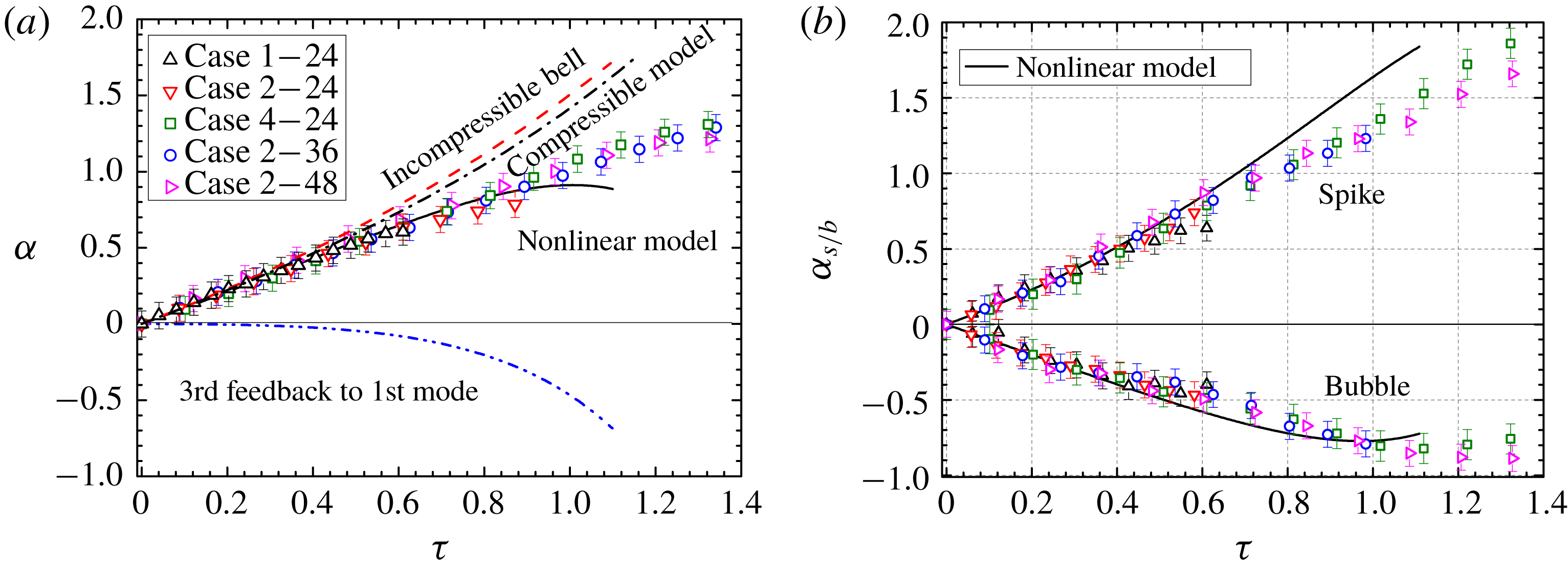
Temporal variations of the perturbation amplitude for five cases are plotted in figure 4(a). The time is normalized by
 $\unicode[STIX]{x1D70F}=kv_{0}(t-t^{\ast })$
with
 $k$
the wavenumber,
 $v_{0}$
the initial growth rate measured from experiment and
 $t^{\ast }$
the time just after the shock impact. The amplitude is scaled as
 $\unicode[STIX]{x1D6FC}=k(a-a^{\ast })$
with
 $a^{\ast }$
the corresponding amplitude at
 $t^{\ast }$
. We can find that the dimensionless amplitude variations for different cases coincide quite well and exhibit a persistently linear increment during the whole experimental time (
 $\unicode[STIX]{x1D70F}\geqslant 1.0$
). This is quite different from the planar situation in which the linear growth rate reduces gradually after
 $\unicode[STIX]{x1D70F}=0.7$
due to the increasing nonlinearity. The incompressible model (Bell Reference Bell1951) gives a good prediction of the perturbation growth at the early stage and overestimates it after
 $\unicode[STIX]{x1D70F}=0.3$
. The large discrepancy between the prediction and the experiments at later stages may be ascribed to the ignorance of compressibility and nonlinearity in the theory of Bell (Reference Bell1951).
Comparisons between experimental results and model predictions for (a) the overall amplitude and (b) amplitudes of the bubble and spike. Dash and dash-dot lines represent, respectively, the linear predictions of the incompressible model (Bell Reference Bell1951) and the compressible theory considering the fluid compression. Solid and dash-dot-dot lines denote the nonlinear prediction and the feedback of the 3rd harmonic to the 1st mode in the model of Wang et al. (Reference Wang, Wu, Guo, Ye, Liu, Zhang and He2015), respectively.

To assess the compressibility effect, we introduce a uniform and constant volume expansion ratio
 $c$
in both interior and exterior fluids, and the compressible linear model for cylindrical RMI can be written as (Epstein Reference Epstein2004)
 $$\begin{eqnarray}\displaystyle \displaystyle \frac{1}{R^{2}}\frac{\text{d}(R^{2}{\dot{a}})}{\text{d}t}-(nA-1)\frac{\ddot{R}a}{R}-c{\dot{a}}-\frac{{\dot{R}}ac}{R}=0, & & \displaystyle\end{eqnarray}$$
where
 ${\dot{a}}$
is the amplitude growth rate,
 ${\dot{R}}$
and
 $\ddot{R}$
are the first and second derivatives of radius with time, respectively. Note the present theory is a direct extension of the compressible Bell model, where only one side of the interface is occupied by fluid. The growth rate of the perturbation amplitude can be obtained by integrating equation (3.1) from
 $t_{0}$
to
 $t$
,
 $$\begin{eqnarray}\displaystyle \displaystyle {\dot{a}}(t)=c\frac{aR^{2}-a_{0}R_{0}^{2}}{R^{2}}-\frac{1}{R^{2}}\int _{t_{0}}^{t}R{\dot{R}}ac\,\text{d}t^{^{\prime }}+\frac{nA-1}{R^{2}}\int _{t_{0}}^{t}R\ddot{R}a\,\text{d}t^{^{\prime }}+\left(\frac{R_{0}}{R}\right)^{2}{\dot{a}}_{0}, & & \displaystyle\end{eqnarray}$$
where
 $t_{0}$
denotes the moment that the amplitude starts to grow and
 ${\dot{a}}_{0}$
is the initial growth rate at
 $t=t_{0}$
. The first two terms in the right-hand side of equation (3.2) are caused by volume expansion (compressibility effect), the third term is caused by non-uniform motion of the shocked interface (RT effect) and the last term is the pure RM instability as in the planar case. The factor
 $1/R$
appearing in all the four terms represents the geometry convergence effect (BP effect). In our experiments, the shocked interface moves uniformly during the experimental time and thus the RT effect is negligible. The compressibility effect can be estimated by reasonably approximating the volume expansion ratio as
 $$\begin{eqnarray}\displaystyle \displaystyle c=\frac{1}{V}\frac{\text{d}V}{\text{d}t}\approx \frac{(R_{min}/R_{0})^{2}-1}{t_{r}}, & & \displaystyle\end{eqnarray}$$
where
 $V$
is the fluid volume,
 $R_{min}$
the minimum mean radius of the interface and
 $t_{r}$
the time duration that the interface moves from
 $R_{0}$
to
 $R_{min}$
. The expansion ratios for Cases 1–5 are calculated to be
 $-0.000564$
,
 $-0.000574$
,
 $-0.000533$
,
 $-0.000528$
,
 $-0.000613~\unicode[STIX]{x03BC}\text{s}^{-1}$
, respectively. Note with
 $c=0$
, equation (3.1) reduces to the incompressible linear model of Bell (Reference Bell1951). As seen from figure 4(a), there exists only a minor difference between the incompressible and compressible predictions, which indicates a weak compressibility effect in the present convergent RM instability. It should be pointed out that the present result is different from the previous analysis of Epstein (Reference Epstein2004) where compressibility is found to play a significant role in the instability growth. A main reason is that in the present experiments, the test section possesses an open trailing end such that the inward-moving fluid is allowed to move out of the test section. As a consequence, the fluid suffers a much weaker compression as compared to that of conventional convergent RMI (Ding et al.
Reference Ding, Si, Yang, Lu, Zhai and Luo2017; Vandenboomgaerde et al.
Reference Vandenboomgaerde, Rouzier, Souffland, Biamino, Jourdan, Houas and Mariani2018).
Since the compressibility is very weak, the incompressible model of Wang et al. (Reference Wang, Wu, Guo, Ye, Liu, Zhang and He2015) considering the nonlinearity correction for cylindrical RM instability can be employed to predict the present instability growth. Under the assumption of incompressible, inviscid and irrotational flow, the amplitude variation of the
 $n$
th-order harmonic on a cylindrical interface subjected to arbitrary radial motion can be derived using the perturbation expansion method, and it is implicitly controlled by a second-order ordinary differential equation. Considering the current flow conditions, i.e. the shocked interface implodes uniformly (
 ${\dot{R}}=V$
and
 $\ddot{R}=0$
), a considerable simplification can be made such that an analytic solution explicitly describing the perturbation growth is achieved. For simplicity, here only the analytical solution up to the second order is given,
 $$\begin{eqnarray}\displaystyle & \displaystyle a_{1,1}=a_{0}+\dot{a_{0}}tC_{r}, & \displaystyle\end{eqnarray}$$
 $$\begin{eqnarray}\displaystyle & \displaystyle a_{2,2}=a_{0}\dot{a_{0}}t\left(A\frac{n}{R}-\frac{1}{2}\frac{1}{R}\right)(C_{r}-1)+\dot{a_{0}}^{2}t^{2}\left[\left(\frac{1}{6}A\frac{n}{R}-\frac{1}{4}\frac{1}{R}\right)C_{r}^{2}-\frac{2}{3}A\frac{n}{R}C_{r}\right], & \displaystyle\end{eqnarray}$$
 $$\begin{eqnarray}\displaystyle & \displaystyle a_{2,0}=-\left(a_{0}\dot{a_{0}}t\frac{1}{2}\frac{1}{R}C_{r}+\dot{a_{0}}^{2}t^{2}\frac{1}{4}\frac{1}{R}C_{r}^{2}\right), & \displaystyle\end{eqnarray}$$
where
 $C_{r}=R_{0}/R(t)$
is the convergence ratio. The
 $a_{1,1}$
and
 $a_{2,2}$
represent the amplitude developments of the first and second harmonics, respectively, and
 $a_{2,0}$
denotes the second-order feedback to the unperturbed mode. For more details about the nonlinear theory, readers should refer to the original work of Wang et al. (Reference Wang, Wu, Guo, Ye, Liu, Zhang and He2015).
The analytical solution diverges after a certain time (
 $\unicode[STIX]{x1D70F}>1.0$
here) and thus only the early-stage prediction is given. It is seen that the nonlinear model forecasts the experimental results well during its whole validity range. A significant negative feedback of the third-order harmonic to the fundamental harmonic predicted by the model is also plotted in figure 4(a), which demonstrates an evident nonlinearity. Note that the magnitude of the third-order feedback here is about two times larger than that in the planar RM instability with the same initial conditions, which indicates a stronger nonlinearity in the convergent RM instability. The counteraction between the promotion by the BP effect and the suppression by nonlinearity effect is the primary reason for the prolongation of linear growth. The present finding gives a clear clarification for the so called ‘prolonged linear stage’ observed in several independent converging experiments (Fincke et al.
Reference Fincke, Lanier, Batha, Hueckstaedt, Magelssen, Rothman, Parker and Horsfield2005; Luo et al.
Reference Luo, Zhang, Ding, Si, Yang, Zhai and Wen2018). We stress that coaxial converging shock tubes, which usually have a very small test section due to the structure limitation, provide a very short experimental time (before reshock) during which nonlinearity has not acted prominently on the interface evolution. Hence, the instability in previous coaxial shock-tube experiments is always in a linear regime, and the Bell’s linear theory can reasonably predict the whole-stage perturbation growth under evident BP and RT effects (Ding et al.
Reference Ding, Si, Yang, Lu, Zhai and Luo2017; Lei et al.
Reference Lei, Ding, Si, Zhai and Luo2017). Amplitude histories for the bubble and spike are given in figure 4(b) to examine the development of finger-like structures. Considering the fact that the shocked interface undergoes nearly a uniform motion during the current experimental time, which indicates a negligible influence of geometric convergence on the interface motion, it is reasonable to employ the one-dimensional shock dynamics theory to estimate the interface velocity. The considerable agreement between the predicted speed (
 $110~\text{m}~\text{s}^{-1}$
) and the measured one (
 $107~\text{m}~\text{s}^{-1}$
) for the unperturbed case strengthens our confidence. Hence, the individual amplitudes of bubble and spike for each perturbed case can be measured by taking the corresponding unperturbed case calculated by one-dimensional shock dynamics theory as a reference. It is seen that both the spike and bubble present a nearly linear growth before
 $\unicode[STIX]{x1D70F}=1.2$
at normalized growth rates of 1.20 and 0.85, respectively. The model of Wang et al. (Reference Wang, Wu, Guo, Ye, Liu, Zhang and He2015) can also give a reasonable prediction of the development of each structure. A visible difference between the bubble and spike amplitudes at
 $\unicode[STIX]{x1D70F}=0.4$
suggests an earlier effect of nonlinearity.
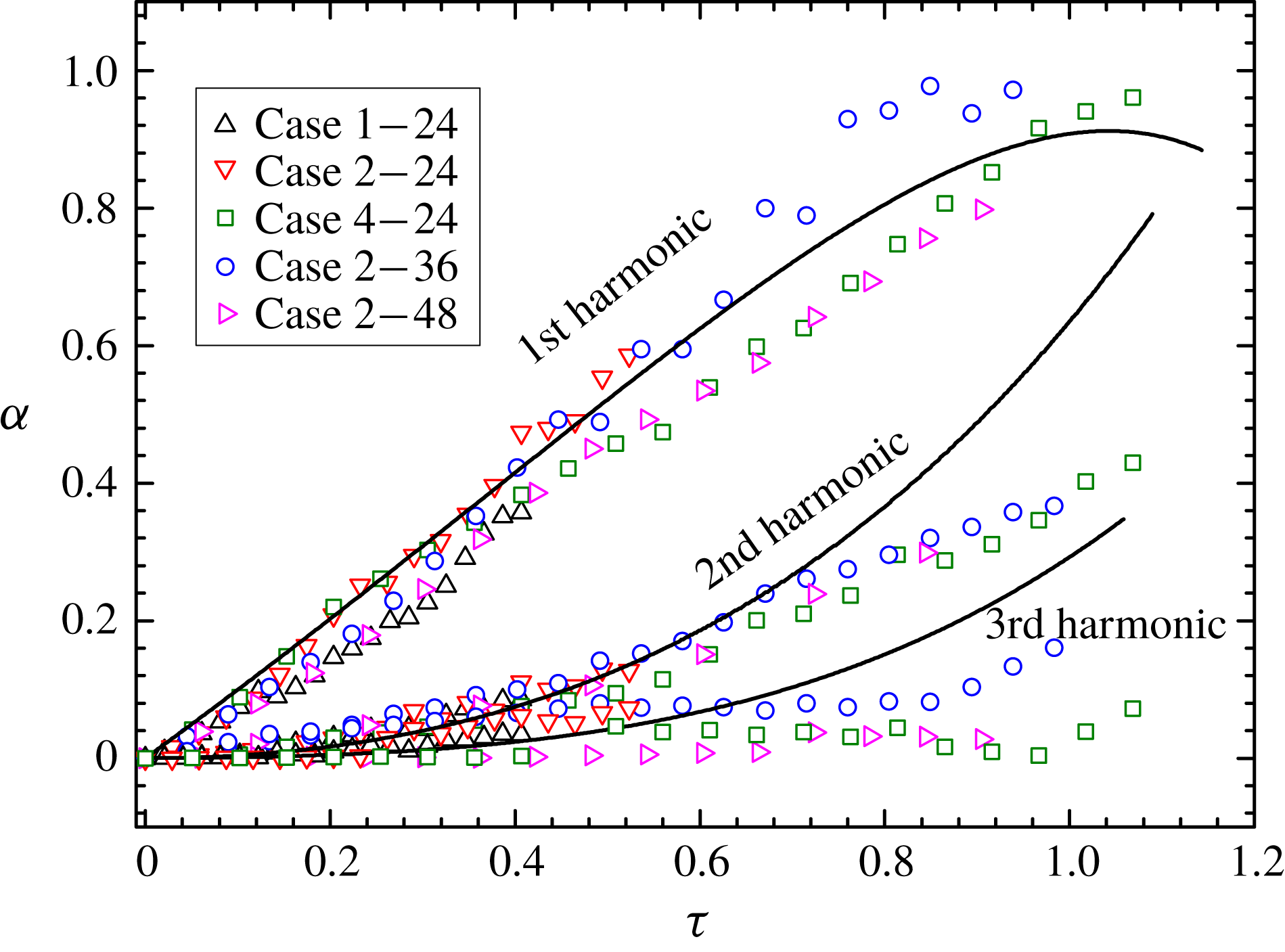
Temporal variations of the perturbation amplitude for the first three harmonics. Lines denote the nonlinear predictions of Wang et al. (Reference Wang, Wu, Guo, Ye, Liu, Zhang and He2015).

The high-quality schlieren pictures obtained facilitate a reliable extraction of the interfacial profiles by a simple image-processing program. By performing a spectrum analysis on the interfacial contour, growths of the first, second and third harmonics from the early to weakly nonlinear stages can be obtained. As shown in figure 5, the fundamental harmonic presents a long linear growth like the overall amplitude. The growth rates of the second and third harmonics are far smaller, demonstrating a dominant role of the fundamental harmonic in the weakly nonlinear stage. As time proceeds, the amplitude of the second harmonic increases continuously to a considerable level, which reasonably explains the increasing discrepancy between the bubble and spike growths after
 $\unicode[STIX]{x1D70F}=0.4$
as shown in figure 4(b). During the experimental time, the third harmonic maintains a very small amplitude, which implies that the energy of the basic harmonic is mainly transferred to the second harmonic at the weakly nonlinear stage. It is seen that the nonlinear model of Wang et al. (Reference Wang, Wu, Guo, Ye, Liu, Zhang and He2015) gives a reasonable prediction of the growth of each harmonic. To the authors’ knowledge, this is the first direct validation of the nonlinear model of cylindrical RM instability in terms of the harmonic developments from early to weakly nonlinear stages. The good agreement between the experiments and the theory is mainly ascribed to the fact that the present flow meets the application condition of Wang’s theory well, where the interface is assumed to implode uniformly and also the flow is assumed to be incompressible and inviscid.
It should be stressed that although the present work is full of novelty, namely, for the first time, we realize the flow control of convergent RM instability through elaborately designed shock-tube experiments, the most significant contribution of this work is the scientific finding on flow regimes. Specifically, we perform the first quantitative study on compressibility and nonlinearity effects of convergent RM instability experimentally, and it is found that compressibility plays a minor role but nonlinearity manifests more evidently than that in planar geometry. The results with respect to the generation and growth of high-order harmonics (caused by nonlinearity) are of great importance for understanding and modelling the late-stage flow transition and turbulent mixing. The present finding is a substantial step forward in understanding of convergent RM instability.
4 Conclusions
To isolate the nonlinearity effect from the RT effect and reshock in a convergent RM instability, we designed a novel shock tube. The shock tube has a concave–oblique–convex wall profile, which first transforms an incident planar shock into a cylindrical arc, then strengthens the cylindrical shock gradually, and finally converts it back into a planar one again. In this way, the cylindrically converging shock can exit the test section before it approaches the geometry centre, and hence the interface deceleration and reshock can be avoided. A soap film technique is adapted to the present convergent geometry for forming well-controlled single-mode interfaces free of small wavelength perturbations, diffusion layer and three-dimensionality. An unperturbed case is first examined, and reveals a long-term uniform motion of the shocked interface which demonstrates a successful elimination of the interface deceleration and reshock. Then five single-mode interfaces with different amplitudes and wavelengths are considered. The perturbation amplitude for all cases shows a much longer linear growth with time than that in the planar geometry. A compressible linear model is derived by considering a constant uniform fluid compression, which shows a weak compressibility in the present cylindrical RM instability by comparing it with that of the incompressible model (Bell Reference Bell1951). Both the linear models overestimate the perturbation growth from a very early stage due to the presence of strong nonlinearity. The nonlinear model of Wang et al. (Reference Wang, Wu, Guo, Ye, Liu, Zhang and He2015) considering the third-order correction can reasonably predict the amplitude growth up to a dimensionless time of 1.0. The prolongation of the linear stage in cylindrical geometry is mainly ascribed to the compensation between the promotion by the BP effect and the inhibition by the negative feedback of the third-order harmonic. Quantitative growths of the first, second and third harmonics, obtained from a Fourier analysis of the interface contour, provide a first direct validation of this nonlinear model. The results on high-order harmonic generation and growth caused by nonlinearity are of great importance for understanding and modelling the late-stage flow transition and turbulent mixing.
Acknowledgements
This work was supported by the National Natural Science Foundation of China (nos 11625211, 11802304, 11722222 and 11621202) and the Science Challenging Project (no. TZ2016001). The authors are grateful to Mr Z. Zhou and Dr F. Lei for helpful discussions on theoretical analysis.