Introduction
Habitat loss and fragmentation can sometimes lead to the creation of artificial habitats through landscape change and are expected to influence interactions between species. Studies of the effects of habitat alteration on invertebrate species associations and interactions suggest that natural enemies may not be able to successfully locate their hosts in fragmented landscapes (Roland Reference Roland1993). Additionally, natural enemies such as parasites and parasitoids may not thrive at artificial sites because beneficial habitat requirements or abiotic factors are missing or poorly represented (e.g., Heikkinen et al. Reference Heikkinen, Luoto, Virkkala and Rainio2004; Holzschuh et al. Reference Holzschuh, Steffan-Dewebter and Tscharntke2010). For example, increased agricultural land use and urban development have been negatively associated with the presence of parasitoids of bees and wasps (Hymenoptera) (Holzschuh et al. Reference Holzschuh, Steffan-Dewebter and Tscharntke2010). In another study, increasing levels of disturbance were associated with lowered success of parasitoids of a leaf-mining fly (Diptera: Agromyzidae) (Fenoglio et al. Reference Fenoglio, Salvo and Estallo2009).
James et al. (Reference James, Bert and Forbes2009) showed that parasitism of Ischnura verticalis (Say) (Odonata: Coenagrionidae) by ectoparasitic water mites of the genus Arrenurus Duges (Acari: Arrenuridae) was higher for damselflies collected from natural wetlands than for those from artificial wetlands, perhaps because of the mite's lessened ability to establish itself in recently created artificial habitats. Taylor and Merriam (Reference Taylor and Merriam1996) demonstrated lowered endoparasitism by gregarine protozoans of ebony jewelwing damselflies, Calopteryx maculata (Beauvois) (Odonata: Calopterygidae), in human-modified (agricultural) landscapes. Such variation is likely dependent on host behaviour, diet, habitat use, and host habitat fidelity (Clopton et al. Reference Clopton, Cook and Cook2004), all of which can vary among habitats and landscapes. Parasitism by gregarines may reduce host fitness and survival, even leading to host death, especially when the parasite load is very high (Åbro Reference Åbro1971, Reference Åbro1987; Forbes and Robb Reference Forbes, Robb and Cordoba-Aguilar2008). Variation in gregarine parasitism and strength of the host–parasite interaction therefore appear to be correlated. Demonstrating that associations vary across habitats and landscapes is an important component in characterizing selection effects that natural enemies impose on hosts (Thompson Reference Thompson2005) and whether or not hosts show life-history variation in relation to parasitism. Such studies may also help in identifying sink and source habitats.
We studied I. verticalis at the study locations used by James et al. (Reference James, Bert and Forbes2009), focusing on gregarine infection patterns in natural and artificial wetlands and surrounding landscapes varying in forest and wetland cover and road density. Emergence dates and densities of I. verticalis did not vary at these wetland sites. If densities of hosts and parasites are similar at different sites, similar host infection levels at the different sites are expected (Locklin and Vodopich Reference Locklin and Vodopich2010). Seasonality is important in gregarine infection and, as a host flight season progresses, infective stages of gregarines are expected to be more abundant (Bouwma et al. Reference Bouwma, Howard and Jeanne2005; Locklin and Vodopich Reference Locklin and Vodopich2010). It is therefore necessary to compare populations at similar stages of their flight seasons.
We also compared the results of our study with those of James et al. (Reference James, Bert and Forbes2009) to determine whether or not there were general patterns of internal (gregarine) and external (Arrenurus mites) parasites despite differing life histories. One might expect that the magnitude and direction of effects will depend on the parasite under study. Adult Arrenurus mites are predatory (Smith Reference Smith1988); gregarines are not predatory but do appear to require vectors, possibly midges (Diptera: Nematocera), to complete their life cycle (Åbro Reference Åbro1976). It is likely that the dispersal ability of natural enemies relative to their hosts is an important factor in the successful colonization of new (artificial) habitats. Bergerot et al. (Reference Bergerot, Julliard and Baguette2010) and Schüepp et al. (Reference Schüepp, Herrmann, Herzog and Schmidt-Entling2011) suggested that parasites do not disperse as efficiently as was previously thought. Other species present in new habitats or modified landscapes also may be important in determining whether or not natural enemy populations become established.
Methods and materials
Study organisms
Ischnura verticalis is one of the most commonly encountered damselflies in eastern North America. Adults feed around the edges of a wide range of permanent still-water habitats and are less vagile than many other odonates (Walker Reference Walker1953).
Gregarine prevalence of about 20% is often seen in damselflies (Corbet Reference Corbet1999). Gregarines have a simple, direct, one-host life cycle and can be vectored to new host individuals as oocysts attached to the tarsal hairs of odonate prey (Åbro Reference Åbro1976). Developing gregarines anchor themselves to the wall of the host's midgut and absorb nutrients from the gut lumen (Åbro Reference Åbro1976). Fully fed gregarines (trophozoites) detach from the gut wall and form gametocysts, containing oocysts, which are released through the feces (Åbro Reference Åbro1990; Bush et al. Reference Bush, Fernández, Esch and Seed2001).
Study sites
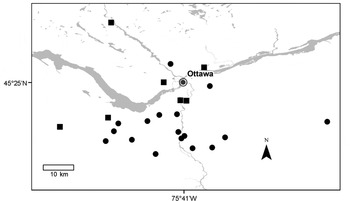
Specimens of I. verticalis were collected between 10 June and 1 July 2005 from 17 artificial wetlands and 7 natural wetlands in a 3446km2 area surrounding Ottawa, Ontario, and Gatineau, Quebec (approximately 45°26′N, 75°41′W) (Fig. 1). We attempted to collect about 30 individuals by sweep-netting at each site. Natural and artificial wetlands were sampled as blocks at the same time. Individually netted damselflies were identified in the field and stored in 95% ethanol.
Map of the study sites in the Ottawa, Ontario (●), and Gatineau, Quebec, region used to compare the rates of gregarine parasitism in Ischnura verticalis between natural (●) and artificial (■) wetlands.

All wetlands had been permanent since at least 2002, ranged in size from 1 to 5ha, and contained well-established emergent vegetation. The size of each wetland was estimated by digitizing aerial photographs taken in 2000. In all wetlands I. verticalis was present in large numbers (see James et al. Reference James, Bert and Forbes2009). The artificial wetlands were sites created as storm water drainage compounds, excavation sites, and drainage ditches at least 10 years prior to our study, and were often located near housing and shopping-centre developments. The natural wetlands were characterized by their development through natural geological and hydrological processes and their presence in aerial photographs taken in 1972 and 1975. The natural wetlands were generally located in Ottawa's “greenbelt” or in Gatineau Park, Quebec.
Landscape data
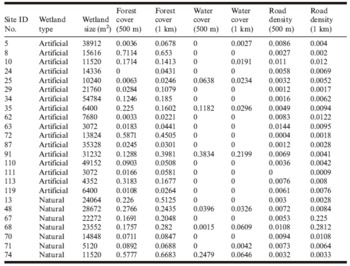
The proportions of forest cover, wetland cover, and road density at 500 m and 1 km scales around each wetland were assessed using 30 m digital topographic data (Appendix) (for details see James et al. Reference James, Bert and Forbes2009). These six continuous variables allowed us to explore a gradient from artificial to natural landscapes that could influence host and parasite site-to-site movement and interactions. For example, increasing road density and decreasing forest and wetland cover were associated with increasing artificiality. We tested these variables at 500 m and 1 km for two reasons. James et al. (Reference James, Bert and Forbes2009) measured forest and wetland cover at the same distances and we wished to compare our results with theirs. Second, 1km is probably the upper limit of dispersal from a wetland for I. verticalis. Distances less than 500 m were excluded because these probably still include the influence of the focal wetland for some of the larger wetlands included in this study.
Dissections
The abdomen of each of the 597 damselflies collected by James et al. (Reference James, Bert and Forbes2009) was separated from the thorax and dissected, gently removing the gut with forceps. The gut was then dissected with fine probes, and gregarine trophozoites were counted to determine the prevalence and intensity of parasitism.
Statistical analyses
We used SPSS statistics version 17.0 (SPSS Inc. 2008) to perform analyses. We tested for sex bias in gregarine prevalence using a two-tailed t test on point estimates of prevalence between females and males to determine whether one sex was more parasitized than the other (which could be important if one sex was differentially represented at one wetland type). Prevalence, sensu Bush et al. (Reference Bush, Lafferty, Lotz and Shostak1997), was assessed as the proportion of hosts from an individual wetland infected by one or more gregarines. Square-root transformation was performed on the proportional data to achieve a normal distribution. Using a weighted analysis of covariance (ANCOVA), we compared the difference in gregarine prevalence between samples of hosts collected from the two different wetland types and the area of the focal wetland. We also compared mean intensity, or the average number of gregarines per infected individual, in the sample (Bush et al. Reference Bush, Lafferty, Lotz and Shostak1997) between wetland types. By log-transforming the data, we achieved normality. Analyses were weighted by sample size to take into account the disparity in number of I. verticalis individuals collected at each site; greater weight was given to samples with more individuals.
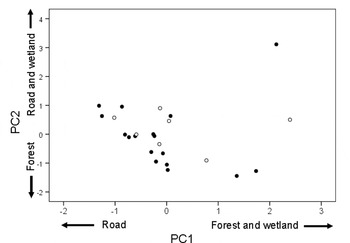
We combined the six environmental variables (forest cover, wetland cover, and road density at 500m and 1km) in a principal component (PC) analysis. This reduced dimensionality, demonstrated collinearity between the environmental variables, and allowed us to more easily characterize wetlands as embedded in landscapes along an artificial gradient (visualized by plotting wetlands against PC1 and PC2 scores; Fig. 2). Using an analysis of variance (ANOVA), we tested whether or not variation in the principal components was explained by the original classification of natural and artificial wetlands. We then performed separate Pearson's correlations between landscape variables (forest and wetland cover and road density) and measures of parasitism. We used only landscape variables at the 1km scale because of the collinearity between the same variables at the two distances. The correlation allowed us to determine whether there were any relationships between the original landscape variables and gregarine prevalence or intensity.
Bivariate plot of PC1 (x-axis) and PC2 (y-axis) based on the original six landscape variables (proportions of forest cover, wetland cover, and road density at 500 m and 1 km) for natural (○) versus artificial wetland sites (●). See Table 2 for an explanation of the weightings of the original landscape variables on the two axes.

Results
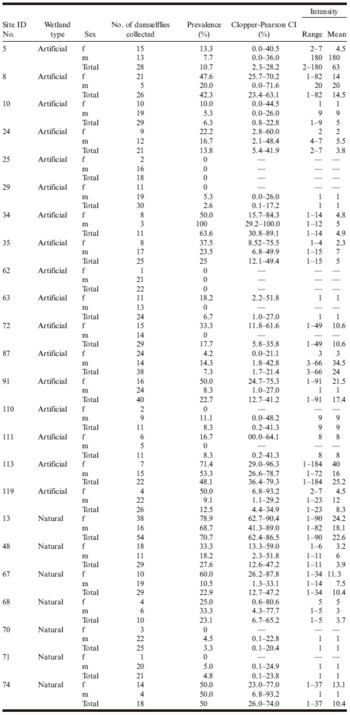
In total, 410 (average ± SE = 24.9 ± 2.0) and 187 (average ± SE = 26.6 ± 5.2) damselflies were collected from each of the 17 artificial and 7 natural wetlands, respectively (Table 1). Two of the 17 artificial sites had no damselflies infected with gregarines, whereas all of the 7 natural sites had at least one infected individual (Table 1). Of all damselflies from all wetlands, 144 were infected with at least one gregarine; 453 individuals were uninfected (overall prevalence = 24.1%; Clopper-Pearson 95% confidence interval = 20.7%–27.6% (Zar Reference Zar1984)). Intensity ranged from 1 to 90 and from 1 to 184 gregarines per host in natural and artificial wetlands, respectively (Table 1). With the exception of two heavily infected individuals (180 and 184 gregarines), intensity never exceeded 91 parasites per host. Intensity ranged from 7.49 to 13.22 (grand mean intensity ± 1 SE = 13.38 ± 4.04) and from 9.05 to 15.98 (grand mean intensity ± 1 SE = 7.56 ± 2.91) gregarines per infected damselfly host in artificial and natural wetlands, respectively. There was no consistent sex bias in parasitism across sites (mean difference = 0.098, t = 1.496, df = 23, P = 0.148). Additionally, males were no more intensively collected at one site type than the other (James et al. Reference James, Bert and Forbes2009). Therefore, we tested whether or not wetland type accounted for variation in parasitism (sexes combined).
Site data from wetlands in Ottawa, Ontario, and Gatineau, Quebec, including numbers and sex of collected gregarine-parasitized damselflies, prevalence and mean intensity of infection, and range of infection for each site.

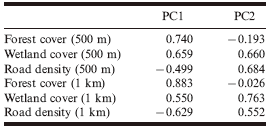
The weighted ANCOVA analysis showed a significantly higher proportion of I. verticalis infected with at least one gregarine in natural wetlands than in artificial wetlands (F 1,23 = 4.332, P = 0.05). Mean prevalences were 37.6% (30.7%–44.6%) and 18.0% (14.3%–21.7%) in natural and artificial wetlands, respectively. Wetland size was not associated with gregarine prevalence (F 1,23 = 1.28, P = 0.271). When the proportions of forest and wetland cover and road density within 500 m and 1 km (Appendix) were considered, PC1 accounted for 45.1% of the variation in the original data. Forest and wetland cover loaded positively; road density loaded negatively (Table 2, Fig. 2). PC2 accounted for another 30.5% of the variation in the original data, but forest cover loaded negatively and wetland cover and road density loaded positively on this axis at both scales (Table 2). Based on the ANOVA, wetland type did not count significantly in either PC1 (−0.518, df = 22, P = 0.609) or PC2 (−1.566, df = 22, P = 0.132). Therefore, the association between wetland type and prevalence of parasitism appears robust and not due to some confounding variable measured at the level of the landscape. However, certain surrounding landscape characteristics correlated with gregarine prevalence and intensity. Forest cover at 1km had a strong positive effect on gregarine prevalence (Pearson's r = 0.618, df = 1,23, P = 0.001) but did not relate to gregarine intensity (Pearson's r = 0.307, df = 1,23, P=0.165). Wetland cover had no effect on either prevalence (Pearson's r = 0.146, df = 1,23, P = 0.496) or intensity (Pearson's r = 0.137, df = 1,21, P = 0.543). Finally, road density did not affect prevalence (Pearson's r = −0.186, df = 1,23, P = 0.384) but had a significant negative effect on intensity of gregarine parasitism (Pearson's r = −0.440, df = 1,21, P = 0.041). Results were similar if analyses were based at the 500 m scale (data not shown).
Loadings of the original six landscape variables at wetland sites near Ottawa, Ontario, and Gatineau, Quebec (forest and wetland cover and road density at 500 m and 1 km) on the two principal components.
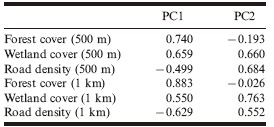
Note: Forest-cover weight is highly positive on PC1 and slightly negative on PC2. Wetland-cover weight is highly positive on both axes, whereas road-density weight is highly negative on the first axis and highly positive on the second.
Taken collectively, wetland type and landscape variables were associated with measures of parasitism in I. verticalis. It appears that artificial habitats or habitat elements in the landscape were associated with reduced parasitism.
Discussion
Our main finding suggests that damselflies from artificial wetlands are less frequently parasitized by gregarines than are damselflies from natural wetlands. Artificial wetlands are more common than natural wetlands in our study region and this could cause a mosaic of selection (Thompson Reference Thompson2005). Some artificial wetlands may be important as sources of damselflies because parasitism was reduced for damselflies at many of those sites.
Notwithstanding wetland type, however, there was high variation in gregarine prevalence (Table 1). Prevalence ranged from no infected damselflies in 2 of the 17 artificial wetlands to 63.6% infected (Clopper-Pearson confidence interval = 30.8%–89.1%). All natural sites contained infected damselflies. Because two artificial sites had no gregarine infection, we propose that artificial sites may reduce the numbers of damselflies subjected to parasitism pressures. As observed with ectoparasitic mites (James et al. Reference James, Bert and Forbes2009), gregarines may require lengthy periods to become successfully established in many human-created habitats, despite the expectation of multiple colonization events by parasitized hosts.
Additionally, artificial wetlands were no more likely to be embedded in more strongly modified landscapes than were natural wetlands (at least with respect to the landscape variables measured in this study), because wetland type did not account for PC1 or PC2 (Fig. 2). This suggests that the difference in gregarine parasitism in artificial versus natural wetlands is not due to some confounding influence of habitat elements in the surrounding landscape. The associations between wetland type or landscape variables and gregarine parasitism found in our study are probably due to anthropogenic modification of habitats. These modifications could result in changes of gregarine infection by changing host behaviour or prey availability (Clopton Reference Clopton, Cook and Cook2004).
We did not detect a relationship between habitat area or wetland cover with gregarine prevalence or intensity. However, there are relationships between other surrounding landscape variables and parasitism (Table 2). For example, forest cover was positively correlated with gregarine prevalence and gregarine intensity was negatively correlated with road density (Table 2). We speculate that landscape variables are also responsible for releasing damselfly hosts from attack by their gregarine parasites, as proposed by Bergerot et al. (Reference Bergerot, Julliard and Baguette2010) for a butterfly parasitoid. Our analysis also supports the hypothesis that parasites may not disperse as efficiently as was previously thought (Schüepp et al. Reference Schüepp, Herrmann, Herzog and Schmidt-Entling2011). Individuals of I. verticalis may benefit from lower pressures of parasitism associated with artificial habitats because as landscapes tended to increase along an increasing gradient of artificiality, gregarine infections decreased. It appears, therefore, that important landscape elements in invertebrate host-parasitoid interactions (Heikkinen et al. Reference Heikkinen, Luoto, Virkkala and Rainio2004; Fenoglio et al. Reference Fenoglio, Salvo and Estallo2009; Holzschuh et al. Reference Holzschuh, Steffan-Dewebter and Tscharntke2010) are also important in invertebrate host-parasite interactions, despite possible differences in active versus passive host-finding strategies.
One purpose of this study was to compare the prevalence and intensity of internal parasitism to previous results for external parasitism in the same host/wetland system. However, because internal and external parasites have different life histories, they may respond differently to habitat change. Arrenurus water mites track nymphal hosts (Smith Reference Smith1988), attach to teneral adults, and when they have finished feeding, return to the water during the damselfly flight season (James et al. Reference James, Bert and Forbes2009). Therefore, water quality and water characteristics should be studied when considering these ectoparasites. Gregarine infection, on the other hand, accumulates throughout the life of an adult odonate (Locklin and Vodopich Reference Locklin and Vodopich2010), suggesting that terrestrial habitats and their characteristics might be important determinants of parasitism. Interestingly, patterns of parasitism in relation to wetland type were somewhat similar for the two host-parasite associations (James et al. Reference James, Bert and Forbes2009).
Future studies on internal and external parasites should consider multiple geographic and temporal scales with additional variables, such as abundance and diversity of vectors of oocysts or alternative prey. Such studies are necessary to determine whether host species at artificial sites, which may be less parasitized, also have higher fitness levels and act as regional source populations.
Acknowledgements
We thank L. Nagel and two anonymous reviewers for commenting on the manuscript. This study was partly funded by a Natural Sciences and Engineering Research Council of Canada discovery grant awarded to M.R.F. and an Ontario Graduate Scholarship and Ontario Graduate Scholarship in Science and Technology to D.G.B.
Appendix
Site descriptions with environmental variables, to assess gregarine infection in Ischnura verticalis at wetland sites near Ottawa, Ontario, and Gatineau, Quebec.