Introduction
Increased potential for niche marketing and a growing demand for improvement in pork quality have led to the development of alternative pig production systems (Wheatley, Reference Wheatley2003; Millet et al., Reference Millet, Moons, Van Oeckel and Janssens2005). Alternatively managed systems differ from intensive systems in that pigs typically have more space to freely move about and have access to either pasture or deep bedding (Honeyman, 1996). These characteristics are brought about by variations in housing style, stocking density, floor type and provision of bedding or other types of environmental enrichment. Improvements in perceived welfare of pigs have driven alternative production systems to allocate larger space during rearing and finishing compared with confinement systems (Lyons et al., Reference Lyons, Bruce, Fowler and English1995).
Allocating different amounts of space to pigs during finishing influences social interactions (Turner et al., Reference Turner, Ewen, Rooke and Edwards2000; Schmolke et al., Reference Schmolke, Li and Gonyou2004) and growth performance potential (Hyun et al., Reference Hyun, Ellis, Riskowski and Johnson1998). Reduced space allocation has been shown to result in increases in observed abnormal behaviours and levels of aggression (Bryant and Ewbank, Reference Bryant and Ewbank1974; Randolph et al., Reference Randolph, Cromwell, Stahly and Kratzer1981). One study reported that increasing stocking space from 0.40 to 0.63 m2 per pig in deep-bedded finishers resulted in higher average daily feed intake (ADFI) and lower gain : feed ratio, with no difference in average daily gain (ADG) between the two treatment groups (Turner et al., Reference Turner, Ewen, Rooke and Edwards2000). Compared with other environmental stressors, reducing space allowance has been shown to decrease ADFI by 6.0% and feed efficiency by 10% (Hyun et al., Reference Hyun, Ellis, Riskowski and Johnson1998). In addition, changing space allocation during finishing may have profound effects on fatty acid composition, even when diet is standardised due to deviations in feed intake and feed utilisation (Nürnberg et al., Reference Nürnberg, Wegner and Ender1998).
The components of meat quality influenced by fatty acids are adipose tissue firmness (hardness), shelf-life (lipid and pigment oxidation) and flavour. Higher levels of unsaturation will lead to softer, less-firm fat (Wood et al., Reference Wood, Enser, Fisher, Nute, Sheard, Richardson, Hughes and Whittington2007). Since soft fat is associated with greater percentage of unsaturated fatty acids, it is associated with a product with less shelf stability with regard to flavour stability. In Japan, soft fat is subjectively evaluated and can be a cause for downgrading a pork carcass (Irie et al., Reference Irie, Sakimoto and Ohmoto1983). Sensory analysis has also shown that increased levels of unsaturated fatty acids in pork are negatively observed by pork consumers (Kouba et al., Reference Kouba, Enser, Whittington, Nute and Wood2003) due to the propensity of unsaturated fatty acids to oxidise, leading to the development of rancidity during storage or retail display.
The standard stocking density commonly implemented in most confinement or all-in all-out systems is 0.72 to 0.90 m2 per pig from 68 to 115 kg (NCR-89, 1993). There is no evidence that a space allowance of more than 0.93 m2 per pig leads to improved performance and health of pigs (NCR-89, 1993; Gentry et al., Reference Gentry, McGlone, Miller and Blanton2002a; Hoy, Reference Hoy2004). In relation to common confinement systems, allocating more than 0.93 m2 per pig may be improbable due to structural dimensions and finishing-group size. However, in alternative pig production systems in which an increased area such as pasture or a deep-bedded semi-outdoor structure is utilised, space may not be a limiting factor. Furthermore, allocating more space during finishing has been shown to affect behaviour and peri mortem metabolism (Beattie et al., Reference Beattie, O’Connell and Moss2000; Klont et al., Reference Klont, Hulsegge, Hoving-Bolink, Gerritzen, Kurt, Winkelman-Goedhart, de Jong and Kranen2001), which may lead to differences in ultimate pork quality. Although several studies have reported increased acceptability of pork from pigs finished in systems that allocate more space (Gentry et al., Reference Gentry, McGlone, Miller and Blanton2002a and Reference Gentry, McGlone, Blanton and Miller2002b; Estevez et al., Reference Estevez, Morcuende and Cava2003), these experiments are mainly comparisons of increased stocking density as well as comparisons of indoor and alternative or outdoor production systems. Research linking pork quality with varying stocking rates within certain alternative production systems is limited.
The space requirement of pigs housed in large groups in deep-bedded semi-outdoor structures has not been adequately evaluated. Consequently, the following experiment was designed and implemented to demonstrate the degree to which space allocation in a deep-bedded system influences pig performance, pork composition and pork quality.
Material and methods
Animals
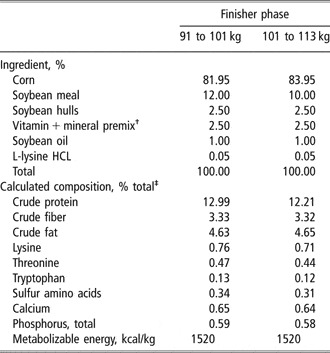
The Iowa State University Institutional Animal Care and Use Committee approved use of animals for the described experiments. At 4 months of age, five groups of 100 gilts were weighed into allotment blocks by weight. From those weight blocks, gilts ranging in weight from 59 to 71 kg were randomly assigned to treatments of either low (0.70 m2 per pig, n = 50) or high (1.13 m2 per pig, n = 50) space allocation. Gilts were transported to the Iowa State University Western Research Farm, Castana, IA. The alternative housing method employed in the current study was the use of hoop structures, which are tent-like shelters with cornstalks or straw for bedding (Honeyman and Harmon, Reference Honeyman and Harmon2003). Gilts were ad libitum fed a two-phase diet (Table 1) for a period of 45 days. Six gilts per pen were selected for slaughter, carcass composition and meat quality evaluation. All pigs were transported to a distance of 200 km prior to delivery to the ISU Meat Laboratory for processing.
Description of nutritional rations fed to gilts during the finishing period, as-is basis

†Vitamin + mineral premix contained phytase.
‡Calculated composition based on NRC (1998) values.
Growth and performance
Initial, 21- and 45-day body weights, and slaughter weight were obtained for each pig. ADG (g/day), feed conversion (G : F) and shrink (%) during transport and lairage were calculated for each pig.
Slaughter and sample collection
Feed was removed 18 h prior to slaughter. Gilts were randomly assigned to a process order and subsequently electrically stunned. After exsanguinations via jugular depletion, carcasses were eviscerated, washed and chilled. Carcasses were placed in a 0°C cooler and chilled for 24 h. After 24 h, carcasses were ribbed at the 10th–11th rib interface for carcass composition and pork quality evaluation.
Carcass composition and quality
Temperature and pH measurements were taken by a penetration probe at 1, 6 and 24 h post mortem on right-side loins using a Hanna 9025 pH/ORP meter (Hanna Instruments, Woonsocket, RI, USA). The pH probe was calibrated with temperature at each time period using two buffers (pH 4.2 and 7.10). Calibration was monitored after each carcass. Carcasses were ribbed between the 10th and 11th ribs and allowed to bloom for approximately 45 min. Loins were assigned a score for colour firmness, wetness and marbling while a trained panel (n = 2) was used to determine a colour score (1 = pale, 6 = dark) for each loin eye (National Pork Board, 2000). Firmness and wetness were evaluated on a three-point scale (1 = soft and wet, 3 = firm and dry). Marbling values were based on National Pork Board standards. Tenth rib loin depth and loin eye area were measured and recorded with percentage fat-free lean calculated using the National Pork Board fat-free lean percentage calculation (National Pork Board, 2000).
Hunter L*(light–dark), a*(red–green) and b*(yellow–blue) values were determined at 1 day post mortem on 2.54-cm-thick chops. Samples were allowed to bloom for 1 h at room temperature and were analysed on a calibrated Hunter Labscan colorimeter (Hunter Associates Laboratories Inc., Reston, VA, USA). A CIE D/65 10° standard observer and a 1.27 cm viewing port were used to obtain three-colour measurements on each of three chops. All nine colour measurements were used to determine an average colour score for each loin. Drip loss was determined using 2.54-cm-thick boneless chops (two per loin) by a method similar to Lonergan et al. (2001). Purge loss was measured on the sirloin after 120 h of storage at 4°C in a vacuum bag (Gardner et al., Reference Gardner, Huff-Lonergan, Rowe, Schultz-Kaster and Lonergan2006).
Four 2.54-cm chops from right-side loins were stored in a vacuum bag at 4°C for 24 or 120 h post mortem. After ageing, chops were frozen in a −20°C blast freezer until needed for Star Probe analysis. Chops were completely thawed at 4°C and then were cooked in a convection oven (140°C) until an internal end-point temperature of 72°C, turning once at a mid-cook cycle temperature of 35°C. Pre- and post-cooked weights were recorded and used to calculate cooking loss percentage. After cooking, chops were cooled at 4°C overnight prior to measurement. The chops were allowed to equilibrate at room temperature for 2 h before Star Probe analysis (Lonergan et al., Reference Lonergan, Stalder, Huff-Lonergan, Knight, Goodwin, Prusa and Beitz2007). Force (kg) required to puncture and compress the chop to 20% of sample height was recorded and the mean of three measurements per chop was used for statistical analysis.
Total lipid and fatty acid analysis
The inner layer of adipose tissue immediately adjacent to the epimysial connective tissue was chosen for adipose analysis. Lean samples were taken from the longissimus dorsi muscle. Total lipid analysis was conducted according to the method of Folch et al. (Reference Folch, Lees and Stanley1957). Fatty acid methyl esters were prepared according to the method of Morrison and Smith (1964) and were separated according to Jo and Ahn (2006). Analysis of fatty acid composition was performed with a HP 6890 gas chromatograph (Hewlett-Packard Company, Palo Alto, CA, USA) equipped with an autosampler, flame ionisation detector and SP-2560 fused silica capillary column (100 m × 0.25 mm × 0.2-μm film thickness). Peak areas and percentages were calculated using HP ChemStation™ software (Dayton, OH, USA). Fatty acid methyl esters were identified by comparison with retention times of standards (Sigma-Aldrich, St Louis, MO, USA). Fatty acid values and total lipids were expressed as weight percentages of adipose or lean tissue sample.
Adipose tissue firmness
Adipose samples were cut into 5 × 3-cm squares and analysed for firmness using a method modified from Nishioka and Irie (Reference Nishioka and Irie2005). Samples were evaluated using TA-XT2 texture analyser (Texture Technologies, Scarsdale, NY, USA) with a 0.25″ diameter ball-shaped probe. Sample height was noted by the testing machine, and the probe was driven downward at 2 mm/s to compress the sample to 20% of the sample height.
Statistical analysis
The influence of space allocation on performance pork quality and adipose tissue attributes were analysed using general linear model (GLM) procedures of Statistical Analysis Systems Institute Inc. (Cary, NC, USA). The experimental model included main effects of space allocation and replication and their interaction as independent variables. Pairwise comparisons of means were carried out using Tukey’s test with an α = 0.05.
Results
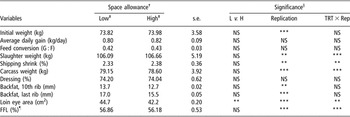
Allocating larger amounts of space did not influence ADG or feed conversion ratios (Table 2). Initial weight, slaughter weight and dressing percentage did not vary by treatment, and space allocation did not affect backfat thickness at the 10th or last rib. Pigs finished with greater space allocation had a smaller loin eye area. Specific treatment-by-replication interactions were noted for slaughter weight, carcass weight and fat-free lean percentage.
Effect of space allocation within hoops on swine growth and carcass performance

†Low = 0.70 m2/pig; high = 1.13 m2/pig.
‡Presented as least squares means.
§Significance: **P < 0.05; ***P < 0.01; NS: P > 0.05; L v. H=space allocation significance, low v. high=replication group of experiment significance. Experiment was replicated five times, between the months of August and November; TRT × Rep=treatment-by-group interaction significance.
¶Fat-free lean percentage calculated using national pork board % FFL equation.
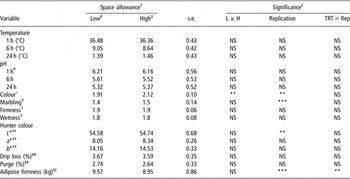
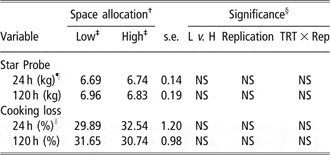
Space allocation within hoop structures in this experiment had minimal influence on fresh-pork quality (Table 3). Temperature and pH decline did not differ between the two treatment groups. Space allocation did not affect pork loin marbling, firmness or wetness. Pigs finished with greater space allocation produced pork appearing darker than pigs stocked at higher rates; however, there were no measurable differences between Hunter L*, a* or b* between pigs raised in the two space allocations. Pork from pigs finished in different stocking allocations did not differ in drip or purge loss. Table 4 presents cooking loss and Star Probe measurements taken at 24 and 120 h of ageing. There were no differences between treatment groups on any cooked-pork quality attribute. Adipose firmness did not consistently differ due to treatment.
Effect of space allocation within hoops on fresh-pork quality attributes

†Low = 0.70 m2/pig; high = 1.13 m2/pig.
‡Presented as least squares means.
§Significance: **P < 0.05; ***P < 0.01; NS: P > 0.05; L v. H=space allocation significance, low v. high=replication group of experiment significance; TRT × Rep=treatment-by-group interaction significance.
¶pH was measured at the 10th and 11th rib interface of the longissimus muscle.
∥Colour scores range from 1 to 6, 1 = pale, pinkish-grey and 6 = dark, purplish-red.
¥Marbling scores range from 1 to 10, 1 = devoid and 10 = moderately abundant or greater.
♯Firmness and wetness scores range from 1 to 5, with 1 = very soft and watery and 5 = very firm and dry.
††Hunter L* values range from 1 to 100 with 1 = pure black and 100 = pure white. Hunter a* values represent the amount of red to green colours and a higher value indicates a redder colour. Hunter b* values represent the amount of blue to yellow colour in the meat and a higher b* value indicates a more yellow colour.
‡‡Drip and purge loss calculated as [(initial chop/sirloin weight) – (final chop/sirloin weight)]/initial chop weight × 100.
§§Firmness measured as peak force (in kg) exerted to compress the sample to 20% of sample height with 0.25″ diameter probe at 2 mm/s.
Effect of space allocation within hoops on cooked pork quality attributes

†Low = 0.70 m2/pig; high = 1.13 m2/pig.
‡Presented as least squares means.
§Significance: **P < 0.05; ***P < 0.01; NS: P > 0.05; L v. H=space allocation significance, low v. high=replication group of experiment significance; TRT × Rep=treatment-by-group interaction significance.
¶Star probe texture evaluated at 24 and 120 h ageing periods using TA-XT2 texture analyser with probe driven downward at 2 mm/s to 20% of sample height. Peak force exerted (kg) is presented.
∥Cooking loss calculated as (raw chop weight – cooked chop weight)/(raw chop weight) × 100.
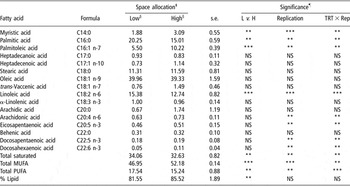
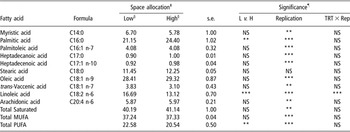
Space allocation variation altered the fatty acid composition of inner layer of adipose tissues as well as lean tissues (Tables 5 and 6). Pigs allotted more space produced adipose with greater proportion of myristic acid and lower proportion of linoleic acid in adipose tissues. These differences in concentration corresponded to differences in the proportion of saturated and polyunsaturated fatty acids (PUFA). Lipid percentage in adipose tissue was greater in pork from pigs allotted more space during finishing. Adipose tissue from pigs allotted less space contained a greater proportion of saturated and PUFA than adipose tissue from pigs allotted more space. Adipose tissue from pigs allotted less space also contained a lower proportion of palmitoleic acid.
Effect of space allocation within hoops on fatty acid composition and total lipid concentration of adipose tissue†

Abbreviations are: MUFA = monounsaturated fatty acids; PUFA = polyunsaturated fatty acids.
†Analysis done on inner layer of backfat tissue.
‡Low = 0.70 m2/pig; high = 1.13 m2/pig.
§Presented as least squares means.
¶Significance: **P < 0.05; ***P < 0.01; NS: P > 0.05; L v. H=space allocation significance, low v. high=replication group of experiment significance; TRT × Rep=treatment-by-group interaction significance.
Effect of space allocation within hoops on fatty acid composition and total lipid concentration of lean tissue†

Abbreviations are: MUFA = monounsaturated fatty acids; PUFA = polyunsaturated fatty acids.
†Analysis done on lean portion of longissimus dorsi.
‡Low = 0.70 m2/pig; high = 1.13 m2/pig.
§Presented as least squares means.
¶Significance: **P < 0.05; ***P < 0.01; NS: P > 0.05; L v. H = space allocation significance, low v. high = replication group of experiment significance; TRT × Rep = treatment-by-group interaction significance.
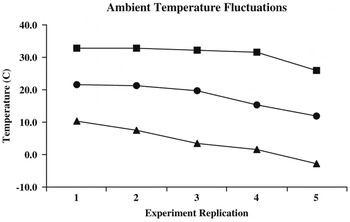
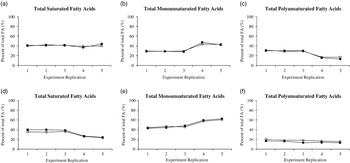
Fatty acid profiles of each tissue varied by experiment replication. As noted, replications spanned the months of August to November 2004, with temperatures ranging from 32°C to −2°C within the hoop structure (Figure 1). Figure 2 presents the variations in adipose tissue total saturated (SFA), monounsaturated fatty acids (MUFA) and PUFA by replication group of the experiment. Comparing these fluctuations to temperature fluctuations (Figure 1), a decline in ambient temperature corresponded to decreases in total saturation and polyunsaturation and increases in the monounsaturation of both tissues.
Ambient temperature fluctuations within hoop structures. Fluctuations in average, high and low temperatures (°C) were recorded over the five repetitions of the experiment (August to November). Temperatures were recorded every minute using a HOBO Pro Series™ temperature recorder. Temperatures are recorded as averages of triplicate measures taken throughout the systems. ▪ = high, ● = average, ▴ = low.

Fatty acid composition of lean and adipose tissue over replications of experiment. Variations in total saturated, monounsaturated and polyunsaturated fatty acids within lean and adipose tissue over the five replications of the experiment were compared. a, b, c = lean tissue; d, e, f = adipose tissue. For all graphs, □ = low and ▪ = high.

Discussion
Adjusting the space allocation for pigs during rearing and finishing has been widely investigated (Pearce and Paterson, Reference Pearce and Paterson1993; McGlone and Newby, Reference McGlone and Newby1994; Hoy, Reference Hoy2004). Recent shifts in pork production systems favour increased space per pig, based on perceived benefit and health of the animal (Millet et al., Reference Millet, Moons, Van Oeckel and Janssens2005). Current research exploring strategies in alternative production systems has revealed that increasing space allocation stimulates foraging or explorative behaviour in pigs, thereby increasing favourable interactions and lowers stress susceptibility among pigs (Guy et al., Reference Guy, Rowlinson, Chadwick and Ellis2002; Olsen et al., Reference Olsen, Simonsen and Dybkjraer2002; Van de Weerd et al., Reference Van de Weerd, Docking, Day, Avery and Edwards2003). Increasing space allocation also influences growth and carcass composition characteristics, stimulating improved growth performance and carcass composition (Gentry et al., Reference Gentry, McGlone, Blanton and Miller2002b; Honeyman and Harmon, Reference Honeyman and Harmon2003). Reduction in stress may promote an increase in growth and performance of pigs. These differences in behaviour during finishing could influence the physiological and behavioural responses of pigs in the period before slaughter, which have been shown to affect peri mortem muscle metabolism and thereby pork quality (Tarrant, Reference Tarrant1989; Cassens, Reference Cassens2000).
In this study, no differences were observed in growth and performance of pigs finished in hoop structures with greater space allocation (Table 2). The current results differed from those reported by Honeyman and Harmon (Reference Honeyman and Harmon2003) where pigs were allotted densities of 1.11 m2 per pig in hoops and 0.74 m2 per pig in confinement over winter and summer seasons. In the winter portion of the trial, hoop-fed pigs had similar growth performance but had greater ADFIs and less efficiency of lean gain than confinement-fed pigs. In the summer portion, hoop-fed pigs had greater ADG but had similar ADFI and feed efficiency rates compared with confinement-fed pigs (Honeyman and Harmon, Reference Honeyman and Harmon2003), which led those authors to conclude that the increased space allocation (1.11 m2 per pig) may have improved performance of pigs finished in hoop structures, but these improvements were seasonally inconsistent. Clearly, other variables may contribute to the observed differences such as group size, bedding type and ambient temperature.
Figure 1 shows the average, high and low temperatures within the hoop structures over the span of the experiment. Within the thermoneutral zone (17.2°C to 22°C), pigs are able to maintain heat production approximately constant for a given energy intake (Bruce and Clark, Reference Bruce and Clark1979). This indicates that although hoop-finished pigs were exposed to temperature fluctuations above and below their thermoneutral target, there were no adverse affects on growth and carcass composition. However, the treatment-by-replication interactions for slaughter weight, carcass weight and percentage fat-free lean indicate that the treatment effects of space allocation acted differently on these variables as temperature fluctuated.
Variations in pork quality were minimal between the two treatments (Table 3). There were no differences in the rate and extent of temperature and pH decline, amount of intramuscular fat or firmness/wetness of the loin. Pigs with increased space produced darker pork and had greater loin eye area than pigs with less space. Our results are similar to Gentry et al. (Reference Gentry, McGlone, Miller and Blanton2002a) who reported that pigs finished with larger space allowance had pork with higher reddish pink colour scores than pigs stocked at a higher density. Drip and purge loss percentages did not differ between treatment groups. These results differ from Klont et al. (Reference Klont, Hulsegge, Hoving-Bolink, Gerritzen, Kurt, Winkelman-Goedhart, de Jong and Kranen2001), who observed a higher water-holding capacity in pork chops from pigs produced in an ‘enriched environment’. The current study varied from that study in housing style, as the current experiment was conducted in semi-outdoor hoop structures while Klont et al. (Reference Klont, Hulsegge, Hoving-Bolink, Gerritzen, Kurt, Winkelman-Goedhart, de Jong and Kranen2001) conducted it in a confinement system. Texture attributes as well as cooking loss did not vary between treatments (Table 4). Our results are similar to those of Stern et al. (Reference Stern, Heyer, Andersson, Rydhmer and Lundström2003), who showed that technological meat quality traits such as cooking loss and Warner–Bratzler shear force did not differ between lower and higher stocked pigs finished in an outdoor, free-range system.
Fatty acid composition of lean and adipose tissue was altered by space allocation (Tables 5 and 6). Adipose tissue from pigs provided less space was more saturated and was composed of higher percentages of PUFA. These results are interesting in that there were no differences in feed intake or feed efficiency between the two groups. Variations in fatty acid were observed between replications of the experiment. Lebret et al. (Reference Lebret, Massabie, Granier, Juin, Mourot and Chevillon2002) reported that a decrease in outdoor environmental temperature from 24°C to 17°C during the finishing period of pig led to higher total MUFA, SFA and PUFA contents in the inner layer of adipose tissue. Figure 2a–c presents the variations in adipose tissue SFA, MUFA and PUFA by replication group of the experiment. Comparing these fluctuations to temperature fluctuations (Figure 1), a decline in ambient temperature corresponded to decreases in total saturation and polyunsaturation of the adipose tissue. In agreement with Lebret et al. (Reference Lebret, Massabie, Granier, Juin, Mourot and Chevillon2002), a subsequent increase in monounsaturation was measured as temperature decreased. Therefore, replication responses and treatment effects might have been dictated by temperature differences, leading to differences in fatty acid profile. Variations in ambient temperature and its subsequent affect on fatty acid profile is an interesting observation and merits continued investigation.
Dietary fat and amount of deposited fat are major factors influencing the fatty acid composition of adipose lipids (Nürnberg et al., Reference Nürnberg, Wegner and Ender1998). This was apparent in the current study, as diets were standardised, but treatment groups did differ in total percentage lipid within the inner layer of adipose tissue (Table 4). Pigs with greater space allocation had higher (85.52% v. 81.55%) total lipid in the adipose tissue than pigs reared with less space. Paralleling these differences, as noted above, was an increase in PUFA incorporation in pigs with less space. It has been established that when tissue lipid content is reduced, the proportion of unsaturated phospholipids is higher, driving an increase in overall PUFA content (Bee, Reference Bee2002; Bee et al., Reference Bee, Guex and Herzog2004).
Conclusions
The results showed that allocating more space during finishing in hoop structures did not affect pig performance or pork quality. Deposition variations in adipose tissue became more prominent as temperatures decreased. Utilisation of systems that do not control the environment may result in seasonal variations in pork composition.
Acknowledgements
Mention of a trade name, proprietary product or specific equipment does not constitute a guarantee or warranty by the USDA or Iowa State University and does not imply approval to the exclusion of other products that may be suitable. This project was supported by Hatch Act and State of Iowa funds, USDA Special Grants and the Leopold Center for Sustainable Agriculture. The authors recognise the significant efforts of the Iowa State University Western Research Farm for animal care. The authors also recognise the technical support provided by Randall Petersohn and the Iowa State University Meat Laboratory.