Introduction
Sesbania [Sesbania cannabina (Retz.) Pers.] is rapidly becoming a major weed threat to cotton (Gossypium hirsutum L.) production in Australia (Anonymous 2018c; Charles Reference Charles1991; Manalil et al. Reference Manalil, Werth, Jackson, Chauhan and Preston2017; Osten et al. Reference Osten, Walker, Storrie, Widderick, Moylan, Robinson and Galea2007; Walker et al. Reference Walker, Taylor, Milne, Osten, Hoque and Farquharson2005). Being native to central and northern Australia, S. cannabina has been introduced to China, India, Indonesia, Malaysia, Papua New Guinea, and the South Pacific Islands (Anonymous 2018a; Johnson and Hazelwood Reference Johnson and Hazelwood2011) and is spreading within Australia. When fully mature, this annual shrub can reach a height of 3.5 m. Successive cohorts can emerge in spring, summer, and autumn (Johnson and Hazelwood Reference Johnson and Hazelwood2011). Summer conditions are ideal for its rapid growth and development, while late spring to early autumn is ideal for flowering and seed production (Johnson and Hazelwood Reference Johnson and Hazelwood2011). As many as 1,200 pods can be produced on a single plant, which can lead to 24,000 to 42,000 dark-green to brown, rod-like seeds being produced (Anonymous 2018c). Mature seeds, once released from the pods, can be carried by irrigation water or in overland water flow after rainfall and can travel attached to mechanical implements and vehicles (Anonymous 2018c). Sesbania cannabina can act as a host for several insect pests like common grass yellow (Eurema hecabe L.), which can be transmitted to crops, and the seeds can make animal diets highly unpalatable due to the presence of canavanine and gum in the seeds (Anonymous 2018d).
Sesbania cannabina is highly competitive with cotton plants throughout the growing season (Anonymous 2018c), and heavy infestations not only reduce cotton lint production substantially, but the adult plant can also interfere with the harvesting operations, causing further deterioration of the lint quality (Johnson and Hazelwood Reference Johnson and Hazelwood2011). When S. cannabina plants attain a height of 50 cm or more, they become difficult to effectively control in cotton using current weed management practices (Anonymous 2018c; Johnson and Hazelwood Reference Johnson and Hazelwood2011). Therefore, appropriate measures should be taken in advance to remove this weed before it reaches this critical mass (Johnson and Hazelwood Reference Johnson and Hazelwood2011).
Weed seed germination biology and seedling emergence are highly affected by many environmental factors and stressors like light, temperature, salt stress, osmotic stress, soil pH, and depth of seed burial, as the developing embryo may be affected by changes in nutrient supply and hormones under differential growth conditions (Ahmed et al. Reference Ahmed, Opeña and Chauhan2015; Bajwa et al. Reference Bajwa, Chauhan and Adkins2018; Baskin and Baskin Reference Baskin and Baskin2014; Ozaslan et al. Reference Ozaslan, Farooq, Onen, Ozcan, Bukun and Gunal2017; Willis et al. Reference Willis, Baskin, Baskin, Auld, Venable, Cavender-Bares, Donohue and Rubio de Casas2014). Previous germination studies on wand riverhemp [Sesbania virgata (Cav.) Poir.] and S. cannabina have indicated the presence of innate dormancy in freshly shed seeds (de Souza et al. Reference de Souza, Agra, de Andrade, de Oliveira and de Oliveira2010; Veasey et al. Reference Veasey, Freitas and Schammass2000) and seedling tolerance to waterlogging and to waterlogged soils (Ren et al. Reference Ren, Kong, Yan, Zhang, Luo and Xie2017; Zanandrea et al. Reference Zanandrea, Alves, Deuner, de, Goulart, Henrique and Silveira2010). Scarification by boiling-water treatment, H2SO4, or physical abrasion of the seed coat were all found to be effective in breaking dormancy in wand riverhemp and Egyptian riverhemp [Sesbania sesban (L.) Merr.] (Camargos et al. Reference Camargos, Carvalho, Araújo and Magalhães2008; Wang and Hanson Reference Wang and Hanson2008). However, no studies have been undertaken to investigate the germination biology of S. cannabina, especially biotypes coming from contrasting locations.
The germination biology of biotypes of weed species is known to vary under different environmental conditions (Bajwa et al. Reference Bajwa, Chauhan and Adkins2018). A better understanding of the germination biology of S. cannabina will give some insight into the adaptability of this species to different climates, the variation in its invasiveness, and possibilities for developing effective measures to stop its further spread (Ahmed et al. Reference Ahmed, Opeña and Chauhan2015; Flores et al. Reference Flores, González-Salvatierra and Jurado2016). Environmental conditions could influence the supply of nutrients and hormones to the developing embryo and affect the germination pattern of seeds (Gorecki et al. Reference Gorecki, Long, Flematti and Stevens2012; Roach and Wulff Reference Roach and Wulff1987). Environmental conditions vary within the cotton-growing regions of Australia due to differences in rainfall patterns and altitudes (Cai et al. Reference Cai, Crimp, Jones, McInnes, Durack, Cechet, Bathols and Wilkinson2005; Whitfield et al. Reference Whitfield, Oude-Egberink, Wecker, Cravigan, Pozza, Hernaman, Scott and Chidzambwa2010); therefore, the probability exists that weed populations vary in their responses to different environments, a factor that subsequently affects management practices under different environmental conditions. Moreover, knowledge of emergence patterns of weeds at different burial depths and their potential to emerge under complete darkness can provide important information for tillage-based weed management and the effectiveness of residue level in suppressing weed emergence. High variability exists in the soil properties of Queensland, a major cotton-growing region of Australia; salinity and alkalinity are often cited as major crop production constraints (Dang et al. Reference Dang, Christopher and Dalal2016). Knowledge gaps exist in the response of S. cannabina to different levels of salt, osmotic stress, and pH. Hence, a study was carried out with the following objectives:
1. To investigate the effect of various environmental conditions (e.g., light, temperature, soil burial depth) on seed germination biology of two biotypes of S. cannabina originating from contrasting environments;
2. To evaluate the seedling emergence of S. cannabina from burial depths under glasshouse conditions; and
3. To determine whether S. cannabina biotypes from contrasting habitats differ in their seed biology.
Materials and Methods
Seed Collection and Storage
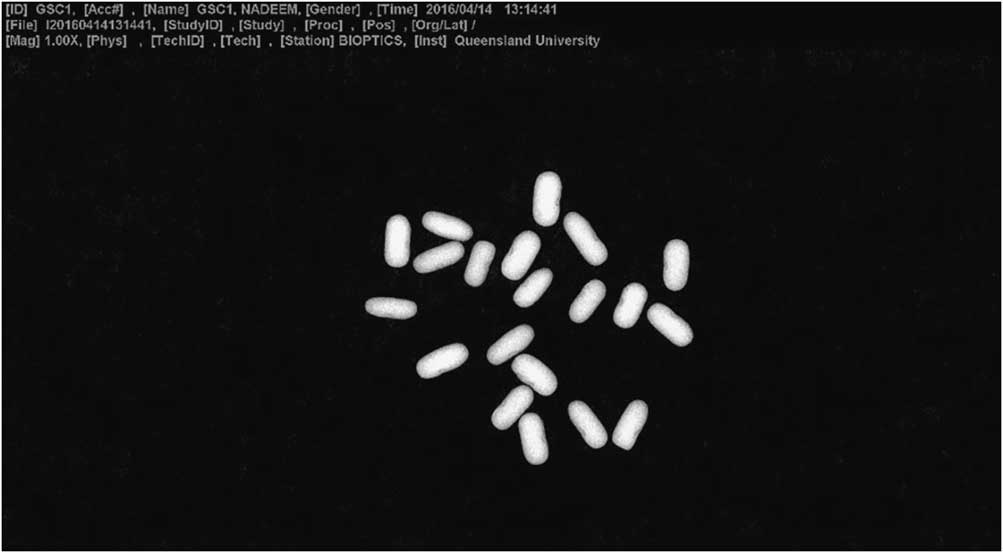
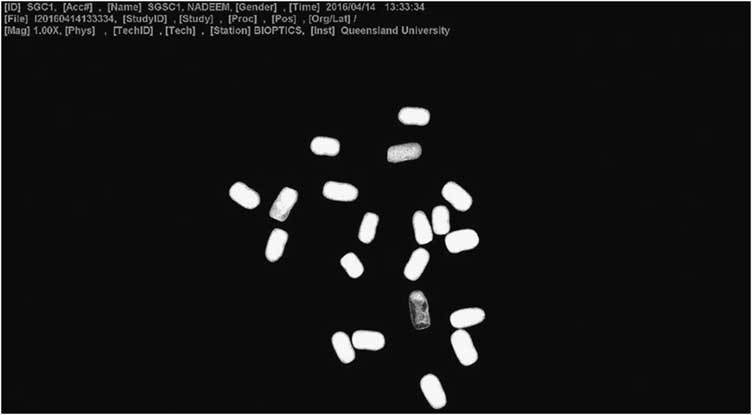
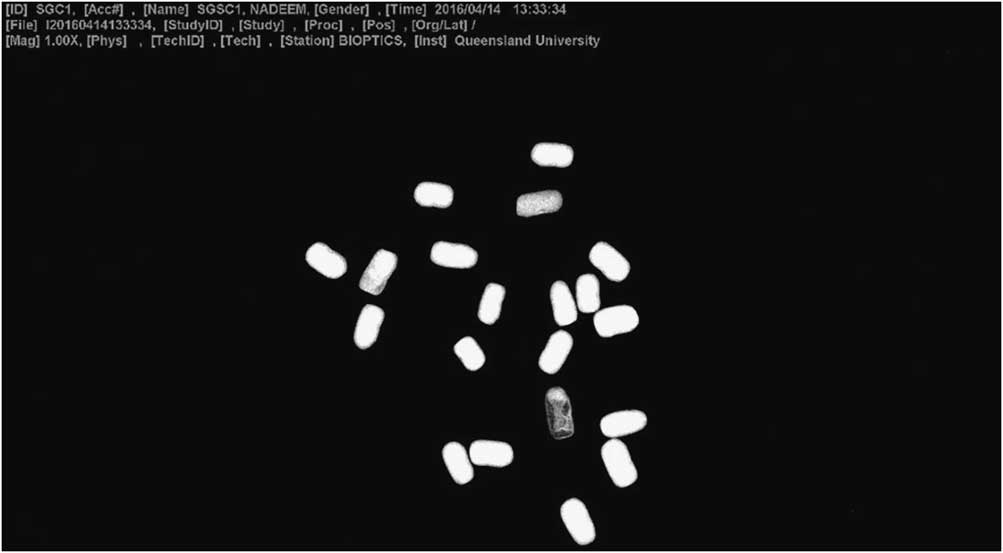
Fresh seeds of S. cannabina were collected from two contrasting cotton-growing regions. The Dalby biotype was collected from a cropping field in a high-rainfall region (540 mm yr−1; 27.367°S, 151.261°E) on April 7, 2016. The St George biotype was collected from a cropping field in a medium-rainfall region (481 mm yr−1; 28.185°S, 148.633°E) on March 20, 2016. St George is around 300 km (aerial distance) away from Dalby at an elevation of 211 m above mean sea level; whereas Dalby is at an elevation of 190 m above mean sea level (Anonymous 2018d). The soil of St George is calcic, mesocentric, red sodosol with bulk density of 1.40 g cm−3 and a pH of 8.4 (Anonymous 2018b). In comparison, the soil of Dalby is epihypersodic-endocalcareous, crusty, gray vertisol with a bulk density of 1.6 g cm−3 and a pH of 8.2 (Anonymous 2018b). Furthermore, the St George biotype is short statured with more branches compared with the Dalby biotype. Seeds of both biotypes were stored for 4 mo under laboratory conditions and then used for the study. Seeds of both biotypes were healthy and vigorous as observed in X-ray image analysis (Figures 1 and 2).
X-ray image of S. cannabina seed, Dalby biotype.

X-ray image of S. cannabina seed, St George biotype.
Seed Germination
All germination tests were performed on seeds that were first surface sterilized by soaking them in sodium hypochlorite (1% v/v) for 1 min followed by a triple rinse in sterile deionized water to prevent later fungal or bacterial contamination growth on seeds. After that, seeds were subjected to boiling-water treatment to break dormancy. In each test, 25 seeds in three replicates were evenly placed in a 9-cm-diameter petri dish on a double layer of Whatman No. 1 filter paper Filter papers were then moistened with 5.0 ml of sterile water or a treatment solution, the petri dishes were closed and placed into a transparent plastic box (40 cm long by 20 cm wide by 10 cm deep) lined with a saturated paper towel, which was then closed with an airtight lid to reduce evaporation from the dishes. Seeds were considered to have germinated when the radicle protuberance from the testa was at least 2 mm. All experiments were conducted twice. Seed germination percentages were calculated for each replicate based on an aggregated germination count after 15 d after the start of incubation. To create darkened conditions, petri dishes were wrapped with three layers of aluminum foil and only opened once for a germination count at 15 d from incubation. Treatments including light were opened for germination every 3 d from the start of incubation.
Experiments involving alternating day/night temperature regimes were undertaken in germination incubators (TRIL-750 Illuminated Refrigerator Incubator, Thermoline, Wetherill Park, Australia) fitted with a rear-wall white fluorescent light source (photosynthetic photon flux density ca. 100 µmol m−2 s−1).
Experiments involving constant temperatures were performed on a thermogradient bar (Thermoline) with a white fluorescent light source (photosynthetic photon flux density ca. 200 µmol m−2 s−1) set above the bar. The table consisted of 10 equal-sized chambers, each with a different but constant temperature (8.0, 11.0, 14.0, 17.0, 20.0, 23.0, 26.0, 29.0, 32.0, and 35.0±1.5 C). Each petri dish placed on the thermogradient bar was wrapped around its edges with parafilm to reduce evaporation.
Experiments examining the effects of boiling water and osmotic, salt, and pH stress on germination were conducted in a germination incubator set at alternating 30/20±1 C day/night thermoperiod with a matched 12/12-h photoperiod (photosynthetic photon flux density ca. 100 µmol m−2 s−1). A preliminary study had determined that these were the optimal conditions for germination.
Effect of Boiling Water on Germination
To overcome physical seed dormancy, seeds of both biotypes were immersed in boiling water (100±2 C) for either 2, 5, 10, 20, 30, or 60 min using a temperature-controlled water bath (Gallenkamp). After the boiling-water treatment, seeds were blotted dry with tissue paper and then placed in petri dishes to undergo the germination studies described earlier.
Effect of Temperature and Light on Germination
To determine the effect of constant temperature and light, seeds of both biotypes were incubated at five different alternating temperatures (15/5, 20/5, 25/15, 30/20, and 35/25 C) under two different light treatments, either complete darkness or a 12/12-h photoperiod as described earlier.
Effect of Osmotic Stress on Germination
To examine the effect of osmotic stress on seed germination, aqueous solutions of polyethylene glycol 8000 (Sigma-Aldrich, St Louis, MO) were prepared to produce soil water potentials of −0.1, −0.2, −0.4, −0.6, −0.8, and −1.0 MPa (Michel Reference Michel1983). These osmotic treatments were selected based on previous studies on different weed species (Ahmed et al. Reference Ahmed, Opeña and Chauhan2015; Bajwa et al. Reference Bajwa, Chauhan and Adkins2018; Bell Reference Bell1999; Chauhan and Johnson Reference Chauhan and Johnson2008a, Reference Chauhan and Johnson2008b; Chauhan et al. Reference Chauhan, Gill and Preston2006a, Reference Chauhan, Gill and Preston2006b; Opeña et al. Reference Opeña, Chauhan and Baltazar2014) and were identical to soil water potentials found in different parts of Australia where this weed invades (Chiew et al. Reference Chiew, Piechota, Dracup and McMahon1998; Izanloo et al. Reference Izanloo, Condon, Langridge, Tester and Schnurbusch2008).
Effect of Salt Stress on Germination
To evaluate the effect of salinity on seed germination, solutions of either 0, 25, 50, 100, 150, 200, or 250 mM NaCl were prepared. These salt treatments were selected based on previous studies on different weed species (Ahmed et al. Reference Ahmed, Opeña and Chauhan2015; Bajwa et al. Reference Bajwa, Chauhan and Adkins2018; Chauhan and Johnson Reference Chauhan and Johnson2008a, Reference Chauhan and Johnson2008b; Chauhan et al. Reference Chauhan, Gill and Preston2006a, Reference Chauhan, Gill and Preston2006b; Opeña et al. Reference Opeña, Chauhan and Baltazar2014) and were identical to soil salinity levels found in various parts of Australia where this weed invades (Rengasamy Reference Rengasamy2006, Reference Rengasamy2010).
Effect of pH on Germination
To investigate the effect of pH on seed germination, buffered solutions ranging from pH 4.0 to 10.0 were prepared (Chachalis and Reddy Reference Chachalis and Reddy2000). Those values represent the pH values of Australian soils where this weed may invade (de Caritat et al. Reference de Caritat, Cooper and Wilford2011). A 2 mM solution of MES [2-(N-morpholino) ethanesulfonic acid] was adjusted with 0.1 N hydrogen chloride (HCl) or sodium hydroxide (NaOH) to obtain solutions of pH 4.0, 5.0, and 6.0. A 2 mM solution of HEPES [N-(2-hydroxymethyl) piperaziine–N′–(2-ethanesulfonic acid)] was adjusted with 0.1 N NaOH to obtain the solutions with pH 7.0 and 8.0. Buffer solutions of pH 9.0 and 10.0 were prepared with 2 mM tricine [N-Tris (hydroxymethyl) methylglycine] and adjusted with 0.1 N NaOH. Unbuffered deionized water (pH 6.4) was used as a control.
Effect of Burial Depth on Seedling Emergence
The effect of burial depth on seedling emergence of both biotypes was determined using pots (30-cm diameter by 30-cm height) with drainage holes covered with paper towel and filled with approximately 1 kg of a heavy alkaline clay soil (CEC>12), pH 7.5, with an organic matter content of 2.8%. The nitrogen, phosphorus, and potassium contents were 62, 87, and 412 kg ha−1, respectively. The soil was autoclaved and passed through a 3-mm sieve before use. For each biotype, in turn, 50 seeds were broadcast onto the soil surface and then covered with further soil to form depths of 0.0, 1.0, 2.0, 4.0, 8.0, and 16.0 cm. The pots were irrigated with an overhead sprinkler initially and later subirrigated. The appearance of shoots at the soil surface was used as the indicator of seedling emergence and was recorded every third day to day 24 from sowing, after which no further emergence occurred.
Statistical Analyses
All experiments were arranged in a completely randomized design giving equal importance to all treatment factors with three replicates. Each experiment was repeated twice to verify the results. The significance of means of individual treatment factors and their interactions was estimated through ANOVA in all experiments. Normality and homogeneity of variance assumptions were checked and satisfied before ANOVA (Statistix v. 8.1 statistical software). In no experiment was there a treatment by experimental replicate interaction, so results were pooled across experimental replicates. Means were separated using Fisher’s protected LSD test at P=0.05. Treatment means were presented in bar charts with±LSD of means using SigmaPlot v. 14 for the temperature, light, and pH experiments. Germination percentages were regressed on different osmotic potentials or NaCl concentrations using regression models with SigmaPlot. The R2 values were used to determine the goodness of fit of all selected models.
A quadratic model was fit to the germination values obtained at different osmotic potential levels of the buffered solution:
 $$G\left( {\rm \,\%\,} \right){\equals}a{\plus}bx{\plus}cx^{2} $$
where a, b, and c are constants and x is the osmotic potential.
Results and Discussion
Scarification
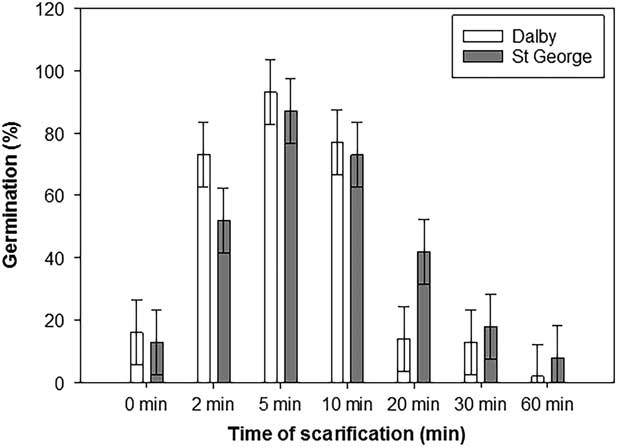
The germination of the two biotypes was significantly (F=171.6800; P<0.0000) improved by scarifying the seeds with boiling water, with an optimum effect recorded after 5 min (Figure 3). Boiling-water treatment interaction was also significant with the biotype (F=8.3700; P<0.0000), with the Dalby biotype (93%) responding more than the St George one (87%).
Effect of boiling-water treatment (100±2 C) for different durations of time on promoting germination of Dalby and St George biotypes incubated at 30/20 C in a 12/12-h photoperiod for 15 d. Error bars represent LSD (F=171.6800; P<0.0000; n=6).
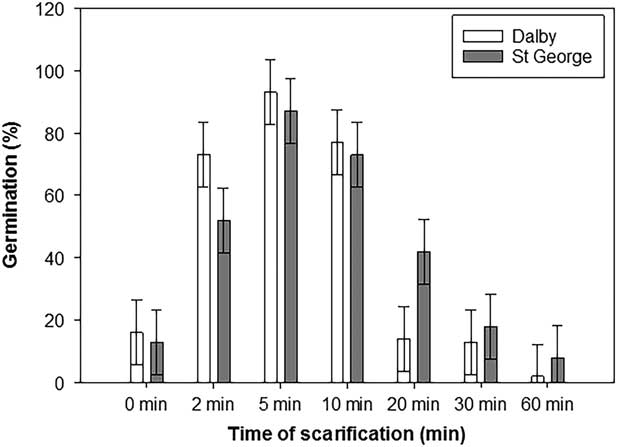
It is well known that S. cannabina has an innate, physical dormancy due to a water-impermeable, hard seed coat (Veasey et al. Reference Veasey, Freitas and Schammass2000). The boiling-water treatment stimulated germination by softening the seed. Others have observed the removal of physical germination by boiling-water treatment is similar to that seen in other leguminous plant species (Herranz et al. Reference Herranz, Ferrandis and Martínez-Sánchez1998; Wang and Johnson 2007). In a previous study, Wang and Hanson (Reference Wang and Hanson2008) reported a hot-water (80 C) treatment of 8-min duration followed by physical scarification was the best treatment to overcome dormancy of S. sesban. Exposure of seeds to a higher temperature (>85 C) caused seed injury and a reduction in germination (Wang and Hanson Reference Wang and Hanson2008). In the present study, a 5-min treatment at 100±2 C was shown to overcome dormancy in both biotypes (Figure 3), with a lower germination recorded if the boiling-water treatment was for a longer or a shorter period. Presumably, the shorter periods are insufficient to soften the seed coat, while the longer periods have a fatal effect on embryo growth and development (Tarrega et al. Reference Tarrega, Calvo and Trabaud1992).
Effect of Thermoperiod and Photoperiod
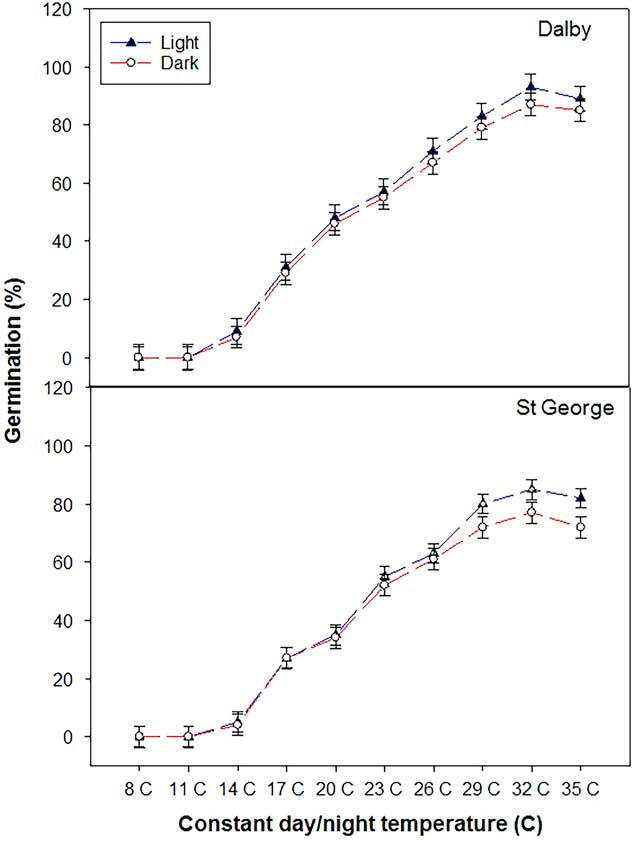
In the case of constant incubation temperatures, the results revealed a significant effect of biotype (F=148.4500; P<0.0000), temperature (F=2477.4200; P<0.0000), photoperiod (F=44.2100; P<0.0000), and interaction of biotype with temperature (F=9.8000; P<0.000) and interaction of temperature with photoperiod (F=4.1800; P<0.0000). In the light conditions, germination of the Dalby biotype (93%) was 9% greater than that observed for the St George biotype (85%) (Figure 4). Both biotypes exhibited a neutral photoblastic response, with germination improved by only 7% in the 12/12-h photoperiod (Figure 4). Germination was greatest at constant temperatures above 30 C, with an optimum temperature of around 32 C (86%) to 35 C (82%), declining gradually as temperatures increased or decreased (Figure 4). No germination was recorded for either biotype at 8 or 11 C.
Effect of constant day/night temperature and photoperiod on germination of Dalby and St George biotype in a 12/12-h photoperiod or 24-h complete dark for 15 d. Error bars represent LSD (F=2477.4200; P<0.0000; n=6).

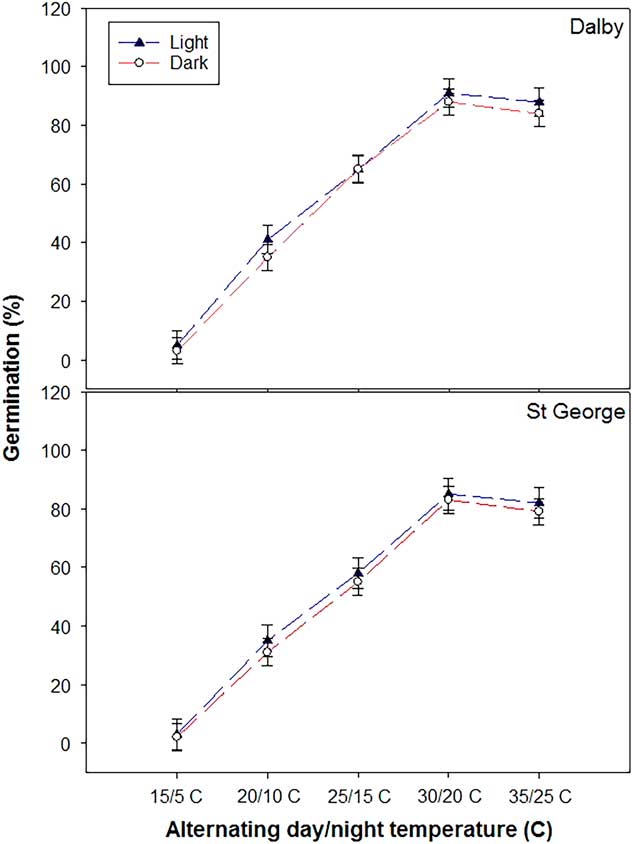
There was a significant effect of biotype (F=50.7700; P<0.0000), thermoperiod (F=1933.5600; P<0.0000), light (F=15.5100; P<0.0000), and interaction of biotype with thermoperiod (F=37.800; P<0.0482) under alternating temperature regimes (Figure 5). The Dalby biotype exhibited 10% greater seed germination compared with the St George biotype over all temperature treatments (Figure 5). Germination of both biotypes improved slightly under illumination (12/12-h photoperiod) and showed 5% better germination compared with the complete dark (24-h) conditions. The optimum alternating temperature needed for the maximum germination of both biotypes was either 30/20 C (87%) or 35/25 C (83%). Germination was reduced by 30%, 59%, and 97% on an alternating day/night temperature of 25/15, 20/10, and 15/5 C, respectively, in comparison with the maximum germination temperature (30/20 C).
Effect of alternating day/night temperature and photoperiod on germination of Dalby and St George biotype in a 12/12-h photoperiod or 24-h complete dark for 15 d. Error bars represent LSD (F=1933.5600; P<0.0000; n=6).

The germination of the two biotypes coming from contrasting environments was affected differently by light and temperature incubation conditions. The Dalby biotype, collected from the high-rainfall and low-altitude area, showed greater germination under the different photo- and thermoperiod regimes as compared with the St George biotype, collected from a lower-rainfall and higher-altitude area. Such differences in germination behavior may be due to the differences in altitude and rainfall patterns of the collection sites (Kafi et al. Reference Kafi, Saeidnejad and Pessarakli2012). However, another reason may be lower food reserves stored in the embryo of the St George biotype due to a drier environment, resulting in reduced germination compared with the Dalby biotype (Baskin and Baskin Reference Baskin and Baskin2014).
The seeds of both biotypes exhibited a neutral photoblastic behavior, suggesting that S. cannabina is not dependent upon a phytochrome-mediated light response and can germinate in both light and dark conditions (Baskin and Baskin Reference Baskin and Baskin2014; Willis et al. Reference Willis, Baskin, Baskin, Auld, Venable, Cavender-Bares, Donohue and Rubio de Casas2014). This neutral photoblastic germination behavior of S. cannabina can empower this weed to germinate from greater burial depths or from under crop residues or mulches, so S. cannabina is therefore unlikely to form a soil seedbank. However, the innate physical dormancy or an enforced dormancy caused by environmental conditions such as temperature and soil moisture fluctuations (Koornneef et al. Reference Koornneef, Bentsink and Hilhorst2002) can facilitate S. cannabina buildup in a soil seedbank (Jurado and Flores Reference Jurado and Flores2005), which can be ameliorated by tillage operations, which bury new seed and bring older seed to the surface, and residue cover, which is used for the management of many troublesome weeds emerging in cropping systems (Buhler Reference Buhler1995; Rao et al. Reference Rao, Johnson, Sivaprasad, Ladha and Mortimer2007; Wallace et al. Reference Wallace, Keene, Curran, Mirsky, Ryan and VanGessel2018). Deep inversion tillage is recommended for the control of heavily infested, deeply buried weeds, especially S. cannabina, as this would not only minimize the emergence of such weeds but also demolish the seedbank reserve in the soil (Barberi and Lo Cascio Reference Barberi and Lo Cascio2001; Gruber and Claupein Reference Gruber and Claupein2009).
Temperature is also a key factor that influences seed germination by regulating enzyme activity and hormone synthesis (Baskin and Baskin Reference Baskin and Baskin2014). Effects of various temperature treatments revealed that S. cannabina can sprout under a diverse range of constant (14 to 35 C) and alternating (15/5 to 35/25 C) temperatures. However, maximum germination was recorded at temperatures greater than 30 C. This revealed that S. cannabina is well adapted to the diverse environments of the central and northern regions of Australia and is likely to become a big problem for summer crops like cotton, grain sorghum [Sorghum bicolor (L.) Moench ssp. bicolor], and rice (Oryza sativa L.). Good germination of S. cannabina at temperatures below its optimum (down to 15 C) indicates that it has high adaptability and can germinate throughout the spring–summer–autumn growing seasons. Hence, S. cannabina is likely to become more widespread in the diverse climates of Australian agricultural regions.
No prior studies are available to compare the results of S. cannabina germination within its own species; however, comparable results were reported by Eastin (Reference Eastin1984) for Drummond rattlebush [Sesbania drummondii (Rydb.) Cory] regarding constant temperatures. But no evaluation was done regarding alternating temperatures or considering two populations from different environments (Eastin Reference Eastin1984).
Effect of Osmotic Stress
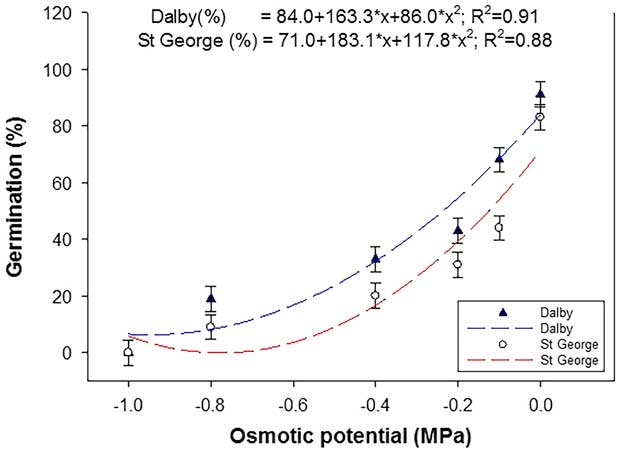
A negative quadratic correlation was observed between germination and osmotic potential of both biotypes. On average, the Dalby biotype gave 37% greater germination across all osmotic treatments (Figure 6) compared with the St George biotype. The maximum germination (87%) for both biotypes occurred when there was no osmotic stress (0 MPa), and germination decreased gradually to 14% with the decrease in osmotic potential up to −0.8 MPa. The osmotic stress necessary to decrease the maximum germination by 50% was approximate −0.2 MPa, with no germination for either biotype at −1.0 MPa. These findings suggest that S. cannabina germination is affected by osmotic stress. Similar results have been reported for other weed species for which germination was affected by high osmotic potential, including ragweed parthenium (Parthenium hysterophorus L.) (Bajwa et al. Reference Bajwa, Chauhan and Adkins2018), South African lovegrass (Eragrostis plana Nees) (Bittencourt et al. Reference Bittencourt, Bonome, Trezzi, Vidal and Lana2017), feather lovegrass [Eragrostis tenella (L.) Beauv. ex Roem. & Schult.] (Chauhan Reference Chauhan2013), goosegrass [Eleusine indica (L.) Gaertn.] (Chauhan and Johnson Reference Chauhan and Johnson2008a), barnyardgrass (Echinochloa glabrescens Munro ex Hook. F.) (Opeña et al. Reference Opeña, Chauhan and Baltazar2014), cutleaf groundcherry (Physalis angulata L.) (Ozaslan et al. Reference Ozaslan, Farooq, Onen, Ozcan, Bukun and Gunal2017), tomatillo (Physalis philadelphica Lam. var. immaculata Waterfall) (Ozaslan et al. Reference Ozaslan, Farooq, Onen, Ozcan, Bukun and Gunal2017), and littleseed canarygrass (Phalaris minor Retz.) (Sethi and Kaur Reference Sethi and Kaur2016).
Effect of osmotic potential on germination of Dalby and St George biotypes incubated at 30/20 C in a 12/12-h photoperiod for 15 d. Error bars represent LSD (F=806.6000; P<0.0000; n=6)

Considering the inability of the S. cannabina to germinate under low osmotic potential, it may be concluded that its invasiveness will be restricted to those Australian regions having a moist climate. The Dalby biotype, which was collected from a high-rainfall area, recorded 37% greater germination compared with the St George biotype, which was collected from a dry area. For this reason, it is likely that the Dalby biotype has greater potential than the St George biotype to invade other regions.
Effect of Salt Stress
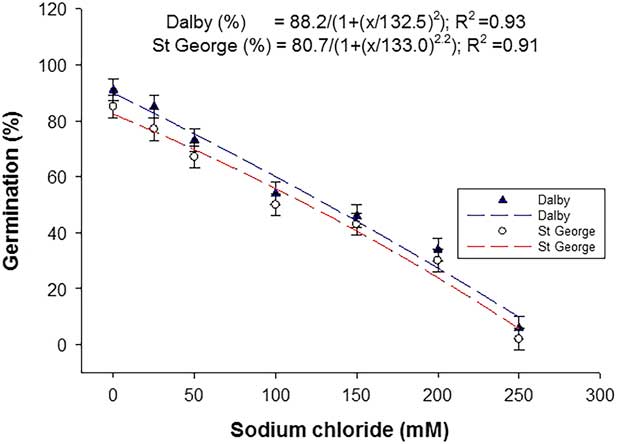
A sigmoid negative correlation was observed between different NaCl concentrations and germination of both biotypes (Figure 7). The Dalby biotype recorded 9% greater germination compared with the St George biotype across all salt treatments. Greatest germination (88%) for both biotypes occurred in the control, and germination decreased from 81% to 4% as the salt stress was increased from 25 to 250 mM NaCl. The NaCl concentration required for 50% reduction of maximum germination was estimated at around 150 mM.
Effect of NaCl concentration on germination of Dalby and St George biotypes incubated at 30/20 C in a 12/12-h photoperiod for 15 d. Error bars represent LSD (F=864.4800; P<0.0000; n=6)

These results indicate that S. cannabina has the potential to germinate under relatively high salt concentrations and that the Dalby biotype performs better than the St George biotype in such environments. A reduction in seed germination with increasing salt stress is due to various physiological processes caused by ion toxicity or elevated diffusion (Farooq et al. Reference Farooq, Hussain, Wakeel and Siddique2015). Some other weeds such as P. hysterophorus (Bajwa et al. Reference Bajwa, Chauhan and Adkins2018), African mustard (Brassica tournefortii Gouan) (Gorecki et al. Reference Gorecki, Long, Flematti and Stevens2012), bird’s-eye cress (Myagrum perfoliatum L.) (Honarmand et al. Reference Honarmand, Nosratti, Nazari and Heidari2016), and American sloughgrass [Beckmannia syzigachne (Steud.) Fernald] (Rao et al. Reference Rao, Dong, Li and Zhang2008) possess characteristics identical to those of S. cannabina and can germinate under conditions of extreme salinity. Soil salinization affects approximately one-third of all Australian soils (Rengasamy Reference Rengasamy2006). Saline groundwater is affecting a further 16% of agricultural soils and 67% of all remaining agricultural areas are also under threat of transient salinity (Rengasamy Reference Rengasamy2006). In Australia, agricultural soils are generally sodic and pile up salts under cyclic seasonal variations and have complex subsoil deficiencies such as sodicity, alkalinity, acidity, and toxic ions (Rengasamy Reference Rengasamy2006). In view of its germination under high salt stress, S. cannabina has the potential to spread into the saline environment of Australia and become a bigger challenge for agriculture.
Effect of pH
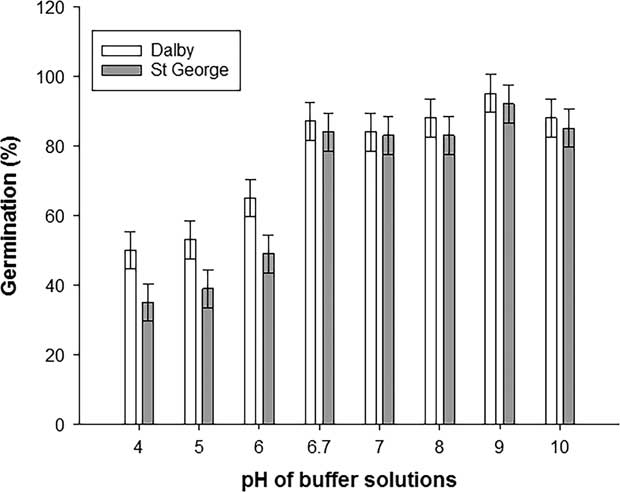
There was a significant effect of biotype (F=63.0000; P<0.0000) and different pH levels (F=228.3900; P<0.0000), and the interaction of these two factors was also significant (F=5.5800; P<0.0000) (Figure 8). The Dalby biotype showed 11% greater germination compared with the St George biotype across all pH levels. Germination of both biotypes was maximized at pH values ranging from 7 to 10. Germination of both biotypes was substantially reduced at pH 6 or lower, with the St George biotype being considerably more sensitive to acidic conditions than the Dalby biotype. The greatest (94%) germination of both biotypes was recorded at pH 9, and the lowest (42%) was recorded at pH 4. These results suggest that S. cannabina can germinate under a wide range of soil pH values. This feature was reported in some other weed species like P. hysterophorus (Bajwa et al. Reference Bajwa, Chauhan and Adkins2018), Japanese brome (Bromus japonicus Houtt.) (Li et al. Reference Li, Tan, Li, Yuan, Du, Ma and Wang2015), and B. syzigachne (Rao et al. Reference Rao, Dong, Li and Zhang2008). The capacity of S. cannabina to germinate under diverse acidic and alkaline conditions indicates that soil pH is not a controlling factor for the germination of this weed and that it can adjust to a wide range of edaphic conditions. In Australia, soil pH ranges from 4 to 9 in different regions of the country; neutral to alkaline in the inland sites where agriculture is widely practiced and acidic along coastal belts (de Caritat et al. Reference de Caritat, Cooper and Wilford2011; Rengasamy Reference Rengasamy2006). The incursion of S. cannabina is mainly found in the northern region, where soil pH ranges from 7 to 9. Thus, the findings of this study testify that S. cannabina can germinate aggressively in neutral to alkaline soil conditions and that germination declines in acidic soil. However, keeping in view this weed’s potential for germinating across a wide range of soil pH (4 to 10), it is likely that S. cannabina could invade other cropping regions of Australia and become a big problem for the cotton and grain industries in the future.
Effect of pH on germination of Dalby and St George biotypes incubated at 30/20 C in a 12/12-h photoperiod for 15 d. Error bars represent LSD (F=228.3900; P<0.0000; n=6).

Effect of Seed Burial Depth on Seedling Emergence
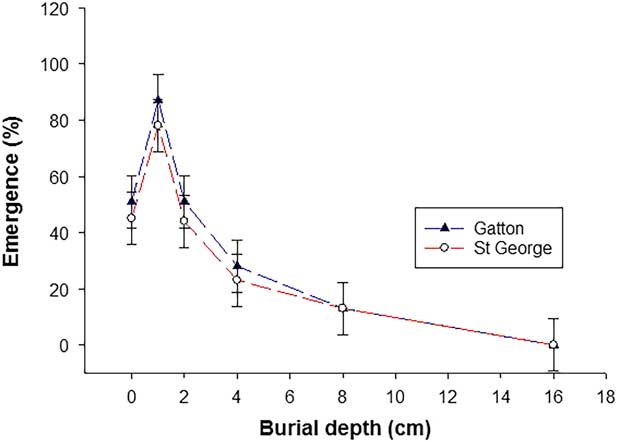
The emergence of S. cannabina showed a significant effect of biotype (F=5.7800; P<0.0000) and different burial depths (F=159.4900; P<0.0000) (Figure 9). As S. cannabina exhibits neutral photoblasticity and germinates well under dark conditions (Figures 4 and 5), this weed may germinate under deep burial conditions. Overall, there was a negative correlation between emergence and increasing burial depth. Comparing the two biotypes, the Dalby biotype displayed greater potential to germinate across various burial depths and recorded 14% greater germination than the St George biotype. Both biotypes had maximum emergence (82%) at the 1-cm burial depth, and germination decreased linearly from 48% to 13% with an increase in burial depth from 2 to 8 cm. Matching what is commonly reported in the literature for other species, only 48% of S. cannabina seeds germinated and emerged on the soil surface owing to limited seed–soil contact (Blunk et al. Reference Blunk, de Heer, Sturrock and Mooney2018). No germination was recorded at a burial depth of 16 cm. These results concur with previous findings, wherein percent seedling emergence decreases with an increase in seed burial depth (Önen et al. Reference Önen, Farooq, Tad, Özaslan, Gunal and Chauhan2018; Schutte et al. Reference Schutte, Tomasek, Davis, Andersson, Benoit, Cirujeda, Dekker, Forcella, Gonzalez-Andujar, Graziani, Murdoch, Neve, Rasmussen, Sera, Salonen, Tei, Tørresen and Urbano2014; Zhao et al. Reference Zhao, Li, Guo, Zhang, Ge and Wang2018).
Effect of burial depth on the emergence of Dalby and St George biotypes grown in a glasshouse at 30 C for 15 d. Error bars represent LSD (F=5.7800; P<0.0000; n=6).

It is predicted from this study that S. cannabina can emerge from soil depths as great as 8 cm. Furthermore, with deep burial, seedling emergence depends only on seed carbohydrate reserve in the absence of light (Mennan and Ngouajio Reference Mennan and Ngouajio2006). Species having large seeds like S. cannabina can germinate well due to greater seed reserves compared with small-seeded weeds like Asia Minor bluegrass (Polypogon fugax Nees ex Steud.) (Baskin and Baskin Reference Baskin and Baskin1998; Willis et al. Reference Willis, Baskin, Baskin, Auld, Venable, Cavender-Bares, Donohue and Rubio de Casas2014; Wu et al. Reference Wu, Li, Xu and Dong2015). Seeds buried deep in the soil are also safe from desiccation or predation by insects, thereby aiding in the buildup of seedbank reserves (Chauhan et al. Reference Chauhan, Singh and Mahajan2012; Chauhan and Johnson Reference Chauhan and Johnson2010). Furthermore, in conservation agricultural systems (no-till), S. cannabina can be noxious and difficult to control due to its ability to emerge from deep in the soil profile. Deep inversion tillage may be the best management strategy to stop its emergence and deplete of soil seedbank reserves (Dang et al. Reference Dang, Seymour, Walker, Bell and Freebairn2015). Interrow cultivation is recommended as a weed management option in cotton to minimize the dominance of weeds that are tolerant to glyphosate (CottonInfo 2018). In addition, in cotton, tillage is often practiced for land preparation and stubble removal and as part of pest management (pupae-busting tillage) (CottonInfo 2018). This study indicates that shallow inversion tillage and burial of seeds may not be very effective in suppressing this weed and ratifies the prevalence of this weed in cotton tracts of Australia (Manalil et al. Reference Manalil, Werth, Jackson, Chauhan and Preston2017) and the demand for an integrated weed management program that includes efficacious herbicides other than glyphosate.
Overall, the findings of this study indicate that S. cannabina has the potential to germinate and emerge under a broad range of ecological, environmental, and edaphic conditions generally observed in the central and northern regions of Australia. This may somewhat explain its notable infestation of that region. As S. cannabina germinates rapidly above 30 C, strategies should be in place in advance in late autumn or early summer to control its infestation and limit its occurrence to below the economic threshold level. Sesbania cannabina is highly sensitive to low osmotic potential, forecasting that water stress may be a limiting component for its further invasion in dry areas. Water stress at an appropriate time can be an effective measure to reduce its germination. The emergence of S. cannabina from deeper burial in the soil (up to 8 cm) indicates that this weed will be highly problematic in conservation agricultural systems (no-till) and difficult to control with current management practices. Strategic deep tillage is often recommended as a weed management option to suppress heavy infestations of weeds like S. cannabina. Hence, an integrated weed management involving all aspects of cultural, mechanical, and chemical measures should be taken to control this weed and limit its occurrence to below the economic threshold level in the cotton crop. Future experiments should be conducted to investigate the effect of various environmental factors on the growth and reproductive ability of S. cannabina to further understand its potential invasiveness.
Author ORCIDs
Nadeem Iqbal, http://orcid.org/0000-0002-9659-3861; Sudheesh Manalil, http://orcid.org/0000-0002-2951-8693; Bhagirath S. Chauhan, http://orcid.org/0000-0003-1540-4668.
Acknowledgments
The authors thank the University of Queensland for providing funding for this study. No conflicts of interest have been declared. We thank associate editor John L. Lindquist and the anonymous reviewers for useful and insightful comments on draft versions of the article.