Bob Hepple the legal activist (continued from Part I)
After his, and his wife's, dramatic escape from South Africa, Bob arrived as a refugee from TanganyikaFootnote 2 in the last days of 1963. The following account is of his fresh struggle to create a new career in an alien legal culture, and how he rapidly established himself as a champion of anti-racist and labour legislation in the UK. It also shows his great legal versatility in becoming an authority on the law of tort, and more recently with his observations on the relationship between labour law and globalisation.
Throughout his time in the UK, Sir Bob has maintained close ties with the University of Cambridge – it gave him academic shelter in his early years in the country, and towards the end of his academic career provided an ideal platform from which to consider more global matters.
Righting industrial and social wrongs in the UK (1964–1993)
Bob Hepple's two priorities on arriving in the UK were to persuade the authorities to allow him into the country, and to acquire the basic tools to operate in an alien legal system viz, English qualifications.Footnote 3 In both these ventures he was fortunate to receive the assistance of influential and helpful benefactors.
On the December day that he arrived at Heathrow from Tanganyika, where he had been sheltering) seeking asylum, he was taken under the wing of the prominent liberal Anglican cleric Canon Collins (who was then a prominent CND activistFootnote 4). Through Collins' intercession with Conservative Government ministers, Bob was allowed into the country for seven days. This was later extended to three years, and then, because of his grandfather Tom's patriality, he was given British citizenship. He was similarly fortunate in his choice of contacts when he ventured up to Cambridge seeking advice and assistanceFootnote 5, and by the start of the next academic year (i.e. 1964-65) he had been accepted into Clare College. Crucially, he soon also fell in with Paul O'Higgins,Footnote 6 who was to have such an influence on his life, both as an academic and fellow human rights activist.
We can return to Professor Hepple's academic career anon, but let us pursue his “activist” role. As soon as he arrived at Cambridge he took up the cause on behalf of the disadvantaged citizens of the UK, hardly breaking stride from his South African activities. Ever alert for signs and effects of racial and social discrimination, Bob found a soul mate in Paul O'Higgins, who agreed to supervise his LLM dissertation on the extent of racial discrimination in Britain, when others were not keen because of the lack of legislation in the early 60s. As he told me,
“I had arrived …. . as a refugee from apartheid South Africa and I was shocked to find the extent of racial discrimination in Britain. In particular, one would see signs in windows of landladies, saying: no coloureds, no Irish, no dogs, and workers would go on strike when so-called coloured, Asian and Afro-Caribbean workers were engaged to drive the buses. So I became interested in the subject.”
Luckily for Bob, Paul O'Higgins
“ … expressed enthusiasm, and immediately saw how important it was to ask why was there no law on the subject and what role could law play and how did the existing common law and legislation impact on discrimination.”
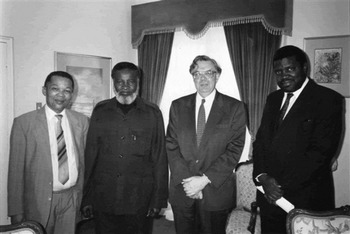
Professor Hepple after presenting his draft Labour Code for the newly independent Namibia. Left to right: Minister of Labour; President Sam Njoma; Professor Bob Hepple; Prime Minister Geingob; April 1991.

The result was Bob's first book, which O'Higgins helped him to publish: Race, Jobs and the Law in Britain. Footnote 7 For someone so recently arrived, and unfamiliar with the social and political terrain, Bob Hepple's imported insights had an immediate political effect, and I quote his own account of his opening salvo on the British human rights and labour law scene.
“I believe my book was used by parliamentary committees and others, both because I had compiled an appendix showing examples of the kind of racial discrimination that was going on – many people at that time didn't believe there was much racial discrimination – and secondly, I discussed the legal issues. Parliament then enacted the 1968 Act and I was asked to prepare an edition based on the 1968 Act and that was the second edition, published in 1970. There were quite a lot of changes in the structure of the book and I explained the new law, and I also was critical of it in some respects. And I'm glad to say that many of my criticisms were met in the 1970s because first the Sex Discrimination Act was passed in 1975 and then the Race Relations Act in 1976, which adopted or followed many of the suggestions I had made in the second edition of my book.”
As I explained earlier, it is not possible to separate totally Bob's academic and activist roles, and in many ways the former laid the foundations for the latter, at least as far as their legal pursuance went. The reason was that the application of legally enforceable “human rights” in the UK, both socially and in the industrial sphere, was in its infancy, and looking back, Bob identified his time working with Paul O'Higgins as a “remarkable partnership” at Cambridge in the late 60s and early 70s. It was a “very fruitful and very enjoyable period”. The two assembled a large team of research students and were able to develop the subject of labour law at a time when it was “very prominent on the public agenda” after the Donovan Royal CommissionFootnote 8 and the Conservatives' 1971 Industrial Relations Act.
Bob's contribution to the evolution of the subject can be seen in his phenomenal output during this golden period: Individual Employment Law (1971, with O'Higgins); Public Employee Trade Unionism in the United Kingdom, The Legal Framework (1971, with O'Higgins); Laws Against Strikes (1972, with Kahn-Freund); A Bibliography of the Literature on British and Irish Labour Law (1975, with Neeson & O'Higgins); and Labour Law and Industrial Relations in Great Britain (1977, with Fredman).
It was also during this period that his interest in administrative law and his passion for human rights led him to write a seminal article on Home Office procedures over the deportation of the German activist Rudi Dutschke.Footnote 9
“Rudi Dutschke was a German student who had been shot by a right-wing fanatic in Berlin and he had brain damage as a result of this and he was allowed into Britain for a very short period and then wanted to study. He was accepted as a student at Clare Hall….. I worked closely with his solicitor, Rosemary Sands Footnote 10in Cambridge and Brian Wigoder QC, his counsel, on the case. I sat through all the hearings and the conferences with Dutschke and his wife and …. I wrote this article based on the transcripts and what I had seen and heard and I raised a number of questions about the inadequacy of Administrative Law to deal with this sort of case.”
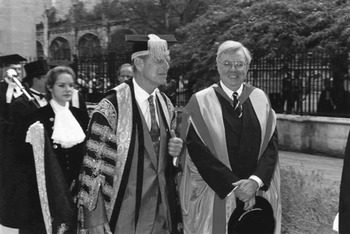
Sir Bob with the Chancellor, H.R.H. the Duke of Edinburgh, following graduation ceremony, entering Clare College for lunch, 1995.

Bob was very critical of the procedures surrounding Dutschke's deportation “on the grounds of what we now call national security” that he was moved to write that “Perhaps tears were shed as well for modern administrative justice which failed to rise phoenix-like from the ashes of 19th century liberalism.” He commented during our conversations, that despite the resonance with modern times, “a solution hasn't been found [yet].”
Bob Hepple is a man who has devoted much of his life to addressing the real problems of ordinary people, particularly the under-represented, and to this work he brought two talents – his experience from South Africa, and his innate interest in the legal issues that these problems involved. For eighteen years (1975–1993) he was Chairman of the Industrial Tribunals (England & Wales)Footnote 11, and despite the fact that industrial disputes dealt with prosaic issues such as unfair dismissal, race and sex discrimination, and Bob admitted that it was “very boring” because it was all about facts, with very little law involved, he stuck with it. It is a reflection of his concern for grounding workers rights in law that in this work he was able to apply creative scholarship to such cases.
“For example, when I was sitting in Cambridge I heard the very first case of indirect sex discrimination here in Cambridge, and the first decision on the subject reported was given by me in Cambridge. Similarly when I was sitting in Kent, I developed because of my academic knowledge, the notion of the duty of mutual co-operation, which was very little used in labour law until then. But I gave a judgment, which was reported, and it is now regarded as one of the basic tenants of labour law. I was able through my judicial work to actually develop some ideas because you are always getting rich new material in cases.”
It was during this period that several major industrial disputes occurred, and famously, Mrs Thatcher and her government fought out her confrontations with the unions. Although, as Bob put it “I am certainly not a supporter of the neo-liberal ideology of Mrs Thatcher”, and “I therefore was opposed to a lot of her legislation”, his openness on the broader issues of national well-being, was refreshing: “I fully recognise that the unions too were, in a sense, abusing their power; at one point they were going in for all of these strikes. For example, the famous Winter of Discontent in 1979/1980, which seemed to me an abuse of their position and so, in a way, they were asking for it.”
The issues certainly put labour law into the news, and Bob said
“I found [myself] quite often on television commenting on things like the miners' strike and so on, not on the merits, but more on the legal position because this was a huge confrontation. … That coincided with an economic period in which Britain was moving from manufacturing, where the unions had the greater strength, to service industries…. At the same time what was happening was what some people called the juridification of law, that is all sorts of disputes like dismissals, discipline, discrimination, which would have been dealt with informally, now became the subject of legal regulation; so it was a period of major change.” Because his sympathies lay within the broad church of the unions“ I knew quite a number of the leading union figures, like Jack Jones Footnote 12and others, and I did a lot of work for the TUC…. I was involved in advising the TUC on its proposals for legislative reform. I also advised somebody called Tony Blair Footnote 13, who was the employment spokesman for the Labour Party at that time.”
Professor Hepple resigned from the industrial tribunals in 1993 when he returned to Cambridge as Master of Clare College.
A wider canvas (1986–present)
In the mid-80s, Bob Hepple's activities began to broaden their compass, and for the next twenty years he was associated with a succession of non-governmental bodies addressing a variety of human rights issues. Taken together, these expanded his work well beyond the industrial/labour relations sphere, and suggest that his concerns were returning to their roots in wider society, particularly those touching on racial and multi-cultural matters. The titles of the bodies with which he became associated give a sense of the direction Bob's activist path now followed: Commissioner for Racial Equality (1986–90); Trustee, Canon Collins Educational Trust for South Africa (1990–); Runnymede Commission on Future of Multi-Ethnic Britain (1998–2000); Nuffield Council on Bioethics (2000–07); European Roma Rights Centre (2001–07); Board International Centre for Protection of Human Rights (2005–); and Equal Rights Trust (2008–). I cannot give a full account of all these activities, but perhaps I can pick up on one or two points Professor Hepple raised.
Such work was not without its frustrations, and Bob spoke of the way some bodies became side-tracked when important, but extraneous, issues arose. For instance, while he was appointed to the Commission for Racial Equality
“the Salman Rushdie affair occurred, where a fatwa was issued. Footnote 14I think the Commission wasted a lot of time debating this, because some of us, who were advocates of free speech, were very disappointed at the way in which some people were protesting about Rushdie's free speech, but on the other hand that wasn't the job of the commission, I thought. It rather frustrated some of the work we did.”
On the other hand, some of his activities in this sphere were of seminal importance, and as I write, the fruits of Bob Hepple's endeavours are before Parliament in the form of a BillFootnote 15 and are likely to be incorporated into far-reaching legislation. This was the work he, his wife and a researcherFootnote 16 did for the Runnymede Commission on the Future of Multi-Ethnic Britain.
“Before the 1997 general election, Lord Lester and I, who had worked together for a long time, discussed this and we thought the time had come to bring together something like nine different Acts of Parliament and over a hundred other laws dealing with discrimination. The field was just exploding and it was very difficult for people to know their rights and there were a lot of inconsistencies between the different strands of discrimination. There was EU law coming into it, there was the question of whether we were complying as well with international covenants and so at Lord Lester's suggestion, we first wrote a little pamphlet calling for a review of the legislation and then after the election, when the Labour Government was elected, we went to see Jack Straw who was then the Home Secretary Footnote 17…..He wrote a very nice letter which assisted us in getting a grant from the Nuffield Foundation and the Rowntree Trust and we did that here in Cambridge in the Centre for Public Law and we spent one year on it….We then produced it in a very short space of time, there was a lot of public involvement. There were public consultations. Lord Falconer Footnote 18, who later became Lord Chancellor, was at the time a minister in the Cabinet Office, he gave us his backing for it and it has had, I think, a very significant impact on the development of employment and generally on equality legislation in general, because I think people accepted we had shown the need for a Single Equality Act and for a Single Equality and Human Rights Commission. Step by step, the government has been implementing these things, sometimes not in ways we would approve of, but generally following those lines. They first set up an Equality and Human Rights Commission which started work in October 2007. They have announced that there will be the Single Equality Bill introduced in 2008/2009 session…” This legislation may well be a lasting legacy of Sir Bob's career as an activist for human rights and social justice.
The last two items that I would like to put before readers bearing on Bob Hepple's career as an “activist” show that despite the longevity of their roots, his notions are finely attuned to modern legal problems. Of his work for the Nuffield Council on BioethicsFootnote 19 he said that
“perhaps the most significant of my activities in this period was my chairmanship of the Nuffield Council on Bioethics… I have chaired two working parties. One on the subject of the ethics of research into genetics in human behaviour, like the connection between your genes and your intelligence or your sexuality and so on, and… then more recently….on the forensic use of bio information, in particular DNA…we got a report out rather quickly and it has had a lot of [press] coverage because it deals with all of the current disputes about civil liberties and police powers on the one hand and the benefits of DNA in fighting crime.”
Finally, in our conversations we came to a point on his long journey from Jeppe Boys High where the old warrior for other peoples' rights was able to survey the global extent of his concerns for the workers of the world. When I asked him what his priorities had been when he retired from the Mastership at Clare, he said “I really wanted very much to finish a book I had been working on for ten years…Labour Law and Global Trade. Footnote 20”
Globalisation is a topic bandied about by politicians and economists, and generally we are exhorted to believe that it is a good thing, something that we should all embrace (probably because we have no option!). Bob Hepple, ever alert to others' problems, however, sees things through different lenses, and explained that
“I think globalisation is what's having the major effect on labour laws all over the world, both internationally and locally, and ….that this has gone beyond national regulation. The question is: what kind of international regulation is possible and desirable? I stressed the point there is a lot of scope for a national regulation of labour relations but it has to play on the comparative institutional advantages of each country. I think, if I may say, that one of the most original parts of this book is an attempt to look at the competition between labour law systems, because people are very worried about exporting jobs to cheap labour countries. My argument is that every country must have a competitive advantage based on what it's got, as long as they comply with basic human rights, and it's wrong, if you like, of the developed western countries to expect all of the underdeveloped or developing countries to adopt standards which are so much like the European ones, or the American ones, that these countries can't compete. I always stress there must be basic human rights in all of these countries, but nevertheless countries have to play to their own strengths.
Now that's not a very popular thesis particularly among some of the older and more traditional labour lawyers, who feel everything must be immediately to the higher standard achieved…But after all, we achieved industrialisation in the West without these standards, and you can't expect others to immediately have those standards, although they should improve over time”.
Despite his unconventional views the book received excellent reviews, and one of the UK's most prominent constitutional lawyersFootnote 21 has described it as a “seminal text with a long shelf life, which will shape the thinking of a generation of lawyers.”
Sir Bob agreed that this book reflected his current thinking, and that it emerged after he “had been working on it for a long time…it's a kind of reflection of a long submersion in that subject.” In scope and subject matter it transcends many of the more local issues with which he had been working and fused his “activist” and legal thinking. Significantly, it was aimed at a very wide audience:
“I know that the book is being used not only in law courses but also in politics and international relations and so on. So it has had a wider audience than law. This is a book which comes directly out of my teaching. For many years, both in London and Cambridge, I taught courses on international and comparative labour law. I also did quite a lot of work for the International Labour Organisation as an expert, for example, working in Namibia and Russia and other countries…. I'm glad that it's had a good audience.”
Perhaps this is a convenient point to look at the other side of Sir Bob's UK career.
Bob Hepple and academia
Notwithstanding his glittering catalogue of extra-mural achievements, Bob Hepple also had a parallel career in teaching and research in the UK during which he reached the highest levels: a chair on three occasions, and a knighthood in 2004 for services to legal studies. Most of his time in academia was spent at Cambridge (26 years) first as an assistant/lecturer, and later as Professor of Law, but he also had a highly successful spell as Professor of English Law at University College London (11 years), and two short stints at Nottingham University (2 years as lecturer), and University of Kent (1 year as professor).
His early years as a student were grounded in the seminal work he first began as the radical, pioneering LLB student with Paul O'Higgins in the mid-1960s, and which laid the foundations for their later joint labour law work in the 70s. In those early years he was inspired by some of his other teachers, on whom he reflected with gratitude: Kurt Lipstein (for conflict of laws – “one of the best teachers I ever had”), Mickey Dias (Negligence in English and Roman Law – “very systematic…very clear.. a wonderful bridge for me between South African law, Roman/Dutch and English law”), and Tony Bradley (Administrative law – “wonderful teacher”).
After graduating with his English law qualification, Bob initially moved to Nottingham as a lecturer (1966–8), and although his stay there was short (“…my then wife just didn't settle very well in Nottingham and she was very keen to come back to Cambridge”), he became a disciple of Professor John Smith who was pioneering the American case-based method of teaching (on contract law), and Bob began apply it to the courses he was teaching at Nottingham in the law of tort.
His return to Cambridge in 1968, and a Fellowship at Clare College, saw the flowering of an “eight-year period, [that] were probably my most productive years.” As I have already recounted, Bob and Paul O'Higgins launched modern UK labour law and they produced several groundbreaking texts on human rights, and industrial and race relations. In addition, it was during this period that Bob met, and became a friend of the famous Sir Otto Kahn-Freund.Footnote 22
“He was the greatest of all German and British labour lawyers…..I think almost more than any other academic, Kahn-Freund has influenced my approach: his great comparative knowledge and his sense about these things and so it was a great privilege to work with him. [In their joint publicationFootnote 23] I have to say all the chapters I wrote were influenced by his views. …..I know it's something that is still today quoted, it's not easy to come across, but it is …quite an important contribution to the debate.”
Despite this outpouring of legal creativity and his early associations with the industrial tribunals, Bob simultaneously began to apply his newly acquired notions of the case-method to the teaching of tort. This was one of the subjects in which he was expected to give instruction at Cambridge, and one he had been taught by Mickey Dias. Although, as he explained, the case-based technique did not work well at Cambridge (“where students go to lectures and they keep quiet and then they have a lot to say in small supervisions or tutorials”), Butterworths were keen for him to bring out a tort casebook based on Wright's famous Canadian text.Footnote 24 Bob's book appeared in 1974Footnote 25, and was at one time Butterworth's best seller – “it has been the only book from which I ever earned any reasonable royalties..!” His association with the book continued to its fourth edition (1991 – it is now in its fifth edition (2001) with new authors).
His writings on tort continued, and shortly after Cases and Materials appeared he co-authored, with Emeritus Professor Glanville Williams, the delightful Foundations of the Law of Tort,Footnote 26 that is littered with literary illusions and quotations which were a hallmark of Glanville Williams' style. This little book had a long gestation. Glanville Williams,
“who I think must be the most outstanding and brilliant law teacher there's ever been in this country - most inventive - had been working on the law of tort and been writing a textbook. But that suddenly came to an end in 1961, when he started to specialise in criminal law. And in the early 1970s he arrived in my rooms in Clare College one day, with a number of boxes, saying, “this is my text book on tort which I stopped writing in 1961" and this was more than a decade later, “I‘d like you to finish it”. There were lots more boxes which I had to collect from him and of course, I was flattered and honoured because he was such a brilliant man, one of the most rational people, irritatingly logical, but could see through lots of arguments and he was always interested in what was ultimately the social impact of the law.”
“He had wanted me to complete a full textbook, but when I looked at the materials they were outdated and this was in the days before emails and computers and so on, and everything was written by Glanville Williams in an almost indecipherable script on tiny scraps of paper – they looked like tissue paper – and I had to go through these and would find little gems.”
But Bob “was just leaving Cambridge and I wanted to sort of draw to a close. So I said to him “let's just make an introductory book and use some of the best parts and not write the full textbook”. I regret that I didn't have time to write the full textbook, because I think it would have been… with his contribution, a valuable book.”
His experiments with cased-based teaching of tort, which began when he was a Lecturer at Cambridge in the 70s, had followed an earlier failed attempt to introduce it by Glanville Williams, who had even “had a lecture room specially designed for the purpose.” Later, on Bob's return to Cambridge in 1993, when he was Professor of Law, he tried again and once more it “failed completely,” which illustrates an important point that certain techniques have to fit particular situations.
His last attempt to revamp the procedures at Cambridge were all the more pointed after the success that he had achieved during his time at University College London, where he was appointed to the chair of English Law in 1982. With the more flexible structure at UCL, Bob had achieved a very satisfactory system with the case-based method of teaching that he had had observed at first hand in the USA. “I followed exactly the American system of a class of 100 students, sitting in named seats,…. you make them prepare for each class.. I would call on them and they would have to discuss.” Bob applied the method at UCL, and he was able to apply it to a new course that he called the law of obligations, which was a mixture of contract, tort and restitution, following an approach inspired by Glanville Williams.
His achievements at UCL, where he later became Dean (1982–93), led him to reflect that in “..many ways I had some of my very best teaching years at UCL. I had a thoroughly enjoyable time. I think it is a wonderful institution and a wonderful faculty.”
While at UCL, his success in the teaching work, and his innate interest in the quality of all forms of law instruction, resulted in his becoming Chairman of the Heads of University Law Schools and working closely with Professor Peter BirksFootnote 27 who was Secretary of the Society of Public Teachers of Law. His great interest in this field was recognised and formalised in 1994, immediately after his return to Cambridge as Master of Clare College (1993), when he was invited by the Lord Chief Justice Johan Steyn, to serve on the Lord Chancellor's Advisory Committee on Legal Education and Conduct (ACLEC). During this period he was charged with compiling a lengthy report on national legal education, and it was on conclusions from this investigation that he based his inaugural lecture at Cambridge: “Renewal of the Liberal Law Degree.”
Bob felt that his report was “an important turning point in legal education in this country”, but he confessed that on the issue of “the rights of audience of the Crown Prosecution Service in the High Court” the ACLEC became seriously divided. His frustrations grew, and when the government “disregarded the.. [Committee's views] ..completely and did its own thing…and the [Committee] didn't fit the government's agenda, it was wound up…”.
Bob waited for his retirement (2001) and then left ALEC's successorFootnote 28 in 2002. He then turned his attention to completing his excellent Labour Law and Global Trade, and concentrating on his committee work and other fields that opened up during his busy, productive retirement.
Some loose ends
I can only acknowledge the shortcoming of my account of Professor Hepple's academic career, and if readers would like to learn more, they might like to see the contribution on the Squire Law Library's Eminent Scholars website.Footnote 29 I hope, however that by concentrating on certain aspects I have been able to highlight areas where his “activist” alter ego has shone through and formed a highly effective, unique, symbiotic relationship in UK academic circles.
Towards the end of our conversations I asked Sir Bob if there were any regrets in his career. “Well, I have many regrets, but I think academically ……I am sorry I gave up administrative law. [When] Professor Stanley de Smith, who is really one of the founders of modern administrative law…was appointed to the Downing Chair [in 1970] …I was asked to …..move aside so he could take over [the teaching], which I was very glad to do because he was such a distinguished and very nice man. But that meant that I gave up administrative law, which I saw as one of the biggest mistakes of my career because it was just the most exciting moment for administrative law. The case of Ridge and Baldwin Footnote 30had been decided in 1964 and there were huge developments in judicial review. I always felt that that was what I should have been doing, as well as labour law, but I kind of missed the boat because I had got into other things.”
In this one instance it seems that fate did not open a door for Bob to pass through, but in all other aspects the South African crusader for human rights and the well-being of the downtrodden, is content. Apropos his retirement in Cambridge he says
“It is a wonderful environment…I wouldn't want to be anywhere else because the Faculty is very kind to its retired professors. We have full use of the facilities and you feel part of the family and the same applies to my college, of course…it is a great environment…intellectually stimulating, lots of friends….”
When I asked Sir Bob to look back on his career here, he said his most important book was “The Making of Labour Law in Europe”.Footnote 31 He also seemed particularly satisfied that his position has been adjudged by what he chose to call a “Lord of Appeal who shall remain nameless” to lie somewhere amongst two of his guiding figures, Sir Otto Kahn-Freund, and Glanville Williams.
“...I was lucky in having as influences, on the one hand Sir Otto Kahn-Freund…who was a radical, but a very clear thinker on a comparative basis…and on the other…Glanville Williams, who was the most rational, utilitarian man I have ever met; a very shy man, but on the other hand somebody who would subject everything to careful analysis on a rational basis…those were both influences, which I tried to bring into bear in my work.
The epithet of the un-named Lord, of which Bob was so satisfied, was that he was “a sensible radical”. “I really like that description. I hope I live up to it because I like to do radical things but I like to do them in a rational way.”
I think Sir Bob Hepple can rest assured that His Lordship was spot on.
It was a great pleasure to have been able to listen to Bob Hepple's humble, lucid account of his career as it raced through the fraught, raw politics of 50–60s South Africa and on to the more measured academic and industrial scene of Britain. From the shelter of his retirement it seems that Bob has emerged onto broader, more global issues but, as ever, his views remain wedded to the same principles of fairness and even-handed treatment under the law that originally drove the radical law student in his earlier battles with authority.
Career highlights post 1963
– University of Cambridge LLB 1966
– Called to Bar, Gray's Inn 1966, Bencher 1996
– Lecturer in Law Nottingham University 1966–68
– Assistant Lecturer in Law Cambridge 1968, Lecturer 1971–76
– Fellow, Clare College 1968–76
– Professor of Comparative Social & Labour Law, University of Kent 1976–77
– Chairman Industrial Tribunals (England & Wales) 1977–82
– Professor of English Law University College London 1982–93, Dean & Head of Department 1989–93)
– University of Cambridge LLD 1993
– Master Clare College 1993–2001
– Professor of Law Cambridge 1995–2001
– Queen's Counsel (honoris causa) 1996–
– LL.D honoris causa, Witwatersrand 1996, Cape Town 2006, UCL 2006, [Bari 2009]
– Honorary Professor of Law, University of Cape Town 2000–2005
– Fellow, British Academy 2003
– Knighted 2004