

A comparative approach to the history of European guilds continues to show considerable lacunae. This article discusses one particular characteristic of central European guilds: the spread of rural guilds and the establishment of an area-wide guild system in the early modern period. In European historiography, guilds usually appear as urban institutions; the first medieval craft guilds were certainly established in towns, and the spread of guilds in the late Middle Ages was an urban phenomenon. In the early modern period, however, things changed, at least in some European regions.
In many parts of central Europe, guilds became widespread in rural areas too, and in some regions at the beginning of the eighteenth century village master artisans belonging to guilds far outnumbered their urban counterparts. The aim of this article is first to present some evidence on the development of rural crafts and of urban as against rural guild systems, and second to discuss relations between rural and urban craftsmen, and rural and urban guilds.
Guilds appear as fields of joint as well as divergent interests, of agency and conflicts. The argument here is based on a rich historiographical tradition in the German-speaking world as well as on newer “revisionist” approaches to the history of artisans and guilds.Footnote 1 This paper makes particular use of research by younger scholars who in recent years have been engaged in impressive empirical studies as well as elaborate methodological discussions. Nevertheless, many questions are far from being resolved and many topics still lack sufficient theoretical reasoning or serious empirical basis. Therefore, some of the following remains hypothetical.
The expansion of rural crafts and the spread of rural guilds
In central Europe, the expansion of rural crafts was an important expression of social and economic change throughout the early modern period. The manner of expansion involved clear contrasts in different regions and for various crafts and trades. It was strongest in the west and south of the Holy Roman Empire, where economic development was far more advanced, with at least 50 per cent of all artisans living in rural areas by about 1800, whereas in eastern and central Germany about three-quarters of artisans resided in cities,Footnote 2 the more markedly so as one travelled eastwards across the Elbe.
That phenomenon was closely connected to the population density of practitioners of crafts and trades. In many regions of western and southern Germany around 1800, there were 60 or more master artisans for every 1,000 inhabitants, which was twice the rate found in the eastern provinces of Prussia.Footnote 3 The development of rural crafts correlated positively with urbanization: the more cities there were, the more rural craftsmen; the fewer cities, the more strongly those cities monopolized artisanal production. Nevertheless, even in southern and western Germany, artisan occupations were not evenly distributed within rural and urban regions. In the country, occupations such as blacksmith, wainwright, tailor, and miller were widespread whereas specialized trades were concentrated in cities.Footnote 4
There was an additional correspondence between rural crafts and trades and proto-industry, with rural crafts especially widespread in areas where there was extensive proto-industrial production, although of course that does not necessarily mean that proto-industry itself was predominantly or exclusively practised in rural areas. The export-oriented textile industry in south-west Germany was located both in cities and villages, and so we can identify very different distribution patterns in urban and rural areas.
In the case of linen weaving in the Swabian Alb, production increased dramatically in rural regions in the eighteenth century while urban production stagnated.Footnote 5 In contrast, worsted weaving in the Black Forest region long remained centred on towns rather than villages. Between the mid-seventeenth and eighteenth centuries, the number of rural worsted weavers rose quickly in several districts of the Black Forest, whereas in other districts the dominance of urban proto-industry remained. All in all, even in the middle of the eighteenth century, “towns dominated the industry to an extent wholly out of proportion to their demographic weight: in the district of Wildberg in 1750, 55 per cent of weavers but 75 per cent of the total population lived in the countryside”.Footnote 6 However, proto-industry in general had a positive influence on the spread of a wide variety of small-scale crafts and trades.
The enormous growth in rural handicrafts is particularly well documented for the southern parts of central Europe. About 1800, various government surveys provided quantitative evidence of the importance of rural trades. In 1789 in the Margraviate of Baden, for instance, 26 per cent of all artisans, involved in a wide range of occupations, lived in towns, with 74 per cent in rural areas.Footnote 7 This article will concentrate on the southern parts of the German-speaking world, particularly an area extending from the Upper Rhine valley to the Hungarian plains and including southern Germany, northern Switzerland, and western parts of the Austro-Hungarian Empire.Footnote 8
This map shows the geographical region under consideration in this article: the area from the Upper Rhine to western Hungary, stretching over 700 km from west to east, which was characterized in the early modern period by a wide dissemination of rural crafts and guilds. The author wishes to thank Annemarie Steidl for the design of this and the following map.

This map gives an example of the sheer volume and the wide geographical range of central European journeymen’s migration. It shows the places of origin of the 9,547 journeyman tailors (Kleidermacher-Gesellen), who arrived in Vienna in the course of the year 1837, turned up at the guild office, and had their names and data entered into the tailors’ guild journeymen registration book. Source: Vormerkbuch über die ein- und ausgewanderten und in Arbeit eingebrachten Gesellen; Wiener Stadt- und Landesarchiv Innungen/Bücher, 29/36 ff. The first version of this map was published in Steidl, Auf nach Wien!, p. 195.

An excellent recent study of rural crafts and guilds in a small region in southern German deals with eastern Swabia in the seventeenth and eighteenth centuries, a region bounded by Augsburg, Ulm, Memmingen, and Kaufbeuren, since Napoleonic times part of the Kingdom of Bavaria. There, in 1811, 31 per cent of master artisans were registered in towns, 69 per cent in rural areas.Footnote 9 In the early modern period the region saw a large increase in numbers of rural artisans, becoming one of those parts of central Europe with an extraordinarily high density of them. In 1809–1810 the Bavarian government launched an official census of crafts and trades, which showed that about 200,000 people lived in this densely populated region, including about 16,000 master artisans. That implies a figure of 81 master artisans per 1,000 inhabitants – a surprisingly high proportion which exceeded the ratio of many large urban settlements. In Vienna, for instance, and some smaller Austrian towns, from the late seventeenth to the early nineteenth centuries, the ratio was surprisingly stable at between 62 and 68 master artisans per 1,000 inhabitants.
The term “master” here refers to all independent craftsmen who ran their own workshops, regardless of their legal status, including guild masters as well as those who had received only a municipal or royal freedom, and even chamber masters who worked illegally but were nevertheless personally known to the authorities and guilds and therefore appeared in the trade censuses.Footnote 10 In eastern Swabia, the proportion of weavers among master artisans and, therefore, roughly their share of proto-industrial production, was about 20 per cent. That means the huge majority of rural artisans belonged to the sphere of “small commodity production”, as Karl Marx called it.
The settlement structure of eastern Swabia consisted of Augsburg as the one major urban centre, with about 30,000 inhabitants, seven smaller cities with 20,000 altogether, about 28 market-villages (Märkte, Marktflecken) (in sum 23,000 inhabitants), and rural villages (123,000 inhabitants or 61.5 per cent of the population).
Markt/Märkte/Marktflecken (market-villages) in southern Germany and Austria means a type of settlement which in legal, political, and economic respects was ranked between villages and towns. Their inhabitants enjoyed greater autonomy and self-administration than village people but less than urban burghers. One of their privileges was the right to hold weekly market days as well as some annual market festivities, for instance at parish fairs. As the settlement structure of craftsmen in eastern Swabia shows (Table 1), the large city of Augsburg, the group of smaller towns, and the market-villages had an almost equal share of master craftsmen, about 15 per cent, so quite clearly they were outnumbered by village artisans. The majority of artisans lived in the country; and if we regard market-villages as non-urban settlements, that majority is more than two-thirds.
The settlement structure of urban and rural artisans in eastern Swabia, 1810

Source: Sczesny, Zwischen Kontinuität und Wandel, pp. 57ff., 438ff.
From the late sixteenth century onwards an increasing number of rural artisans organized themselves into guilds, until by the end of the eighteenth century they included the vast majority of rural artisans. Government economic censuses in Baden-Durlach (1767), Württemberg (1759), and Bavaria (1811) show that between 80 and 95 per cent of all craftsmen belonged to a guild, without any principal difference between towns and villages.Footnote 11 In Württemberg between the sixteenth and eighteenth centuries, state laws confirmed that “guilds were not urban, but ‘regional’: each guild was organized into a district Laden (guild lodge) which regulated all matters pertaining to that occupation in the district town and in the villages without distinction”.Footnote 12 In one of the smaller German states, the Archbishopric of Salzburg, the authorities began to establish a state-wide guild system in the late seventeenth century, into which, during the course of the eighteenth century, all rural and urban master artisans became incorporated.Footnote 13 An analysis of the regional distribution of artisans in the major metal trades shows that 70 per cent of all guildsmen lived and worked in the country.
The settlement structure of urban and rural artisans and guildsmen in the Archbishopric of Salzburg, 1795–1810
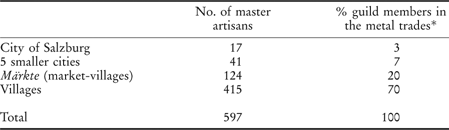
*These metal trades consisted mainly of smiths, locksmiths, and wainwrights, and of a few other occupations such as nailsmiths. Watchmakers are not included.
Source: Wiedl, Alltag und Recht, pp. 35ff., 282–283.
In eastern Swabia the late sixteenth and early seventeenth centuries were the first boom period in founding rural guilds, while a second one occurred in the late seventeenth and early eighteenth centuries. Similar trends were followed in Switzerland and Austria.Footnote 14 All in all, in the southern parts of central Europe at the end of the ancien régime a dense and region-wide guild system covered towns and rural areas and included most artisans.
Spatial structures of the guild system
The result of the incorporation of rural artisans led to complex spatial structures in the guild system. Roughly, we can distinguish three different types. First, rural guilds came into existence, which organized the craftsmen of perhaps one or two villages and small market towns, or of a larger rural region, administering them completely independently of urban guilds. In some parts of southern Germany the coverage of rural guilds was identical with the territory of a Grundherrschaft, an area subordinated to the political and legal authority of its owner, whether a nobleman for example, or urban patricians, or monasteries. Rural artisans who intended to establish a guild had to ask their lords for approval and they had the authority to issue a guild statute. In eastern Swabia, for instance, the Augsburg patrician Fugger merchant family possessed Herrschaften, where a large number of guilds were established in the seventeenth century.Footnote 15
In Austria we find similar tendencies, but as the homeland of the Habsburg Emperors it had a much stronger centralized political structure, so from the seventeenth century onwards the provincial prince (Landesfürst in the person of the Habsburg Emperor) or his administration (Landesregierung) tried to monopolize the right to issue guild statutes. In the Hungarian part of the Habsburg realm, on the other hand, guild statutes were issued by the more important of the feudal lords as late as the early nineteenth century.
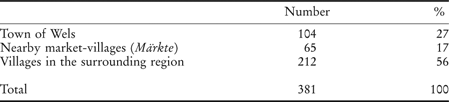
A second type was represented by the incorporation of rural craftsmen into urban guilds. A recent study on rural crafts and trades in Upper Austria provides many examples.Footnote 16 In Wels – a provincial centre of Upper Austria halfway between Vienna and Munich – 17 craft guilds were registered incorporating 381 master artisans in 1769. The town had a population of slightly more than 3,000 people, which means a rather high ratio of 127 guild masters per 1,000 inhabitants, but only a minority of Wels artisans lived within the town walls (Table 3). The majority of incorporated craftsmen in Wels lived in the country, most within a radius of 30 kilometres of Wels.
Place of residence of Wels guildsmen
Source: Schwarzenbrunner, “Geymaisterschafft”, p. 66.
A third type consisted of guilds which incorporated artisans from larger territories. In Austria, Länder (provinces, states) had been the basic units of political systems since the late Middle Ages, ruled by the Landesfürst (prince) and the Landstände (estates). In the early modern period quite a number of Land-wide (province-wide) guilds were established, which incorporated urban as well as rural craftsmen. In 1549, for example, the weavers of Upper Austria founded a province-wide guild which was intended to comprise the master weavers of all towns, market-villages, and villages. In 1558 the Carinthian belt-makers (Riemer) established a guild, and in 1705 the Salzburg butchers did the same. In large provinces such as Lower Austria (including the city of Vienna), there was usually a subdivision into quarter-chapters (Viertelladen), with the Viennese guild as the leading centre in the form of a “main chapter” (Hauptlade).Footnote 17
These three types of rural or rural–urban guilds were not neatly separated, but overlapped. A good example of the complexity of the spatial structure of the Austrian guild system is offered by a 1724 census of crafts and trades in the town of Wiener Neustadt, some 50 kilometres south of Vienna.Footnote 18 In the first half of the eighteenth century, the princely (landesfürstlich) city of Wiener Neustadt had a population of about 4,000, with 250 masters in its crafts and trades, which made it one of Austria’s most important cities. Almost all the master artisans were incorporated in guilds, but they belonged to quite different types of guild. A few of the crafts and trades represented in Wiener Neustadt had set up main chapters and had therefore advanced to the top of the guild hierarchy. Others had formed quarter-chapters that were subordinate to main chapters elsewhere – as a rule, the main chapter in Vienna. For their part, Wiener Neustadt’s main chapters and quarter-chapters incorporated masters from outside its borders, including neighbouring cities, market towns, and surrounding villages.
A few examples can serve to illustrate the colourful confusions of affiliations. There were nine bakers who formed a main chapter that incorporated one baker from each of two market towns and three villages nearby. The membership of the butchers’ main chapter consisted of nine masters from Wiener Neustadt and fifteen from rural hinterland communities. The glaziers’ guild was composed of three urban and fifteen rural masters. Five gardeners formed a main chapter, with thirty-eight masters from outlying villages included. Similar circumstances prevailed with the four soap makers and chandlers, whose guild functioned as the main chapter for all cities and market towns in western Lower Austria and even had authority over guilds in communities north of Vienna such as Mistelbach and Klosterneuburg as well as the “workshop in the ‘Freihaus’ in Vienna”. The three saddle-makers formed a quarter-chapter subordinate to the main chapter in Vienna and incorporated, in turn, the so-called rural masters of four market towns as well as the “fürstliche City of Eisenstadt in Hungary.” In numerous crafts and trades, the Wiener Neustadt masters did not form their own local chapter, but belonged instead directly to the Vienna main chapter in which they were considered rural masters.
The list includes a brewer and a brushmaker, three tanners, and three leather craftsmen, three combmakers, and several others. The master blacksmith was a member of the guild in the neighbouring market town of Gutenstein; the nailsmith was included in the market town of Piesting; the two Hungarian bootmakers in the nearby Hungarian city of Eisenstadt; the three herdsmen in the “main chapter in Neunkirchen”; and the bladesmiths/swordmakers even “paid their dues to Passau”, about 300 kilometres west in what is now Bavaria. The innkeepers, beer and wine merchants, and distillers maintained that they belonged to no guild at all; rather, they stated that they had joined together with the confectioners, dyers, and chimney sweeps in a religious brotherhood named The Holy Trinity.
The urban–rural guild system as a field of interests, agency, and conflicts
The expansion of this densely interwoven guild system and its complex spatial structure was the result of the interests and actions of varied social groups and actors.Footnote 19 In the following paragraphs I shall restrict myself to some remarks about the relationship between urban and rural guilds.
As far as we can see from the sources, the initiative behind founding a guild came mainly from craftsmen themselves, whether all the master craftsmen of one trade, or larger or smaller groups. That is true both for urban guilds and rural, or regional, guilds. The motives and interests that resulted in the foundation of a guild were various and included economic, political, social, and cultural aspects. The rural craftsmen of eastern Swabia gave one motive above all for founding a guild, which was access to urban goods and labour markets.Footnote 20
Products and goods made by guild craftsmen were considered “honourable work”. For urban guilds it was much more difficult to demand the exclusion of rural products from urban markets and to give reasons to their superiors if products had been produced by incorporated master craftsmen. The situation was similar for the careers of young rural craftsmen. Having completed their apprenticeship with a rural guildsman, journeymen could not be excluded from access to urban labour markets, nor from settling in a town or city as master craftsmen.
In the competition between urban and rural craftsmen the concept of honour played an important role. In the seventeenth and eighteenth centuries at least membership of a guild placed rural master craftsmen on the same level as their urban fellows, and local or regional authorities usually supported initiatives by rural craftsmen, as they expected economic advantages for the economy of their territory to ensue from granting them the same rights as urban craftsmen.Footnote 21
In a few cases political authorities took the lead in establishing new rural guilds. An interesting example, studied by Hans Medick, relates to proto-industrial linen production in the Swabian Alb. In the sixteenth century, weavers in the rural village of Laichingen were incorporated in the imperial city of Ulm. Around 1600, the Duke of Württemberg established a new rural guild, subordinated to the urban merchant company of the city of Urach. The rural weavers were forced to leave the guild in Ulm, where they had been incorporated for a long time, because as an imperial city it was a foreign state. They had to join instead the newly founded guild in their home province. Nevertheless, in the eighteenth century they made use of their guild to fight the monopoly of the Urach merchant company and to establish a system of “free trade”, which would allow them to sell their linen to foreign merchants if they offered the best prices.Footnote 22
Perhaps the foundation of province-wide guilds in many Austrian territories followed political goals. A province-wide guild, with statutes and privileges guaranteed by the prince, strengthened the autonomy and status of rural artisans against the local authorities, whether noblemen or urban magistrates. In the early seventeenth century, in Upper Austria, province-wide guilds were strongly resisted by the estates but were supported by the prince in the person of the Habsburg Emperor, who was eager to promote the political, administrative, and religious uniformity of the Habsburg Empire.Footnote 23
The position of urban guilds towards rural master craftsmen shows a clear change. In the fifteenth and sixteenth centuries Austrian urban guilds tried to limit rural production and the access of rural artisans to urban markets. One expression of that policy was the establishment of an area surrounding the city in which artisan production was to be completely prohibited (Bannmeile). Later on urban guild masters changed their strategy. They became willing to incorporate rural craftsmen and tried to make use of guilds to exercise a certain control over their rural fellow guildsmen. There were even efforts to combine the establishment of a Bannmeile, and to integrate rural master artisans into urban guilds. One example involved tailors in the five landesfürstliche cities belonging to the sovereign prince of Upper Austria. An ordinance enacted jointly there in 1582 established such a Bannmeile: tailors were forbidden to set up shop within a mile of any of these cities; moreover, the rural master artisans beyond the Bannmeile – the so-called Geyschneider – had to be absorbed into the guild in the nearest city.Footnote 24
The control which urban masters exercised over rural guildsmen took various forms. Guild statutes, for example, restricted the number of apprentices or journeymen for rural master craftsmen, or they granted urban master craftsmen privileged access to raw materials. Rural and urban guildsmen had to pay annual fees, but control of the finances was dominated by the urban masters. Where rural guilds belonged to quarter-chapters subordinated to main chapters, as was characteristic in the guild system of Lower Austria in relation to Vienna, those main chapters were the administrative centres, so that if a guild received new statutes, perhaps from a new ruler, they were then kept by the main chapter in Vienna. Quarter-chapters or local guilds had to order copies, and they had to pay for them.
Under certain conditions, however, the hierarchy of quarter-chapters and main chapter in Vienna was advantageous to incorporated master craftsmen in villages and market-villages. If the local leadership of a rural guild made use of the corporation only for their own private interests, the Viennese main chapter embodied a superior authority. Rural guildsmen could complain to Vienna about their local officials.Footnote 25 Nevertheless, there are many examples of attempts by rural guilds to split from their urban main chapters, such as the Laichingen village weavers in 1724–1726.Footnote 26 In Lower Austria too we find efforts by rural guildsmen to separate from the Viennese main chapter and form autonomous rural guilds. Often village masters argued that it was costly, time-consuming, and tiring to walk more than 100 kilometres to Vienna to participate in their guild assembly.
Urban artisans, on the other hand, could make use of their influence on rural crafts and trades for the social placement of their offspring and for the creation of kin-based occupational networks. There were very few urban crafts in early modern Austria where family strategies and guilds overlapped. One, however, was chimney-sweeping, which was a kind of ethno-business dominated by Italians from the Grisons and Ticino; its Viennese guild masters spread a dense family network over small towns and market-villages, even beyond Austria’s borders.Footnote 27
To sum up, the development of a guild system which variously included urban and rural craftsmen appears ambivalent. Certainly urban master craftsmen tried to maintain or even extend their dominant position, with the help of the common guild. On the other hand, the rural–urban guild system resulted in a revaluation, and led to equality between rural crafts and trades and those in towns and cities. All in all, I think that what predominated was a tendency to incomplete equality.
Social and economic consequences of the rural–urban guild system
There is still a lack of systematic research and thinking on the social and economic consequences of the rural–urban guild system. So far, the influence of rural guilds on economic and social development has been discussed in relation mainly to proto-industry. With respect to south-west Germany, two diverse perspectives have been employed. Using the example of the linen weavers’ guild in the village of Laichingen in the Swabian Alb, Hans Medick has shown that as a rural guild it put up resistance to the monopoly of the urban merchant guild and became an advocate of “free trade”.Footnote 28 Sheilagh Ogilvie, on the other hand, has drawn a rather gloomy picture in which rural and urban guilds jointly constituted twin buttresses of a “corporate society”. From her study of proto-industrial worsted weaving in the Black Forest region, she derived the hypothesis that the tightly interwoven relationships among guilds, communities, and the state in the form of “state corporatism” served, above all, to ensure the preservation of privileges and to prevent competition, resist social change, and constrain economic growth.Footnote 29
But is it possible to conclude from such findings that central European guilds in general retarded economic progress?Footnote 30 My view of the guilds is considerably more positive, of rural guilds above all, those involved not only in proto-industry but also in the wider range of “small commodity production”. My bare hypothesis is that the establishment of rural guilds in the early modern period had a strongly beneficial impact on the economic, social, and cultural integration of wider territories, as guilds contributed to decreasing the differences between city and surrounding country and diminished the significance of the city walls. Nevertheless, essential differences continued: the cities had a much more differentiated structure in their trades than did market-villages and rural settlements.
The number of trades and therefore of guilds too was much higher in towns and cities than in the country. Certain trades were restricted to towns and cities, most of all the production of luxury goods and technically difficult products. Rural crafts dominated in quantitative terms in respect of the number of masters and workshops, but urban crafts still held the lead in respect of quality and technical innovation.
In spite of that difference, the establishment of a rural-urban guild system promoted the integration of the urban and the rural worlds of artisans. That can be discussed in the context of labour markets and the labour migration of artisans. The high geographical mobility of central European artisans is well known,Footnote 31 its core the system of journeymen “tramping”.Footnote 32 A great number of apprentice boys came from the country and were trained by rural master craftsmen, usually not in their fathers’ workshops but with foreign masters, often at some distance from their homes. A certain number of them, however, went to a town or city before starting their apprenticeship,Footnote 33 at the end of which the young artisans became Gesellen (journeymen). In most central European crafts and trades (except textile production and building crafts), being a journeyman meant being an unmarried, unattached, and highly mobile young man, being on the road for a year or two as a “tramping artisan”.Footnote 34
“Tramping” was not restricted to towns and cities, although they were the journeymen’s preferred destinations, where demand for wage labour was more likely and there were larger workshops. For the tramping journeymen, towns and cities were attractive not only for their promise of labour but for cultural, even for tourist-like reasons, for a visit to one or more of the most famous cities provided lifelong cultural capital.Footnote 35 Independently of their motivations, tramping journeymen travelling from one town to the next constituted a highly flexible supra-regional workforce and formed an indispensable complement to the relatively fixed labour potential of urban guild masters. Guilds were the social and cultural framework of this system of mobility, offering lodgings, ports of call, material support, and social contacts.Footnote 36
After some years of moving around, a great number of journeymen tried to establish themselves as masters, invariably in combination with marriage and starting a family, although, in a large metropolis like Vienna, marriage and settling down as a householder were not necessarily bound to guild membership. There was a huge and barely legal labour market for non-incorporated masters or Störer (chambrelans), but in most towns, particularly smaller ones, guilds either provided limited access to the social position of the master artisan, or they formed considerable financial obstacles.
So, it was common to go back to the country, where it was easier to establish oneself as a self-employed master artisan and to become incorporated in the rural guild. The country was the realm of the small and self-employed master, and the average labour force of a rural workshop was extremely small. In towns, and even more so in large cities on the other hand, we find larger workshops and a concentration of journeymen in work, looking for work, or just breaking their journeys for a day or two.Footnote 37 Cities, then, were centres for journeymen’s associations and for labour conflicts.
The basic features of artisan mobility in early modern central Europe were, therefore, determined by rural–urban relations. Growing up in the countryside, being apprenticed most likely to a rural master artisan, but to an urban one in a minority of cases, circulating as a journeyman among a large number of towns and cities, a man would then return to the country around the age of thirty, to settle as a village master. The existence of an urban–rural guild system provided the institutional framework for that particular form of mobility, the artisan life course transcending borders between an urban and rural world.
On that assumption, the prospects of one day becoming a master craftsman remained realistic for journeymen in the crafts and trades – if not in a city, then in a village, perhaps their home village. Even after the end of the guilds, in the late nineteenth century – on which German occupational statistics provide very precise and extended information – about one-third of all craftsmen, having completed their apprenticeship, later on achieved the position of a self-employed master craftsman. Another third kept the status of a journeyman into old age, while the remaining third switched to a trade outside small-scale artisan production, mainly in the industrial sector.Footnote 38
The rural–urban integration of central European crafts and trades was, therefore, one of the reasons for the peculiar persistence of small-scale artisan production and of a traditional artisanal way of life which extended far beyond the dawn of industrial society.



