I. Introduction
Courts are typically passive institutions that must be mobilized by litigants. They are also known to suffer from chronic case overload. Under these conditions, Galanter’s (Reference Galanter1974) influential party capability theory suggests that the status of litigants before courts has substantial influence on judicial outcomes. Corporations and the government act as repeat players, enabling them to take better advantage of the legal system.Footnote 1 In contrast, one-shot litigants usually have high stakes in the outcome of their cases, have fewer resources at their disposal for expensive legal battles or to pursue their long-term interests, and receive little benefit from developing a precedent.
The theory’s predictions have been corroborated in many studies.Footnote 2 Wheeler et al. (Reference Wheeler, Cartwright, Kagan and Friedman1987) found support for the theory in a study of 16 state supreme courts. Songer and Sheehan (Reference Songer and Sheehan1992) showed that party capability is strongly related to appellant success in federal courts of appeals in both published and unpublished opinions. Internationally, Atkins (Reference Atkins1991) demonstrated that governments fare better than corporations and corporations fare better than individuals in the English courts of appeals. McCormick (Reference McCormick1993) found similar results for the Supreme Court of Canada. More recently, Chen, Huang, and Lin (Reference Chen, Huang and Lin2014) have shown party capability effects in the Taiwanese Supreme Court at the jurisdictional stage, that is, to grant or deny certiorari review.
While party capability studies have shown the effects of litigant status in different settings, existing research has been less successful at disentangling the sources of litigant advantages. Following Galanter (Reference Galanter1974), the litigation advantages of “haves” are believed to derive from their capacity to mold the law through time to accommodate their interests and to adapt their legal relationships to take full advantage of the law, from a better ability to select which cases to litigate and which cases to settle, and from a conscious or unconscious tendency of adjudicators to find in their favor, as well as from the ability to retain better counsel (i.e., representational advantage).
This study contributes to the literature on party capability—and, more generally, on access to justice—by investigating the effects of representational advantages in the discretionary jurisdiction of the Supreme Court of Argentina (CSJN). We define “representational advantage” as the capacity to secure better counsel, and we use the ability of legal counsel to fulfill certain formal legal requirements as a proxy to evaluate it.Footnote 3
In 2007, CSJN took advantage of its broad regulatory powers to impose formal requirements on appeals through an administrative order called Acordada 4 (or, simply, Acordada). Noncompliance with those requirements is sufficient ground for CSJN to dismiss an appeal by issuing a decision that merely states that the appellant did not comply with one or more specific articles of Acordada (e.g., the maximum number of pages per appeal or the maximum number of lines per page). Justices have the option to make an exception and substantively revise appeals violating Acordada rules, but the use of such exceptions is believed to be very limited.Footnote 4 Because appeals are rejected purely on formal grounds, our research design allows us to study representational advantages in a context in which other sources of litigant advantages identified in the literature should not play a role.Footnote 5
Our study is based on the analysis of an original database consisting of the 1,160 decisions to dismiss appeals on formal grounds issued by CSJN during 2012, as well as 1,118 decisions issued by the courts after substantive review.Footnote 6 These decisions were individually codified and processed. We also conducted 27 semistructured interviews to gain greater insight into the underlying reasons for the observed results. The study shows that representational advantage plays a significant role by unevenly affecting certain types of appeals. Specifically, individual appellants represent a larger proportion of appeals rejected on formal grounds than of appeals analyzed on their merits. In addition, certain areas of law in which asymmetrical capability is prevalent and consistent, particularly labor law, are significantly overrepresented in appeals rejected on formal grounds.
To the best of our knowledge, no other article has been able to parse out representational from other types of haves’ advantages. Johnson, Wahlbeck, and Spriggs (Reference Johnson, Wahlbeck and Spriggs2006) provided strong evidence of the importance of lawyer quality by studying lawyers’ impact on success based on Justice Blackmun’s grading of attorney performance during hearings. Nevertheless, they admit that “it is possible that attorneys get higher grades in cases in which they have the ‘better’ legal position; thus the relationship between [appeal success and lawyer performance during oral argument] reflect[s] the effect of the legal and factual circumstances of the case” (108). By contrast, this type of difficulty does not arise in the present context, given that the objective requirements of Acordada are neutral between the parties.Footnote 7 Furthermore, our setting avoids the need to wrestle with the issue of who actually won a case. Judicial decisions typically entail many subtleties that may allow a losing party to claim small victories that carry over to other cases. This difficult evaluative scenario is prevented, as it is clear that parties who have had their appeals rejected on formal grounds have flatly lost.
Our main findings are also important because they incorporate docket management techniques into discussions of party success in developing countries. While several studies have confirmed the main tenets of the party capability theory in the United States (Wheeler et al. Reference Wheeler, Cartwright, Kagan and Friedman1987; Songer and Sheehan Reference Songer and Sheehan1992), other studies have found that some supreme courts in other countries tend to favor weaker parties—for either strategic or ideological reasons (Haynie Reference Haynie1994; Dotan Reference Dotan1999). Nevertheless, those studies do not focus on case dismissals.Footnote 8 Kastellec and Lax (Reference Kastellec and Lax2008) have shown that not accounting for case dismissals can distort findings about the effects of case characteristics on outcomes. Our results suggest that docket management techniques may also affect case outcome results, as well as the ability of even the most willing ideological courts to offset resource differences among litigants.
The article proceeds as follows. Section II introduces relevant background information on CSJN. In Section III, we present our main hypotheses based on the party capability theory. Section IV describes our data collection. In Section V, we present descriptive statistics and our main results. Section VI discusses the results and their implications. In Section VII, we briefly conclude.
II. Legal and Institutional Background
Before we start, we need to briefly explain the formal restrictions introduced by CSJN in 2007 through Acordada and the context in which these requirements were introduced, as well as describe the Court’s organizational structure and jurisdiction. CSJN intervenes both through its original jurisdiction and as the tribunal of last resort.Footnote 9 Only the latter is relevant for our purposes here.Footnote 10 CSJN’s appellate jurisdiction includes appeals of cases decided by courts of federal, national (i.e., local courts of the city of Buenos Aires; Art. 4 of Law No. 48), federal/national (i.e., criminal cases from federal or national origin that reach the Federal Criminal Cassation Court), or provincial jurisdiction.Footnote 11
In order to reach CSJN, appellants must file complaints—commonly referred to as recurso extraordinario (REX)—in the relevant lower court of appeals (or provincial supreme court), which decides whether the appeal meets the substantive and procedural requirements after affording an opportunity for respondents to file replies. If the lower court considers that all requirements are satisfied, the appeal is sent to CSJN. If the lower court believes they are not, the appeal is denied; in that case, litigants may directly ask CSJN to hear their cases through a recurso de queja (RHE). In this case, CSJN will review whether the lower court legitimately denied the appeals.
Once appeals reach CSJN, they are distributed to the judicial department specialized in the area of the appeal. The specialized department will conduct a preliminary assessment on the basis of the formal requirements. The department will often keep the file for internal drafting before being circulated among the justices if the appeal arrives through RHE. When the appeal was granted by the previous court, the specialized department will usually distribute it among the justices, often starting with one with particular specialization in an area (before going to the others).Footnote 12 Justices will make a decision on the appeal after reviewing the appeal file. Hearings are extremely rare.Footnote 13
The fact that CSJN has jurisdiction over a case does not guarantee that the court will arrive at a decision on the merits of the appeal. In 1990, Congress reformed the Code of Civil and Commercial Procedure, giving CSJN discretion to dispose of appeals based on a lack of substantive importance.Footnote 14 This type of decision is referred to as Article 280. Since then, CSJN has routinely made use of the discretionary power to reject appeals on the grounds that the matters raised by the appellant are either insignificant or inconsequential.
After the 2001 economic crisis, in the context of a legitimacy crisis that affected public offices more broadly, CSJN was facing the “worst crisis of credibility in its institutional history” (Ruibal Reference Ruibal2009, 59). CSJN was significantly renovated by the first Kirchner administration.Footnote 15 Since then, CSJN has struggled to relegitimize itself; among its actions toward that goal, it has sought to improve the efficiency and transparency of its decision making.
In 2007, CSJN adopted Acordada as one of its key measures to streamline and facilitate appeals before it, as well as making decision making more transparent and efficient.Footnote 16 Acordada is a formal step before proceeding to analyze any extraordinary appeal. It stipulates a series of formal requirements each appeal must follow, among which we could highlight the following ones: a maximum length of 40 pages for the original appeal—REX (Art. 1)—and of 10 pages for the direct appeal, RHE (Art. 4);Footnote 17 a maximum of 26 lines per page and a minimum font size of 12 (Art. 1);Footnote 18 and a cover page with all of the relevant information on the file and the appeal (Arts. 2 and 5, respectively). Moreover, the submission itself should contain specific references about the court whose decision is appealed, the facts of the case, the type of harm the decision generates for the appellant, a clear refutation of “each and every independent argument” on which the disputed decision rests, and a “direct and clear relationship” between the federal norms invoked and the decision that has been reached (Arts. 3 and 6, respectively); the RHE submission should be accompanied by copies of several parts of the file (Art. 7); appeals should contain a detailed list of all of the legal norms cited that do not appear in the Argentine National Gazette (Boletín Oficial; Art. 8); appeals should follow the rules of citation of Supreme Court precedents preferred by CSJN (Art. 9); and the grounds of the appeal should not constitute a mere reference to previous parts of the file or a schematic or formal enunciation that does not allow CSJN to understand the precise grievance that is being alleged (Art. 10). Finally, Article 11, paragraph 1, stipulates that failure to fulfill each and every requirement would be sanctioned by rejection of the appeal, unless CSJN considers that that lack of fulfillment is not an insurmountable obstacle for the admissibility of the appeal.Footnote 19 Article 12, in turn, clarifies that these provisions will not apply to appeals presented in forma pauperis.Footnote 20
In order for CSJN to reject an appeal on Acordada grounds, it must deliver an opinion—typically of the boilerplate type.Footnote 21 In practical terms, it means that, at the time of our study, at least four justices must vote to decide that the submission had not met the minimal standards set by Acordada.Footnote 22 Notably, this procedure is exactly the same one that the Argentine Supreme Court employs in order to issue opinions on the merits of cases.
III. Hypotheses
We examine party capability theory in the context of appeals to CSJN that were rejected on formal grounds or analyzed on their merits. Looking at these appeals is important because it allows us to direct our attention toward the specific reasons underlying why haves come out ahead.
The literature has identified four sources of haves’ advantages (Wheeler et al. Reference Wheeler, Cartwright, Kagan and Friedman1987), typically interacting with one another to reinforce their effect. First, through lobbying practices across time, haves may be able to mold the normative structure of the legal system in their favor. Further, because of their knowledge of the legal system, haves may better construct their legal relations so as to use the rules to their advantage. Second, as repeat players with deep pockets, haves develop strategic abilities that allow them to cherry pick which cases they want to litigate in order to generate favorable precedents (Albiston Reference Albiston1999). Due to litigation experience, haves are, on average, better able to assess success probability in any given case. Hence, cases with fact patterns that may not be best suited to generate wins can be settled privately without affecting the development of precedents. Third, judicial attitudes may cement the position of haves too. Through social relationships and social rank, judges tend to be closer to haves, and, as a result, they may tend to favor consciously or unconsciously the positions advanced by haves. Finally, haves tend to possess representational advantages. As repeat players, haves can use their experience with lawyers to better select the counsel to represent them. In the specific Acordada context, such a selection would involve evaluating the lawyer’s familiarity with institutional rules—what Kritzer (Reference Kritzer1998) calls “process expertise.” Also, because of their deeper pockets, haves can typically afford to select better-qualified counsel, build more effective litigation teams, and withstand extensive trial and appeal sequences.
By looking at the proportional differences between appeals that are rejected on formal grounds and appeals revised on the merits, we are able to parse out representational advantages from judges’ ideological preferences (Sheehan, Mishler, and Songer Reference Sheehan, Mishler and Songer1992), judicial alignment with certain parties (Kritzer Reference Kritzer, Kritzer and Silbey2003), any normative tilt of the substantive legal system in favor of haves, and any differences in strategic abilities parties may have in selecting cases for appeal. None of these considerations should affect the decision of the Argentine Supreme Court to reject the case on formal grounds. As a result, we hypothesize that representational advantages, by themselves, matter. Hence, appellants with fewer (more) resources should have a higher (lower) proportion of appeals rejected on Acordada grounds than examined on the merits.
The proxies used in the literature for stronger or weaker party capability are imperfect (Wheeler et al. Reference Wheeler, Cartwright, Kagan and Friedman1987). This is the case because researchers seldom have information about litigant resources. Nevertheless, in some areas of law, some litigants are more consistently the underdog. This is the case with individuals who litigate labor disputes against corporations or the government, or with individuals who go against the public prosecutor in criminal cases. In both cases, these individuals have fewer resources at their disposal than their counterparts and may be unable to retain CSJN-savvy lawyers. Therefore, we expect to see a larger proportion of appeals rejected under Acordada arising from subject areas in which litigant asymmetry is systemic, such as labor law or criminal law.
IV. Data Collection and Processing
The focus of this study is on decisions arising out of REX and RHE appeals issued by CSJN in 2012, that is, the subset of cases in which litigants decided to appeal to CSJN. CSJN publishes online every opinion it issues, along with a case history and other background information. Starting in 2012, CSJN has categorized every opinion according to different criteria, and it introduced a search engine that allows searching for opinions meeting any of the predetermined criteria. One such criterion is the outcome of the opinion. We used the search engine to find every opinion that CSJN made during 2012 categorized as Acordada, or decided on the merits, excluding pension cases.Footnote 23 In addition, we randomly selected one-fourth (500) of all opinions issued in 2012 decided on Article 280 grounds, again excluding pension cases. After discarding repeated opinions and opinions that were mistakenly classified as Acordada, Article 280, or decisions on the merits, we ended up with a working database consisting of 621 decisions on the merits, 1,160 Acordada decisions, and 497 Article 280 opinions.Footnote 24 The data obtained provide a sound basis for assessing party capability theory. Further, the opinions we looked at are significant. The bulk of CSJN’s workload is composed of its discretionary jurisdiction opinions. The practical importance of these opinions to every participant in the CSJN appeals process is evident.Footnote 25
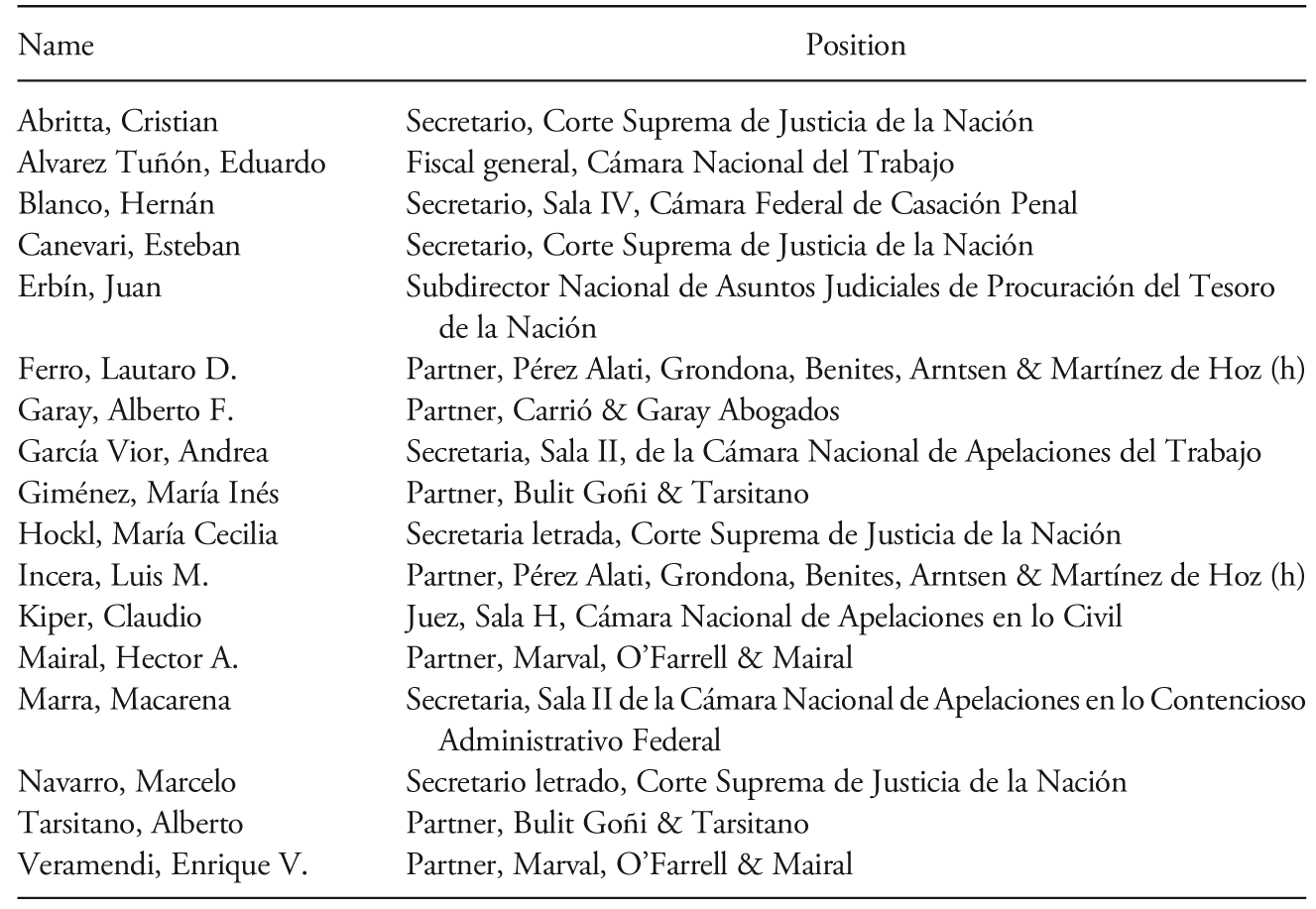
To further understand the work of CSJN regarding formal appeals rejections, we conducted a series of interviews with 27 key participants of the appeals process. The respondents were chosen for their experience with CSJN, as well as for their different roles in the appeals process. After developing an open-ended questionnaire, we interviewed practicing lawyers with regular experience filing CSJN appeals. We interviewed appeals court judges and appeals court officials who routinely handle CSJN appeals. In addition, we interviewed CSJN officials in charge of dealing with appeals and preparing internal documents. Finally, we interviewed officials from the relevant public offices in charge of litigation before CSJN, that is, the Procuración General de la Nación, the Defensoría General de la Nación, and the Procuración General del Tesoro de la Nación.Footnote 26 The answers obtained informed both our hypothesis design and the discussion section of this essay. A list of those interviewees who authorized us to reveal their names can be found in table 1. To ensure greater disclosure, no proposition is explicitly attributed to any of them.
List of Interviewees
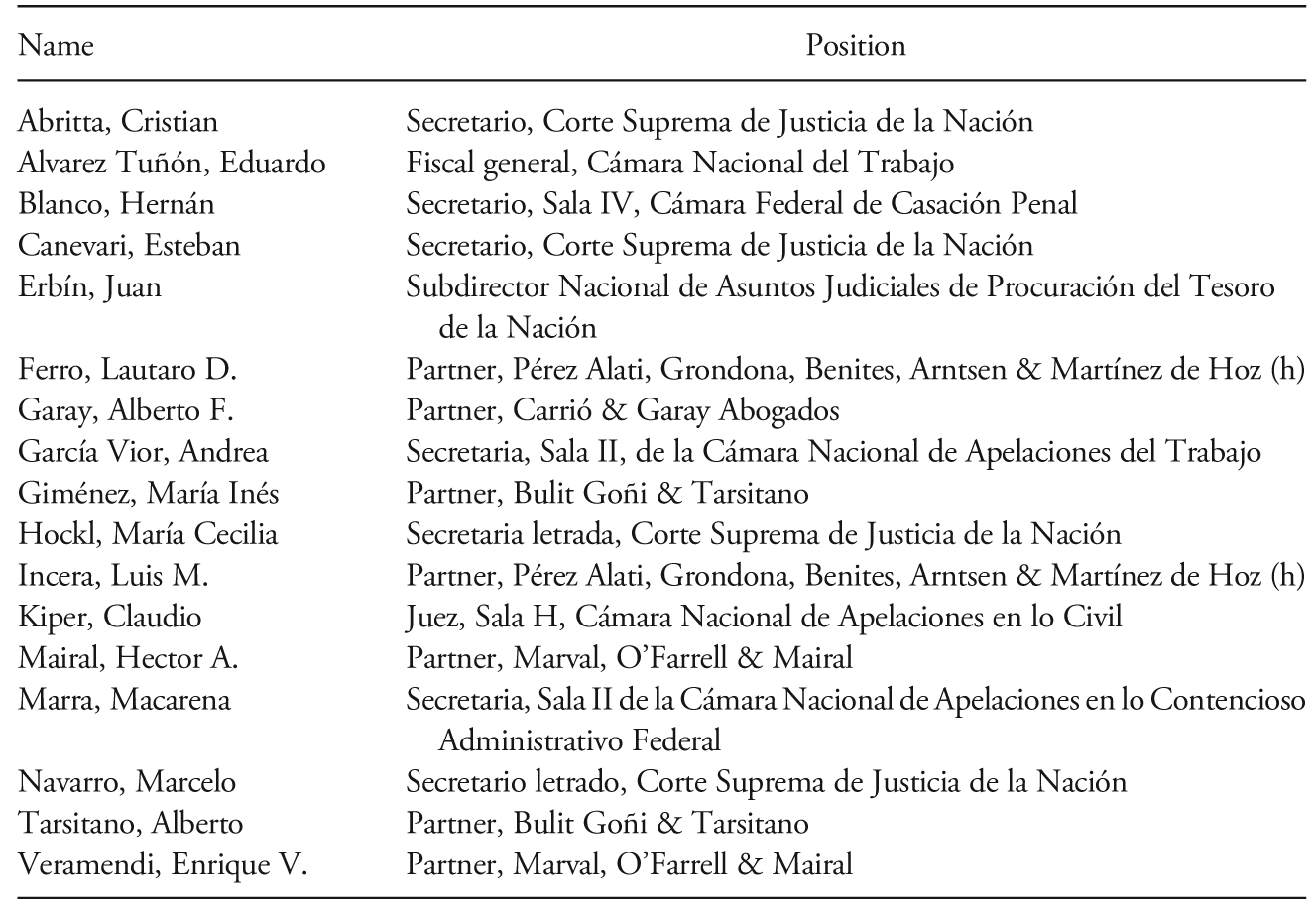
Note.—This list does not include individuals who have requested to remain anonymous.
V. Results
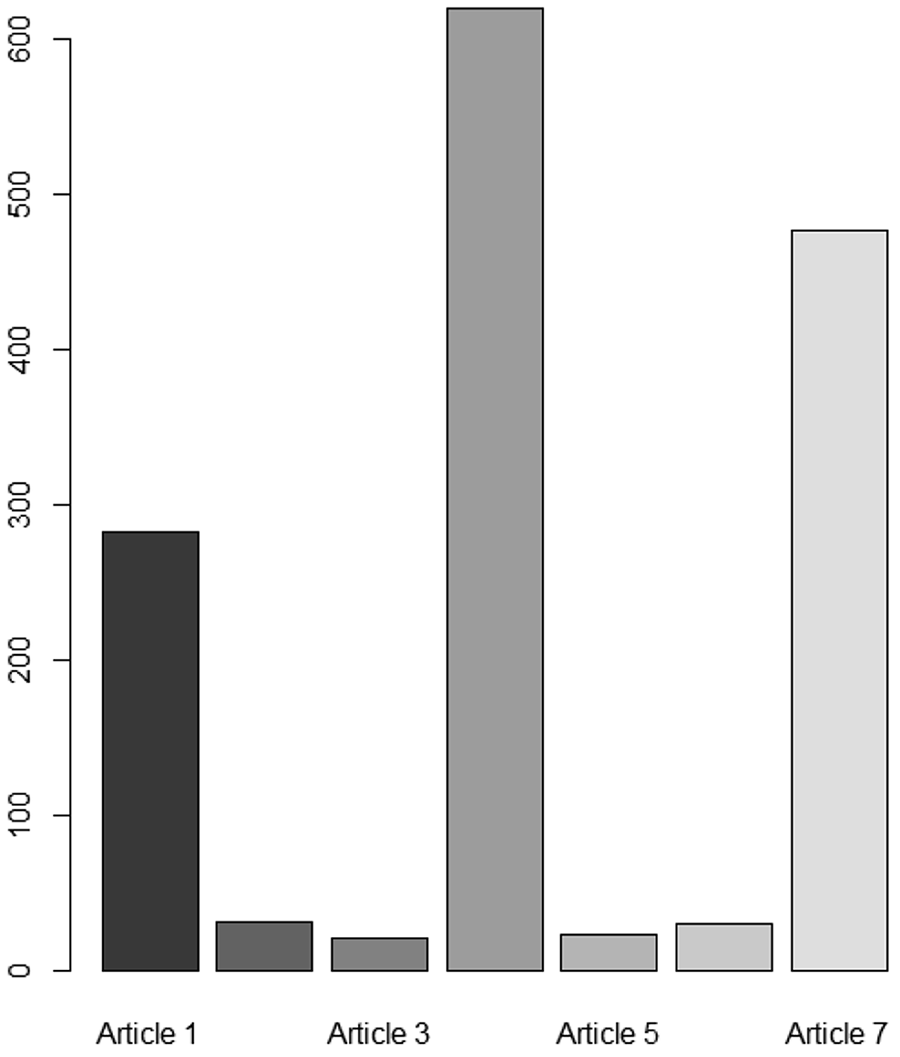
We started by looking at the Acordada decisions in order to confirm that they are based on formal requirements. For each Acordada opinion in our database, we coded the article(s) explicitly cited by CSJN in each of its rejections. Most of the time (73% of cases), CSJN cites just one article, and, in our sample, up to five articles are cited, but only three times.
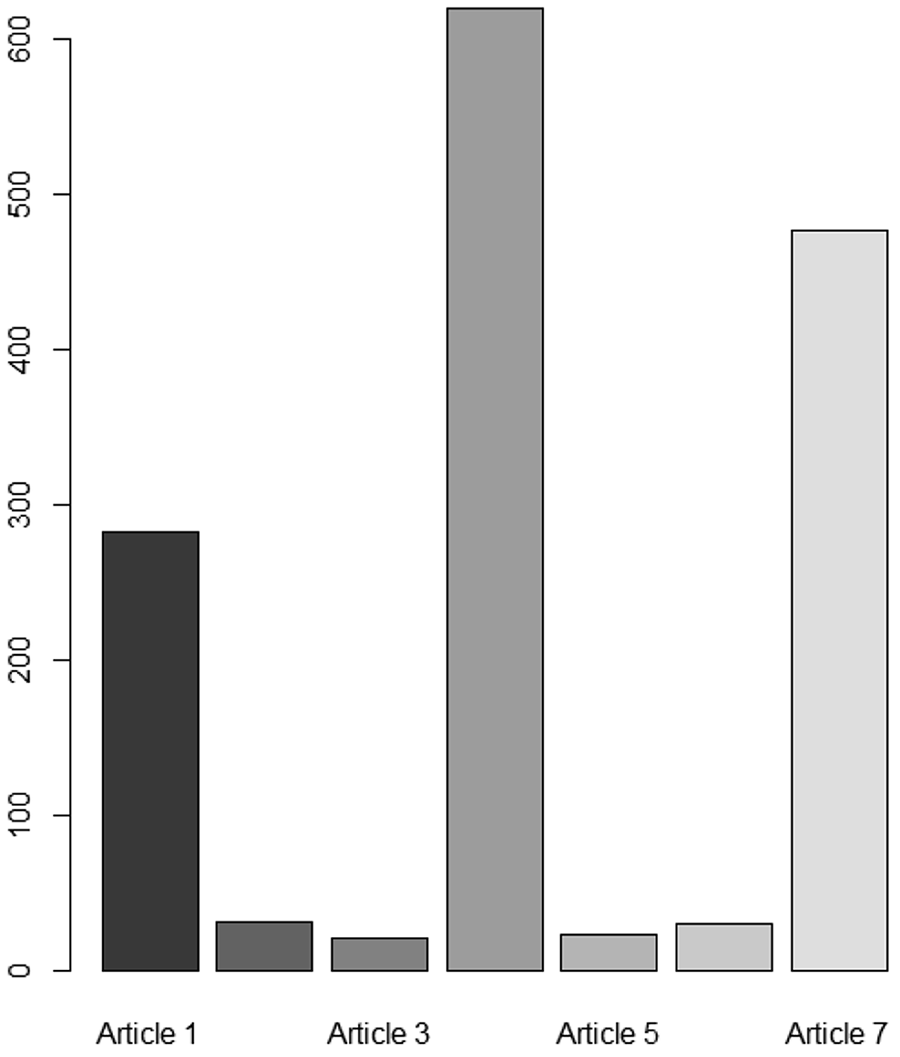
As shown in figure 1, the article most frequently cited by CSJN is Article 4 (54.66% of the time), followed by Article 7 (41.99%) and Article 1 (24.73%). Articles 1 and 4 refer to the maximum page length and to the page format for the REX and RHE, respectively. Together, violation of the maximum length and page format accounts for 72.89% of all the appeals rejected. Adding Article 7 rejections—that is, appeals lacking copies of relevant docket documents—accounts for 97.27% of all appeal rejections based on Acordada.
Frequency of Acordada articles cited by CSJN
To test our first hypothesis of party capability effects, we follow Wheeler et al.’s (Reference Wheeler, Cartwright, Kagan and Friedman1987) classification of litigants into classes. We distinguish between individual litigants, business or corporate litigants, public prosecutor, and government as parties. Individuals are assumed to have, on average, fewer resources than businesses, which are assumed to have, in turn, fewer resources than the government. We separate government from public prosecutor because the Argentine Constitution since 1994 has established that the public prosecutor’s office is independent of any other branch of government. Nevertheless, we believe that the public prosecutor’s office, as a state agency, shares much of the same litigation advantages as the government.
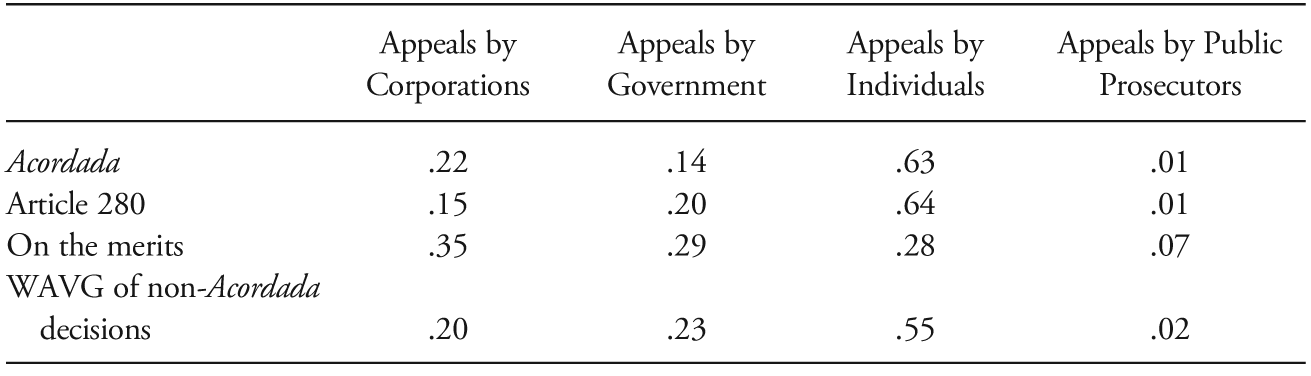
As shown in table 2, Article 280 opinions represent 76.3% of total non-Acordada opinions in 2012, while the decisions on the merits represent 23.7%. Table 3 presents the appellant status results of appeals rejected under Acordada, dismissed under Article 280 (the rough equivalent to certiorari denied), or decided on the merits, as well as the weighted average of non-Acordada appeals. Given that the Article 280 sample size is roughly one-fourth of the population of Article 280 opinions for 2012, and that we have census information for the other types of opinions, we assigned weights to the average proportion of each category of non-Acordada opinions.
Total Number of Non-Acordada Decisions Issued by CSJN during 2012

Proportion of Appeals Decided in Each Category, by Type of Appellant
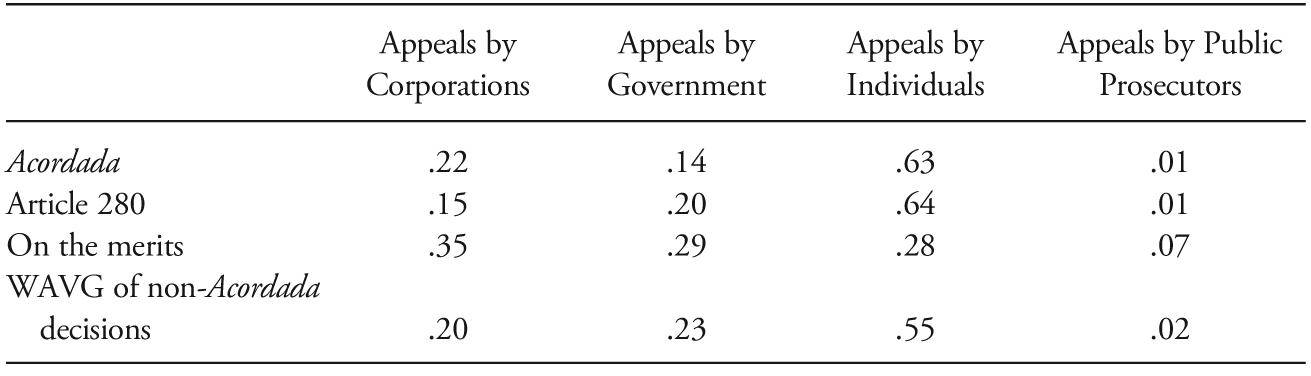
As hypothesized in Section III, we find that individual (government) appellants are more (less) likely to have their appeals rejected for formal reasons. As shown in table 3, the weighted non-Acordada opinions that came from individual appellants represent 55% of all the non-Acordada opinions. This figure is 8% lower than the one for Acordada opinions, and the difference is statistically significant at the 1% level (p = .0001). Additionally, 23% of the weighted non-Acordada opinions derived from government appeals. This figure is 9 percentage points higher than the one for Acordada opinions, and the difference is significant at the 1% level (p < .0001). Contrary to our expectations, the percentage of Acordada opinions brought up by corporations (22%) is larger than the percentage in non-Acordada opinions (20%). This difference is statistically significant at the 5% level. Surprisingly, even giant corporations, such as Petrobras, Schlumberger, Bayer, and Procter & Gamble, have had cases dismissed on Acordada grounds. While we are not sure what is driving our corporate appellants’ results, we suspect that our inability to further weave out the corporation category based on other proxies for party capability—such as number of employees, annual revenue, annual profits, type of company, and so on—could help explain this outcome.Footnote 27
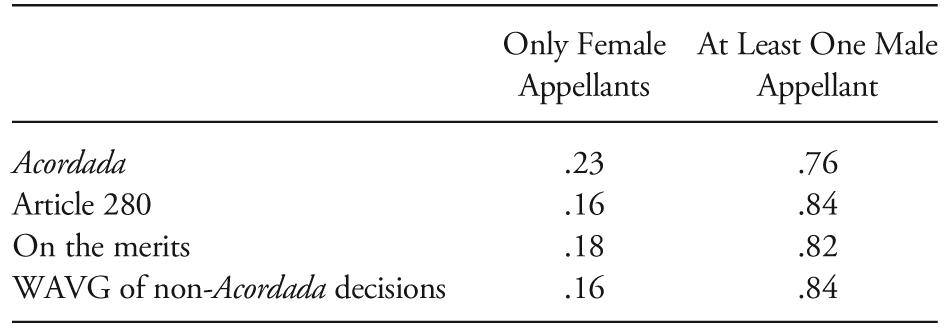
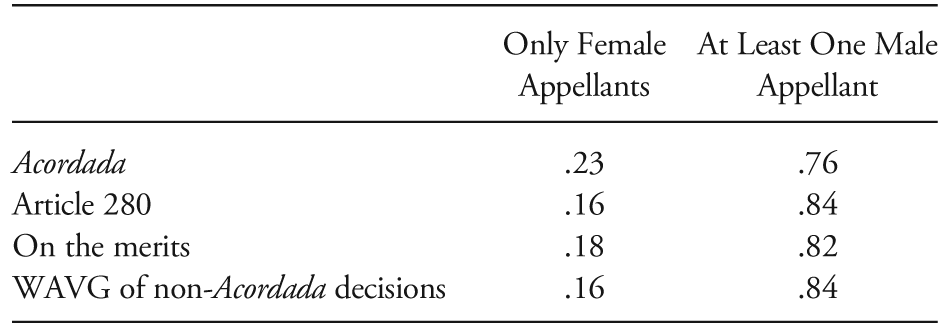
In order to explore whether all individuals are equally affected by Acordada, we looked at the percentage of opinions for the subset of only female appellants. Table 4 presents the results. As hypothesized above, we find that the percentage of female appellants is higher in Acordada opinions (23%) than in non-Acordada ones (16%). The difference is significant at the 1% level. In the same vein, the percentage of Acordada decisions arising out of at least one male appellant is lower (76%) than the one in non-Acordada opinions (84%). This difference is statistically significant at the 1% level.
Proportion of Appeals Decided in Each Category, by Gender
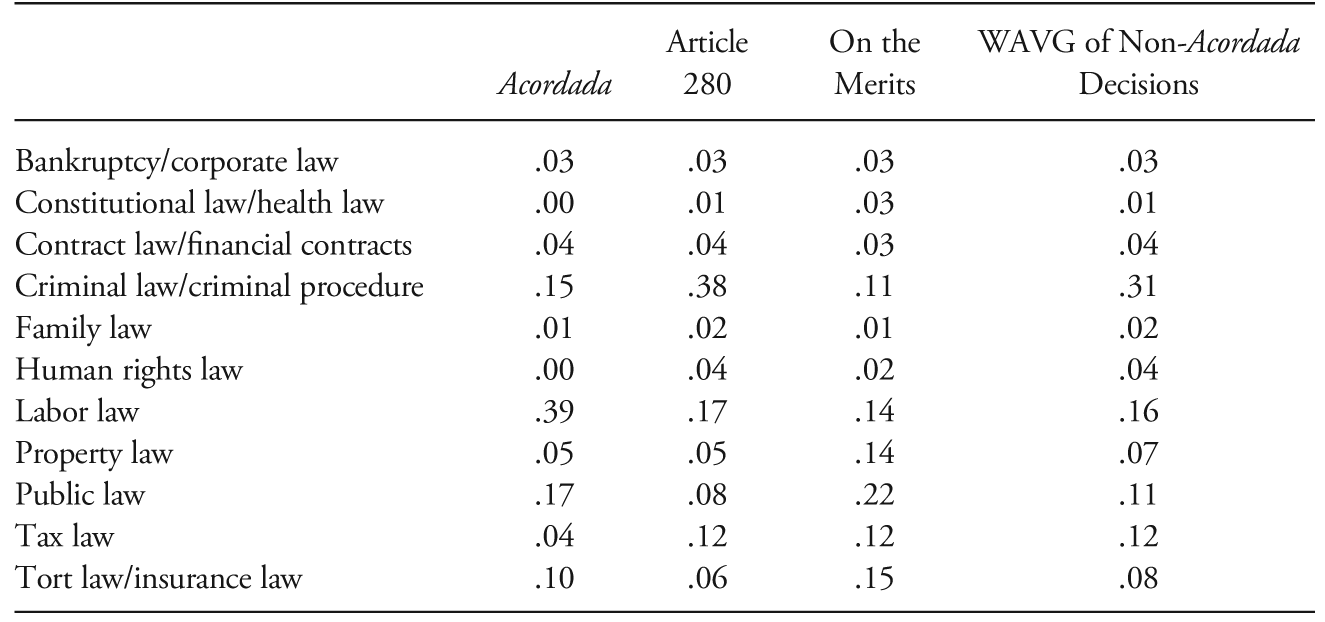
Some areas of law lend themselves to systematic differences among litigants’ resources. Labor law and criminal law are clear examples of areas in which individuals typically face uphill battles while confronting corporations or the state. As we hypothesized above, we found evidence of a higher proportion of cases rejected due to formal errors in subject matter areas in which disparity among litigants tends to be large. Table 5 reports data of different types of CSJN opinions by area of law. More than one-third of the appeals rejected on Acordada grounds (39%) are labor law appeals. This figure is much larger than the one for the non-Acordada opinions (16%).Footnote 28 The difference is statistically significant at the 1% level.
Proportion of Appeals Decided in Each Category, by Area of Law
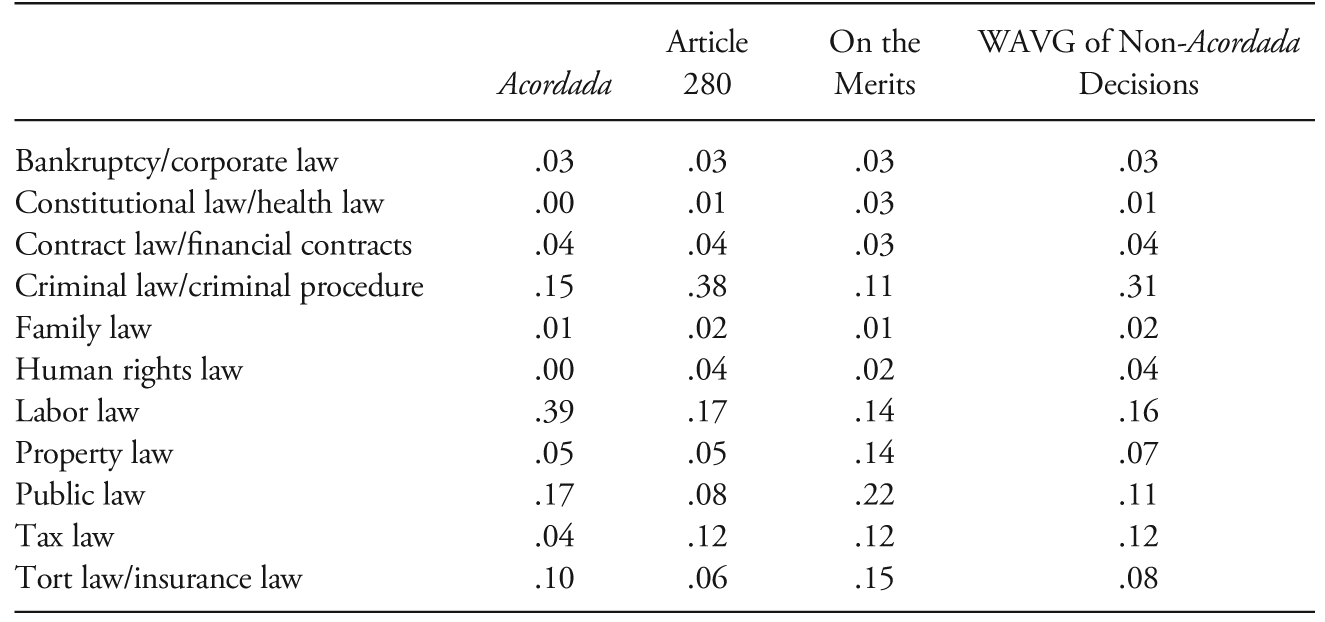
By contrast, criminal law appeals did not yield the expected results. They represent a smaller percentage of Acordada (14.7%) than non-Acordada (31.5%) appeals. The difference is highly statistically significant (p < .0001).Footnote 29
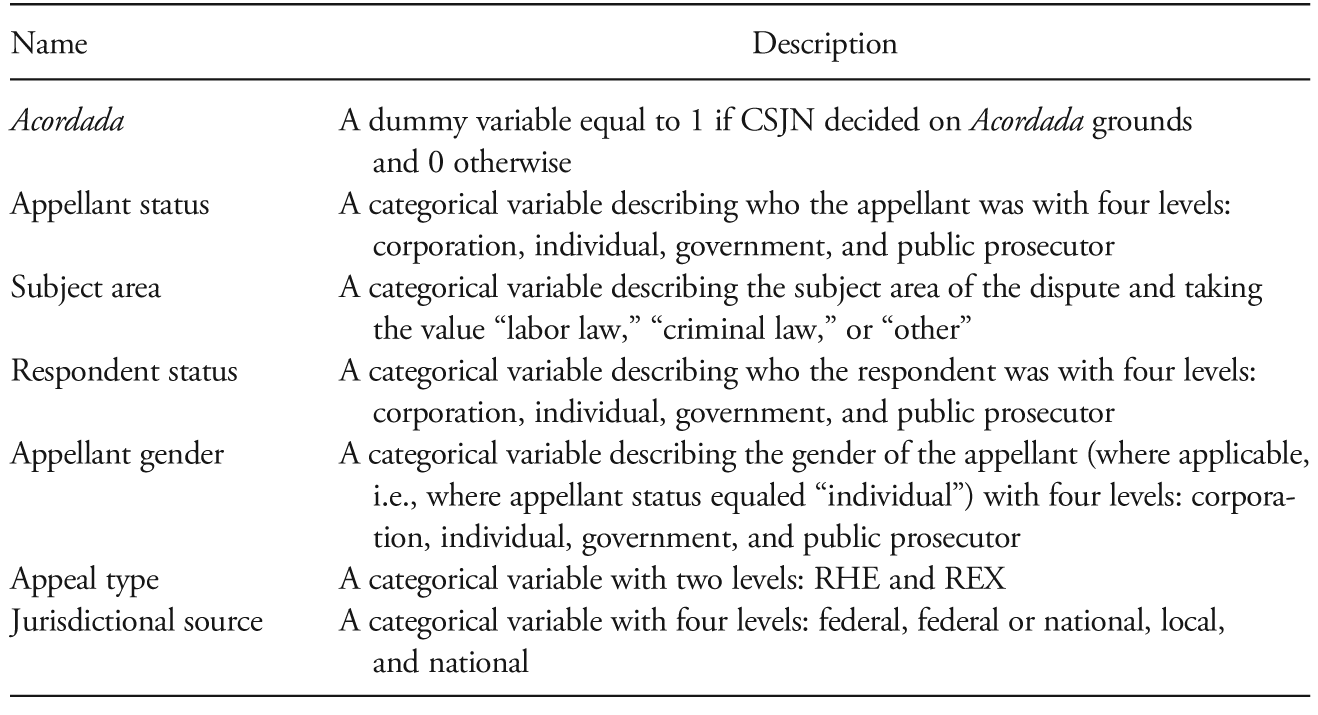
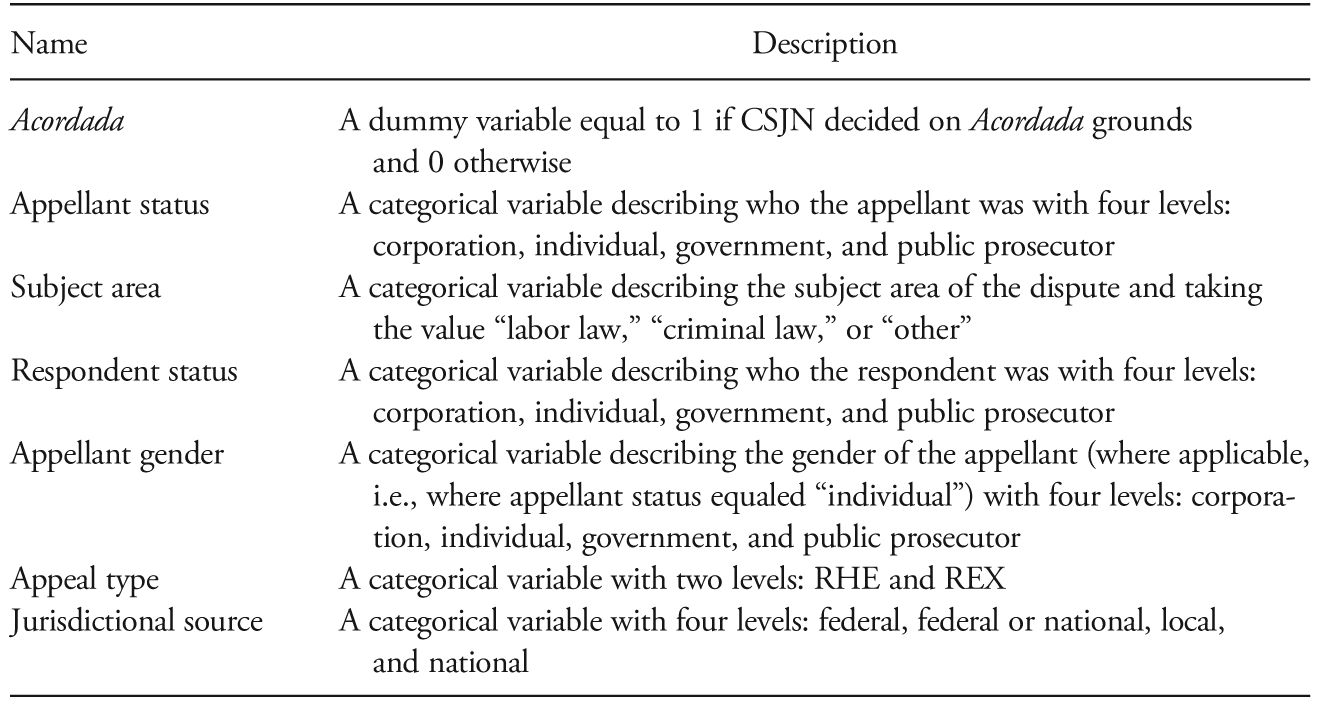
To test whether the above empirical patterns held up in the multivariate context, we ran logistic multiple regression models. In each case, the dependent variable is whether the appeal is dismissed on formal grounds (coded as 1) or analyzed on its merits (coded as 0). As independent variables, we included appellant status, appellant gender, appeal subject area (where the baseline category group is composed of all cases for which the subject area is neither labor law nor criminal law), jurisdictional origin (where the baseline category group is composed of cases coming from the federal justice system, which is compared to cases coming from national, national/federal, or provincial jurisdiction), appeal type (whether it was REX or RHE), and respondent status. A description of the variables can be found in table 6. It should be noted that, while some studies (Tanenhaus et al. Reference Tanenhaus, Schick, Muraskin, Rosen and Schubert1963; Caldeira and Wright Reference Caldeira and Wright1988; Caldeira, Wright, and Zorn Reference Caldeira, Wright and Zorn2012; Black and Boyd Reference Black and Boyd2013) have found amici briefs to influence the decision to grant certiorari, we did not include such a variable, because amici briefs were filed in only three cases in our data set.Footnote 30
Variable Names and Descriptions
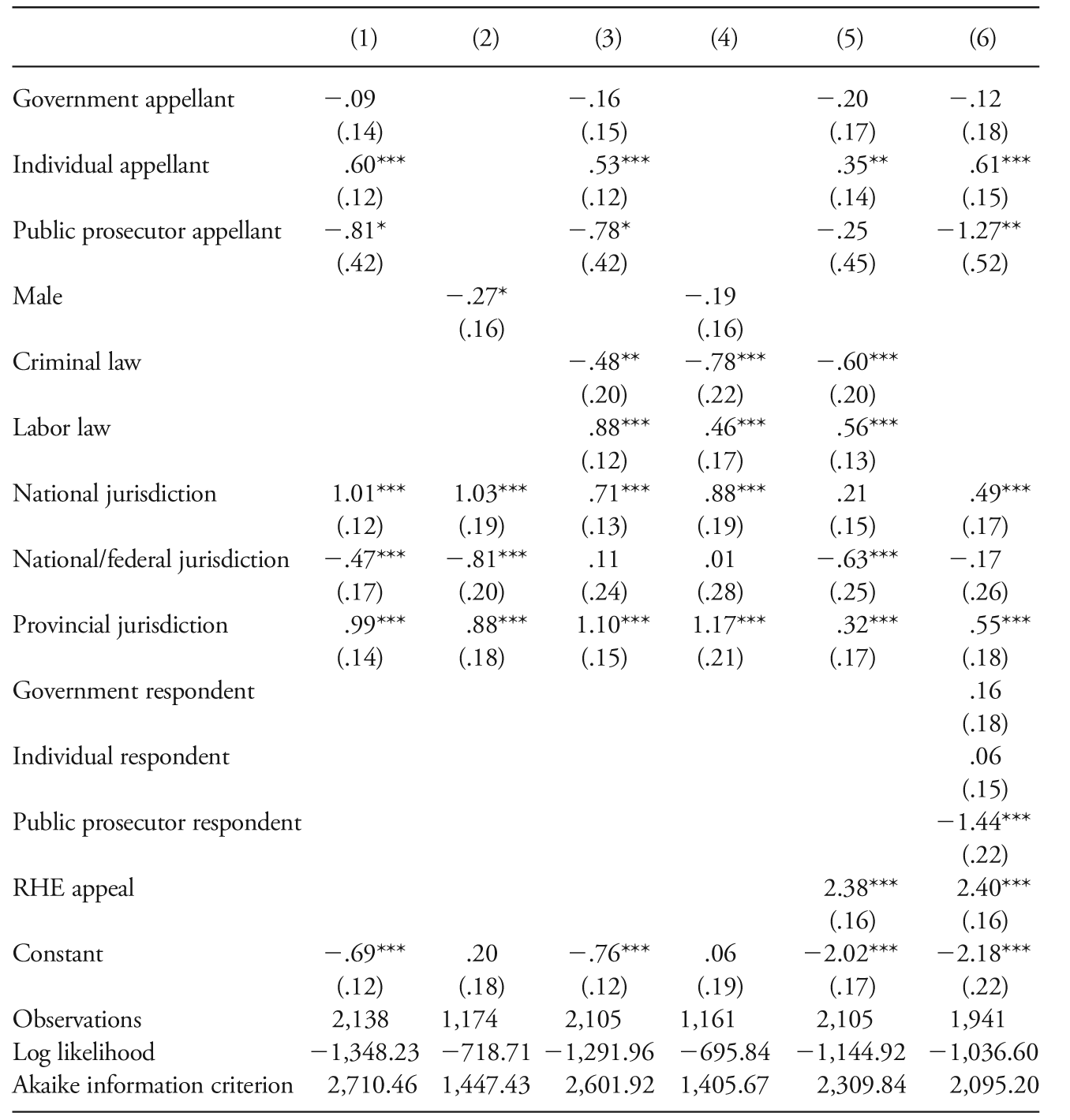
The regression results (see table 7) generally support the univariate analysis. First, appellant status coefficients follow the predicted direction. Individuals are more likely to have their cases rejected on formal grounds than are businesses (statistically significant at the 1% level).Footnote 31 In addition, public prosecutors are less likely to have their appeals rejected for Acordada reasons than are businesses (statistically significant at the 10% level). Second, areas of law with systemic asymmetry among litigants have a discernable effect. Labor law appeals are more likely to result in formal rejections than are appeals in nonsystemic asymmetry areas of law (statistically significant at the 1% level). Again, criminal law follows a strikingly different pattern, being less likely to be rejected on Acordada grounds (statistically significant at the 5% level). Third, jurisdictional source plays a role too. Appeals with a nonfederal origin are more likely to be rejected for formal reasons than appeals from federal courts (statistically significant at the 1% level). This result is consistent with the fact that a larger proportion of cases from federal jurisdiction reach CSJN, making lawyers litigating in that forum more likely to be familiar with Acordada. Fourth, as was expected given the formal nature of Acordada, respondent status is not statistically significant. The exception occurs with the public prosecutor as respondent category, which is negative and highly significant. This result is consistent with the criminal law result, as the public prosecutor appears as a respondent only in criminal cases in our sample. Finally, RHE appeals are more likely to be rejected on Acordada grounds than are REX appeals (statistically significant at the 1% level).
Regression Results
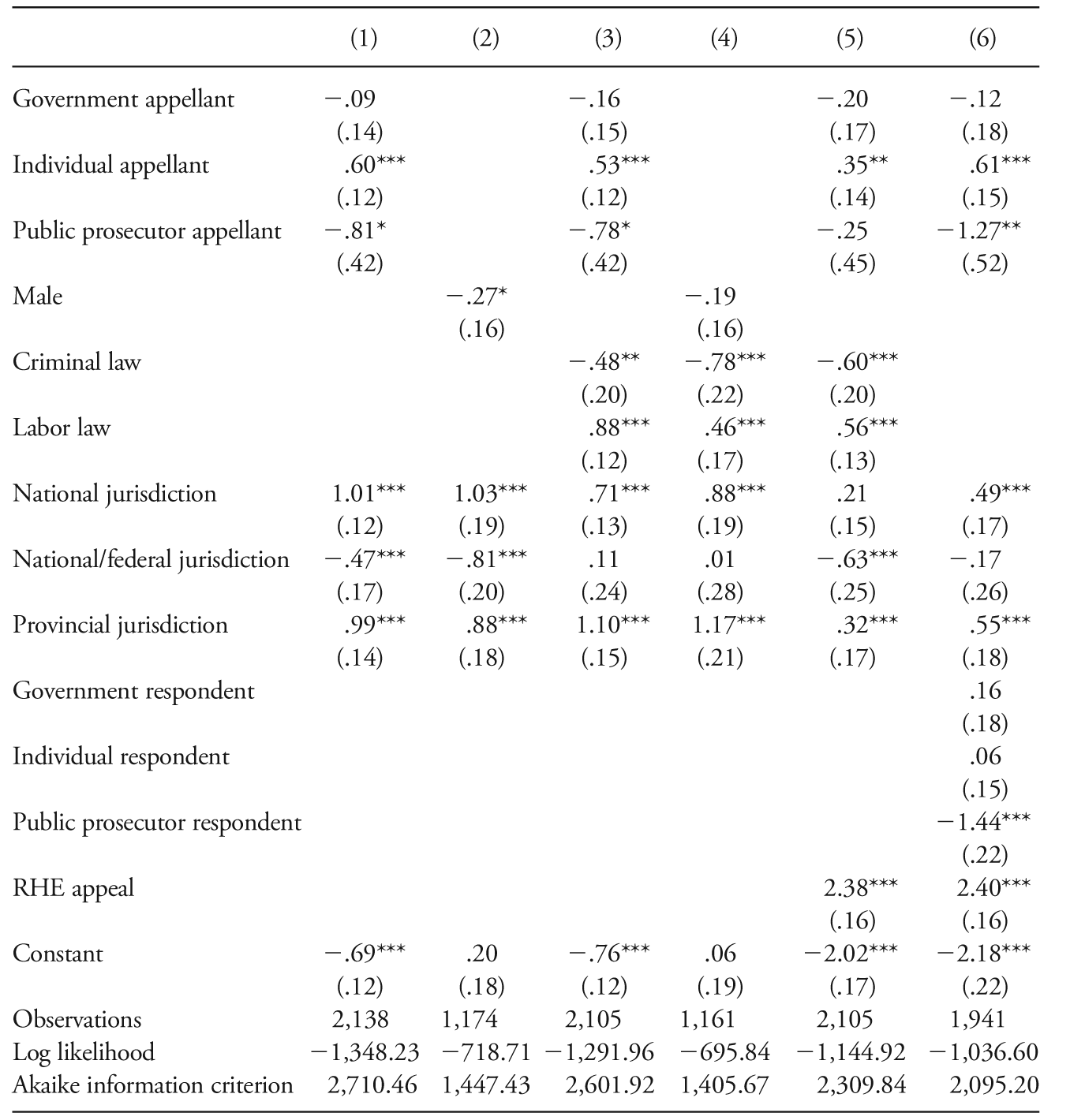
Note.—The dependent variable in all regressions is Acordada. Standard errors in parentheses.
*. p < .10.
**. p < .05.
***. p < .01.
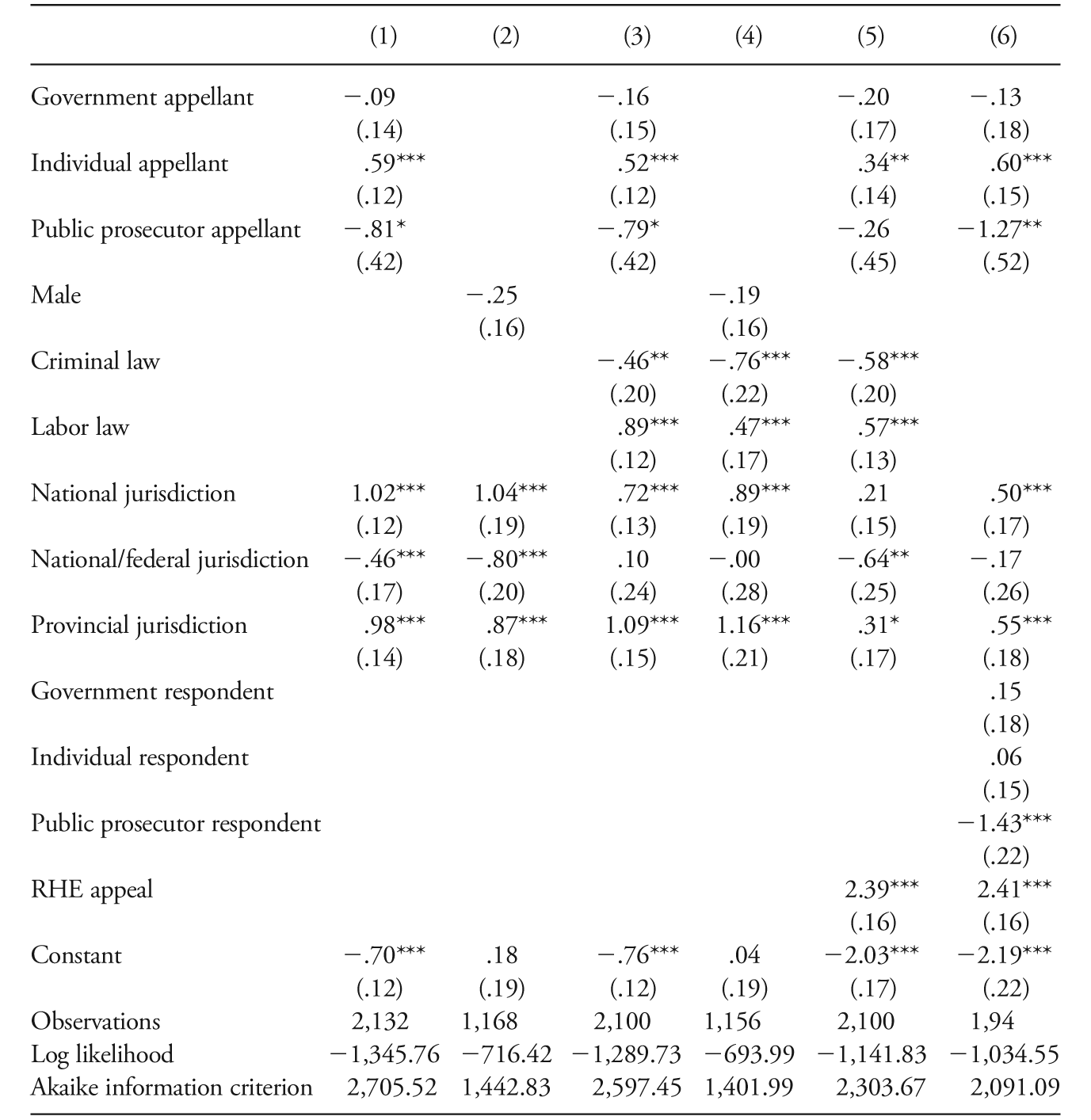
We ran additional regressions after dropping from our data appeals that were decided exclusively under Articles 3 or 6 of Acordada. Those articles could be interpreted as including nonformal tests, given that CSJN must assess whether the appellant provided “a clear refutation of each independent argument” given by the relevant lower court. Unsurprisingly, given that very few cases are decided on Article 3 or 6 grounds, the results remained unchanged and can be found in table 8.
Regression Results, Excluding Decisions Based Only on Articles 3 or 6
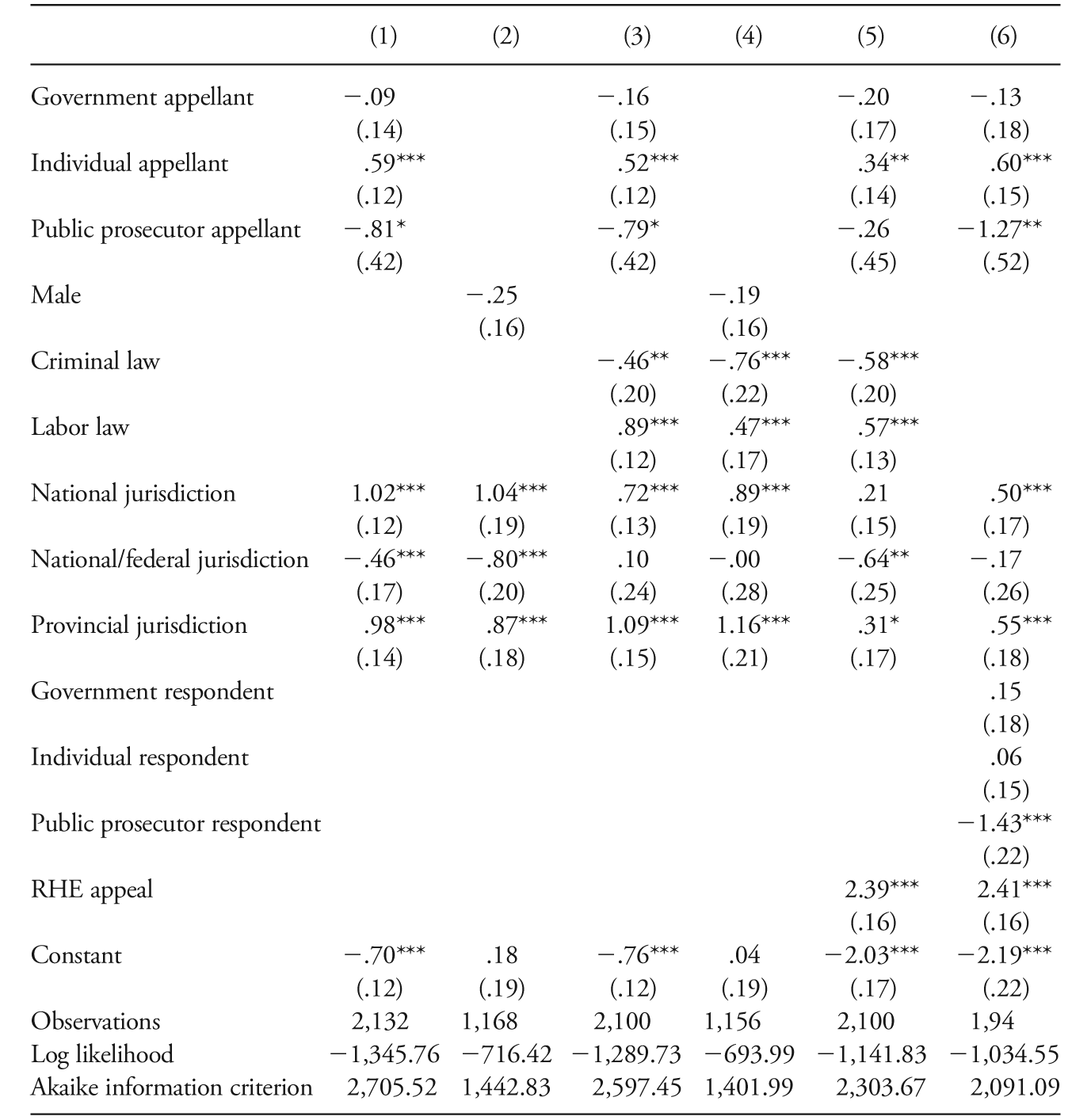
Note.—The dependent variable in all regressions is Acordada. Standard errors in parentheses.
*. p < .10.
**. p < .05.
***. p < .01.
Finally, we looked at case strength as a potential driver of our results. CSJN does not rely on the substance of the case to dismiss an appeal on Acordada grounds. Nevertheless, following the case selection hypothesis, it could be argued that haves’ superior ability to decide which cases to settle would lead them to present stronger cases for appeals. As a result, the use of the Acordada’s exception would target haves’ appeals, and our party capability results could be driven by case selection. To assess this possibility, we investigated dissenting votes in decisions on the merits. Of the 1,118 decisions on the merits we reviewed, 196 (17.5%) contained dissenting opinions, and in only 17 cases (1.5%) did one or more justices use Acordada grounds to justify their votes.Footnote 32 In unreported results, we reran our regressions excluding the cases in which one or more dissenting opinions were based on Acordada grounds. The results remained the same.
There are two additional reasons that suggest that case strength does not drive the results. First, the internal memo generated by the specialized judicial department is “more laconic” when formal errors are present.Footnote 33 Furthermore, for appeals lacking relevant docket copies, CSJN usually cannot complete its preliminary assessment due to insufficient information. Hence, further analysis of the appeal is made less likely by these circumstances regardless of case strength. This is especially true given CSJN’s heavy workload.Footnote 34 Second, the case strength hypothesis suggests that the proportion of haves’ appeals rejected on Acordada grounds should be no different from the one for Article 280. However, this is not the case. In fact, the proportion of government appellants is higher in Article 280 appeals (20.5%) than in Acordada ones (14%), a difference that is statistically significant at the 1% level.
VI. Discussion
Our main goal is to understand how litigants fare in the context of CSJN’s use of Acordada. Our results show a strong relationship between representational advantages and how litigants fare. This relationship is unaffected by standard understandings of a legal system’s bias in favor of haves, as CSJN decisions are not based on substantive aspects of the law.
A. The Distribution of Acordada Decisions
A key finding of this study relates to the uneven distribution of Acordada decisions. Among the different underlying subject matters, labor law decisions enjoy the rare privilege of overrepresentation. When interviewees were asked to explain this result, a common set of answers arose, most of which are consistent with the representational aspect of the party capability theory. On the supply side, labor law plaintiffs usually hire high-volume lawyers who take on many cases simultaneously to compensate for the smaller average amount of each claim. Therefore, those lawyers cannot afford to spend too much time on any of them.Footnote 35 In addition, labor law itself has a strong pro-worker structure. Judges in the early stages of a lawsuit would normally give lawyers’ mistakes a pass in order to repair the underlying wrong.Footnote 36 By contrast, CSJN is without a similar lax attitude.
Appeals costs also play a role. Unlike any other subject area, labor law plaintiff appeals have no costs (besides plaintiff lawyers’ opportunity costs), as they are not required to make the relevant deposit.Footnote 37 Furthermore, labor lawyers’ clients are seldom repeat players, limiting their power to take away business if mistakes are made.
At the same time, appeal rejections by CSJN do not carry an important reputational cost. There are two main reasons for this phenomenon. On the one hand, most clients rely on their lawyers to learn about any decision made in a dispute. On the other hand, the boilerplate language that CSJN uses in its decisions does not facilitate a clear understanding of the lawyer’s responsibility for the outcome. Therefore, labor law Acordada rejections carry lower costs to the appealing lawyers, which helps to explain their frequency.Footnote 38
Finally, from the demand side, labor law cases are not very palatable to CSJN, except for those carrying constitutional issues—for example, labor discrimination disputes.Footnote 39 Hence, Acordada has generated a new balance favoring access by litigants supported by CSJN specialized lawyers.Footnote 40
Criminal law’s underrepresentation in Acordada opinions was initially more puzzling, especially since one interviewee mentioned that some chambers at the Federal Criminal Cassation Court do not even check compliance with Acordada’s formalities.Footnote 41 There seem to be at least five main drivers behind it. First, criminal law appeals are required to pay the deposit if the appeal is dismissed. As a result, many litigants may not appeal unless they believe they have a good case. Second, Acordada does not apply to in pauperis litigants. Many individuals accused of criminal conduct are jailed through the trial process. Several of them appeal in forma pauperis.Footnote 42 Third, defendants with fewer resources tend to be represented by the office of the public defender (defensoría pública). Public defenders, in turn, share some of the advantages of the haves, in that they are repeat players, they have a good knowledge of the legal system, and they enjoy the relevant social relations. Indeed, González Bertomeu (Reference González Bertomeu2016) recently found that public defenders are better than private counsel at complying with Acordada.Footnote 43 Fourth, officers in Judicial Department No. 3 have been opposed to the enactment of formal requirements under an Acordada decision by CSJN.Footnote 44 Finally, the nature of criminal cases may lead CSJN to be prone to reviewing criminal appeals on their merits and, as a consequence, to use more frequently Acordada’s substantive exception.Footnote 45 The latter fact is confirmed by the lower level of agreement among justices in these cases. In fact, 38% of all Acordada criminal law opinions have a dissenting or separate opinion, a figure that is almost four times as large as the mean for all areas of law.
B. Total Number of Acordada Decisions
Another important finding is that the number of appeals failing to comply with Acordada is surprisingly high, suggesting an access to justice problem.Footnote 46 The high number of appeals failing to comply with Acordada is especially remarkable for several reasons. First, at the time of our study, Acordada had been in effect for more than 4 years. Moreover, several interviewees considered that Acordada merely made explicit already existing requirements.Footnote 47 It is evident that lawyers have had a hard time adjusting to the rules. Second, Acordada requirements, while demanding, do not come across as formidable obstacles. The common understanding among judicial officials is that the requirements are easy to meet and that, thanks to Acordada, those requirements are publicly available.Footnote 48 Third, there is qualitative evidence that some of the lower courts have been very strict in the implementation of Acordada and that CSJN has informally encouraged them to check compliance with its requirements.Footnote 49 Finally, lawyers’ economic incentives should discourage them from letting their appeals be subjected to Acordada rejection. The Argentine law on professional fees instructs judges to assess professional fees according to lawyers’ involvement in each stage of the litigation. But appeals rejected due to formal errors do not grant the right to professional fees’ assessment.Footnote 50 This is especially important given that dismissals based on Article 280 do grant this right. Therefore, the economic incentives run against appeals containing formal errors.
Two groups of lawyers may be unaffected by those economic incentives. First, lawyers representing the federal government are required to obtain express and written authorization not to appeal a case all the way up to CSJN.Footnote 51 Violating this rule may make government lawyers liable to civil action, as well as cost them their jobs. Hence, and contrary to the party capability theory’s expectations, government appeals commonly occur regardless of success probabilities or cost considerations. In addition, many government lawyers carry a very large caseload.Footnote 52 These two elements largely explain the relatively high number of error-prone appeals from government lawyers.Footnote 53 In effect, government entities are the only appellant for which we observe counsel representing the same client with several appeals dismissed on Acordada grounds.Footnote 54 Second, some corporate lawyers who routinely defend their clients have compensation schemes covering each stage of the trial.Footnote 55 For those lawyers, reaching CSJN may just be enough, as their compensation schemes do not distinguish between appeal rejections based on Acordada or Article 280.
The practicing lawyers we interviewed did not share the view that Acordada rules were innocuous. Indeed, Acordada raised a hurdle some viewed as already challenging. First, complying with Acordada rules is time consuming. One interviewee mentioned that just observing the appeal’s front-page requirements takes a specialist lawyer about 2 hours, and even more for those less familiar with the rules.Footnote 56 Similarly, observing the maximum number of lines per page requirement routinely made lawyers adjust their electronic documents a few times before filing.Footnote 57 For lawyers, having just 10 business days to file their REX appeals and just 5 business days to file their RHE appeals, the time demanded by Acordada requirements is extremely onerous.
Second, Acordada’s appeal extension rules place important constraints on appellants. CSJN has a long-standing appeal requirement rule mandating that appeal documents need to be self-standing.Footnote 58 Therefore, appellants must describe the complete history of the case, refute all the arguments provided by the lower court, and express all their claims in just 40 or 10 pages (depending on whether they are facing a REX or RHE appeal). The difficulty is compounded by the fact that CSJN does not allow appellants to include appendixes. To illustrate the practical difficulties that may arise due to the total page limit, one interviewee mentioned that once the limit was so stringent that his appeal ended up having just one long paragraph.Footnote 59
Finally, several interviewees mentioned the added difficulties posed by the interpretation of Acordada rules.Footnote 60 For instance, in interviews conducted in the first half of 2014, several interviewees pondered whether the language of Acordada means a limit of 26 lines per page or whether 26 lines per page are mandatory (even on the last page).Footnote 61 The large number of dissenting and separate opinions we found suggests that there could be some validity to lawyers’ uneasiness with Acordada’s interpretation.Footnote 62
Despite the added difficulties, all the practicing lawyers interviewed took pride in the fact that they have never had an appeal rejected on Acordada grounds. One interviewee suggested that facing a client after an appeal is rejected on formal grounds would be highly embarrassing.Footnote 63 We believe this sentiment to be genuine for a sizable portion of practicing lawyers. At the same time, Acordada rejections affect a large number of lawyers, most of them with scant familiarity with CSJN. These lawyers may not perform a cost-benefit analysis of Acordada compliance before submitting an appeal. An anonymous interviewee exemplified the lawyer side of the problem by mentioning that a government unit that routinely, although not exclusively, files CSJN appeals started only in 2010—3 years after enactment—to train its lawyers on Acordada. As a result, we believe that the lack of lawyer Supreme Court specialization, institutional design, and limited resources play an important role in explaining the high number of Acordada decisions.
The existence of so many rejections on grounds of Acordada is of significant concern. Previous research on high courts has found legal counsel to rebalance a litigant’s strengths in favor of the weaker party.Footnote 64 One of the main functions of legal counsel would then be to provide access to legal knowledge and legal know-how to reduce the asymmetry among litigants. The large number of Acordada rejections suggests this function is being poorly performed.Footnote 65 To explain this failure, some interviewees mentioned that some Argentine lawyers are plainly unaware of Acordada.Footnote 66 Another interviewee believes that some lawyers erroneously equate mostly complying with fully complying with Acordada.Footnote 67 As a result, one-shot litigants face unwarranted odds, as they are more likely to be represented by error-prone counsel.Footnote 68 This, in turn, affects their access to justice.Footnote 69 Interestingly, with a lone exception, none of the interviewees believed that Acordada disproportionately affects any group.Footnote 70
VII. Conclusion
The tenets of the party capability theory have been supported by the evidence in numerous contexts. Nevertheless, disentangling the source of the haves’ advantages has not been an easy task. Notoriously, the haves’ effects found by previous studies could theoretically have been attributed to the haves’ ability to select stronger cases for litigation. Our article takes advantage of a special rule enacted by CSJN—Acordada—and it is the first to present evidence confirming that representational advantages affect case outcome, independently of the strength of the appeal presented to CSJN.
While evidence on appeal rejections at the level of a high court is insufficient to evaluate access to justice in a society, the results presented above show that access to high courts can be highly uneven. As resource mobilization is required to preserve legal entitlements, resource inequality may affect outcomes, since disputes arise. While this problem is universal, it is especially important in the Global South, where the distribution of resources in the economy is highly unequal and legal needs are poorly addressed. The results presented above strongly suggest that more research should be done on access to justice, especially in the context of developing countries, where inequalities in access to legal services can be severe.