1. INTRODUCTION
The increasing use of high power laser beams in various applications has worldwide interest in laser-plasma interaction (Sharma & Sharma, Reference Sharma and Sharma2009) in the nonlinear regime. In collisionless plasmas, the nonlinearity arises through the ponderomotive force-induced redistribution of plasma. It is well known that various laser-plasma instabilities like, filamentation (Kaw et al., Reference Kaw, Schmidt and Wilcox1973; Young et al., Reference Young, Baldis, Drake, Campbell and Estrabrook1988), harmonic generation (Ozaki et al., Reference Ozaki, Bom Elouga, Ganeev, Kieffer, Suzuki and Kuroda2007; Baeva et al., Reference Baeva, Gordienko and Pukhov2007; Dombi et al., Reference Dombi, Racz and Bodi2009), stimulated Raman scattering (SRS) (Kline et al., Reference Kline, Montgomery, Rousseaux, Baton, Tassin, Hardin, Flippo, Johnson, Shimada, Yin, Albright, Rose and Amiranoff2009), and stimulated Brillouin scattering (SBS) (Kappe et al., Reference Kappe, Strasser and Ostermeyer2007) might be generated from the interaction of laser pulses with plasmas. Advances in ultra short laser pulse technology have made it possible to exploit the Terahertz (THz) frequency range of the electromagnetic spectrum between the microwave and infrared. The generation of THz radiation is of great practical and theoretical interest because of its non-ionizing character and penetrating power comparable to the microwaves and has been extensively studied by laser-plasma interaction experiments (Dong et al., Reference Dong, Sheng, Wu, Wang and Zhang2009; Schroeder et al., Reference Schroeder, Esarey, Tilborg and Leemans2004; Abo-Bakr et al., Reference Abo-Bakr, Feikes, Holldack, Kuske, Peatman, Schade, Wustefeld and Hubers2003; Yoshii et al., Reference Yoshii, Lai, Katsouleas, Joshi and Mori1997; Yugami et al., 2009; Hamster et al., Reference Hamster, Sullivan, Gordon, White and & Falcone1993), and formation of filaments by intense laser propagating in air or gas (Sprangle et al., Reference Sprangle, Penano, Hafizi and Kapetanakos2004; Xie et al., Reference Xie, Dai and Zhang2006; Yugami et al., Reference Yugami, Ninomiya, Kobayashi and Noda2006; D'Amico et al., Reference D'amico, Houard, Franco, Prade, Mysyrowicz, Couairon and Tikhonchuk2007). This high power radiation has many potential applications in biological imaging, material characterization, remote sensing, and tomography. Some of the specialized reviews for applications of THz are also available in Feruguson and Zhang Ghang (Reference Feruguson and Zhan Ghang2002).
The key issue with plasma is to find appropriate ways of producing THz emission with high conversion efficiencies. The first experimental observation of laser-plasma-produced THz emission was reported by Hamster et al. (Reference Hamster, Sullivan, Gordon, White and & Falcone1993). Their experiment was based on the acceleration of the charged electrons and ions by the ponderomotive forces exerted by the intense light pulse. Ponderomotive force and nonlinear process in laser plasma interaction are the main mechanisms of THz wave generation. Laser plasma interaction also offers the promise for generating coherent radiation (Nuss & Orenstein, Reference Nuss and Orenstein1997; Yampolsky & Frainman, Reference Yampolsky and Frainman2006; Cheng et al., Reference Cheng, Wright and Moloney2001; Antonsen et al., Reference Antonsen, Palastro and Milchberg2007; Gildenburg & Vvedenskii, Reference Gildenburg and Vvedenskii2007). For example, coherent pulses of THz radiation are especially of interest for time domain spectroscopy (Nuss & Orenstein, Reference Nuss and Orenstein1997). It has been observed by Sheng et al. (2005) in their particle in cell simulations that coherent THz radiation can be generated around plasma frequency from vacuum-plasma interface through laser wake filed excitation. Wu et al. (Reference Wu, Sheng, Dong, Xu and Zhang2007) studied the effect of transverse magnetic field on this process and found substantial enhancement in the efficiency of THz generation, which is one of the key challenges in this domain. Yampolsky and Frainman (Reference Yampolsky and Frainman2006) proposed a scheme to produce or amplify THz radiation based on four-wave coupling (two lasers, plasma wave, and terahertz wave) in a plasma filled capillary. Two counter propagating laser pulses interfere to exert an electrostatic ponderomotive force on electrons with frequency close to plasma frequency. The nonlinear current generated in the beating process interacts with the parallel component of the electric field of THz wave and amplifies it. They have also investigated the effect of backward Raman scattering on the growth rate of THz wave. Cheng et al. (Reference Cheng, Wright and Moloney2001) have reported the generation of THz pulse radiation from plasma channels induced by femtosecond light strings, which are generated due to the establishment of a dipole moment in the channel by radiation pressure force of the light string, which oscillates at the plasma frequency and radiates. Antonsen et al. (Reference Antonsen, Palastro and Milchberg2007) proposed the employment of a corrugated plasma channel for phase matched THz radiation generation by the ponderomotive force of a laser pulse.
One of the main motivations of this manuscript is to present a more general analytical approach together with numerical results to investigate the excitation of electromagnetic wave at difference frequency ω2 = ω0 − ω1 in the THz frequency range, by laser and low density electron plasma waves of frequencies ω0, ω1, respectively in the paraxial approximation. We consider a circularly polarized high power laser beam propagating through magnetized plasma with propagation along the static magnetic field. Ponderomotive force at the difference frequency generates a nonlinear current due to the interaction between low density rippled plasma and laser beam and leads to THz generation.
The organization of this paper is as follows. In Section 2, we have given the theory of filamentation of high power laser beam in magnetized plasma when ponderomotive nonlinearity is operative using the paraxial ray approximation. Section 3 investigates the THz generation due to filamentation and resulting localization. We continue in Section 4 with numerical results and discussion. Section 5 summarizes the main conclusion in the manuscript.
2. FILAMENTATION OF GAUSSIAN LASER BEAM IN NONLINEAR MAGNETO PLASMA
Consider the propagation of a circularly polarized laser beam of angular frequency “ω0” in a homogeneous magnetoplasma with electron density η0, along the direction of static magnetic field  . In linear approximation, we have taken the laser beam wave to be propagating in extraordinary mode (Ginzburg, Reference Ginzburg1964). The electric vector of laser field
 can be written as

where  is the propagation constant of the pump wave, and is given as
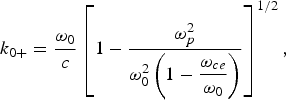
where 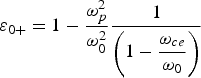 is the dielectric constant,
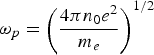 is the plasma frequency,
 is the electron cyclotron frequency, e and m e are the charge and rest mass of electron. The laser imparts oscillatory velocity
 to electrons given by the expression,
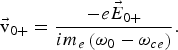
The extraordinary mode amplitude is A 0+ = E x + iE y. We consider here the propagation of a three dimensional intense Gaussian electromagnetic beam along the direction of magnetic field. The intensity distribution of this mode at z = 0 in the direction transverse to the direction of propagation is given by
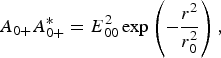
where r 2 = x 2 + y 2, E 00, and r 0 are the axial amplitude and initial width of main beam, respectively. When a laser beam propagates through the plasma, the transverse intensity gradient generates a ponderomotive force, which modifies the plasma density profile in the transverse direction as in Sodha et al. (Reference Sodha, Ghatak and Tripathi1974).

where 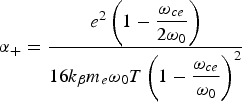 is the nonlinearity parameter, e and m e are the electronic charge and mass, and T is the equilibrium temperature of the plasma. N 0e is the time independent component of electron density as modified by main laser beam and N 00 is the electron density in the absence of the beam, k β is the Boltzman's constant.
The wave equation in its general form for a field varying as exp(iωt) is written as

where  is the dielectric tensor having components:




and

Here the components of the dielectric constant have their usual meaning (Sodha et al., Reference Sodha, Ghatak and Tripathi1974). We assume that the field varies in the z-direction (i.e., along the static magnetic field) with variations being much larger than in the x − y plane so that waves can be treated as transverse in the zeroth order approximation, and hence no space charge is generated in the plasma. Therefore, using
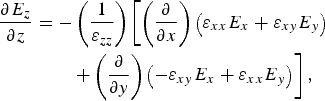
and following Sodha et al. (Reference Sodha, Maheshwari, Sharma and Kaushik1980), the wave equation governing the propagation of the circularly polarized wave can be written as

The appropriate components of the dielectric tensor of the magneto plasma can be written as in Sodha et al. (Reference Sodha, Maheshwari, Sharma and Kaushik1980).

where ɛ0+ and 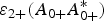 are the linear and nonlinear parts of the dielectric constant, ε+, respectively. In Eq. (7),
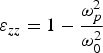 and
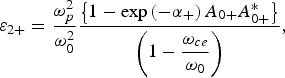
where ωce is the cyclotron frequency. Following Sodha et al. (Reference Sodha, Ghatak and Tripathi1974) and Akhamanov et al. (Reference Akhmanov, Sukhorukov and Khokhlov1968), the solution of Eq. (7) for A 0+ may be written in the following form

where
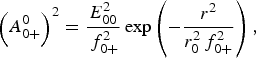
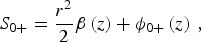
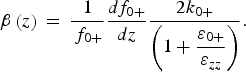
A 0+0(r, z) is a real function of its argument, S 0+ is the eikonal for the main beam, and ωp is the electron plasma frequency. The parameter β−1 may be interpreted as the radius of the curvature of the main beam. In Eq. (11), ø0+(z) is a constant that is not required explicitly in further analysis, f 0+ is the dimensionless beam width parameter satisfying the boundary conditions  , and
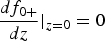 is governed by the following differential equation
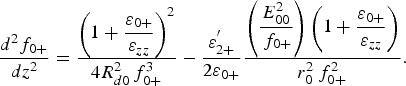
R d0 = k 0+r 02 is the diffraction length and  is the derivative of ɛ2+ with respect to its argument. The first term on the right-hand side of Eq. (13) is related to the diffraction and the second term is related to the focusing effect due to the ponderomotive force. The density of the plasma varies through the channel due to the ponderomotive force. As a result, the refractive index increases and the laser beam is focused in the plasma. Eq. (10) gives the intensity profile of the laser beam in the plasma and is solved numerically.
3. THZ WAVE DYNAMICS
Now we consider the nonlinear interaction between the high power laser beam (ω0, k 0+) and the density ripple (ω1, k 1) in order to generate the THz radiation. We setup the model equations as follows. For circularly polarized wave (ω2, k 2), we introduce the following complex representation for THz electric field,  and the variation of electric field,
 as

For the right-(left) handed wave, we have  , with
 and
 being the unit vectors along the x and y directions, respectively. The wave equation for electric vector E T+ with the magneto plasma may be written as (Shukla & Sharma, Reference Shukla and Sharma1982)

where  is the total current density vector in the presence of low frequency electric field
 and it is given by

where J 1+ and J 10+ are the linear and nonlinear current densities, respectively.
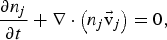
Nonlinear interaction of a finite-amplitude plasma wave with high-and low frequency circularly polarized waves is governed by continuity equation,
and momentum transfer equation,

where n j, m j, and v j are the particle density, the mass and the fluid velocity of species j = e, i;  and
 are the self-consistent electric and magnetic fields associated with the wave.
In the field of the plasma wave (ω1, k 1) with the electric field

the electron quiver velocity  , and the electron density perturbation
 are related by
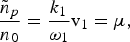
where  and μ are the normalized ripple density amplitude. Nonlinear interaction of an electron-plasma mode with a high-frequency circularly polarized electromagnetic wave (ω0, k 0+) gives rise to a low frequency circularly polarized wave (ω2, k 2). The phase matching conditions are ω2 = ω0 − ω1 and k 2 = k 0+ − k 1. We write,



and

In the above equation, e and  are charge and density perturbation of the electron, and n 0 is the background density,
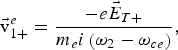
 are linear and nonlinear velocities. Solving Eq. (18) we get the linear velocity,
 of electron for low frequency (ω2) right-handed circularly polarized wave:
and the linear velocity for ion:
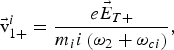
where  is the ion cyclotron frequency with the ion mass m i.
Substituting  and
 from Eqs. (23) and (22) into Eq. (21) we find the linear current density
 for the right circularly mode,
 will be:

The nonlinear velocity is produced by the beating of electron-induced velocity in density ripple with the laser velocity  , and the corresponding laser-frequency magnetic field
 . In particular,
 is obtained by solving the following equation (Shukla & Sharma, Reference Shukla and Sharma1982),

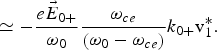
If we let  , Fourier transformation of Eq. (26) then gives

where superscript  implies a complex conjugate of that quantity. The low-frequency wave is taken to be a right-handed polarized wave. Substituting Eq. (27) and laser velocity,
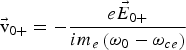 into Eq. (22), we get

In the above equation, contribution of the ion term to the nonlinear coupling coefficient is small and is, therefore, neglected. Combining Eqs. (25) and (28) and substituting in (15), we obtain the following wave equation for  in terms of the electric fields of the pump and plasma wave (at r = 0).
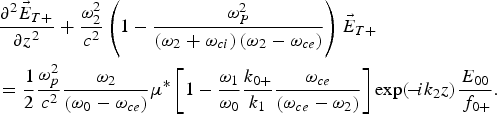
Here f 0+ is the function of z and it is governed by Eq (10). To evaluate E T+ we employ the Green function technique. The solution of Eq. (26) may be written as (Mathews & Walker, Reference Mathews and Walker1965)
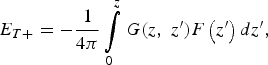
where
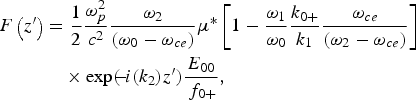
and  is the Green's function. Using the appropriate value of the Green's function,

Eq. (30) may be written as

where  . The amplitude of emitted electromagnetic wave may be given as

One can obtain the THz field intensity with Eq. (32) where the laser beam intensity is changing with the distance of propagation as given by Eq. (10). The THz field generated by this mechanism can also be obtained numerically straight from Eq. (32) with the appropriate boundary conditions. The laser imparts oscillatory velocity to plasma electrons and exerts a ponderomotive force on them. The ponderomotive force has a transverse component that drives nonlinear current, producing THz radiation.
4. RESULTS AND DISCUSSION
This section deals with the results obtained by numerically solving Eqs. (10), (29), and (32), respectively. The following set of parameters has been used in the numerical calculations: we have used laser beam intensity  = 3 (laser power flux
 1014 W/cm2), beam radius r 0 = 40 µm, laser frequency (ω0) = 1014 rad/s, plasma density n 0 = 3 × 1018 cm−3, applied magnetic field B 0 = 60 and 77 and 105 kG for T = 1 KeV and ripple density amplitude μ = 0.3. For initial wave front of the beam, the initial conditions for f 0+ are
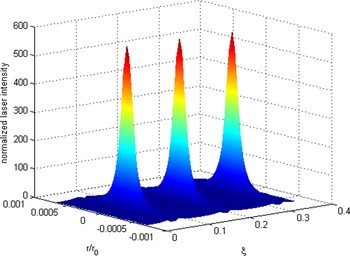
 . When laser beam propagate through the plasma, then density of plasma will be varying through the channel due to ponderomotive force. But the ponderomotive nonlinearity introduced in the plasma depends upon the intensity of laser beam. We solve Eq. (10) for initial field of the laser that is greater than the critical value. In that case, f 0+ is obtained from the numerical solution. Figure 1 illustrates the behavior of the laser beam (variation in laser beam intensity versus normalized distance
 and radial distance), when the ponderomotive nonlinearity and paraxial approximation are taken into consideration for n 0 = 3 × 1018 cm−3, B 0 = 60 kG, and α+E 002 = 3. The laser intensity increases as f 0+ decreases, attains a maximum at an optimum distance and then falls.
(Color online) Variation of laser beam intensity with normalized distance  and radial distance ( r/r 0) (r) in paraxial case by using ponderomotive nonlinearity.

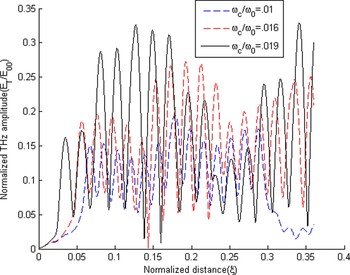
Here we have also developed the theory of THz wave generation. We solve Eqs. (26) and (29) numerically by using the data of the solution of Eq. (10). Figure 2 depicts the variation of the THz field with the normalized distance of propagation when laser beam exhibit oscillatory focusing at different values of the static magnetic field. In Figure 2, for ωce/ω0 = .01, .016, and .019, i.e., by increasing the magnetic field, the normalized THz amplitude rises at ω2 = around 1 THz. These parameters, for plasma frequency n 0 = 3 × 1018 cm−3, laser frequency (ω0) 1014 rad/s (CO2 laser), correspond toB 0 = 60 kG, 77 kG, and 105 kG. It is quite apparent that the THz amplitude exhibits maxima and minima. We find that the radiated electromagnetic wave has power level in the GW range as shown in Figure 2. We report the generation of THz radiation with maximum conversion efficiencies 20%, 27%, and 35% for ωce/ω0 = .01, .016, and .019. It should be mentioned here that if the laser beam is not self focused (f 0+ = 1), the conversion efficiency is constant at the level of 0.6%. Therefore, self focusing of the laser beam plays a very important role in this conversion mechanism. This is on account of the fact that the self focusing of the laser beam leads to enhanced intensity of the laser therefore the conversion process which depends on the laser intensity gets enhanced.
(Color online) Variation of normalized THz field amplitude (normalized with laser field amplitude) with normalized distance  in paraxial case by using ponderomotive nonlinearity. Dotted blue line, semi-dotted red line and black solid line, are respectively for ωce/ω0 = .01,ωce/ω0 = 0.016, andωce/ω0 = 0.019.

5. CONCLUSION
We have studied the dynamics of the generation of THz wave by self focusing of high power laser beam in magnetized plasma that couples with low density ripples, when ponderomotive nonlinearity is operative. The nonlinear mechanism which generates the THz radiation can be understood as follows: The nonlinear interaction of laser beam and density ripple generates a nonlinear current. It is obvious from Eq. (23) that the nonlinear current is generated due to the ponderomotive force by the beating of pump (laser) wave and density ripple electric field. The ponderomotive force has two components: Due to nonlinear terms  and
 . By the difference in pump wave frequency (ω0) and density ripple frequency(ω1), we get a frequency (ω2) in the range of THz frequency. Thus the THz radiation is resonantly excited if the matching conditions are satisfied. THz amplitude can be controlled by applied magnetic field, laser amplitude, and rippled density amplitude. The dependence on the ripple density amplitude (μ) is obvious from Eq. (26) of THz wave. But the dependence on laser amplitude and applied magnetic field is quite complex. Let us discuss first the dependence on laser amplitude. From THz expression Eq. (26) THz amplitude depends directly on laser amplitude. But in addition to this the self focusing of the laser beam also affect the THz generation. (Please confirm from Eq. (26)).The self focusing of laser beam gets affected if initial laser beam intensity is changed. Therefore on account of the self focusing, the THz generation is having a complex dependence on laser amplitude. Now we discuss the effect of magnetic field on THz generation. The magnetic field affects the THz generation in three ways. Firstly the laser beam propagation in our geometry is a right circularly polarized mode and its phase velocity and group velocity depends on the background magnetic field strength. Secondly, self focusing of the laser beam gets affected by changing the strength of the magnetic field. THz wave geometry also depends on the background magnetic field. Acutely THz wave in our geometry is basically an Alfven wave which gets affected by change in background magnetic field. Hence magnetic field plays an important role in the generation of THz radiation.
The effect of magnetic field on the THz wave amplitude is shown in the fig. (2).The emission frequency and phase can also be controlled by this process. The related simulation being complicated and beyond the scope of the present work will be done in future. Numerical Simulation shows that for the incident laser power flux = 1014 W/cm2, laser beam radius  , laser frequency
 and plasma density
 , one can obtain GW power at around 1 THz frequency. The radiation that is emitted in this process can be a powerful THz source at the GW level. Self focusing of the laser beam plays a very important role in this conversion mechanism. This technique could be a source of generating high-power THz radiation in future.
ACKNOWLEDGMENTS
This work was partially supported by DST, Government of India. One of the authors (Monika) is grateful to Dr. Karuna Batra for useful discussions.