


INTRODUCTION
There is ample evidence that on-line language processing in adults is fast and incremental; words are processed as they are being heard, by integrating linguistic cues with world knowledge and information from the visual scene (e.g., Hagoort, Hald, Bastiaansen, & Petersson, Reference Hagoort, Hald, Bastiaansen and Petersson2004; Rayner & Clifton, Reference Rayner and Clifton2009; Tanenhaus, Spivey-Knowlton, Eberhard, & Sedivy, Reference Tanenhaus, Spivey-Knowlton, Eberhard and Sedivy1995). Furthermore, adults can predict how discourse will unfold on the basis of semantic information associated with a word currently being processed (e.g., Altmann & Kamide, Reference Altmann and Kamide1999; Mak, Tribushinina, & Andreiushina, Reference Mak, Tribushinina and Andreiushina2013; Pyykkönen & Järvikivi, Reference Pyykkönen and Järvikivi2010; Sedivy, Tanenhaus, Chambers, & Carlson Reference Sedivy, Tanenhaus, Chambers and Carlson1999).
For example, in the experiment reported in Sedivy et al. (Reference Sedivy, Tanenhaus, Chambers and Carlson1999) the participants heard sentences such as Touch the tall glass in the visual context of a target (e.g., a tall glass), a contrastive same-class item (e.g., a short glass), an object from a different category sharing the target property (e.g., a tall pitcher), and an object that shared neither the category nor the property with the target (e.g., a key). The proportion of looks to the target increased after the adjective, which suggests that the subjects started interpreting the attributive adjective before the head-noun was presented and were able to predict the noun based on adjective meaning and referential context. Since adjectives are often used to identify members of the same category (e.g., Give me the tall glass, not the short one), adults are able to establish reference (the glass rather than the pitcher) before they hear the noun.
In this paper we pursue the question of whether young children also process language incrementally. More specifically, we investigate whether three-year-olds are able to process adjective–noun phrases such as delicious candy incrementally and to predict the noun based on adjective meaning.
The acquisition of adjectives received relatively little attention compared to other content-word classes. The existing research on adjective acquisition has largely focused on the extension of novel adjectives to new objects (Graham, Cameron, & Welder, Reference Graham, Cameron and Welder2005; Mintz, Reference Mintz2005; Waxman & Klibanoff, Reference Waxman and Klibanoff2000), and on the comprehension of colour terms (Andrick & Tager-Flusberg, Reference Andrick and Tager-Flusberg1986; Bornstein, Reference Bornstein1985; Pitchford & Mullen, Reference Pitchford and Mullen2001; Soja, Reference Soja1994) and spatial adjectives (e.g., Barner & Snedeker, Reference Barner and Snedeker2008; Ebeling & Gelman, Reference Ebeling and Gelman1994; Harris, Morris, & Terwogt, Reference Harris, Morris and Terwogt1986; Smith, Cooney, & McCord, Reference Smith, Cooney and McCord1986). There have also been a few studies exploring the development of adjectives in longitudinal transcripts of spontaneous child speech (Blackwell, Reference Blackwell2005; Tribushinina & Gillis, Reference Tribushinina and Gillis2012; Tribushinina et al., Reference Tribushinina, Van den Bergh, Kilani-Schoch, Aksu-Koç, Dabašinskienė, Hrzica, Korecky-Kröll, Noccetti and Dressler2013). Prior research shows that even though young children make relatively few errors in adjective production, their adjective comprehension is often non-adult-like, as evidenced for example by non-relational interpretations of scalar adjectives such as big and high (Smith et al., Reference Smith, Cooney and McCord1986; Tribushinina, Reference Tribushinina2013a).
Attributive adjectives seem to be particularly problematic. For instance, in the experiment reported in Ninio (Reference Ninio2004), toddlers were asked to point to the big teddy in the visual scene showing a big teddy (correct attribute; correct noun), a small teddy (wrong attribute; correct noun), a big clock (correct attribute; wrong noun), and a small clock (wrong attribute; wrong noun). In order to identify the correct referent in this setting, one has to combine the meaning of the adjective with that of the noun. The subjects made incorrect choices in 40% of the trials, and the majority of errors were category choices (based on the noun alone). However, when presented with same-class objects differing only in their attributes (e.g., small bear vs. big bear), children performed significantly better (87% correct). Ninio (Reference Ninio2004) concludes that children under the age of four have difficulty integrating the adjective information with the noun information, but their knowledge of adjectives is sufficient in two-referent contrastive situations where “they can base their choice on the adjective alone, without having to integrate it with the noun” (Ninio, Reference Ninio2004, p. 272). In other words, children could simply identify which of the two pictures exemplifies ‘bigness’, and base their decision on that. Ninio also proposes that the integration of adjective and noun meanings is a two-step process, whereby one first needs to determine the object category (e.g., teddy) and then process the attribute to find the relevant member of that category (e.g., big teddy). By this view, a two-step process is too demanding for younger children.
Since most studies of adjective comprehension were based on off-line measures, a question arises of whether these measures were sensitive enough and whether children's capacities were not underestimated due to task effects. The advent of eye-tracking made it possible to measure comprehension in a more subtle way and in real time. It is reasonable to assume that such measures could reveal a more advanced capacity to process adjectives incrementally and to integrate the adjectival and the nominal meaning at an earlier age than has been previously assumed.
There have been only a few attempts to study adjective processing by children. In one such study, Sekerina and Trueswell (Reference Sekerina and Trueswell2012) showed six-year-old Russian-speaking children displays with nine pictures and asked them to drag one of the objects to a container with the computer mouse while the subjects' eye-movements were measured. The pictures included a smiley face in the middle, five coloured pictures of different objects, and three black-and-white pictures of containers. In the contrastive condition, there was an intended referent (e.g., a red butterfly), a contrastive object (e.g., a purple butterfly), and a competitor sharing a property with the target (e.g., a red fox). If children, like adults (Sekerina & Trueswell, Reference Sekerina and Trueswell2011), are able to use contrastive information in the adjective, they should attend to the red butterfly upon hearing the adjective. The results revealed that six-year-olds waited until the noun was pronounced. These findings seem to be consistent with Ninio's (Reference Ninio2004) claim that children have trouble integrating the meaning of attributive adjectives with that of their head-nouns, and that the interpretation of adjective–noun phrases involves a two-step process. However, this result could also be due to task complexity, since children had to identify the target referent in the referential scene of nine objects. A recent experiment by Huang and Snedeker (Reference Huang and Snedeker2013) shows that the latter explanation is more plausible.
Huang and Snedeker (Reference Huang and Snedeker2013) tested five-year-old English-speaking children in a similar paradigm, but had a simpler design with only four objects in the visual array. The subjects were asked to point to, for example, a big coin in the context of two coins of different sizes, a distractor of the same size as the target object (e.g., big stamp), and an irrelevant object (e.g., a marshmallow). In this experiment, children started looking at the target object before they heard the noun, if there was a contrastive object from the same noun category. These results indicate that five-year-olds are, in fact, able to predict the head-noun based on adjective semantics and referential context, when the task is not too demanding, which is evidence against a two-step procedure. These results also show that children are sensitive to the contrastive function of adjectives and expect an adjective to refer to an object having a within-category contrast (cf. Gelman & Markman, Reference Gelman and Markman1985). However, this finding does not per se contradict the idea that children younger than the age of four have problems interpreting attributive adjectives, because the participants in this experiment were older.
To the best of our knowledge, only one study has so far investigated on-line interpretation of adjective–noun phrases in children younger than four. In the experiment reported in Fernald, Thorpe, and Marchman (Reference Fernald, Thorpe and Marchman2010), children saw two pictures and heard adjective–noun phrases, where the adjective was either informative (e.g., blue car in the visual context of a blue car paired with either a red car or a red house) or uninformative (e.g., blue car in the visual context of a blue car paired with a blue house). Three-year-olds looked to the target object more quickly when the adjective was informative, which means that toddlers process prenominal adjectives without waiting for the head-noun, which is against the two-step procedure posited by Ninio (Reference Ninio2004). Notice, however, that in Fernald et al.'s (Reference Fernald, Thorpe and Marchman2010) experiment, the adjective alone was sufficient for establishing reference, since in the informative condition there was only one blue object: saying the blue one instead of the blue car would have been enough, and the noun is essentially irrelevant. The informative conditions in this experiment are similar to Ninio's (Reference Ninio2004) 2-referent condition where “the task allows treating the adjectives as individual referential terms and does not require them to combine the adjective with a noun in an attributive relation” (p. 272). Hence, the findings of Fernald et al. (Reference Fernald, Thorpe and Marchman2010) do not tell whether three-year-olds are able to integrate the adjectival and the nominal meaning and to predict the noun on the basis of the attributive adjective, or just look towards, say, ‘blueness’ on the basis of hearing the word blue. In order to investigate whether toddlers are able to predict the noun based on the adjective, we need a paradigm in which the target property is not apparently visible on the screen, i.e., when both referents can potentially be described by means of the adjective, but one of them is more compatible with it. For example, when a child sees a pillow and a book, is she able to predict that the pillow is a more likely referent of soft before hearing the noun? Since softness is not something you can see in the picture (unlike, for instance redness), noun prediction in this case would require the child to process the meaning of the adjective and to integrate it with the knowledge that pillows are typically softer than books, and/or that pillows are more commonly described in terms of softness.
In this paper we target this issue in an eye-tracking experiment, in which children see two pictures (e.g., a clown and a doctor) and hear adjective–noun phrases where the adjective is either informative (e.g., ‘the funny clown’) or uninformative (‘the slim clown’) about the upcoming noun. If children use their world knowledge that clowns are typically funny, they are likely to start looking at the target upon hearing the informative adjective. The experiment was performed with three-year-olds to test Ninio's (Reference Ninio2004) claim that children under the age of four have difficulty integrating the adjectival meaning with the nominal one and over-rely on the noun (in a two-step procedure). Since this design has never been used with adults, we first tested adult participants to see whether their looking behaviour indeed confirms our expectations and to determine a baseline for child performance.
METHOD
Participants
Twenty-one monolingual typically developing Dutch-speaking children (16 female) took part in the experiment. The children were on average aged 3;2 (range: 3;0–3;5). There were also twenty-one adult participants (19 female), all undergraduates at Utrecht University. Their mean age was 23·1 years (range 20–28 years).
Materials
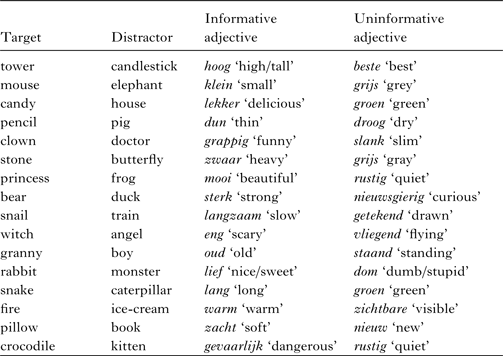
Sixteen items were prepared. All items consisted of two pictures. An example item is given in Figure 1. The pictures were accompanied by a sound file. The participants heard a noun phrase describing one of the pictures. This noun phrase consisted of a definite article, an adjective, and a noun. The adjective was either informative or uninformative about the noun that was going to follow. A critical difference from the experiment reported in Fernald et al. (Reference Fernald, Thorpe and Marchman2010) is that none of the informative adjectives in our study denoted properties visible on the screen. This set-up is crucial to establish whether toddlers can predict the noun based on the adjective, when the adjective does not uniquely identify the referent, but is more associated with one of the objects on the screen than with the other. Critically, adjectives denoting visible properties that are uniquely sufficient for referent identification (such as colour terms) were only used in the uninformative condition. In the example in Figure 1, the informative noun phrase was de zware steen ‘the heavy stone’, the uninformative noun phrase was de grijze steen ‘the grey stone’ (both objects were grey in the picture). Since prenominal adjectives in Dutch are marked for gender, the two pictures always corresponded to same-gender nouns so that the subjects could not identify the target based on the formal aspects of the adjective. The complete list of items is presented in the ‘Appendix’.
Example of a picture combination.

The noun phrases were recorded with a pause between the adjective and the noun. This pause was edited to ensure that there was a 3-second interval between the onset of the adjective and the onset of the noun. We used this interval to make sure that the children had sufficient time to predict the noun before they would actually hear it. The items sounded as if there was a word-finding pause in which the speaker was searching for the noun. We used hesitant speech because we expected the children to need more time to predict the upcoming noun (given the complexity of the task). If the noun immediately followed the adjective, it would be possible that a delayed reaction to the adjective would occur during the presentation of the noun, and in that case it would be impossible to distinguish between the effect of the adjective and the effect of the noun.
The duration of each item was 9 seconds. The onset of the adjective was after 3 seconds, the onset of the noun was after 6 seconds. The duration of the adjective was on average 784 ms (SD = 152), the duration of the noun was on average 599 ms (SD = 77).
There were four versions of each item: the item was presented in either the informative or the uninformative condition, and for both variants the position of the target picture was either on the left or on the right. Four lists were created, using a Latin square design. The participants saw each item only once. In each list, there were four items of each type (target right-informative; target left-informative; target right-uninformative; target left-uninformative).
Apparatus
The experiment was run on a Tobii 1750 eye-tracker, sampling at 50 Hz (every 20 ms). The items were presented on a 17-inch monitor via a computer running Tobii's Clearview software.
Procedure
The experiment took place in a sound-treated booth in the eye-tracking lab. The adult participants were seated on a medical chair in front of the eye-tracker and were told they would see pictures accompanied by spoken sentences. They were not given a task, they were only asked to sit back and enjoy the pictures. A calibration procedure then followed. When the calibration was successful, the experimenter left the booth and the experiment started. The children sat on their caretakers' laps.
Before being presented with the experimental items, the participants saw all the pictures accompanied by music. In this way we could establish a baseline for the attention for both pictures.
Analysis
From the eye-tracking record we determined the position of the eye in 100-ms steps. The final dataset was analyzed by means of a multilevel logistic regression (Goldstein, Reference Goldstein1999; Mirman, Dixon, & Magnuson, Reference Mirman, Dixon and Magnuson2008) in R using the lme4 package (Bates, Maechler, & Bolker, Reference Bates, Maechler and Bolker2013). This way, we treated the eye-tracking data for each trial as longitudinal data with 100-ms time windows. The logistic regression characterizes the data as binomial in that every 100 ms a subject can either fixate on the target or on the distracter, allowing us to assess the change in the probability of looks to the target over time (if the subject fixated elsewhere, the data were not included for analysis). By using a multilevel approach, we can take into account the nested nature of the data: trials were nested within items and within subjects. Using the multilevel logistic regression analysis, we modelled the probability of fixation on the target picture. Subjects and items were added as random factors (for a similar approach, see Trueswell & Papafragou, Reference Trueswell and Papafragou2010). We created several models: we started with a model (Base model) in which the probability of fixating on the target was computed as a function of Informativeness (informative adjective versus uninformative adjective versus music). We then added the interaction of Informativeness and Time (Linear model). Adding this factor enabled us to test whether in any of the conditions there was a linear increase (or decrease) in looks to the target. The music condition provided a baseline for the analysis: if the participants reacted to the auditory stimulus (either the adjective or the noun) by looking at the target, the proportion of looks to the target would increase relative to the music condition. However, since there was a 3-second interval between the onset of the adjective and the onset of the noun, it is possible that, especially for the three-year-old children, this increase would be temporary. The proportion of looks at the target might go back to the baseline. In that case, there would be no linear increase. Hence we also computed a model (Quadratic model) in which we added the interaction of condition with the square of Time, in order to be able to test for such an effect. We investigated the effect of adding these parameters on the fit of the model by using the –2 times log-likelihood statistic. This deviance statistic enables us to determine whether adding the parameter leads to a better fit of the model.
The analysis was performed on two time intervals: the first was the time interval between the onset of the adjective until the onset of the noun. In this interval, if the noun is predicted on the basis of the adjective, we expect the proportion of looks on the target to increase over time for the informative adjective condition, but not for the other conditions. The second was the time interval between the onset of the noun and the end of the trial. In this interval, we expected the proportion of looks at the target to increase in the uninformative adjective condition.
RESULTS
Adult participants
We first analyzed the results in the adult group. The proportion of looks at the target over the timecourse of the trial is presented in Figure 2. The first analysis region was the region from the onset of the adjective until the onset of the noun. Table 1 shows the results of the fit of the models.
Proportion of looks at the target picture throughout the trial (adults). The first vertical line indicates the onset of the adjective, the second (dotted) vertical line indicates the average offset of the adjective, the third vertical line indicates the onset of the noun.

Comparison of fit of the models of the adult data in the adjective region

The model including the quadratic component provided the best fit with the data. The model showed that there was no difference between the music condition and the uninformative condition in the intercept (β = 1·41, SE = 1·02, z = 1·39, p = ·17), the linear component (β = –0·06, SE = 0·05, z = –1·29, p = ·20), and the quadratic component (β = 0·0008, SE = 0·0005, z = 1·55, p = ·12). Both in the music condition and in the uninformative condition the proportion of looks at the target did not change over this time period.
The informative condition, however, showed a difference with the music condition in all components (intercept: β = –8·70, SE = 1·13, z = –7·70, p < ·001; linear: β = 0·37, SE = 0·052, z = 7·10, p < ·001; quadratic: β = –0·003, SE = 0·0005, z = –5·40, p < ·001).
The second analysis region was the region from the onset of the noun until the end of the item. Table 2 shows the results of the fit of the models. The model including the quadratic effect provided the best fit with the data. The model showed a difference between the music condition and both the uninformative condition and the informative condition in the intercept (music versus uninformative: β = –49·94, SE = 3·66, z = –13·65, p < ·001; music versus informative: β = –9·20, SE = 3·73, z = –2·47, p = ·014), the linear component (music versus uninformative: β = 1·37, SE = 0·10, z = 13·71, p < ·001; music versus informative: β = 0·333, SE = 0·101, z = 3·30, p < ·001), and the quadratic component (music versus uninformative: β = 0·009, SE = 0·0007, z = –13·20, p < ·001; music versus informative: β = –0·002, SE = 0·0006, z = –3·55, p < ·001).
Comparison of fit of the models of the adult data in the noun region

Three-year-old participants
The proportion of the children's looks at the target over the timecourse of the trial is presented in Figure 3. The first analysis region was the region from the onset of the adjective until the onset of the noun. Table 3 shows the results of the fit of the models.
Proportion of looks at the target picture throughout the trial (children). The first vertical line indicates the onset of the adjective, the second (dotted) vertical line indicates the average offset of the adjective, the third vertical line indicates the onset of the noun.

Comparison of fit of the models of the child data in the adjective region

The model including the quadratic effect provided the best fit with the data. The model showed that there was no difference between the music condition and the uninformative condition in the intercept (β = –35·39, SE = 10·79, z = –3·28, p = ·45), the linear component (β = 2·48, SE = 4·30, z = 0·58, p = ·57), and the quadratic component (β = –3·72, SE = 9·84, z = –0·38, p = ·71). Both in the music condition and in the uninformative condition the proportion of looks at the target did not change over this time period.
The informative condition, however, showed a difference with the music condition in all components (intercept: β = 22·49, SE = 6·19, z = 3·63, p < ·001; linear: β = –1·75, SE = 0·43, z = –4·03, p < ·001; quadratic: β = 0·044, SE = 0·010, z = 4·45, p < ·001; β = –0·0004, SE = 0·00007, z = –4·77, p < ·001).
The second analysis region was the region from the onset of the noun until the end of the item. Table 4 shows the results of the fit of the models. The model including the quadratic effect provided the best fit with the data. The Quadratic model showed a difference between the music condition and both the uninformative condition and the informative condition in the intercept (music versus uninformative: β = –51·35, SE = 3·42, z = –15·03, p < ·001; music versus informative: β = –32·33, SE = 3·32, z = –9·75, p = ·001), the linear component (music versus uninformative: β = 1·39, SE = 0·092, z = 14·99, p = < ·001; music versus informative: β = 0·92, SE = 0·090, z = 10·15, p = < ·001), and the quadratic component (music versus uninformative: β = –0·009, SE = –0·0006, z = –14·63, p < ·001; music versus informative: β = –0·006, SE = –0·0006, z = –10·27, p < ·001).
Comparison of fit of the models of the child data in the noun region

Comparison between adults and children
The analysis showed a difference between the music condition and the informative condition in the adjective region for both adults and children. The question is whether this difference is similar for the adults and the children, both in the timecourse and in the strength of the effect. We tested this in an additional analysis including only the music condition and the informative condition, in which we included Group (children versus adults) as an additional predictor.
In this analysis we focused on the time window of the adjective. The average duration of the adjective was 784 ms, which means that it was presented in the time frame from 3 seconds to 3·8 seconds after stimulus onset. Since it takes 200 ms to compute and initiate a saccade (see Salverda, Kleinschmidt, &Tanenhaus, Reference Salverda, Kleinschmidt and Tanenhaus2014, for a recent discussion), we performed the analysis on the time window from 3·2 until 4 seconds. Figure 4 presents the results for the two groups in this time window.
Proportion of looks at the target picture in the informative condition in the adjective region.

There was an interaction of Informativeness and Time (β = 0·15, SE = 0·03, z = 5·99, p < ·001), which reflects the increase in the probability of fixating the target picture in the informative condition compared to the music condition. However this interaction was qualified by a three-way interaction of Informativeness, Group, and Time (β = –0·093, SE = 0·037, z = –2·54, p = ·01). Therefore we analyzed the data of the adults and the children separately, to see whether the interaction of Informativeness and Time is found for both the adults and the children. This was indeed the case (adults: β = 0·15, SE = 0·03, z = 6·00, p < ·001; children: β = 0·060, SE = 0·026, z = 2·28, p = ·02). So both for the adults and for the children, the probability of fixating the target picture in the informative condition increased while they heard the adjective.
CONCLUSION AND DISCUSSION
This study set out to explore whether three-year-old children process adjective–noun phrases incrementally and predict the head-noun by integrating adjective semantics with world knowledge and visual context. The results demonstrate that this is indeed the case. When the adjective was uninformative (e.g., ‘the grey mouse’ for the mouse–elephant trial in which both the mouse and the elephant were grey), the proportion of looks to the target between adjective onset and noun onset was not different from the music condition. In contrast, when the adjective was informative (e.g., ‘the small mouse’), the proportion of looks to the target increased while the children heard the adjective, well before the onset of the noun. Contrary to our expectations, the children did not need more time than the adults to start moving their eyes to the target picture. So, in hindsight, the lag between the adjective and the noun in our materials was unnecessary.
Crucially, none of the target properties was apparently visible on the screen. For example, the adjective–noun phrase kleine muis ‘small mouse’ was paired with equally sized pictures of a mouse and an elephant (i.e., the children could not see that the elephant was bigger than the mouse and had to rely on their knowledge). Also, for properties such as warmness, heaviness, and sweetness the children had to use their knowledge rather than simply rely on the visual information. Hence, children younger than the age of four are able to process adjectives as they hear them and even to predict the head-noun based on the adjective meaning, which could be part of the integration process. This raises a question about the source of this prediction.
One possibility is that children compute which of the two entities has the target property to a greater extent. For example, upon hearing the adjective klein ‘small’ in the referential context of a mouse and an elephant (equally sized in the picture), children may retrieve information that in real life mice are much smaller than elephants and in this way compute the most probable referent of klein in that context. Alternatively, toddlers may rely on patterns of adjective–noun co-occurrence. In this scenario, looking at the mouse before the noun is pronounced might be caused by the fact that children hear the combination kleine muis ‘small mouse’ more often than kleine olifant ‘small elephant’.
Research on the earliest stages of adjective production suggests that the two explanations do not necessarily exclude each other. Early in development, toddlers keep track of objects that are described by means of particular adjectives in child-directed speech and conservatively apply adjectives to this restricted set of nouns/objects (Carey, Reference Carey, Halle, Bresnan and Miller1978; Harris et al., Reference Harris, Morris and Terwogt1986; Tribushinina, Reference Tribushinina2008, Reference Tribushinina, Paradis, Hudson and Magnusson2013b). For instance, they may learn that small describes mice and chickens, whereas big is used for elephants and hippos. Caregivers adjust their adjective use when talking to young children in at least two ways. First, they overwhelmingly use adjectives with respect to a limited number of entities. Second, these entities are often prototypical instantiations of the property denoted by the adjective. For example, caregivers often describe towers as tall, elephants as big, mice as small. It is also noteworthy that child-directed speech deviates from adult-directed speech in this respect. For example, tall is employed to describe towers only in 1·3% of its uses in the British National Corpus, whereas a third of its contexts in child-directed speech in the Manchester Corpus are about towers (Tribushinina, Reference Tribushinina2008).
In view of these insights, it is plausible that the two explanations of the predictive behaviour in toddlers are complementary rather than mutually exclusive, since an important part of early adjective semantics are stored exemplars of adjective–object pairings in actual language use.
The possibility that the children in our study do integrate the adjective and the noun seems contradictory to the results of Ninio (Reference Ninio2004). As described in the ‘Introduction’, she finds that children under the age of four do have difficulty integrating an adjective and a noun. That conclusion was based on the high number of errors (40%) in a picture selection task. Notice, however, that the age range of the children in Ninio's experiment was very broad (1;6–4;4, with a mean age of 2;8). It is possible that many of the errors were made by the younger children in her experiment.
We have shown that three-year-olds are able to predict a head-noun based on the lexical information in the adjective. What we have not investigated is whether toddlers can also use referential context and predict the upcoming noun based on contrastive inference the way adults (Sedivy et al., Reference Sedivy, Tanenhaus, Chambers and Carlson1999; Sekerina & Trueswell, Reference Sekerina and Trueswell2011) and older children do. For example, five-year-olds in Huang and Snedeker's (Reference Huang and Snedeker2013) experiment started looking at the big coin (rather than at a big stamp) before hearing the head-noun, when the referential scene contained a contrastive object from the same noun category (small coin). Since there were two coins and only one stamp (and a stamp could therefore be identified by the noun alone), five-year-olds inferred that the adjective big was more likely to be used for referent identification in the coin category. Future research should test this ability in children younger than the age of five. Given earlier findings by Sekerina and Trueswell (Reference Sekerina and Trueswell2012) and by Ninio (Reference Ninio2004), there are reasons to assume that predicting the upcoming noun based on the referential context (through contrastive inference) is more demanding than predicting the noun based on the property–object and/or adjective–noun co-occurrence statistics. In line with this prediction, research on sentence processing reveals that adults use both information about verb bias (e.g., probability that the verb would be followed by an instrument or a modifier) and referential context in sentence parsing, whereas five-year-olds over-rely on verb bias and largely ignore referential context (Snedeker &Trueswell, Reference Snedeker and Trueswell2004). These results, like our findings on adjective processing, do suggest that children keep track of the (syntactic) environments in which words occur and use that information in language processing.
To conclude, this study has shown that three-year-old toddlers process attributive adjectives as they hear them, and even predict the upcoming noun based on adjective meaning. This finding undermines the claim that attributive adjectives are only processed after their head-noun (two-step process) and that children under the age of four have difficulty integrating the adjectival and the nominal meaning (Ninio, Reference Ninio2004). By means of eye-tracking we were able to reveal that three-year-olds are much better at adjective comprehension than has been assumed on the basis of earlier off-line work. This highlights the need to use research techniques that are sensitive enough for studying language processing in young children.
APPENDIX
List of items used in the experiment