Introduction
In 2007 Takano and Nagamasu described a new genus with a single species, Myxochlamys mullerensis A.Takano & Nagam., based on specimens collected in Central and West Kalimantan in the island of Borneo. Myxochlamys A.Takano & Nagam. (Zingiberaceae) is characterised by its loosely arranged leaf sheaths which do not form a pseudostem, the spiral arrangement of the bracts, indeterminate flowering sequence, two-keeled bracteole opposed to the bract, single flower per bract, elongate basal spurs on versatile anthers, and grooved inner surface of the corolla tube (Takano & Nagamasu, Reference Takano and Nagamasu2007).
Phylogenetic analysis based on the DNA sequences of the ITS and matK regions placed the new genus in a clearly defined clade with Scaphochlamys Baker and Distichochlamys M.F.Newman (Takano & Nagamasu, Reference Takano and Nagamasu2007). Myxochlamys is also morphologically close to these two genera, which are in the tribe Zingibereae Meisn. (Kress et al., Reference Kress, Prince and Williams2002).
During field work in Kotawaringin Timur District, Central Kalimantan in 1997, the second author collected a new species of Myxochlamys which is described here. Further study of the material cited in the protologue of Myxochlamys mullerensis results in the transfer of one specimen to this new species.
Species Description
Myxochlamydi mullerensi A.Takano & Nagam. affinis, sed rhizomate in parte supera verticaliter disposito et foliorum basibus distichis anfractuoso-flexuose ordinatis incluso, foliis lamina linearielliptica (non anguste obovata) 55–65 × 12–17 cm (non 50 × 7 cm) metienti, florum bracteis caenose albis (non sanguineis), floribus albis minoribus (non albis et rubris) labello viridialbo (non albo et roseo) praeditis differt. – Type: Indonesia, Central Kalimantan, Kotawaringin Timur District, Wanariset Sangai Pondok, km 92, Kalang Mantar, 01°17′52″S, 112°22′48″E, 16 vii 1997, M.F. Newman 845 (holo E, incl. flowers in spirit).
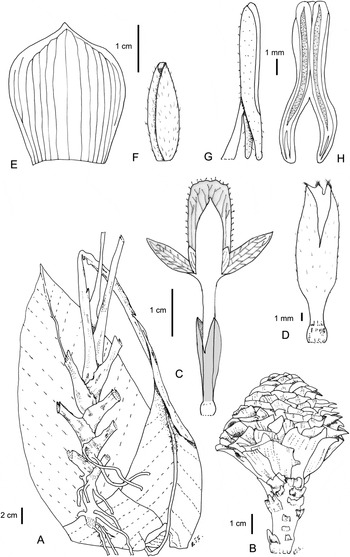
Myxochlamys amphiloxa R.J.Searle. A, habit; B, inflorescence; C, flower: viewed from above and with calyx attached; D, calyx; E, bract; F, bracteole; G, anther side view; H, anther frontal view (Newman 845 (E), A from the herbarium sheet and B–H from the spirit material).
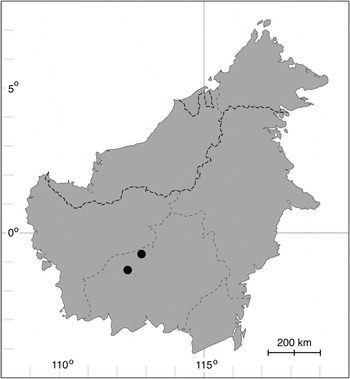
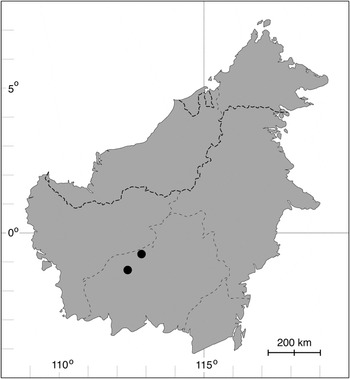
The distribution of Myxochlamys amphiloxa R.J.Searle.
Terrestrial herb 70 cm tall. Rhizome robust, white inside and faintly aromatic in life, turning up terminally to form an upright leafy shoot, 2 cm thick when dried. Leafy shoot elongate, with up to 10 leaves, growing in a zigzag, each one at an angle of the zigzag, 2–3 cm from the last, arranged distichously and terminating in an inflorescence. Leaf-sheath 25–30 × 1 cm, broadly sheathing and red at base and with roots breaking through those nearer the soil, with broad thin margins, finely channelled on the outer surface, with a squamate layer of pale scale-like hairs; ligule lobes directly below base of lamina, triangular, 3 mm long, covered in a dense coating of appressed, straight hairs; petiole absent; lamina 55–65 × (8–)12–17 cm, linear-elliptic, base long decurrent, apex acuminate, upper surface plain green, glabrous, lower surface pale whitish-green and practically glabrous except for a dense covering of long, fine hairs along the midrib from the leaf-base, thinning towards the apex, margin sparsely hairy, more so towards apex. Inflorescence terminal; peduncle thick and woody, c.8 cm long, 1.3 cm in diameter, densely covered in short, woolly hairs, emerging from upper 2 leaf-sheaths; inflorescence large, torch-shaped, to 10 × c.7.5 cm with many overlapping bracts, outer ones marcescent, flowering from base to apex; bracts dirty white, 2.5–3 × 2.3 cm at base of inflorescence, attached by a very broad base, imbricating, the apex emarginate and outcurved so that each bract forms an open pouch, glabrous; bracteole opposite the bract, 1.8–2.2 × 1.1 cm, becoming smaller towards apex of inflorescence, bi-keeled, apex bluntly pointed, densely, finely pubescent; flower one per bract, sessile, white, except for greenish white labellum and anther; ovary small, globose, glabrous, c.2.5 mm long; calyx 18 mm long, apex toothed, split 8 mm from apex, sparsely, finely pubescent; floral tube 27 mm long, glabrous; dorsal floral lobe 17 × 6 mm, linear with an acute, hooded apex; lateral lobes 16 × 5 mm, linear with rounded apex; lateral staminodes ovate, acute, 6 mm long, minutely glandular hairy; labellum 20 × 9 mm, straight sided, greenish white, apex entire and rounded, the margin slightly frilled; filament apparently short, anther 10 × 2 mm, versatile, dehiscing longitudinally, with 3 mm long spurs which curve inwards slightly towards the tips, abaxial anther surface and crest with tiny glandular hairs, greenish white, crest truncate; stigma protruding just above the thecae, small and cup-shaped with a short fringe of cilia around the ostiole. Fruit unknown.
Distribution. Endemic in two adjacent districts of Central Kalimantan Province, Indonesia.
Habitat and ecology. Primary lowland rain forest, on damp soil in heavy shade near watercourses.
Etymology. Greek meaning ‘slanting both ways’, in reference to the zigzag shoots.
Proposed IUCN conservation status. EN B2a,b(iii); only known from two localities in a total area of less than 500 km2 where the area and quality of the habitat are declining. The three known collections were made in primary dipterocarp forest in logging concessions. The holotype and Jarvie & Ruskandi 5447 come from a single locality and probably grew no more than 200–300 m apart.
Additional specimens examined. Indonesia. Central Kalimantan: Katingan District, Samba, 1994–1995 cutting blocks of PT Handiyani, 0°43′22.5″S, 112°50′37.5″E, 27 i 1995, J.K. Jarvie & A. Ruskandi 5447 (E); Kotawaringin Timur District, ODA, km 92 from Sangai, Blok 1 jalur 51, 9 ix 1996, Ambriansyah & Arbainsyah AA1971 (E).
The only flowering material of Myxochlamys amphiloxa is the spirit collection of the holotype. Even here, there are only two broken and partly decayed flowers so the description above is incomplete. For example, both anthers are detached so we cannot describe the filament, and the floral tubes are so delicate that we cannot see whether the style is held in a groove in its inner surface without destroying the little material we have.
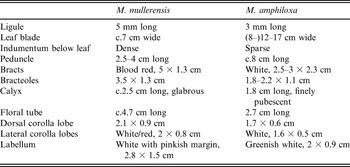
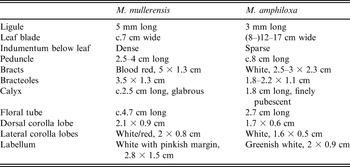
While Myxochlamys amphiloxa shares characters of the original species such as the large, torch-like inflorescence structure, the spiral arrangement of the bracts, the indeterminate flowering, the two-keeled bracteole opposite the bract, the single flower per bract, and the basal spurs of the versatile anther, it differs from M. mullerensis by the characters shown in Table 1. In addition, its vegetative morphology appears to be rather different. Myxochlamys amphiloxa has strikingly distichous leafy shoots consisting of 8–10 leaves growing in a zigzag pattern up a thick, vertically growing rhizome. By contrast, Myxochlamys mullerensis is described as having ‘leaves sessile’, arising from a horizontally growing, ‘slender’ rhizome (Takano & Nagamasu, Reference Takano and Nagamasu2007). The vegetative morphology of Myxochlamys amphiloxa is unusual by comparison with its closest relatives and warrants further study of living material.
Differences between Myxochlamys mullerensis and M. amphiloxa
Takano & Nagamasu (Reference Takano and Nagamasu2007) cited five collections of Myxochlamys mullerensis, in addition to the type. Of these, the holotype and an isotype at BO, Okada et al. 691, have been seen, along with Awmack 109, 198 and 199 (K) and Jarvie & Ruskandi 5447 (E). The isotypes at HYO and KYO, and the two other specimens at BO (Jarvie & Ruskandi 5447, Church & Mahyar 1702) have not been seen. Jarvie & Ruskandi 5447 (E) matches the holotype of Myxochlamys amphiloxa by its vegetative architecture and its almost glabrous leaves, and has white flowers with green stamens, according to the label. This collection has been re-determined as Myxochlamys amphiloxa.
Acknowledgements
We are grateful to A. D. Poulsen (E) for producing Fig. 2, to Mark Hughes (E) for advice on assigning the IUCN conservation category and to Philip Oswald for translating the diagnosis into Latin.