Degenerate (i.e. monomoraic) feet, while permitted in some languages, tend to be highly restricted in their distribution (Hayes Reference Hayes1995). In Ojibwe, for instance, a degenerate foot is possible only at the end of a prosodic word (PWd), as in (1) (Piggott Reference Piggott1980; Newell & Piggott Reference Newell and Piggott2014), suggesting that Parse, which requires syllables to be footed, dominates foot binarity (FtBin), which requires feet to be binary. (Throughout, feet are delimited by parentheses.) Non-final degenerate feet, as in ungrammatical (1c) and (1d), are gratuitous because the feet could be combined, as in (1b), satisfying Parse without compromising FtBin. In (1d), [(ˌgin)] violates FtBin because codas are non-moraic in Ojibwe.

As I argue here, some languages that forbid degenerate feet in isolated PWds permit them in phrasal phonology, where multiple PWds interact. Classical Latin and Homeric Greek furnish two cases, along with the metrical diagnostics to confirm that the syllables in question are in fact degenerate feet, that is, both light (monomoraic) and independently footed. Specifically, degenerate feet arise in these languages due to resyllabification. An isolated PWd can be
 $\text{C}_0$
VC (throughout, V is short), as with Latin dat ‘gives’ in (2a). As the subscripts indicate, the PWd is bimoraic, satisfying FtBin; indeed, isolated PWds are required to be at least bimoraic in Latin (Mester Reference Mester1994) and Ancient Greek (Blumenfeld Reference Blumenfeld2011). When prevocalic, however, as in (2b), dat loses its coda, which is now parsed as the onset of the following PWd. Latin, like Greek, tolerates the resulting degeneracy (subminimality). The metrical evidence reviewed below confirms that in configurations like (2b), the consonant is resyllabified (without ambisyllabicity), the vowel remains short and the first word retains its stress.

Not all languages with bimoraic minima and resyllabification tolerate resyllabification-induced degeneracy like Latin and Greek do. Tamil, for instance, geminates the final consonant (if geminable) of a
 $\text{C}_0$
VC word when it undergoes resyllabification, as in (3a) and (3b) (cf. Italian; Chierchia Reference Chierchia1982). Crucially, in Tamil, such gemination is absent when FtBin is not at stake, as with [aʋaɭ] ‘her’ in (3c), which remains bimoraic after losing its coda (Ryan Reference Ryan2019: 128–132 and references therein). If the final consonant of a prevocalic
 $\text{C}_0$
VC word is not geminable in Tamil, as with the rhotics, the vowel lengthens instead, as in (3e) (Rajam Reference Rajam1992: 85; Ryan Reference Ryan2019).

Another strategy to avoid resyllabification-induced degeneracy is to suppress resyllabification if it threatens binarity (e.g. by ranking FtBin over Onset). Ryan (Reference Ryan2019) documents this situation in Māhārāsṭṛī Prakrit, which records word-final nasals differently depending on whether or not they undergo resyllabification. The final nasal of a
 $\text{C}_0$
VC word, where degeneracy is threatened, is significantly less likely to resyllabify than the final nasal of a longer word, where degeneracy is not at stake. Of course, a language might also forbid cross-PWd resyllabification across the board, as Dutch does (Booij Reference Booij1996).
A final logically possible strategy to avoid resyllabification-induced degeneracy is to suppress stress. In such a language, a
 $\text{C}_0$
VC word, say, tat, would be stressed when preconsonantal but unstressed when prevocalic, as schematised in (4). I am not aware of any case exactly like this one, though Hayes (Reference Hayes1995: 112–113) considers possible cases of subminimal words being unable to surface with stress in any context. While uncommon at best across words, within words, contrasts like (4a) versus (4b) are commonplace.

Latin and Greek, as mentioned, do not employ any of these strategies to circumvent a degenerate foot when one arises due to resyllabification. Rather, they let the degenerate foot stand. A benefit of examining such languages is that their extensive and exacting metrical traditions furnish independent diagnostics of prosodic properties such as weight and stress. Whether Ancient Greek had stress in addition to pitch accent is irrelevant here; either way, I assume, along with most analysts (e.g. Steriade Reference Steriade1988; Sauzet Reference Sauzet1989; Golston Reference Golston, Myers and Pérez1990; Devine & Stephens Reference Devine and Stephens1994; Blumenfeld Reference Blumenfeld2004, Reference Blumenfeld2011; Sandell Reference Sandell2020), that it had feet, as discussed in §5.
For both languages, I focus on the dactylic hexameter, as schematised in (5). The following basic description of the metre will suffice for all present purposes. Each of six metra, as enumerated, is divided into two metrical positions. The first,
 , must be filled by a heavy syllable and the second,
 , by either a heavy or pair of lights. If the latter is filled by a pair of lights, each light occupies a subposition, in Prince’s (Reference Prince, Kiparsky and Youmans1989) terminology. Note that ‘subposition’ is equivalent to saying ‘light-requiring position’ for this metre, since light syllables are not otherwise licensed outside of line end. The cadence comprises the final two metra. In Latin, the cadence, unlike the rest of the line, is strictly regulated for stress, being nearly always (for most authors) stressed in strong (
 ) positions and unstressed in weak positions (
 and
 ).

As I will show, stressed
 $\text{C}_0$
VC retains its stress even while undergoing resyllabification, resulting in a degenerate foot. While such feet were freely tolerated in prose (and thus everyday speech), they were strongly avoided in most authors’ hexameters. I attribute this avoidance to a maximum size constraint on the subposition, such that it cannot contain a prosodic constituent higher than the syllable. A degenerate foot, in effect, is too large for a subposition, but too small (being light) for a heavy-requiring position. It therefore finds no comfortable place to sit in the metre, even though it freely occurs outside of verse.
To be clear, this analysis does not suppose that degenerate feet are somehow confined to poetic language, or that they are a property of the metre itself. Rather, degenerate feet are a property of the general language. Poets, in turn, can be sensitive to them, just as they are sensitive to moraic structure and other properties of the general language. In this way, verse sheds light on general prosody. Poets’ special treatment of degenerate feet, as distinct from similar structures such as stressed light syllables more generally, supports the psychological reality of the construct. I conclude that degenerate feet are more widely distributed in the world’s languages than previously assumed.
I begin with the empirical facts in Latin in §1 before turning to the formal analysis of degenerate feet as induced by resyllabification in §2. The next two sections, §§3 and 4, address the verse evidence for degeneracy in Latin, including (in §4) a cline of stressability among function words. I turn to Greek in §5, demonstrating that essentially the same behaviour is found in the Homeric hexameter. Finally, §6 considers alternatives to the degenerate foot, with §7 concluding.
1. Resyllabification-induced degeneracy in Latin
Latin is a classical example of a moraic trochee language (Mester Reference Mester1994). Feet are initially prominent and may be two syllables or one heavy (bimoraic) syllable. Degenerate feet are forbidden in isolated words, as supported by convergent evidence. For one, in words of three or more syllables, stress falls on the penult if the penult is heavy. If the penult is light, stress falls on the antepenult, as in (6a). With feet, this pattern is analysed as involving a right-aligned trochee subject to final syllable extrametricality (i.e. foot-based NonFinality: ‘penalise a footed ultima’). FtBin is then necessary to preclude the ungrammatical alternative in (6a) in which stress falls on the penult, a candidate that otherwise satisfies both NonFinality and Trochee. Second, in disyllables with an initial light, FtBin is seen to dominate extrametricality, as in (6b). Evidence that the ultima is footed in such cases includes so-called iambic shortening (found especially in Archaic Latin), whereby a would-be light–heavy trochee becomes light–light due to FtBin (Mester Reference Mester1994).Footnote 1 On this analysis, if the stressed light syllable were footed by itself as a degenerate foot, the motivation for shortening the ultima would be lost. After all, unfooted ultimas are not shortened, as (6a) illustrates. Finally, FtBin has been invoked to explain prosodic minimality, such as the lengthening in (6c) (Prince & Smolensky [1993] Reference Prince and Smolensky2004). An isolated PWd cannot be a degenerate foot. Monosyllables also reinforce the violability of NonFinality.Footnote 2

Despite being forbidden within words in Latin, degenerate feet, I argue, arise in cross-word contexts. In Latin, as in many of its descendants, a word-final consonant resyllabifies with a following vowel-initial word (Allen Reference Allen1978; Harris Reference Harris1983; Peperkamp Reference Peperkamp1997; Ryan Reference Ryan2019; Passino et al. Reference Passino, de Carvalho, Scheer, Gabriel, Gess and Meisenburg2022).Footnote
3
If a stressed monosyllable of the shape
 $\text{C}_0$
VC is prevocalic, resyllabification yields a degenerate foot, as in (7a). As argued presently, such phrases are not normally parsed as (7b) (suppressing resyllabification), (7c) (lengthening the vowel) or (7d) (suppressing stress), among other possibilities (the possibility of ambisyllabicity, for one, is rejected in §2).

First, resyllabification applies as normal to
 $\text{C}_0$
VC words. Among other evidence, this is clear from verse, where such words scan as light prevocalically. In the lines in (8), for example, vir ‘man’, fer ‘carry’ and dat ‘gives’ must scan as light to fit the hexameter. Slashes indicate boundaries between metrical feet. Macrons mark long monophthongs. Metrically elided vowels are underlined. Each line is followed by its scansion (
 being heavy,
 light) and a rough gloss. If prevocalic
 $\text{C}_0$
VC resisted resyllabification, as in (7b), one would expect it to be treated as heavy in verse.

As (9) illustrates, these same
 $\text{C}_0$
VC words scan as heavy when pre-consonantal.

Second,
 $\text{C}_0$
VC does not undergo lengthening of the vowel or consonant when prevocalic, which would yield a heavy syllable. This again is clear from scansion, as in the verse lines in (8), as well as from manuscripts in which vowel length is indicated.
Finally, lexical
 $\text{C}_0$
VC does not lose its stress due to resyllabification. For starters, to the best of my knowledge, no language with phrasal resyllabification works that way. In Italian, for instance, snob horrendo [ˈsnɔ.b or.ˈrɛn.do] ‘horrible snob’ exhibits resyllabification, but the monosyllable retains its stress, as reinforced by [ɔ], which diagnoses stress (Peperkamp Reference Peperkamp1997).Footnote
4
Likewise, in Latin, resyllabification does not, in general, trigger destressing. This is clear, once again, from metrics. Ovid, for instance, virtually requires strong positions to be stressed in metrical cadences (Sturtevant Reference Sturtevant1923). A typical cadence such as mīlitis ūsū [ˈmiːliti.ˈs uː.suː] ‘from use of the soldier’ would be impossible if the resyllabification induced destressing of either word (i.e. [miːliti.ˈs uː.suː] or [ˈmiːliti.s uː.suː]), as either parse would fill a metrically strong position in the cadence with an unstressed syllable.
More to the point,
 $\text{C}_0$
VC monosyllables, in particular, do not lose their stress when undergoing resyllabification, as metrical evidence further supports. Consider once again Ovid’s Metamorphoses (8 ce), in hexameter. Recall that stressed light syllables are rarely permitted in the cadence, though they are frequently found elsewhere in the line (Sturtevant Reference Sturtevant1923; see also §3). If, on the one hand, lexical
 $\text{C}_0$
VC words retain their stress under resyllabification, one would expect them to be excluded from cadences, a context in which stress must coincide with heaviness. If, on the other hand, lexical
 $\text{C}_0$
VC words lose their stress under resyllabification, they should be free, like unstressed function words, to occupy cadences when prevocalic, being unstressed light syllables.
In Metamorphoses, lexical
 $\text{C}_0$
VC#V never occupies the cadence, whereas function
 $\text{C}_0$
VC#V often does. As representative function words, I take all
 $\text{C}_0$
VC prepositions from the text, namely, ad ‘to’, in ‘in’, ob ‘against’, per ‘through’ and sub ‘under’.Footnote
5
As representative lexical words, I take all
 $\text{C}_0$
VC nouns and verbs from the text, namely, dat ‘gives’, det ‘gives’ (subjunctive), fac ‘make’, fer ‘carry’, flet ‘weeps’, it ‘goes’, nat ‘swims’, vir ‘man’,Footnote
6
scit ‘know’, stat ‘stand’ and stet ‘stand’ (subjunctive).Footnote
7
Corpus counts are provided in (10). While
 $\text{C}_0$
VC#V prepositions are roughly equally frequent inside and outside of the cadence, lexical
 $\text{C}_0$
VC#V occurs only outside of the cadence. This significant difference between lexical and functional words (Fisher’s exact test
 $p<0.0001$
) suggests that stressed
 $\text{C}_0$
VC retains its stress even when prevocalic.

A second and independent argument that lexical
 $\text{C}_0$
VC retains its stress under resyllabification concerns Virgil’s hexameter. Virgil avoids lexical
 $\text{C}_0$
VC before a vowel altogether, regardless of position in the line. In Virgil’s three hexameter works, the Eclogues, Georgics and Aeneid (collectively c. 37–19 bce), lexical
 $\text{C}_0$
VC (using the same lists as above) occurs prevocalically six times. Preconsonantally, by contrast, it occurs 119 times. In other words, non-line-final lexical
 $\text{C}_0$
VC precedes a vowel 5% of the time. This rate differs significantly from that of prepositions, which precede a vowel 41% of the time (Fisher’s exact test odds ratio = 14,
 $p<0.0001$
). Corpus frequencies are provided in (11). This difference in Virgil’s treatment of lexical and functional
 $\text{C}_0$
VC arguably reflects stress: Virgil strongly disfavours stressed monosyllables in light-requiring positions, even when they are rendered light by resyllabification.Footnote
8
A formalisation of this avoidance is presented in §3.

In conclusion, the final consonant of a
 $\text{C}_0$
VC word resyllabifies when prevocalic, regardless of whether the word is lexical or functional. If the word would otherwise be stressed, it retains its stress under resyllabification. In a foot-based formalism, these conditions necessitate a degenerate foot.
2. Resyllabification-induced degeneracy: analysis
As a simple representative example, consider it as ‘the coin (as) goes (it)’. The winner [(ˈi)(ˈt as)] in (12) exhibits a degenerate foot induced by resyllabification. (To save space, when a PWd dominates nothing but a foot, they are notated on the same line as ‘
 $f,\omega $
’.) Resyllabification is driven by Onset, which penalises a syllable with an empty onset. Because Latin permits isolated words to begin with vowels, Onset must be dominated by faithfulness constraints precluding prothesis and aphaeresis (not shown).Footnote
9
Onset must, in turn, dominate any constraint penalizing resyllabification (Ito & Mester Reference Ito, Mester and Parker2009), including Align-R below. The tableau also includes ‘weight by position’ (WbP: coda consonants are moraic), which dominates *
 $\mu $
/C (consonants must not be moraic), a ranking necessary to account for the weightiness of codas in Latin.
Align-R in (12) is short for Align(lex, R,
 $\omega $
, R) ‘the right edge of a lexical word coincides with the right edge of a PWd’. A penalty is incurred by each misaligned segment. A separate constraint ensures that lexical words are parsed into PWds: Max(lex,
 $\omega $
) ‘a lexical word corresponds with a PWd’ (Ito & Mester Reference Ito and Mester2019). This constraint checks the existence of a coindexed PWd, not its alignment. While a more traditional formulation of Match (Selkirk Reference Selkirk, Goldsmith, Riggle and Yu2011) might wrap these two functions (alignment and existence) into a single Match constraint, I follow Ito & Mester (Reference Ito and Mester2019) in separating them, as they must be ranked differently: Alignment is violable; existence is not. The indexation to lexical words reflects the fact that, as Selkirk (Reference Selkirk, Goldsmith, Riggle and Yu2011) puts it, ‘lexical category words are standardly parsed as PWds (
 $\omega $
), while functional category words like determiners, complementizers, prepositions, auxiliary verbs, etc. – in particular the monosyllabic versions of these – are not.’ Additional candidates without footing of the first word are considered later in this section.

Given the two rankings Onset
 $\gg $
Align-R and WbP
 $\gg $
*
 $\mu $
/C, ambisyllabicity is untenable. Candidates (12b) and (12c) exhibit ambisyllabicity of the resyllabified consonant. That is, [t] is shared by two syllables. In (12b), [t] is moraic; in (12c), it is not. Of these two candidates, (12b) is incorrect on empirical grounds. As discussed in §1, resyllabified consonants do not contribute to weight, ruling out (12b). Candidate (12c), however, has the appropriate weight profile. Nevertheless, (12c) is ruled out analytically. Because WbP must dominate *
 $\mu $
/C, (12b) is more harmonic than (12c), and, as just mentioned, (12b) cannot win. If Align-R (or FtBin) were ranked above WbP or *
 $\mu $
/C, (12b) would win, which cannot be allowed. In short, because (12b) must lose, both (12b) and (12c) must lose. Resyllabification cannot induce ambisyllabicity in Latin.
Candidates (12b) and (12c) also violate CrispEdge (not shown), which in this case penalises spreading a consonant across syllables (Ito & Mester Reference Ito, Mester, Kager, Hulst and Zonneveld1999). The ranking of CrispEdge is irrelevant here, in that (12a) wins regardless of how it is ranked.
Next, as the tableau in (13) illustrates, lexical it cannot cliticise to the following PWd. Max(lex,
 $\omega $
) requires it to project its own PWd, ruling out candidate (13b). (For clarity,
 $\omega $
is indexed to the lexical word, if any, that stands in correspondence with it for the purposes of assessing Max(lex,
 $\omega $
) and Align-R; if no lexical word corresponds to
 $\omega $
,
 $\omega $
is left unindexed.) The alternative indexation in (13c) satisfies Max(lex,
 $\omega $
) by indexing it to the maximal
 $\omega $
, but is then eliminated by Align-R, given that the nearest right edge of a PWd is two segments away, across as. Additional possible indexations can be similarly eliminated.

Function words are free to cliticise, as in (14), which replaces it ‘goes’ with et ‘and’. Max(lex,
 $\omega $
) and Align-R, as defined, ignore function words. (This is not to deny that function words might be stressed for other reasons, as discussed in §4.) In (14), FtBin favours PWd adjunction, the correct outcome.

The analysis as it stands is incomplete, in that it predicts that a function word like et is free to be stressed or unstressed when preconsonantal. In (15), the three candidates, the first two with stress on et and the last without, are tied. At first glance, this might not seem a bad prediction, since function words like et can, in fact, be stressed or unstressed depending on how they are used. Nevertheless, a lack of stress is the default outcome (modulo overriding factors such as narrow focus; see §4). Thus (15c), with cliticisation of the function word, should win in the base case. Various constraints could be added to militate against stressing a function word in order to break the tie in favour of (15c). One is Dep(
 $\omega $
, lex), which penalises a PWd that does not correspond to a lexical word (Ito & Mester Reference Ito and Mester2019). Any constraint militating against feet or stress (even indirectly, as with alignment) would also work, appropriately lowly ranked. Output–output correspondence in stress is yet another possibility.

Finally, consider the fact that lengthening is a possible repair for degeneracy for isolated words but not for words affected by resyllabification. For example, /da/ ‘give’ is lengthened to [(ˈda:)], necessitating that FtBin dominate Dep-
 $\mu $
. But given this ranking, what precludes /it as/ above from lengthening to *[(ˈi:)(ˈt as)]? Higher-ranking output–output correspondence, specifically Dep
 $_{\textrm {OO}}$
-
 $\mu $
, penalises lengthening if the word surfaces elsewhere without length. Thus, free-standing [(ˈit)] precludes *[(ˈi:)(ˈt as)], but no output *[(ˈda)] is found to stand in the way of [(ˈda:)]. See Breiss (Reference Breiss2021) on prosodic output–output correspondence more broadly.Footnote
10
3. Degeneracy avoidance in the Latin hexameter
As discussed in §1, in Virgil’s hexameter,
 $\text{C}_0$
VC words freely occur prevocalically if they are function words (41%), but rarely if they are lexical words (5%). This difference can be explained by stress. If
 $\text{C}_0$
VC is unstressed, as with the function word ab ‘from’ in (16a), resyllabification does not create a degenerate foot. If lexical monosyllables lost their stress prevocalically, as with dat ‘gives’ in (16b), Virgil would have no reason to avoid them prevocalically. However, lexical monosyllables retain their stress under resyllabification, as in (16c), permitting one to explain the rarity of that configuration in Virgil’s epics as reflecting a constraint against degenerate feet.

This avoidance does not extend to stressed light syllables in general. Ryan (Reference Ryan2017: 590, see also Mercado Reference Mercado and Hisatsugi2021) finds that stressed light syllables occur in Virgil’s Aeneid at nearly the same rate as in prose (indeed, in the pre-cadence, they are overrepresented relative to prose). Thus, Virgil’s avoidance of forms like (16c) is not due to the coincidence of lightness and stress; it is specific to degenerate feet. Moreover, lexical monosyllables with long vowels (
 $\text{C}_0$
V:C) are not avoided before vowels. They occur prevocalically 57% of the time.Footnote
11
Thus, Virgil’s avoidance of forms like (16c) is not due to the coincidence of monosyllabicity and stress.
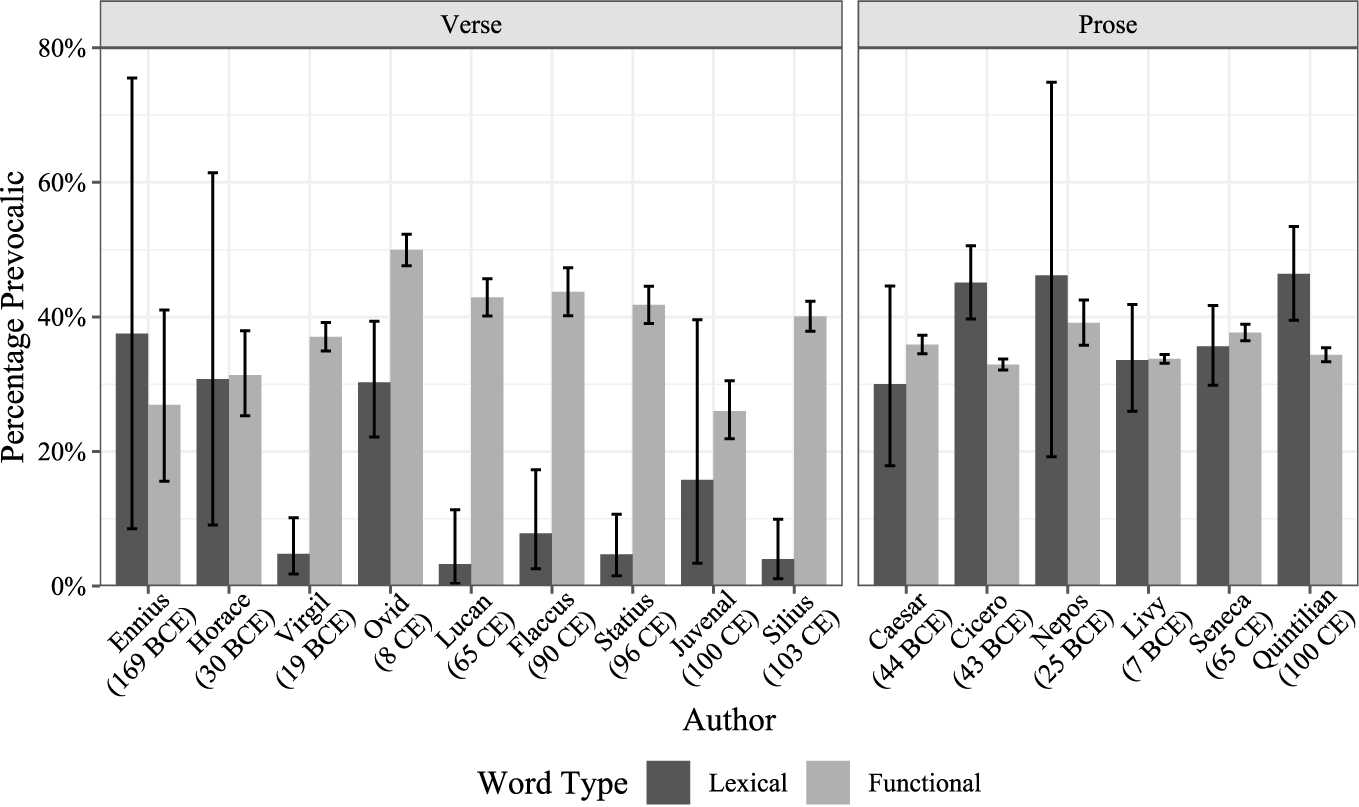
Despite the avoidance of degenerate feet in Virgil’s (and certain others’) hexameter corpora, such avoidance is not characteristic of Latin in general, judging by prose, nor is it found in the verse of all poets. Figure 1 shows the rate at which
 $\text{C}_0$
VC is found prevocalically for lexical versus functional words for several authors. As a sample of hexameter authors, I take (roughly chronologically) Ennius, Horace, Virgil, Ovid, Lucan, Valerius Flaccus, Statius, Juvenal and Silius Italicus. As a prose sample, I take Caesar, Cicero, Nepos, Livy, Seneca and Quintilian. Approximate end dates are provided in the figure.Footnote
12
The lists of prepositions and lexical words are the same as in §1. Prose corpora were split into lines by sentence punctuation.
Percentage of
 $\text{C}_0$
VC words that are prevocalic as opposed to preconsonantal, arranged by genre (labels at top), author (at bottom) and word type (shading). Within each genre, authors are arranged by rough termini ad quem, usually the end of the author’s life (to save space, ‘circa’ is omitted). Throughout, error bars are 95% confidence intervals based on the binomial.

As Figure 1 reveals, most of the hexameter corpora – with the exceptions of Ennius, Horace and possibly Juvenal – exhibit strong avoidance of lexical
 $\text{C}_0$
VC before a vowel, whereas none of the prose corpora does. In particular, hexametrists Virgil, Lucan, Valerius Flaccus, Statius and Silius Italicus nearly (though never categorically) forbid lexical
 $\text{C}_0$
VC in prevocalic position. Ovid likewise shows a significant difference between lexical and functional
 $\text{C}_0$
VC, though in his case, lexical
 $\text{C}_0$
VC remains frequent before vowels. The two earliest hexameter corpora examined here, by Ennius and Horace, exhibit no discernible avoidance of lexical
 $\text{C}_0$
VC before a vowel, though the error bars are large due to the small sizes of the corpora (just 515 lines in the case of Ennius). Ennius (c. 169 bce or earlier) is substantially earlier than the other authors, being the sole representative here of Old Latin.
It therefore appears that avoidance of lexical
 $\text{C}_0$
VC before a vowel is specific to verse, reflecting the poetic grammars of certain hexametrists.Footnote
13
These poetic grammars, I claim, possess a constraint forbidding feet in metrical subpositions: *SubPos
 $\supset $
Foot. (Because degenerate feet always project to degenerate PWds in Latin, *SubPos
 $\supset $
PWd would work equally well here.) This constraint belongs to a family of position size maxima (Hanson & Kiparsky Reference Hanson and Kiparsky1996). By excluding degenerate feet from subpositions, the constraint effectively excludes degenerate feet from anywhere in the line, as such feet already could not occur elsewhere, being light. To account for the varying strength of *SubPos
 $\supset $
Foot for different poets, the constraint could be weighted, as in Harmonic Grammar (Pater Reference Pater2009). A constraint against stress in subpositions would not be a viable substitute for *SubPos
 $\supset $
Foot. As discussed earlier in this section, stressed lights are not generally avoided in subpositions.Footnote
14
This analysis based on *SubPos
 $\supset $
Foot makes no predictions about degeneracy avoidance outside of verse. After all, subpositions are not found in prose (or, insofar as they might be found in clausulae, they need not be subject to the same constraints as in verse). Moreover, because different poets have different metrical grammars even for the same metre, *SubPos
 $\supset $
Foot need not be active, or active to the same degree, for every poet and every type of verse. Individual poets, even when part of the same metrical tradition, vary in their permissiveness of licences and their sensitivity to linguistic factors in ways that do not necessarily reflect differences of dialect (see e.g. Hayes et al. Reference Hayes, Wilson and Shisko2012 on the iambic pentameters of Shakespeare vs. Milton). In the present case, *SubPos
 $\supset $
Foot would have different weights for, say, Ovid and Virgil. But the lack of evidence for *SubPos
 $\supset $
Foot in Horace’s verse does not imply that Horace’s language lacks degenerate feet. It suggests only that his poetic grammar is insensitive to the category. Meters are not sensitive to every kind of linguistic structure available to the poet (consider the marginal role of pitch accent in most quantitative metres; e.g. West Reference West1987: 2; Arnold Reference Arnold1905: 6).
4. Varying stress propensities of function words
The previous section identified five hexametrists who strongly (but not categorically) avoid lexical
 $\text{C}_0$
VC before a vowel, namely, Virgil, Lucan, Valerius Flaccus, Statius and Silius Italicus. So far, I have employed prepositions as representative function words and nouns and verbs as representative lexical words. In this section, I consider additional word types of shape
 $\text{C}_0$
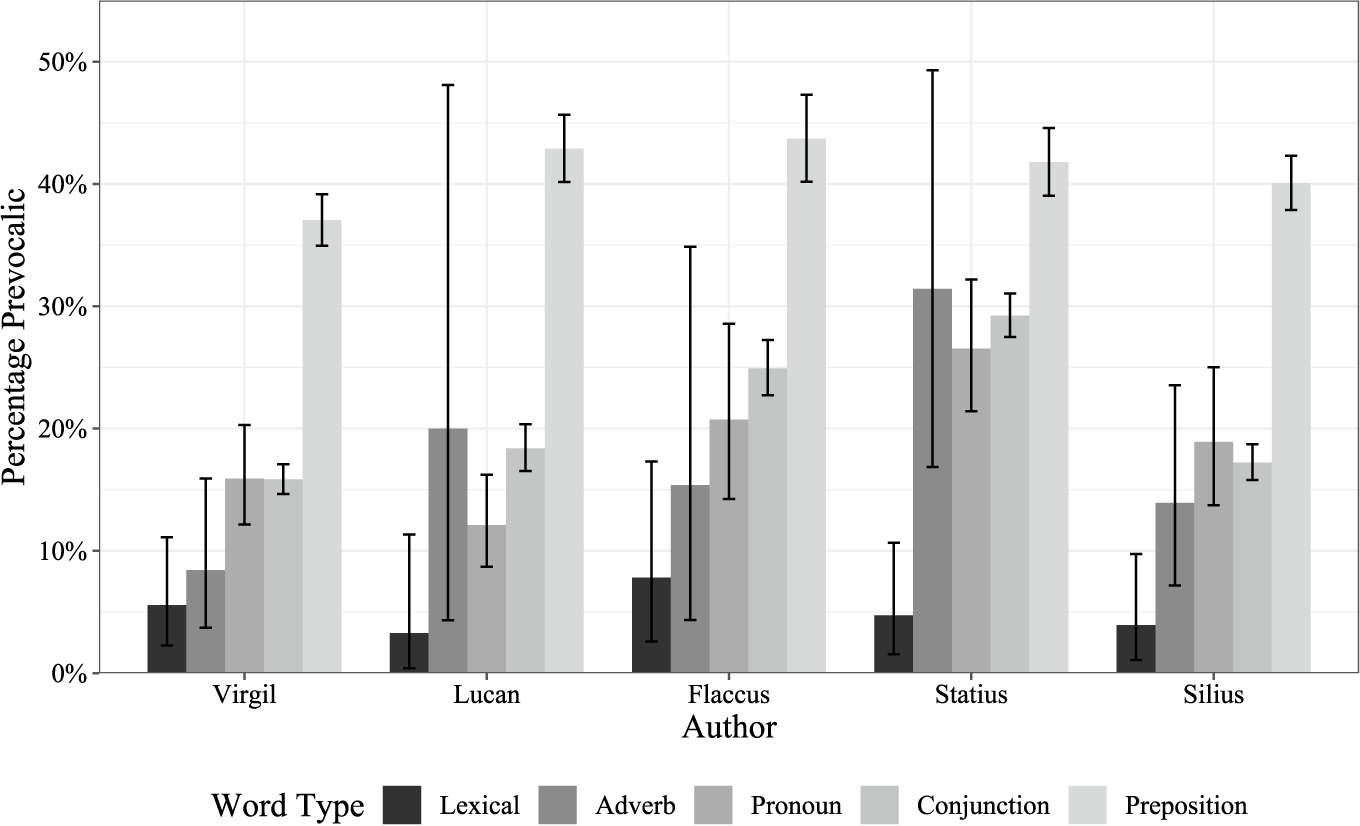
VC, namely, adverbs, pronouns and conjunctions. Here, adverbs include bis ‘twice’, sat ‘enough, well’ and ter ‘thrice’; pronouns include id ‘it’, quid ‘what’, quis ‘who’ and quod ‘which’; and conjunctions include an ‘whether’, at ‘yet’, et ‘and’, sed ‘but’, tot ‘so many’, ut ‘that’ and vel ‘or’. As Figure 2 shows, these additional types are intermediate in behaviour between lexical words and prepositions. Across authors, they are more vowel-avoiding than prepositions, but less vowel-avoiding than nouns or verbs. For most authors, the two contrasts just mentioned are significant, as the non-overlapping error bars in Figure 2 suggest.
Prevocalic rates of five word types for five hexameter authors. ‘Lexical’ here comprises nouns and verbs; adverbs are separate.

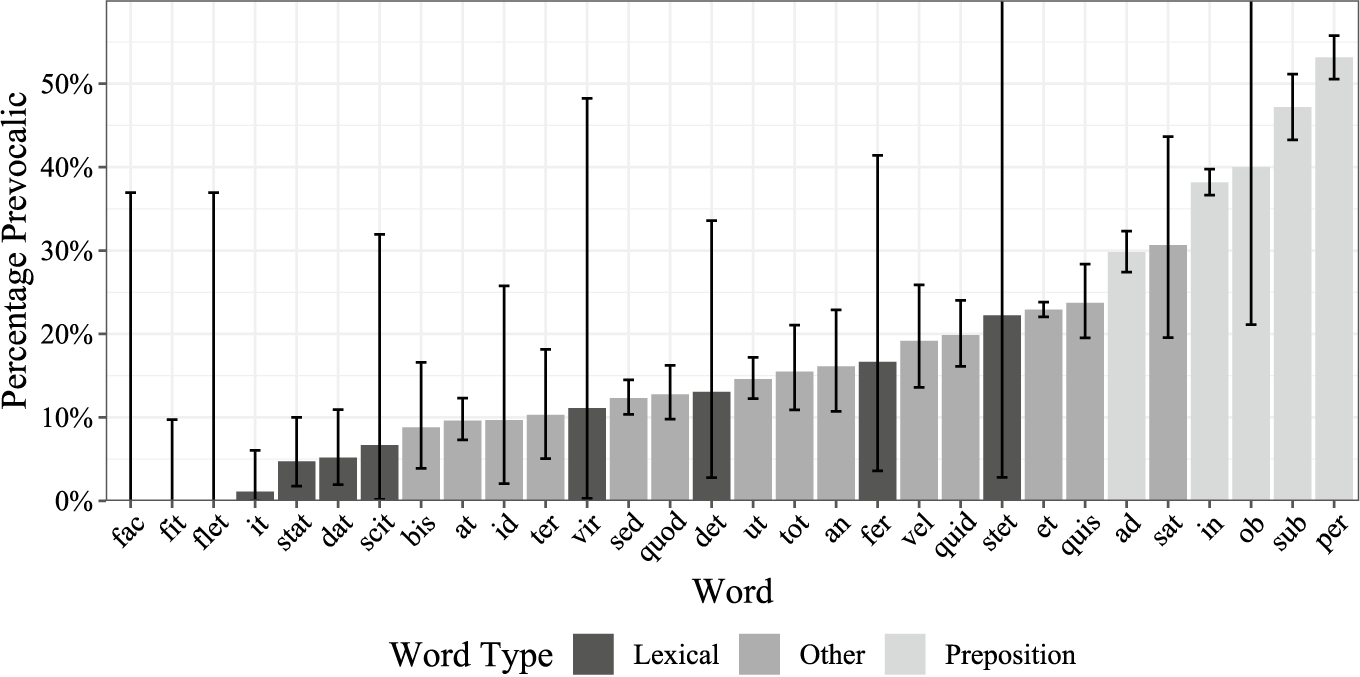
Figure 3 shows the rate for each individual word, combining the works of the five authors into a single corpus. The rarer the word (judging by its count in each author’s corpus), the larger its error bar. Note that some words that appear to be outliers for their category, such as stet ‘stand’ (subjunctive) for lexical words, are sparsely attested (
 $n=9$
in this case) and thus less reliable. Furthermore, categorisation is not always straightforward. Lexical words here include nouns and verbs; adverbs are kept separate. Among adverbs, bis ‘twice’ and ter ‘thrice’ pattern more like lexical words, whereas sat ‘enough, well’ patterns more like a preposition.
Prevocalic rates by word, pooling the corpora in Figure 2. Prepositions (lightest shading) tend to exhibit the highest rates, lexical words (i.e. nouns or verbs, darkest shading) the lowest. Other word types (adverbs, pronouns and conjunctions) tend to be intermediate.

On the present analysis, words’ varying rates of prevocalism reflect their varying propensities for stress. These stress propensities are general to the language – indeed, they are highly general across languages – and need not be stipulated by this analysis by, for instance, indexing *SubPos
 $\supset $
Foot to individual words. The different treatment of lexical versus functional words vis-à-vis stress and cliticisation has been treated extensively (Selkirk Reference Selkirk, Morgan and Demuth1996, Reference Selkirk, Goldsmith, Riggle and Yu2011; Truckenbrodt Reference Truckenbrodt and Lacy2007; Ito & Mester Reference Ito and Mester2019). Meanwhile, pronouns and conjunctions vary in stress, as determined in part by pragmatic factors such as focus, givenness, topic, demonstrativity and so forth (Lee et al. Reference Lee, Gordon and Büring2008). In sum, the range of prevocalic rates in Figure 3 reflects a ‘cline of clisis’, to use the term from Gunkel & Ryan (Reference Gunkel and Ryan2017). The more likely a
 $\text{C}_0$
VC word is to be stressed, the more it will be avoided prevocalically, as it is only stressed
 $\text{C}_0$
VC words that incur violations of *SubPos
 $\supset $
Foot under resyllabification.
5. Degeneracy avoidance in the Ancient Greek hexameter
Like Latin, the Ancient Greek hexameter, as represented here by the Iliad and Odyssey, distinguishes degenerate feet from other light syllables. The basic template for the metre is the same as in (5), though Greek, unlike Latin, is a pitch accent language. I assume, following most modern analyses, that Ancient Greek word prosody – not just its poetic metrics – is organised around feet, which are invoked to motivate pitch accent placement, prosodic minimality, syllable timing and other phenomena (Steriade Reference Steriade1988; Sauzet Reference Sauzet1989; Golston Reference Golston, Myers and Pérez1990; Devine & Stephens Reference Devine and Stephens1994; Blumenfeld Reference Blumenfeld2004, Reference Blumenfeld2011; Sandell Reference Sandell2020; but cf. Steriade Reference Steriade2014). Here, all that is relevant is that monosyllables can be footed, normally so as lexical words, and sometimes as function words, just as in Latin and other languages.
As before, the present concern is monosyllables of the shape
 $\text{C}_0$
VC. Short-voweled monosyllables exhibit three accentual patterns, namely, acute (high or rising), grave (lowered or cancelled high; cf. Devine & Stephens Reference Devine and Stephens1994; Probert Reference Probert2003, Reference Probert2006) and none (certain clitics). An accented monosyllable is acute when at the end of an intonation group or hosting an enclitic; otherwise, it is grave. Regardless of accent and word type, resyllabification normally applies in
 $\text{C}_0$
VC#(h)V throughout the line, as confirmed by scansion.
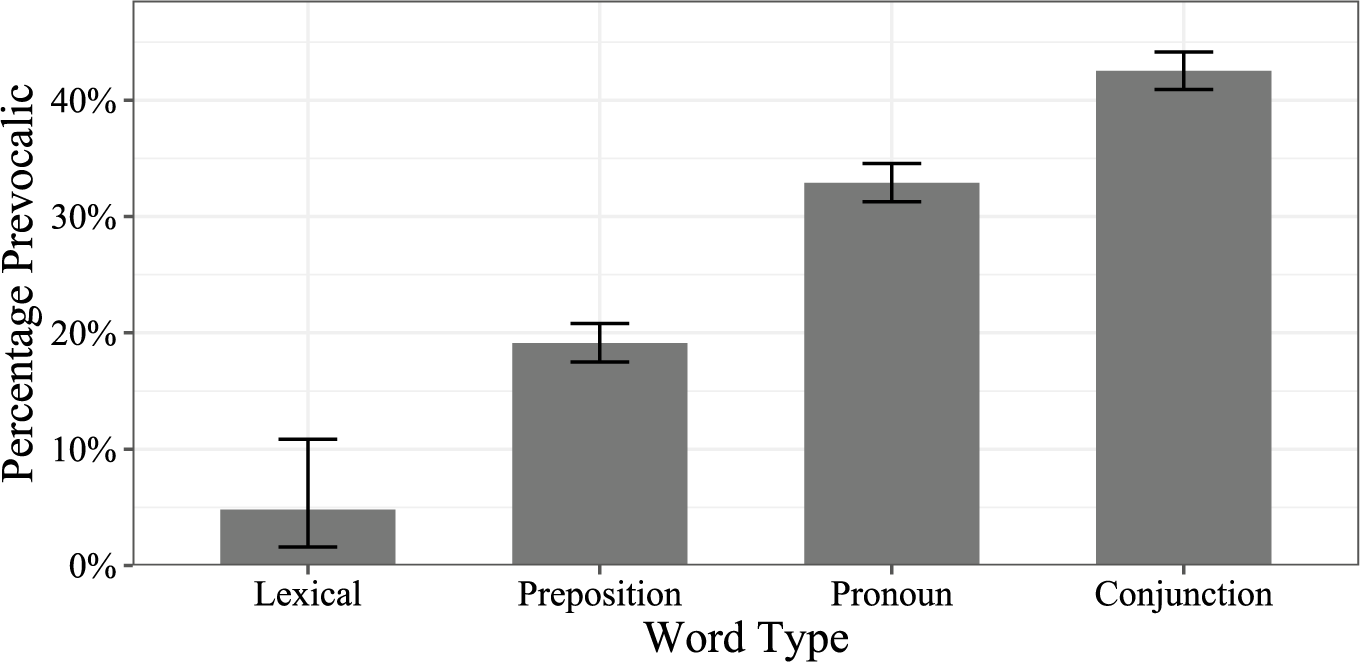
Figure 4 shows prevocalic rates of monosyllables in the combined Homeric corpus, aggregated by word type (lexical, pronoun, preposition or conjunction). The corpus and word lists were prepared as follows. The two Greek texts were downloaded from the Perseus Digital Library.Footnote
15
Repeated lines were removed after the first instance. All words of shape
 $\text{C}_0$
VC were taken as data, excluding those with long vowels (even when length is not orthographically apparent, as with some alphas, iotas and upsilons), apocopic forms such as pot’ (for pote ‘at some time’) and allomorphs confined to preconsonantal or prevocalic position (e.g. kád for katá ‘against’ before d). The emphatic enclitic per was excluded because it does not fit well with any of the categories in the figure.Footnote
16
Finally, any token of prevocalic
 $\text{C}_0$
VC scanning as heavy was excluded.Footnote
17
Prevocalic rates for Greek monosyllables, aggregated by word type.

After these exclusions, the following
 $\text{C}_0$
VC words remain. Lexical words include bán ‘go, mount’, dós ‘give’, phán ‘speak’, phthán ‘come’, stán ‘stand’ and thés ‘put’.Footnote
18
Because there is only one adverb, trís ‘thrice’, and it patterns with the lexical words, the adverb is counted as lexical in this section. Pronouns include hén ‘one’, min ‘him/her/it’, són ‘your’, sós ‘your’, sphin ‘for them’, tís ‘who’, tis ‘someone’ and tón ‘him’. Prepositions include en ‘in’, es ‘into’, ksún ‘with’, prós ‘towards’ and sún ‘with’. Finally, conjunctions include án (modal particle), gár ‘for, since’, ken (modal particle), mén ‘whereas’ and tár ‘and so’.
As Figure 4 reveals, lexical
 $\text{C}_0$
VC words, unlike the other word types, are almost categorically avoided before vowels. Their prevocalic incidence is 4.8% (5 of 104 tokens), almost exactly matching Virgil’s rate of 5.0% (6 of 119 tokens) in (11) and that of several other Latin hexametrists in Figure 1. The analysis is likewise the same. Due to Max(lex,
 $\omega $
), a lexical word, regardless of accent, must correspond with a PWd. If the lexical word is
 $\text{C}_0$
VC and prevocalic, the PWd is rendered light by resyllabification, as in (17). The resulting syllable, being light, cannot occupy any position in the metre that requires a heavy syllable. But it also cannot occupy a light-requiring subposition, given *SubPos
 $\supset $
Foot (weighted as necessary to permit exceptions). It follows that degenerate feet are disfavoured throughout the hexameter.

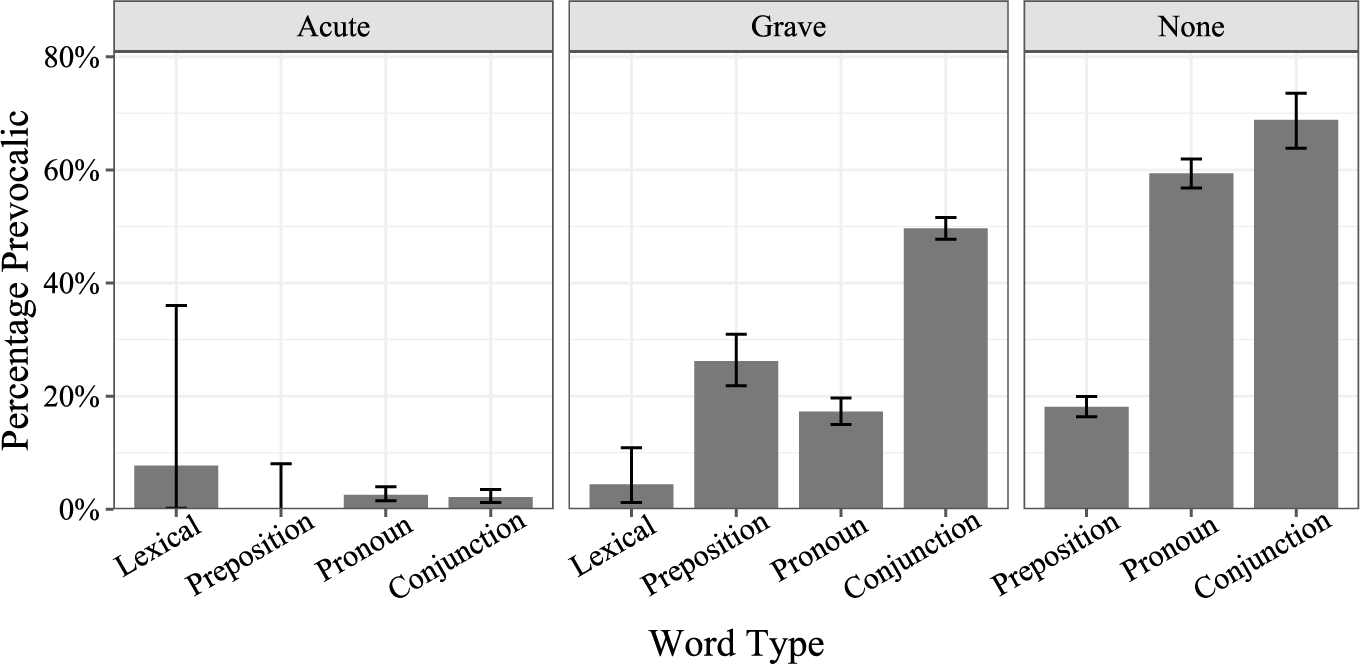
The presence of pitch accent in Greek raises a possible confound for this analysis that I now address. Hypothetically, one could imagine that lexical monosyllables might be more likely to be acute than other monosyllables and that it might be their acuteness rather than their lexicality driving their underrepresentation before vowels. Figure 5 breaks down word type by accent type, showing that accent type does matter, but not in a way that undermines the generalisation just posited. To wit, two generalisations are now evident: first, lexical
 $\text{C}_0$
VC is avoided prevocalically regardless of accent (acute or grave), as already stated. Second, acute
 $\text{C}_0$
VC is avoided prevocalically regardless of word type. Even
 $\text{C}_0$
VC function words are nearly unattested before vowels when they are acute.
Prevocalic rates for Greek monosyllables, grouped by accent type (top) and word type (bottom).

Analysing this second generalisation is beyond the scope of this article, but possibly represents another way in which degenerate words are avoided in subpositions. Recall that monosyllables are acute in two contexts, namely when final in an intonation group and when hosting an enclitic.Footnote 19 Both contexts have been analysed in other languages as being associated with prominence. First, Selkirk (Reference Selkirk, Morgan and Demuth1996) and Ito & Mester (Reference Ito and Mester2019) treat the non-reducibility of function words when final in the phonological phrase in English. Second, clitics are pre-stressing (requiring their host to be footed) in some languages (Mester Reference Mester1994). That said, I leave these matters in Ancient Greek to future research. What is important here is that the lexicality gradient persists even when accent is controlled, as with grave accent in Figure 5.
Finally, as in Latin, beyond lexical categories, individual Greek
 $\text{C}_0$
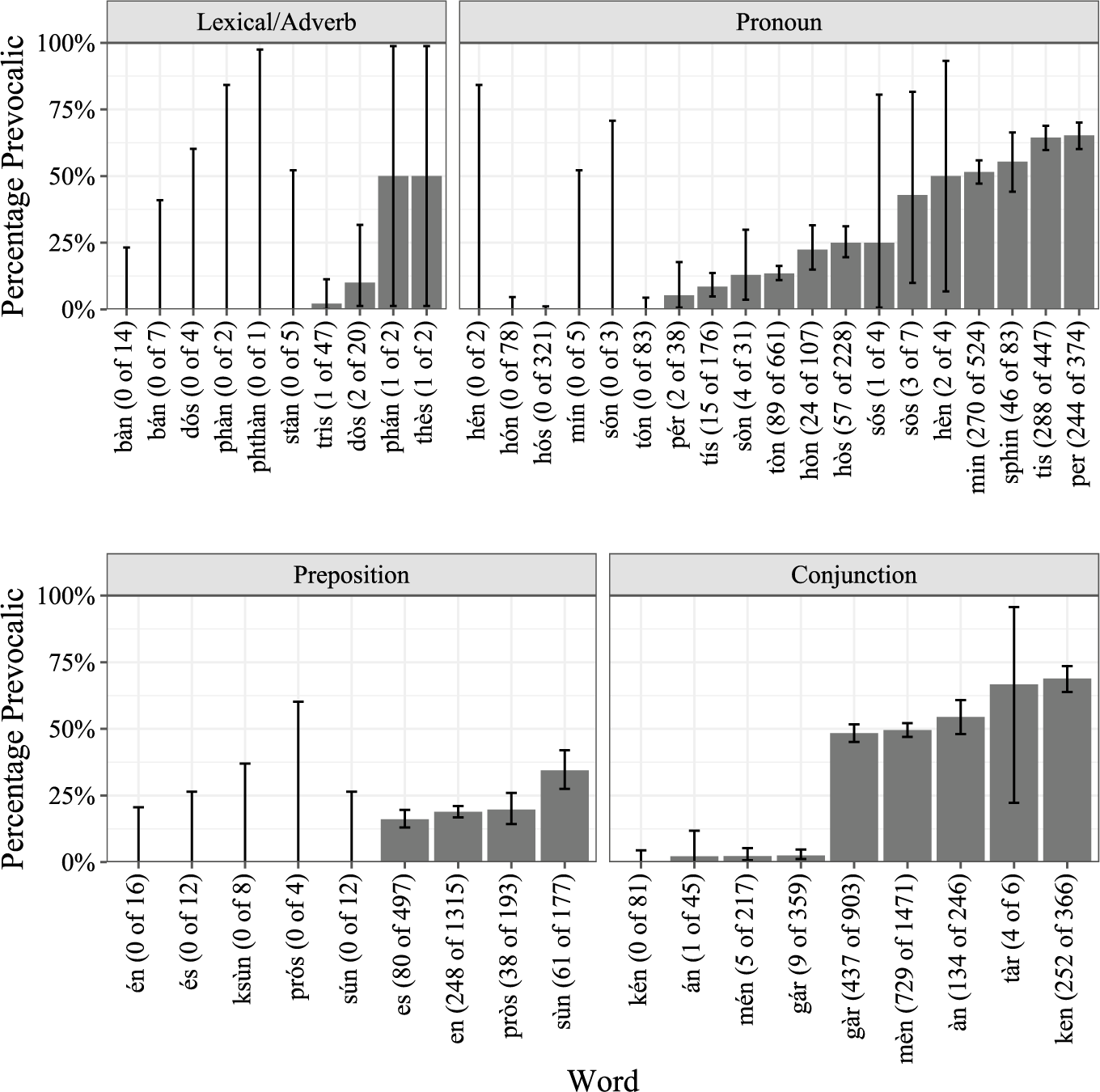
VC words vary in their prevocalic propensities, presumably reflecting varying propensities to be stressed. Figure 6 shows the rates for individual monosyllables in Greek. Note that each word has a separate entry for each accent pattern that it takes. For example, tís ‘who’, which is rarely prevocalic, is separate from tis ‘someone’, which is often prevocalic.
Prevocalic rates for Greek monosyllables, showing individual words. The labels at bottom also indicate the prevocalic and total frequencies of each word. The bimodality within conjunctions (and to some extent within the other categories) can be motivated by acute versus non-acute accent, as addressed by the previous figure: if a
 $\text{C}_0$
VC conjunction (or other word type) is acute, it is unlikely to immediately precede a vowel.

6. Discussion
A degenerate foot, despite being a kind of light syllable, is penalised in light-requiring positions in metre, being nearly banned by some poets. The present analysis does not maintain that the poets avoid degenerate feet simply because such feet are marked. (If that were the case, there would be no explanation for why the poets avoid one type of marked structure but not numerous others, nor would there be an explanation for the confinement of the avoidance to verse.) Rather, the poets avoid degenerate feet because they exceed the tolerance of a light-requiring metrical position. That is, a light-requiring position (subposition in this case) cannot dominate a prosodic category higher than the syllable.
Such avoidance is phonetically natural in the sense that a degenerate foot is presumably the longest type of light syllable in the language. At least three factors potentially conspire to make degenerate feet longer than other light syllables in Latin and Greek. First, on the present analysis, a degenerate foot arises only in a monosyllable, and monosyllables tend to be longer cross-linguistically than syllables that are part of longer words and therefore subject to polysyllabic shortening (Lehiste Reference Lehiste1970; Mori Reference Mori2002; Braver & Kawahara Reference Braver and Kawahara2014). Second, degenerate feet are stressed, and stressed syllables tend to be longer than their unstressed counterparts, as evidenced in Latin by reductive sound changes (Weiss Reference Weiss2020: 119–132). Finally, degenerate feet, being always word-final on this analysis, have the potential to undergo phrase-final lengthening (cf. Delattre Reference Delattre1966; Lindblom Reference Lindblom1968; Wightman et al. Reference Wightman, Shattuck-Hufnagel, Ostendorf and Price1992), whereas non-word-final light syllables lack this potential.
With this phonetic rationale in mind, this section briefly addresses the viability of alternative possible analyses of the avoidance of stressed
 $\text{C}_0$
VC#V in verse that do not depend on the foot. First, as mentioned in §3, *SubPos
 $\supset $
PWd would work just as well as *SubPos
 $\supset $
Foot here, since degenerate feet are always coextensive with degenerate PWds on this analysis. Thus, if one rejects the foot but not the PWd, an alternative is available that trivially modifies the present analysis.
Consider next a purely grid-based approach, without any bracketing for feet or PWds. As (18) illustrates, the avoidance of stressed
 $\text{C}_0$
VC#V does not reflect the avoidance of a particular rhythmic configuration, at least not one expressed by the standard grid. For example, avoided type (18a) dat amīca has the same rhythmic profile as unavoided type (18b) data porta. To address the excessive crudeness of the traditional grid, one might pursue one of two strategies, invoking either monosyllabicity or phonetic duration.

First, consider a constraint like *SubPos
 $\supset $
StressedMono ‘a subposition cannot contain a stressed monosyllable’. The first issue with this constraint is that it defeats the intent of the purely grid-based strawman by invoking what can only be construed as a type of PWd, namely, the monosyllable. As just discussed, if one allows reference to the PWd, then a constraint like *SubPos
 $\supset $
PWd suffices, which has the effect of excluding degenerate PWds from the hexameter without invoking monosyllabicity. Another objection to an analysis in terms of *SubPos
 $\supset $
StressedMono is that it stipulates the description, giving up a fair amount of restrictiveness in so doing. For instance, the constraint *SubPos
 $\supset $
StressedMono implies the simpler constraint *SubPos
 $\supset $
Mono, banning all monosyllables from subpositions. I am not aware of such a metre.Footnote
20
The *SubPos
 $\supset $
Foot analysis, in which a position type exhibits a prosodically defined maximum (Hanson & Kiparsky Reference Hanson and Kiparsky1996), avoids such overgeneration. ‘Monosyllable’, not being a prosodic category, is not available as a predicate.
A final possible line of analysis that eschews the foot is to refer directly to (normalised) phonetic duration, defining duration ranges for metrical positions (cf. Flemming Reference Flemming2001; Ryan Reference Ryan2014). On such an approach, stressed monosyllables would exceed the durational tolerance of a light-requiring position. Restrictiveness, once again, is a concern. For example, if the cutoff for light positions can be drawn at whichever point is necessary to preclude stressed monosyllables, what prevents other cutoffs, such as excluding stressed monosyllabic
 $\text{C}_0$
V, but only if the vowel is low? Another concern is the abstract computation of duration, that is, normalisation. For example, one would presumably not want positional tolerances to vary as a function of speech rate, as raw duration would predict. Moreover, categories tend to overlap. For instance, the shortest heavies are often shorter than the longest lights, even when considering mean durations (Hayes Reference Hayes, Darnell, Moravscik, Noonan, Newmeyer and Wheatly1999; Gordon Reference Gordon2002). Thus, a structure-free approach appears to be a non-starter. That said, poetic practice can be sensitive to fine-grained phonetic detail (Ryan Reference Ryan2011), leaving open the question of how best to integrate phonetic and phonological phenomena in metrics.
7. Conclusion
In Latin and Ancient Greek, lexical monosyllables of the shape
 $\text{C}_0$
VC remain PWds when they undergo resyllabification, thereby becoming degenerate feet. Verse evidence confirms that such monosyllables retain their stress even while becoming light. PWd minimality (here in the form of FtBin) is thus conditional in these languages, being suspended under certain conditions in a phrasal context. As discussed in the introduction, however, not all languages with PWd minima and resyllabification permit phrase-internal violations of minimality like Latin and Greek do.
Hexametrists in both the Latin and Greek traditions avoided degenerate feet in their verse due, I maintain, to a constraint against a subposition dominating a foot. Meanwhile, prevocalic lexical
 $\text{C}_0$
VC was permitted freely outside of verse, revealing that the languages in general tolerated degeneracy. Beyond lexical words, as this article recognises, function words vary in their propensities to be stressed. The more likely a
 $\text{C}_0$
VC function word is to be stressed, the more it is avoided before a vowel in the hexameter, reflecting the same degeneracy effect observed more rigidly for lexical words. With this new evidence for degenerate feet being induced by resyllabification in languages that otherwise do not permit degeneracy, the degenerate foot receives additional support, being more widely distributed in the typology than previously acknowledged.
Acknowledgements
I would like to thank three anonymous referees for their careful reading of the submission. Additionally, though they did not see any version of this article, parts of it benefited from earlier input by Dieter Gunkel, Bruce Hayes, Donca Steriade, Brent Vine, Kie Zuraw and audience members at NELS 41 at the University of Pennsylvania in 2010.
Competing interests
The author declares no competing interests.