


1. Introduction
Both in popular media and within the academic press it is common to read that particular traits have a largely ‘genetic’ basis. It is assumed that this term implies some form of genetic causation, yet the causal concept invoked is underspecified, and thus the exact meaning of such assertions is not immediately clear. These types of claims form part of the ‘nature-nurture’ debate, where the relative importance of genes and the environment continues to be a controversial subject of discussion.
Usually, assertions of this form are derived from heritability estimates, using the quantitative genetic method of apportioning the ‘genetic’ and ‘environmental’ influences on a phenotype. Under a heritability framework, ‘nature’ has traditionally been interpreted as corresponding to genetic differences, and ‘nurture’ to differences in the environment (Tabery Reference Tabery2014). In simple cases, a high heritability estimate is meant to correspond to some notion of genetic causation or determination of trait variation (Fisher Reference Fisher1918, 399; Block Reference Block1995, 116; Lynch and Walsh Reference Lynch and Walsh1998, 13; Sesardic Reference Sesardic2005, 22). However, heritability can be challenged by the presence of two ‘nonadditive’ factors. The first is gene-environment interaction, which occurs when the effect of genetic differences varies depending on environmental differences (and vice versa). This limitation is routinely factored into heritability estimates (Falconer and MacKay Reference Falconer and MacKay1996) and has been relatively well studied in philosophical contexts (for a recent and comprehensive example, see Tabery [Reference Tabery2014]). The second involves situations that encompass complicated causal stories, such as those leading to a correlation between genes and environment. These cases can yield a high heritability for a trait that, in an intuitive sense, does not appear to have its variation caused genetically. The problem of gene-environment covariance (G-E covariance) has led many (e.g., Jencks et al. Reference Jencks, Smith, Acland, Bane, Cohen, Gintis, Heyns and Michelson1972; Block and Dworkin Reference Block and Dworkin1974; Jencks Reference Jencks1980; Block Reference Block1995; Gibbard Reference Gibbard, Wasserman and Wachbroit2001; Sober Reference Sober, Wasserman and Wachbroit2001) to conclude that heritability analyses are a useless tool for causal inquiry or, at the least, do not accord with commonsense ascriptions of what counts as ‘genetically caused’. For instance, Jencks (Reference Jencks1980, 723) asserts that “until we know how genes affect specific forms of behavior, heritability estimates will tell us almost nothing of importance.”
This article aims to evaluate heritability measures as causal claims by examining different notions of the terms ‘genotype’ (which links to ‘genetic’, ‘genetically caused’, or ‘caused by genes’), ‘phenotype’, and ‘environment’. These distinctions are especially pertinent in regard to cases that involve G-E covariance. We show that the current uses of these terms for interpreting heritability estimates are muddled, and by proposing a new account of these concepts, a consistent interpretation of heritability estimates that involve G-E covariance can be salvaged to allow one to make consistent causal claims.Footnote 1 Specifically, we will argue (1) that some cases that have classically been considered as different kinds of G-E covariance have the same causal structure and should be understood in the same way. (2) In these cases, because the causal origin of the G-E covariance can be traced to genotypes, G-E covariance should be incorporated in measures of heritability.
To do so, we begin by introducing heritability in section 2 and the notion of G-E covariance and its different types in section 3. We show that two different types of G-E covariance (active and reactive) conform to the same underlying causal structure, despite their traditionally different causal interpretations. In section 4 we outline two ways in which the terms ‘genotype’, ‘environment’, and ‘phenotype’ can be interpreted and propose a framework of our own for the interpretation of heritability. In section 5 we apply this framework to the cases introduced in section 3. Finally, in section 6, we argue that although this results in some cases appearing unintuitive in their causal interpretation, these can be alleviated once the associations between ‘heritability’ and ‘nature’, ‘immutability’, and ‘moral responsibility’ are dispelled. We support this idea with reference to literature on causal reasoning in which moral responsibility plays a role in people’s folk causal judgments.
2. Heritability
There are several existing approaches to heritability (see Jacquard Reference Jacquard1983; Downes Reference Downes and Zalta2009; Bourrat Reference Bourrat2015; Bourrat and Lu, Reference Bourrat and Luforthcoming), but for the purpose of this article we focus on one particular approach known as the variance approach. This is the method classically used in behavioral genetics (Plomin et al. Reference Plomin, DeFries, McClearn and McGuffin2008), which is the main target of our article. Under this approach, heritability (H 2) is defined as a measure of the variation in a trait T,Footnote 2 due to variation in the genotype G rather than variation in environment E, within a given population of individuals. Variation is represented by the statistical notion of variance, and heritability thus corresponds to the proportion of the total variance of the trait (VT) that is due to the genotypic variance (VG). Variance VT is supposed to be the sum of VG and VE (the environmental variance), assuming there is no correlation or interaction between genes and environment:

and

Within the variance approach two definitions of heritability are commonly used. Equation (2) represents a definition of broad-sense heritability (H 2), which is the notion of heritability employed by behavioral geneticists, for whom “the measure of broad heritability is used in relation to psychological traits, because total genetic contribution to these traits is of interest” (Oftedal Reference Oftedal2005, 702; see also Jensen Reference Jensen1976, 88; Sesardic Reference Sesardic2005, 21). A different heritability concept is narrow-sense heritability (h 2), which is used by biologists concerned with evolutionary theory and selective breeding and is not the focus of this article. For more on this concept and how it relates to H 2, see Falconer and MacKay (Reference Falconer and MacKay1996).
While equation (2) is exact in its expression, this formulation of heritability encounters two difficulties in causal interpretation. The first is linked to its statistical nature. In the context of heritability, equation (2) does not lead to a clear picture of how Variance in genotype (VG) ‘causes’ trait variation (VT). This definition alone only states that there is a relation of association between the two terms. This issue is especially pertinent in cases in which there exists a covariance between genotypes and environments,Footnote 3 and thus between VG and VE. This phenomenon is not represented in equation (2), where independence of G and E has been assumed, but it is described and formulated in section 3 below. Such covariance generally leads to difficulties in interpretation for a given heritability estimate, as the attained value may not intuitively correspond to folk notions of genetic cause or determination, and intuitions of this type appear to differ between individuals (Block Reference Block1995). This will be explored in more detail in section 3.
Second, this formulation does not explicitly state where and how to draw the distinction between genotypes, a genotype’s effect on a trait, the environment, and the environment’s effect on a trait. This means that by holding different intuitions or implicit concepts on where to draw these conceptual distinctions, one can in principle obtain very different estimates of heritability for the same population. In some cases of G-E covariance, the representation of a genetic effect and an environmental effect can easily be conflated.
In the remainder of this article we show that previous attempts to provide a rational way of estimating heritability when G-E covariance exists have either excluded important phenotypes or relied heavily on intuitions and ‘common sense’. After presenting these attempts, we show that there is a more general and principled way to do so. This approach, instead of relying on intuition, uses a clear rationale based on explicit and nonoverlapping definitions of ‘genotype’, ‘phenotype’, and ‘environment’.
3. Gene-Environment Covariance
G-E covariance occurs when there is an association between the genotype of individuals and their environment,Footnote 4 which leads to an association between variation in genotype (VG) and variation in environment (VE) within a population.Footnote 5 When the assumption of nil G-E covariance is relaxed, (1) must be rewritten as follows:Footnote 6

Provided that variation in genotypes and variation in the environment are the sole causal factors responsible for trait variation, the presence of a non-nil covariance term in (1′) provokes the question whether this term should be causally attributed to variation in genotypes (VG), and thus incorporated into the estimation of heritability, or else causally attributed to variation in the environment (VE). We contend that under the most consistent interpretation, if the causal origin of the covariance is environmental, then the G-E covariance should not be included in the heritability estimate, while if the causal origin is genotypic, it should be included. In more formal terms, we can provisionally separate the covariance term as follows:

where 2Cov(G, E)G corresponds to G-E covariance with a genotypic causal origin and 2Cov(G, E)E corresponds to G-E covariance with an environmental causal origin. In section 5 we demonstrate that this separation is not an artificial one.
We can then replace equation (3) in equation (1′) as follows:

which leads heritability to be defined as

We will argue that, when applying the consistent causal approach proposed below (sec. 4), equation (2′) can be used as a basis for heritability estimates when used to make causal claims. But before we get to this, we introduce different types of G-E covariance as they are classically separated: into passive, active, and reactive forms (Plomin, DeFries, and Loehlin Reference Plomin, DeFries and Loehlin1977). We then show that the way in which some of these cases are causally interpreted is disputed among theorists and that different cases with the same causal structures, namely, reactive and active G-E covariance, have sometimes received different causal interpretations.
3.1. Passive Gene-Environment Covariance
Individuals who are raised by their biological parents inherit from them not only their genes but also part of their environment. For example, parents with high IQs tend to not only pass on a genetic endowment to their children but also shape their children’s environment to allow better development of some phenotypes, such as intelligence.Footnote 7 Often the developmental environment shaped by parents is in part determined by the parents’ genotype, which results in a covariance between the parental genotype and developmental environment. In a population, this results in passive G-E covariance (Plomin et al. Reference Plomin, DeFries and Loehlin1977) because the shaping of the child’s environment is in no way due to his or her own genotype but is instead due to the actions of his or her parents (based on their genotypes).
Passive G-E covariance is not extensively discussed in the context of this article because there is a general consensus in the literature with which we agree that any variation that is accounted for by an inherited environment should be subsumed under VE (Roberts Reference Roberts and Hirsch1967; Block Reference Block1995; Sober Reference Sober, Wasserman and Wachbroit2001; Sesardic Reference Sesardic2005). We concur with the consensus on the passive case because the causal origin of the covariance is not the variation in genotype of the individuals measured but variation in that of their parents. This means that in the context of broad-sense heritability it would not make sense to consider any resulting phenotypic variance from passive G-E covariance as caused by VG and thus to include it in a heritability estimate.Footnote 8 This kind of consensus does not exist for active cases, for which interpretation is subject to debate and as such is in need of further analysis (discussed below).
3.2. Reactive Gene-Environment Covariance
Reactive G-E covariance occurs when an individual’s developmental environment is altered by others as a result of the subject’s original genetic difference (Plomin et al. Reference Plomin, DeFries and Loehlin1977). Extreme versions of this phenomenon have been illustrated via a macabre series of thought experiments in which society singles out children with red hair and subjects them to abuse on the basis of their hair color. The children are starved (Block and Dworkin Reference Block and Dworkin1974), beaten (Sesardic Reference Sesardic2005), or in a comparatively kinder scenario denied educational access (Jencks et al. Reference Jencks, Smith, Acland, Bane, Cohen, Gintis, Heyns and Michelson1972). As a result of the abuse, other phenotypes in these children are affected, such as reading scores (Jencks et al. Reference Jencks, Smith, Acland, Bane, Cohen, Gintis, Heyns and Michelson1972), IQ (Sesardic Reference Sesardic2005), and height (Block and Dworkin Reference Block and Dworkin1974). To further illustrate, here are the details of one of the (less extreme) examples: “If, for example, a nation refuses to send children with red hair to school, the genes that cause red hair can be said to lower reading scores. … If an individual’s genotype affects his environment, for whatever rational or irrational reason, and if this in turn affects his cognitive development, conventional methods of estimating heritability attribute the entire effect to genes and none to environment” (Jencks et al. Reference Jencks, Smith, Acland, Bane, Cohen, Gintis, Heyns and Michelson1972, 66–67). In reactive G-E covariance cases, genotypic differences that manifest themselves physiologically (e.g., hair color) result in individuals’ being exposed to different kinds of environments. Thus, there is a covariance between an individual’s genotype and environment, and in a population, of VG and VE. In Jencks’s example, a heritability analysis would attribute variation in genotype as a cause of variation in reading scores, through this environmental reaction (which varies between genotypic groups).
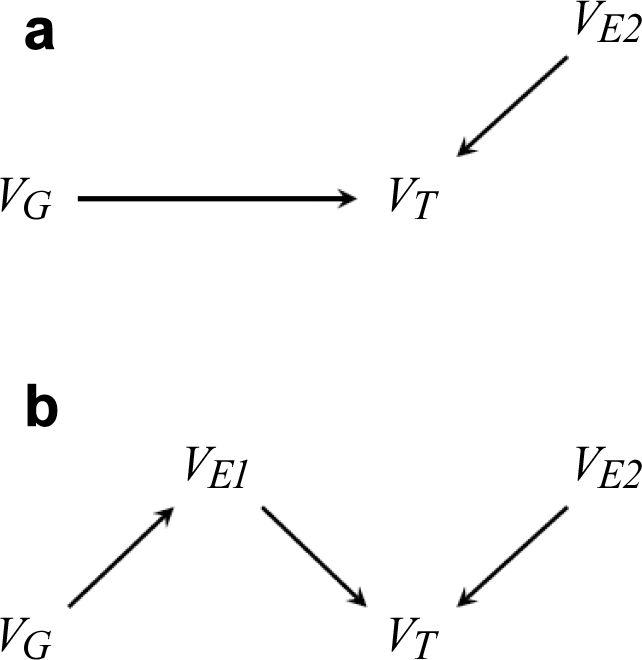
Figure 1 illustrates the causal structure of these kinds of scenarios, where VG can causally influence VT in two different ways (which may simultaneously occur; see n. 9). In both figure 1a and figure 1b variation in genotype (VG) leads to differences in hair color, which causes variation in reading scores (VT), and variation in the external environment, such as nutrition ( ), also has a causal influence on VT. The difference between the cases is that in figure 1a, there is no G-E covariance: VG and
 influence VT along independent causal chains. In figure 1b, VG acts independently of
 but also influences VT via
 —a part of the environment that differs between individuals because of a reaction to differences in genotype (VG).Footnote 9 We call
 ‘variation in the intermediate environment’ and
 ‘variation in the independent environment’. This gives us

where ET is the total environment of an organism.Footnote 10
Causal structures underlying active and reactive gene-environment covariance cases: a, no G-E covariance is present and VG causes VT directly; b, VG causes (and thus covaries with)  and in doing so indirectly causes VT.

The reason for a focus on these kinds of hypothetical examples has been the practical impossibility of estimating active and reactive G-E covariance in human populations. Plomin et al. (Reference Plomin, DeFries and Loehlin1977, 321) summarize this point in their seminal paper on G-E covariance: “Because it is not possible to measure all aspects of the environment (including everybody and everything) that might correlate with children’s genotypes, it will probably never be possible to assess completely the effects of active and reactive genotype-environment correlations.”Footnote 11
3.3. Active Gene-Environment Covariance
Active G-E covariance occurs when VG is correlated with some environmental factor that is due to the motivation of the individual possessing the genotype (Plomin et al. Reference Plomin, DeFries and Loehlin1977). In these examples individuals modify their own environment, on the basis of some genetic predisposition to do so. As with the reactive cases, genetic correlations with the environment can lead to an altered heritability estimate, where any resulting phenotypic variance is accounted for by VG, despite the causal work done by mediating environmental variance ( ).
To illustrate this type of G-E covariance, imagine an experiment in which IQ is found to be highly heritable. In this study children with genotype G 1 performed substantially better than those with G 2, and those in turn outperformed G 3 children (it is assumed in this example that variation in independent environments across the genetic groups makes a negligible contribution). Now imagine that there is allelic variation in this population at a hypothetical book-smell-preference locus leading to differences across the three genotypes: G 1, G 2, and G 3. Because of this genetic variation, G 1 children particularly enjoy the musty smell of books and thus are compelled to seek out and surround themselves with books. Conversely, G 3 children cannot stand the smell of books and actively avoid them. Finally, G 2 children are indifferent to the odor. As a result, differences in odor preference lead G 1 individuals to develop in a different, more book-filled environment than those with G 2 and G 3 genotypes.
Because of the constant surrounding of books, G 1 children will spend, on average, a larger amount of time reading and learning from books than the others. This leads to variation in the environment (VE) between G 1, G 2, and G 3 children. This extra reading and learning through books aids the G 1 children in the skills needed to perform in IQ tests, and as a result they are measured as being more intelligent than those who have G 2 or G 3 genotypes. As such, VG accounts for a large amount of VT, resulting in a high heritability estimate. Whether this covarying VG should be included is subject to debate, which is covered in section 3.4 below. In this case VT that is accounted for by VG corresponds to the causal structure presented in figure 1b. Like in the reactive case, the resulting phenotypic variance accounted for by VG is entirely mediated through ‘intermediate’ environmental variance.
3.4. Current Interpretations of Active and Reactive Gene-Environment Covariance
Examples of reactive G-E covariance suggest that the differential treatment of an individual on the basis of some expression of genetic difference (be it skin color, hair color, gender, etc.) can play a part in the apparent heritability of other phenotypes. When discrimination is triggered by the manifestation of an initial genetic difference, then the consequences of this discrimination will appear as genetic in a heritability estimate. Despite this, there is widespread agreement that the resulting phenotypic variance should be attributed to VE rather than VG. As such, reactive G-E covariance cases are be used as a criticism of heritability estimates (Block and Dworkin Reference Block and Dworkin1974, 52; Jencks Reference Jencks1980; Gibbard Reference Gibbard, Wasserman and Wachbroit2001, 194; Sober Reference Sober, Wasserman and Wachbroit2001, 76). For these authors, proximate environmental causal variables such as abuse and discrimination (which we have labeled as  ) have been said to completely explain the phenotypic differences (Sesardic Reference Sesardic2005, 90). Following this interpretation, any reactive G-E covariance should not be subsumed under genetic variance and thus eliminated from heritability estimates. As a result, in reactive cases, equation (2) rather than (2′) presented in section 2 is used to measure heritability.
Because of their identical causal structure (fig. 1), one might expect to find symmetric causal interpretations for both active and reactive G-E covariance. However, while there is widespread agreement on how to interpret reactive cases, how to interpret active cases remains controversial. Some feel that the resulting phenotypic variance from active G-E covariance should be treated as caused by VG and should thus be understood as 2Cov(G, E)G (Roberts Reference Roberts and Hirsch1967, 218; Jinks and Fulker Reference Jinks and Fulker1970, 323; Eaves et al. Reference Eaves, Last, Martin and Jinks1977, 19). They argue that genetic differences in environmentally modifying behaviors can be thought of as part of the differences in the phenotype that one is measuring. That is, they believe that these cases are simply a reflection of the expression of genetic variation, that the covarying environments that are caused by genetic differences are ‘natural’ products of the genotype of an individual and therefore present “no more of a dilemma than the observation that fast growing genotypes eat more” (Eaves et al. Reference Eaves, Last, Martin and Jinks1977, 19). This is supported by the idea that some environmental modifications appear to be an inherent part of human development (Lerner Reference Lerner1995), meaning that environmental modifications in an active G-E covariant form are “a more or less inevitable result of genotype” (Jinks and Fulker Reference Jinks and Fulker1970, 323). As Jinks and Fulker put it: “To what extent could we ever get a dull person to select for himself an intellectually stimulating environment to the same extent as a bright person might?” (323).
Others think that any resulting variation from active G-E covariance should be either subsumed under VE, that is, understood as 2Cov(G, E)E, or treated as deriving from a separate source of variation. These theorists believe that, alongside reactive G-E covariance, active cases should not be subsumed under the VG term. For instance, Block and Dworkin (Reference Block and Dworkin1974) and Block (Reference Block1995, 116) believe that active and reactive G-E covariance cases are in “violent conflict” with “ordinary socially important ideas of causation” and that VT resulting from any type of G-E covariance should be discounted from the VG term (Block Reference Block1995, 118). To distinguish acceptable measures of heritability (where no G-E covariance is involved) from unacceptable measures of heritability (where G-E covariance is present), Block introduces the terms ‘direct heritability’ and ‘indirect heritability’. Direct heritability describes cases in which active and reactive G-E covariance are absent and VG has a direct causal influence on VT via a causal chain contained within the physical boundaries of the individual (fig. 1a). Indirect heritability describes cases in which G-E covariance is present and VG causally influences VT via a causal chain that extends beyond the physical boundaries of the individual and into the environment (fig. 1b). According to Block and Dworkin only direct heritability should be counted as a valid heritability estimate (Block and Dworkin Reference Block and Dworkin1974, 481–82; Block Reference Block1995, 118). Yet, no justification is given for why the extension of a causal chain beyond the physical boundaries of the individual is relevant to causation and to heritability if interpreted causally. Gibbard (Reference Gibbard, Wasserman and Wachbroit2001, 177–79) and Sober (Reference Sober, Wasserman and Wachbroit2001, 75) reach a conclusion similar to Block and Dworkin’s, by appealing to ‘commonsense’ causal intuitions about what should count as genetic and environmental causation.
It is problematic that reactive and active cases have the same causal structure yet can receive different interpretations. This brings into question how to consistently interpret or apportion causal responsibility when VG causally influences VT via what we have termed the intermediate environment ( ). Sesardic (Reference Sesardic2005) suggests that the best means to decide whether to subsume G-E covariance under VG or VE is by appealing to ‘commonsensicality’. According to his account, what constitutes as commonsensical will differ depending on the nature of the particular G-E covariance case, analogous to some forms of contextual causal reasoning (104). We contend that commonsensicality does not permit a rigorous analysis, since what is considered as common sense might vary within a population, across populations, and over time. Instead, we assert that the reasons for interpretative differences, and perhaps the source of Sesardic’s commonsense intuitions, are different uses of the concepts ‘environment’ and ‘phenotype’. This is outlined in sections 4 and 5 below.
4. Genotypes, Phenotypes, and Environments
This section explores two approaches under which the notions of genotype, phenotype, and environment can be understood. One is used by population, quantitative, and behavioral geneticists (see Falconer and MacKay Reference Falconer and MacKay1996) and is purely descriptive; the other is used by gene selectionists (Williams Reference Williams1966; Dawkins Reference Dawkins1982; Haig Reference Haig2012) and permits one to track the causal relationships between variables consistently. We then propose a third set of concepts, which we call the ‘causal account’, that generalizes the gene-selectionist approach. We call it ‘causal’ because like the gene-selectionist approach it permits one to consistently track causation between variables but can be applied to any context whether evolutionary or not and at any scale (e.g., gene, cell, organism). It is the use of this third set of concepts that gives the most consistent account for a causal interpretation of heritability in situations involving G-E covariance.
Phenotypes have originally been characterized as “all ‘types’ of organisms, distinguishable by direct inspection or only by finer methods of measuring or description” (Johannsen Reference Johannsen2014, 991). An organism’s phenotype is contemporarily understood as a “class to which that organism belongs as determined by the description of the physical and behavioral characteristics of the organism” (Lewontin Reference Lewontin and Zalta2011). In this contemporary sense, the phenotype is considered descriptively regardless of its causes and corresponds to the notion of trait we have used throughout.Footnote 12 For instance, if we take the classical example of the peppered moth, one can distinguish two phenotypes based on the color of the organism: “black” and “white.” These two phenotypes are considered distinct regardless of their basis in genetic or environmental differences: that is, the phenotype is considered on a purely descriptive and noncausal basis. This notion of phenotype is equivalent to the notion of “trait” we have used so far, as we reserve the term “phenotype” for another concept. To get to this concept, we first must turn to the concepts of the evolutionary gene and environment.
Williams (Reference Williams1966, 25; see also Griffiths and Neumann-Held Reference Griffiths and Neumann-Held1999) defines an evolutionary gene as “any hereditary information for which there is a favorable or unfavorable selection bias equal to several or many times its rate of endogenous change.” The evolutionary gene (or genotype) is thus an abstract or theoretical entity whose localized physical existence (e.g., as a particular piece of DNA) does not matter. In the most recent and consistent account of gene selectionism, Haig (Reference Haig2012) proposes a definition of an evolutionary gene as a heritable determinant of difference.Footnote 13 Haig also defines a gene-centered notion of phenotype as “a gene’s effects relative to some alternative” (461). Note that under this latter definition, whether the effects of the gene on a trait are ‘direct’ or ‘indirect’ (in Block and Dworkin’s sense) is irrelevant. This definition of phenotype is inspired by Dawkins’s (Reference Dawkins1982) notion of an extended phenotype, in which the effect of a gene can extend beyond the physical boundaries of the organism bearing it. For example, the houses of caddis fly larvae, a beaver’s dam, and the shell of a snail may all count as evolutionary phenotypes. Note again that under this account, the notion of “phenotype” is changed from its traditional descriptive meaning in quantitative and behavioral genetics.Footnote 14 Under Haig’s approach, an observed trait will depend on factors originating both from the genotype and the environment, while this notion of phenotype has a specific causal meaning. Below, we show how a notion of genotype analogous to the evolutionary gene (with a potentially extended phenotype) can be used to make consistent claims about G-E covariance with respect to heritability.
Before focusing on this account let us turn to the concept of environment. Brandon (Reference Brandon1990) terms factors outside of the organism, such as temperature, latitude, food abundance, and social structures, the ‘external environment’. This corresponds to what we call the ‘organism-external environment’ and seems to parallel the notion of environment used by Block and Dworkin. Recall that under their account, only the ‘direct’ effects of genes, which are limited to that within the physical boundaries of the organism, are considered for making valid causal claims about heritability.
For Haig and more generally for gene selectionists, the environment is defined “as all parts of the world that are shared by the alternatives [evolutionary genes] being compared” (Haig Reference Haig2012, 461). Under this framework, part of the world that would, under an organism-centered approach, be attributed to the “environment” could, depending on the case, represent the “phenotype” of a gene (an extended phenotype). This account is consistent with the interpretation of active G-E covariance given by Jinks and Fulker (Reference Jinks and Fulker1970, 323) and Eaves et al. (Reference Eaves, Last, Martin and Jinks1977, 19), who consider some environmental modifications part of the phenotype because they are seen as natural extensions of the effects of the genotype. However, it must be noted that these authors do not make the same conclusions about reactive G-E covariance cases, despite their identical causal structures.
Because the organism-external notion of environment and the traditional notion of phenotype are descriptive (as opposed to being based on causal presuppositions), when they are used only physiological or (a limited type of) behavioral characteristics of organisms can be considered to be heritable. All other effects of variation in genotype will be subsumed under environmental variance under this account. This seems to work for some authors’ intuitions about active and reactive G-E covariance, where the phenotypic variance appears to intuitively result from environmental variation. However, this approach also rules out the effects of genetic variance on any behavioral differences that may be mediated by the intermediate environment (E 1)—excluding a large range of behaviors of interest to behavioral geneticists. For instance, personality measures like extroversion, which is considered to be a heritable trait in which a specific type of interaction with the environment is considered as part of the phenotype (Plomin et al. Reference Plomin, DeFries, McClearn and McGuffin2008), would be excluded under this account.
Although Haig’s account is causal and therefore uses a terminology consistent with causal relationships between variables, his approach to separate the effects of a gene from those of the environment cannot be straightforwardly applied to whole genotypes, organisms, or any other entity. Therefore, it cannot be used in the context of broad-sense heritability, which is organism centered rather than gene centered.Footnote 15 That said, Haig’s approach can be used as a foundation for a more general causal approach for the interpretation of heritability estimates. This general causal approach should keep the notion that genes and therefore genotypes are determinants of differences, some of which will be differences in the trait studied. To this concept of genotype correspond the notions of causal phenotype and causal environment, of which the definitions can be directly imported from Haig’s (Reference Haig2012) terms. Under this account the environment is considered as all parts of the world that are shared by the alternatives (genotypes) being compared,Footnote 16 and the phenotype to be a genotype’s effects relative to some alternative. It should be stressed again that the phenotype includes all the effects of the genotype and not merely physical and behavioral differences that result ‘directly’ from the effects of the genotype, to use Block and Dworkin’s (Reference Block and Dworkin1974, 48–50) distinction. It will also include indirect effects of genotypes that result in physical or behavioral differences such as an extended phenotype.
5. Applying the Causal Framework to G-E Covariance
With these causal concepts at hand, we can now reevaluate, using a consistent set of definitions for “genotype,” “phenotype,” and “environment,” whether and under what circumstances heritability should include G-E covariance. The causal notion of phenotype is consistent with the assumption that causation is transitive (Carroll Reference Carroll, Menzies, Beebee and Hitchcock2009). As noted in section 3 with equation (2′), for heritability to fully measure the effects of VG on VT, any G-E covariance should be included in the heritability estimate if it originates causally from genotypic variation. This rationale is also entailed by our definitions of the causal concepts of “genotype,” “phenotype,” and “environment” that any causally related (and thus covarying) variation in part of the external environment (which we call the intermediate environment E 1), which is itself caused by variation in genotype, represents variation in part of the phenotype of the entities studied (e.g., organisms).
If we now take the cases of both reactive and active covariance, we can see that in both situations what is referred to as variation in the intermediate environment ( ) corresponds to a situation in which this variation is causally due to variation in genotype (VG). In other words (
 ) represents variation in the phenotype as understood under our causal account. For instance, in the active example given in section 3.3, variation in genotype causes variation in smell preferences that in turn causes variation of the intermediate environment with relation to book exposure. This indirect causal chain then results in IQ differences in the population (VT). The same causal structure is observed in the reactive case: being red-haired causes differential treatment from others in the environment, which results in IQ differences in the population (see fig. 1).
Because in both cases  is caused by VG, the resulting trait variance should be subsumed under VG. Going back to equations (1″), (2′), (3), and (4), we can write another form of equation (3), using the notions of intermediate and independent environment (eq. [4]), as follows:

Since 2Cov(G, E 1) corresponds to 2Cov(G, E)G in equation (3), and as such it represents an effect of VG, we can rewrite equation (2′) as

This way of partitioning the effects of variation in the environment from variation in genotypes might seem counterintuitive to some. We argue that it represents the only systematic and consistent framework that can allow for causal apportioning of trait variation for heritability estimates that include cases of G-E covariance. A consequence of this formulation is that the resulting trait variance in both reactive and active cases of covariance should be regarded as caused by VG (and thus included in a heritability estimate). This entails, for instance, that variation in IQ due to variation in bullying treatment, as a reaction to differences in hair color, contributes to the heritability of IQ, an interpretation that may result in a biased interpretation of heritability estimates by the public, with socially and politically undesirable consequences (see Sesardic Reference Sesardic2005). It is examples of this kind that are often used to discredit the validity of heritability estimates, as the resulting heritability of these traits appear assuredly and intuitively wrong. In the final section we address this worry.
Some might argue at this point that there is another systematic and consistent approach to interpreting heritability and G-E covariance cases, that is, one in which a trait is defined as genetic by the availability of an intervention on the organism-external environment leading to trait changes. Under this account, causes in which interventions leading to trait changes are not available should be counted as genetic ones and those in which such interventions are available would be counted as environmental. Cases of the second kind would include all active and reactive cases because intermediate environmental variables such as education and societal prejudice are always potentially intervenable. It follows from this that the resulting trait variance would be excluded from H 2 in such cases. Cases of the first nonintervenable kind would include traits that are typically insensitive to organism-external environment changes. We have in mind typical genetic diseases such as Duchenne’s muscular dystrophy or cystic fibrosis, in which the causal relationship from genetic variation to trait variation remains invariant despite environmental interventions. Although this approach is certainly systematic and matches with some intuitions about genetic diseases, it is inconsistent with the classically accepted notions of the gene. In fact, to our knowledge there is no definition of the gene in the literature (or the genotype, an ensemble of genes) that requires an unavailability of intervention on the environment that leads to changes in the trait(s) they are the cause(s) of. Yet this requirement is a necessary condition for this intervention-availability approach to be viable. As heritability estimates concern the partitioning of genetic variation as a cause, an account consistent with the gene concept as used in scientific practice is paramount. For this reason, we consider the intervention-availability approach to be unsatisfactory and related to the notion of ‘immutability’ that we argue below need not be associated with the term ‘genetic’ and related concepts such as heritability.
6. Genetic Causation and ‘Nature’
Our main answer to the worry of misuses of heritability estimates in G-E covariance cases is that the heritability of a trait does not contain information regarding moral responsibility, nor does it imply genetic fatalism. Those who wish heritability to provide information about responsibility and predestination are right to question the validity of the estimates. However, we believe that heritability estimates can retain their validity and utility in the absence of these features and that it is concepts of this kind that have influenced the intuitive causal attributions that have thus far undermined a consistent interpretation of heritability estimates in such situations.
It is a common error to conflate ideas about heritability to those of ‘nature’. This is reflected in the term ‘the nature-nurture debate’, which primarily concerns the degree to which a trait is heritable. However, the term ‘nature’ also has connotations of immutability (Block and Dworkin Reference Block and Dworkin1974, 57) and is tied to ideas about free will and agency (Baron Reference Baron, Wasserman and Wachbroit2001; Kaebnick Reference Kaebnick, Parens, Chapman and Press2006). When a behavior is said to be ‘genetically caused’ people tend to interpret that behavior as ‘controlled’ by their genes, somehow undermining one’s own free will, and exempting them from blame and moral responsibility (Kaebnick Reference Kaebnick, Parens, Chapman and Press2006, 220). We believe that the intuitive discomfort felt about the inclusion of active and reactive G-E covariance cases in heritability measures comes about because of this conflation of heritability with ‘nature’. We illustrate this by briefly canvassing some of the potential factors that appear to influence causal reasoning in G-E covariance cases. As the psychological features that play into causal reasoning are complex, especially in contentious cases regarding genetic causation, race, and human ability, we recognize that this account is likely to be limited and is an area for future work. For a more detailed account of factors that influence causal reasoning in these cases, see Lynch (Reference Lynch2016).
One noticeable disparity between active and reactive G-E covariance is a difference in the causally most proximal agent to the individual bearing the measured trait T (e.g., IQ) involved in the causal chain from G to T. In our example of reactive G-E covariance, individuals in society whose actions are to discriminate against red-haired children are the most causally proximal to the trait T. In the active case, the children themselves (because of their own actions toward the environment) are the most causally proximal agents involved in the determination of T. Agency and culpability are some of the factors that are related to the ‘nature’ concept (Kaebnick Reference Kaebnick, Parens, Chapman and Press2006), and it seems that causal intuitions alter when there is an addition of another morally culpable agent to the causal system (Alicke Reference Alicke1992). We believe that this difference between cases is one reason that reactive G-E covariance cases are sometimes thought of as being ‘environmental’, and active cases as ‘genetic’.
Intuitively it seems that if an agent other than the one bearing T modifies T, especially in a way that is regarded as negative and without the bearer of T having exerted a choice in the matter, then the nonbearing agent in the environment of the bearer of T is responsible for the value of T. One way of interpreting this intuitive reaction is that the intermediate variable ( ) is assigned independent causal responsibility when it is affected by an additional agent. One may argue in these cases that it is more precise to think that this variable could be assigned independent moral responsibility. For instance, if the E 1 variable is caused by other morally responsible agents who exerted a choice with consequences on T, as in cases of reactive G-E covariance, it seems people are likely to hold them causally responsible. We have seen however that this is independent of the causal relations between the variables in the system—and as such should bear no weight on causal responsibility. Instead this seems a matter of moral responsibility alone.
This is supported by ideas from the philosophy of causation that show that extracausal factors such as agency and moral responsibility play a role in folk causal attribution (Alicke 1992; see also Driver Reference Driver and Sinnott-Armstrong2007). Alicke (Reference Alicke1992), for instance, conducted a study in which respondents were presented with vignettes describing an event involving a causal relationship. The stories presented in the vignette involved a focal agent who was speeding to get home and has a car accident due, for instance, to a large tree branch obscuring a stop sign. First, Alicke found that respondents are more likely to attribute causal responsibility to the focal agent rather than other nonagential factors such as the tree branch. Second, when a morally culpable agent was used to replace the nonagential causal factors (a person rather than a branch) in the story, respondents tended to cite the focal agent much less often as the cause of the event, even if the situations involving the second agent and those involving nonagential factors had identical causal structures. Finally, in examples involving two agents, when the motive of the focal agent was socially desirable (speeding to get home and hide a present) the second agent was cited more often than the focal agent as the cause of the event. When the motive of the focal agent was socially undesirable (speeding to get home and hide a vial of cocaine) respondents tended to cite the focal agent as often as the second agent as being the cause of the event. This indicates that the blameworthiness of the agents involved also plays a role in intuitions about causal attribution.
Second, in many classical cases of genetic disease or traits with a high heritability (e.g., Duchenne’s muscular dystrophy or cystic fibrosis, both mentioned above), it is difficult to intervene on the phenotype. Immutability or impossibility of intervention also relates to traits that are thought of as belonging to the “nature” of individuals (Block and Dworkin Reference Block and Dworkin1974, 57) and appear to contribute toward the intuition that a trait is “genetically caused.” It has been pointed out many times that high heritability does not entail immutability (see, e.g., Loehlin, Lindzey, and Spuhler Reference Loehlin, Lindzey and Spuhler1975), yet the association between the two is often still made. It could be argued that intervention is more manageable in the cases of G-E covariance, particularly in reactive cases (in which changing a societal convention could change the variance of traits). It may be that this difference in perceived immutability contributes to the intuition that some cases of G-E covariance are nongenetic ones.
Yet immutability is not sufficient in accounting for causal intuitions about genetic causation. This is demonstrated with cases of ‘classical genetic traits’ (i.e., those not including G-E covariance), which causal intuition regards as genetic, yet there is ease of intervention. For instance, the oft-cited metabolic disorder phenylketonuria (PKU) is a genetic disorder that results from a mutation on the PAH gene, leading to an inability to metabolise phenylalanine, which causes mental retardation and other symptoms. However, these phenotypic effects can be altered by intervening on the environment of the PKU sufferers, limiting their phenylalanine intake.Footnote 17 This intervention can be thought of as a case of G-E covariance in itself. Variation in the PAH gene causes (in a reactive sense) differential treatment of individuals in the environment—as those with the mutant alleles are subjected to different diets. Although intervention is possible and often put in place, PKU is still used as a paradigm example of a genetically caused disease in the literature on heritability. Thus, if one were to exclude cases of reactive and active G-E covariance from heritability estimates on the basis of intervention availability, in principle one would have to also exclude structurally identical examples that our intuitions do not reject such as PKU.
Furthermore, and consistent with what has been recognized for more than 40 years (see Lewontin Reference Lewontin1974), the only reasonable causal interpretation one can give using heritability (and more generally variances in an analysis of variance) is a spatiotemporally localized one. In other words, heritability can only be used for context- or description-dependent causal claims and not be extrapolated to other contexts.Footnote 18 For this reason, we believe that although our framework challenges some long-held intuitions that genetic causation implies immutability or some kind of invariance across contexts, it is in line with the now standard scientific interpretation of heritability.
We should emphasize that folk causal attribution is a complex matter of which the disentangling would go beyond the scope of this article and that is therefore left for further work. For now, suffice to say that reasoning about agency, moral responsibility, and immutability are likely determining factors in folk causal attributions. But in the case of reactive and active covariance these factors are irrelevant in the decision of how to assign causal responsibility of trait variation to variation in genotype or environment. For instance, claiming that variation in IQ is caused by variation in genotype in a reactive (or active) way does not imply that individuals with a low IQ are responsible for that trait or that the trait cannot be intervened on.
7. Conclusion
To be of scientific use, the interpretation of heritability in behavior genetics requires a consistent approach devoid of political bias. We propose that by using the causal concepts of ‘genotype’, ‘environment’, and ‘phenotype’, as outlined in section 4, the actual causal relationships between these three variables can be elucidated without prejudice. This results in both active and reactive G-E covariance cases being subsumed under the VG term (contributing toward H 2) when the causal origin of trait variance originates from genetic variance. This framework may lead to heritability estimates that appear unintuitive at first. However, this reaction can be avoided if one understands that the relationship of trait variation caused by genetic variation is not to be confused with ideas about immutability, agency, and moral responsibility—ideas that are tied up with the more general concept of ‘nature’ within the nature-nurture debate and have been shown to bias causal reasoning. We have shown in section 6 that a high heritability estimate does not entail any of these features and that this is true for estimates both inclusive and exclusive of G-E covariance. We believe that differences in implicitly held concepts of ‘genotype’, ‘phenotype’, and ‘environment’ alongside a conflation of heritability with ‘nature’ have skewed the nature-nurture debate, incited unwarranted controversy, and hampered progress of the understanding of a causal interpretation of heritability. By abandoning these connotations, a structured, scientific approach to heritability interpretation may be implemented. We propose and have demonstrated in this article that the structured, consistent approach is one in which both active and reactive G-E covariance contributes toward the heritability of a trait.


 VE1


