Introduction
A stylized description of the three waves of democratization in the world associates the first wave with the extension of suffrage rights and the inclusion of the urban working class in the nineteenth century in some European countries and the early twentieth century elsewhere. The second wave of democratization began after World War II, when many democracies extended suffrage rights to women and several former colonies became independent. The third wave of democratization at the end of the twentieth century is associated with the collapse of communism and the end of various military dictatorships (Huntington Reference Huntington1991).
In this article, we focus on the expansion of suffrage in Chile between 1932 and 1950, an interregnum between the first and second waves of democratization. The Chilean case is striking given that, as the country underwent profound social, economic, and political changes in the period, electoral participation evolved differently since women were allowed to vote in municipal elections but not in legislative or presidential elections. On the economic level, Chile transitioned from an agriculture-based and export-oriented economy to an important substitution industrialization economy that fostered a manufacturing industry and the growth of urban areas. In the social sphere, the state provision of public services, like education and health, expanded, reducing illiteracy rates and infant mortality. In political rights, women were granted the right to vote in municipal elections in 1935 and in legislative and presidential elections only in 1949. The case of Chile in this period shares traits with the trends observed during the first wave of democratization, such as expansion of suffrage rights to the working class, and others that characterized the second wave of democratization, such as the adoption of women’s suffrage.
Between 1932 and 1950, Chileans registered to vote almost doubled, from 429,000 to 833,000. Still, less than 9 percent of the population voted. Focused on institutionalist arguments, some authors suggest that registration barriers, literacy and voting age requirements, and restricting suffrage rights for women discouraged electoral participation in Chile (Posada Reference Posada, Jaksic and Ossa2017; Valenzuela Reference Valenzuela1978). Yet, although registration barriers were uniform across the country, there were disparities in electoral participation at the provincial level. While in the mining Antofagasta Province 11 percent of the population voted, only 6 percent did in the sparsely populated southern Aysén Province. In Colchagua, 71 percent of eligible voters went to the polls, but only 36 percent did in Atacama.
This study examines the determinants of voter turnout in Chile between 1932 and 1950, using sociodemographic census data and statistical yearbooks. We first present the case, highlighting that, in the mid-twentieth century, Chile was considered among the most stable democracies in the world (Dahl Reference Dahl1971: 50; Sartori Reference Sartori1976; Valenzuela Reference Valenzuela1978). Subsequently, our theory discussion leads to four hypotheses that associate turnout with institutional rules, industrialization policies, sociodemographic traits, and political mobilization strategies. After discussing our methodological strategy, we explain the data and present the results. We end by discussing the relevance of our findings to understand this period of democratization and the effect of the gradual inclusion of historically marginalized groups into the voting population.
Political, economic, and social development in Chile until the mid-twentieth century
The broad literature on electoral participation in contemporary elections in Chile shows lower levels of participation among the youth (Bargsted et al. Reference Bargsted, Somma and Muñoz-Rojas2019), the lower class (Corvalán and Cox Reference Corvalán and Cox2013), and when voting is not compulsory (Contreras et al. Reference Contreras, Joignant and Morales2016) or when rules for participation are stricter (Contreras and Navia Reference Contreras and Navia2013). Electoral participation increases when there are indigenous candidates in southern municipalities (Morales Reference Morales2021), municipal employment grows (Navia and Mimica, Reference Navia and Mimica2018), and when the foreign-born become more politically engaged (Contreras Reference Contreras2023). Unfortunately, few studies have explored voter turnout in the first half of the twentieth century (Maza Reference Maza1998; Valenzuela Reference Valenzuela1985). Those studies point to institutional factors, such as the exclusion of women from voting in national elections before 1949 or the exclusion of illiterates until 1971 (Posada Reference Posada, Jaksic and Ossa2017; Valenzuela Reference Valenzuela1978). But those studies overlook sociodemographic factors that account for different levels of electoral participation within the country.
From its first years as a republic, there was a top-down state formation process in Chile with political participation being limited to the most affluent sectors (Faúndez Reference Faúndez2007). In the first national government junta of 1810, those who held public office were required to have patriotic virtues, be talented, be prudent, and have fortune and important positions (Villalobos Reference Villalobos2008). The Constitution of 1833, the first permanent constitution in the country, restricted the right to vote to literate male property owners over the age of twenty-five.
As elsewhere, voter turnout in Chile gradually increased in the nineteenth century (Valenzuela Reference Valenzuela1985). The lower sectors of society participated as suffrage rights were extended to War of Independence veterans and to National Guard militiamen who were artisans or former peasants (Valenzuela Reference Valenzuela1997). The electorate was concentrated in urban areas, although 71 percent of people lived in rural areas.
In 1873, the electoral registry had 48,930 voters, barely 2 percent of the 1.8 million inhabitants reported in the 1865 Census. In 1874, an electoral reform that eliminated wealth and property requirements for voting rights was often cited as the moment of adoption of universal suffrage (De León et al. Reference de León Atria and Larraín2017; Joignant Reference Joignant2001). The 1874 reform led to a significant increase in electoral participation among the middle class and popular sectors (Grez Reference Grez2014; Valenzuela Reference Valenzuela1985). In 1876, there were 106,194 people registered to vote, but most workers and peasants were still excluded because they remained illiterate (Vitale Reference Vitale2011a).
Socioeconomic variables explained the limited electoral participation. Since most of the population lived in rural and isolated areas, they could not enroll in schools (Salazar Reference Salazar2000). The agricultural economic structure prevented the expansion of public education and political inclusion. With a life expectancy of thirty years and widespread poverty, education and civic participation were not priorities at the end of the nineteenth century. Thanks to the incorporation of the nitrate mining region in the north, which Chile obtained during the War of the Pacific (1879–84) and the incipient industrial sector in the capital city of Santiago and in coal mining regions in the south, many peasants migrated to urban centers in search of job opportunities. The economy went from being mostly agrarian to increasingly dependent on mining. Saltpeter exports accounted for 30 percent of GDP between 1900 and 1920 (Meller Reference Meller1996). But poor working conditions in mining and urban centers led to constant protests and the formation of trade unions.
In the late nineteenth century, the party system comprised the Conservative, Liberal, and Radical parties. While conservatives defended the strong role of the church in state affairs, liberals and radicals promoted secularism. But all three groups were made up of well-to-do members of society and were reluctant to incorporate the demands of the working class (Vitale Reference Vitale2011b). The Democratic Party began to represent the interests of the working class in Congress (Grez Reference Grez2014). After the Civil War of 1891, the ruling class wrestled power away from the executive and consolidated its political power in the legislature. As a result, bills that sought to protect the popular sector languished in Congress (Faúndez Reference Faúndez2007).
In 1888, permanent electoral registries were created in each province. The Autonomous Commune Act of 1891 empowered municipalities to create their own electoral registries and restricted the executive’s ability to manipulate elections. As a result of this reform, large local landowners replaced the national executive in manipulating records (Nazer and Rosemblit Reference Nazer and Rosemblit2000). Landowners used patronage and bribes to mobilize low-income citizens. At the time, some political leaders criticized these practices. Arturo Alessandri, who would later become president in 1920, declared in the legislature: “We have granted universal suffrage to people who were not prepared to exercise this right and this superior function of a free and sovereign people…. We must restrict popular suffrage to contain the excesses of unbridled electoral bribery that corrodes and destroys us” (Donoso Reference Donoso1953, cited in Valenzuela Reference Valenzuela1977: 214). In 1915, to prevent electoral manipulation in the municipalities and eliminate fraudulent registrants, new electoral rolls were established. The number of registered voters declined from 593,000 in 1912 to 184,000 (Nazer and Rosemblit Reference Nazer and Rosemblit2000: 217).
The early years of the twentieth century saw slight social progress. In 1920, 50 percent of the population was literate, and 46 percent lived in urban areas. The provinces with the highest literacy rates, close to 60 percent, were Santiago, Valparaíso, Tarapacá, and Antofagasta, the urban centers in the central region and the northern mining regions. The lowest literacy levels, below 40 percent, were found in the agricultural provinces of Malleco, Cautín, and Arauco in the south. In 1920, the Primary Education Law made basic education compulsory and free. By 1930, literacy had increased to 75 percent. In some provinces with urban centers, such as Santiago, Magallanes, Tarapacá, and Antofagasta, literacy reached around 90 percent. But in rural provinces, such as Cautín or Coquimbo, approximately 36 percent of the population remained illiterate.
The working class began to show its political muscle. From the end of the nineteenth century, working-class sectors organized strikes to demand better working conditions. Around 1890, an articulated trade union movement championed the creation of different mutual societies that offered benefits and protection to workers (Ramírez Necochea Reference Rámirez Necochea1984). At the beginning of the twentieth century, two large workers’ organizations were founded: the Sociedad Combinación Mancomunal de Obreros (Society of United Workers) in 1901 and the Chilean Labor Federation (FOCH) in 1909. FOCH was the first major trade union federation in the country (ibid.).
Popular organizing led to the creation of left-wing parties that mobilized workers in elections and validated electoral processes as a legitimate means to bring about structural change (Grez Reference Grez2014). In 1912, Luis Emilio Recabarren, a member of the Democratic Party and FOCH, founded the Socialist Workers Party (POS) (Ramírez Necochea Reference Rámirez Necochea1984: 100). The POS advocated for the rights of workers living in precarious conditions and demanded political and social transformations. In 1921, the POS received 4,814 votes, winning two seats in the Chamber of Deputies, representing northern mining districts (Correa Reference Correa2011: 77). In 1922, the POS joined the Communist International and changed its name to Communist Party (PC). The PC was more influential in the mining sectors of northern Atacama, Antofagasta, and Tarapacá, where it won several mayoral elections and seats in the Chamber of Deputies (Angell Reference Angell1972: 83–147).
In the 1920s, the FOCH attempted to mobilize rural workers by forming federal councils in rural municipalities (Ramírez Necochea Reference Rámirez Necochea1984). But these and other efforts were harshly repressed by the government with the support of the landowning class represented by the National Agricultural Society (SNA). As successive governments cracked down on unionization in rural sectors, the left focused on organizing urban constituencies (Kaufman Reference Kaufman1972).
The inaction of the political elite in Congress to respond to the demands of the working class led the military to intervene in 1924 in the so-called saber rattling, a show of force that persuaded traditional parties to approve several social laws that had been stalled in Congress. Military pressure prompted the creation of a new constitution in 1925, in the last years of the Arturo Alessandri administration (1920–25). In subsequent years, the country experienced a period of turmoil and political instability. The authoritarian government of General Carlos Ibáñez (1927–31) ended amid popular mobilization and social discontent caused by the world economic crisis of 1929.
In 1932, a military junta declared Chile a socialist republic. Although in power for less than six months, that short-term government is essential to understand political developments in the following years (Moulián Reference Moulian2009). The Junta declared the failure of liberal economics, promoted the incorporation of popular sectors, and pushed for a modernization plan with a leading role for the state in the economy, a view that remained popular for decades (Collier and Sater Reference Collier and Sater2004: 224). A new military coup deposed the socialist republic, and new elections were convened in late 1932.
Liberal Party candidate and former president Arturo Alessandri (1920–25) won the presidential election in 1932 for a six-year term. After a period of political turmoil, Alessandri’s return to the presidency was widely perceived as an opportunity to restore political stability. Alessandri’s decision to appoint an ideologically broad cabinet, comprising radicals, liberals, conservatives, and democrats, confirmed the effort to form a national unity government that could rebuild the country after the economic crisis brought about by the Great Depression of 1930.
One of the most important consequences of the period of political and economic instability between 1925 and 1932 was the adoption of a state-led model of domestic industrialization, also known as import-substitution industrialization (ISI) (Meller Reference Meller1996). The state promoted domestic manufacturing, like paper, food, tobacco, clothing, and medicines, but technical limitations prevented the production of heavy machinery. There was a significant migration to urban centers to work in manufacturing and earn higher wages than in rural and agricultural areas (Reyes Campos Reference Reyes Campos2015). To consolidate the industrialization process, the government created the Corporation for the Promotion of Production (CORFO) in 1938, a public institution in charge of launching strategic companies, stimulating technological innovation, and granting loans to the private sector. Although the adoption of the ISI model was common in Europe and North America, Chile was a pioneer in adopting this model in Latin America (Meller Reference Meller1996).
The State expanded public services to include marginalized sectors and to curb social discontent and political instability. That resulted in strengthening the democratization process (Serrano et al. Reference Serrano, de León, Rengifo and Mayorga2018). The expansion of public education was seen as a tool for development and for democratic stability. Between 1938 and 1952, an active program to build public schools fell short of meeting the growing demand in urban sectors (ibid.). As Carlos Keller, a public intellectual, wrote, “The education of all children is a fundamental principle of any democratic society. In this respect, we are still in a state of lamentable backwardness” (Keller Reference Keller1931: 76).
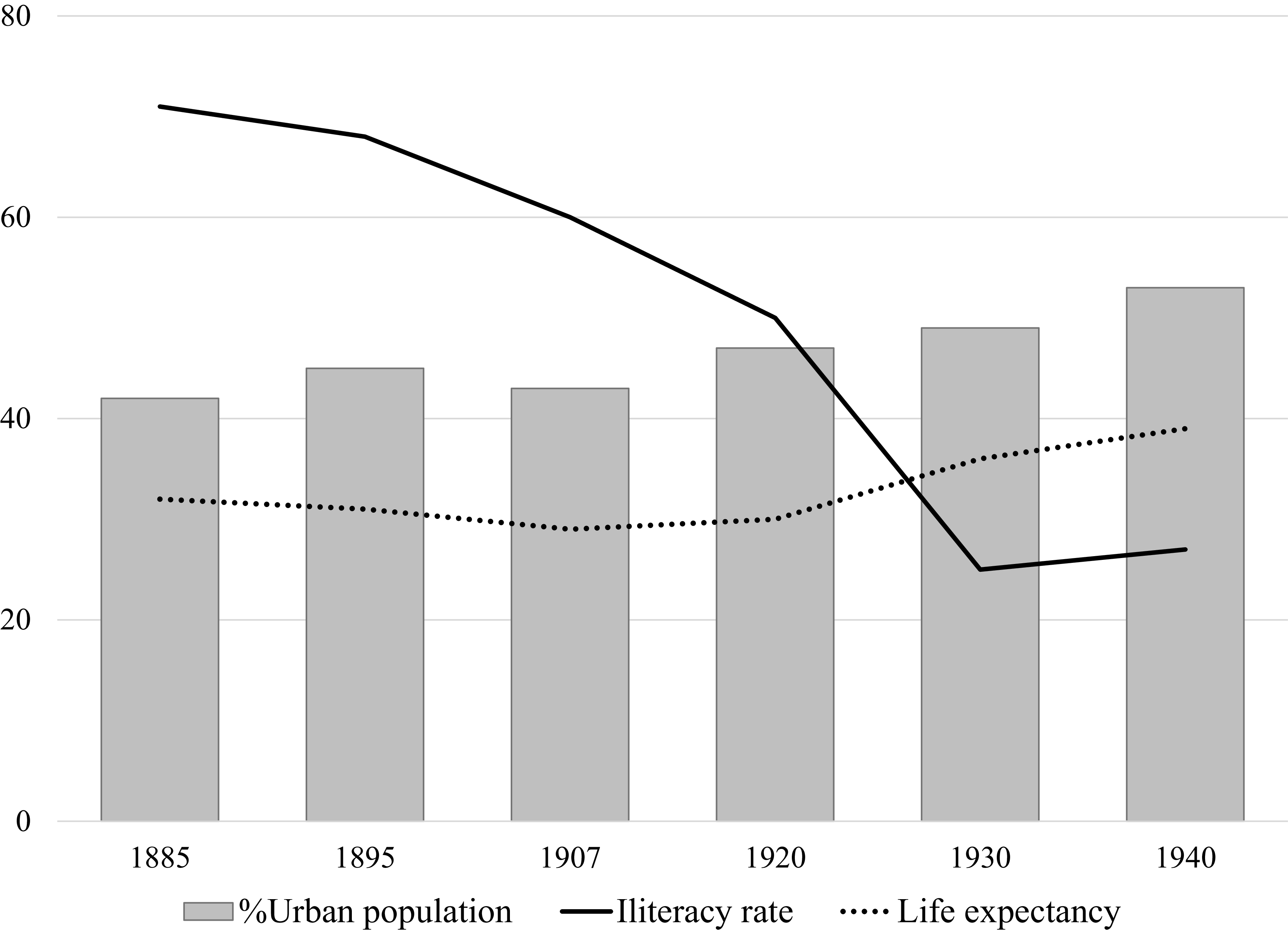
Successive governments also sought to increase the public health budget (Llanos Reyes and Lanfranco Reference Llanos Reyes and Lanfranco2017). With more access to government services, including public education, health, and better public infrastructure, more people were able to get involved in politics and participate in elections (Collier and Sater Reference Collier and Sater2004: 285–299). Figure 1 shows the evolution of the urban population, the illiteracy rate, and life expectancy between 1885 and 1940.
Urban population, illiteracy rate, and life expectancy in Chile, 1885–1940.
Source: Authors’ elaboration with data from Díaz et al. (Reference Díaz, Lüders and Wagner2016).

Opposition to the Alessandri government emerged mostly from left-wing parties. The Socialist Party (PS), founded in 1933, had a Marxist ideology, just like the PC, but was more critical of the Soviet Union than the PC. The growth of left-wing parties led the Radical Party to break with the Alessandri government in 1934 and to join left-wing parties in forming the Popular Front in 1936 (ibid.: 228). The Alessandri government fiercely suppressed workers’ strikes, resulting in a high electoral cost for the government candidate in the 1938 elections.
In the 1938 presidential election, the Popular Front candidate Pedro Aguirre-Cerda, a member of the Radical Party, received 50.4 percent of the vote (and 9 percent of the national population), defeating the government candidate, Gustavo Ross, a member of the Conservative Party. As the first reformist president to come to power, Aguirre-Cerda’s victory was a major setback for right-wing oligarchic parties. The landowning ruling class entrenched itself in rural areas, where it exerted a strong influence (Correa Reference Correa2011: 77). In the countryside, landowners exercised a great influence over peasants, with multiple vote-mobilization and vote-buying strategies (Posada Reference Posada, Jaksic and Ossa2017). Moderate governments allowed the repression of agrarian unions to protect the interests of landowners in exchange for right-wing parties in the legislature not obstructing the government’s agenda (Loveman Reference Loveman, Valenzuela and Samuel Valenzuela1976).
Due to resistance from the right-wing opposition, Aguirre-Cerda was unable to carry out structural changes, which led left-wing parties to abandon the Popular Front in 1941 (Collier and Sater Reference Collier and Sater2004: 242), the same year that Aguirre-Cerda died. In 1942, Juan Antonio Ríos, also from the Radical Party, won the presidential election and appointed left-wing socialist, radical, and liberal politicians to his cabinet. Ríos’ government lasted until 1946, when cancer forced him to resign. In 1946, Gabriel González-Videla, a member of the Radical Party, took office with the support of the communists. González-Videla ascended to the presidency at the start of the Cold War. González-Videla included the communist party in the government cabinet, but the communist party remained active in the labor movement and organized strikes against private companies, including multinational mining companies associated with the United States. In the 1947 municipal election, the Communist Party received 16.5 percent of the vote, becoming the third largest party in the country. The growing influence and power of the Communist Party put González-Videla in a tough spot. Eventually, the president aligned himself with the United States and expelled the Communist Party from the government coalition. In 1948, González-Videla championed a law that banned the Communist Party and persecuted labor union leaders and politicians from the Communist Party. González-Videla also broke diplomatic relations with socialist countries, such as Czechoslovakia, Yugoslavia, and the Soviet Union (Correa Reference Correa2011: 148). The active persecution of communists in Chile lasted for almost a decade. In 1952, the election of populist former military general Carlos Ibáñez ended a long period of Radical Party governments (1938–52). Toward the end of his administration, Ibáñez successfully passed a bill to end the ban on the Communist Party. The banning of the Communist Party might have undermined what could have been a more successful mobilization effort of recently enfranchised women and newly urban residents by the Communist Party and other left-wing parties.
Although clientelism and vote buying had been a common feature of electoral politics in Chile, especially in rural areas, since the mid-nineteenth century (Cruz-Coke Reference Cruz-Coke1984; Posada Reference Posada, Jaksic and Ossa2017), the rise of left-wing parties that mobilized popular sectors also triggered an increase in clientelistic vote-buying practices by traditional right-wing parties, especially in rural areas (Drake Reference Drake1978; Loveman Reference Loveman1979). As traditionally marginalized voters were mobilized, the increase in electoral participation levels generated incentives for other parties to attract the support of part of that growing electorate with different clientelistic and mobilization strategies (Valenzuela Reference Valenzuela1985).
An important milestone in those years was the adoption of women’s suffrage for local elections. Although there had been some bottom-up pressure on the part of upper and middle-class women to acquire voting rights in the late nineteenth and early twentieth centuries (Gaviola et al. Reference Gaviola, Jiles, Lopresti and Rojas1986, Maza Reference Maza1998), those efforts did not attract sufficient support among parties with legislative representation. Moreover, as many women who demanded suffrage rights were politically linked to conservative and clerical sectors in the late nineteenth and early twentieth centuries, the anticlerical sectors refrained from supporting women’s suffrage, fearing that it would harm them electorally (Maza Reference Maza1998: 324). Conservative legislators introduced the first women’s suffrage bill in 1917, but the dominant opinion among many conservatives was that women should first be educated to acquire the public spirit required by citizens, which stalled progress in that bill (ibid.). In fact, left-wing political parties feared that the extension of voting rights to women would strengthen conservative parties rather than increase support for working-class parties that sought to bring about significant transformations in favor of the working-class poor (Gaviola et al. Reference Gaviola, Jiles, Lopresti and Rojas1986; Maza Reference Maza1998).
Women’s suffrage in municipal elections was enacted under the authoritarian government of General Carlos Ibáñez through a decree law in 1931 and resulted more from a top-down dynamics than from bottom-up social mobilization on the part of women’s groups or left-wing parties that advocated for expanding suffrage rights. Ibañez’s decree established the voting age at twenty-five years, but in 1934, the age was lowered to twenty-one. The political elite was somewhat supportive of women’s suffrage based on the view that women’s sweet and maternal instincts would benefit public life (Aylwin et al. Reference Aylwin, Correa and Piñera1986). While there were women’s groups that advocated for the extension of suffrage to women, the adoption of that reform was not associated with massive mobilization among women (Gaviola et al. Reference Gaviola, Jiles, Lopresti and Rojas1986; Maza 1988; Neusse Reference Neusse, Booth and Seligson1978).
Not surprisingly, the extension of suffrage rights did not immediately result in high levels of electoral participation among women. Prior works on the reasons for the enfranchisement of women argue that political parties push for including women in the electoral rolls when they have the capacity to mobilize those new voters and when parties believe that women will be supportive of their ideology (Buechler Reference Buechler1990; Teele Reference Teele2018). The evidence from the way in which women’s enfranchisement was adopted in Chile for municipal elections is not fully inconsistent with those findings. Although women’s enfranchisement was a top-down decision and political parties did not immediately engage in mobilizing women voters, eventually parties became far more active in the mobilization of women voters, especially after suffrage rights were granted to women for presidential and legislative elections (Aylwin et al. Reference Aylwin, Correa and Piñera1986; Maza 1988).
Women voted for the first time in the municipal elections of 1935. Of the twenty-five women elected, sixteen were conservative, five liberal, two radical, one democrat, and one independent (Statistical Yearbook 1935). In the following years, women’s groups continued to fight for the right to vote in legislative and presidential elections (Gaviola et al. Reference Gaviola, Jiles, Lopresti and Rojas1986). Legislators in the 1940s believed that marginalizing women from general elections could jeopardize democratic institutions as popular sovereignty would be in question if half of the population was excluded (Errázuriz Tagle Reference Errázuriz Tagle2005). But women’s suffrage in legislative and presidential elections was legalized in 1949, fourteen years later. While other Latin American countries adopted women’s suffrage under democratic or authoritarian regimes, in Chile, women’s suffrage for local elections was adopted under an authoritarian government and for national elections under a democratic government (Castillo Reference Castillo2024).
Although democratic elections became the norm in the 1930s and 1940s, and foreign-born residents and women were allowed to vote, the voting population did not increase significantly until the 1950s. In 1932, the 429,772 people who voted represented 9.5 percent of the population. In 1949, 591,994 people voted. In 1950, that figure was 13.7 percent (Cruz-Coke Reference Cruz-Coke1984). In 1952, more than a million people registered to vote for the presidential election, mainly due to the adoption of women’s suffrage.
Valenzuela (Reference Valenzuela1978) highlights that the low voter turnout in previous years is due to institutional factors, such as the requirement of literacy and the need to re-register periodically to remain on the electoral roll, which discouraged electoral participation. Subsequent institutional changes, such as the lowering of the voting age requirement to eighteen and the extension of the right to vote to the illiterate in 1971, helped expand the voting population (Posada Reference Posada, Jaksic and Ossa2017). Although the barriers to enrollment were the same throughout the national territory, there were provinces where conditions were more favorable for political mobilization, and there was greater access to education. Moreover, the presence of political parties seeking to mobilize new voters was not homogeneous throughout the country.
Determinants of voter turnout
The literature that explains electoral participation argues that institutional, economic, sociodemographic, and partisan mobilization factors account for why people vote (Blais Reference Blais, Russel and Klingemann2008; Carreras and Castañeda-Angarita Reference Carreras and Castañeda-Angarita2014; Franklin Reference Franklin2004). Theories that rely on institutional factors suggest that turnout is lower when there are more voter registration barriers and when people have little interest in the outcome of the election (Blais Reference Blais, Russel and Klingemann2008; Franklin Reference Franklin2004; Uhlaner Reference Uhlaner and Grofman1995). But lowering registration requirements has a more limited impact among the poor and less educated (Mitchell and Wlezien Reference Mitchell and Wlezien1995). Thus, even if registration requirements are eliminated, a participation gap will remain in favor of people with more means.
A) Institutional factors: Compulsory voting is an institutional factor that increases participation, while the adoption of voluntary voting decreases it (Cancela and Geys Reference Cancela and Geys2016). Monetary fines and other forms of punishment for abstentionists encourage more participation. When voting is voluntary, people participate because they expect some kind of payoff, like voting for candidates who are aligned with their beliefs and ideology (Downs Reference Downs1957). The type of election is also associated with turnout, with presidential elections having higher turnout than other elections (Blais Reference Blais, Russel and Klingemann2008; Franklin Reference Franklin2004).
Several studies have underlined the strong impact of the extension of women’s suffrage in the late nineteenth and early twentieth centuries (Kittilson and Schwindt-Bayer Reference Kittilson and Schwindt-Bayer2012; Paxton Reference Paxton, Goertz and Amy2008). However, the adoption of women’s suffrage was not always a straightforward event. In Chile, women gained the right to vote in municipal elections in 1935 and in national presidential and legislative elections only in 1949.
Therefore, although there is broad agreement in the literature that more important elections lead to higher turnout, the way in which suffrage is extended might limit that effect. In Chile, where women were granted suffrage rights in local elections by a top-down decision, the incorporation of women into the voting population might have depressed overall turnout, as most women refrained from participating in elections. In turn, in legislative and presidential elections where women did not have the right to vote, turnout might have been higher since the universe of potential voters was comprised exclusively of males. As the texts that discuss the incorporation of women into the electoral registry show that women only slowly began to join the voting population, we would expect turnout to be higher in presidential and legislative elections than in municipal elections. Our first hypothesis formally postulates the following:
Hypothesis 1: Electoral participation among eligible voters was higher in legislative and presidential elections, where women were not included in the eligible population, than in local elections, where women were part of the eligible population.
B) Educational factors: Theories also rely on educational factors to explain voter turnout. Lipset argued that societies with more economic development are also societies with higher levels of education and a larger middle class (Lipset Reference Lipset1959). Those with more education and those in an upper social group – in short, those with a higher quality of life – are also more likely to engage in politics and participate in elections (Contreras et al. Reference Contreras, Joignant and Morales2016; Franklin Reference Franklin2004; Gallego Reference Gallego2010; Smets and Van Ham Reference Smets and Van Ham2013; Verba et al. Reference Verba, Schlozman and Brady1995). In the years we study, successive governments implemented policies to expand public education as a means to bring about more economic development. The country made significant progress in reducing illiteracy, but that progress was uneven across provinces. As being literate was a condition to acquire suffrage rights, the expansion of education was part of a larger democratization process (Serrano et al. Reference Serrano, de León, Rengifo and Mayorga2018). However, since the effort to expand education in Chile at the time was intended to bring about economic development and not a consequence of economic development, the association regularly made in the literature about economic development, education, and political participation would not necessarily be expected in Chile at the time. The improving levels of education – in the form of literacy – were the result of a government effort at bringing about modernization and economic development. In the long run, those efforts would be expected to help produce more economic development, but the higher levels of education were not a consequence of more development in those years. Still, since conventional wisdom associates education with higher political and electoral participation, we postulate a second hypothesis to that effect:
Hypothesis 2: Electoral participation among eligible voters was higher in provinces with higher levels of adult literacy.
C) Sociodemographic factors: Several studies associate sociodemographic traits, including rurality, poverty, age, and generational factors with electoral participation (Blais Reference Blais, Russel and Klingemann2008; Carreras and Castañeda-Angarita Reference Carreras and Castañeda-Angarita2014). A greater degree of urbanization drives higher levels of industrial development and, with it, economic development, which improves the quality of life of the popular sector, expands access to education, and also fosters political participation. We should then expect that in provinces with lower levels of urbanization, electoral participation will be lower. That brings us to our third hypothesis:
Hypothesis 3: Electoral participation among eligible voters was lower in provinces with a more rural population.
D) Inequality factors: Other explanations emphasize the impact of inequality on participation. In theory, in democratic systems, citizens with lower income levels and poorer quality of life would vote for redistribution (Meltzer and Richard Reference Meltzer and Richard1981). In addition, a more equitable distribution of wealth is associated with more economic and political inclusion. As income inequality declines, participation levels increase (Ansells and Samuels Reference Ansell and Samuels2014). Yet, in highly unequal societies, people with higher incomes might prefer more restrictions on political participation to prevent the state from expropriating their wealth or property. In fact, there is a negative impact of economic inequality on the electoral participation of lower-income groups (Gallego Reference Gallego2015).
The Gini coefficient is the leading indicator of income inequality, but historical studies normally rely on other indicators of inequality. For the period we study, there are no reliable estimations of the Gini coefficient. An alternative indicator of inequality is infant mortality (Przeworski et al. Reference Przeworski, Alvarez, Cheibub and Limongi2000; Zweifel and Navia, Reference Zweifel and Navia2000). When political authorities are indifferent to the needs of low-income sectors that participate less in politics, infant mortality is higher. In turn, greater political participation puts pressure on the political class to address health issues, such as infant mortality (Bellinger Reference Bellinger2018). In places with more wealth, better quality of life, and broader access to health, more children survive. In some countries, infant mortality rates are negatively associated with voter turnout (ibid.: 10).
In the period we study, infant mortality was a widespread problem in Chile. It was strongly linked to poverty and poor nutrition among children, resulting from low wages for the working class and the poor quality of life among the lower class (Llanos Reyes and Lanfranco Reference Llanos Reyes and Lanfranco2017). As differences in infant mortality varied across provinces, we would expect a negative association between infant mortality, our indicator of inequality for that time period, and electoral turnout. We postulate the fourth hypothesis:
Hypothesis 4: Electoral participation among eligible voters was higher in provinces with lower infant mortality.
E) Political mobilization factors: There is a theoretical link between political mobilization and electoral participation (Carreras and Castañeda Reference Carreras and Castañeda-Angarita2014). The social composition of countries normally generates social cleavages that foster the formation of political parties that build support among members of the groups defined by those cleavages (Lipset and Rokkan Reference Lipset, Rokkan, Lipset and Rokkan1967). In places with strong networks associated with the workplace, church, or schools, people find it easier to engage in political activities around shared interests. Social engagement feeds interest in electoral participation (Verba et al. Reference Verba, Schlozman and Brady1995). In places with a larger population or higher population density, political parties find it easier to reach eligible voters and thus mobilize them electorally. In countries with a large urban working-class sector, working-class parties have emerged to represent the interests of those workers and to mobilize them.
The process of economic development in Chile since the late nineteenth century was closely associated with the rapid growth of the mining industry (Collier and Sater Reference Collier and Sater2004; Loveman Reference Loveman1979; Volk Reference Volk1993). At the time, most of the mining activity was in copper although there was still some nitrate mining in the north and coal in the south (Collier and Sater Reference Collier and Sater2004: 268–269). The growth of nitrate mining in the nineteenth century and copper mining in the twentieth century propelled economic development and facilitated the formation of a working-class sector. The first systematic organization of working-class Chileans was associated with the mining industry (Angell Reference Angell1972: 11–41).
In the early twentieth century, several trade unions emerged in nitrate and mining areas in the north and coal mines in southern Chile, several trade unions due to the active unionization efforts conducted by left-wing parties and radical groups, including Luis Emilio Recabarren, who founded the Socialist Workers Party in 1902 (Drake Reference Drake1978). The large concentration of workers inside saltpeter offices and mining camps in the northern provinces of Tarapacá and Antofagasta allowed leftist forces to build electoral support, especially in the provinces of Tarapacá and Antofagasta (Ramírez Necochea Reference Rámirez Necochea1984). In turn, labor union organizing and left-wing political parties fought an uphill battle against the landed oligarchy to organize workers in agricultural provinces, where the majority of the population lived (Loveman Reference Loveman, Valenzuela and Samuel Valenzuela1976). The presence of political parties that mobilized workers in nitrate and coal mining areas should have been positively associated with higher voter turnout rates in those areas. Our fifth hypothesis postulates the following:
Hypothesis 5: Electoral participation among eligible voters was higher in provinces with a larger workforce in the mining sector.
Finally, industrialization is associated with less social discontent and more legitimation of the political process (Huntington Reference Huntington1968). When a country enjoys economic growth, more people become involved in the political process. In the period we study, many Latin American governments promoted import-substitution industrialization to promote economic development and employment. The implementation of those policies fostered the emergence of an urban working class (Bulmer-Thomas Reference Bulmer-Thomas2003).
In the mid-1930s, as mining activity declined as a result of the global depression, the Chilean government began to promote domestic industrialization as well. The higher salaries in the manufacturing sector, compared to rural sectors, attracted a growing number of workers to urban areas with a manufacturing industry (Meller Reference Meller1996; Reyes Nora Reference Reyes Campos2015). Mining remained the most important activity in the country – with copper mines representing the bulk of exports in Chile (Bulmer-Thomas Reference Bulmer-Thomas2003: 34–60). But, starting in the 1930s, the government promoted domestic industrialization (ibid.: 198–231). During that decade, the industrial sector expanded rapidly, attracting workers to urban centers. As formal sector workers, especially those in the government-sponsored manufacturing sector, were more likely to be politically engaged, we would expect the size of the manufacturing sector to be positively associated with electoral participation:
Hypothesis 6: Electoral participation among eligible voters was higher in provinces with a larger workforce in the manufacturing sector.
Methodology
Normally, studies on the determinants of voter turnout rely on public opinion surveys to explore the association between sociodemographic variables and electoral participation. But in Chile, public opinion polls only date back to the late 1950s. Thus, we rely on aggregate sociodemographic data at the provincial level to explore the determinants of electoral participation between 1932 and 1950. There were fifteen provinces in Chile in 1932 and twenty-four provinces in 1950. Our study covers four presidential elections in the period (1932, 1938, 1942, and 1946), four legislative elections (1937, 1941, 1945, and 1949), and six municipal elections (1935, 1938, 1941, 1944, 1-1950, 947, and 1950). As the unit of analysis is the province for each election, we have 331 observations. As presidential and legislative elections were not concurrent, Chileans voted every six years (in even years) for the president and every four years (in odd years) for legislators (all the members in the Chamber of Deputies and half of the members of the Senate). In municipal elections, Chileans voted for the members of the municipal councils, which in turn elected the municipal mayor.
From 1932 to 1950, we obtained provincial-level electoral data and infant mortality data from the Statistical Yearbook of the Republic, produced by the National Statistics Directorate (Dirección Nacional de Estadísticas, the precursor of the current Instituto Nacional de Estadísticas, INE) and from the National Library of the Electoral Registry Directorate Dirección General de Estadística 1932–1950; Dirección General de Estadística 1865–1940. Unfortunately, there were no data available for the 1932 legislative election. We obtained urbanization and literacy data and the share of labor force in the mining, agriculture, commerce, and manufacturing sectors for each province from the 1930, 1940, and 1952 census data. We used data from the 1930 census for the 1932 to 1938 elections, the 1940 census data for the 1941 to 1946 elections, and data from the 1952 census for the elections between 1947 and 1950.
Our dependent variable is voter turnout. We use the widely used indicator of turnout among eligible voters. Notice that the eligible population is not always the same as the voting age population as adult women were eligible to vote in municipal elections but not in legislative or presidential elections. Similarly, as literacy requirements were in place, illiterate adults were not part of the eligible population. We only include literate adults (those aged twenty-one or older) as part of the eligible population in each province. Thus, our electoral participation indicator is estimated differently for municipal elections and for presidential/legislative elections. As women had the right to vote only in local elections, the eligible population was higher in municipal elections than in national elections.
The independent variable for Hypothesis 1 is the type of election (presidential, legislative, or municipal). We expect that since women were among the eligible population for municipal elections, but not for presidential or legislative elections, the low incorporation rates of women into the voting population would result in lower turnout rates for municipal elections than for presidential and legislative elections. In the models, the reference category is the presidential elections.
The independent variable for Hypothesis 2 is the urban population in each province. The independent variable for Hypothesis 3 is the share of literate adults. The independent variable for Hypothesis 4 is the infant mortality rate in each province. As mentioned above, in the absence of more widely used indicators of income inequality, such as the Gini coefficients, studies from earlier historical periods where the data to estimate the Gini coefficient were not widely available, rely on alternative indicators, such as the infant mortality rate. Estimated as the number of deaths in the first year of life per 1,000 persons, the infant mortality rate is considered by the United Nations as a very sensitive index of the social conditions in which people live.
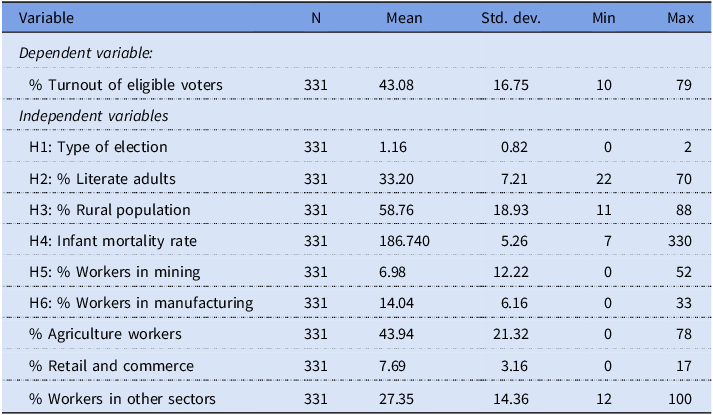
The independent variable for Hypothesis 5 is the percentage of people employed in mining. Finally, the independent variable for Hypothesis 6 is the percentage of the provincial population in the manufacturing sector. Table 1 shows the descriptive statistics of the dependent and independent variables used in the models.
Descriptive statistics

Table 1 Long description
A table with descriptive statistics of dependent and independent variables used in models. The table has 12 rows and 6 columns. Column headers are Variable, N, Mean, Std. dev., Min, and Max. Row labels include the dependent variable and independent variables H1 to H6, and additional categories. Row 1: % Turnout of eligible voters, 331, 43.08, 16.75, 10, 79. Row 2: H1: Type of election, 331, 1.16, 0.82, 0, 2. Row 3: H2: % Literate adults, 331, 33.20, 7.21, 22, 70. Row 4: H3: % Rural population, 331, 58.76, 18.93, 11, 88. Row 5: H4: Infant mortality rate, 331, 186.740, 5.26, 7, 330. Row 6: H5: % Workers in mining, 331, 6.98, 12.22, 0, 52. Row 7: H6: % Workers in manufacturing, 331, 14.04, 6.16, 0, 33. Row 8: % Agriculture workers, 331, 43.94, 21.32, 0, 78. Row 9: % Retail and commerce, 331, 7.69, 3.16, 0, 17. Row 10: % Workers in other sectors, 331, 27.35, 14.36, 12, 100.
Source: Prepared by the authors using data from the Statistical Yearbook of the Republic (1932–1950), Electoral Registry Directorate, and the Censuses of 1930, 1940, and 1952.
Results
Figure 2 shows the relationship between electoral participation by province according to urbanization level. While Figure 2A uses data from legislative and presidential elections, where only men could participate, Figure 2B uses data from municipal elections, which did include female participation. Based on this figure, women’s right to vote in municipal elections did not result in higher participation rates, as women only slowly began to join the national electoral registry. Furthermore, it is evident that in presidential and legislative elections, participation was higher in provinces with lower levels of urbanization than in provinces with higher levels of urbanization. In municipal elections, participation varied less across provinces, given their levels of urbanization. The presence of clientelist networks in rural provinces and vote-buying practices (Cruz-Coke Reference Cruz-Coke1984; Posada Reference Posada, Jaksic and Ossa2017) is likely responsible for this finding on electoral participation in Chile, which contradicts theoretical expectations.
Average electoral turnout and urbanization levels by provinces in Chile, 1932–1950.
Source: Prepared by the authors using data from the Statistical Yearbook of the Republic (1932–1950), Electoral Registry Directorate, and the Censuses of 1930, 1940, and 1952.

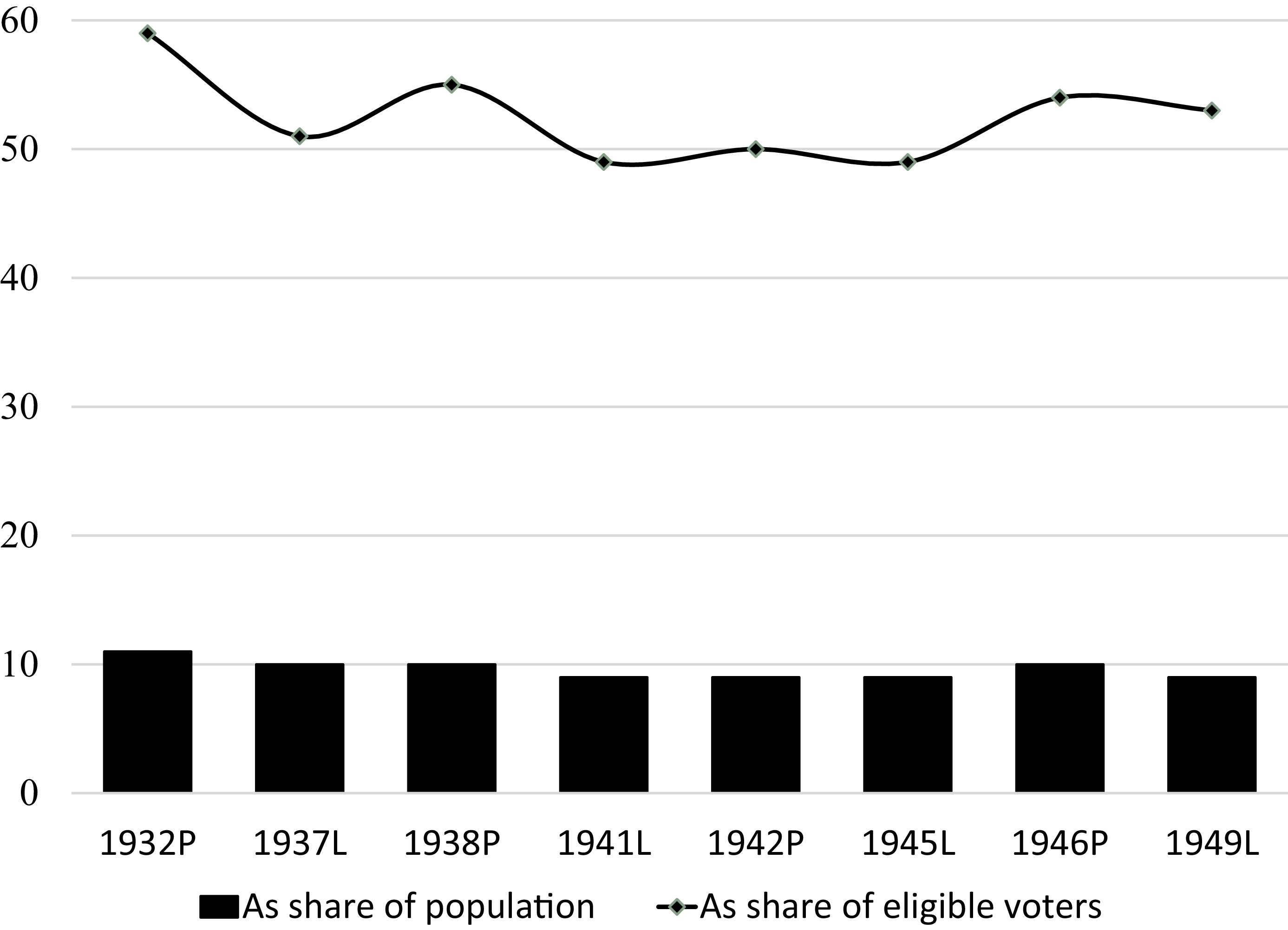
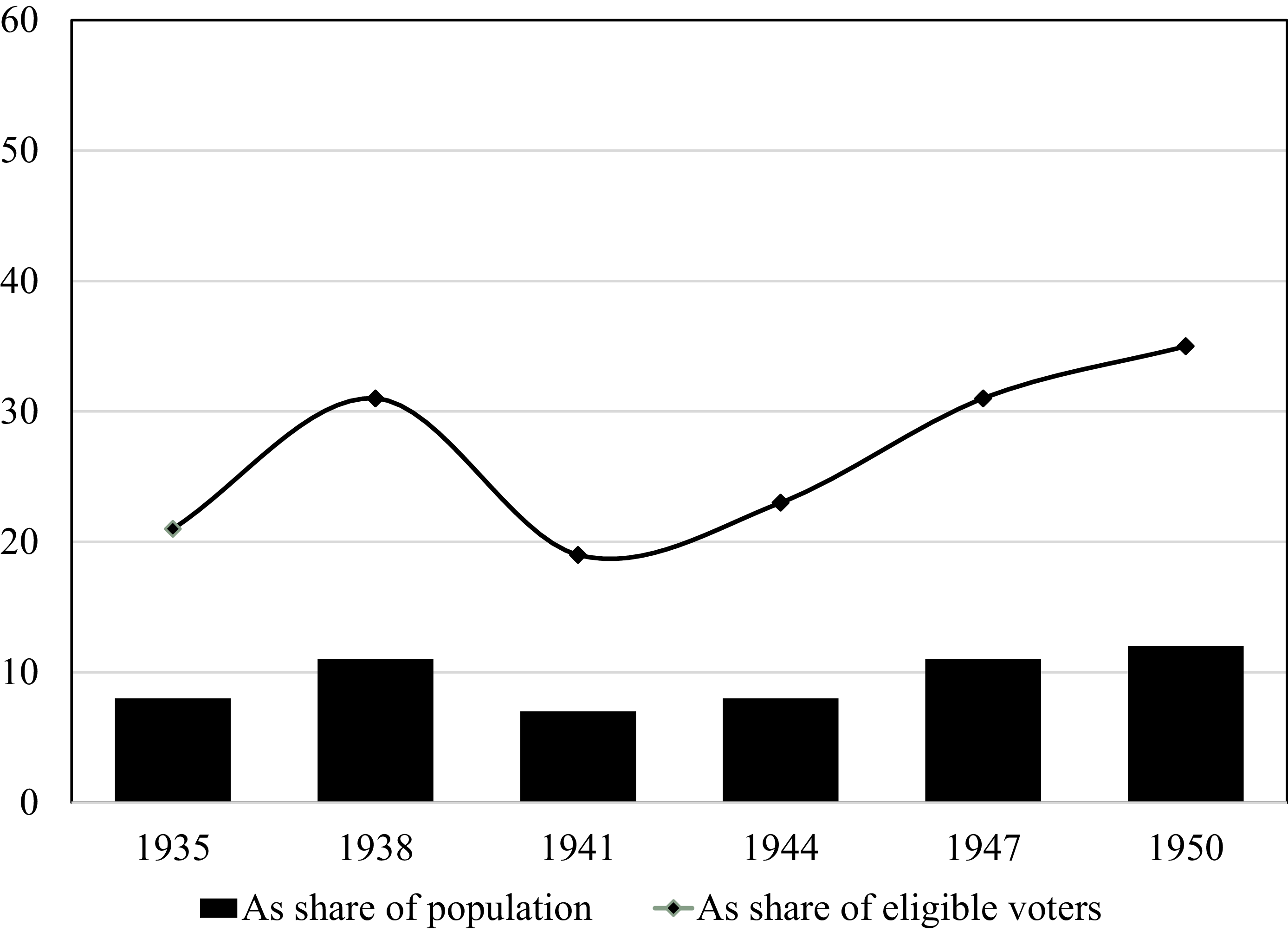
Figures 3 and 4 show the electoral turnout as a share of the total population and as a share of the eligible population for presidential/legislative and municipal elections, respectively. As a share of the eligible population, turnout was higher in presidential/legislative elections than in municipal elections. The enfranchisement of women actually lowered the turnout rate among the eligible population. Participation is expected to be higher in elections that people deem more important. Thus, it should come as no surprise that turnout among the eligible population was higher in presidential/legislative elections than in municipal elections. But the very low levels of electoral participation in municipal elections in Chile in the period are likely associated with the extension of voting rights to women. The enfranchisement of women for municipal elections rapidly increased the eligible voting population for those elections. As a majority of women stayed away from participating in municipal elections, turnout among the eligible population in local elections was significantly lower than turnout among the eligible population for presidential and legislative elections.
Electoral participation in presidential/legislative elections (1932–1950).
P = presidential election; L = legislative election.
Source: Authors with data from the Statistical Yearbook of the Republic (1932–1950), Electoral Registry Directorate, and the Censuses of 1930, 1940, and 1952.

Electoral participation in municipal elections (1932–1950).
P = presidential election; L = legislative election.
Source: Prepared by the authors using data from the Statistical Yearbook of the Republic (1932–1950), Electoral Registry Directorate, and the Censuses of 1930, 1940, and 1952.

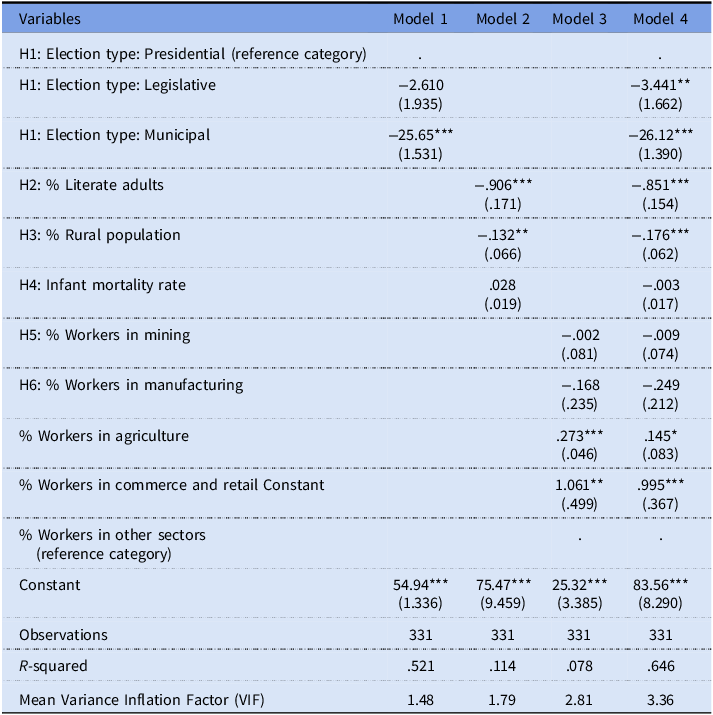
Table 2 shows ordinary least squares (OLS) models where the dependent variable is voter turnout among the eligible population. Notice that the more widely used concept of voting age population is less useful, as women were allowed to vote in municipal elections but not in presidential/legislative elections, and literacy requirements were in place.
OLS models of the determinants of voter turnout among eligible voters in Chile, 1932–1950
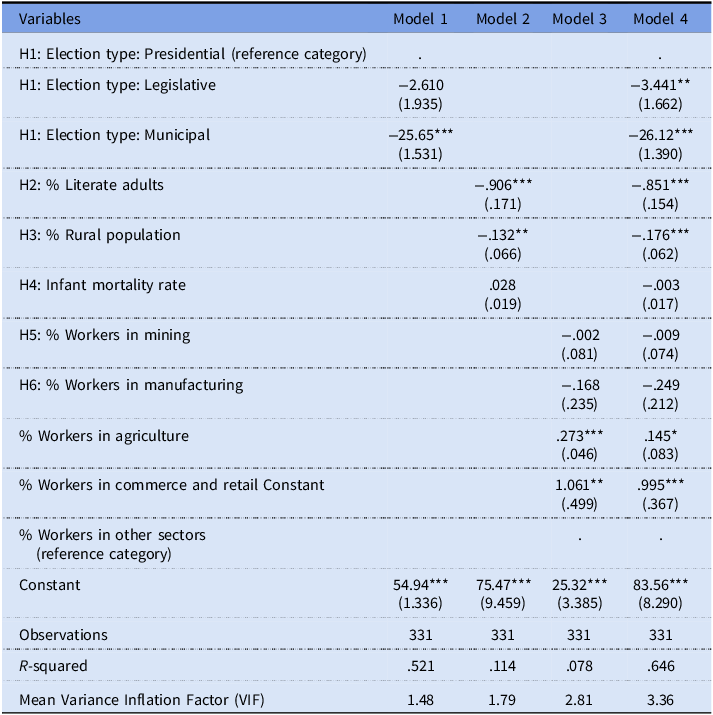
Table 2 Long description
A table with four columns and twelve rows, showing ordinary least squares (OLS) models of voter turnout determinants among eligible voters in Chile from 1932 to 1950. The columns are labeled Model 1, Model 2, Model 3, and Model 4. The rows are labeled with variables and their respective coefficients and standard errors. Row 1: H1: Election type: Presidential (reference category). Row 2: H1: Election type: Legislative, with values -2.610 (1.935), ., -3.441** (1.662). Row 3: H1: Election type: Municipal, with values -25.65*** (1.531), ., -26.12*** (1.390). Row 4: H2: % Literate adults, with values ., -0.906*** (0.171), ., -0.851*** (0.154). Row 5: H3: % Rural population, with values ., -0.132** (0.066), ., -0.176*** (0.062). Row 6: H4: Infant mortality rate, with values 0.028 (0.019), ., -0.003 (0.017). Row 7: H5: % Workers in mining, with values ., -0.002 (0.081), ., -0.009 (0.074). Row 8: H6: % Workers in manufacturing, with values ., -0.168 (0.235), ., -0.249 (0.212). Row 9: % Workers in agriculture, with values ., 0.273*** (0.046), ., 0.145* (0.083). Row 10: % Workers in commerce and retail, with values ., 1.061** (0.499), ., 0.995*** (0.367). Row 11: % Workers in other sectors (reference category). Row 12: Constant, with values 54.94*** (1.336), 75.47*** (9.459), 25.32*** (3.385), 83.56*** (8.290). The table also includes observations (331 for all models), R-squared values (0.521, 0.114, 0.078, 0.646), and Mean Variance Inflation Factor (VIF) values (1.48, 1.79, 2.81, 3.36).
Robust standard errors in parentheses. *** P < .01, ** P < .05, * P < .1.
Source: Prepared by the authors using data from the Statistical Yearbook of the Republic (1932–1950), Electoral Registry Directorate, and the Censuses of 1930, 1940, and 1952.
Hypothesis 1 suggests that electoral participation among eligible voters was higher in legislative and presidential elections, where women were not included among the eligible population, than in local elections, where women were part of the eligible population. The results of models 1 and 4 are consistent with that expectation. The models compare electoral turnout in legislative and municipal elections with that in presidential elections (the reference category). The results show that participation rates were slightly lower in legislative elections than in presidential elections and greatly lower in municipal elections than in presidential elections. Turnout rates were lower in elections where women participated than in elections where they were not allowed to participate. As we discussed above, prior works on Chile have shown that, after women’s enfranchisement in municipal elections, the participation of women began to increase gradually over the years. Our findings confirm the claims made before that the main determinant that expanded the participation of women in the political process was the adoption of women’s suffrage in presidential elections, not in municipal elections (Posada Reference Posada, Jaksic and Ossa2017; Valenzuela Reference Valenzuela1977).
Hypothesis 2 suggests that in the provinces with a greater number of literate adults, voter turnout would be higher. The results of the models in Table 2 reveal the opposite results. The models show a negative association such that, for every 1 percent increase in adult literacy, voter turnout decreased between 0.91 percent and 0.81 percent. This result contradicts the expectations that political interest will be higher among those who have better access to education (Lipset Reference Lipset1959; Verba et al. Reference Verba, Schlozman and Brady1995). As a literacy requirement was in place, the eligible population was higher in provinces with higher levels of education. But in those provinces, electoral participation was lower. This suggests that there was limited inclusion of eligible voters in urban centers and other provinces with higher levels of education. In turn, in provinces with lower levels of education, clientelist practices and voter mobilization efforts on the part of the landed elite resulted in higher participation rates. Although the expansion of education was conceived at the time as part of the democratization process (Keller Reference Keller1931; Serrano et al. Reference Serrano, de León, Rengifo and Mayorga2018), that expansion of education did not immediately result in higher participation rates among eligible voters.
This somewhat contradictory result might, in fact, call into question the causality of the association between education and levels of democracy that is posited by modernization theory. When education is promoted in a top-down fashion by the government, it might not result in higher levels of democratization. For example, in the case of Cuba, there was significant progress in educational coverage in the years after the 1959 revolution, but higher levels of education did not lead to an electoral democracy. When the push to expand education is associated with a modernization strategy implemented by an authoritarian government or with the effort to bring about economic development, the expected impact of higher education on a push for democratization might not materialize.
Hypothesis 3 suggests that voter turnout was lower in rural areas. The results of the models are consistent with the expectations. Voter turnout was higher in urban areas. Although Figure 2 suggests that participation among eligible voters was higher in areas with less urbanization, the models actually show that urbanization was positively associated with participation among eligible voters. While historical accounts suggest that there was voter mobilization in rural areas in Chile, there were also efforts by working-class parties to mobilize low-income voters in urban centers. The models suggest that those mobilization efforts paid off and turnout rates were higher in urban centers than in rural provinces.
Hypothesis 4 suggests that infant mortality (our inequality indicator for that period) was negatively associated with electoral participation, but this is not consistent with expectations in either of the two models that include this variable. In both models 2 and 4, urbanization and literacy are more significant predictors of electoral participation among eligible voters than infant mortality.
Hypotheses 5 and 6 suggest a positive association between a larger workforce in the mining and manufacturing sectors, respectively, with turnout. In those sectors, left-wing parties were strong. Yet, the models fail to show an association between the manufacturing and mining workforce and electoral participation. Although leftist parties cultivated support among the working class and became strongly involved in labor unions, especially in the mining sectors (Ramírez Necochea Reference Rámirez Necochea1984), that mobilization did not translate into higher turnout in provinces where manufacturing and mining employed more workers. There might be several reasons behind that. The industrial urban sector and mining towns also attracted other people who worked in the informal sector and were not politically associated with labor unions. Unlike those formally employed in mining and manufacturing activities, recent urban migrants might have lacked the networks and connections to become more politically involved. Unlike rural areas, where landowners have developed clientelist practices for a long time, recent urban residents, especially those in slums, might have remained marginalized from formal institutions, including the electoral registries. Working-class parties mobilized those employed in the mining and manufacturing sectors, but the bulk of the population worked in the informal sector and might not have been successfully mobilized by the working-class parties.
The effect of the control variables is consistent with what we have discussed above. Farm workers found it much more difficult to form unions to mobilize politically (Loveman Reference Loveman, Valenzuela and Samuel Valenzuela1976). In rural areas, the practice of bribery was quite common. Landowners mobilized rural voters to support the interests of the landed elite. Rural voters lacked political alternatives as working-class parties were mostly absent in rural areas (Cruz-Coke Reference Cruz-Coke1984, cited in Posada Reference Posada, Jaksic and Ossa2017).
Model 3 shows that the share of workers in commerce and retail was positively associated with higher electoral turnout. This suggests that the incorporation of workers into the formal sector facilitated the exercise of their suffrage rights. Among recent urban residents, especially those who lived in slums or were informally employed, the chances of becoming politically involved were more limited.
The results of the models in Table 2 are strongly consistent with our expectation that the extension of suffrage rights to women did not immediately result in higher participation rates. Instead, when women became eligible to vote and the eligible voting population increased, participation rates declined as most newly eligible women voters stayed away from participating in elections. This underlines the importance of mobilization efforts to incorporate newly enfranchised voters into the political process. When voting rights are extended, the newly enfranchised population will not immediately join the voting population. Especially when the decision to incorporate new voters responds to top-down political dynamics, as opposed to bottom-up political pressure, political parties and other organizations with potential mobilizing capacities must work hard to incorporate those new voters into the political process.
To better visualize our results, we estimate the predicted probabilities based on model 4 in Table 2. Figure 5 shows the predicted probabilities of voter turnout among eligible voters by each type of election: presidential, legislative, and municipal. Figure 5A shows that, as the percentage of literate adults by province increased, electoral participation among eligible voters declined. The downward slope is observed in the three types of elections, but municipal elections have consistently lower participation rates than presidential and legislative elections. Although it is expected that turnout will be lower in municipal elections, the extension of suffrage rights to women in a top-down fashion – rather than as a result of a bottom-up social movement mobilization – ended up having a further detrimental effect on turnout in municipal elections compared to presidential and legislative elections.
Predicted probabilities of voter turnout among eligible voters by type of election in Chile, 1932–1950.
Source: Authors using data in model 4 in Table 2.

Figure 5B shows a negative association between the rural population per province and electoral participation. Turnout was higher in urban areas than in rural areas. But the slope of the curve in Figure 5B is less pronounced than in Figure 5A. Presidential and legislative elections had a higher turnout than municipal elections. Historical accounts from Chile underline that electoral participation among women was far lower than initially expected when suffrage rights were extended to women (Gaviola et al. Reference Gaviola, Jiles, Lopresti and Rojas1986). It does seem somewhat surprising, given the well-established claim that landowners used clientelist and vote-buying practices to mobilize eligible voters.
Conclusion
This study examined the determinants of electoral participation in Chile between 1932 and 1950, a period of significant socioeconomic transformation situated between the first and second waves of democratization. Drawing on provincial-level data, we evaluated how institutional design, urbanization, literacy, political mobilization, and sectoral employment shaped patterns of voter turnout. Our findings challenge several assumptions derived from modernization theory and underscore the complexities of democratization in practice.
Contrary to expectations, higher levels of literacy were associated with lower turnout, suggesting that eligibility alone does not guarantee political engagement. In contrast, urbanization was positively correlated with participation, supporting arguments that urban settings facilitate mobilization and reduce clientelist constraints prevalent in rural areas. Surprisingly, provinces with larger mining and manufacturing workforces did not exhibit higher turnout, pointing to the limits of partisan mobilization and the possible exclusion of informal sector workers and recent migrants from effective political incorporation.
One of the study’s most revealing insights is the effect of the partial enfranchisement of women. The extension of voting rights to women in municipal elections did not immediately translate into higher participation and, in fact, contributed to lower turnout rates. The top-down nature of this reform, coupled with the absence of mobilization strategies targeting women, limited the impact of this expansion of suffrage.
Overall, the Chilean case underscores that institutional reforms alone are insufficient to increase participation. Democratization requires active efforts to incorporate newly eligible voters into the political process. Future research should explore the mechanisms of political mobilization – particularly the role of parties, unions, and social movements – in integrating marginalized groups. As our findings show, democratization is not simply a matter of expanding rights but also of building the infrastructure and incentives necessary for those rights to be exercised.
Acknowledgments
We collected the data from public access sources. Anyone who wishes to replicate our findings using our Stata do and data files, please contact the corresponding author.
Financial support
We acknowledge funding from the National Fund for Scientific and Technological Development (grant # 1231627) and by the Millennium Nucleus Center for the Study of Politics, Public Opinion and Media in Chile (grant number NCS2024_007).