INTRODUCTION
During the Pleistocene (2.58 Ma–11.7 ka; Cohen et al., Reference Cohen, Finney, Gibbard and Fan2013), megafauna, mammals weighing more than 45 kg (Martin, Reference Martin, Martin and Klein1984), had a much greater diversity and abundance than at present, with gomphotheres, proboscideans of family Gomphotheriidae, common in South America (Mothé et al., Reference Mothé, Ferreti and Avilla2019). The arrival of gomphotheres into South America was part of the Great American Biotic Interchange, or GABI, following closure of the Isthmus of Panama, which provided a land bridge for southward dispersion of gomphotheres between North and South America (Prado et al., Reference Prado, Alberci, Azanza, Sánchez and Frassinetti2005; Lucas, Reference Lucas2013).
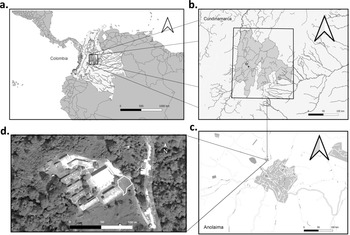
Colombia is located at the southern end of the biogeographic corridor that connects North and South America. As a result, a variety of skeletal remains attributed to gomphotheres have been preserved in the country. However, despite being relatively common fossils, gomphotheres have not frequently been described in detail and taxonomically identified to genus and species (e.g., Páramo-Fonseca and Escobar-Quemba, Reference Páramo-Fonseca and Escobar-Quemba2010; Suárez-Ibarra et al., Reference Suárez-Ibarra, Cardoso, Asevedo, De Melo França, Dantas, Cruz-Guevara, Rojas-Mantilla and Ribeiro2021). In 2017, a new site with abundant and well-preserved megafaunal remains was discovered on lands of the Carlos Giraldo School in the municipality of Anolaima, Cundinamarca, located within the Eastern Cordillera (mountain range) of Colombia (Fig. 1).
Geographic location of the Colegio Carlos Geraldo site, Anolaima, Cundinamarca, Colombia. (a) Location of Colombia in the Americas; black square shows location of Cundinamarca in Colombia; (b) location of the site within the Departamento de Cundinamarca and location of the Laguna de Pedro Palo (black dot); (c) location of the site within the Municipality of Anolaima; (d) Google Earth image of the Colegio Carlos Geraldo showing the location of the fossiliferous site.

The Pleistocene witnessed major global environmental and faunal changes (van der Hammen, Reference van der Hammen1974; Cione et al., Reference Cione, Tonni, Soibelzon and Haynes2009; Bush and Metcalfe, Reference Bush, Metcalfe, Metcalfe and Nash2012; Villmoare, Reference Villmoare2018) that affected the geographic distribution of many organisms, including South American gomphotheres (Lima-Ribeiro et al., Reference Lima-Ribeiro, Nogués-Bravo, Carina Terribile, Batra and Diniz-Filho2013; Cabanne et al., Reference Cabanne, Calderon, Trujillo Arias, Flores, Pessoa, D'Horta and Miyaki2016). The new environmental conditions may have resulted in gomphotheres’ home range expansion or contraction and in nutritional stress and disease. These factors, combined with the slow reproductive rates and long generation times of proboscideans (Haynes, Reference Haynes1991; Malhi et al., Reference Malhi, Doughty, Galetti, Smith, Svenning and Terborgh2016), must have played a leading role in the process of the extinction of the South American mastodons (Cione et al., Reference Cione, Tonni, Soibelzon and Haynes2009; Barnosky and Lindsey, Reference Barnosky and Lindsey2010; Stuart, Reference Stuart2015; Malhi et al., Reference Malhi, Doughty, Galetti, Smith, Svenning and Terborgh2016; Mothé et al., Reference Mothé, Avilla, Asevedo, Borges-Silva, Rosas, Labarca-Encina and Souberlich2017; Meltzer, Reference Meltzer2020).
Diet, behaviour, ecological interactions with the environment and other species, selective pressures, and disease all have the potential to modify the bones of living animals. Hence, the study of individual and ontogenetic variation, biomechanical stress, asymmetries, and pathology is extremely important for understanding the life histories of organisms, including extinct South American gomphotheres (Barbosa et al., Reference Barbosa, Porpino, Lima Fragoso and Cavalcante Ferreira dos Santos2013, 2017; Andrade et al., Reference Andrade, Barbosa, Melki, Oliveira, de Araújo-Júnior and Maniesi2021). However, despite this importance, pathological studies are not frequent, probably because not all pathologies leave characteristic signatures on bones, pathological traits can be confused with taphonomic signatures, and just a fraction of pathological bones are likely to have been preserved in the limited fossil record (Barbosa et al., Reference Barbosa, Porpino, Lima Fragoso and Cavalcante Ferreira dos Santos2013). Descriptions of pathologies affecting proboscideans have been addressed for North American and Eurasian mammoths and mastodons (Rothschild et al., Reference Rothschild, Wang and Shoshani1994; Krzemińska, Reference Krzemińska2008; Lister, Reference Lister2009; Clark and Goodship, Reference Clark and Goodship2010; Kirillova et al., Reference Kirillova, Shidlovskiy and Titov2012; Krzemińska and We¸dzicha, Reference Krzemińska and We¸dzicha2015; Krzemińska et al., Reference Krzemińska, Wojtal and Oliva2015; Oliveira et al., Reference Oliveira, Asevedo, Calegari, Gelfo, Mothé and Avilla2021); however, details of pathologies that affected South American gomphotheres are strictly limited (Labarca, Reference Labarca2003; Barbosa et al., Reference Barbosa, Porpino, Lima Fragoso and Cavalcante Ferreira dos Santos2013, 2017; Labarca and Pacheco, Reference Labarca and Pacheco2019), and no studies have thus far been performed on Colombian proboscidean fossils. In this article, we present a detailed description of seven gomphothere vertebral elements recovered from Anolaima and explore the possible causes of vertebral asymmetries and alterations.
MATERIALS AND METHODS
In this study we describe and interpret seven gomphothere vertebrae: a cervical vertebra (CCG17-021b), three substantially complete and articulated thoracic vertebrae (CCG17-020a, CCG17-021a, CCG17-026b), an isolated thoracic neural spine (CCG17-002d), and two lumbar vertebrae (CCG17-026a, CCG17-027a). The fossils are housed in the Museo Geológico Nacional José Royo y Gómez (MGNJRG) of the Servicio Geológico Colombiano (SGC), Bogotá, Colombia. The CCG codes refer to the Colegio Carlos Girado, where the Anolaima site is located.
Broken elements of the vertebrae (the spinous process and right transverse process of CCG17-021a, the neural arch of CCG17-026a, the spinous process of CCG17-026b, and the right transverse process and anterior zygapophysis of CCG17-027a) were reattached using Paraloid B72 (10% weight by volume) dissolved in ethanol. Taxonomic identification of the specimen to the species level was based on the tusk's characters described by Cabrera (Reference Cabrera1929), Ferreti (Reference Ferretti2010), and Mothé et al. (Reference Mothé, Avilla, Cozzuol and Winck2012).
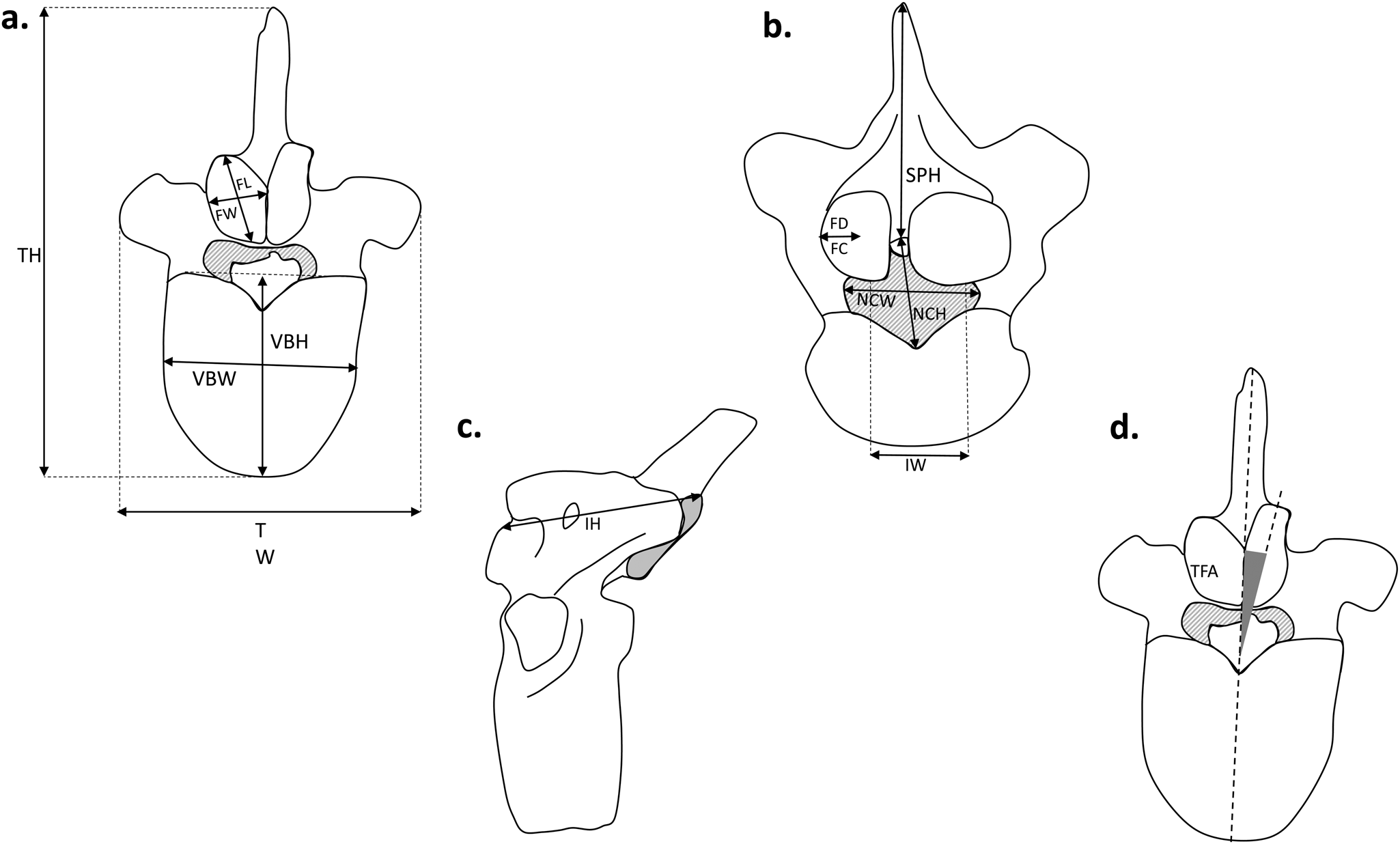
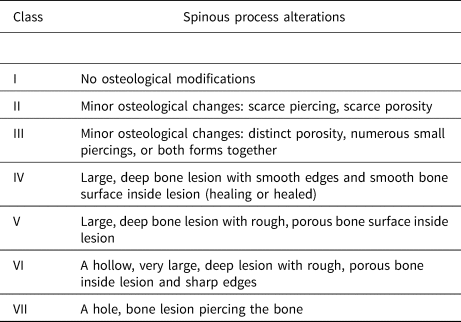
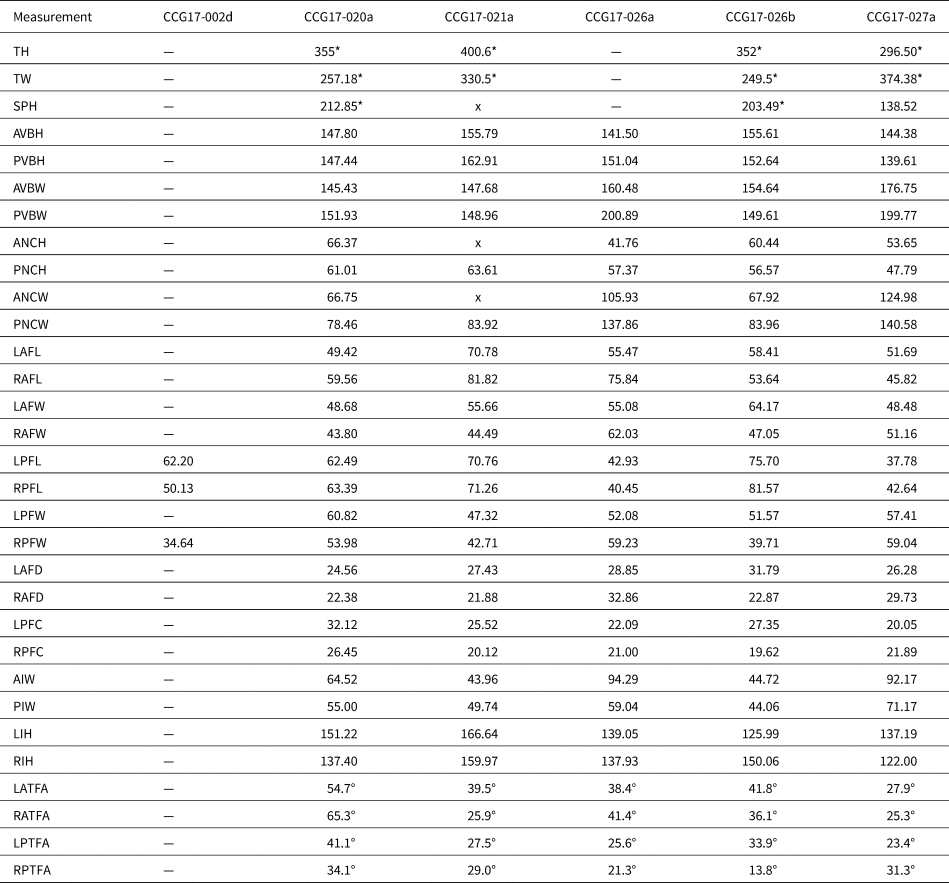
Pathological alterations in the neural arches and spinous processes of the vertebrae are described using a published classification scheme, and the bone lesions are classified in seven classes (Krzemińska et al., Reference Krzemińska, Wojtal and Oliva2015; Table 1). Vertebral measurements of <200 mm were obtained using a Mitutoyo Absolute Digimatic 500 series digital caliper (200 mm length, precision 0.02 mm); larger measurements were taken using a metric tape (Fig. 2, Table 2), following published guidelines (von den Driesch, Reference von den Driesch1976; Masharawi et al., Reference Masharawi, Peleg, Albert, Dar, Steinberg, Medlej and Abbas2008). Transverse zygapophyseal facet angles (Masharawi et al., Reference Masharawi, Peleg, Albert, Dar, Steinberg, Medlej and Abbas2008) were measured from orthogonal photographs, using Angulus 4.0 (https://play.google.com/store/apps/details?id=com.drinkplusplus.angle&hl=es_CO&gl=US, last accessed December 3, 2021), as direct measurements were rendered inaccurate by the presence of vertebral asymmetries and alterations. All measurements were taken three times, and the average (arithmetic mean) value is reported.
Locations of measurements (lengths and angles) taken on the Notiomastodon platensis vertebrae from Anolaima, Colombia. Drawings based on thoracic vertebra CCG17-026b (a). (d) Posterior; (b) oblique antero-dorsal; and (c) left lateral views. Abbreviations: CCG, Colegio Carlos Giraldo (housed in the MGNJRG, SGC, Bogotá), followed by specimen numbers; prefixes: A, anterior; L, left; R, right; P, posterior; measurements: FD, facet depth; FL, facet length; FW, facet width; IH, interfacet height; IW, interfacet width; NCH, neural canal height; NCW, neural canal width; SPH, spinal process height; TFA, transverse facet angle; TH, total height; TW, total width; VBW, vertebral body width; VBH, vertebral body height. See Table 2 for measurements.

Classification of spinous process pathologies observed in Notiomastodon platensis from Anolaima, Colombia, as used in the text (modified from Krzemińska et al., Reference Krzemińska, Wojtal and Oliva2015).

Lengths and angles for the Notiomastodon platensis thoracic and lumbar vertebrae from Anolaima, Colombia.a

a Abbreviations and symbols: CCG, Colegio Carlos Giraldo (housed in the MGNJRG, SGC, Bogotá), followed by specimen numbers; prefixes: A, anterior; L, left; R, right; P, posterior; measurements: FD, facet depth; FL, facet length; FW, facet width; IH, interfacet width; IW, interfacet width; NCH, neural canal height; NCW, neural canal width; SPH, spinal process height; TFA, transverse facet angle; TH, total height; TW, total width; VBW, vertebral body width; VBH, vertebral body height; x, data not available due to pathologies; —, measurement not available; *, measurement taken with a metric tape. For locations of measurements, see Fig. 2. The transverse facet angle is the angle between the lines of the facet length (FL, right and left, anterior and posterior) and the vertebral body height (VBH; Fig. 2; Masharawi et al., Reference Masharawi, Peleg, Albert, Dar, Steinberg, Medlej and Abbas2008).
Accelerator mass spectrometry radiocarbon dating on plant material associated with the megafaunal remains was financed by the Instituto Colombiano de Antropología e Historia (ICANH) and performed by Beta Analytic testing Laboratory (Miami, FL, USA). Direct radiocarbon dating of bone collagen was attempted at Poznan Radiocarbon Laboratory, Poland.
RESULTS
The Anolaima site
All fossil remains from Anolaima have been recovered from a single stratigraphic unit (Unit 3; depth 190–220 cm; Suárez-Gómez, C., Leguizamón-Pineda, P., Cortés-Giraldo, J., Cabrera-Claros, E.N., Hilarión-Bohórquez, C., unpublished internal SGC report, 2019). A radiocarbon date performed on an unidentified botanical sample recovered from stratigraphic unit 3 next to the megafaunal remains indicates the bones were deposited towards the end of the Pleistocene (10,850 ± 30 yr BP; 12,771–12,690 cal yr BP 2σ, Beta–557280; Lozada, N., unpublished report ICANH, 2020). Verification of this date was attempted by direct dating of the megafaunal remains; however, the described bones did not preserve collagen. The majority of megafaunal remains recovered from Anolaima and studied thus far are attributed to gomphotheres, although other osteological remains have been determined as belonging to the giant ground sloth (Eremotherium laurillardi) and a single bone belongs to a currently unidentified ungulate (possibly a horse). The gomphothere material includes the six vertebrae and incomplete neural arch listed in the previous section.
Systematic palaeontology
Class Mammalia
Order Proboscidea Illiger, 1811
Superfamily Elephantoidea Gray, 1821
Family Gomphotheriidae Hay, 1922
Notiomastodon Cabrera, 1929
Notiomastodon platensis (Ameghino, Reference Ameghino1888) Cabrera, Reference Cabrera1929
Identification
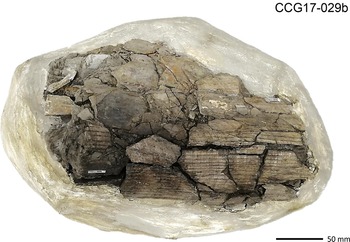
Only two species of gomphotheres inhabited South America: Cuvieronius hyodon (Fischer, Reference Fischer1814) and Notiomastodon platensis (Ameghino, Reference Ameghino1888) (Mothé et al., Reference Mothé, Avilla, Cozzuol and Winck2012, 2017, 2019; Mothé and Avilla, Reference Mothé and Avilla2015). Notiomastodon platensis is widely distributed, while confirmed records of Cuvieronius hyodon in South America are currently restricted to Ecuador, Bolivia, and Perú (Mothé and Avilla, Reference Mothé and Avilla2015; Mothé et al., Reference Mothé, Avilla, Asevedo, Borges-Silva, Rosas, Labarca-Encina and Souberlich2017). Considering Cuvieronius hyodon remains have been recovered in Central America (Arroyo-Cabrales et al., Reference Arroyo-Cabrales, Polaco, Laurito, Johnson, Alberdi and Zamora2007), the species is likely to have lived in what is now Colombia during the Quaternary. However, direct evidence for the presence of the genus Cuvieronius in Colombia is elusive. There is a single specimen identified as Cuvieronius hyodon, based on the species’ characteristic twisted tusks (De Porta, Reference De Porta1961; Mothé et al., Reference Mothé, Avilla, Cozzuol and Winck2012): specimen 2357, from the Museo de la Salle, apparently recovered from the Department (Colombian administrative district) of Huila and identified by José Luis Prado (Gómez, Reference Gómez2006, p. 67). As fragments of tusk recovered from Anolaima (CCG17-029b) do not show the characteristic twist of Cuvieronius hyodon, the remains described here are provisionally attributed to Notiomastodon platensis (Fig. 3).
Fragmented tusk from Anolaima, Colombia, attributed to Notiomastodon platensis. Abbreviations: CCG, Colegio Carlos Giraldo (housed in the MGNJRG, SGC, Bogotá), followed by specimen number.

Material
As mentioned in the “Materials and Methods” section, the specimen described here includes six substantially complete vertebrae and a neural spine, all of which exhibit pathological alterations and zygapophysial asymmetries. The bones are well preserved, and all vertebral centra are symmetrical, without taphonomic deformation; however, the zygapophyses, and transverse and mamillary processes all exhibit nontaphonomic asymmetries and alterations.
Minimum number of individuals and ontogenetic age
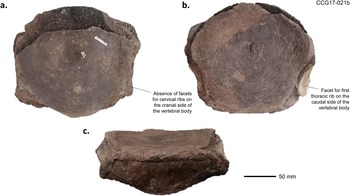
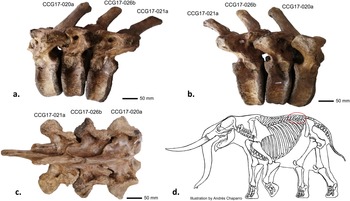
A cervical vertebra CCG17-021b (Fig. 4) has both vertebral endplates fused but with visible suture lines. The three thoracic vertebrae are substantially complete, and although recovered separately, articulate, and the vertebral pathologies align (anterior to posterior: CCG17-020a, CCG17-026b, CCG17-021a; Fig. 5), hence these three bones undoubtedly belong to a single individual. All three of the articulated thoracic vertebrae exhibit unfused vertebral endplates. A lumbar vertebra, CCG17-027a, exhibits an unfused anterior vertebral endplate but a fused posterior endplate and a second lumbar vertebra, CCG17-026a, exhibit both vertebral endplates fused. However, all vertebral centra are of similar size, there are no overlapping elements, and the preservation of the vertebrae is similar. As endplate fusion occurs at different times along the vertebral column in mammals (Hautier et al., Reference Hautier, Weisbecker, Sanchez-Villagra, Goswami and Asher2010; Cardoso and Ríos, Reference Cardoso and Ríos2011), all the reported bones could belong to a single individual, so the minimum number of individuals present is one. However, as the vertebrae were recovered disarticulated and as the sample size is small, there can be no certainty to this inference. Additional work on the Anolaima fauna may help to resolve this question. In modern elephants, vertebral endplates begin to fuse during the sixth decade (Haynes, Reference Haynes2017), which suggests the Anolaima Notiomastodon vertebrae belonged to an aged individual(s).
Seventh cervical vertebra of Notiomastodon platensis (CCG17-021b) from Anolaima, Colombia, in (a) anterior; (b) posterior; and (c) postero-ventral views. Abbreviations: CCG, Colegio Carlos Giraldo (housed in the MGNJRG, SGC, Bogotá) followed by specimen number.

Three articulated thoracic vertebrae of Notiomastodon platensis (anterior to posterior: CCG17-020a, CCG17-026b, CCG17-021a) from Anolaima, Colombia, in (A) left lateral; (B) right lateral; and (C) dorsal views. (D) Reconstruction of Notiomastodon platensis showing the probable position of the vertebrae. Abbreviation: CCG, Colegio Carlos Giraldo (housed in the MGNJRG, SGC, Bogotá) followed by specimen number.

Description
Cervical vertebra
The cervical vertebral centrum (CCG17-021b) is a seventh cervical vertebra of Notiomastodon and exhibits fused endplates but with the suture lines visible. The convex cranial endplate is broken, and the dorsal section is missing, with the left side exhibiting postmortem erosion. The caudal endplate is concave and exhibits some erosion on the left dorsal surface. The edges of the centrum are eroded, and there is small perforation in the centre caudally. The ventral surface of the centrum bears numerous pores, and the articular facets for the first thoracic ribs are present on the caudal surface of the vertebral body. There are no articular facets for cervical ribs on the cranial surface. The neural arch and the transverse processes are missing (Fig. 4).
Thoracic vertebrae
Three substantially complete thoracic vertebrae (CCG17-020a, CCG17-021a, CCG17-026b) exhibit heart-shaped centra, well-developed central mammillary processes, short spinous processes, caudally oriented transverse processes, and only cranial costal facets. These are all characteristics typical of relatively caudal proboscidean thoracic vertebrae. In modern elephants, the final four thoracic vertebrae exhibit cranial costal facets only (Bezuidenhout and Seegers, Reference Bezuidenhout and Seegers1996), and in the Buesching mastodon (Mammut americanum) (https://umorf.ummp.lsa.umich.edu/wp/mammutidae2, last accessed December 3, 2021), only the last five thoracic vertebrae exhibit this feature, which was also observed for Notiomastodon platensis (Ferretti, Reference Ferretti2010). Therefore, it is probable the Anolaima thoracic (T) vertebrae were posterior to vertebra T15, and hence probably represent T16–T18 or T17–T19 (Fig. 5).
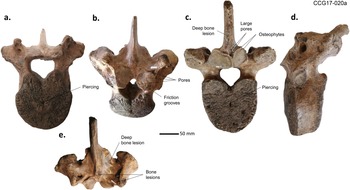
The anterior-most of the three articulated thoracic vertebrae, CCG17-020a (Figs. 5 and 6, Table 2), exhibits unfused endplates, and the borders of the centrum are eroded. The middle of the centrum exhibits a small perforation and a central mammilla on the cranial side and a small central perforation on the caudal side, presumably the notochordal pit, which is also observed in other vertebrae with unfused endplates. The right transverse process is wider than the left, and both anterior and posterior zygapophyses are asymmetrical. The right anterior zygapophysis is taller and narrower than the left, and the left anterior zygapophysis has several pores and osteophytes (fibrocartilage-capped bony outgrowths on the edges of articular surfaces; van der Kraan and van den Berg, Reference van der Kraan and van den Berg2007). There are also what appear to be friction grooves, which are formed due to movement against bony intra-articular bodies. The right posterior zygapophysis is narrower and slightly taller than the left and has osteophytes on the dorsal surface. There is a Class IV bone lesion (large, deep bone lesion with smooth edges) and smooth bone surface inside the lesion (healing or healed) on the neural arch and on the dorsal surface of the left posterior zygapophysis. The base of the anterior of the spinous process shows a Class III bone lesion (minor osteological changes: distinct porosity, numerous small piercings, or both forms together), a series of bone lesions that include large pores, and a Class IV bone lesion in the caudo-ventral side. The left mammillary process has a similar lesion, but the aetiology is not clear. The tip of the spinous process is missing.
The anterior-most of three articulated thoracic vertebrae (CCG17-020a; Fig. 5) of Notiomastodon platensis from Anolaima, Colombia, showing pathologies and asymmetry of the zygapophyses in (a) cranial; (b) oblique antero-dorsal; (c) caudal; (d, left lateral; and (e) dorsal views. Abbreviation: CCG, Colegio Carlos Giraldo (housed in the MGNJRG, SGC, Bogotá) followed by specimen number.

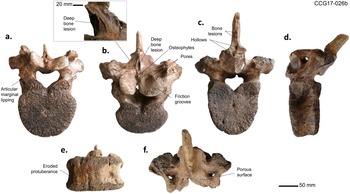
The second of the three articulated thoracic vertebrae, CCG17-026b (Figs. 5 and 7, Table 2), exhibits unfused vertebral endplates, and as in CCG17-020a, the edges of the centrum are eroded, and there is small piercing and a central mammilla on both the cranial and caudal sides. The ventral surface of the centrum has an eroded protuberance on the right. The anterior zygapophyses are asymmetrical, with the left wider and with a more open transverse facet angle than on the right (Fig. 7, Table 2). The left anterior zygapophysis exhibits pores on the articular surface together with friction grooves, marginal lipping, and an osteophyte on the posterior edge. Several pores around the left anterior zygapophyses indicate bone resorption. The posterior zygapophyses are also asymmetrical, clearly visible in dorsal view (Fig. 7f). The right posterior zygapophysis is taller than the left and exhibits an osteophyte on the ventro-lateral edge. The left posterior zygapophysis also shows marginal lipping.
The second of three articulated thoracic vertebrae (CCG17-026b; Fig.5) of Notiomastodon platensis from Anolaima, Colombia showing pathologies and asymmetry of the zygapophyses in (a) cranial; (b) oblique antero-dorsal, with a close-up of the lateral surface of the base of the neural spine; (c) caudal; (d) left lateral; (e) ventral; and (f) dorsal views. Abbreviation: CCG, Colegio Carlos Giraldo (housed in the MGNJRG, SGC, Bogotá) followed by specimen number. Scale bar: (a, c–f) 50 mm; (b) 20 mm.

The transverse processes of the neural arch of CCG17-026b are eroded and show loss of cortical bone; however, the right transverse process is wider than the left. There is a Class IV bone lesion on the base of the spinous process and another close to the right-hand edge of the right posterior zygapophysis. There are also two large pores on the ventro-caudal side of the spinous process, together with evidence of bone resorption (a Class III lesion). The mammillary processes are asymmetrical, the left being wider than the right.
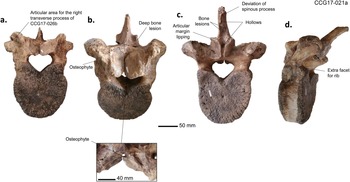
The posterior of the three articulated thoracic vertebrae, CCG17-021a (Figs. 5 and 8, Table 2), exhibits a central piercing in the centrum, on both the cranial and caudal surfaces, and the edges of the centrum are eroded. The anterior zygapophyses are asymmetrical, the right being taller and narrower than the left, and there is an osteophyte between the anterior zygapophyses that unites them. The right anterior zygapophysis exhibits marginal lipping on the cranio-ventral surface, and the left anterior zygapophysis has an osteophyte on the dorso-caudal edge, a protuberance on the facet, and evidence of bone resorption. The posterior zygapophyses are less asymmetrical, with the left slightly larger than the right, and there are pores (Class III lesions) between the two zygapophyses. On the dorsal surface of the posterior zygapophyses, close to the lateral edges, there are Class IV bone lesions, and although part of the right posterior zygapophysis is missing, a portion of the lesion is preserved.
The posterior of three articulated thoracic vertebrae (CCG17-021a; Fig. 5) of Notiomastodon platensis from Anolaima, Colombia, showing pathologies and asymmetry of the zygapophyses in (A) cranial; (B) oblique antero-dorsal, with a close-up of the osteophyte that unites the anterior zygapophyses; (C) caudal; and (D) left lateral views. Abbreviation: CCG, Colegio Carlos Giraldo (housed in the MGNJRG, SGC, Bogotá) followed by specimen number. Scale bar: (a, c, d) 50 mm; (b) 40 mm.

The transverse processes of CCG17-021a are slightly asymmetrical, but the mammillary processes are markedly asymmetrical, the right being much wider than the left. Both transverse processes exhibit porosities, and the right ventro-lateral side exhibits an additional articular region for the right transverse process of CCG17-026b. There is an abnormal articular facet for the left rib, which exhibits a double joint (with an extra upper facet) and also shows osteophytes. In addition, there is an osteophyte above the articular facet for the right rib that, from dorso-cranial view, produces a notch that is absent on the left side. The spinous process is short and exhibits large pores on the caudo-ventral surface, as well as evidence of bone resorption (Class III lesions).
CCG17-002d (Fig. 9) is an isolated thoracic neural spine and only preserves the posterior zygapophyses and a portion of the spinous process. There is a recent longitudinal fracture that passes through the left posterior zygapophysis, and this may slightly affect the measurements taken (Table 2). However, the posterior zygapophyses are asymmetrical, with the left zygapophyses larger than the right. The right zygapophysis shows osteophytes on the lateral edge, and there are large pores on the dorsal side of the spinous process and between the posterior zygapophyses.
Neural spine of a thoracic vertebra of Notiomastodon platensis (CCG17-002d) from Anolaima, Colombia, in oblique postero-ventral view, showing pathologies and asymmetry of the zygapophyses. Abbreviation: CCG, Colegio Carlos Giraldo (housed in the MGNJRG, SGC, Bogotá) followed by specimen number.

Lumbar vertebrae
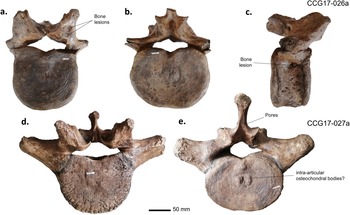
CCG17-026a (Fig. 10, Table 2) has fused vertebral endplates, although the suture lines remain visible. The centrum has two protuberances in the middle of the caudal side and a protuberance on the dorsal edge on both the cranial and caudal surfaces. There are many pores on the sides of the centrum and a bone lesion on the right side, under the transverse process. There is also an eroded protuberance to the right on the ventral side of the centrum. The anterior zygapophyses are markedly asymmetrical, with the right larger than the left, several pores in the dorso-caudal edge, and marginal lipping along the cranial border. The left anterior zygapophysis exhibits osteophytes on the cranio-lateral edge, and beneath it there is a Class IV bone lesion. A smaller lesion is also present under the right anterior zygapophysis. The posterior zygapophyses are slightly asymmetrical, with the left zygapophysis larger than the right. The right posterior zygapophysis has a protuberance near the dorsal edge, and there is a large pore anterior to the cranial edge. Due to postmortem damage, the transverse processes are both broken and missing. The right mammillary process is eroded but is much less well developed than the left mammillary process, which bears numerous pores. The spinous process is broken and missing, but there is a Class III bone lesion and osteophytes at the base of the spinous process.
Two lumbar vertebrae of Notiomastodon platensis from Anolaima, Colombia, showing pathologies and asymmetry of the zygapophyses. CCG17-026a in (a) cranial; (b) caudal; and (c) left lateral views. CCG17-027a in (d) cranial; and (e) caudal views. Abbreviation: CCG, Colegio Carlos Giraldo (housed in the MGNJRG, SGC, Bogotá) followed by specimen number.

CCG17-027a (Fig. 10, Table 2) exhibits an unfused anterior and a fused posterior vertebral endplate. There are three clear protuberances in the middle of the posterior side of the centrum, and these protuberances also seem to be present in the anterior surface. The anterior and posterior zygapophyses are both slightly asymmetrical, with the left anterior zygapophysis taller than the right. There are Class IV bone lesions behind the anterior zygapophyses and a large pore on the surface of the right posterior zygapophysis. The left posterior zygapophysis exhibits resorption and marginal lipping (Class III bone lesions) on the dorsal surface.
DISCUSSION
Three categories of bone alterations are observed on the gomphothere vertebrae from Anolaima. The first alterations are depressions, which include piercings, porosities, deep bone lesions, and hollows, especially on the spinous processes, but also more generally on the neural arch. A second group of alterations are the asymmetrical nature of the articular surfaces of the zygapophyses and deviations of the spinous processes. A third group of alterations includes articular marginal lipping, osteophytes, and friction grooves. The question arises as to whether these bone alterations are congenital abnormalities, pathological affects caused by disease, the result of biomechanical loading due to advanced age, or a combination of these factors.
Neural arch depressions have been frequently observed in mammoth remains (Maschenko, Reference Maschenko2002; Leshchinskiy and Burkanova, Reference Leshchinskiy and Burkanova2003; Maschenko et al., Reference Maschenko, Gablina, Tesakov and Simakova2006; Krzemińska, Reference Krzemińska2008; Krzemińska et al., Reference Krzemińska, Wojtal and Oliva2015; Leshchinskiy, Reference Leshchinskiy2015, Reference Leshchinskiy2017), and although it has been suggested that these depressions are specific to mammoths (Krzemińska et al., Reference Krzemińska, Wojtal and Oliva2015), the descriptions given here, together with evidence presented by other authors (Leshchinskiy, Reference Leshchinskiy2017; Labarca and Pacheco, Reference Labarca and Pacheco2019), indicate that these features are common within various lineages of proboscideans. Several hypotheses regarding the aetiology of these depressions have been proposed, including: a genetic trait (Maschenko, Reference Maschenko2002; Maschenko et al., Reference Maschenko, Gablina, Tesakov and Simakova2006), abnormal bone formation (Musil [1983] as cited in Krzemińska et al., Reference Krzemińska, Wojtal and Oliva2015, p. 179), Kashin-Beck disease (Leshchinskiy and Burkanova, Reference Leshchinskiy and Burkanova2003; Leshchinskiy, Reference Leshchinskiy2012, Reference Leshchinskiy2015, Reference Leshchinskiy2017), or a calcium-phosphate metabolic disorder resulting from elevated rates of calcium and/or phosphate resorption from bone. This last would probably be linked to malnutrition or mineral deficiency, leading to the transfer of calcium or phosphate from the bones into the blood (Krzemińska et al., Reference Krzemińska, Wojtal and Oliva2015). Calcium demand in captive elephants has been shown to be greatest during tusk growth in males and directly before parturition and during milk production in females, although these losses may be replaced through the diet or geophagy, if available (Davis, Reference Davis1968; Holdø et al., Reference Holdø, Dudley and McDowell2002; Sach et al., Reference Sach, Dierenfeld, Langley-Evans, Watts and Yon2019; EAZA, 2020). Because the calcium of the vertebrae and ribs has proven to be more labile than the calcium from the long bones, the vertebrae and ribs are the first elements affected when the animal is subjected to high growth demands or environmental pressures such as malnutrition (Leshchinsky, Reference Leshchinskiy2017).
Observations on mammoth skeletons demonstrate that the presence of bone lesions, hollows, and holes are osteolytic bone changes that involve bone resorption and remodelling (Krzemińska et al., Reference Krzemińska, Wojtal and Oliva2015). As the bone lesions develop, they have the potential to heal, and are therefore unlikely to be the result of genetic traits or abnormal bone formation (Krzemińska et al., Reference Krzemińska, Wojtal and Oliva2015). Kashin-Beck disease is a metabolic disorder related to mineral starvation in animals living in landscapes depleted in key elements (such as Ca, Mg, Na, K, P, Co, Cu, I, Se), and is often associated with an excess of strontium and barium, that together leads to disruption of the calcium–phosphate exchange system (Leshchinskiy, Reference Leshchinskiy2017). However, the debate as to whether bone alterations in proboscideans are due to Kashin-Beck disease or another calcium or phosphate metabolic disorder remains open. Although the definitive reason for the neural arch piercings, porosities, bone lesions, and hollows on the Anolaima gomphothere(s) remains unclear, what appears to be certain is that the observed depressions are likely the result of a mineral metabolism disorder or pathology related to mineral starvation.
The asymmetries of the vertebral articular facets, where the left and right zygapophyses differ in size and orientation, is a condition called tropism (Xeller et al., Reference Xeller, Sanders, Athari and Gibson2014; Garg and Aggarwal, Reference Garg and Aggarwal2021). Tropism is remarkably well displayed in the Anolaima gomphothere vertebrae. Tropisms appear to be a common condition in proboscideans, both in modern and fossil animals, and have been observed in numerous different individuals (e.g., Reumer et al., Reference Reumer, ten Broek and Galis2014; Haynes and Klimowicz, Reference Haynes and Klimowicz2015; Krzemińska et al., Reference Krzemińska, Wojtal and Oliva2015; Maschenko et al., Reference Maschenko, Potapova, Vershinina, Shapiro, Streletskaya, Vasiliev and Oblogov2017; Petrova et al., Reference Petrova, Masutin and Zhuykova2017). However, discussion regarding the aetiology of these asymmetries is rare. It has been suggested that asymmetry in thoracic and lumbar vertebrae could be the result of the strengthening of the mid-back (Lister, Reference Lister2009), a response to biomechanical stresses, or due to developmental or mass changes during the lifetime of an individual (Labarca and Pacheco, Reference Labarca and Pacheco2019). Left–right asymmetries have also been described as possible degenerative enlargements and birth defects (Böhmer et al., Reference Böhmer, Amson, Arnold, Van Heteren and Nyakatura2018; Stinnesbeck et al., Reference Stinnesbeck, Frey, Aviles Olguin, Gonzalez, Velazquez Morlet and Stinnesbeck2020). Although tropisms are poorly studied and poorly understood in proboscideans, vertebral asymmetries are much better known in the human skeleton.
Detailed studies of asymmetries in human thoraco-lumbar vertebral facet orientations show that tropisms are a normal feature in the human thoracic spine (Masharawi et al., Reference Masharawi, Rothschild, Dar, Peleg, Robinson, Been and Hershkovitz2004, 2008). In humans, asymmetry commonly follows the same pattern: the right thoracic facets in children are typically shorter, wider, and more frontally oriented than those on the left side (Masharawi et al., Reference Masharawi, Peleg, Albert, Dar, Steinberg, Medlej and Abbas2008). This condition is thought to be caused by biomechanical forces applied to the spine before birth or by preferential use of one hand (usually the right) and as a result of spending long periods of time sitting during childhood or adolescence (Taylor, Reference Taylor1983; Masharawi et al., Reference Masharawi, Peleg, Albert, Dar, Steinberg, Medlej and Abbas2008). As tropisms in the human lumbar spine have been observed in individuals since childhood, their presence is not necessarily pathological or related to degenerative changes. Hence, asymmetrical vertebral facet orientation can be considered a normal condition, and unless it is accompanied by bone increase, osteoarthritic alterations, and other pathological aspects, it cannot necessarily be described as a pathological condition (Masharawi et al., Reference Masharawi, Peleg, Albert, Dar, Steinberg, Medlej and Abbas2008).
The magnitude and dynamic nature of pre- and postpartum biomechanical forces applied to a Pleistocene proboscidean spine are likely to have been very different from those acting on the bipedal (and much smaller) human spine. However, with our understanding of asymmetries in the human thoraco-lumbar vertebrae, we must consider that the asymmetries observed the Anolaima gomphothere vertebrae are not necessarily pathological. They could, however, reflect a pathological condition, such as a limb fracture (Lister, Reference Lister2009), biomechanical loading in some other part of the body, or an age-related degenerative disease. Whether congenital or acquired, asymmetry could be a contributing aetiological factor in the development of scoliosis and herniated intervertebral discs (Masharawi et al., Reference Masharawi, Peleg, Albert, Dar, Steinberg, Medlej and Abbas2008; Qi et al., Reference Qi, Liu, Guo, Lv, Wang, Zhu, Zhang and Dai2018). Some congenital disorders can affect brain function. This can lead to impaired balance and coordination (Fry et al., Reference Fry, Kim, Chigurapti, Mika, Ratan, Dammermann, Mitchell, Miller and Lynch2020), which can consequently affect the loading on the spine and hence biomechanically modify the shape and orientation of vertebral articular facets. It is possible the uneven upland terrain of Anolaima from which the vertebrae were recovered, and more generally of the Colombian Andes where the gomphotheres must have had to move during their migrations, contributed to excessive biomechanical loading.
Osteoarthritis, or degenerative joint disease, is both mechanically and autoimmune driven. Osteoarthritis primarily affects the cartilage, resulting in structural and functional failure of synovial joints, including the vertebral joints (Sokolove and Lepus, Reference Sokolove and Lepus2012; Haseeb and Haqqi, Reference Haseeb and Haqqi2013). Degenerative joint disease, as observed on bones, is characterized by the presence of osteophytes, intra-articular bodies (such as cysts) causing friction grooves, marginal lipping, and irregular bone contours; the friction grooves are likely to have been produced by intra-articular bodies grinding against the articular surfaces of the vertebrae (Sakalauskienė and Jauniškienė, Reference Sakalauskienė and Jauniškienė2010). All these features are observed in the Anolaima gomphothere vertebrae and have been detected in mammoth and mastodon skeletons from Eurasia and the Americas (Rothschild et al., Reference Rothschild, Wang and Shoshani1994; Krzemińska, Reference Krzemińska2008; Haynes and Klimowicz, Reference Haynes and Klimowicz2015; Barbosa et al., Reference Barbosa, Araújo-Júnior, Mothé and Avilla2017; Leshchinskiy, Reference Leshchinskiy2017; Labarca and Pacheco, Reference Labarca and Pacheco2019). They have also been described in modern African and Asian elephants (Evans, Reference Evans1910; Haynes and Klimowicz, Reference Haynes and Klimowicz2015). Although degenerative bone diseases are usually associated with aged animals, like the one(s) from Anolaima, similar osteological changes have been described in younger individuals (Labarca and Pacheco, Reference Labarca and Pacheco2019; Stinnesbeck et al., Reference Stinnesbeck, Frey, Aviles Olguin, Gonzalez, Velazquez Morlet and Stinnesbeck2020). These features of younger animals have been explained through a lack of essential minerals due to malnutrition, resulting in weakened bone structure (Leshchinskiy, Reference Leshchinskiy2017), but biomechanical changes derived from trauma, disease, repetitive motions, or in response to traversing difficult terrain are other possible explanations (Pereira et al., Reference Pereira, Ramos and Branco2015). The presence of age- or malnutrition-related bone alterations would therefore be consistent with the presence of all three bone alterations observed in the Anolaima proboscidean vertebrae: bone piercings, porosities, lesions, and hollows; asymmetries; and degenerative joint disease.
Pathologies and megafaunal extinctions
Megafaunal extinctions were a global evolutionary process, although the extinctions were not synchronous on different continents, and the times and causes of the decline of different taxa seem to vary, even within a single region (Barnosky et al., Reference Barnosky, Koch, Feranec, Wing and Shabel2004; Koch and Barnosky, Reference Koch and Barnosky2006; Barnosky and Lindsey, Reference Barnosky and Lindsey2010; Broughton and Weitzel, Reference Broughton and Weitzel2018; Saltré et al., Reference Saltré, Chadoeuf, Peters, Mcdowell, Friedrich, Timmermann, Ulm and Bradshaw2019; Meltzer, Reference Meltzer2020; Prates and Perez, Reference Prates and Perez2021). Late Pleistocene climatic changes, human action (through hunting pressure and/or profound modification of ecosystems), or a combination of factors (climate and human action) are the three main hypotheses proposed to explain megafaunal extinctions (Cione et al., Reference Cione, Tonni, Soibelzon and Haynes2009; Johnson et al., Reference Johnson, Bradshaw, Cooper, Gillespie and Brook2013; Broughton and Weitzel, Reference Broughton and Weitzel2018; Meltzer, Reference Meltzer2020; Pires et al., 2020; Mothé et al., Reference Mothé, Avilla, Araújo-Júnior, Rotti, Prous and Azevedo2020; Prates and Perez, Reference Prates and Perez2021). Nevertheless, whatever the cause of megafaunal decline, what is certain is that both climatic oscillations and human activities would have led to environmental changes and probable habitat modification.
Due to their large size and relatively inefficient digestive systems, modern proboscideans (Loxodonta and Elephas) need to consume large amounts of plants and water to satisfy their nutritional and energetic needs (Owen-Smith, Reference Owen-Smith1992). The same has been observed for mammoths thanks to preserved stomach contents (Haynes, Reference Haynes1991). Gomphotheres similarly exhibited large size, and as proboscideans, it is likely that they had a similarly inefficient digestive system and therefore needed to eat large amounts of plants and drink large amounts of water (Haynes, Reference Haynes1991). It is important to mention that several studies on South American gomphothere feeding ecology have been conducted in different places using stable isotope analyses (MacFadden, Reference MacFadden2000; Prado et al., Reference Prado, Alberdi, Sánchez and Azanza2003, 2005; Sánchez et al., Reference Sánchez, Prado and Alberdi2003, 2004; Alberdi et al., Reference Alberdi, Cerdeño and Prado2008; Dantas et al., Reference Dantas, Dutra, Cherkinsky, Fortier, Kamino, Cozzuol, Ribeiro and Silva2013), tooth enamel microwear (Asevedo et al., Reference Asevedo, Winck, Mothé and Avilla2012; Asevedo, Reference Asevedo2015; González-Guarda et al., Reference González-Guarda, Petermann-Pichincura, Tornero, Domingo, Agustí, Pino and Abarzúa2018) and dental calculus plant microfossil analysis (Asevedo et al., Reference Asevedo, Winck, Mothé and Avilla2012). Those studies have shown that both Notiomastodon platensis and Cuvieronius hyodon were mixed feeders (Asevedo et al., Reference Asevedo, Winck, Mothé and Avilla2012, p. 50) and had a generalist-opportunistic strategy that allowed their wide geographic and environmental distribution (Mothé et al., Reference Mothé, Avilla, Asevedo, Borges-Silva, Rosas, Labarca-Encina and Souberlich2017, p. 59), which is why it is unlikely that a change in the floral spectrum of the area, related with the shift of the vegetation belts, was responsible for their extinction.
Extant proboscideans often have extensive home ranges, defined by lifetime movements in search of food and water. Because these movements are directly related to nutrition, elephants living in resource-rich habitats (with sufficient food and water) typically move less and, as a consequence, have smaller home ranges than elephants living in resource-poor habitats (Haynes, Reference Haynes1991; Wooler et al., Reference Wooler, Bataille, Druckenmiller, Erickson, Groves, Haubenstock and Howe2021). Major global environmental and faunal changes, including plate tectonic movements, drastic temperature and sea-level changes, droughts, and the global dispersal of Homo sapiens occurred at the end of the Pleistocene (van der Hammen, Reference van der Hammen1974; Cione et al., Reference Cione, Tonni, Soibelzon and Haynes2009; Bush and Metcalfe, Reference Bush, Metcalfe, Metcalfe and Nash2012; Villmoare, Reference Villmoare2018). In South America, these Pleistocene environmental changes, together with the arrival of humans, led to habitat reduction, either through modification of landscapes and ecosystems or, perhaps, as a result of hunting pressure (Cione et al., Reference Cione, Tonni, Soibelzon and Haynes2009; Meltzer, Reference Meltzer2020; Mothé et al., Reference Mothé, Avilla, Araújo-Júnior, Rotti, Prous and Azevedo2020). These new conditions may have resulted in home range expansion, with gomphotheres being forced to migrate further to fulfil their nutritional needs, or in home range contraction, with habitat changes making it impossible for South American gomphotheres to establish the large home ranges they required. Either home range expansion or contraction could have been reflected in stress responses to adverse environmental conditions, leading to malnutrition and disease, thus affecting gomphothere populations.
Home range contraction, in particular, may have led to reduced genetic variability due to inbreeding, and therefore an increase in congenital anomalies (such as birth or growth defects), reflected in the later, declining populations of now extinct proboscideans (Reumer et al., Reference Reumer, ten Broek and Galis2014; Fry et al., Reference Fry, Kim, Chigurapti, Mika, Ratan, Dammermann, Mitchell, Miller and Lynch2020) and, in general, megafauna taxa (van der Geer and Galis, Reference van der Geer and Galis2017; Rios et al., Reference Rios, Kivell, Lalueza-Fox, Estalrrich, García-Tabernero, Huguet, Quintino, de la Rasilla and Rosas2019). Birth defects in proboscideans are usually accompanied by other skeletal alterations, such as the presence of transitional cervical–thoracic and thoracic–lumbar vertebrae. In these cases, the seventh cervical vertebra often has articular facets for cervical ribs on the anterior of the vertebral body, and the last thoracic vertebra often lacks articular facets for the ultimate rib, which is lost (Hostikka et al., Reference Hostikka, Gong and Carpenter2009; Varela-Lasheras et al., Reference Varela-Lasheras, Bakker, van der Mije, Metz, van Alphen and Galis2011; van der Geer and Galis, Reference van der Geer and Galis2017). As the gomphothere seventh cervical vertebra recovered from Anolaima (Fig. 4) lacks articular facets for cervical ribs, it is unlikely the articular facet asymmetry observed in the thoracic and lumbar vertebrae from Anolaima was the result of a congenital anomaly.
Skeletal abnormalities described for modern African elephants (Loxodonta africana) are thought to be the result of nutrient shortages during droughts (Haynes and Klimowicz, Reference Haynes and Klimowicz2015). Malnutrition and disease are also visible in the abundant evidence of metabolic disorders in some mammoth-bone assemblages dating to the late Pleistocene, characterized by an oscillating climate and especially hard cold winters that would have reduced minerals and nutrients available (Krzemińska et al., Reference Krzemińska, Wojtal and Oliva2015). Alterations observed in the Anolaima gomphothere vertebrae, particularly the depressions in the spinous processes and neural arches, seem to be associated with mineral deficiencies, indicating the gomphotheres living by end of the Pleistocene in what is now Colombia were vulnerable to environmental stresses. Dietary mineral deficiency also would have had an impact on bone structure, making it more susceptible to being modified by applied biomechanical forces (Leshchinskiy, Reference Leshchinskiy2017), perhaps through the preferential use of one side to support the weight of the body (Lister, Reference Lister2009). In the Anolaima gomphothere, degenerative joint disease is probably related to the advanced ontogenetic age of the individual(s), but this disease may have been exacerbated by dietary mineral deficiency and by alterations derived from applied biomechanical forces.
Colombia is one of the most widely studied neotropical countries in terms of Quaternary climatic changes, and variations in the distribution of vegetation (Flantua et al., Reference Flantua, Hooghiemstra, Grimm, Behling, Blush, González-Arango, Gosling, Ledru, Lozano-García, Maldonado, Prieto, Rull and van Boxel2015; Muñoz et al., Reference Muñoz, Gorin, Parra, Velásquez, Lemus, Monsalve-M and Jojoa2017). The Eastern Cordillera, where the Anolaima site is located, has been the focus of many of these studies (e.g., van der Hammen, Reference van der Hammen1974, Reference van der Hammen1978, Reference van der Hammen1986; van Geel and van der Hammen, Reference van Geel and van der Hammen1973; van der Hammen and González, Reference van der Hammen and González1960, Reference van der Hammen and González1965; Kuhry, Reference Kuhry1988; Schreve-Brinkman, Reference Schreve-Brinkman1978; Hooghiemstra and van der Hammen, Reference Hooghiemstra and van der Hammen1993; van der Hammen and Hooghiemstra, Reference van der Hammen and Hooghiemstra2003; van't Veer et al., Reference van't Veer, Islebe and Hooghiemstra2000) relevant for understanding the history of climate and vegetation of the region. Thanks to these works, it is known that there were temperature and humidity oscillations at the end of the Tardiglacial and the beginning of the Holocene that consequently produced shifts in the upper forest line (UFL) and in the vegetation belts.
Because of the geomorphological characteristics of the region, environmental changes did not occur synchronously throughout its area, and therefore the use of palaeoenvironmental generalizations is not adequate to approach palaeoenvironmental conditions at a specific location. Pollen analysis performed on the Laguna Pedro Palo V core (Hooghiemstra and van der Hammen, Reference Hooghiemstra and van der Hammen1993), located at 2000 m above sea level (m asl) and not far from Anolaima (Fig. 1), provided important information to understand potential climate changes in the area. The two radiocarbon dates performed in Laguna de Pedro Palo were not calibrated, so direct correlations with Anolaima were only possible using the calibrated age–depth model provided for the core by Flantua et al. (2016, and affiliated supplementary material). In synthesis, deposition of the bones recovered in Anolaima would have happened during the transition between pollen zone 2, which corresponds to the last interstadial of the last glacial period, and the beginning of pollen zone 3a, which corresponds to the last stadial. This transition was characterized by palaeoenvironmental instability that included cooling and oscillations in the vegetation belts. During the warm pollen zone 2, Anolaima (1657 m asl) was located in the subandean forest belt. With the arrival of the stadial, the UFL descended about 300 m, and the Anolaima region was then covered by the Andean forest.
Pollen analysis carried out at Laguna Pedro Palo V also showed that there was a decrease in the level of the lagoon that suggests drier conditions (Hooghiemstra and van der Hammen, Reference Hooghiemstra and van der Hammen1993, p. 258). These conditions may have resulted in water scarcity, which is known to be problematic for modern elephants and was most likely problematic for gomphotheres, because they would have had to travel long distances between water sources with the possible consequences of dehydration and starvation.
Concerning modern elephants, Haynes (Reference Haynes, Cavarretta, Giola, Mussi and Palombo2001, p. 575) pointed out that in “Zimbabwe, elephants aggregate around the last remaining natural water sources during drought years. There they dig deep wells in superficially dry stream channels, thereby providing water—for themselves and other animals—in ranges where no other water can be found. Elephant die-offs take place in such refugia patches, where water is scarce, but the main cause of death usually is starvation rather than severe dehydration, as elephant feeding-pressure mounts to unsustainable levels within walking distance of the last water sources.” Taking into account that the Anolaima site seems to have been a wetland or a lagoon and the remains of other taxa were recovered in association with the mastodon bones, it is possible that the death and deposit of these animals happened in a context resembling the one described by Haynes (Reference Haynes, Cavarretta, Giola, Mussi and Palombo2001). It is important to point out that local drought, and the consequent crowding around water resources and overgrazing along the migration routes, has also been suggested as the cause of death of the gomphothere population from Águas de Araxá (Mothé et al., Reference Mothé, Avilla and Winck2010, p. 993). The aforementioned factors together with the slow reproductive rates and long generation times of proboscideans (Haynes, Reference Haynes1991; Malhi et al., Reference Malhi, Doughty, Galetti, Smith, Svenning and Terborgh2016), possibly caused South American gomphothere extinctions (Cione et al., Reference Cione, Tonni, Soibelzon and Haynes2009; Barnosky and Lindsey, Reference Barnosky and Lindsey2010; Stuart, Reference Stuart2015; Malhi et al., Reference Malhi, Doughty, Galetti, Smith, Svenning and Terborgh2016; Mothé et al., Reference Mothé, Avilla, Asevedo, Borges-Silva, Rosas, Labarca-Encina and Souberlich2017; Meltzer, Reference Meltzer2020).
CONCLUSIONS
The asymmetries in the vertebral bodies of Notiomastodon from Anolaima, Cundinamarca, Colombia, may or may not be pathological, but these features are definitively not a taphonomic artefact. If pathological, these characters are most likely due to the application of biomechanical forces following mineral deficiencies, possibly related to locomotion through the rough, steep terrains that characterize the upland Anolaima region. However, the considerable variation in the zygapophyses suggests the gomphothere vertebrae exhibited scoliosis in addition to osteoarthritic lesions that played an important role in the asymmetry of the vertebrae. Although the biomechanical forces exerted on the spine may have been the result of congenital pathology, the absence of posterior cervical rib articulations in the Anolaima individual(s) suggests that the animal(s) did not have a pathology of this type. The alterations in the gomphothere vertebrae from Anolaima are possibly derived from mineral deficiencies, most likely loss of bone calcium and/or phosphate. This would be consistent with environmental stresses that resulted in home range expansions or contractions. This observation seems to be in acccordance with the late Pleistocene age of the Anolaima deposits correlated with what is known about the palaeoenvironmental conditions of the area at that time. The observed pathologies, together with the late Pleistocene radiocarbon date obtained from associated plant material, indicate the Anolaima gomphotheres may have been some of the last Notiomastodon platensis populations to live in northwestern South America.
Acknowledgments
The authors would like to thank Oscar Paredes, director of the Servicio Geológico Colombiano, and Mario Cuellar, technical director the area of basic Geosciences from the Servicio Geológico Colombiano, for their support; Jaime Vega Rojas, director of the Institución Educativa Departamental Carlos Giraldo from Anolaima, and the staff in general, for granting access to site and for their cooperation during the fieldwork seasons; Catalina Suárez and Laëtitia Demay for stimulating discussions; and Lina Torres and Jennifer Cortés (Museo Geológico Nacional José Royo y Gómez) for their kind help in accessing the Anolaima palaeontological material. CMZ-L was supported by the project “Plan de fortalecimiento de los Laboratorios de Paleontología del Servicio Geológico Colombiano” CT- 455-2020, funded by Minciencias; LFN by “Programas de Investigación para Profesores de Planta Associados, Titulares y Emeritos” (no. P18.160322.001/23), Facultad de Ciencias, Universidad de los Andes; MG-P by the Servicio Geológico Colombiano; SG by AASPE UMR 7209 CNRS-MNHN; and AC by the Servicio Geológico Colombiano. Finally, we would like to thank Gary Haynes, Dimila Mothé, and associate editor Tyler Faith for their thoughtful reviews and valuable suggestions, which improved our work.