Introduction
Dormancy cycling in seeds with non-deep physiological dormancy, i.e. dormancy caused by low embryo growth potential (PD) (Baskin and Baskin, Reference Baskin and Baskin2004), is a well-known phenomenon (Baskin and Baskin, Reference Baskin and Baskin1985, Reference Baskin and Baskin1998). Courtney (Reference Courtney1968), Schafer and Chilcote (Reference Schafer and Chilcote1970) and Taylorson (Reference Taylorson1970) found the first evidence for dormancy cycling in seeds with non-deep PD by testing germination of exhumed seeds, buried under natural conditions, throughout one or more years. Annual cycling of germinability has also been observed in seeds of several papilionoid legumes (Van Assche et al., Reference Van Assche, Debucquoy and Rommens2003) with physical dormancy, i.e. dormancy caused by water-impermeable seed or fruit coat(s) (PY) (Baskin and Baskin, Reference Baskin and Baskin2004), and there are several claims for dormancy cycling in physically dormant seeds (Rolston, Reference Rolston1978; Norsworthy and Oliveira, Reference Norsworthy and Oliveira2007). However, dormancy break of physically dormant seeds occurs by formation of an opening in the water-impermeable seed or fruit coat through a physical break in a specialized morphoanatomical area, the water gap (Baskin et al., Reference Baskin, Baskin and Li2000; Jayasuriya et al., Reference Jayasuriya, Baskin, Geneve and Baskin2007), and resealing of this opening would not seem to be anatomically possible (Jayasuriya et al., Reference Jayasuriya, Baskin, Geneve and Baskin2007).
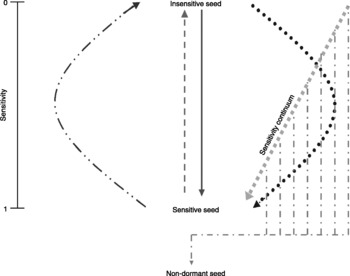
Taylor (Reference Taylor1981, Reference Taylor2005) proposed a two-step dormancy-breaking model to explain the cyclic pattern of germination of Trifolium subterraneum (Fabaceae) seeds with PY. Jayasuriya et al. (Reference Jayasuriya, Baskin and Baskin2008a) further developed this model and demonstrated sensitivity cycling to dormancy-breaking treatment of seeds with PY using Ipomoea lacunosa (Convolvulaceae). According to these models, there are two states of dormant seeds: insensitive seeds (Jayasuriya et al., Reference Jayasuriya, Baskin and Baskin2008a) [ = hard seeds (Taylor, Reference Taylor2005)], which are not sensitive to a dormancy-breaking treatment; and sensitive seeds (Jayasuriya et al., Reference Jayasuriya, Baskin and Baskin2008a) [ = latent soft seeds (Taylor, Reference Taylor2005)], which are sensitive to dormancy-breaking treatment. Dormant seeds can cycle between sensitive and insensitive states (insensitive ↔ sensitive), and the cycle is driven by environmental stimuli such as temperature and moisture content of the substrate. Actually, there is a continuum of degrees of sensitivity between sensitive and insensitive states (Fig. 1) (Jayasuriya et al., Reference Jayasuriya, Baskin and Baskin2008a, Reference Jayasuriya, Baskin, Geneve, Baskin and Chienb). Seeds closer to the sensitive state (1 in Fig. 1) require a low intensity of dormancy-breaking treatment for a short period of time to become non-dormant (ND), whereas insensitive seeds (0 in Fig. 1) require a high intensity of the dormancy-breaking treatment for a longer period of time (Jayasuriya et al., Reference Jayasuriya, Baskin and Baskin2008a).
Generalized model of dormancy-breaking requirements and sensitivity cycling in seeds with physical dormancy. Solid arrow, environmental conditions make insensitive seeds sensitive at a fast rate, e. g. storage at 25°C and high relative humidity (>90%) for I. lacunosa; dotted line, environmental conditions make insensitive seeds sensitive at a slow rate, e.g. storage at 35°C and low relative humidity ( < 25%) for I. lacunosa; vertical dashed line, environmental conditions make sensitive seeds insensitive at a fast rate, e.g. storage at 35°C and low relative humidity ( < 25%) for I. lacunosa; dashed/double dotted line, environmental conditions make sensitive seeds insensitive at a slow rate, e.g. storage at 5°C in low or high relative humidity; dashed/single dotted lines on right hand side, environmental conditions that break physical dormancy, e.g. storage at 35°C at high relative humidity (>90%) for I. lacunosa (length of a line represents time that seeds have to be exposed to dormancy-breaking environmental conditions to become non-dormant).

Despite the evidence to the contrary, many biologists working with seeds consider PY break in nature to be a simple physical event, in which dormancy is released by microbial action, abrasion by soil particles or passage through the digestive tract of animals (see Baskin and Baskin, Reference Baskin and Baskin2000); or, more rarely, via opening of the water gap in the seed (or fruit) coat in response to an environmental cue such as high or fluctuating temperatures (Baskin et al., Reference Baskin, Baskin and Li2000; Van Assche et al., Reference Van Assche, Debucquoy and Rommens2003; Jayasuriya et al., Reference Jayasuriya, Baskin and Baskin2008a). However, sensitivity cycling to physical dormancy break shows that environmental control of germination of seeds with water-impermeable seed coats may be much more complex (Taylor, Reference Taylor1996, Reference Taylor2005; Jayasuriya et al., Reference Jayasuriya, Baskin and Baskin2008a, Reference Jayasuriya, Baskin, Geneve, Baskin and Chienb). The aims of this paper are: (1) to discuss sensitivity cycling and its role in controlling the germination of seeds with PY; (2) to distinguish sensitivity cycling from PY cycling; (3) to compare sensitivity cycling with PD cycling; and (4) to discuss briefly the possible relevance of sensitivity cycling to dormancy classification.
Sensitivity cycling or PY cycling
There are some claims of cycling of dormancy (PY ↔ ND) in seeds with PY (Rolston, Reference Rolston1978; Norsworthy and Oliveira, Reference Norsworthy and Oliveira2007). Rolston (Reference Rolston1978) mentioned dormancy cycling in his review on physical dormancy of seeds. However, he did not present any experimental evidence for it. To explain the cyclic pattern of germination they observed in exhumed seeds buried in the field, Norsworthy and Oliveira (Reference Norsworthy and Oliveira2007) hypothesized that Ipomoea lacunosa seeds underwent dormancy cycling. However, seasonal cycles of germination in seeds of this species can be explained by sensitivity cycling (Jayasuriya et al., Reference Jayasuriya, Baskin and Baskin2008a).
There are two important points that need to be demonstrated to show the existence of sensitivity cycling to PY break. First, seasonal cycling in germination patterns has to be demonstrated. Second, this cycling pattern of germination is not a result of cycling of dormancy (PY or PD). Laboratory, as well as field-based, methods have been used to study the cyclic patterns of germinability in seeds with PY. It is common to study seasonal patterns of germination in seeds buried in soil. In this method, field-buried seeds are exhumed at intervals of time and germination is tested under laboratory conditions (Van Assche et al., Reference Van Assche, Debucquoy and Rommens2003; Benvenuti et al., Reference Benvenuti, Dinelli, Bonetti and Catizone2005; Van Assche and Vandelook, Reference Van Assche and Vandelook2006). However, it is important to test germination at a minimum of three temperature regimes. If germination is tested at only one temperature regime (as by Benvenuti et al., Reference Benvenuti, Dinelli, Bonetti and Catizone2005), it is not certain whether seeds are cycling between sensitivity ↔ insensitivity or between PY ↔ ND. If seeds germinate well at only one temperature regime or only at a few temperature regimes, it is a strong indication that they are not undergoing PY cycling but sensitivity cycling. However, seeds may undergo PD cycling. To check whether PD cycling occurs or not, swelling or imbibition of seeds at all temperatures tested can be used. If seeds swell but do not germinate in the temperature regimes tested, they undergo PD cycling. If seeds swell only at one temperature (where high germination was observed) and do not swell at the other temperatures, then it can be concluded that they cycle between insensitivity ↔ sensitivity.
A simulated natural PY-breaking treatment has to be identified first when laboratory conditions are used in assessing sensitivity cycling of seeds with PY (Jayasuriya et al., Reference Jayasuriya, Baskin and Baskin2008a). Then, the effect of different storage treatments can be tested. Some treatments may reduce the sensitivity of seeds to PY breaking, some may induce sensitivity and some may have no effect. To further confirm that seeds are made sensitive using the above-mentioned treatments, seeds can be subjected to treatments that reduce the sensitivity and vice versa.
A physical break forms in a specialized morphoanatomical structure known as the water gap in the seed or fruit coat of physically dormant seeds when they become non-dormant (Baskin et al., Reference Baskin, Baskin and Li2000; Baskin, Reference Baskin2003; Jayasuriya et al., Reference Jayasuriya, Baskin, Geneve and Baskin2007). Resealing of this break is not anatomically possible in most, or any, of these seeds. Shaw (Reference Shaw1929) observed a physical break in the protuberance of Nelumbo lutea seeds during PY break. In Malvaceae and related families, the bixoid chalazal plug (specialized hilar area) is the water gap, and removal of this plug is through formation of slits during natural PY break (Malvaceae: Egley and Paul, 1982; Poljakoff-Mayber et al., Reference Poljakoff-Mayber, Somers, Werker and Gallagher1992; Daws et al., Reference Daws, Orr, Burslem and Mullins2006; Cistaceae: Thanos and Georghiou, Reference Thanos and Georghiou1988; Cochlospermaceae, Dipterocarpaceae, Sarcolaenaceae and Bixaceae: Nandi, Reference Nandi1998). Li et al. (Reference Li, Baskin and Baskin1999) demonstrated that a blister forms during a physical break in the water-impermeable fruit coat at the carpillary micropyle during breaking of PY in Rhus aromatica and R. glabra (Anacardiaceae). Physical separation of the imbibition lid from the rest of the seed coat during dormancy-breaking treatment allows water to enter seeds of Canna indica, C. flaccida, C. tuerckheimii, C. lutea, C. jaegeriana and C. glauca (Cannaceae) (Graven et al., Reference Graven, De Koster, Boon and Bouman1997). These physical breaks are impossible to reseal. Therefore, reversal to PY in non-dormant seeds of these species is not possible.
However, more complex situations occur in Fabaceae and Convolvulaceae. In most species of Fabaceae, the lens (sometimes incorrectly referred to as strophiole) is the water gap in seeds with PY (Dell, Reference Dell1980; Hanna, Reference Hanna1984; Manning and Van Staden, Reference Manning and Van Staden1987; Serrato-Valenti et al., Reference Serrato-Valenti, De Vries and Cornara1995), while two bulges adjacent to the micropyle form the water gap in most species of Convolvulaceae (Jayasuriya et al., Reference Jayasuriya, Baskin, Geneve and Baskin2007, Reference Jayasuriya2008d). These studies clearly showed that a physical break occurs in the lens (Fabaceae) or around the bulges (Convolvulaceae) and allows water to enter the seed. These breaks are not resealable. However, Jones and Geneve (Reference Jones and Geneve1995) hypothesized that the hilar fissure is the water gap in seeds of Cercis canadensis (Fabaceae, Caesalpinioideae), and Morrison et al. (Reference Morrison, McClay, Porter and Rish1998) suggested that the hilar fissure or micropyle is the water gap in seeds of Bossiaea heterophylla, B. obcordata, B. rhombifolia, B. stephensonii, Glycine clandestina and Platylobium formosum (Fabaceae, Papilionoideae). Jayasuriya et al. (Reference Jayasuriya, Baskin, Geneve, Baskin and Chien2008b) clearly showed that the hilar fissure is the water gap in seeds of Cuscuta australis. Thus, in seeds of these species there is no physical break in the seed coat, as there is in seeds in which the lens or the bulge functions as the water gap during seed dormancy break. Instead, the hilar fissure opens and allows water to get into the seed. In which case, it would seem that resealing of the opening in seeds of Cuscuta and some legumes might be possible (but see later for Cuscuta).
However, there is no direct experimental evidence to show that seeds in which the hilar fissure serves as the water gap can undergo dormancy cycling. Callihan (Reference Callihan1933), Hyde (Reference Hyde1954), Rangaswamy and Nandakumar (Reference Rangaswamy and Nandakumar1985) and Jayasuriya et al. (Reference Jayasuriyain press a) described the ability of the hilar pad to act as a valve in seeds of Convolvulvus arvensis (Convolvulaceae), Trifolium repens (Fabaceae), Rhynchosia minima (Fabaceae) and Ipomoea lacunosa (Convolvulaceae), respectively. In all of these studies, the hilar fissure opened when seeds were stored at low relative humidity (RH), and it closed when seeds were under high RH. There is no experimental evidence to show that the hilar fissure opens under wet conditions and allows uptake of enough water for the seed to germinate. Jayasuriya and co-workers have shown that the hilar pad has the ability to act as a valve in seeds of Ipomoea lacunosa (Jayasuriya et al., Reference Jayasuriya, Baskin and Baskinin press a) and I. hederacea (Jayasuriya et al., Reference Jayasuriya, Baskin, Geneve, Baskin and Chienin press b). It was clearly shown that sensitive dormant seeds can even absorb some amount of water (2%) through the hilar fissure, but that swelling of the hilar pad prevents further absorption of water; thus, the seeds remain dormant (Jayasuriya, Reference Jayasuriya2008). Further, it was suggested that movement of water or water vapour through the hilar fissure facilitates dormancy break of I. lacunosa seeds by promoting formation of (a) permanent opening(s) in the seed coat (slits around the two bulges adjacent to micropyle), which allows enough water to get into seeds for them to germinate. Hanna (1984) suggested a mechanism for opening the lens in seeds of Acacia kempeana (Fabaceae, Mimosoideae), by which heating caused the lens to open via an increase in pressure in the vascular bundle, but he did not have any experimental evidence for his hypothesis.
The hilum acts as the water gap in seeds of Cuscuta australis, which has a seasonal germination pattern. Jayasuriya et al. (Reference Jayasuriya, Baskin, Geneve, Baskin and Chien2008b) have shown that seeds undergo sensitivity cycling, but not dormancy cycling, by testing them at different temperature regimes. Two-month wet-stored seeds germinated well at 35/20°C but not at any other test temperature. This shows that seeds did not became non-dormant during dry storage but that their sensitivity to a 35/20°C wet-incubation treatment for dormancy break increased. Further, although dry storage at 35/20°C for 2 months reversed sensitivity (sensitive → insensitive) of dormant seeds of C. australis, it did not cause permeable seeds [made permeable (impermeable → permeable) by dipping them into boiling water] to revert to impermeable seeds (Jayasuriya, Reference Jayasuriya2008). This suggests that even physically dormant seeds with a simple water gap cannot cycle between dormancy and non-dormancy.
Thus, results of the above-mentioned experiments lead to the conclusion that the hilar fissure acts as a temporary opening to absorb some water that may aid in dormancy break, and that the fissure may be opened and closed. However, it seems that in order to obtain enough water for germination the hilar fissure has to be opened permanently, in which condition it will not reclose under high humidity, as observed in the above experiments.
Hagon and Ballard (Reference Hagon and Ballard1970) claimed that permeability of Trifolium subterraneum seeds [made permeable by percussion (impaction)] was reversed when they dried the seeds at 5% RH. Percussed seeds germinated to high percentage at 20°C (the only temperature they tested), but when they were stored dry at 5% RH the germination percentage was low. However, when percussed seeds were kept in high RH ( ≥ 70%) prior to drying at 5% RH they germinated to high percentage. Hagon and Ballard (Reference Hagon and Ballard1970) observed that the palisade layer in the lens of seeds incubated at 70% RH had slits through its entire width, and although the palisade layer of seeds incubated at 5% RH also had slits, they did not penetrate through the whole width of the palisade layer. They only tested germination at 20°C. Although they claim that reversal of permeability had been demonstrated, their observations can also be explained by sensitivity cycling. Thus, percussion may not have made the seeds permeable. Instead, it might have increased the sensitivity of the seeds to dormancy break at 20°C, while drying reduced their sensitivity to dormancy-breaking treatment. High RH-cued dormancy break was observed by Jayasuriya et al. (Reference Jayasuriya, Baskin, Geneve and Baskin2007, Reference Jayasuriya, Baskin, Geneve, Baskin and Chien2008b). Our suggestion that Hagon and Ballard (Reference Hagon and Ballard1970) were observing sensitivity cycling and not dormancy cycling is supported by the fact that the palisade layer of dry-treated seeds of T. subteraneum was not split through its entire width. Further, these authors did not observe the lens of percussed seeds before they were treated with high or low RH conditions, to determine whether the seeds were permeable or impermeable before exposing them to high or low RH.
Sensitive seeds of most species, e.g. Trifolium subterraneum (Taylor, Reference Taylor1981), Ornithopus compressus (Taylor and Revell, Reference Taylor and Revell1999), Geranium robertianum (Van Assche and Vandelook, Reference Van Assche and Vandelook2006), Alyogyne huegelii (Baker et al., Reference Baker, Steadman, Plummer, Merritt and Dixon2005), Ipomoea lacunosa (Jayasuriya et al., Reference Jayasuriya, Baskin and Baskin2008a) and Cuscuta australis (Jayasuriya et al., Reference Jayasuriya, Baskin, Geneve, Baskin and Chien2008b), can germinate at one or more temperature regimes, but they can not germinate at others. This is similar to the behaviour of seeds with conditional dormancy, which germinate over a narrower range of temperatures than those that are non-dormant (Baskin and Baskin, Reference Baskin and Baskin2004). However, there are several differences between conditionally dormant and sensitive seeds. Embryos within intact conditionally dormant seeds can grow at particular temperatures, whereas they are unable to grow at other temperatures. Further, certain environmental cues may reimpose the constraint for embryo growth at temperatures at which they otherwise germinate (Baskin and Baskin, Reference Baskin and Baskin1998, Reference Baskin and Baskin2004; Finch-Savage and Leubner-Metzger, Reference Finch-Savage and Leubner-Metzger2006). However, sensitive seeds are impermeable to water at all temperatures. When these sensitive seeds are kept under certain temperature and humidity conditions, a physical break occurs via opening of the water gap, and the seed can germinate over a wide range of temperatures in light and dark (Baskin et al., Reference Baskin, Davis, Baskin, Gleason and Cordell2004). When this opening forms, it seems to be irreversible and thus cannot be closed. Thus, sensitive seeds are not similar to conditionally dormant seeds, and sensitivity cycling in seeds with PY is not the same thing as dormancy cycling in seeds with PD. However, sensitivity cycling to PY break has the same ecological function as PD cycling, allowing seeds to germinate only at favourable conditions for seedling establishment.
Occurrence of sensitivity cycling in angiosperms
Sixteen angiosperm families are known to have seeds with PY (Baskin et al., Reference Baskin, Baskin and Li2000, 2006; Baskin and Baskin, Reference Baskin, Baskin, Smith, Dickie, Linnington, Pritchard and Probert2003). Thirteen of these families are clustered in the rosid clade, one is a monocot (Cannaceae), one a basal eudicot (Nelumbonaceae) and one an asterid (Convolvulaceae) (Baskin et al., Reference Baskin, Baskin and Li2000). To date, sensitivity cycling to physical dormancy break has been demonstrated clearly only in Fabaceae (Taylor and Revell, Reference Taylor and Revell1999; Van Assche et al., Reference Van Assche, Debucquoy and Rommens2003; Taylor, Reference Taylor2005) and Convolvulaceae (Jayasuriya et al., Reference Jayasuriya, Baskin and Baskin2008a, Reference Jayasuriya, Baskin, Geneve, Baskin and Chienb), two families that are not closely related to each other (Angiosperm Phylogeny Group, 2003).
Fabaceae
Taylor (Reference Taylor1981) described a two-stage model of PY break in seeds of Trifolium subterraneum (Fabaceae, Papilionoideae). Non-treated seeds of T. subterraneum respond slowly to dormancy-breaking treatment (dry incubation at 60/15°C daily fluctuating temperature), whereas those stored dry at constant temperatures ( ≥ 15°C) prior to dormancy-breaking treatment respond significantly faster to dormancy-breaking treatment. However, Taylor (Reference Taylor1981) did not demonstrate sensitivity cycling ability of the seeds to dormancy-breaking treatment. Later Taylor (Reference Taylor1996) and Taylor and Ewing (Reference Taylor and Ewing1996) used the same model to explain the dormancy-breaking behaviour of Medicago polymorpha and M. truncatula, which also belong to subfamily Papilionoideae (Fabaceae). There was an indication of a cyclic pattern of germinability in seeds of M. polymorpha and M. truncatula, although reduction of seed germination was not significant (Taylor, Reference Taylor1996).
The first convincing evidence of sensitivity cycling to dormancy-breaking treatment was provided by Taylor and Revell (Reference Taylor and Revell1999) for seeds of Ornithopus compressus (Fabaceae, Papilionoideae). O. compressus seeds were made sensitive ( = latent soft, hereafter sensitive) by storing them dry at 60/15°C for 205 days. These seeds became permeable by incubating them dry at 48/15°C for 7 days. However, the authors did not provide any information on the dormancy-breaking requirements of insensitive seeds. Sensitivity of these seeds could be reversed by storing sensitive seeds (made sensitive by storing at 60/15°C for 205 days) dry at 8°C for 8 weeks. Thus, seeds can become water permeable only after a long, hot summer when rains begin. Van Assche et al. (Reference Van Assche, Debucquoy and Rommens2003) documented a cyclic pattern of germinability in Lathyrus aphaca, L. nissolia, Lotus corniculatus, Medicago lupulina, Melilotus albus, Trifolium pratense, T. repens, Vicia cracca and V. sativa (Fabaceae, Papilionoideae). Seeds of these nine species exhumed at different times of the year and incubated at several temperatures exhibited a cyclic pattern of germination. The fact that seeds did not germinate equally well at all test temperatures shows that, during burial, seeds of these nine species did not became permeable but that they were sensitive to dormancy-breaking treatment. For example, fresh seeds of M. lupulina did not germinate at any of the test temperatures. However, after seeds were buried for 7 months they germinated at 15/6°C but not at 20/10, 30/20 or 23°C (Van Assche et al., Reference Van Assche, Debucquoy and Rommens2003). If PY had been broken, they also would have germinated at the other three temperatures. Further, seeds buried for 10 months did not germinate at any temperature. After 14 months of burial, seeds again had the capability to germinate at 15/6°C, but not at the other temperatures tested. The consequence of sensitivity cycling of these nine species is that seeds can become water permeable only in spring.
Convolvulaceae
Jayasuriya et al. (Reference Jayasuriya, Baskin and Baskin2008a) demonstrated sensitivity cycling in seeds of Ipomoea lacunosa (Convolvulaceae, Ipomoeeae) with PY using sequences of laboratory storage and incubation treatments. They proposed a model to explain dormancy break of I. lacunosa seeds. Sensitivity of I. lacunosa seeds can be induced at a fast rate by storing them wet at ≥ 25°C, while dry storage at ≥ 30°C increases the sensitivity of insensitive seeds gradually. Wet or dry storage at low temperatures ( ≤ 5°C) and dry storage at high temperatures ( ≥ 25°C) reversed the sensitivity of sensitive seeds. Incubation of sensitive seeds at high RH (>90%) at 35°C for ≥ 3 h made them permeable (Jayasuriya et al., Reference Jayasuriya, Baskin and Baskin2008a). Insensitive seeds gradually germinated at 35/20°C on wet sand, reaching 100% germination after 7 months, and they germinated to < 25% at the other temperatures tested, even after 7 months (Jayasuriya et al., unpublished data). Norsworthy and Oliveira (Reference Norsworthy and Oliveira2007) observed a cycling pattern of germinability in seeds of I. lacunosa. Seeds exhumed from burial in the field in January (winter), April (spring) and July (summer) germinated to lower percentages than fresh seeds at all the temperatures tested. However, seeds exhumed in October (autumn) germinated to higher percentages at ≥ 30°C than did seeds exhumed in January (winter), April (spring) or July (summer). These seeds did not germinate at ≤ 20°C. They explained this as dormancy cycling. However, we suggest that they were observing sensitivity cycling to dormancy break, as explained by Jayasuriya et al. (Reference Jayasuriya, Baskin and Baskin2008a). According to the observations made by Jayasuriya et al. (Reference Jayasuriya, Baskin and Baskin2008a), I. lacunosa seeds can become permeable in late spring or early summer if they are exposed to regular rain. If the summer is wet, seeds can become permeable throughout the summer.
Sensitivity of Ipomoea hederacea (Convolvulaceae, Ipomoeeae) seeds was induced by storing them wet or dry at ≥ 25°C (Jayasuriya et al., in press b). Sensitive seeds of I. hederacea became permeable within 2 weeks when they were stored dry at 35/20°C. Sensitivity of these seeds was reversed by storing them wet or dry at ≤ 15°C. Seeds stored at 5/1°C wet or dry for 1 month germinated to < 50% after dry storage at 35/20°C for 2 weeks, whereas untreated seeds and seeds stored at ≤ 15°C followed by dry storage at 35/20°C for 2 weeks germinated to 75% and >90%, respectively. However, after 2 months of dry storage at 35/20°C, seeds preconditioned at 5/1°C wet or dry for 1 month germinated to 75% (Jayasuriya et al., Reference Jayasuriyain press b). Jacquemontia ovalifolia (Convolvulaceae, Jacquemontieae) seeds became sensitive when they were stored dry at 15/6°C, and dormancy of sensitive seeds was broken by incubating them at 35/20°C wet (Jayasuriya et al., Reference Jayasuriyain press b). Sensitivity of these seeds was reversed by storing them dry at 35/20°C. As a result of sensitivity cycling, it would be predicted that J. ovalifolia seeds can only become permeable in summer after rain.
Cuscuta australis (Convolvulaceae, Cuscuteae) seeds became sensitive to dormancy-breaking treatment (wet incubation at 35/20°C for 1 month) when they were stored dry at ambient laboratory temperature (22–24°C) for 2 months or at 15/6°C for 4 months. Sensitivity was reversed by dry storage at 35/20°C (Jayasuriya et al., Reference Jayasuriya, Baskin, Geneve, Baskin and Chien2008b). Insensitive seeds germinated to < 50% at every temperature regime tested, even after 3 months of incubation (Jayasuriya et al., unpublished data). Benvenuti et al. (Reference Benvenuti, Dinelli, Bonetti and Catizone2005) observed a cyclic germination pattern in seeds of Cuscuta campestris stored in the field and tested at 30°C, and they explained it as follows: PY (1st autumn) → ND (1st spring) → PD (2nd autumn) → ND (2nd spring) → PD (3rd autumn). However, embryos of fresh seeds of C. campestris are not dormant (Hutchison and Ashton, Reference Hutchison and Ashton1979), and therefore it is unlikely that they could cycle between PD and ND (see Simpson, Reference Simpson1990; Baskin and Baskin, Reference Baskin and Baskin2004). Further, they did not show that seeds had PD in the 2nd autumn or in the 3rd autumn. The cycling pattern of germinability observed in this species could also be explained using sensitivity cycling to PY break. Thus, seeds may undergo sensitivity cycling during burial, and 30°C wet incubation may have fulfilled their dormancy-breaking requirements (Jayasuriya et al., Reference Jayasuriya, Baskin, Geneve, Baskin and Chien2008b). According to the results of Benvenuti et al. (Reference Benvenuti, Dinelli, Bonetti and Catizone2005), it seems that in spring seeds were sensitive to dormancy-breaking treatment and in autumn they were insensitive. Thus, Benvenuti et al. (Reference Benvenuti, Dinelli, Bonetti and Catizone2005) observed high germination in spring and low germination in autumn at 30°C.
At least in Convolvulaceae, sensitivity cycling to PY break seems to be a common phenomenon that is not phylogenetically constrained. Thus, it occurs in an advanced tribe Ipomoeeae, in a tribe evolved directly from basal tribes (Cuscuteae) and in a tribe in the middle of the phylogenetic tree (Jacquemontieae) (Jayasuriya et al., Reference Jayasuriya, Baskin and Baskin2008c).
Other families
Although not as convincing as in Fabaceae or Convolvulaceae, there is some evidence for the occurrence of sensitivity cycling to PY break in seeds of other families with PY. Fresh seeds of Alyogyne huegelii (Malvaceae) germinated to low percentage ( < 40%) when they were heated at 70°C for 1 h (Baker et al., Reference Baker, Steadman, Plummer, Merritt and Dixon2005). Germination was further reduced when seeds were buried in burned or unburned soil for 6 months and heated at 70°C for 1 h. Germinability of seeds increased to >60% when they were buried in burnt or unburnt soil for 12 months and heated at 70°C for 1 h. However, since germination was tested only at one temperature (20°C), there is no direct evidence to exclude PY cycling (i.e. PY ↔ ND). However, as discussed previously, PY cycling does not seem to be anatomically possible.
Van Assche and Vandelook (Reference Van Assche and Vandelook2006) tested for a cyclic pattern of germinability in the physically dormant seeds of Geranium spp., Malva spp. and Erodium cicutarium. They buried seeds in the field for 3 years and at monthly intervals exhumed and tested samples for germination at 23, 20, 10 and 20/10°C. No cyclic patterns of germination were observed, except in seeds of Geranium robertianum (Geraniaceae). Fresh seeds of G. robertianum germinated to low percentages ( < 10%) at all temperatures tested, whereas those exhumed in February (winter) germinated >65% at 20/10°C and to < 5% at the other temperatures. Seeds again germinated to very low percentages when exhumed in April (spring), June (summer) or October (autumn). This is clear evidence for sensitivity cycling in G. robertianum seeds with PY. Low germinability of February (winter)-exhumed seeds at 23, 20 or 10°C indicates that exhumed seeds were impermeable; otherwise, they should have germinated. Although a cyclic pattern was not observed in E. cicutarium, G. columbianum, G. dissectum, G. lucidum, G. molle or G. pusillum (Geraniaceae) seeds, there is evidence for a two-stage dormancy break among the observations made by Van Assche and Vandelook (Reference Van Assche and Vandelook2006). Fresh non-treated or desiccated (at 20°C using silica gel) seeds of these species did not germinate at 23°C. However, sensitivity of seeds to drying (PY break) increased during burial. Seeds buried for 0.5, 1.5 and 2.5 years germinated to high percentages at 23°C after drying, but they did not germinate without drying. Although there was no evidence of a cyclic pattern of germination in seeds of these species, it is theoretically possible for seeds with a two-stage dormancy break to undergo sensitivity cycling.
Sensitivity cycling to PY break is not phylogenetically constrained. It occurs in Fabaceae and Convolvulaceae, and evidence seems to indicate that it occurs in Malvaceae and Geraniaceae. Jayasuriya et al. (Reference Jayasuriya, Baskin and Baskin2008c) mentioned that seeds of all the species tested for sensitivity cycling showed evidence for it. Therefore, we suggest that lack of examples of seeds with sensitivity cycling in other families is due to lack of testing for it, and not for lack of occurrence. Documenting (or not) sensitivity cycling in seeds is not easy.
Categories of sensitivity cycling
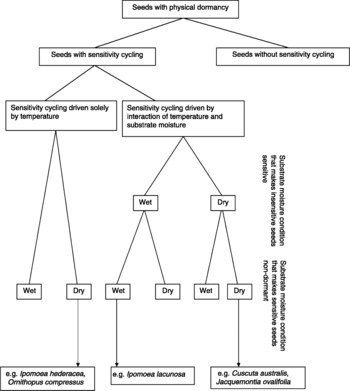
Seeds with PY can be categorized into two major groups, based on occurrence of sensitivity cycling: seeds with sensitivity cycling and seeds without sensitivity cycling (Fig. 2). As data are limited, all seeds with PY may have sensitivity cycling, and additional experiments are needed to evaluate the extent of sensitivity cycling in families whose seeds have PY. Seeds with sensitivity cycling can be categorized using the environmental cues that influence this sensitivity, as well as the environmental cues that break PY in seeds. In some species, sensitivity cycling is driven solely by temperature, and in other species it is driven by an interaction between temperature and substrate moisture conditions.
Categories of physical dormancy according to sensitivity-cycling and dormancy-breaking requirements.

In the first case, we suggest the name ‘temperature-driven sensitivity cycling’. Moisture content of the substrate does not interact in this category of sensitivity cycling. Ipomoea hederacea is a good example of seeds with temperature-driven sensitivity cycling (Jayasuriya et al., Reference Jayasuriyain press b). In I. hederacea, sensitivity was induced by high temperatures, whereas low temperatures reversed the sensitivity of sensitive seeds. Temperature-driven sensitivity cycling seems to be an adaptive advantage to species in temperate regions producing seeds with PY. Temperature fluctuations are important cues to detect the favourable and non-favourable conditions in temperate regions.
For the second type of sensitivity cycling, we suggest the term ‘temperature- and substrate-moisture-driven sensitivity cycling’. Sensitivity cycling of Ipomoea lacunosa is driven by the interaction of temperature and substrate moisture (Fig. 2). High temperatures under wet conditions induce the sensitivity of insensitive seeds of I. lacunosa, whereas high temperatures under dry conditions gradually increase the sensitivity of insensitive seeds (Jayasuriya et al., Reference Jayasuriya, Baskin and Baskin2008a). However, storage at high temperatures on a dry substrate reverses the sensitivity of sensitive seeds, while storage under wet conditions has no effect on reversal. Sensitivity cycling that is driven by the interaction of temperature and moisture conditions is induced by wet conditions (high relative humidities or high soil water potentials) in some seeds and by dry conditions (low relative humidities or low soil water potentials) in others. Sensitivity of I. lacunosa seeds mainly is induced by wet conditions, whereas in seeds of Cuscuta australis (Jayasuriya et al., Reference Jayasuriya, Baskin, Geneve, Baskin and Chien2008b) and Jacquemontia ovalifolia (Jayasuriya et al., Reference Jayasuriya2008c) sensitivity is induced by dry conditions. It is difficult to classify species in which burial induces sensitivity, since we do not know the exact moisture or temperature conditions that induce sensitivity in these seeds. More laboratory experiments are needed to identify the category(ies) into which these species fit. Sensitivity cycling driven by the interaction of temperature and moisture conditions is an adaptive advantage for tropical and subtropical species. In these regions, temperature is not always a good cue for favourable versus non-favourable conditions for germination. Instead, a combination of soil moisture content and temperature would provide more precise information about the environment of the seeds.
When we consider dormancy-breaking cues together with sensitivity-cycling cues, several combinations of environmental factors (categories) can be derived. The theoretical possibilities of combinations of dormancy-breaking cues and cues that can induce sensitivity are shown in Fig. 2. Although we do not have examples for all of these theoretical categories, they may exist in nature, but more experiments are needed to determine whether these categories exist. However, awareness of these theoretical categories is important in planning experiments to evaluate the sensitivity cycling of seeds with PY.
Baskin and Baskin (Reference Baskin and Baskin2004) identified five classes of seed dormancy (physical, physiological, combinational, morphological and morphophysiological). Neither physical dormancy (PY) nor combinational dormancy (PY+PD) were subdivided into levels and types, or just levels, of dormancy. No levels or types within the physical or combinational dormancy classes have been proposed. Sensitivity cycling categories may be useful in subdividing PY and (PY+PD).
PD cycling and sensitivity cycling of seeds with PY
Dormancy cycling is well known in seeds with non-deep PD (Baskin and Baskin, Reference Baskin and Baskin1998). However, although the molecular and biochemical mechanisms of the breaking and maintenance of non-deep PD are understood to a great extent, the mechanism of cycling of PD (PD ↔ ND) is not (Finch-Savage and Leubner-Metzger, Reference Finch-Savage and Leubner-Metzger2006). Hilhorst and Karssen (Reference Hilhorst and Karssen1992) suggest that dormancy cycling occurs due to cycling of sensitivity of the embryo to abscisic acid and to gibberellins, and/or cycling of production of abscisic acid. Using the hydrothermal time model, Bradford (Reference Bradford2002) suggested that dormancy break involves a decrease (more negative value) in ψb (basal osmotic potential) at which seeds can germinate. Thus, dormancy cycling occurs due to cycling of ψb between more negative and less negative values. All of these mechanisms involve active metabolic reactions in the embryo or living endosperm. New enzymes or other molecules have to be formed, and some molecules and enzymes have to be destroyed, every time seeds enter into dormancy or non-dormancy. Thus, this might affect the vigour of the seed.
In contrast, sensitivity cycling of seeds with PY is maintained mainly in the non-living part of the seed, the seed coat. Although the exact physical–chemical mechanism is not known in sensitivity cycling to PY, Jayasuriya et al. (Reference Jayasuriyain press a) have shown that in seeds of I. lacunosa it is maintained by cycling of affinity of the hilar pad to water/water vapour. Chemical change is definitely involved, but it seems that this (these) chemical reaction(s) is (are) driven by moisture and/or temperature conditions (Jayasuriya et al., Reference Jayasuriyain press a), rather than by metabolic energy in the living part of the embryo. Thus, sensitivity cycling seems to be a more advanced and efficient way of maintaining a long-lived, vigorous, soil seed-bank. Baskin et al. (Reference Baskin, Baskin and Li2000) and Finch-Savage and Leubner-Metzger (Reference Finch-Savage and Leubner-Metzger2006) agreed that PY is the most evolutionary advanced kind of seed dormancy in angiosperms, and hence sensitivity cycling must have evolved along with, or after, PY. This strongly suggests that sensitivity cycling in seeds with PY is more advanced than dormancy cycling in seeds with PD.
Furthermore, seeds with PD have no mechanism to keep seed moisture content low. Every time environmental moisture increases, so does seed moisture content. According to Harrington's (Reference Harrington1960) water absorption isothermic data, seeds of most species gain >18% and >20% seed moisture content when they are stored at 90% and 100% RH, respectively. However, both sensitive and insensitive seeds of I. lacunosa and I. hederacea had < 14% seed moisture content, and the theoretical maximum moisture content in sensitive seeds was 16% when they were kept on wet sand ( ≈ 100% RH) (Jayasuriya et al., unpublished). In high moisture contents (>15%), several adverse enzymatic reactions can take place that can cause gradual degradation of the seed (Copeland and McDonald, Reference Copeland and McDonald2001). Fungal infections are high when seed moisture content is >15% (Christensen and Kaufmann, Reference Christensen and Kaufmann1969; Christensen and Sauer, Reference Christensen, Sauer and Christensen1982). Especially under soil seed-bank conditions, pathogenic infections are one of the important components of seed-bank depletion (Roberts, Reference Roberts and Roberts1972; Thompson, Reference Thompson and Fenner2000). Seeds with PY are among those with high longevity. Live seeds of Nelumbo nucifera (Nelumbonaceae) collected from a lake bed in China were 14C dated to over 1200 years old (Shen-Miller et al., Reference Shen-Miller, Mudgett, Schopf, Clarke and Berger1995). Seeds of Malva rotundifolia were among those of the two species found to be living after 120 years in Beal's seed burial experiment (Telewski and Zeevaart, Reference Telewski and Zeevaart2002). Seeds of both N. nucifera and M. rotundifolia have PY. Even in controlled − 18°C storage, Fabaceae and Malvaceae are among the four families with highest average storage life (Walters et al., Reference Walters, Wheelar and Grotenhuis2005), and many species in these two families produce seeds with PY.
Jayasuriya et al. (unpublished) demonstrated that insensitive seeds of I. lacunosa can maintain lower seed moisture content than sensitive seeds. Further, they found that the rate of vigour loss was lower in insensitive than in sensitive seeds of this species, thus showing that sensitivity cycling is important in maintaining vigour of I. lacunosa seeds. However, they did not observe any significant vigour change in sensitive seeds of I. hederacea, which also undergo sensitivity cycling.
Therefore, it seems that physically dormant seeds with sensitivity cycling have an advantage in keeping seed moisture content low and in being fine-tuned to environmental cues to detect the suitable season for germination and subsequent seedling establishment. This is especially advantageous under unpredictable environmental conditions.
Future focus
Sensitivity cycling has been demonstrated clearly in only two (Fabaceae and Convolvulaceae) of the 16 families of angiosperms known to have PY, although there is evidence that it also occurs in Malvaceae and Geraniaceae. Therefore, testing seeds with PY in other families for sensitivity cycling is important in understanding the evolution of PY in angiosperms. Seeds with combinational dormancy should be an important focus. The mechanism of sensitivity cycling is not clearly understood, although some functional differences have been identified between sensitive and insensitive seeds of I. lacunosa (Jayasuriya et al., Reference Jayasuriyain press a). Chemical changes in seeds involved in sensitivity cycling may prove to be an interesting area of research. Also, there is no information on soil seed-bank dynamics of sensitive and insensitive seeds with PY.
Concluding remarks
Seasonal cyclic behaviour of germination in some seeds with PY can be adequately explained by sensitivity cycling to PY break. Sensitivity cycling seems to be a widespread phenomenon among seeds with PY; thus, it is not phylogenetically constrained. Categories of sensitivity cycling may be useful in establishing subcategories of physical dormancy in the Baskin and Baskin (Reference Baskin and Baskin2004) dormancy classification system. Sensitivity cycling would seem to be an efficient way to maintain a long-lived soil seed-bank without losing seed vigour. In seeds with PY, sensitivity cycling is ecologically analogous to cycling of dormancy in seeds with PD.
Dormancy cycling in seeds with PY does not seem to be anatomically possible, and there is no clear evidence for its occurrence. Further, once dormancy is broken, seeds with PY can germinate over a wide range of temperatures in light, including that with a high far red/red (FR/R) ratio, and in constant darkness (Baskin et al., Reference Baskin, Davis, Baskin, Gleason and Cordell2004). Thus, if seeds did not cycle between insensitive and sensitive states to dormancy-breaking conditions, they would need to be continuously in the sensitive state in order to ever come out of dormancy and germinate. In which case, it seems likely that they would germinate ‘out of season’ as well as ‘in season’. Thus, having the capacity to be in an insensitive state to dormancy-breaking factors during the unfavourable season(s) for growth would be of selective advantage for the species. As such, then, we suggest that sensitivity cycling evolved along with PY to synchronize germination at a time of the year that would give the plant enough time to complete its life cycle, or (in perennials) to form a perennating structure before the onset of unfavourable conditions for survival.