

The global response to the 2014 Ebola outbreak in Africa highlighted the need to understand attitudes toward aiding foreign countries faced with a disease outbreak. The response to Ebola was plagued with infighting, a lack of resources, and little accountability. Reference McNeil1 In this article, we seek to answer the question, how does the threat of disease influence people’s willingness to provide humanitarian aid to foreign countries? Although many have speculated about the mechanisms by which disease outbreaks in foreign countries may influence attitudes, Reference Gronke2 empirical work on the topic is scarce. A popular assertion among scholars regarding the 2014 Ebola outbreak was that disease salience increased xenophobic attitudes, which was associated with increased opposition to sending foreign aid to countries afflicted with the disease. However, tests of this proposed causal framework have yet to be done. In this article, we test the proposition that disease salience decreases support for humanitarian aid, and we examine whether these effects are constrained to aid that involves the potential risk of contamination or are ubiquitous enough to affect other forms of aid support. Further, we test the assumed mechanism of the effects of disease salience on policy attitudes related to humanitarian aid: increased xenophobia.
One promising concept that has gained attention in political science and psychology and that could explain how humanitarian aid attitudes change when disease is salient is the behavioral immune system (BIS). The BIS involves a number of evolved psychological mechanisms that work to detect and avoid potentially infectious pathogens. Reference Schaller and Park3 According to this theory, negative affect toward out-groups will increase in the face of disease salience because, from an evolutionary perspective, avoiding members of other groups minimizes the spread of disease and thus the risk of becoming infected. Reference Faulkner, Schaller, Park and Duncan4,Reference Navarrete and Fessler5,Reference Schaller, Duncan, Forgas, Haselton and von Hippel6 We utilize the BIS as a theoretical framework for deriving the hypothesis that support for particular forms of humanitarian aid will decrease when that aid involves the prospect of disease. Specifically, the BIS literature suggests that when a disease outbreak occurs, such as the Ebola outbreak in 2014, the threat of disease will trigger an evolutionarily ingrained pathogen avoidance mechanism, which causes individuals to feel negatively toward out-groups and, presumably, to oppose aid to foreign populations. Therefore, the proposed mechanism of the effects of disease salience in the context of humanitarian aid attitudes is xenophobia, or negative affect toward foreigners.
The primary goal of the present work is to test the hypothesis as derived from the BIS that disease salience influences support for humanitarian aid. Further, xenophobia is tested as the mediator of the effects of disease salience on aid support. Finally, we examine the pervasiveness of the effects of disease salience on aid support — that is, whether disease salience influences attitudes toward aid that is not related to disease and whether the effects of disease salience extend beyond aid that involves the potential risk of direct contamination. Two experiments were conducted with the intention of answering these questions. The findings from these experiments shed light on the lasting impact of evolutionary processes related to pathogen avoidance on political attitudes and, critically, the psychological mechanisms of the effects of these evolutionary processes.
The behavioral immune system and xenophobia
The BIS is argued to be a set of “psychological processes that infer infection risk from perceptual cues, and that respond to these perceptual cues through the activation of aversive emotions, cognitions, and behavioral impulses.” Reference Schaller7 In other words, the BIS suggests that evolutionary forces have imbued humans with mechanisms for avoiding people, places, or things that are associated with perceived disease. Schaller identifies multiple implications of the BIS, including social gregariousness, person perception, mate preferences, sexual behavior, conformity, and intergroup prejudice. 8 Others have suggested that the BIS drives political conservatism. Reference Fincher, Thornhill, Murray and Schaller9,Reference Terrizzi, Shook and McDaniel10
This article explores one specific mechanism of the BIS — the link between disease avoidance and out-group prejudice. This link has substantial implications for how the BIS influences policy attitudes. If the primary mechanism of the relationship between disease threat and policy attitudes is out-group prejudice, we should expect the effects of disease salience to operate through increased out-group prejudice and for the effects of disease salience to be asymmetrical depending on whether the target of the policy is an out-group or in-group. However, if the mechanism is instead a broader contamination threat that lowers levels of social trust in general, we should not expect group biases in the effects of disease threat or mediation by out-group prejudice.
We focus on xenophobia as a primary form of out-group prejudice that might influence humanitarian aid attitudes. We define xenophobia broadly as negative affect toward individuals from other countries. Several studies have argued that evolved disease avoidance mechanisms may be an explanation for xenophobic attitudes. Reference Faulkner, Schaller, Park and Duncan4,Reference Navarrete and Fessler5,Reference Schaller, Duncan, Forgas, Haselton and von Hippel6 According to Faulkner and colleagues, xenophobia is thought to emanate largely from an evolutionarily advantageous strategy designed to avoid the strange parasites, bacteria, and viruses lurking in foreign communities. Reference Faulkner, Schaller, Park and Duncan4 In support of their hypothesis, they find that perceptions of disease vulnerability are consistently correlated with anti-immigration attitudes. This suggests that disease salience influences policy attitudes related to out-groups through increases in xenophobic attitudes.
Schaller and Duncan suggest two theoretical mechanisms that explain why the relationship between disease avoidance and xenophobic attitudes exists. Reference Schaller, Duncan, Forgas, Haselton and von Hippel6 First, an association of an out-group member with a disease would be advantageous in that the out-group member could be a vessel for a disease that others have not built immunity against from previous exposure. The second explanation is that an out-group member would be unfamiliar with the in-group cultural practices created to combat the spread of diseases, such as the washing of hands or other sanitary procedures. The intuitive appeal of this theory as it might be related to humanitarian aid was highlighted in a discussion of the 2014 Ebola outbreak’s political ramifications. Reference Gronke2 It has been hypothesized by many that attitudes toward humanitarian aid related to the Ebola outbreak were driven by xenophobia. Reference Gronke2 Correlational evidence suggests that ethnic prejudice exhibited stronger relationships with restrictive healthy policies in light of the Ebola crisis than sheer fears of infection. Reference Stürmer, Rohmann, Mazziotta, Siem and Barbarino11
Operationalizing xenophobia
Critically, in the existing literature, policy attitudes such as those toward immigration or foreign policy are treated as proxy measures for xenophobia, Reference Faulkner, Schaller, Park and Duncan4,Reference Choma, Hodson and Costello12 and so no existing work directly tests the assumption that policy attitudes shift because of increases in xenophobia. We treat measures of xenophobia and policy support as distinct for several reasons. Although a relationship between xenophobia and humanitarian aid attitudes is expected, there are a number of plausible factors that influence policy attitudes such as those toward immigration or humanitarian aid other than xenophobia; for example, preferences for limited government, economic conservatism, or other ideological values. Further, by using measures of policy attitudes as proxies for xenophobia, it is difficult to determine whether decreased policy support is due to increased negative affect toward foreigners, as suggested by the BIS, or simply a misplaced fear of contamination from infected populations entering the country’s borders. Measuring xenophobia and policy preferences separately is thus critical to directly test the assumed mediational role of xenophobic attitudes.
We operationalize xenophobia in two ways to provide converging tests of its assumed mediational role. In these measures, there is a common thread. They identify xenophobia as negative feelings toward foreigners. In Study 1, we use a survey measure of xenophobia. We gauge people’s emotions toward foreigners, such as comfortable, friendly, angry, or fearful. Overtly having participants rate their feelings toward foreigners has certain benefits, but, as is the case with most measures that overtly gauge prejudice, there is a chance that forces of social desirability may lead some participants to tailor their responses to appear unprejudiced. Therefore, in Study 2, we attempt to address these concerns by utilizing a between-subjects experimental manipulation of which country is receiving the aid.
Why it may not be about xenophobia
Although the predominant interpretation of how the BIS operates is that pathogen avoidance yields greater out-group prejudice, an alternative mechanism of the BIS is a generalized fear of contamination. Indeed, recent work has shown that disgust sensitivity is associated with a range of policy attitudes that are not necessarily based in group preferences, such as support for genetically modified organisms, vaccines, organic food, and policies that address homelessness. Reference Clifford and Piston13,Reference Clifford and Wendell14,Reference Kam and Estes15 Further, several experiments have demonstrated that physical disease cues elicited heightened discomfort with physical interactions (e.g., shaking hands) but not nonphysical interactions (e.g., having a telephone conversation), suggesting that the effects of disease salience do not generalize beyond interactions involving a direct risk of physical contamination. Reference Park, van Leeuwen and Chochorelou16
Some research suggests the BIS may not necessarily lead to increased out-group prejudice but may nonetheless have social implications by leading to decreased social trust in general. Aarøe, Osmundsen, and Petersen describe how pathogen avoidance motivations should be associated with avoidance of anyone regardless of their group membership, and they show evidence that generalized social trust is more central to the effects of pathogen avoidance motivations than out-group prejudice. Reference Aarøe, Osmundsen and Petersen17 Specifically, across three samples of U.S. adults, Aarøe, Osmundsen, and Petersen show that individual differences in pathogen-related disgust sensitivity are associated with trust in others regardless of group affiliation and that generalized social trust largely mediates the relationship between disease salience and feelings toward out-groups.
The proposed explanation for these findings is that the primary function of the BIS is not necessarily to distinguish between in-groups and out-groups but to motivate individuals to avoid those who exhibit only “weak ties” with an individual (i.e., those in an individual’s extended social network). Indeed, Aarøe, Osmundsen, and Petersen find that pathogen avoidance motivations predict negative attitudes toward in-group members who have only weak ties with the respondent. This work suggests that the relationships between disease salience and attitudes toward out-groups observed in previous research may be masking the effects of deep-seated contamination fears more broadly. However, it also suggests that the effects of disease salience are ubiquitous and influence attitudes toward others in a way that extends beyond simply avoiding physical contact with infected individuals. Social ties in general may be adversely affected by disease salience.
Although Aarøe, Osmundsen, and Petersen find evidence that the BIS does not operate through increased out-group prejudice per se, they also do not claim that group affiliation is entirely unrelated to pathogen avoidance motivations. In one analysis, they find that pathogen avoidance motivations are independently related to perceptions of immigrants beyond the indirect influence through generalized social trust, which they explain as possibly being due to a number of factors such as those already outlined by the existing BIS literature (e.g., cultural differences between groups in terms of hygiene or sanitation practices), the possibility that physical differences such as skin tone variation might be used as a cue for infection, or a sort of “spillover” from mechanisms that are already in place to aid in coalition building. In other words, although the BIS seems to operate predominantly through generalized social trust, there are nonetheless psychological mechanisms in place that may make the effects of the BIS somewhat asymmetrical depending on group affiliation.
The degree to which out-group prejudice, fear of physical contamination, and decreased generalized social trust underlie the effects of the BIS has important ramifications for how we should expect an event such as a disease outbreak to influence public opinion toward humanitarian aid. If the mechanism of the BIS is decreased generalized social trust, we should expect disease salience not to affect attitudes toward foreigners and for disease salience to decrease support for aid regardless of who is the target of the aid. Further, if fear of physical contamination is key, disease salience should only influence support for aid that brings with it the possibility of infection. Alternatively, if out-group prejudice lays at the core of the BIS, disease salience should directly influence attitudes toward foreigners, and its effects should be limited to (or at least stronger for) aid to populations that are overtly categorized as foreign. Further, disease salience should influence support for any policy that aids foreign populations regardless of whether there is an immediate risk of infection because xenophobia in general has increased.
Current research
The BIS literature offers a promising theoretical model for understanding attitudes toward humanitarian aid in the face of disease outbreak. This study seeks to develop such a framework and, in doing so, to test a critical assumption regarding the causal mechanisms of the BIS. Research on the BIS has yet to fully test the proposed causal relationship between disease threat, out-group prejudice, and relevant policy attitudes. Most studies rely on known correlational relationships between disgust or disease sensitivity and prejudiced attitudes and behaviors and use measures of out-group-related policy attitudes as measures of out-group prejudice. Reference Choma, Hodson and Costello12,Reference Faulkner, Schaller, Park and Duncan4,Reference Kam and Estes15,Reference Terrizzi, Shook and McDaniel10
The two studies presented here experimentally manipulate disease salience to ascertain its effects on policy attitudes and to directly examine whether these effects are mediated by xenophobia (gauged in two distinct ways). Furthermore, these studies test whether disease salience and/or xenophobia affects attitudes toward two kinds of humanitarian aid: housing refugees and sending foreign aid. The findings of these studies suggest that disease salience has no causal effect on general levels xenophobia (without this main effect, xenophobia cannot mediate the relationship between disease salience and policy attitudes), and the effect of disease salience on policy attitudes is constrained to policies involving potential contact with infected populations, implying that the effects are associated with fear of contamination rather than animus toward foreigners. These findings hold substantial implications for understanding public opinion toward a range of other contemporary international events and issues such as other virus outbreaks (e.g., Zika), refugee crises (e.g., Syria), immigration, and vote choice.
Study 1
The purpose of Study 1 was to examine the relationship between disease salience and attitudes toward foreign aid policies that do not pertain explicitly to disease. The initial task of this study was to examine how people’s attitudes toward two humanitarian policies, sending foreign aid to a country and bringing refugees into the United States, change when disease is salient. These two forms of humanitarian aid were chosen to test a gap in the literature concerning the assumed mechanism of the BIS. Schaller and Park suggest that as disease becomes salient, people become increasingly xenophobic. Reference Schaller and Park18 However, tests of this hypothesis have been limited to policy attitudes involving potential contact with infected populations. On the one hand, if the effects of disease salience are due to an increase in xenophobia broadly, effects should generalize to any outcome involving assisting out-groups. On the other hand, if the effects of disease salience are due to general contamination fears rather than increased xenophobia, these effects should be limited to attitudes regarding policies that involve potential contact with another population (such as housing refugees).
To test these hypotheses, we utilized a survey experiment about the 2014 Ebola outbreak, which occurred a few months prior to data collection. The experiment manipulated the placement of four questions pertaining to the Ebola outbreak: half of the participants were asked these questions at the beginning of the survey, and half of the participants were asked these questions at the end of the survey. Thus, half of the sample was primed with questions about Ebola before reporting support for humanitarian aid and the other half of the sample was not. The Ebola questions gauged how threatened the participant was by Ebola (e.g., “Ebola is a virus that has been in the news recently. How threatened do you feel by the spread of the Ebola virus?”) as well as perceptions of the American health care system’s ability to deal with an outbreak.
Data
A total of 273 participants were recruited through Amazon’s Mechanical Turk (MTurk) on December 10, 2014. This sample was characteristic of a typical MTurk sample, which suggests a level of external validity slightly higher than that of student samples but lower than a national probability sample.
Reference Clifford, Jewell and Waggoner19,Reference Berinsky, Huber and Lenz20
Specifically, compared with representative samples of the United States, the sample was fairly educated (median = “some college”), young (median = 30 years old), Democratic (72% Democratic or leaning Democratic, 4% Independent, 24% Republican or leaning Republican), and slightly liberal (
 $M=3.20$
,
 $\mathit{SD}=1.56$
) on a 7-point scale, with higher values indicating a more conservative ideology.
Two participants failed an attention check question that required participants to choose a particular response option to a survey item “to ensure that responses were coded correctly.” However, these participants were included in all analyses because the attention check was after the experimental manipulation. Nonetheless, all results are substantively identical when these participants are omitted from analyses.
Design and measures
Participants were randomly assigned to either the Ebola prime condition or the control condition. In the Ebola prime condition, questions about the Ebola outbreak were asked first in the survey, whereas these questions appeared last (and in reverse order) in the control condition. The questions (in the order they were presented for the Ebola prime condition) were as follows: “Ebola is a virus that has been in the news recently. How threatened do you feel by the spread of the Ebola virus?” (1 = not at all threatened, 5 = extremely threatened); “From what continent did the current Ebola outbreak originate?” (1 = Asia, 2 = Europe, 3 = Africa, 4 = North America, 5 = South America, 6 = Australia); “The American health care system has the capacity to deal with the Ebola virus” (1 = strongly disagree, 5 = strongly agree); and “The health care systems of countries in western Africa have the capacity to deal with the Ebola virus” (1 = strongly disagree, 5 = strongly agree). Most participants did not feel threatened by Ebola (
 $M=1.69$
,
 $\mathit{SD}=.79$
), which is expected given that several months had passed since peak media coverage of the Ebola epidemic. It should nonetheless be expected that the prime increased the cognitive accessibility of thoughts about the Ebola outbreak.
The main dependent variables gauge support for two humanitarian policies. Participants were asked the degree to which they support or oppose two policies regarding humanitarian aid: “The United States sending foreign aid to disadvantaged countries” and “People from disadvantaged countries coming to the United States to receive American aid” (1 = strongly oppose, 5 = strongly support). There was substantial variation on both variables, with participants being somewhat less likely to support the second item (
 $M=3.04$
,
 $\mathit{SD}=1.08$
), which involves people from disadvantaged countries coming to the United States for aid, than the first item (
 $M=3.71$
,
 $\mathit{SD}=0.96$
), which involves sending aid to disadvantaged countries. The two variables were significantly correlated but far from redundant (
 $r=0.52$
,
 $p<0.001$
).
Disease anxiety and xenophobia were also measured (for item wording, see Appendix A). Disease anxiety was measured to gauge individual-level differences in the degree to which people are made anxious by the thought of disease. This measure is a complementary way of estimating the threat of disease alongside the experimental manipulation. Disease anxiety was measured using a modified version of the six-item Death Anxiety Scale
Reference Wong, Recker, Glaser and Neimeyer21
in which the word “death” was simply replaced with the word “disease” (
 $M=3.02$
,
 $\mathit{SD}=0.74$
,
 $\unicode[STIX]{x1D6FC}=0.80$
). Xenophobia was measured to test the degree to which the effects of disease salience were mediated by negative attitudes toward foreigners. Xenophobia was assessed using 13 items asking respondents to rate the degree to which they felt specific discrete emotions toward foreigners on a five-point scale (scored so that higher numbers indicate more negative feelings;
 $M=2.20$
,
 $\mathit{SD}=0.64$
,
 $\unicode[STIX]{x1D6FC}=0.92$
). Critically, this measure was chosen in part so that xenophobia could be gauged independently from policy attitudes.
Results
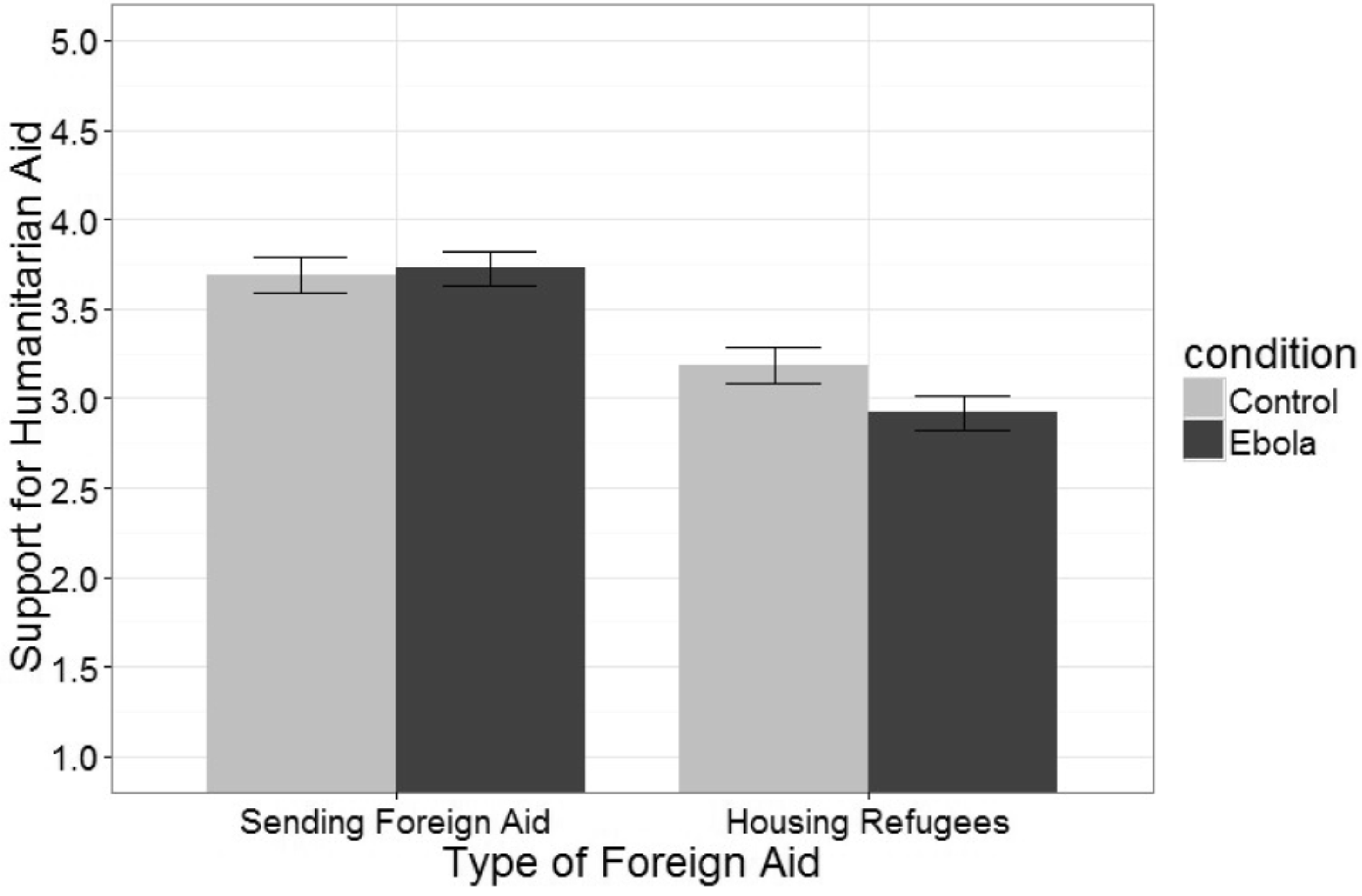
ANOVAs were first conducted to estimate mean differences between conditions in the variables of interest. As shown in Figure 1, between-groups ANOVAs show that support for bringing refugees from developing countries to the United States was significantly lower in the Ebola prime condition (
 $M\,=\,2.92$
,
 $\mathit{SD}\,=\,1.00$
) than in the control condition (
 $M\,=\,3.19$
,
 $\mathit{SD}\,=\,1.16$
;
 $F[1,271]=4.16$
,
 $p<0.05$
,
 $d\,=\,0.249$
), but there was no significant difference between the Ebola prime condition (
 $M\,=\,3.72$
,
 $\mathit{SD}\,=\,0.94$
) and the control condition (
 $M\,=\,3.69$
,
 $\mathit{SD}\,=\,0.98$
) in attitudes toward sending foreign aid to developing countries (
 $F[1,271]\,=\,0.07$
,
 $p\,=\,0.789$
,
 $d\,=\,0.031$
). However, contrary to the hypothesis that a disease prime would increase xenophobia, there was no significant difference in xenophobia between the Ebola prime condition (
 $M\,=\,2.22$
,
 $\mathit{SD}\,=\,0.68$
) and the control condition (
 $M=\,2.18$
,
 $\mathit{SD}\,=\,0.60$
;
 $F[1,\!271]$
 $=0.18$
,
 $p\,=\,0.671$
,
 $d\,=\,0.062$
). The lack of an effect of condition on xenophobia suggests that the effects of disease salience were not mediated by xenophobia.
Study 1. Effects of Ebola prime on humanitarian aid. Note: Error bars illustrate 95% confidence intervals.

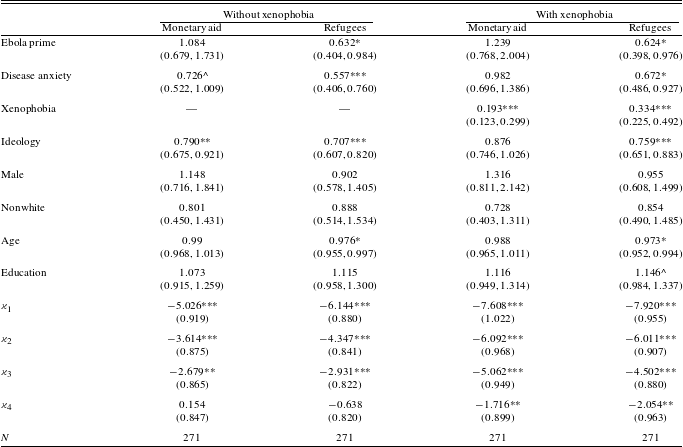
The effect of condition on attitudes toward refugees but not sending foreign aid was corroborated by ordered logistic regression models predicting each dependent variable with condition while controlling for ideology, sex (coded with female as the reference category), race (white versus nonwhite, with white as the reference category), age, and level of education. Each model also included the disease anxiety variable as a predictor in order to estimate the role of individual differences in disease-related anxiety alongside the effects of the experimental disease prime. Further, two additional models were estimated including xenophobia as a predictor of each humanitarian aid variable. Ordered logistic regression was used to account for the fact that the dependent variables are interval-level measures and therefore ordered logit represents a more appropriate model than simple linear regression. Table 1 reports the results of these models.
Study 1. Ordered logits predicting support for humanitarian aid with condition, disease anxiety, and xenophobia.

Note: Coefficients are odds ratios with 95% confidence intervals in parentheses (
 $\unicode[STIX]{x1D718}$
indicates thresholds with standard errors in parentheses).
***
 $p<0.001$
; **
 $p<0.01$
; *
 $p<0.05$
; ˆ
 $p<0.10$
.
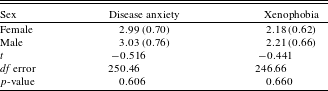
Regarding attitudes toward sending foreign aid, neither disease salience nor individual differences in disease anxiety were significant predictors. However, both the Ebola prime and individual differences in disease anxiety predicted attitudes toward bringing refugees into the United States. Individuals in the Ebola prime condition and individuals high in disease anxiety were significantly less likely to express support for refugees. Additionally, conservatism was significantly associated with opposition to both types of aid, and age had a significant negative relationship with support for refugees. Critically, although xenophobia was negatively related to both humanitarian aid variables and individual differences in disease anxiety were correlated with xenophobia (
 $r=0.252$
,
 $p<0.001$
), condition and disease anxiety continued to significantly predict attitudes toward refugees when xenophobia was included as a predictor indicating independent effects of both.
These independent effects suggest there are contextual factors beyond xenophobia driving the effects of disease salience and anxiety on attitudes toward refugees. Therefore, there is support for the baseline hypothesis that disease salience has a conservatizing effect on attitudes toward humanitarian aid, but only with regard to policies that involve the threat of contact with infected individuals. Given that disgust sensitivity, which may reasonably be related to disease anxiety, has been related to both sex Reference Haidt, McCauley and Rozin22,Reference Rohrmann, Hopp and Quirin23,Reference Smith, Oxley, Hibbing, Alford and Hibbing24,Reference Balzer and Jacobs25 and ideology Reference Inbar, Pizarro, Iyer and Haidt26,Reference Terrizzi, Shook and Ventis27 in prior literature, we ran models interacting both condition and xenophobia with sex and ideology to see whether our primary results varied across these variables. No interactions were significant. The relationships between disease anxiety, xenophobia, sex, and ideology are reported in Appendix B.
It might also be the case that the relationship between disease salience and xenophobia is one of moderation rather than mediation. That is, an alternative interpretation of the BIS literature might suggest that rather than directly increasing xenophobia, disease salience influences the effects of xenophobia by triggering and exacerbating the conservatizing effects of preexisting xenophobia. Therefore, we also tested whether disease salience moderated the role of xenophobia by running the same models but with interactions between condition and xenophobia. Significant interactions were found predicting both dependent variables, but in the opposite direction from what would be expected according to this interpretation of the BIS literature. The relationship between xenophobia and support for sending foreign aid was significantly weaker in the Ebola prime condition than in the control condition (
 $\mathit{OR}=2.654$
, 95% CI = 1.242–5.727,
 $p<0.05$
), and the same pattern was evident regarding the relationship between xenophobia and support for housing refugees (
 $\mathit{OR}=3.832$
, 95% CI = 1.814–8.237,
 $p<0.001$
). These results suggest that disease salience did not moderate the effects of xenophobia in such a way that the conservatizing effects of xenophobia were exacerbated.
Given that the nature of xenophobia and humanitarian aid attitudes may be related to race, we also conducted all analyses with white participants only (
 $n=218$
) and found no differences in results. Further, we interacted both condition and disease anxiety with race to see whether race moderated the results, and we found no differences in results.
Discussion of Study 1
The results of this study provide evidence in support of the overarching hypothesis that disease salience and disease-related attitudes significantly influence a particular type of humanitarian aid — attitudes toward bringing refugees to the United States — but have no relationship with attitudes toward sending foreign aid to developing countries. This finding is demonstrated experimentally and correlationally. Individuals given a simple prime regarding the 2014 Ebola outbreak were significantly less likely to support bringing refugees to the United States, even though the policy had nothing to do with the refugees being diseased or from a disease-stricken country. The relationship between individual-level variation in disease anxiety and support for refugees corroborates this framework. Individuals who generally feel more anxious at the thought of disease were significantly less likely to support bringing refugees to the United States, which is predicted by the BIS literature. Reference Schaller and Park18 However, there is no evidence that disease salience leads to more xenophobic attitudes, that the effects of disease were mediated by xenophobia, or that the effects of xenophobia were moderated by disease salience, which runs counter to most existing theories. Instead, it seems the link between disease and attitudes toward refugees is direct and based on generalized contamination fears. Reference Aarøe, Osmundsen and Petersen17
There are several limitations to this experiment. The disease prime in this study was specifically related to the 2014 Ebola outbreak, and so it is unknown whether this effect would be replicated using other diseases or if disease were referred to in a general sense. Critically, it is also impossible to know whether the effect of the prime was due to disease salience or to tragedy more broadly. Would the same effect occur if the prime referred to another tragic event such as war or natural disaster? Further, although the survey was administered several months after the initial Ebola outbreak in 2014, and participants reported being mostly unthreatened by the Ebola virus, it is nonetheless possible that the relative salience of the Ebola outbreak made the prime more effective than it would have been otherwise.
The tests of mediation by xenophobia were also limited. Although the effects of disease salience were tested experimentally, the mediating role of xenophobia on those effects was only correlational, as xenophobia was measured using a survey battery and not manipulated. Thus, the analyses of Study 1 test only the correlations that would be expected if mediation were occurring. Manipulation of the mediator, xenophobia, would be necessary to properly examine a causal link between disease, xenophobia, and humanitarian aid attitudes. Reference Imai, Keele, Tingley and Yamamoto28,Reference Spencer, Zanna and Fong29,Reference Stone-Romero and Rosopa30 Finally, the measure of xenophobia in this experiment was an adaptation of a scale that measures positive and negative affect generally rather than a validated measure of prejudice toward foreigners. The intention here was to measure attitudes toward foreigners as broadly as possible, but it can reasonably be argued that the measure did not gauge xenophobia adequately enough to test its role properly. All of these limitations were addressed in Study 2.
Study 2
Study 2 sought to corroborate the findings of Study 1 while providing an experimental test of the mediational role of xenophobia. Participants simply indicated whether they support or oppose providing humanitarian aid to a foreign country as described in a vignette. Four factors were manipulated with regard to how the aid was described: (1) whether the crisis at hand involved disease (rather than some other crisis), (2) the country affected by the crisis (a country in Africa or a country in Europe), (3) the institution providing the assistance (government or charity), and (4) whether the assistance was in the form of monetary aid or bringing refugees to the United States. If disease salience, rather than the salience of any tragic event, influences humanitarian policy attitudes, support for assistance should be lower when the crisis involves disease than when it involves some other crisis. Crucially, the effect of disease should only be evident when assistance involves housing refugees rather than sending monetary aid, as housing refugees entails an immediate risk of infection. Thus, an interaction between crisis type and support type is expected when support will be negatively influenced only when dealing with refugees from diseased countries.
Further, if xenophobia is influenced by disease salience and mediates the effects of disease salience on policy attitudes, the effects of disease salience should be dependent on which country is affected by the disease. Any country besides one’s own may be reasonably perceived as an out-group, and so we may expect disease salience to decrease support for humanitarian aid to all other countries, but countries perceived as more foreign should experience a steeper decrease in support in the face of disease outbreak compared with countries perceived as less foreign. Reference Faulkner, Schaller, Park and Duncan4 Therefore, it is expected that disease will have a greater impact on opposition to housing refugees when the affected country is in Africa than when it is in Europe. In effect, having the affected country located in Europe should make the xenophobia triggered by disease salience less relevant than when the affected country is located in Africa. Finally, the source of humanitarian assistance was manipulated (charity or government) to investigate and rule out the possibility that the effect of disease salience might be limited to government action.
Data
Another MTurk sample was recruited (
 $N=\text{1,608}$
) between July 20 and July 21, 2015, to experimentally test our hypotheses. Ninety-seven participants failed to correctly answer the attention question, resulting in a sample of 1,511. Participants who failed the attention check question were omitted from all analyses because the attention question asked which continent was referenced in the vignette, which we considered to be a critical component of the manipulation being successful. Nonetheless, all results are substantively identical when analyses are conducted including these participants. The sample was very similar demographically to the sample in Study 1. Specifically, the sample was fairly educated (median = “college graduate”), young (median = 28 years old), Democratic (62% Democratic or leaning Democratic, 17% independent, 21% Republican or leaning Republican), slightly liberal (
 $M=3.19$
,
 $\mathit{SD}=1.54$
), 60% male, and 77% white.
Design and measures
The primary independent variables of interest were all experimentally manipulated in a 2 (type of crisis) × 2 (affected country) × 2 (source of assistance) × 2 (type of assistance) between-subjects design. All analyses involving the source of assistance manipulation are presented only in Appendix B. Participants were randomly assigned to one of 16 conditions, yielding just under 100 participants in each condition. Participants were asked to indicate the extent to which they would support or oppose humanitarian aid as proposed in a vignette. The vignette prompt can be seen here, with each block of text that was manipulated appearing in bold:
A (natural disaster/disease outbreak [type of crisis]) has ravaged a country in (Eastern Europe/Eastern Africa [affected country]). In response, (a humanitarian organization in the United States/the United States government [source of assistance]) has agreed to (bring in refugees from that country to the United States/send monetary aid from the United States to that country [type of assistance]).
After indicating their level of support or opposition for this aid, participants were asked which continent the assistance was aimed at helping as an attention check and then completed several demographic questions.
Results
Ordered logit models (accounting for the interval-level nature of the dependent variables) were estimated regressing support for assistance on dummy variables for all possible interactions between conditions (including the four-way interaction between all conditions and all lower-order interactions within the four-way interaction), and controls for self-reported ideology, sex, age, race, a dummy variable for being from the South, and a dummy variable for being a born-again Christian. Separate models were run estimating the four-way interaction between all of the conditions, each of the three-way interactions, and each of the two-way interactions, as well as each interaction separately.
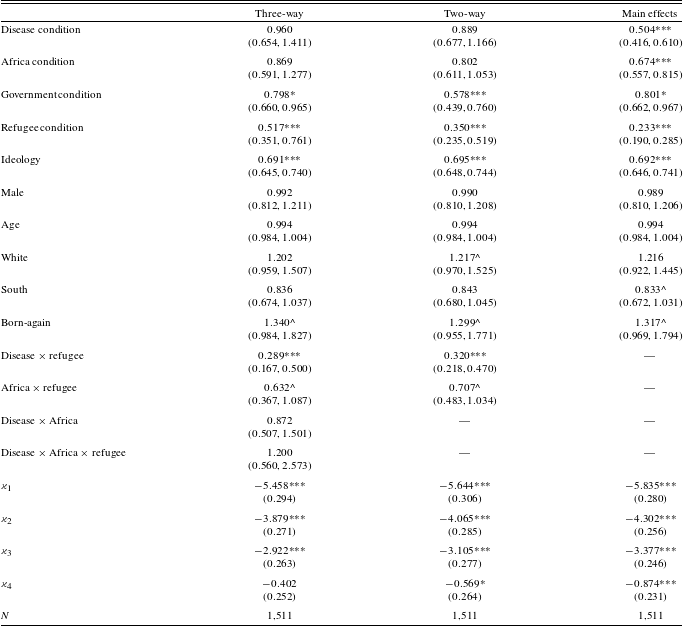
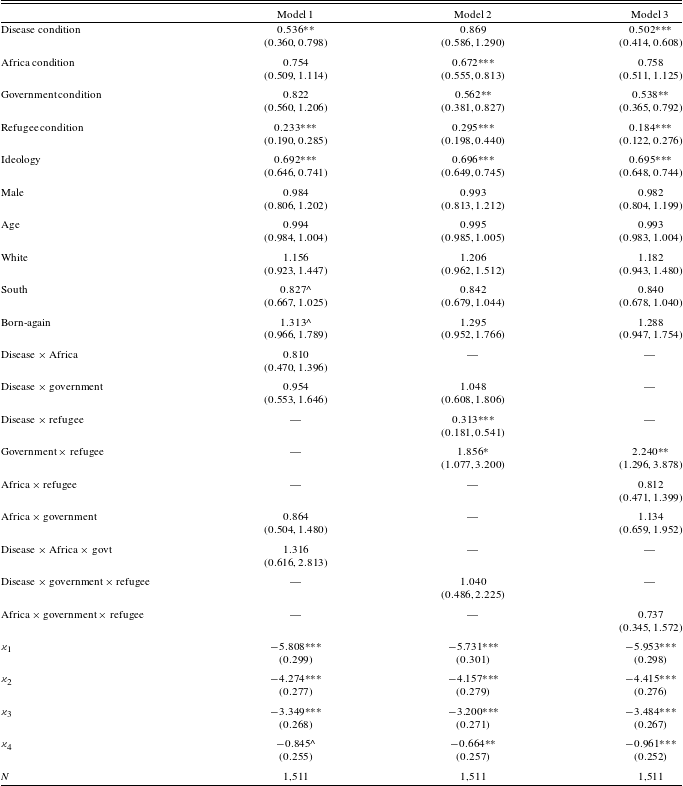
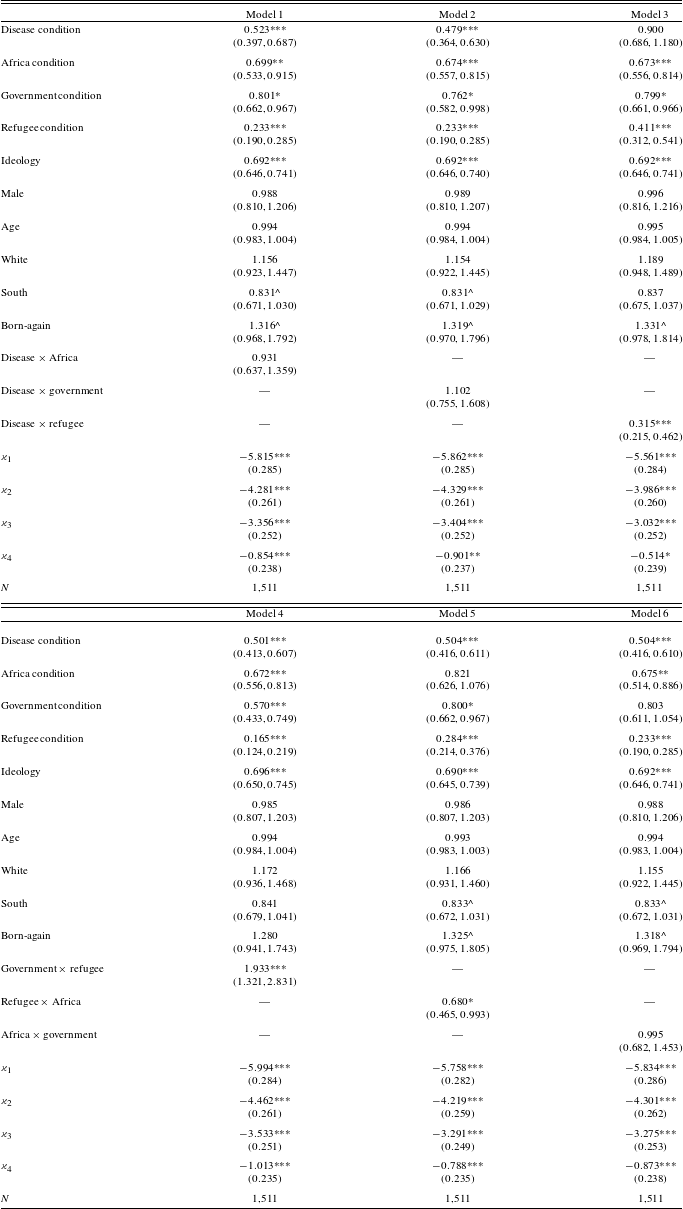
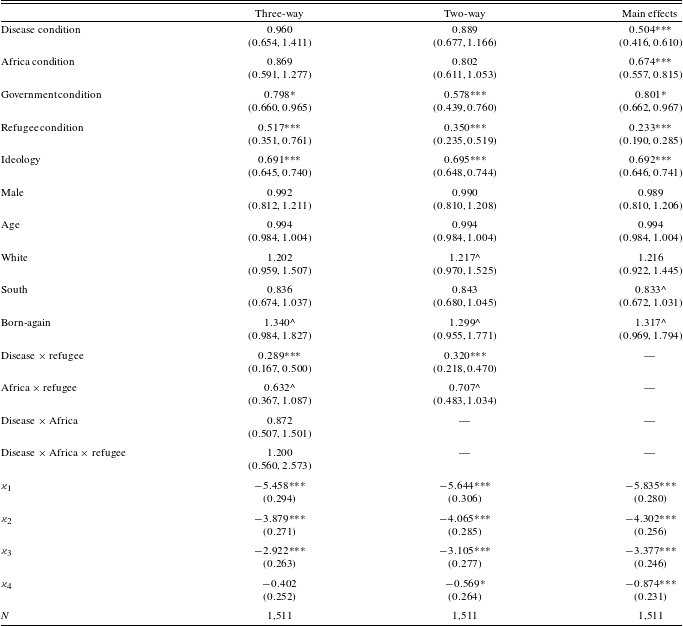
In the interest of presenting the results most crucial for testing this article’s hypotheses, Table 2 shows the odds ratios for the effects of each covariate for just three models (for full model results, see Appendix B). The four-way interaction between all conditions was not significant, and so those results are not shown. The first column shows the results for a model that only estimated the three-way interaction between the disease condition, the Africa condition, and the refugee condition, as this three-way interaction represents the test of the hypothesis that out-group prejudice will mediate the effect of disease salience on humanitarian aid support, and this effect will be constrained to refugee support (rather than sending monetary aid) because of the fear of contamination associated with out-groups. The second column shows the results of a model estimating only significant two-way interactions (interactions involving the government condition are shown in Appendix B). The crucial interactions in this model are the interaction between the disease and Africa conditions and the interaction between the disease and refugee conditions.
Study 2. Ordered logits predicting aid support by condition.
Note: Coefficients are odds ratios with 95% confidence intervals in parentheses (
 $\unicode[STIX]{x1D718}$
indicates thresholds with standard errors in parentheses).
***
 $p<0.001$
; **
 $p<0.01$
; *
 $p<0.05$
; ˆ
 $p<0.10$
.
If out-group prejudice is the mechanism by which disease salience influences policy attitudes but this is not necessarily dependent on contamination fears, we should see a significant interaction between the disease and Africa conditions such that the effect of being in the disease condition is stronger (if not only evident) when the affected country is in Africa. If fear of contamination is the mechanism by which disease salience influences policy attitudes but this is not necessarily dependent on out-group prejudice, we should see a significant interaction between the disease and refugee conditions such that the effect of being in the disease condition is only evident when the aid involves refugees (and thus direct contact with potentially infected individuals). Finally, the third column contains the main effects of each condition without any interactions to get a sense of the effects of each manipulation in the aggregate.
In the main effects model, all experimental manipulations had significant aggregate effects. Overall, aid support was significantly lower when the crisis involved disease (rather than a natural disaster), when the affected country was in Africa (rather than Europe), when the aid was coming from the government (rather than charity), and when the aid involved housing refugees (rather than sending monetary aid). In the first column, the three-way condition between the disease, Africa, and refugee conditions was not significant, and further analyses showed that no other three-way interactions were significant. However, there were two significant two-way interactions. In the second column, a significant two-way interaction exists between the disease condition and the refugee condition. This interaction means that when assistance involved sending monetary aid, support did not differ depending on whether the crisis involved disease or a natural disaster. Yet when the assistance involved housing refugees, support was significantly lower when the crisis involved disease than when it involved a natural disaster (
 $\mathit{OR}=0.282$
, 95% CI = 0.190–0.416,
 $p<0.001$
). This corroborates the finding in Study 1 that disease salience lowers support for humanitarian aid, but only when the aid involves possible contact with foreign individuals.
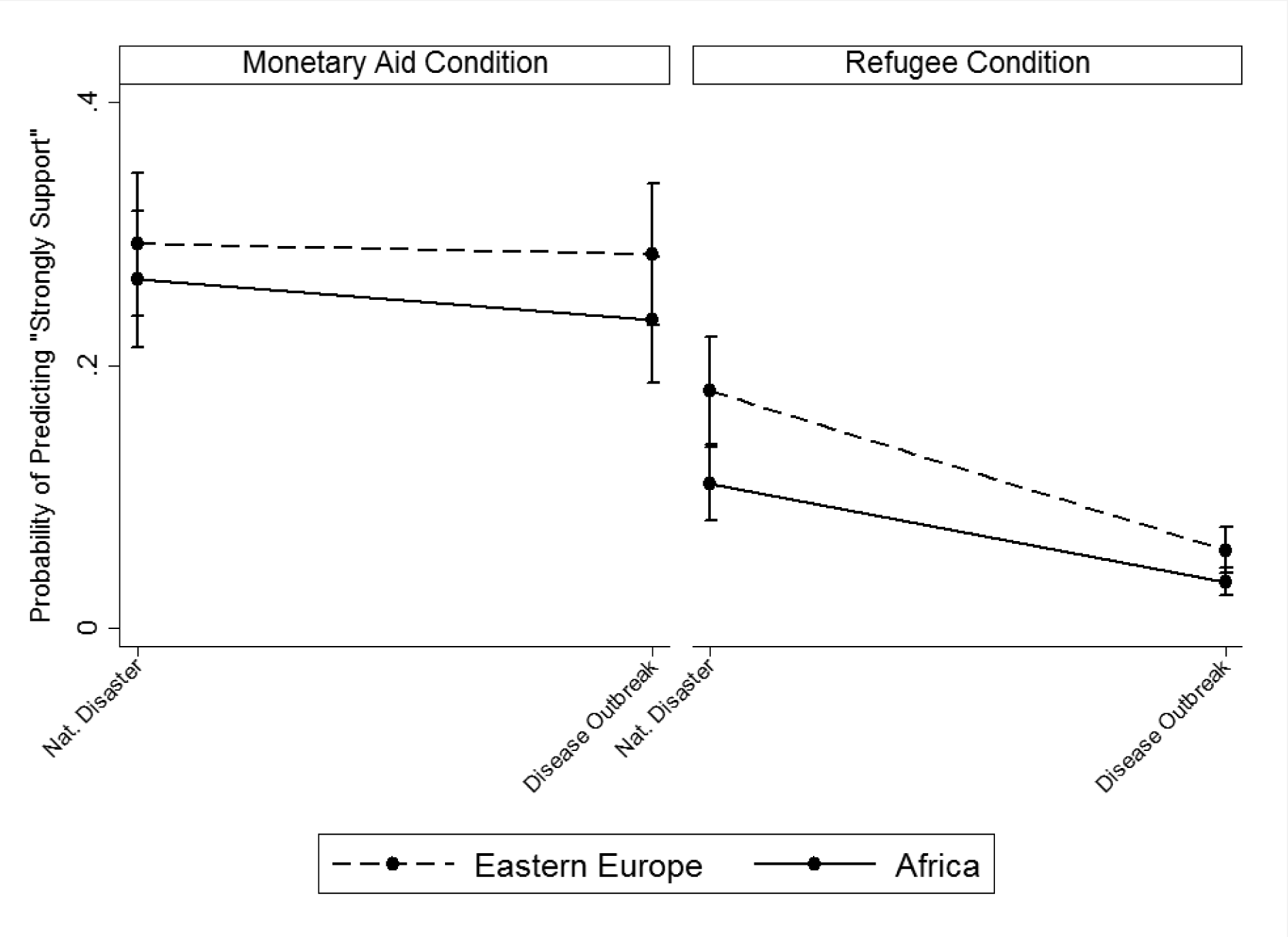
The interaction between the disease and Africa conditions was not significant, suggesting that the effects of out-group prejudice were not influenced by disease salience. In conjunction with the fact that the interaction between the disease condition and the refugee condition was not dependent on whether the affected country was in Africa or Europe, this suggests that contrary to the hypothesis that disease salience operates through (or moderates the effects of) out-group prejudice and xenophobia, the role of out-group prejudice was equal whether the aid was for a disease outbreak or a natural disaster. Also, contrary to the hypothesis that out-group prejudice mediates the effect of disease on attitudes toward refugees, disease salience exhibited an effect on support for housing refugees regardless of the target country. Figure 2 illustrating the interaction between the disease condition, Africa condition, and refugee condition shows that this interaction did not differ depending on whether the affected country was in Africa or Europe.
Study 2. Predictive margins of aid support by condition. Notes: Error bars represent 95% confidence intervals. Estimates are the marginal mean estimates corresponding to a three-way interaction between the disease condition, the Africa condition, and the refugee condition. The two-way interaction between the disease condition and the refugee condition is significant, but this interaction does not vary across the Eastern Europe and Africa conditions. Further, these estimates average over the government and charity conditions, as results did not differ across these conditions.

Given the fact that the country of origin manipulation was explicitly tied to race, we also conducted all analyses with white participants only (
 $n=\text{1,160}$
) and found no differences in results. Further, we interacted race with every condition variable (and each of the higher-order interactions between conditions) to see whether race moderated the results. We found only one significant interaction whereby the effect of being in the disease condition was significantly diminished among whites compared to nonwhites (
 $\mathit{OR}=1.557$
, 95% CI = 1.014–2.392,
 $p<0.05$
).
There was also a marginal two-way interaction between the Africa condition and the refugee condition, such that when aid was monetary, support was no different when the affected country was in Europe than when it was in Africa, but when aid involved refugees, support was significantly lower when the affected country was in Africa than when it was in Europe (
 $\mathit{OR}=0.590$
, 95% CI = 0.402–0.866,
 $p<0.01$
).
A significant two-way interaction was also found between the government condition and the refugee condition. Although support was significantly lower when it was coming from the government rather than a private charity when the aid involved refugees, when the aid was monetary, there was no difference in support between the government condition and the charity condition (
 $\mathit{OR}=1.067$
, 95% CI = 0.726–1.567,
 $p=0.741$
). Support for refugees was nonetheless lower than support for monetary aid in both the government and charity conditions.
Interactions between each condition variable and sex as well as ideology were tested given the aforementioned literature relating disease anxiety and xenophobia to sex and ideology. No interactions were statistically significant.
Discussion of Study 2
The primary findings of Study 1 — that disease salience reduced support for bringing refugees to the United States but not for providing monetary aid and that the effect on refugee support was not mediated by group-based prejudice — was corroborated in Study 2. Several limitations of Study 1 were addressed. Study 2 primed participants with disease in a general sense rather than priming the 2014 Ebola outbreak specifically. Thus, the findings of Study 2 suggest that the effects of disease salience are not limited to contextual facets of the Ebola outbreak. Critically, Study 2 also contained a manipulation of whether the humanitarian aid was in response to a disease outbreak or to a natural disaster, and so this study provided evidence for the hypothesis that the mechanism by which disease salience influences support for refugees is through fear of contamination. Finally, although individual differences in out-group prejudice were not directly manipulated, the country of origin manipulation allowed for an experimental examination of differences in support that would be expected if out-group prejudice was the mechanism by which disease salience influenced support for refugees. Support for aid was indeed lower when the country of origin was in Africa than when it was in Europe, and there was some evidence that this anti-Africa bias was greater when aid involved refugees than when it involved monetary aid, but, crucially, the effect of disease on refugee support was not dependent on whether the country of origin was in Africa or Europe.
Limitations
Several limitations exist across the two studies. First, both samples were relatively young, liberal/Democratic, and well educated, which is typical for online samples such as these but nonetheless may limit the generalizability of these results. For example, mean levels of support for humanitarian aid were quite high and xenophobia was relatively low in the aggregate, so it could be the case that manipulating aid support and xenophobia among these individuals is more difficult than it would be in a more diverse sample. We do not consider this limitation critical, as the hypothesized effects of the manipulations were to decrease support for humanitarian aid and increase xenophobia, and so there was adequate room for movement in both samples. Also, some work has shown that, broadly, the psychological profiles of liberals and conservatives in MTurk samples closely mirror those of liberals and conservatives in the general public. Reference Clifford, Jewell and Waggoner19 Nonetheless, it remains possible that the manipulations in our studies would have different effects on more representative samples.
Another limitation is that both studies primed disease with text-based prompts. Although the text-based primes have consistently influenced support for refugees in the expected ways, it may be the case that a more powerful, visceral prime is necessary to create measurable changes in xenophobia. With regard to the measurement of xenophobia, it may be reasonably argued that the measures used so far have yet to properly gauge xenophobia as it relates to attitudes toward refugees. The measure used in Study 1 was not a well-validated survey instrument, and the manipulation used in Study 2 was aimed at race-based prejudice rather than xenophobia, and thus evidence of mediation by out-group prejudice would have been evidenced by differences in support when the refugees are “more of an out-group.” This was done because all refugees are foreign by definition, and so it would be impossible to manipulate refugees to be members of an in-group versus an out-group.
However, it may be the case that out-group prejudice nonetheless serves as the mechanism by which disease salience influences support for refugees, but this mediation is more context-dependent — that is, it may be expressed through attitudes toward foreigners, specifically, and not through other forms of out-group prejudice. Future work should aim toward a more direct test of the in-group/out-group dynamics as they pertain to our findings. It is quite possible that the “foreignness” of Eastern Europeans was still able to function as a disease cue for our American sample. It is possible the results would differ if we also included a condition dealing with aiding a disease outbreak going on in the United States. We would still expect disease avoidance to play a major role in shaping attitudes in an American context, but it is possible that we may also find the mediating or moderating influence of xenophobia that we did not find in the present study. This is an important empirical question that we will leave for future researchers to answer.
Some readers may be concerned that the measures of xenophobia used in this article capture xenophobia as a trait rather than as a state. The worry here is that traits remain relatively immutable and are not as susceptible to short-term influences such as disease salience. In fact, there is plenty of evidence here to suggest that xenophobic feelings prior to engaging in these studies play a significant role in the development of attitudes toward humanitarian aid. This worry is greatest with the first measure of xenophobia. Yet, a strength of this study is that we examined the role of xenophobia in multiple ways. In Study 1, we overtly measured feelings toward foreigners, and in Study 2, we used an experimental manipulation to determine whether the effects of disease salience depended on the group being assisted. Across both studies, the results remained the same regardless of how we gauged xenophobia.
Even through different manipulations of disease salience and two different operationalizations of the role of xenophobia, there were no major differences on our outcomes of interest. Had there been a single operationalization of xenophobia used in both studies, it would be difficult to predict how the evidence presented here would have differed. Perhaps the results would diverge, but that is an empirical question best left to future research. Moving forward, studies examining the linkages between disease, xenophobia, and policy outcomes need to focus on building evidence that is both convergent and replicable. Here our focus was on convergent validity. We plan to build on our findings with other measures and manipulations aimed at gauging xenophobia and disease threat while working to replicate results with the measures used in this study.
A final limitation of Studies 1 and 2 is that out-group prejudice was gauged in ways that were reliant on explicit attitude measures. Across studies, evidence of xenophobia mediating the relationship between disease salience and refugee support could only be obtained if participants were willing and able to convey the influence of xenophobia through survey measures. However, decades of research have shown that self-report measures are limited in their capacity to accurately ascertain preferences because of factors such as social desirability, and so implicit measures are often useful in gauging people’s preferences. Reference Greenwald, McGhee and Schwartz31,Reference Pérez32 As group-related attitudes of individuals are often motivated to inhibit or edit prejudiced responses, this is especially concerning. Reference Dovidio and Gaertner33,Reference Mendelberg34 The degree to which social desirability may have led to artificially low reported levels of xenophobia in this study so far cannot be properly estimated.
In Study 1, there was no evidence of particularly negative feelings toward foreigners, but there was also no baseline measure to compare against (e.g., feelings toward Americans) and so a meaningful estimate of overall xenophobia in that sample cannot be obtained. In Study 2, there was indeed a main effect of the Africa condition, but since this is a between-person comparison, it is still impossible to say whether the effects of the Africa condition, and potentially mediation of disease salience by automatic, nonconscious out-group prejudice triggered by the Africa condition, were underestimated due to social desirability. Therefore, it is possible given the explicit nature of the measures employed in Studies 1 and 2 that the role of xenophobia has thus far gone unobserved but is nonetheless present. Future research might utilize implicit attitude measures to detect changes in levels of xenophobia that occur at the automatic level.
Discussion
Disease salience consistently reduced support for housing refugees in the United States but not for sending foreign aid to developing countries. This provides evidence that the BIS is a suitable theoretical model for understanding attitudes toward assisting developing countries. However, the distinction between types of humanitarian aid is important. By separating out support for aid alternatives, we showed how the prospect of disease influences these attitudes. If aid organizations — governmental or nongovernmental — seek to assist disease-stricken countries in the future, they should consider the implications of disease salience for different types of aid. Indeed, it seems the easiest political route for these agencies may often be to simply assist disease-stricken foreign countries by sending foreign aid. Attitudes regarding aid are only swayed by disease when the aid requires people from those countries to come to the United States. The findings of this study are therefore concerning when the optimal form of aid involves housing refugees, as the salience of disease may substantially inhibit support for such policies.
Any existing effect of disease salience on humanitarian aid attitudes was not mediated by a corresponding increase in xenophobic attitudes. It is still possible that the BIS works to shape xenophobic attitudes, as Study 1 shows that self-reported disease anxiety is positively correlated with xenophobic attitudes. A number of studies in political science Reference Kam and Estes15,Reference Smith, Oxley, Hibbing, Alford and Hibbing24 and psychology Reference Faulkner, Schaller, Park and Duncan4,Reference Navarrete and Fessler5,Reference Inbar, Pizarro, Iyer and Haidt26 have pointed to the correlation between disease threat or disgust and policies that protect in-group interests, including recent correlational work regarding Ebola specifically. Reference Stürmer, Rohmann, Mazziotta, Siem and Barbarino11 Much of the existing literature on the BIS assumes a causal relationship between disease and xenophobia based on correlational results. Given the nature of the experimental results for both studies presented here, it is difficult to firmly conclude that the relationship between disease anxiety and xenophobic attitudes is causal. This failure to find a causal relationship between disease salience and xenophobia is important and calls into question a small but rapidly growing literature in political science. Disease threat and salience does influence attitudes toward humanitarian assistance, but this relationship seems influenced by perceived disease proximity and weakened social ties because of general fears of contamination rather than xenophobia. Reference Aarøe, Osmundsen and Petersen17
The recent Syrian refugee crisis highlights the need to further understand how particularized threats influence humanitarian aid attitudes. Was the widespread European and American opposition to the relocation of Syrian refugees in Western countries motivated by fears of terrorism spreading like a virus, concerns about disease, or were these attitudes shaped more by preexisting xenophobia, and to what extent was that xenophobia shaped by fears of terrorism? Gadarian and Albertson have demonstrated that in both instances — disease and terrorism — the increased levels of anxiety lead to biased information-searching processes and an increase in support for protective policies that often violate civil liberties. Reference Gadarian35,Reference Gadarian and Albertson36,Reference Albertson and Gadarian37
Another major question left to be answered is, what are the contours of the behavioral immune system and its effects on politics? Right now, the most convincing narrative suggests a straightforward answer to this question. People take sometimes extreme measures to avoid getting sick, as illness can bring death and thoughts of our ultimate demise. However, the effects of disease salience on policy attitudes are more crosscutting and pervasive than common sense might suggest, as disease salience was shown to influence attitudes toward refugees even when the refugees were not tied to a disease outbreak (see Study 1). Therefore, the effects of disease salience seem to be driven not by people’s conscious efforts to avoid infection, but rather by automatic processes that trigger a desire for social distance. Yet this increased fear of contamination does not seem to make people more xenophobic; instead, this increased fear seems to simply decrease support for policies that may involve contact with others. Disease threat does not appear to make people more xenophobic than their day-to-day baseline level, but it does make people want to avoid contact with foreign populations.
Throughout the past century, the world became a smaller place. Once imposing distances became easier to traverse, disease outbreaks in far-off lands suddenly became immediate local concerns. At the same time, global temperatures have increased and will continue to change for the foreseeable future. The epidemiology of infectious diseases such as malaria, dengue, Zika, and Ebola will alter as a result, and diseases once thought to be in the purview of the Global South may become more common in once temperate locations. Reference Khasnis and Nettleman38 As these global disease threats increase in conjunction with other types of threat, we can expect an increase in refugees seeking safe shelter elsewhere in the world. Even without the specter of disease clouding our judgment, many would rather see refugees settled outside of their communities and are susceptible to threatening media frames. Reference Ferwerda, Flynn and Horiuchi39 The backlash to these types of policies is very real, and even the simple threat of Ebola — without any additional refugee threat framing — caused those in conservative leaning states to vote even more Republican in the 2014 midterm elections. Reference Beall, Hofer and Schaller40 It is clear the BIS helps us to understand more than attitudes toward foreigners. Therefore, understanding its mechanisms is of the utmost importance as we move into an uncertain future.
Note
The R scripts to replicate analyses in the article are available as supplementary material on Cambridge Core.
Appendix A
Study 1: Disease anxiety scale.
(Modified from Wong et al.’s 1994 Death Anxiety Scale. 5-point scale from “strongly disagree” to “strongly agree.”)
-
1. The prospect of disease arouses anxiety in me.
-
2. Disease is no doubt a grim experience.
-
3. I have an intense fear of disease.
-
4. I avoid thoughts of disease at all costs.
-
5. I always try not to think about disease.
-
6. I try to have nothing to do with the subject of disease.
Study 1: Xenophobia scale.
(Modified from Watson & Clark’s 1988 PANAS battery. 5-point scale from “strongly disagree” to “strongly agree.”)
Prompt: Please rate the extent to which you agree with the following statement: “I feel _____ with/toward foreigners.”
-
1. Content
-
2. Annoyed
-
3. Frustrated
-
4. Tense
-
5. Friendly
-
6. Comfortable
-
7. Agreeable
-
8. Angry
-
9. Joyous
-
10. Enthusiastic
-
11. Disgusted
-
12. Fearful
-
13. Anxious
Appendix B
Study 1. Sex, disease anxiety, and xenophobia.

Study 1. Correlations between ideology, disease anxiety, and xenophobia.

Study 2. Additional three-way interactions predicting aid support.

Study 2. Two-way interactions predicting aid support.