


Obesity and poor nutrition are global health problems( 1 – 3 ). The World Health Assembly 2004 called on governments to take a strategic approach to the promotion of healthy diets (Assembly resolution). Many countries have developed national nutrition policies (Australia, UK, Europe and the USA). While one might hope that a country's national nutrition policy is designed by government to protect and enhance public health, there is evidence from a number of countries to suggest that the food industry has considerable influence( Reference Brownell and Horgen 4 – Reference Simon 7 ). The competing interests of industry and public health in national nutrition policy have not been systematically documented in the peer-reviewed literature, nor has their impact on national nutrition policy been analysed. Further, there has been no theoretically informed analysis of the influence of these key players. The present paper examines whether national nutrition policy reflects public health or industry interests and why. It does so using a case study( Reference Yin 8 ) of submissions to the New Zealand Health Select Committee Inquiry into Obesity and Type 2 Diabetes (the ‘Inquiry’) and related government documents.
This case is exemplary for a number of reasons. First, the history of the select committee process in New Zealand (NZ) reveals that inquiries can, and have had, significant policy consequences such that select committees have become a critical place for policies to be ‘brokered’( Reference Palmer and Palmer 9 ). Second, such inquiries provide opportunities for the public and interested parties to participate in policy making. Third, submitters to the process are cross-examined by the members of Parliament who sit on the inquiry. Fourth, NZ, as a country with a large food industry base( 10 ), provides an exemplar case because of strong industry interests. For these reasons, this Inquiry presented a rare opportunity to listen, observe and document the positions of industry and public health on key nutrition issues as they relate to obesity.
In 2006, in response to escalating concerns over obesity, the NZ Parliamentary Health Select Committee (the ‘Committee’) announced its intention to conduct the Inquiry. The Terms of Reference were advertised, and the public and interested parties were invited to make submissions. The Committee received 313 written submissions( 10 ). The Inquiry lasted for ten months and the Committee heard oral evidence (on twenty occasions) from 142 of these submitters( 10 ). The Committee's recommendations to the Government were released in August 2007( 10 ) and the Labour-led (centre-left) Coalition Government tabled its response in Parliament in November 2007( 11 ).
The extent to which various groups are able to influence policy in such forums is the subject of some theoretical debate. In particular, there is disagreement over whether all interest groups are treated equally by ‘democratic’ states, or whether some interest groups are given preferential treatment( Reference Shaw and Eichbaum 12 , Reference Tenbensel and Gauld 13 ). According to a classical pluralist model, all groups are treated equally by the state and therefore have equal opportunity to influence policy( Reference Shaw and Eichbaum 12 , Reference Heywood 14 – Reference Signal 16 ). In contrast, a neo-pluralist model suggests that in reality the picture is much more complex( Reference Heywood 17 ). Specifically, the neo-pluralist model holds that business interests, especially those of big business, often have considerably more influence on the state than other groups( Reference Shaw and Eichbaum 12 , Reference Lindbolm 18 ). Lindbolm, for instance, has highlighted how the business sector, as a large investor and major employer in society, and as the major provider of financial credit to the government, has considerable influence over the state, regardless of the ideological position of the government of the day( Reference Lindbolm 18 ). There is also some debate over whether the ‘democratic’ state acts as a neutral umpire – as suggested under classical pluralism, or – as suggested by neo-pluralists – whether the state has interests of its own( Reference Shaw and Eichbaum 12 ). These theories are used to analyse the case.
Methods
Data sources
This case study involved the analysis of the written and oral submissions of key industry (n 17) and public health (n 14) submitters to the Inquiry, the Committee recommendations( 10 ) and the official Government response( 11 ) to these. Industry submitters were defined as commercially operated food, marketing and advertising businesses and their industry associations. This group included food industry giants: McDonalds and Coca-Cola, Fonterra, NZ Sugar; and large food and advertising associations including the Food and Grocery Council of NZ, the Confectionery Manufacturers of Australasia, the NZ Retailers Association, the Advertising Standards Authority and the Communications Association of NZ. Public health submitters were defined as the key public health-oriented national non-government organisations and professional associations and the three public health-oriented independent advisors appointed by the Committee. Examples of public health submitters included in this group are the NZ National Heart Foundation, the Cancer Society, the Public Health Association of NZ, the NZ Medical Association and the Agencies for Nutrition Action.
Data analysis
Nineteen key nutrition-related recommendations made by the Committee were identified. These were organised into four (logical) policy domains:
-
1. the existing national obesity strategy, i.e. Healthy Eating/Healthy Action (HEHA) (five recommendations);
-
2. the food industry (four recommendations);
-
3. the marketing and advertising industries (six recommendations); and
-
4. school environments (four recommendations).
All submissions were read to identify the positions taken by industry and public health submitters on the Committee's recommendations. For each sector, information was sought on: views of current policies; proposed solutions and their rationale; responsibility for solutions; and solutions opposed. The identification of the various positions evident in the data utilised the constant comparative method( Reference Glaser and Strauss 19 ) which promotes the repeated examination of the source material. This method involves constant reading and re-reading of the data and adjusting the coding schema accordingly as new themes emerge (the method is described in detail in Jenkin et al.( 20 )).
A qualitative and descriptive assessment was undertaken of the match between the positions taken by industry, public health and the Government for each of the recommendations relevant to the four policy domains.
Results
On seventeen of the nineteen Committee recommendations, industry and public health positions were polarised( 21 , Reference White 22 ). The declared position taken by the Government on the various Committee recommendations and its subsequent action or inaction on the recommendations could be categorised into one of three possible positions. These were that the Government's position:
-
• was predominantly aligned with that of industry (or)
-
• was predominantly aligned with that of public health (or)
-
• reflected a mix of public health and industry positions.
Table 1 provides a summary of the alignment between the position taken by the Government and those taken by industry and public health on the Committee recommendations.
Government alignment with industry and public health positions on key Committee recommendations
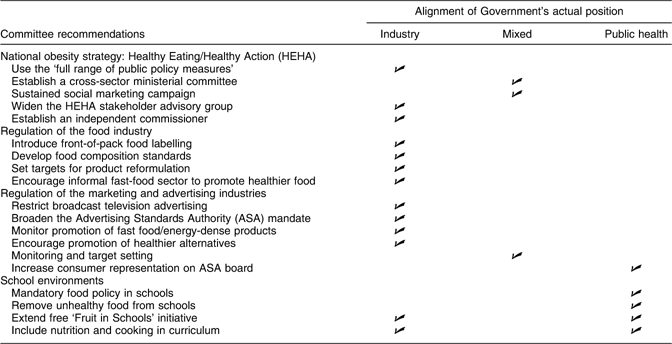
In Table 1, a check mark has been placed in one or more of the final three columns headed ‘industry’, ‘public health’ or ‘mixed’. In two cases (two of the policy recommendations under ‘school environments’), there are check marks under both the industry and public health columns, as these policy options were supported (and therefore uncontested) by both sectors. In all other cases, although a check mark has been placed in one of the columns, suggesting that the Government's position on particular points can be categorically aligned to a public health or industry position (or a mixed position), in reality the exact position taken by the Government was sometimes more blurred. Furthermore, the declared stance taken by the Government was sometimes one of ‘agreement’ (rhetorically) with a Committee recommendation, yet its actual commitment in terms of action did not necessarily reflect this. To address these issues, the results summarised in Table 1 are analysed in more detail below, and it is this analysis that should be considered the ultimate assessment of the alignment of the positions taken by industry, public health and the Government.
The national obesity strategy
The Government's position was aligned with industry on three of the five Committee recommendations relevant to the national obesity strategy (HEHA). The recommendation to use the ‘full range of public policy measures’ – which included regulation of the activities of the food and marketing industries – stemmed from the public health sector. While the Government ‘agreed’ to this recommendation, its actual commitment was limited to a revision and extension of the scope of the implementation plan of the existing HEHA strategy. This lack of commitment by the Government to use the full range of public policy measures – especially regulatory measures – was clearly aligned with industry preferences for self-regulation.
The recommendation for the establishment of a cross-sector ministerial committee (to coordinate action from various government ministries and agencies) was made by the public health sector due to concerns that the national strategy lacked leadership, was haphazard in its implementation and suffered from a lack of coordination between government agencies. Industry did not explicitly oppose this recommendation. Its primary concern was that industry be included in the policy-making process. However, the majority (but not all) of public health submitters were opposed to the involvement of industry at this level of policy making. Thus, while the Government agreed to this recommendation, its decision to include industry in the cross-sector ministerial committee indicates a concession to industry requests. On this recommendation the Government's position can best be described as representing a mix of industry and public health interests.
On the recommendation for a sustained social marketing campaign, the Government noted that two such campaigns were underway. Although industry and public health groups supported social marketing, there was considerable difference between the two groups in the emphasis given to this as a strategy to address obesity. Industry argued that provision of education was key, while public health submitters held that education in isolation from regulatory changes to address features of the obesogenic environment would be ineffective. The Government's agreement that social marketing was necessary together with its lack of action on regulatory changes to the food environment appears to reflect a mix of industry and public health interests.
The recommendation to widen the HEHA stakeholder advisory group was agreed to by the Government. Because this stakeholder group included industry representatives alongside what industry referred to as some of the more ‘difficult’ health-oriented non-government organisations, this action represented a concession to industry requests for Government assistance to facilitate cooperation between industry and non-government organisations in the nutrition policy community. As noted above, public health submitters were, more often than not, of the view that industry should not be involved in expert advisory groups to address obesity.
The Government ‘disagreed’ with the recommendation for the establishment of an independent commissioner – a proposal that appeared to stem from public health requests for an independent body to guide the obesity strategy. Since the establishment of an independent commissioner would clearly indicate a commitment to excluding industry from a key aspect of the policy process, the stance taken by the Government on this matter is a further instance of an alignment between government policy and industry interests.
Regulation of the food industry
All four Committee recommendations directed at the food industry were clearly opposed by the food industry and supported by the public health sector. Public health submitters called for mandatory front-of-pack (FOP) labelling (such as the Traffic Light system) as a measure to improve the nation's diet. Industry was opposed to a mandatory FOP system, arguing that it had already developed various FOP systems and that, in any case, the Traffic Light system was confusing to the consumer. The Government noted that it had not made a decision on FOP labelling because it was waiting for evidence from ongoing research in this area. In this respect, the Government's deferral of any decision – because it supports inaction – was indicative of support for the industry position, at least in the short term.
The recommendation for the development and implementation of food composition standards (to limit the fat and sugar content) was a policy initiative proposed by the public health sector. The Government ‘agreed’ that food composition standards for the reformulation of energy-dense foods were needed, noting that this would become the responsibility of the (to be established) cross-sector ministerial committee. Yet, the Government's invitation to industry to participate in the cross-sector ministerial committee (which had, as one of its tasks, the setting of targets for improving food composition) reflected its support of industry self-regulation in this area rather than a government regulatory model.
The Committee also made a recommendation specifically targeted to the informal fast-food sector (as opposed to the branded fast-food sector). This recommendation originated from arguments made by industry on behalf of the branded fast-food sector (rather than public health where no such distinction was made). The Government ‘agreed’ with the Committee that the informal fast-food sector should be ‘encouraged’ to promote the consumption of healthier foods. It made a commitment to fund ‘one-off’ initiatives from the informal fast-food sector to reformulate its products. This focus on assisting the food industry though Government-funded product reformulation, because it is characterised by encouraging and working with industry rather than regulating, is clearly aligned with industry preferences for self-regulation and collaboration and partnership with government. Thus, in the highly contested domain of food industry policy, the Government's position (in terms of its actual commitment) was, on all four policy recommendations, aligned with the interests of industry.
Regulation of the marketing and advertising industries
On the matter of marketing and advertising regulation, industry supported self-regulation, while public health called for government regulation to control the marketing of unhealthy food. The Committee made six key recommendations in this area. The first of these, the recommendation to restrict broadcast television advertising, reflected the call by public health submitters for bans or restrictions on the advertising of unhealthy food, particularly during children's viewing times. Industry was opposed to any bans or restrictions to television advertising, arguing that the advertising industry was already regulated by the industry-funded Advertising Standards Authority (ASA). It argued that food advertising to children was already regulated through the ASA codes and that the major broadcasters had recently agreed to a new (voluntary) ‘Five Point Plan’ to reduce unhealthy food advertising during children's television viewing hours. Although the Government claimed to ‘agree’ or ‘largely agree’ with the Committee's recommendations on advertising, marketing and promotion, it did not agree with the recommendation to restrict broadcast advertising of unhealthy food until 20.30 hours. The Government noted that industry had already responded to this issue via its Five Point Plan. Further, it noted that government regulation would only be considered should industry self-regulation prove to be ineffective. The Government's commitment to ‘work with industry’ and its ‘wait and see’ approach to voluntary industry initiatives to reduce the advertising of unhealthy food were indicative of an alignment with the industry preference for self-regulation.
The recommendation to broaden the mandate of the ASA, from a limited focus on advertising to a broader emphasis on marketing, stemmed from public health requests. Here, the Government ‘agreed’ although its commitment was limited to making ‘suggestions’ to the ASA and ‘working with industry’ to determine some targets for decreasing unhealthy food marketing to children. The Government provided no incentives for the ASA to improve the self-regulatory advertising system. This provides further evidence of the Government's support for advertising self-regulation – a position consistent with industry interests.
The heavy promotion of fast food and the lack of promotion of healthier alternatives were considered by public health submitters as an important contributor to the nation's obesogenic diet. The Committee made a number of recommendations to address these problems including monitoring industry activity in this area and the setting of targets to reduce the advertising and promotion of unhealthy food. The Government ‘agreed’ and its actions included:
-
• providing the ministerial committee with the mandate to monitor food marketing;
-
• directing the ministerial committee to set targets for the fast-food sector (and encouraging industry to agree to recommended targets); and
-
• obtaining agreement from broadcasters to provide free commercial airtime to promote healthy eating messages.
These actions indicate Government support for the public health calls for monitoring and target setting to alter the balance between the promotion of healthy and unhealthy food. However, the involvement of industry in the cross-sector ministerial committee – the group responsible for monitoring and target setting – was an important concession to industry (and one which might significantly undermine the potential public health benefit of any target setting to reduce the promotion of unhealthy food) since it represents a commitment to working with, assisting and encouraging industry, rather than regulating it.
The Government's position on the recommendation to increase consumer representation on the ASA Board was nevertheless aligned with the interests of public health. This recommendation was a response to public health concerns over industry bias on the ASA Complaints’ Board. The Government ‘agreed’ to this recommendation claiming that half of the Board were now consumer (public) representatives.
School environments
Public health supported all four of the Committee's recommendations in this area. Industry was opposed to mandatory food and nutrition policies in schools and opposed to any controls over the sale of food in schools. However, industry's position was aligned with public health in its support for the free ‘Fruit in Schools’( Reference Boyd, Dingle and Campbell 23 ) initiative (a Government-funded programme providing a piece of fruit free to each child in low socio-economic primary schools) and the inclusion of nutrition education in the school curriculum. The Government ‘agreed’ or ‘largely agreed’ with all four of the Committee's recommendations in this area, noting that the Fruit in Schools initiative would be extended to more primary schools, and that the national school guidelines would be altered to require all schools to sell and promote only healthy food. That the Government agreed to all four recommendations in the area of school environments, despite two of these being contested by industry, is an alignment with the interests of public health.
Discussion
Drawing on submissions from the Health Select Committee Inquiry into Obesity and Type 2 Diabetes, the present research examined the extent to which the NZ Government's national nutrition policy was aligned with industry or public health interests. We compared the positions taken by industry and public health groups with that taken by the Labour-led Government in its response to nineteen Committee recommendations in four areas of nutrition policy. These were: the national obesity strategy; regulation of the food industry; regulation of the marketing and advertising industries; and school environments.
The key findings revealed that the Government's position was, overall, aligned with the interests of industry rather than public health. This was particularly evident in the majority of policy recommendations under three of the four key policy domains: the national obesity strategy, including the involvement of industry in decision making; the regulation of the food industry; and the regulation of the marketing and advertising industries. Alignment between the Government's position and that of public health occurred only in the policy domain of school environments. In this last area however, half of the Committee recommendations were uncontested.
The finding that national nutrition policy was dominated by the interests of industry provides evidence supportive of the neo-pluralist model of interest group influence on the state. That is, rather than the interests of various groups being treated equally by the state, as implied under the pluralist model, it would appear, in this case, that the state favoured the interests of the food and advertising industries. Lindbolm's explanation for the greater influence of industry on the state – its contribution as a large investor, employer and provider of financial credit to society and the economy – appears particularly salient in this case because of the significance of the food industry in the NZ economy. Whether it is also true, as suggested by Lindbolm, that the influence of big business on the state exists regardless of the ideological position of the government of the day was not assessed in this case study. However, the change in government shortly after the Inquiry and the incoming National-led (centre-right) Coalition Government's subsequent actions in the area of nutrition policy, in particular its reversal of the requirement for schools to sell and promote only healthy foods, indicates an even greater alignment with industry. Thus, while Lindbolm is correct in saying that business interests dominate policy making by the state regardless of the government of the day, the extent of this dominance appears to vary between governments.
On the issue of whether the state acts as a neutral umpire (pluralism) or has interests of its own (neo-pluralism)( Reference Shaw and Eichbaum 12 ), it could be argued that the Government acted in the interests of industry and was therefore not neutral. Whether the Government has interests of its own is a more difficult question. Given the likely future costs of obesity-related health care and the fact that government is the major provider of health care in NZ, it could be argued that, at least on this matter, the Government did not act in its own interests. As well, given the likely loss of productivity due to obesity-related poor health (the indirect costs due to lost productivity were estimated to be NZ$370 million in NZ in 2004 alone)( 11 ), it could be argued that the Government not only failed to act in the interests of public health, but it failed to act in the interests of business, i.e. ensuring a healthy workforce for the future.
As a case study, the research is subject to some limitations by design. It is, nevertheless, a strong case because it is an exemplar( Reference Yin 8 ). The core message regarding the greater influence of industry interests in nutrition policy is consistent with the international literature( Reference Brownell and Horgen 4 – Reference Simon 7 ) suggesting that this finding is not limited by time or to the NZ context. This case study adds to the existing literature and knowledge in this area, a depth of information not previously reported. The data source for this case study, the Inquiry, because of its inquisitory nature, also provides a rare glimpse into the unscripted interests of these key stakeholders.
In the face of the finding that nutrition policy is more aligned with the interests of industry than public health, it seems unlikely that the problem of the obesity epidemic will be easily solved. Existing food and nutrition policy in NZ, being based on an industry-based self-regulatory model, largely leaves the responsibility of achieving good nutrition and reducing obesity with the individual. While it is not undesirable for individuals to take some responsibility for their nutrition and weight, the evidence so far suggests that individuals are failing in such significant numbers that a public strategy is urgently needed. Meanwhile, the food and marketing industries, who make a considerable contribution to obesity, continue to benefit from the sale of food without accountability for the risks this poses to public health and the subsequent burden on the public purse( 3 , 10 ). This represents an imbalance in the sharing of the burdens and benefits of health and health risks which we suggest needs to be corrected by the government. To do this, governments need to: (i) regulate the food industry; (ii) regulate the advertising and marketing industries; and (iii) limit the involvement of industry in policy making in order to ensure fair treatment of public health concerns. Failure to address these issues and reduce obesity will be costly for individuals, in terms of poor health and earlier death, costly to governments because of the associated health costs and losses in human productivity and, ultimately, costly to business through failure to ensure a healthy workforce for the future.
Acknowledgements
Although this research was part of a PhD funded by the New Zealand Health Sponsorship Council, the findings and views presented in this paper are the authors’ and are not necessarily supported by the funder. None of the authors declared any competing interests. The study was designed by G.J. with support from L.S. and G.T. Data collection and coding was by G.J. The analyses were conducted by G.J., L.S. and G.T. All co-authors contributed to the writing of the drafts and agreed to the form of the final paper. G.J. is the guarantor. The authors would like to thank Geoff Fougere for peer review of the draft manuscript and the journal's two anonymous reviewers for their helpful comments.



