The ductus arteriosus exists between the pulmonary artery and descending aorta during intrauterine life and allows blood from the right ventricle to bypass the highly resistant pulmonary artery. This physiological structure is open during foetal life and typically closes spontaneously after birth. Ductus arteriosus that persists during postnatal life is termed patent ductus arteriosus. Reference Arcilla, Thilenius and Ranniger1 The persistence of a ductus arteriosus is inversely related to gestational age and birth weight, with the incidence being 57 in 100,000 live births. Studies with premature neonates have reported an incidence rate varying between 29 and 80%. Reference Ellison, Peckham and Lang2,Reference Moore, Brook, Allen, Driscoll and Shaddy3
On cardiographic examination, haemodynamically significant patent ductus arteriosus is a high-flow volume left-to-right shunt with evidence of pulmonary over-circulation and decreased systemic perfusion. It is particularly common among premature infants and causes a reduction in systemic blood flow while increasing pulmonary blood flow. Thus, it may result in an increased likelihood of morbidity, such as chronic lung disease, intraventricular haemorrhage, kidney failure, food intolerance, necrotising enterocolitis, and retinopathy of prematurity. Reference Jim, Chiu and Chen4–Reference Cassady, Crouse and Kirklin6 An effective and safe alternative treatment approach is required to potentially protect haemodynamically significant patent ductus arteriosus patients from any associated comorbidity. Reference Sash, Makker, Nandula, Smotherman, Kropf and Hudak7 Surgical ligation or endovascular intervention can be conducted as a last resource in haemodynamically significant patent ductus arteriosus cases that are unresponsive to pharmacological therapy. Reference Chiruvolu and Jaleel8 Surgical intervention may result in adverse conditions such as neurodevelopmental disorders, chronic lung disease, severe retinopathy of prematurity, and intraventricular haemorrhage. Reference Weisz, More, McNamara and Shah9 On the other hand, endovascular treatment causes exposure to radiation. Therefore, contemporary medical approaches are widely on the rise to prevent the undesirable complications of surgical or endovascular interventions. In the literature, there are a limited number of recent case series with no side effects (thrombocytopenia, liver damage, acute kidney injury) with the use of ibuprofen and paracetamol in combination.
To the best of our knowledge, this is the largest patient series that aims to evaluate the efficacy of combined drug (paracetamol and ibuprofen) therapy in treating haemodynamically significant patent ductus arteriosus cases that are resistant to standard medical therapy as a last approach prior to ligation. We hypothesise that combined therapy should be effective in protecting patients from surgical intervention and possible complications.
Materials and methods
Patient selection
This study was conducted with ethical approval and in two different facilities. Parental informed consent was obtained for the combined therapy. Patent ductus arteriosus cases unresponsive to standard medical therapy that subsequently received combined therapy between January 2016 and December 2020 were assessed retrospectively. Patients with congenital heart anomalies were excluded from the study. Patients with persistent ductus, despite two courses of standard medical treatment, were included in the study.
Management and protocol of treatment
All transthoracic echocardiographic evaluations were performed by an experienced paediatric cardiologist. In these facilities, the treatment protocol for preterm cases of patent ductus arteriosus was as follows: transthoracic echocardiographic was conducted 72 h after birth in neonates with a gestational age of less than 32 weeks. Newborns with a gestational age of more than 32 weeks underwent a transthoracic echocardiographic in the presence of clinical findings pertaining to patent ductus arteriosus. The transthoracic echocardiographic in all patients was done using a GE Vivid Seven Pro, 10S transducer (GE Healthcare, Salt Lake City, UT, USA). Patients were accepted as having haemodynamically significant patent ductus arteriosus if the following criteria were met: ductus diameter > 1.5 mm, left atrium or aortic root diameter ratio (LA/Ao) > 1.5, left-to-right ductal shunt and end-diastolic reversal of blood flow in the aorta, or a decrease in cardiac function (hypotension, oliguria, metabolic acidosis, etc.) due to patent ductus arteriosus. Reference Gokmen, Erdeve, Altug, Oguz, Uras and Dilmen10 The standard pharmacological therapy was administered to all patients exhibiting haemodynamically significant patent ductus arteriosus. The standard treatment protocol consisted of ibuprofen (Pedifen; Atafarm, Istanbul, Turkey) at a starting dose of 10 mg/kg/dose followed by 5 mg/kg/dose orally every 24 h for three days, or paracetamol (Calpol, GlaxoSmithKline, Istanbul, Turkey) at a dose of 15 mg/kg/dose intravenously or orally every six hours for three days. Reference Oncel, Yurttutan and Erdeve11 Ibuprofen was the first choice for patients with no particular contraindications. Patients with haemodynamically significant patent ductus arteriosus that persisted after standard therapy (ibuprofen or paracetamol) were given the combined therapy using both drugs with the aforementioned dose and duration, before recommendation for surgery. The patients were monitored for potential side effects (liver and kidney functions, intestinal perforation, and hyperbilirubinaemia) during standard and combined therapy. The researchers analysed all patients’ renal function tests (serum creatinine, blood urea nitrogen), liver enzymes (alanine aminotransferase, aspartate aminotransferase), bilirubin levels, and complete blood count values before and after 24 h treatment. During the treatment, urine output, abdominal examination, and skin colour were closely monitored. Acute renal failure was diagnosed in patients with a > 50% increase in serum concentration of creatinine from the baseline with an associated decrease in urine output (less than 1.0 mL/kg/h). Reference Andreoli12 All patients were examined with transthoracic echocardiographic one day later to evaluate the efficacy of the combined therapy. Those with persistent patent ductus arteriosus were considered unresponsive to combined therapy and were referred to the surgical department for ligation.
Statistical analysis
The statistical analysis of the study was conducted using SPSS for Windows, version 21.0. Continuous variables were tested for normality through the Shapiro–Wilk test. Continuous variables exhibiting normality were expressed as mean ± standard deviation, while those not displaying normality were expressed as median (min-max). The independent samples t-test and Mann–Whitney U-test were used to compare continuous variables, and the chi-square test and Fisher’s exact test were used to compare categorical variables. A p value of less than 0.05 was accepted as statistically significant.
Results
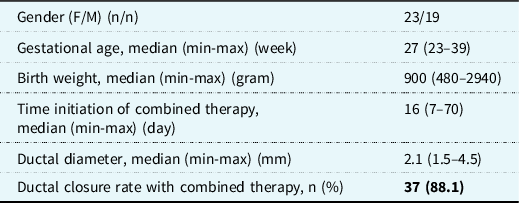
A total of 42 patients were evaluated in this study. Nineteen (45.2%) subjects were male and 23 (54.8%) were female. All patients were premature except two cases (95.2%). The median birth weight of patients was 900 grams (480–2940), while the median gestational age was 27 weeks (23–39). The median ductal diameter of the cases was 2.1 mm (1.5–4.5), and the median postnatal day at the initiation of combined therapy was 16 days (7–70). Of the patients who received combined therapy, 37 (88.1%) exhibited ductal closure without requiring surgical ligation (Table 1).
Demographic characteristics and treatment efficacy in patients who received the combined therapy

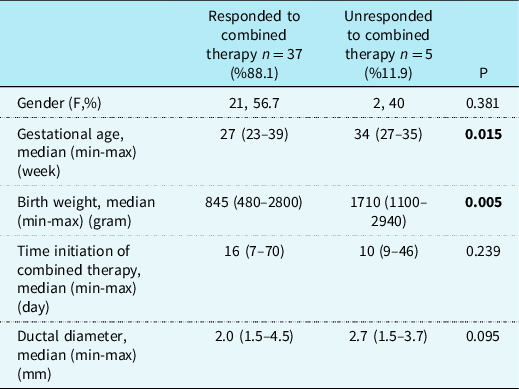
There was no statistically significant difference between patients who were responsive (n = 37) and unresponsive (n = 5) to the combined therapy in terms of gender distribution, postnatal day at the initiation of therapy, and ductal diameter (p > 0.05). However, the median birth weight and gestational age of patients unresponsive to the combined therapy were found to be statistically significantly higher (p < 0.05) (Table 2).
The demographic characteristics of patients who were responded and unresponded to combined therapy

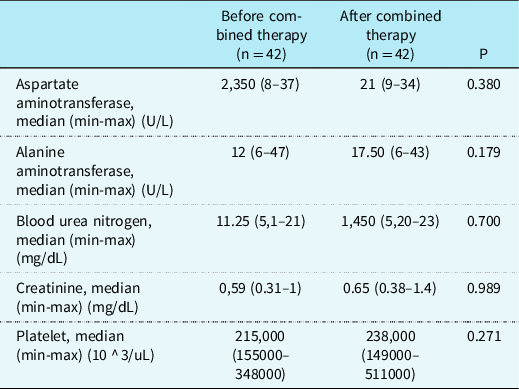
The laboratory values of patients (liver and kidney functions and platelet count) before and after treatment were within the normal range, and there was no statistical difference. Only one (2.4%) patient developed acute renal failure during the combined therapy (Table 3). At the start of combined therapy, 28 of our patients were receiving invasive conventional mechanical ventilation support. Only 3 of our patients had culture-proven sepsis.
Laboratory values of the patients before and after combined therapy

Discussion
The ductus arteriosus carries a vital significance during foetal life and remains open through low oxygen pressure and arachidonic acid metabolites, such as prostaglandin E2 (PGE2) and prostacyclin I2 (PGI2). In term babies, the ductus typically closes within the first postnatal 72 h as a result of increased oxygen concentrations and decreased PGE2 and PGI2 levels. Reference Clyman13 In preterm, the ductal tissue is highly sensitive to prostaglandin and non-sensitive to oxygen, enabling the ductus to stay open for an extended time period. Reference Hamrick and Hansmann14
The persistence of haemodynamically significant patent ductus arteriosus is associated with an increase in comorbidity, mortality, and morbidity, and thus, its closure should be considered. Drugs used in the treatment of patent ductus arteriosus show an effect by inhibiting the synthesis of prostaglandin. Indomethacin and ibuprofen selectively inhibit the cyclooxygenase pathway and are the first-line treatment of choice. On the other hand, paracetamol affects the peroxidase segment of the prostaglandin synthetase enzyme. Reference Gokmen, Erdeve, Altug, Oguz, Uras and Dilmen10,Reference El-Khuffash, Jain and Corcoran15 Both drugs provide successful closure of patent ductus arteriosus in 75–93% of cases. Reference Van Overmeire and Chemtob16 Surgical ligation or endovascular closure is used in cases resistant to pharmacological therapy or when treatment is contraindicated. Surgical ligation is associated with an increase in the risk of surges in blood pressure, neurodevelopmental disorder, chronic lung disease, severe retinopathy of prematurity, chylothorax, recurrent paralysis of the laryngeal nerve, and intraventricular haemorrhage. Reference Weisz, More, McNamara and Shah9 Due to the problematic nature of surgical intervention, there is always a need for medical treatment regimes. In a meta-analysis study by Mitra et al., Reference Mitra, Florez and Tamayo17 it was reported that ibuprofen is more effective at higher doses. In a small-scale study by Yurttutan et al., Reference Yurttutan, Bozkaya, Hüdayioğlu and Oncel18 nine premature neonates with haemodynamically significant patent ductus arteriosus were treated with the combined therapy (ibuprofen and paracetamol) without enduring surgical ligation; in addition, no adverse effects of the treatment were reported. It is speculated that the use of paracetamol and ibuprofen in combination exhibits a synergistic effect, as prostaglandin synthesis is inhibited through separate steps of the pathway. Thus, the combined therapy reduces levels of local prostaglandins more than the standard therapy. Reference Sahin, Dinlen Fettah and Kara19,Reference Terrin, Conte and Scipione20 In the literature, it is widely known that ibuprofen and paracetamol may be safely used in combination in regimens of several ages and patient groups without exhibiting side effects. Reference Sjoukes, Venekamp and van de Pol21–Reference Wong, Stang and Ganshorn23 In our study, this combined therapy was used to treat 42 patients who did not respond to the standard medical therapy, with only one patient experiencing acute renal failure during treatment. It could not be determined whether the cause of acute renal failure was associated with medical treatment or as a complication of haemodynamically significant patent ductus arteriosus.
The rate of ductal closure is associated with the starting time of treatment; early treatment initiation increases the efficacy and success of the therapy. Reference Todd, Jana and John5 In our study, the patent ductus arteriosus of 37 (88.1%) out of 42 cases exhibited closure. Our median time of combined treatment initiation was the postnatal 16th day. In a study involving 20 premature neonates < 29 weeks, Sash et al. Reference Sash, Makker, Nandula, Smotherman, Kropf and Hudak7 reported that the combined therapy was effective as a first-line treatment for patent ductus arteriosus. We believe that three factors were involved in the unsuccessful combined therapy of our five patients. First, the cases that did not respond to the combined therapy had a significantly higher median birth weight [1710 grams (1100–2940) versus 845 grams (480–2800); p < 0.005, respectively] and gestational age [34 (27–35) versus 27 (23–39); p < 0.015, respectively] compared with those who responded. This is associated with the well-documented fact that the ductal structure in prematures is more sensitive to prostaglandin and its inhibitors, thus increasing the rate of success. Reference Hamrick and Hansmann14 Of all our patients, 31 were ≤ 28 weeks at birth. These patients at a smaller gestational age exhibited a higher combined treatment success rate (96%). The second reason, although statistically insignificant (p = 0.09), is that the larger median ductus diameter of infants who did not respond to combined therapy [2.7 (1.5–3.7)] compared with those who responded [2.0 (1.5–4.5)] may have played a role in the persistence of patent ductus arteriosus. A third and minor consideration is that although the time of combined therapy initiation was similar (p = 0.23) between patients who exhibited patent ductus arteriosus closure and those who did not, the therapy was applied following a standard treatment, and the elapsed time may have reduced the efficacy of the combined therapy. Thus, we believe that selecting the combined therapy as the first choice will increase the success rate of haemodynamically significant patent ductus arteriosus treatment, particularly in high-risk infants. On the contrary, one may argue that the patent ductus arteriosus could have closed spontaneously with time.
We have observed that the combined treatment with paracetamol and ibuprofen exhibits a higher rate of success in the closure of haemodynamically significant patent ductus arteriosus resistant to monotherapy without requiring surgical intervention. We believe that the high success rate of paracetamol and ibuprofen in combination is due to its synergistic effect, as prostaglandin synthesis is inhibited through separate steps of the pathway. For this reason, in patent ductus arteriosus cases, particularly those resistant to monotherapy, facilities lacking a surgical department may routinely attempt the combined therapy as a last resource prior to surgical intervention. In addition, very low birth weight infants face a higher risk of patent ductus arteriosus, and combined therapy may be used as the first-line treatment of choice to protect these infants from the early damage of an open ductus. The wide gestational age range of the patients and the fact that combined therapy was not used in the first line limited our study. There is a "time bias" in patent ductus arteriosus closure. The closure in the combined treatment process may be time-dependent. However, further multi-centric, large-scale, randomised, controlled, prospective studies are required to evaluate these speculations. At the least, a study with combined therapy as the primary therapy early, in a subset of preterm neonates < 26 weeks, will yield better insight to this strategy.
Financial Support
This research did not receive any specific grant from funding agencies in the public, commercial, or not-for-profit sectors.
Conflicts of interest
The authors declare that they have no conflict of interest.
Ethical Standards
The study was approved by Inonu University Institutional Ethics Committee (2021/1709).