I. INTRODUCTION
Al–Li alloys with promising properties, such as very low density, high stiffness, and improved specific strength, have stimulated researchers' interest in space and aerospace applications. Nevertheless, low ductility and toughness, poor thermal stability, and especially high anisotropy of mechanical properties make Al–Li alloys less competitive as replacements for conventional aluminum alloys and limit their applications. Reference Gupta, Nayan, Nagasireesha and Sharma1,Reference Rioja and Liu2 These disadvantages are mainly attributed to microstructure-related problems such as the presence of crystallographic texture, as-extruded or as-rolled elongated grains and inhomogeneous distribution of the second phases. Reference Rioja and Liu2,Reference Jata, Panchanadeeswaran and Vasudevan3
As is known to all, severe plastic deformation (SPD) has great potential in refining grains and improving mechanical properties. Unfortunately, SPD methods, such as accumulative roll bonding, high press torsion and equal channel angular pressing, usually produce materials with strong texture. Reference Alexandrov, Dubravina, Kilmametov, Kazykhanov and Valiev4 Repetitive upsetting and extrusion (RUE), however, has several advantages over other SPD techniques: imposing higher strain per cycle, bringing about stronger alternate shear stress and thereby achieving a more effective grain refinement and homogenous structure. Reference Zaharia, Comaneci, Chelariu and Luca5 In the past, RUE processing has been successfully used to produce metallic materials with ultrarefined grain structure and weakened texture. Finite element method was used to simulate RUE processing and it was demonstrated that bulk AZ61 magnesium alloy could obtain equiaxed ultrafine grains by multipass RUE. Reference Xu, Hu, Sun and Ma6 RUE processing was conducted on a LY12 alloy at room temperature and it was found that uniform equiaxed ultrafine grains could be obtained and the mechanical properties could be improved. Reference Hu, Li, Wang and Yu7 The microstructures and mechanical properties of fully annealed pure aluminum processed by RUE processing were investigated and it was found that the grains became smaller and the texture was changed after each cycle. Reference Zaharia, Comaneci, Chelariu and Luca5 Furthermore, it was established that the strain imposed on materials per cycle through RUE processing was the highest among all SPD processes.
Most previous works on RUE processing mainly focused on the deformation flow behaviors and validating the refinement effect on bulk materials such as pure copper, Reference Balasundar and Raghu8–Reference Balasundar, Ravi and Raghu10 magnesium alloys, Reference Xu, Hu, Sun and Ma6 pure aluminum, Reference Zaharia, Comaneci, Chelariu and Luca5 and traditional aluminum alloys. Reference Hu, Li, Wang and Yu7 However, few investigations were carried out on Al–Li alloys to explain the relationship between microstructures and the tensile mechanical properties during RUE processing. In the present study, Continuous RUE (CRUE) was conducted on a 2A66 Al–Li alloy to explore its microstructures and mechanical properties evolution.
II. EXPERIMENTAL
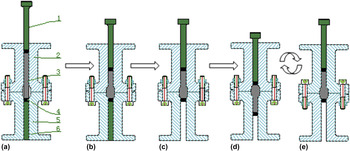
The schematic diagram of CRUE processing is shown in Fig. 1. There were differences between the present CRUE mold and those of previous researchers. Reference Zaharia, Comaneci, Chelariu and Luca5–Reference Balasundar, Ravi and Raghu10 The modified mold chamber was composed of three parts: one interchamber with a diameter of Φ23 mm, an upper chamber, and a lower chamber with equal diameters of Φ15 mm, in a such way that defects such as axial hole/funnel and folds/laps in traditional mold can be eliminated Reference Balasundar and Raghu9 and the subsequent RUE cycle can be continuously performed without reinserting the prior sample. The bars used in the present study were made of 210cr12 steel and the mold was made of H13 steel. The effective strain for each CRUE cycle was 1.708.
Diagram of CRUE processing (a) beginning of upsetting, (b) finishing of upsetting, (c) beginning of extrusion, (d) finishing of extrusion, and (e) turnover (1. upper bar, 2. upper die, 3. the sample billet, 4. shim, 5. bottom die, and 6. lower bar).

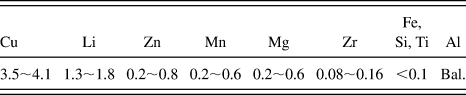
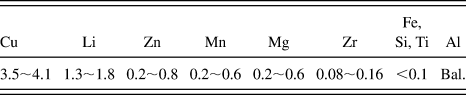
The experiments were conducted on a light-weight 2A66 Al–Li alloy provided by Beijing Institute of Aeronautical Material. The composition of 2A66 alloy is given in Table I. The as-cast billets were first consolidated by hot extrusion at 410 °C with an extrusion rate of 12.96 to improve deformability. The as-extruded 2A66 alloys were then machined to billets with dimensions of Φ15 mm × 125 mm.
Chemical composition of 2A66 Al–Li alloy (wt%).
The sample billets and the CRUE mold chambers were coated with oil-based graphite as lubricates, and then both the mold and the sample billets were heated to 350 °C for about 3 h before performing the CRUE processing. Firstly, the upper bar moved down at a speed of 2.4 mm/s to push the sample billets to fully fill the upsetting chamber. After the first upsetting processing was completed, the low bar was removed and the upper bar continued to move down to finish the first CRUE cycle. Then, the mold was reversed and the next RUE cycle was subsequently performed without reinserting the prior sample.
The microstructure characteristics were examined by electron backscattered diffraction (EBSD) and transmission electron microscopy (TEM). The EBSD analysis was carried out in a FEI Quanta 200 scanning electron microscopy (FEI Company, Brno, Czech Republic) equipped with an EBSD detector. Because Al–Li alloys were easily oxidized Reference Akhtar11 and considerable retained stresses imposed after CRUE processing interfered the diffraction patterns, Reference Zha, Li, Mathiesen, Bjørge and Roven12 the EBSD specimen preparation was critical. The EBSD samples were prepared by mechanical grinding with 5000 grit silicon carbide papers, then fine polished to mirror with chromium oxide solution and finally electro polished with a solution of 33% nitric and 67% methanol at a voltage of 15 V for 90–120 s in the temperature region of −10 to −15 °C. The samples were immediately cleaned using ethanol and kept in cryogenic and vacuum environment. The TEM analysis was carried out on the Tecnai G2 F20 S-TWIN TEM (FEI Company, Almelo, The Netherlands).
The tensile specimens cut from the CRUE processed materials along the extrusion direction were machined as dog-bone geometry. The dimensions were 8 × 3.4 × 2 mm, with a 6.64 mm shoulder radius. The room temperature tensile tests were performed at a constant strain speed of 1 mm/min on Instron 3369 testing machine (Instron, Zurich, Switzerland).
III. RESULTS
A. Microstructures
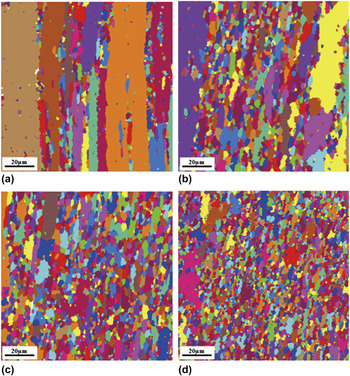
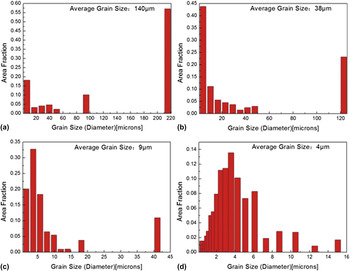
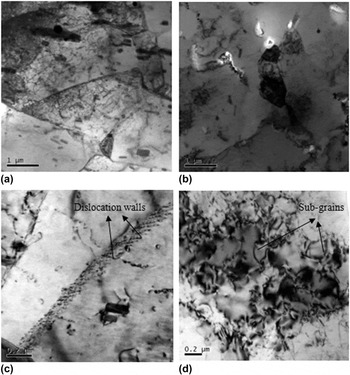
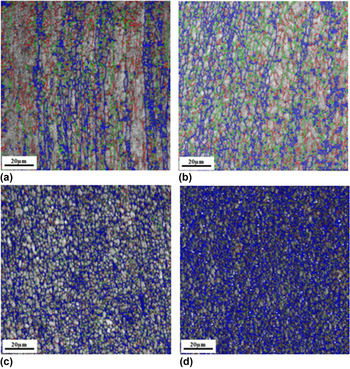
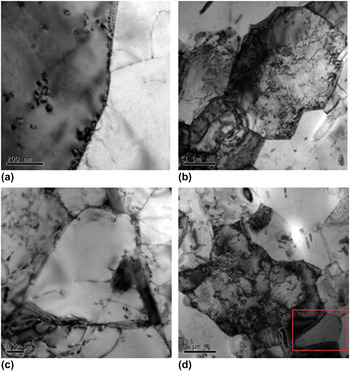
Figures 2 and 3 show the EBSD grain morphology and corresponding grain size distribution of as-extruded and CRUE processed 2A66 alloys, respectively. Strip-shaped grains along the extrusion direction and refined grains along the grain boundaries can be seen in the as-extruded 2A66 alloy [Fig. 2(a)]. The mean size of coarse grains is larger than 200 µm, whilst that of fine grains is about 6 µm [shown in Fig. 3(a)]. This is typically extruded fiber structure companied with partial dynamic recrystallization grains. The shape of grains is found to have evolved from elongated shape into roughly equiaxed shape, with increasing accumulated strain. After one CRUE pass, the strip-shaped structure is weakened. As shown in Fig. 2(b), most grains are still in elongated shape, but the aspect ratio of elongated grains decreases and the fraction of fine grains increases to 44%. Figures 2(b) and 3(b) indicate that both the coarse elongated grains and fine grains are effectively refined and the microstructures become more homogeneous compared with those of as-extruded 2A66 alloy. After 2 and 3 CRUE passes, the grains are gradually refined and tend to be more uniform. In the material with 3 CRUE passes, the grains are clearly refined to about 4 µm compared with ∼140 µm of as-extruded 2A66 alloy. The significant grain refinement may be due to the dislocation transformation in grain interior or near-grain boundaries region promoting the formations of new finer subgrains or grains during either continuous or discontinuous recrystallization. Reference Sakai, Belyakov, Kaibyshev, Miura and Jonas13,Reference Kim, Hong, Kim, Min, Jeong and Lee14 As illustrated in Fig. 4, a large number of dislocations are visible in the grains in as-extruded 2A66 alloy. These dislocations are tangled with each other in grain interior or pile up as dislocation walls. The number of visible dislocations decreases after 3 CRUE passes [Fig. 4(b)]. This means that the dislocations tend to rearrange and annihilate during CRUE processing. The disappearing dislocations tend to develop as subgrain boundaries, as shown in Fig. 4(d). Detailed grain refinement mechanism will be explored in the discussion section.
Grain morphology (SEM-EBSD) images of 2A66 alloys before and after CRUE processing (a) as-extruded, (b) 1 CRUE pass, (c) 2 CRUE passes, and (d) 3 CRUE passes.

Grain size distribution of as-extruded and CRUE processed 2A66 alloys (a) as-extruded, (b) 1 CRUE pass, (c) 2 CRUE passes, and (d) 3 CRUE passes.

TEM images of 2A66 alloys before and after CRUE processing (a & c) as-extruded and (b & d) 3 CRUE passes.

B. Grain boundary
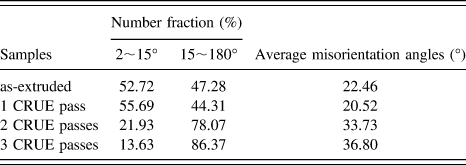
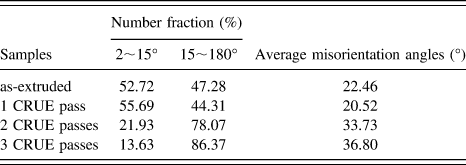
The grain boundary maps of as-extruded and CRUE processed 2A66 alloys are shown in Fig. 5. The red lines denote low angle grain boundaries (LAGBs) with misorientation angles of 2°–5°. The green lines denote LAGBs with misorientation angles of 5°–15°. The blue lines denote high angle grain boundaries (HAGBs) with misorientation angels larger than 15°. Boundaries with misorientation angel less than 2° are not taken into consideration in view of the statistical accuracy of EBSD. As is shown in Fig. 5, the red lines marking LAGBs become less and are replaced by considerable blue lines with the increase of the CRUE passes. In other words, there are large numbers of LAGBs in as-extruded 2A66 alloy but fewer in 3 passes CRUE processed 2A66 alloy. Table II lists the fraction of HAGBs and LAGBs of as-extruded and CRUE processed 2A66 alloys. As listed in Table II, the fraction of HAGBs increases and that of LAGBs decreases with increasing CRUE strain. The fraction of HAGBs in as-extruded 2A66 alloy is 47.28% and dramatically increases to 86.37% after 3 CRUE passes. This means that LAGBs evolve into HAGBs during CRUE deformation. This is mainly attributed to the cyclic occurrence of subgrains transformation and continuous dynamic recrystallization (CDRX) as strain imposed increases during CRUE processing. Reference Mungole, Naresh, Dawara, Kumar, Kawasaki and Langdon15–Reference Kaibyshev, Shipilova, Musin and Motohashi17
Grain boundary maps (SEM-EBSD) of 2A66 alloys before and after CRUE processing (a) as-extruded, (b) 1 CRUE pass, (c) 2 CRUE passes and (d) 3 CRUE passes.

Fraction of boundaries with different misorientation in 2A66 alloys before and after CRUE processing.
C. Texture analysis
The textures were analyzed with orientation distribution function (ODF) determined by the series expansion method, because the ODF exhibited a higher resolution than the pole figure for the interpretation of the texture.
Reference Woo, Choo and Brown18,Reference Wenk and Van Houtte19
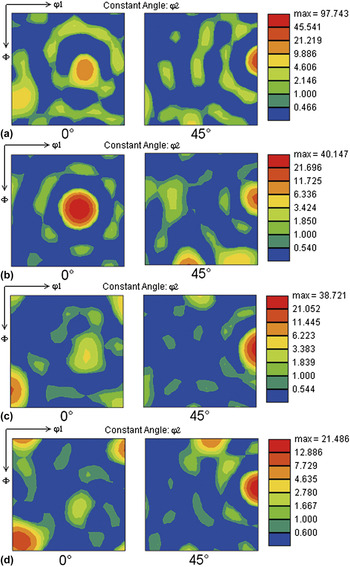
Fig. 6 shows the ODF sections of as-extruded and CRUE processed 2A66 alloys. The maximum intensity of texture decreases from 97.743 to 21.486 as the CRUE pass number increases from 0 to 3, indicating that the texture tends to be weakened with increasing CRUE passes. As illustrated in Fig. 6(a), the main textures in as-extruded 2A66 alloy are composed of strong {112}<111> texture, a weak {011}<111> texture and a relatively weaker {041}<100> texture. After one CRUE pass, the {112}<111> texture becomes weaker and the {011}<111> texture becomes the dominant one and a new {110}<
 $1\bar 15$
> texture appears. After 2 CRUE passes, the main {112}<111> texture and {011}<111> texture still exist with intensity decreased, while a new cube texture ({001}<100>) appears with low intensity as shown in Fig. 6(c). After 3 CRUE passes, the {112}<111> texture and {011}<111> texture become weaker and a new {032}<
 $3\bar 23$
> texture appears and the intensity of cube texture becomes more intense. The increase in the intensity of cube texture means that dynamic recrystallization (DRX) takes place during CRUE processing. This is consistent with the refiner grains observed in Figs. 2(d) and 5(d). The modification of texture component during CRUE processing may be attributed to the accumulation of shear strain. It was reported that texture development in the alloy was related with shear deformation and DRX,
Reference Nadammal, Kailas, Szpunar and Suwas20
because grain and subgrain boundary migration play a significant part in the evolution of the (100) texture.
Reference Jeong, Okayasu and Fukutomi21,Reference de La Chapelle22
ODF sections of 2A66 alloy before and after CRUE processing (a) as-extruded, (b) 1 CRUE pass, (c) 2 CRUE passes and (d) 3 CRUE passes.

D. Mechanical properties
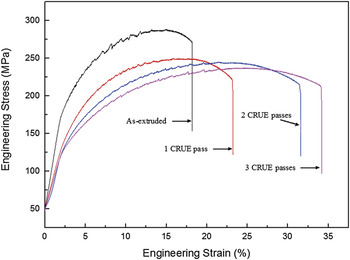
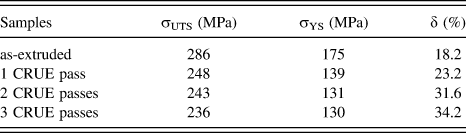
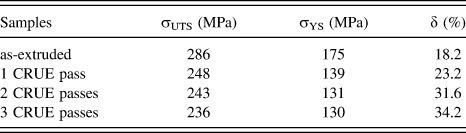
Figure 7 illustrates the tensile test results of 2A66 alloy before and after CRUE processing at room temperature. Table III summarizes the obtained average ultimate tensile strength (σUTS), yield strength (σYS), and elongation (δ). A modest decrease of both tensile strength and yield strength can be observed after 3 CRUE passes, but the total elongation-to-failure increases with increasing CRUE passes. It can be seen that 3 passes CRUE processed 2A66 alloy exhibits a significant enhancement (about 87.9%) in the ductility compared with as-extruded alloy. In detail, the ductility increases from initial 18.2% to 34.2%. To sum up, repetitive CRUE deformation leads to an increase in ductility with a decline in strength. The results are in good agreement with previous SPD processed aluminum alloys. Reference Kim, Kang, Tsuji and Minamino23–Reference Kong, Zhang and Ji25 It was suggested that the softening behavior was due to CDRX, dynamic recovery (DRV), and static recovery during and/or after deformation. Although both the refined grains and the increase in the fraction of HAGBs in present study favor to the enhancement of strength, the decrease of dislocation density overwhelms the strengthening effect of grain boundaries. The strengthening of metals is rooted in the inhibition of dislocation motion, Reference Huskins, Cao and Ramesh26 so the decrease of dislocation density may have more notable influence on the strength of materials. On the other hand, the modification of texture is the other factor for the softening of alloys. Reference Kim, Hong, Kim, Min, Jeong and Lee14,Reference Starink and Wang27 The effect of texture on strength is validated by Taylor factor, M. Reference Starink and Wang27 A higher M value means that slip systems are more difficult to be activated. It is demonstrated in Ref. Reference Starink and Wang27 that copper texture ({112}<111>) has a higher M value than cube texture and other textures in present studied alloy. The weakening of the dominant {112}<111> texture and {110}<111> texture (shown in Fig. 6) would lead to more favorable orientations to slip, thus decreasing the strength. The enhanced ductility was also rationalized by the grain refinement and the increase in the fraction of HAGBs. Reference Mungole, Kumar, Kawasaki and Langdon28 The reason lies in the grain boundary sliding induced by high temperature and large strain.
Engineering stress–strain curves of 2A66 alloy before and after CRUE processing.

Summary of the tensile test results obtained at room temperature.
IV. DISCUSSION
As can be seen from Figs. 2 and 3, the grain size is greatly reduced after CRUE processing. Hu et al. suggested that the new grains evolution during RUE processing was composed of three steps: (i) the development of cellular structure, (ii) the transition of cellular structure to granular structure, (iii) the formation of equiaxed grains with HAGBs. Reference Hu, Li, Wang and Yu7 Balasundar et al. proposed that the grain refinement during RUE processing was attributed to microshear band fragment mechanism induced by strains. Reference Balasundar, Ravi and Raghu29 Though various grain refinement mechanisms during RUE were proposed, Reference Hu, Li, Wang and Yu7,Reference Balasundar, Ravi and Raghu29 they both investigated the grain refinement mechanism during deformation at ambient temperature conditions. As the present study was performed at 350 °C, the grain refinement mechanism may be different.
In previous works, the grain refinement mechanism of aluminum alloys during hot severe deformation was considered to be CDRX. Reference Kaibyshev, Shipilova, Musin and Motohashi17,Reference Sitdikov, Sakai and Avtokratov30–Reference Gourdet and Montheillet33 The grain refinements that occur via the operation of CDRX consist of two steps (i) the formation of three-dimension arrays of low angel boundaries (LABs) (ii) the gradual transformation of LABs into HAGBs. Reference Kaibyshev, Shipilova, Musin and Motohashi17,Reference Sitdikov, Sakai and Avtokratov30–Reference Gourdet and Montheillet33 This is consistent with the grain boundary evolution during CRUE processing shown in Table III. High deformation temperature promotes the lattice dislocations to rearrange within grains and to covert to subgrain boundaries. Reference Sukhopar, Sitdiko, Gottstein and Kaibyshev34 Therefore, at the first stage of deformation, large amount of LABs tend to develop through the rearrangement of dislocations (termed as DRV). Reference Gourdet and Montheillet35 The rearrangement of dislocation as transverse low angel subgrain boundaries leads to the transformation of elongated grains into numerous equiaxed subgrains and the reduction of dislocation density (as shown in Fig. 4). As is known to us, dislocation slip will be easier and more homogenous at high temperature. With increasing strains, dislocations slip within subgrains. When the mobile dislocations try to slide across the subgrain boundaries, the subgrain boundaries will be hindrances, thus leading to aborting these dislocations and gradually increase their misorientation angels. Reference Kaibyshev, Shipilova, Musin and Motohashi17 Additionally, the randomization of texture during CRUE processing (as shown in Fig. 6) indicates that the transformation of LABs to HAGBs may be assisted by the rotation of (sub)grains. Grain boundaries sliding will be available at elevated temperature and at large strains. The rotation of subgrains assisted by grain boundaries sliding will also increase the misorientation angel of LABs. Reference Sukhopar, Sitdiko, Gottstein and Kaibyshev34,Reference Gourdet and Montheillet35 As the subgrain boundaries gradually increase their misorientation and become more stable grain boundaries, new grains surrounded by HAGBs eventually developed.
Meanwhile, inhomogeneous local strain gradient along boundaries during early hot deformation frequently leads to local migration of original HAGBs, Reference Wang, Shao, Zhen, Yang and Zhang36 as shown in Fig. 8(a). Due to the local migration of original HAGBs, long grain boundaries surrounding coarse grains are more likely to be developed as corrugated boundaries, Reference Sangal and Tangri37 as shown in Fig. 8(b). In contrast to dispersed particles retarding recrystallization, coarse particles stimulate the nucleation in their vicinity. Reference Castro-Fernández and Sellars38 Assisted by the operation of grain boundary bulging, new grains usually nucleate at grain boundaries with considerable dislocations or large particles [Fig. 8(c)]. As shown in Fig. 8(c), finer grains developed at triple junctions are nearly dislocation-free. This process of new grains evolved is typical discontinuous dynamic crystallization (DDRX). Reference Gao, Belyakov, Miura and Sakai39 Refiner dislocation-free grains developed through DDRX will grow by bulging into their surroundings and consume the deformation region as deformation continues, Reference Galindo-Nava and Rivera-Díaz-del-Castillo40 as shown in Fig. 8(d). This is also the reason why certain coarse grains still exist after 3 CRUE passes, as shown in Fig. 2(d).
TEM images referring to DDRX grains evolution during CRUE processing (a) local migration of original grain boundary (b) serrated boundaries (c) new grain developed at triple junctions (d) bulging grow-up of DDRX grain.

In summary, the grain refinement during CRUE processing was induced by a compound mechanism of CDRX and DDRX. In grain interior, considerable dislocations rearrange as LABs and then convert into new grains surrounded by HAGBs, which is termed as CDRX. Near certain grain boundaries, new grains nucleate by local migration of original HAGBs, which is termed as DDRX.
V. CONCLUSIONS
In present study, CRUE was conducted on a 2A66 alloy. The microstructure investigations indicate that as-extruded 2A66 alloy could achieve significant grain refinement through CRUE processing. The average grain size is reduced from initial ∼140 µm to ∼ 4 µm after 3 CRUE passes. The fraction of HAGBs and the average misorientation angle tend to increase with increasing CRUE passes due to cyclic transformation of subgrains and CDRX. The textures tend to be weakened and modified with increasing CRUE passes. The maximum ODF intensity reduces from 97.743 to 21.486 after 3 CRUE passes. The original {112}<111> texture and {110}<111> texture of extruded 2A66 Al–Li alloy are weakened and new textures are developed after CRUE processing. The tensile test results show that the CRUE processing leads to a notable enhancement in the tensile ductility of 2A66 alloys. In particular, the elongation-to-failure increased by 87.9% (from 18.2% to 34.2%) after 3 CRUE passes. This increase is combined with a modest decrease in ultimate tensile strength and yield strength. The grain refinement of 2A66 Al–Li alloy during CRUE processing is the combined effect of CDRX and DDRX.
ACKNOWLEDGMENTS
The authors are grateful to National Natural Science Foundation of China (Nos. 51271076; 51474101; 51574118) for the financial support of this work. The authors are also grateful to Beijing Institute of Aeronautical Material for the materials support.