The main plaza was a key element of Hispanic colonial urbanism. In the Americas, Spanish cities were planned around a public square since the early sixteenth century. This practice was initiated in some of the earliest cities, and was later codified in the renowned Ordenanzas de descubrimiento, nueva población y pacificación, 1573. During the colonial regime, as well a good part of the republican period, this plaza was the city's core, its centre. Consequently, the plaza is almost always the starting point from which the history of Hispanic American cities is explored. However, deeper exploration of the actual relations between this square and the rest of the city is necessary. To this end, this article discusses the thorny shift from Plaza Mayor to Plaza de Armas: a series of episodes during the late Bourbon period, in which the uses of this central public space were modified. These two terms correspond to different spatial models for the use of the central square that were clearly distinguished in late colonial documents.Footnote 1 While there were already several places called Plaza de Armas in existence in Hispanic America prior to the second half of the eighteenth century, the Lima case is particularly informative because its Plaza de Armas was designed for the centre of the city, to replace the Plaza Mayor.Footnote 2 The Plaza Mayor can be conceived as a spatial model based on a specific combination of social uses of the main plaza, and thus the city. The application of this spatial model resulted in a particular kind of centrality, and it will be shown how the transition to Plaza de Armas was related to the introduction of new uses for the same square, and thus a reorganization of the city. Considering that each kind of centrality can be associated with a specific urban type, we are dealing with a major transformation in late colonial Lima.Footnote 3
The objective of the late colonial Spanish authorities was to switch from a central square that functioned as a daily market and was also used for public festivities (the Plaza Mayor) to a cleared and empty space devoted to martial activities (the Plaza de Armas). This conceptual, functional and political transformation of the main plaza affected the entire city and was part of the Bourbon reformist projects of the second half of the eighteenth century. This period was characterized by a series of political and administrative interventions promoted by Spanish authorities that attempted to reorganize the colonial territories. Historians basically agree on the spirit that animated the late Bourbon reforms, but there are at least three different perspectives on their efficacy.Footnote 4 Whatever the selected perspective, analysis of specific urban elements like the central square can contribute to better characterization of the reformist project and can provide more data on which to base discussions of its success or failure. For example, the same kinds of Bourbon interventions were met with varying levels of success in different Hispanic American cities, and even within the same city some projects achieved their goals while others did not. While the application of these empire-wide reforms varied according to location, the broad reformist programme can be recognized by the presence of the same rulers in different colonial cities (which contributed to the application of similar strategies), and in the circulation of information on urban administration among the main colonial cities. Recently, the typical periodization of the Bourbon reforms has been reasonably questioned, emphasizing the importance of administrative transformations from the first half of the eighteenth century.Footnote 5 However, in the case of the urban landscape, and particularly the main square, this article will show that the main changes belong to the second half of the eighteenth century. Late Bourbon urban interventions were highly comprehensive in the Americas, ranging from the modification of administrative, tax and police systems to the introduction of new precepts on aesthetics and public hygiene. They were intended to transform the city to control its inhabitants better, especially the lower classes, turning them into disciplined subjects. As part of that overall project, a new series of construction projects that embodied the reformist programme were undertaken in the main cities, such as the extramural cemeteries.Footnote 6 The central plaza, a key urban element, was also affected by this cycle of construction, as it was the most visible stage upon which the late Bourbon project and the older urban system collided.Footnote 7
To start, four main tendencies in the historiography of the central square in Hispanic American cities can be distinguished. The first sought to define the main features or functions of this square in general.Footnote 8 The second focuses on official urban chronicles or testimonies of occasional travellers, and offered a stereotypic or impressionistic view of that plaza.Footnote 9 A third, and more sophisticated, approach was devoted to the political reading of the festive representations staged in the plaza.Footnote 10 And finally, the fourth includes studies that deal with the commercial activities performed in the central square and its surrounding area.Footnote 11 These four tendencies are necessarily complementary if we want to explain the history of the plaza, but they have rarely been used together. In the first tendency, change is often overlooked in order to present a sense of permanence. The second and the third emphasize the festive aspects of the plaza but rarely consider its relations with the more mundane, quotidian and actually representative function of the plaza: the market. Yet, discussions of the plaza that articulate historical contingency (events) and structure (long-term trends) must necessarily incorporate this everyday dimension. The fourth tendency has revealed a vast ‘underworld’ of semi-legal activity related to the plaza, but has disregarded how this actually affected the other uses, and has paid only minor attention to detailed chronology, thus not discussing functional changes in the square. Building on the previous historiography, this article employs an approach that integrates the four mentioned tendencies, proposing a comprehensive reading of the urban shift promoted by the late Bourbons starting from the central square.Footnote 12 One of the consequences of ignoring this kind of articulated approach is that the crucial shift from Plaza Mayor to Plaza de Armas has remained fairly unnoticed in Latin American urban historiography. This lacuna is reinforced since both terms are currently used colloquially (and sometimes interchangeably) to allude to a physical space, while in colonial times these terms also referred to spatial models (i.e. specific set of functions).Footnote 13
As in Mexico City, the Bourbon intervention in the central esplanade of Lima demonstrates the confrontation between metropolitan (the viceroy) and local authorities (the city council). This intervention affected different actors within urban Lima, whose reactions provide complementary snapshots of the same scenario. Quarrels among these various actors help explain the concrete agendas of the late Bourbon viceroys, the Cabildo (city council), the ecclesiastical authorities, the person in charge of renting and subletting the square and the minor vendors who sublet parts of it, among others. Before dealing explicitly with the Bourbon manoeuvres in the central plaza, however, the initial functions of this esplanade are introduced.
A multifunctional square
Internal hierarchies within the Hispanic American colonial system led to a degree of functional variability among cities, and therefore among their central plazas, from Mexico to Santiago de Chile. However, under the Plaza Mayor model these squares shared at least seven attributes.Footnote 14 First, they signalled the area where, fictionally or factually, the city had been founded, providing them with enormous symbolic weight: the city started there. Second, they were surrounded by the main colonial institutions, such as the Cabildo, the viceregal palace, and the cathedral, as well as the residences of the main vecinos, the urban elite. Third, they accommodated the main civil, military and religious celebrations; including processions, bullfights and public punishments. Fourth, they were the most ostentatious point of the urban hydraulic system, with fountains that provided water to the city. Fifth, they were centres of diffusion of information. Until other squares were built, they were the only location where the official bandos (decrees, urban norms, laws) were posted and where proclamations were shouted. From these central squares, the cathedral´s bells marked the rhythm of urban life. Sixth, they were markets. Vendors worked in the central square, and the surrounding buildings held shops. Seventh, they served as epicentres of urban reforms; (re)ordering the plaza was the first step before continuing on to the rest of the city.
All of these functions were present in early colonial Lima. The plaza was the public space, described at the end of the eighteenth century as the ‘universal centre of public functions, and reunion of the entire neighbourhood’.Footnote 15 Such multifunctionality made this square the urban feature with the greatest number of documentary references in the Peruvian viceroyalty (and probably on the whole continent), perhaps only comparable with its Mexican counterpart.Footnote 16 Taken as a whole, this remarkable quantity of references forms the basis from which it is possible to analyse in detail the shift from Plaza Mayor to Plaza de Armas. This process corresponds with what was called the move from ‘the medieval polyvalence to the more restricted and strict use of the modern age’ regarding the main squares in Spain.Footnote 17 This transition is also related to the official late Bourbon intention to impose the neoclassical ‘unison’ over the baroque ‘polychorality’.Footnote 18 Subsequently, in the following, this article considers some major questions. What were the uses of the main square in the eighteenth century? What modifications can be identified in those uses? How was this space affected by the late Bourbon reforms? And, finally, how did the urban system embedded in the plaza collide with the reformist momentum?
In the mid-eighteenth century, Lima´s main square showed most of the above listed uses, with two important changes. First, in 1562, the rollo for public executions was moved to the riverfront and from this point capital punishments were only rarely performed in the main plaza. Second, in 1768, a special arena for bullfighting (Plaza de Acho) was erected in San Lázaro, a neighbourhood on the north side of the river, and only the bullfights that accompanied the important celebrations (related with the arrival of viceroys and proclamation of kings) were still held in the central square.Footnote 19 The functional multiplicity of the plaza made it Lima´s most valuable real estate, consolidating a pattern that continued into the late nineteenth century: property values increased in the central area and decreased as one moved outwards.Footnote 20 In this way, the Plaza Mayor model had concrete effects on the whole city. Simultaneously, the market attracted all kinds of people, securing a constant demand for the vendors and a variety of offerings for consumers, and, therefore, assuring the commercial value of the immediate buildings. In 1773, the logic behind the plaza's valorization process was described by an experienced colonial authority: ‘The houses of the square were the worst of the city, as happens almost all over the world, since the conquistadores and owners of those places sublet them to the permanent merchants, who are those who pay most for renting them.’Footnote 21 Even though Alonso Carrió was describing Cuzco's centre, his observation fits Lima, where early pomp gave way to monetary pursuits.
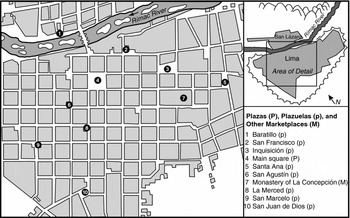
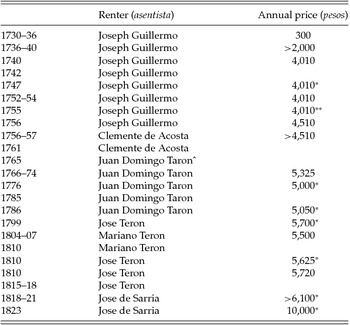
The difference in commercial magnitude between the central and the smaller squares, the plazuelas, becomes apparent when considering the annual cost of the concession of this space, the ramo de toldos y asientos (division of stalls and spaces). At least since 1730, this concession worked in the following way: after a public auction, the winner became asentista assuming the square's administration, normally for five years, but the same person could remain for decades, as happened with Joseph Guillermo who was asentista from 1730 to 1756 and Juan Domingo Taron from 1765 to c. 1791.Footnote 22 The asentista rented sections of the spaces to the vendors, with the possibility of also renting them stalls or tents (awnings) for sun protection. Among other obligations, the asentista had to clean the square after celebrations, replace pavement stones and, when needed, clean the canals crossing the plaza.Footnote 23 In 1756, the asentista of the main plaza paid 4,510 pesos annually to the Cabildo, while that of the plazuela from Santa Ana – Lima´s second market – paid 410 pesos.Footnote 24 In 1774, the prices were 5,325 and 50 pesos, respectively, and in the early nineteenth century, 5,500 and 300 pesos.Footnote 25 In 1815, the plazuela of Baratillo, in San Lázaro, was rented as a market, and its asentista paid 25 pesos, while in 1818, the central square drew 6,100 (see Figure 1 and Table 1).Footnote 26
Plazas, plazuelas and other marketplaces in late colonial Lima. Drawn by Martha Bell using the Plano de la Ciudad de Lima. . ., attributed to Manuel Sobreviela, Bauzá Collection, 1796, British Library, London; reproduced in Ramón, ‘Ilustrar la urbe’, 74.

Annual prices of the ramo de toldos y asientos (1730–1823)

* Auctioned for five years.
** Auctioned for nine and a half years.
> The agreed price was higher.
^ Spelling variations for Taron include Teron and Theron.
Sources: 1730–36 (AGN CAGC1 c. 15 d. 14; LCL, 22 Nov. 1755), 1736–40 (AGN CAGC1c. 15 d. 14; LCL, 16 Mar. 1736), 1740 (AGN CAGC1 c. 15 d. 14), 1742 (AGN CAGC1 c. 15 d. 11; LCL, 14 Apr.), 1747 (AGN CAGC1 c. 15 d. 12; LCL, 24 Nov.), 1752–54 (LCL, 15 Sep., 4. May 1754), 1755 (LCL, 22 Nov.), 1756 (AGN CAGC c. 15 d. 14; LCL, 7 Sep.) 1756–57 (LCL, 1 Oct., 13 Aug. 1757), 1761 (LCL, 15 Sep.), 1765 (LCL, 25 Apr.), 1766–74 (AGN CAGC1 c. 15 d. 27), 1776 (AGN CAGC1 c. 16 d. 37, d. 38), 1785 (AGN CAGC1 c. 17 d. 97), 1786 (AGN CAGC1 c. 17 d. 113, d. 116), 1799 (AGN CAGC1 c. 20 d. 208), 1804–07 (AGN CAGC1 c. 20 d. 208, c. 21 d. 235), 1810 (AGN CAGC6 c. 32 d. 30), 1810 (LCL, 2 Mar.), 1810 (AGN CAGC1 c. 21 d. 285), 1815–18 (LCL, 14 Apr., 25 Apr. 1815; 13 Feb., 13 Jul. 1818), 1818–21 (LCL 4 Sep.; 9 Mar. 1819; 19 Dec.1821), 1823 (LCL 9 Sep.).
Besides the toldos y asientos, the central esplanade was profitable to the Cabildo in other ways. For instance, public spectacles, like bullfights, were performed there until the end of the eighteenth century. In these ceremonies, the square served as an arena, with many spectators paying for their seats. This money was used by the Cabildo for financing public works and official festivities.Footnote 27 While each function of the plaza offers a specific chronology of the Bourbon interventions, the market, which is best documented, provides the most complete characterization of these reforms allowing for an integrated approach.
The market
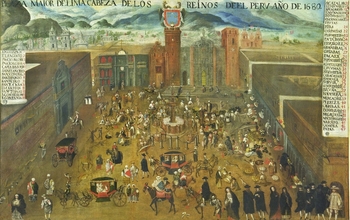
In the mid-seventeenth century, Lima's main square was officially considered the epitome of the Peruvian viceroyalty's prosperity. Authors like Bernabé Cobo, 1639, and Buenaventura de Salinas y Córdova, 1653, or paintings like the splendid Plaza Maior de Lima cabeza de los reinos del Perú año de 1680 praised its market function and its extraordinary abundance. The market's opulence and the diversity of produce available year round substantiated Lima's potency(see Figure 2).Footnote 28 Midway through the eighteenth century, it was still possible to document several key market characters in the square. First, the tenderos, vendors who occupied the shops in the portals along the outer edges of the plaza, including botoneros (button makers) (south side) and escribanos (notaries) (west side). Second, the cajoneros, who sold diverse products in movable kiosks (cajones) placed in front of the viceregal palace (north side), the archbishop's palace and the cathedral (east side). Third, the recauderas, vivanderas or abastecedoras, female vendors who sold food products, dispersed throughout the square; the mercachifles, peddlers. Finally, the negros angarilleros, a guild of black slaves who transported goods and water. The intense commercial activity associated with the plaza left an imprint on the surrounding street names: botoneros, espaderos (swordsmiths), and guitarreros (guitar makers), among others.Footnote 29
Plaza Maior de Lima. . ., anonymous painting, 1680. The list on the right hand side indicates the products available for sale in the main plaza. Lima's cathedral and the archbishop's palace are in the background. At the left side is the viceregal palace. The plaza is represented from the point of view of the Cabildo building. Museo de América, Madrid.

Three institutions with commercial and political interests regularly appear in the seventeenth- and eighteenth-century documentation related to the plaza. First, was the civic institution that represented the urban elite: the Cabildo. This was the owner of the square and the main beneficiary of the commercial activity performed there, through the annual quota paid by the asentista.Footnote 30 Second, was the Tribunal del Consulado, the rich merchant's guild that installed its seat immediately by the main plaza by the end of the sixteenth century. Third, was the viceroy and his court.
To understand the commercial role of the plaza, it is necessary to consider briefly a wider context. Lima was the concentration and distribution centre of produce harvested in diverse rural areas, but especially in its direct hinterland, which extended from Chancay, in the north, to Chilca, in the south, and to Huarochirí, to the east in the highlands. Goods were taxed upon entering the urban milieu, and so were sold at higher prices in the centre. The enormous city wall (finished 1687) controlled traffic into and out of the city at its main gates.Footnote 31 Flouting this system were illegal middlemen, the regatones. Regatones stopped farmers en route with products from their farms before arriving to the city walls, bought the products at lower prices, entered the city and then re-sold the products in the central plaza at a profit.Footnote 32 Considering its location, the main square was the opposite of the rural periphery. It was a privileged spot for supervision and control. The described system of distribution of goods in Lima was related to the Plaza Mayor model, and led to a sort of selective panoptism; much more supervision and control occurred in the central square than in the urban outskirts.
Prior to the late Bourbon reforms, two events occurred with significance for the functioning of the main plaza. First, the reorganization of the asentista system during the government of the viceroy marquis of Villagarcía (1736–45), which led to both an enormous increase in the price of the square´s rent from 300 to 4,010 pesos, and to the Cabildo gaining the responsibility of organizing the public auctions for asentista.Footnote 33 From 1736 to the end of the colonial period, the price of the plaza's toldos y asientos rose continuously (see Table 1).Footnote 34 The second event was the earthquake of 1746. The destruction of many houses and the fear of potential future quakes prompted the relocation of survivors to open spaces, like the urban periphery and the central esplanade. Many vivanderas moved outside the city walls following their public and a good part of the main square came to be occupied by non-commercial tents. A wooden chapel replacing the cathedral was also installed in the plaza. This abrupt decrease in commercial space in the centre caused the price of the alternative location of the market, the plazuela of Santa Ana, to double.Footnote 35 Immediately after the earthquake, the Cabildo decreased the annual price of the toldos y asientos (from 4010 to 1700 pesos) giving two months free to the asentista Joseph Guillermo. The Cabildo also allowed Guillermo to rent mobile kiosks along the main bridge in exchange for the space occupied by the wooden chapel in the plaza. In September 1747, the situation began to return to normal after the compulsory clearing of the main square to celebrate the proclamation of King Fernando VI. At the end of that year, Joseph Guillermo described the plaza's chaotic situation and asked for a discount. Disregarding his claim, the Cabildo held a new auction, and the same asentista obtained the rights for 1748.Footnote 36
As will be shown, the official interventions in Lima's plaza during the second half of the eighteenth century were of two kinds. First, were those which sought to maintain the Plaza Mayor model, termed here ‘habitual interventions’ which were associated with incidents related to the concentration of vendors or to the ongoing conflicts between different kinds of sellers. Second, were those manoeuvres specifically related to late Bourbon reformism that signalled a structural shift towards the Plaza de Armas model.
Habitual interventions
Since the early seventeenth century, if not before, colonial authorities supervised the market organization, probably as represented in the 1680 painting, which shows the plaza market from the visual perspective of the Cabildo’s meeting room, where products are spatially ordered (see Figure 2). However, during the government of Manuel de Amat (1761–76), several crises threatened the normal strategy of maintaining the market in order. For instance, in an edict from 1765 against the regatones, viceroy Amat denounced the constant thefts and vexations perpetuated by the regatones against the Indians who brought their goods to the central esplanade, ‘taking advantage of the multitude that gathers there’.Footnote 37 An incident from 1772, described below, further shows the situation of the square.
In 1772, as a result of an infection attributed to some meat sold in the plaza, the Cabildo carried out an inspection. Some vivanderas found out about the plan ahead of time and informed their colleagues who hid any potential evidence. To avoid similar fiascos, the Cabildo proposed a new organization of the market by rows for each kind of product (meat, vegetables, bread, charcoal, flowers, firewood, lard). This new layout would provide authorities with full visual control of the products; buyers would be able to go directly to their elected row; and pedestrians and carts would have enough space to circulate. The viceroy Amat immediately approved the harsh penalties for those who ignored the new rule.Footnote 38 This case shows the Cabildo and the viceroy working together to fight disarray in the plaza; however, there were other routine or common conflicts that incorporated more voices, a wider scenario and different solutions, like one from the late 1780s.
In December 1787, the plaza merchants with fixed shops and thus higher incomes, the tenderos and cajoneros, issued a complaint at the Tribunal del Consulado against the ‘peddlers called idlers’ (‘mercachifles transeúntes, llamados sanganos’) who sold clothes. They alleged that these itinerant competitors had settled into more permanent stalls and were selling similar products at cheaper prices, thus ruining the tenderos and cajoneros. It was not the first time that these fixed merchants had tried to expel the mercachifles: in a previous ruling, the peddlers had been forced to work five blocks away from the main square. However, after some time, they ‘returned with more strength and disorder’.Footnote 39 The solution suggested by the tenderos and cajoneros was not the same for all mercachifles, since among them ‘there were some that were not worthy of this business at all, since they had previously been alfalfa carriers or worked at other similar activities of such inferior class’. This group, the ‘low-status castes’ (castas de baja esfera) were legally forbidden from selling goods. To sustain this claim, the merchants cited the principles of the official colonial policy, referring to cases from Cadiz (Spain) and Mexico City, where similar low-class sellers had been expelled from markets. There was a second group of mercachifles that was allowed to perform commercial activities, but only with authorization and at a distance of five blocks from the central plaza. These vendors were allowed to sell garments at cheaper prices for people of lower income who were unable to pay main square prices.Footnote 40 The Tribunal del Consulado accepted the claim of the tenderos and cajoneros indicating that it would not be a problem to completely stop the activities of the ‘low-status’ mercachifles. The Tribunal also decided to expulse the legal mercachifles from the plaza, agreeing to ask the viceroy for the necessary edicts to send them to the plazuelas of the convents or to the Baratillo plazuela (see Figure 1).Footnote 41
Colonial urban space was organized according to a series of interlinked norms and its use was conditioned by multiple restrictions, particularly of the commercial variety. The legal foundation of these spatial hierarchies was part of the established colonial urban pattern. It led to the socially differentiated use of the city, but not necessarily to the isolation of social groups: it was impossible to achieve absolute segregation because the work of the ‘low-status castes’ was essential for the rest of society.Footnote 42 Despite proposing the displacement of mercachifles, the plaza merchants needed them, since they themselves were not able to supply all of the urban public, particularly its poorest members. The target was to impose functional hierarchies, translatable in concrete distances: five blocks away from the plaza according to the tenderos and cajoneros and a move to the plazuelas according to the Tribunal. A ‘low caste’ person could circulate in the plaza but not as a mercachifle. The vicissitudes of the late Bourbon project for the plaza must be understood within this broader framework.
An anomalous parade
In between the habitual interventions and the actual application of the Bourbon project in the plaza, there was a groundbreaking incident. It dates to 1773 during the government of Manuel de Amat, a modernist viceroy with military training and architectonical skills. Amat received the Royal Order of San Genaro and in honour of this achievement a simulacra of a military operation was performed: soldiers conquered ‘a fortified place with the shape of a crowned building, or double hornwork’ built over the central fountain of the main square.Footnote 43
Amat's parade broke all conventions. According to Juan Domingo Taron, the asentista de toldos y asientos, the troops remained more than three months in the plaza, halting its commercial activity, which was the main function of that public space. Even if Taron exaggerated in order to justify a discount in his payment, the testimony of a Cabildo representative confirmed the unusual situation. After listing the conditions of the asentista’s contract, the procurador general observed ‘none of them [the conditions] express, show relation to or have analogy with what is happening now; because it is completely different and distinct’.Footnote 44 Even if Juan Domingo Taron was supposed to clean the plaza and to tolerate official acts celebrated there:
the present ones are of such a different kind and so sudden that they could not be previously considered. To be honest, who in 1765 when the contract was signed would have imagined that the army of this kingdom could have arrived to the degree of perfection currently observed? Who would have believed that the army would have performed in this Plaza Mayor such extraordinary operations and the most famous of those taught in the art of war? Who would have judged that the project of disciplining volunteer men without salary but with unrelenting zeal and tenacity, and without regrets about leaving their trade for military training, could have been achieved?Footnote 45
The Cabildo partially recognized the claim of the asentista, confirming the extraordinary character of the parade. When the new contract with Taron was signed, in 1776, the price decreased from 5,325 to 5,000 pesos and the new situation was acknowledged, indicating that to continue with the previous contract the vendors would need to remain in the plaza.Footnote 46
Significantly, that same year the Drama de dos palanganas veterano y bisoño (Drama) circulated in Lima. This anonymous dialogue, attributed to the aristocrat Francisco Ruiz Cano, was officially censored. The Drama attacked the viceroy Amat and included critical references to his parade of 1773.Footnote 47 The Drama is a multilateral critique of Amat's policies. First, Ruiz Cano questioned militarization as a form of social homogenization, or in other words, as a ladder for subaltern classes. Second, the marquis warned of the danger of providing military training to blacks, mulattos and, particularly, Indians, who in 1750 had planned a revolt in Lima. Third, he criticized the despotism of the Catalan viceroy, his repressive politics and the imposition implied by the aforementioned parade.Footnote 48 These critiques show the antipathy of a local aristocrat to the novelty imposed by the Spanish military hierarchy represented by Amat and his entourage, and materialized in the new main function of the plaza. The Drama emphasized the negative economic consequences of the intervention, suggesting that ‘It made a Plaza de Armas of what previously were Armas de Plaza, which were the coins circulating in its shops that today are nowhere to be found.’Footnote 49 Punning, Ruiz Cano was suggesting that the martial use of the esplanade was erasing its long-established commercial value. The aforementioned claims of the asentista Juan Domingo Taron and the Drama are very different kinds of sources, but their coincidence confirms that the multilateral impact of the Bourbon intervention in the plaza was seriously interrupting the Plaza Mayor model.
To put Ruiz Cano's criticism towards Amat's parade in perspective, it must be remembered that two decades before, 1755, Ruiz Cano wrote another text, Júbilos de Lima (Júbilos), praising the reconstruction of the cathedral by the viceroy Manso de Velasco.Footnote 50 Júbilos is recognized as one of the initial markers of the appropriation of classicist modernism in Lima, a critical discourse against baroque.Footnote 51 These two texts (Júbilos and Drama) show the changing relations between a representative member of the urban elite and the Bourbon viceroys (an aristocrat first praising Manso de Velasco and then criticizing Amat). They also suggest the distance between ideal models and their actual application, particularly when they impacted the urban status quo. While the Júbilos defended a classicist architectonical intervention (the cathedral) the Drama attacked an urban one (the plaza) that also went against a baroque model. Even if both interventions have a certain parallelism, their actual application had different timings because of the opposition of locals like those represented by Ruiz Cano and the Cabildo. As far as we know, the stylistic modification of the cathedral did not affect the conventional social uses of that space, whereas the introduction of the Plaza de Armas model impacted the uses of the central square and, as we will see, the whole city.Footnote 52
One decade after Amat's parade, the asentista Juan Domingo Taron was still protesting against the military presence in the plaza. With the establishment of the administrative regime of the Intendencias (1784) the new authorities revised the conditions for renting the central square but made no major modifications. By then, the main plaza was not the only public space affected by military training: in 1786, the plazuela of La Merced was also accommodating the cavalry.Footnote 53
Bourbon manoeuvres
Besides Amat's parade, conflicts like those described above in the section ‘Habitual interventions’ were routine or customary, especially since their solutions sought to restore the established order: the Plaza Mayor model. Meanwhile, another set of interventions was occurring that suggested novel uses of this urban space: those directly related to Bourbon politics. Overall, the late Bourbon script for Lima was characterized by the administrative reorganization of the city, focusing on the establishment of a system of referential points and norms on how to use the city. With that target in mind, three key documents were produced: División de quarteles y barrios (1785), Reglamento de policía (1786) and Plano topográphico (1787).Footnote 54 In parallel, a new cycle of construction was initiated, with the erection of a group of urban establishments with – at least – three common features. First, these institutions concentrated functions that had previously been dispersed across different parts of the city, and therefore these projects were now larger in size. Second, these larger constructions could not be placed within the central urban grid due to their size, and so were placed in the urban periphery. Third, ideas related to public hygiene influenced the location of these new projects, reinforcing their peripheral placement. Two examples are the bullfighting arena (1768) and the General Cemetery (1808) in the northern and eastern extramural areas, respectively.Footnote 55 This late Bourbon cycle of construction also included specific manoeuvres concerning the main plaza, where, between the end of the eighteenth and beginning of nineteenth centuries it is possible to identify three important reformist interventions.
Amat's parade was anomalous but ‘only’ lasted three months. However, by the end of the century, the tendency initiated in Lima by that incident became more permanent. Neoclassical precepts were implanted in the main cities of the Spanish empire. Regarding the main plaza, the target was to liberate it for military use, turning that square into a sort of stage for permanent symbols of the crown: a Plaza de Armas, with certain attributes of a Plaza Real.Footnote 56 In Mexico City, a statue of the king was placed in the main square (installed between 1793 and 1803). Half a century before, 1739, a wooden equestrian statue of the king had already been installed on the main bridge of Lima, immediate to the plaza, but it collapsed during the earthquake of 1746 and was never replaced.Footnote 57 Despite this specific difference, both plazas were crucial spots in the late Bourbon agenda. The strategic role of Lima's main square and its imbrications with the rest of the city are evident in a quarrel between the viceroy Ambrosio O´Higgins and the Cabildo in 1799.
In March, O´Higgins ordered the vibanderas to abandon the plaza, including the portals, the corners and the immediate streets. From this time on, the central esplanade would be devoted to ‘Parade, distribution of the troop in its respective posts, monthly revision by the commissioner, doctrinal exercises of the time of militia assembly, and everything generally related to military service.’Footnote 58 Consequently, the plazuelas of Santa Ana, Inquisition, San Francisco, San Agustín, San Marcelo and San Juan de Dios were to become markets (see Figure 1). Basic products were to be distributed to each plazuela, which were to be organized in calles (streets) or filas (rows). The main plaza was cleared and its previous functions decentralized or concentrated in the periphery, following the late Bourbon script, which already had been applied in 1789 in Mexico's main square by the viceroy Revillagigedo.Footnote 59
In immediate response to O'Higgins' order, the Cabildo manifested its opposition to the reform: ‘The Cavildo considers that the local circumstances, or other insurmountable obstacles make it impossible to place in every plazuela all the necessary items to supply the neighbourhood.’Footnote 60 These representatives of Lima's elite wielded multiple rationales. First, they rejected the possibility of placing all the products normally available in the central plaza in each plazuela. Second, even if it was possible to disaggregate the market function into the plazuelas, how would they decide what kinds of foodstuffs would be assigned to each, to supply all without harming the traders? Third, if a system that solved the previous issues could be designed, how would they deal with ‘sellers not recorded in a census, and that come with potatoes, salted meat, cheese, fruits, legumes, salt, and fish from many towns of the highlands and the coast?’Footnote 61 This latter option would have required the formalization of the other entire world beyond the city walls, which was unnecessary under the Plaza Mayor model.
More than refurbishing a square, the viceroy wanted to replace a form of administrative and commercial organization that since early colonial times had guaranteed the diversity of products within the city. The Cabildo warned that under the system of dispersed markets any supply disruption related to unexpected circumstances in production places or in transport to the city would be critical. If profits diminished because of this new spatial distribution, the sellers would certainly change trades, leaving the city unsupplied. Consumers would also be affected, particularly homeowners ‘because the houses would lose the servants for a whole morning, while they search from plazuela to plazuela, and from section to section for what cannot be found in a determined place’.Footnote 62 True or not – the Cabildo members added – this was ‘an excellent excuse to wander around the entire morning, at the same time that the houses remained without cooks and without the food to be cooked until very late in the day.’Footnote 63 Moreover, the increase of the public in the plazuelas not only caused ‘congestion in the streets, but also, the impossibility of reaching the church doors at the centre of the plazuelas, like San Francisco, to which is added the throng of churchgoers, without space to park the carriages.’ This would result in religious irreverence ‘disturbing the divine services, with the noise of recauderas, cooks, and the common people, with shouting and perhaps verbal obscenities, and in a disorder that our religion detests, which does not happen in the Plaza Mayor because of the distance to the church door’.Footnote 64 According to the Cabildo, the project proposed by O'Higgins not only affected the organization of Lima's commercial system, but also the domestic and religious realms.
Concluding their defence of the Plaza Mayor model, the Cabildo members added a final detail: the plazuelas legally belonged to the convents. If the relocation suggested by the viceroy was carried out, the Cabildo would lose its revenues from the rent of the toldos y asientos. This economic privilege should not be interrupted by the military exercises that ‘have been always performed in the Inquisition plazuela, nor by the parade of the regiment that has been organized in the barracks without using plazuelas, or even less, the Plaza Mayor’. Recognizing a long-term historical trend, the Cabildo members observed that the already established model had actually shaped Lima, setting the price of the properties immediate to the plaza:
This constant gathering [of people], so long-standing and of such great size, in the Plaza Mayor has made attractive and of higher value the houses immediately next to the shops, and stores, that are consequently taxed; and the sale of the merchants’ shops and riverside kiosks is no less conducive and also of interest to the properties [of the Cabildo].Footnote 65
In sum, the Cabildo explained how the militarization of the central plaza and the displacement of the market would radically affect several aspects of the whole urban system.
A week later, O'Higgins accepted the request of the Cabildo, decreeing the ‘restitution of vibanderas and vibanderos to the Plaza Mayor.’Footnote 66 The reform was limited to leaving an open area for the transit of carts, horses and pedestrians, reserving part of the square for the exclusive selling of meat and fish ‘with the adequate cleanliness, that the public demands’.Footnote 67 This hasty response from the viceroy marked a victory for the Cabildo. However, five years later, a similar dispute was raised.
In 1804, as part of his claim for lowering the rent for the toldos y asientos, the asentista Mariano Terón observed that
Regarding its products, the plaza is not the same as it was before, its area has been decreased with the excuse of cleaning it, and forming rows, not only have the recauderos and recauderas left and set up shops in other streets, but also a good part of the plaza has been reduced to a livestock corral. The burden imposed on the recuaderas to vacate their asientos, and to clear the area in the afternoon, has had no small influence on the abandonment of the square, it has obliged them to spend money to transport their goods and to rent a room near the plaza as is happening with those who have stayed there.Footnote 68
Terón is describing the reduction of the central square's commercial area and its partial clearing leading to a Plaza de Armas. This alteration led to higher expenses for the food vendors who needed to pay for lodging and storage for their goods. Even if the request of the asentista was ignored by the Cabildo, a document on the plazuela Santa Ana shows that his position regarding the main square was not unique. In a report to the Cabildo, the procurador general, Francisco Arias, coincided with Terón in his critiques of the modifications to the central square, recommending that those reforms not be applied in Santa Ana:
to the detriment of the city's income, the public, and the miserable vendors, was the project to clean up the Plaza Mayor. This was where 10,000 or more pesos were wasted in the stone pavings and fillings that led to the disturbance and rage of the public. This was where [they] wanted to characterize the Plaza Mayor as Plaza de Armas, and where in spite of the protests against the lack of abundant and timely supply, and the disorder of the servants, the system of keeping the Plaza empty was maintained, and when it was impossible to ignore the cries of the public it was decided to build a ridiculous palisade surrounded by ropes, expensive for the city and incapable of lasting long, only adequate for the square of an Indian town: the centre of which was reduced to a livestock corral: this benefited the people in charge of distributing the rows and asientos [in the plaza], and by general rule, from this point forward, the system of Plaza de Armas was established as if it were the square of Callao, which is cleared each afternoon, and left empty the entire night.Footnote 69
This document has three significant features. First, the terms of the discussion (Plaza Mayor, Plaza de Armas) are explicit; it is the first time that each model is mentioned by its name in an official document (Ruiz Cano did it before with the Plaza de Armas but it was an anonymous text). Second, the comparison with the ‘Indian town’ is not accidental, and together with the explicit terminology already mentioned, suggests the terms of the debate. The Cabildo is defending a proposal to maintain the status quo, the Plaza Mayor model, and was probably already being criticized (by the viceroy) for its conservative attitude. The procurador general defends his side by comparing the partial results of the new model with something that everyone would certainly consider backwards: an Indian town. Third, this document shows the affinity between the asentistas, the author of the Drama, and the Cabildo, including the procurador general. All of these local characters agreed in their criticism of the compulsory militarization of the plaza during the government of the viceroy Gabriel de Avilés (1801–06). This overwhelming reaction against the Plaza de Armas model suggests the significance of the location of the market for the city administration.
Even if viceroys changed, the insistence on shifting urban models remained. Three decades after Amat's government, the viceroy Abascal (1806–16) continued to support the establishment of the Plaza de Armas, albeit in a slightly different form. The first indication of Abascal's intentions came from the asentista, who, in February 1807, requested a discount in his annual payment considering the damages caused by the ‘removal of the vendors to other plazuelas’.Footnote 70 In November 1808, Abascal informed the Cabildo that ‘regarding the extraordinary circumstances that have happened, I have abandoned the idea of facilitating the formation of a market [Plaza para los Abastos Públicos] in a comfortable and adequate space’.Footnote 71 With ‘extraordinary circumstances’, the viceroy was probably referring to the patriotic insurrections on the continent. With ‘Plaza de Abastos Públicos’, he was proposing a large market in a specific building outside the main square. That same year, Abascal had inaugurated the General Cemetery, a project that followed this same urban logic: concentrating a function in a huge peripheral enclosure. Abascal was going beyond his predecessors; he did not want to distribute the market in several plazuelas, like O'Higgins, but to concentrate and relocate it.Footnote 72 In response, the Cabildo declared that the public was ‘incapable of adjusting to the lack of supply in the main square’.Footnote 73 Finally, Abascal added that he was trying to bring the vendors back to the central plaza. This comeback included some partial modifications. First, the internal organization of the market was adjusted so that the supplies ‘do not cause confusion and leave free the centre, forming rectilinear rows around the edges [of the square]’ to facilitate customer circulation as well as cleaning. Second, the recauderas would be placed in cajones as the viceroy observed to be happening in Cádiz and Madrid.Footnote 74
Several sources document the official reinstatement of the market in the main plaza during the Abascal government.Footnote 75 Moreover, the once expelled mercachifles (1787) were returning with momentum to the centre. Between 1815 and 1818, these peddlers presented several requests to formalize their presence in the coveted central space. Finally, they were officially accepted through the creation of sanctioned ‘tendejones portatiles’ (portable small shops).Footnote 76 Together with the constant increase in the price of the central square (see Table 1), all of these disputes indicate its renewed appeal at the end of the colonial era, and thus the endurance of the Plaza Mayor model. However, it was not the only market: besides the one in Santa Anta, there were others in the Inquisition and Baratillo plazuelas (see Figure 1).Footnote 77
As patriotic riots spread across the Americas, the capital of the Peruvian viceroyalty acquired a military hue. Lima quartered numerous troops and became a strong royalist bastion. Consequently, spaces like the Inquisition plazuela were adapted and its main public fountain was retired.Footnote 78 This situation also impacted the central square. In 1818, the asentista asked the Cabildo for a discount due to the ‘space occupied by the troops'. Disregarding this request, the Cabildo held a new auction, and the new asentista, José de Sarria, paid 6,100 pesos. In 1823, during the transition to the republican regime, Sarria paid 10,000 pesos (see Table 1).Footnote 79
Conclusions
The constant magnetism of the central square was the corollary of a city planned under the Plaza Mayor model. During the eighteenth century, many of the plaza's early colonial functions were still in use, even growing in scale: Lima's population had notably increased by this time, but the area occupied by the plaza remained the same, thus resulting in an overcrowded and ever more valuable space. This scenario was ideal for the revival of conflicts related to its administration. Facing these recurrent frictions, the viceroy and the Cabildo intervened, updating old rules of use. Examples included the proposal for the internal reorganization of the market (1772) and the expulsion of the mercachifles (1787). On both occasions, the plaza retained its main function: market. The arrival of the new Bourbon political proposal from the metropolis confronted this habitual function, and thus the Plaza Mayor model. These reforms were materialized in urban interventions and construction projects whose mere presence contributed to the complete alteration of the city of Lima, proposing a whole new urban type.
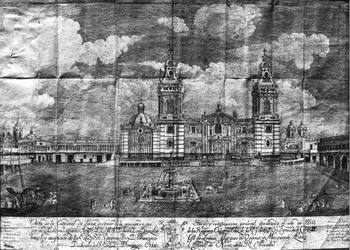
For urban Lima, the late Bourbon reforms must be characterized by their presences (the construction projects and relocations actually performed) and their absences (the unfinished or unsuccessful projects). During colonial times, the transformation from Plaza Mayor to Plaza de Armas was incomplete, but this case is as informative as the successfully finished extramural cemetery: both of them clearly show the implementation of a new urban centrality reinforced by an impressive cycle of construction. Unlike the early incidents (1772, 1787) that were related to frequent users and quotidian disputes about the plaza, the later conflicts (1799, 1804, 1808) implied a new kind of confrontation between two levels of colonial authorities: the viceroy and his entourage following orders from Spain versus the Cabildo, the local elite. This basic conflict was manifested by a volatile topic: the modification of the main and most profitable function of the plaza. The shift of spatial models is also traceable in graphic representations of the main square that had earlier been shown as full of vendors (as in Figure 2) but later was represented as an empty – or almost empty – esplanade used for martial activities. Not surprisingly, this visual tendency began during Amat's regime (1775) and is patent in an engraving from 1805 (see Figure 3).Footnote 80 In parallel, and even prior to any actual urban changes, the graphic representations of the plaza evidence an official intention, a new urban model, with novel aesthetic and political concerns.Footnote 81
Vista de la Catedral de Lima, despues de la ereccion de sus Torres y redificaccion general finalizada el año de 1801. . ., engraving by J.M. Montes de Oca, in J.M. Bermúdez, Fama postuma del Excelentísimo é Ilustrísimo señor doctor Don Juan Domingo Gonzalez de la Reguera. . .Dignísimo XVI. Arzobispo de los Reyes. . .por el mismo autor de la Oración Fúnebre (Lima, 1805).

While the Bourbon urban reforms were only partially applied during the colonial period, some of their features continued to exert influence into republican times. As in Mexico, the independent Peruvian regime assumed some features of the Bourbon programme.Footnote 82 In Lima, the link was the regime of the Argentinian general José de San Martín who presented the Peruvian declaration of independence from Spain in 1821. While extirpating all colonial symbols from Lima's public space, San Martín also put into practice some of the plans of the later viceroys. His decree of June 1822 described the situation of the urban markets. First, it did not mention the central square as a marketplace, instead locating the market in the plazuela of the extinct Inquisition. Second, it issued notification that the food sellers located in the Inquisition plazuela would be distributed in 100 ‘mobile kiosks’ to be placed in the plazuelas of Santa Ana (30), San Agustín (20), Baratillo (20), San Francisco (15), and San Juan de Dios (15) (see Figure 1). Third, this modification was only a temporary plan, while a more major reform was carried out: ‘While the project of a new market corresponding in its utility and magnificence to the ideas of the government and the people's necessities is carried out.’ San Martín was actually following viceroy O'Higgins’ proposal (1799), relocating the market function to different parts of the city.Footnote 83
The collapse of the colonial regime occasioned the extinction of the Cabildo, which facilitated direct state intervention in Lima's urban affairs. The subordination of the church to the new republican state eased these changes. Many ecclesiastical urban properties became national possessions, leaving room for the reforms: it is not accidental that some of the first republican institutions, like the National Library, the Parliament and the National Museum occupied former religious properties. By the late 1840s, when guano exports began to impact the national budget, a new cycle of construction commenced, and the interest in concentrating sellers in an enclosed space outside the plaza was renewed. The monastery of La Concepción was partially expropriated by the government, dissected and modified to house the central market of Lima (1852). In this manner, viceroy Abascal's proposal (1808) was finally implemented: the market function was concentrated in an enormous peripheral structure and the Plaza Mayor model was left behind. This huge market was part of a series of buildings and regulations that transformed Lima, resulting in a different kind of urban centrality.Footnote 84