Introduction
Argentina's economic failure has attracted much attention from scholars of economics and history. Attempts have been made to discover when and why a country rich in natural resources, which for some time had enjoyed a similar level of development to that of other countries, began to fall behind, reaching the situation that can be observed today. Traditionally the evolution of Argentina's economy has been considered alongside that of Australia and Canada, two other countries of recent settlement which shared with Argentina a mode of development that was based on the exploitation of natural resources and the export of primary products.Footnote 1
A study of Argentine historiography leads to the conclusion that there is no clear agreement among the leading authors regarding the precise moment at which the country began to decline in relative terms. Various dates are put forward with 1913, 1929 and 1950 being suggested by Alan Taylor, Carlos Díaz Alejandro and Roberto Cortés Conde respectively.
Debate about the period in which Argentina began to fall behind leads to a search for the factors which lie behind this tendency. In fact, there is a greater degree of agreement in the case of this second debate. Authors such as Guido di Tella and Manuel Zymelman, Carl Solberg, Timothy Duncan and John Fogarty, Guido di Tella and D. C. M. Platt, Carlos Díaz Alejandro, Alan Taylor and Roberto Cortés Conde have all highlighted the role of the institutional framework and, more specifically, that of the economic policies implemented by successive governments, as the factors behind Argentina's economic failure.Footnote 2
However, while all these studies address the causes of Argentina's economic failure, they do not attempt any formal statistical analysis based on the long-term evolution of Argentina's GDP per capita. This is partly due to the fact that the necessary information was not available until 1996 and, despite the fact that while the causes of the situation were considered, no attempt was made to quantify them or to measure the impact that they had.Footnote 3 This paper therefore attempts to review both these debates concerning the causes of Argentina's economic decline, the timing and the causes, but in particular the second. It takes newly available information into account and employs appropriate techniques for the treatment of time series data.
The use of a more technical and formal system of analysis based on the most recent series for GDP per capita for Argentina, Australia and Canada for the period from 1875 to 2000 produces results which suggest that the process under which Argentina was rapidly catching up with Australia and Canada came to a halt at the end of the nineteenth century. The differentials between Argentina and the others remained more or less stable until approximately the late 1930s. Argentina's relative decline then became more accentuated, and after 1974 there was a period when Argentina and the other two countries diverged economically.Footnote 4
This paper attempts, taking a long term perspective, to examine the results of the main economic policies implemented and consider them as a significant element of the institutional framework in order to form an idea of their influence on the nation's economy. The task is far from simple as, although the new growth theory provides us with a clearer analytical structure with which to integrate the institutional context into the economic analysis, the difficulty lies in how to measure it at an empirical level. However, since this paper focuses exclusively on the macroeconomic dimension of the institutional framework, it is possible to make this measurement, albeit imperfectly, using a series of variables which reflect the nature of the policies implemented. How, then, can we define and measure the institutional framework in the particular case of Argentina?
In this paper we use a ‘reduced index of economic freedom’ (abbreviated here as RIEF), based on the index created and published by the Fraser Institute since 1996, in an attempt to interpret the path followed by Argentina in comparison with Australia and Canada.Footnote 5 This index consists of a series of macroeconomic variables, including the relative weight of public consumption compared with total consumption, the real rate of depreciation of the currency, the level of nominal protection, and the difference between the official and the market rates of exchange. It is calculated using principal components techniques. First, an index for Argentina alone was constructed in order to check its appropriateness, and then a relative index for Argentina versus Australia on the one hand and for Argentina versus Canada on the other were calculated. The corresponding relative reduced indices of economic freedom for Australia and Canada can then be compared with the situation for Argentina.
The cointegration analyses that were undertaken in order to compare the index of economic freedom for Argentina with Australia and Canada, and the respective relative series of Argentine GDP per capita indicate that this index may provide a possible explanation for the relative economic evolution of Argentina.
Historiography of Argentina's Economic Growth
Argentina is a nation that is emerging from a deep economic crisis in the context of stagnation and recession that has persisted to a greater or lesser extent for decades. This contrasts sharply with the golden years of intense growth which Argentina experienced at the end of the nineteenth and the beginning of the twentieth centuries. At this time, when the nation boasted one of the highest rates of growth of per capita income, no-one would have dared to question its growth potential. Indeed Argentina's economic evolution during that period could be compared with that of Australia and Canada.
This comparison between these three countries is valid because, at least until the First World War, they were typical examples of areas of recent settlement and had experienced a spectacular rate of development.Footnote 6 Ezequiel Gallo justifies the comparative analysis between Argentina and Australia, arguing that both countries were transformed under British control, exporting primary materials and importing manufactured goods. Both enjoyed abundant natural resources, were only partially populated, and had large areas of land, as well as being distant from the Old World.Footnote 7 Tim Duncan and John Fogarty likewise consider that the similarities between Argentina and Australia were evident from the 1880s, a decade of explosive growth, up to the moment when Argentina adopted its policies of Import Substitution Industrialisation (ISI). During this period from 1880 to 1930, in their view, Argentina and Australia were evolving on a parallel path even in terms of their economic structures.Footnote 8 In the same way, the experience of Canada was also parallel to that of Argentina, despite its proximity to and its close relations with the United States.Footnote 9 Up to the beginning of the twentieth century Argentina and Canada were characterised by their abundant land endowment in relation to capital and labour. Also, in all three cases, the development of a capitalist economy integrated into world markets was achieved through exports of primary products, massive immigration and foreign capital inflows, mainly from Europe.Footnote 10
Apart from these common characteristics, there are elements of contrast between these three countries which are emphasised by different authors to account for the distinct path followed by Argentina from a specific point when, in their view, the country began to lag. For Taylor this is located in 1913, for Díaz Alejandro in 1929, and in the opinion of Cortés Conde it occurred in 1950.
How can Argentina's economic failure and its inability to continue closing the gap with Canada and Australia be explained? The origins of Argentina's economic failure have received much attention. According to di Tella and Zymelman, as well as Aldo Ferrer, the closing of the frontier, which was already evident in 1914, was the greatest difference between Argentina and other areas of recent settlement, insofar as alternatives that might compensate for the end of territorial expansion were not sought.Footnote 11 A pattern of growth which depended on the occupation of new lands involved limitations that could only be overcome through the redirection of investment towards the industrial sector. Argentina therefore ought to have adopted protectionist economic policies, in contrast with the free-trade policies which were implemented until the 1930s.Footnote 12
For Carl Solberg the fundamental difference between Argentina and Canada lay in the policy of land distribution: in Canada the result was a large number of small farmers, while in Argentina there was a small number of large landowners. This situation would have resulted in a less intense process of capitalisation in Argentina's agricultural sector, leading to lower rates of productivity and, since this was the leading sector, reduced possibilities of economic growth.Footnote 13 Díaz Alejandro, however, moderates this opinion, claiming that despite the poor distribution of land in Argentina, high growth rates were achieved until the Great Depression, when the loss of markets and the subsequent worsening of the terms of trade brought the process of growth to a halt. In his opinion, the move towards protectionist policies to reactivate the economy which occurred in the wake of the 1929 crisis, and more especially during the Perón years, rather than solving the problem, served only to shunt the country into a situation of continuous relative stagnation.Footnote 14
The contrast between Australia's stable and flexible administrations and the poor government suffered by Argentina is, according to Duncan and Fogarty, the key factor.Footnote 15 For Platt and di Tella, Argentina's political traditions and the distinctive origins of immigrants to Argentina, compared with Australia, were to blame.Footnote 16 The latter factor is also mentioned by Taylor, while Díaz Alejandro goes further in stating that immigration policies, which were more restrictive in Australia, ought to have led to increased productivity there as a result of the relative scarcity of labour.Footnote 17
The colonial legacy is also seen as one of the causes of Argentina's backwardness. It is considered to have given birth to a set of practices, institutions and customs that were inappropriate for the formation of an economically dynamic, modern society and different from those in place in other regions of recent settlement. The origins of Argentina's backwardness, according to this interpretation, which is prevalent in the Anglophone literature, go back to the nineteenth century.Footnote 18
Alan Taylor, in an original piece of research, points out that Argentina's relative economic failure, which he dates to the period after 1913, can be explained by the combination of higher dependency ratios and the late demographic transition that the country experienced in comparison with Australia and Canada.Footnote 19 This situation may have held back capital formation in Argentina – and consequently the country's economic growth – to the extent that it fell behind Australia and Canada. Obviously, this low savings rate and the fact that Argentina was dependent on foreign capital meant that the situation grew worse in the wake of the First World War when the flow of capital from abroad slowed down.Footnote 20 Nevertheless, this vision of demographic dependence has been criticised by those who see the institutional framework and official policies as the reasons behind Argentina's traditionally low savings rate.Footnote 21
Also writing from this perspective, Cortés Conde highlights the prevailing institutional framework, which he views as ideal for the creation of a rent-seeking society and which led to a poor distribution of property rights, as a cause of the decline and relative backwardness of the nation, a situation which he argues became clear after 1950. The same author also highlights the negative impact of inadequate economic policies after the First World War, which resulted from this institutional context and which were characterised by corporativism.Footnote 22 Moreover, Cortés Conde notes that in the 1920s Argentina began to adopt a policy of ISI, in contrast to Canada's policy of desarrollo hacia afuera.Footnote 23 Taylor agrees in pointing out that capital accumulation became increasingly difficult after the 1930s due to the high relative price of capital goods (which were mostly imported), the result of the ISI policies that were being implemented. Multiple exchange rates, the black market for foreign currency, the depreciation of the peso, and high import tariffs were the factors behind the relatively high price of capital goods.Footnote 24 The lower rate of capital intensity would explain Argentina's lower labour productivity in comparison with Australia and Canada and consequently, therefore, the lower rates of growth there. Thus the policy mix that was implemented in Argentina was, in the final analysis, responsible for its historic economic backwardness.
These ideas are corroborated empirically by the work of Mundlak, Cavallo and Doménech who, using a structural model for Argentina's economy between 1913 and 1984, show how more appropriate economic policies would have meant that Argentina's evolution after 1929 could have followed a similar path to that of Australia and Canada. Such policies would have involved, according to these authors, opening up the economy and eliminating distortions. In this way the country might have exploited its comparative advantages, which would have made higher growth rates possible.Footnote 25
To summarise this brief review of the historiography, it can be stated that, leaving aside other factors which are difficult to quantify since they are by nature more qualitative, Argentina's economy has been characterised by institutional weakness and the implementation of inappropriate economic policies. The causes of its relative backwardness can be attributed to these factors.Footnote 26
The First Debate: When Did the Gap Begin to Open?
When did Argentina begin to trail behind Australia and Canada? As noted already, Taylor argues that the country was capable of reducing the gap until 1913, Díaz Alejandro puts the turning point at 1929, and Cortés Conde even locates it as late as 1950. If we take the cross-section data used by these authors and try to analyse the process of convergence in terms of neoclassical economic theory, it is possible that we might determine which date marks the beginning of Argentina's relative decline.Footnote 27 However, given that processes of convergence are of a long-term nature, cross-section data are of little use in such studies, especially here, where there are only three countries at issue. Therefore, following the ideas and methodology proposed by David Greasley and Les Oxley, this paper will use time series data to establish the date at which Argentina's growth path separated from those of Australia and Canada to enable us to observe the characteristics of the process of convergence over time.Footnote 28
Fortunately, we can now use new and very extensive GDP per capita series prepared by Cortés Conde and Maddison, which are comparable from very early dates. They permit the use of an empirical approach based on techniques appropriate to time series data. It was decided to use Maddison's series in this study because they are the most widely used in historical research, though their use is not unproblematic since they are expressed in relative constant prices in 1990 US dollars, a benchmark which is very distant from our starting year. In order to mitigate this problem we have used purchasing power parity adjusted per capita GDP expressed in 1913 US relative prices for the period 1875–1939, and 1980 US relative prices for the period 1940–2000. The levels of real GDP per capita for 1913 and 1980 come from the work of Leandro Prados de la Escosura.Footnote 29 The volume indices used to project these benchmarks backwards and forwards for the whole period are taken from Maddison, except for the period between 1875 and 1935 in Argentina, for which we used Cortés Conde and Harriague's GDP reconstruction.Footnote 30 It should noted that their reconstruction has been criticised by Della Paolera and Taylor (2003), who re-estimated the historical series for Argentine GDP.Footnote 31 For this reason this paper also considers these new estimates, making the same adjustment as that explained above.Footnote 32 However, as will become clear later in the paper, the results obtained do not differ too much, whether they are based on Maddison or on the alternative series. For this reason the results obtained are presented using Maddison's data. Obviously, as this is a long-run analysis it focuses on the trends in the series, so the possible changes in levels that arise from the adjustments made by other authors have no influence at all. However, they can be used to check the robustness of the analysis.
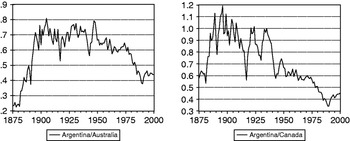
The relative performance of Argentina in terms of GDP per capita compared with Australia and Canada is illustrated in the graphs that follow.
In the case of the comparison with Australia, despite the fact that Argentina never matched its levels of GDP per capita, there was a rapid closing of the gap between the two countries until 1899. Thereafter Argentina's relative position deteriorated marginally until 1945, after which the gap widened further. This trend became more evident after 1974, after which the differences were exacerbated.
We can also note that after 1896 the rhythm of growth which approximated levels in Argentina to Canada's began to slacken, though as can be observed in Figure 1, between this year and 1936 there were times when Argentina's GDP per capita overtook that of Canada.Footnote 33 The year 1974 marks the point at which divergence became a reality as much in the comparison with Canada, as with Australia.Footnote 34 This leads to the conclusion that the process of Argentine divergence began in the late nineteenth century, significantly before the dates suggested in the historiography.
Evolution of the relative series for Argentina′s GDP per capita compared with Australia and Canada, 1875–2000 (relative values).
Source: Maddison, La economía mundial, 1820–1992: análisis estadísticas (Paris, 1997); The World Economy.

In the following section, I try to address the questions which arise as to why Argentina never achieved Australia's levels of per capita GDP, especially since it was able to overtake Canada, and why it was unable to maintain this relative position.
The Second Debate: The Causes of Argentina's Failure
As noted in the review of the historiography, various explanations for Argentina's failure have been advanced. These explanations involve diverse aspects of the institutional framework, such as the way in which land was distributed, the origin of immigrants, the colonial legacy, and the type of policies that were implemented.
Without dismissing these earlier interpretations, this paper concentrates on the role of government policies in the institutional framework, consistent with the most recent theories of economic growth that employ neoclassical assumptions. More specifically, this argument is found in the theory of endogenous growth, which states that a country will grow and maintain its relative position when its institutional framework and economic policies promote innovation and investment in physical and human capital.Footnote 35 Such theories highlight the importance of the legal framework, security for property rights, respect for contracts, the stability of prices and the monetary system, free trade, open markets, and a low level of government intervention as the keys to economic progress.Footnote 36
A nation's institutional framework should thus be considered as an underlying factor when studying growth. In reality, the most significant institutions in terms of stimulating growth are the regulations which control the activity of the economic agents, the legal system, the efficiency and transparency of public administration, social values, and the macroeconomic policies in place. In particular, the macroeconomic policies implemented by a government constitute an important part of the institutional framework since they provide the rules of the game which have to be obeyed by economic agents as they invest, produce and consume. It is generally accepted that the maintenance of macroeconomic distortions over the long term will have a negative effect on growth. There is a problem, however, at the empirical level, since to summarise such distortions and measure their impact on growth is not a straightforward task.
The Construction of an Index of Economic Freedom
Since the beginning of the 1990s, the set of incentives which conditions the behaviour of the economic agents in market economies has been investigated with a view to obtaining quantitative indicators of economic freedom. The Fraser Institute, in successive versions of Economic Freedom of the World, has worked towards the construction of an index of economic freedom based on objective components which reflect the presence or absence of economic freedom. It includes 21 indicators which reflect the coherence of institutional agreements and economic policies.Footnote 37 This index, while not being directly connected with the concepts put forward in the new growth theory, may serve as a bridge between these concepts and the empirical data, given that it includes most of the components highlighted in the theory as determinants of a country's growth.
Gwartney and Lawson, the creators of this index, observe that institutions and policies are compatible with economic freedom when they provide an appropriate infrastructure for voluntary exchange, freedom to compete, and protection for people and property. They add that governments should limit their scope of action and focus on their main task, namely to protect private property and guarantee the enforcement of contracts. In contrast, economic freedom would decrease if the government interfered too much in economic matters, increased its expenditure, and over-regulated or imposed excessive taxes on the economy.Footnote 38
Bringing together these ideas, the index of economic freedom calculated by the Fraser Institute outlines five broad areas: the size of government; the legal structure and security of property rights; access to sound money; freedom to trade with foreign countries; and the regulation of credit, labour and business.
This index serves as a guide here in order to clarify how the institutional framework, or more precisely, an important part of this framework, affected the relative performance of the Argentine economy. However, due to problems of measurement and the lack of statistical information, this paper uses a rather less ambitious index. Although this may be considered, a reduced version, it takes into account the most significant part of the set of economic policies that were being implemented at each particular point in time.Footnote 39 In other words, this study will not include the parts of the index which refer to the legal structure and security of property rights, or the regulation of credit, labour and business.Footnote 40 The index calculated here is therefore closer to the initial version constructed by Gwartney and Lawson which did not include these variables.Footnote 41
The elements which make up the ‘reduced index of economic freedom’ (henceforth abbreviated as RIEF) that is calculated here include, first, public consumption (Gi) as a proportion of total consumption (Gi/(Gi+Ci)), where Ci represents private consumption. This variable attempts to cover the size of government despite the fact that the Fraser Institute's index includes other items such as transfers and subsidies, state-owned companies and the highest marginal tax rate. This historical information is not available in the case of Argentina. The assumption is that when government spending increases relative to individual spending, decisions taken by the government replace personal choice, and economic freedom decreases.Footnote 42 Second, the index includes the ‘depreciation in the real value of money’ (Infl/100+Infl) where Infl is the percentage rate of inflation. This variable attempts to represent access to sound money in the Gwartney and Lawson index and can be interpreted in the same way. A high rate of inflation implies an absence of sound money and reduces the profits derived from commerce. Moreover, high inflation rates distort relative prices and alter the fundamental terms of long-term contracts, leading to decreased economic freedom.Footnote 43
Weighted nominal protection (Tariff), measured as the proportion of customs income to the total value of imports and the deviation of the official exchange rate from the market rate (the logarithmic difference), which is referred to here as ‘black market’ (Black), are two variables which are regarded as representative of the freedom to trade with foreigners. Obviously, international trade is positive since it provides an important channel for the transfer of technology and allows the country to exploit its comparative advantages, thus stimulating a rise in economic growth and standards of living. In contrast, the imposition of tariffs clearly restrict international trade and therefore economic freedom and growth. Exchange controls and the related ‘black market’ problems, insofar as they reduce the convertibility of money, hold back trade.Footnote 44
As noted in the introduction, the question of macroeconomic distortions in Argentina's history has not been addressed from an empirical angle. Nonetheless, there are two studies worth noting, which consider a sample of Latin American countries, in the work of José de Gregorio in 1992 and Alan Taylor in 1998, in which the variables that are listed in this paper are considered in one way or another.Footnote 45 De Gregorio shows how the level and variability of inflation has a negative effect on growth by restricting the rate of investment. Something akin occurs with public spending which, through the crowding out effect that it has on private investment, has a negative impact on growth. Taylor's work also shows how the problems of a black market for foreign exchange, high public spending, inflation, and high tariffs led to an increase in the relative prices of capital goods in Latin America from the 1930s onwards, generating negative effects on accumulation and investment and, in turn, on growth in the region. These studies support our choice of variables as components of the index of economic freedom.
Once the components of the index have been selected, the next step is to establish how to incorporate them. Unfortunately, economic theory does not specify a model for the construction of indices of economic freedom and, as a result, the principal components method is frequently used in this type of study. Principal components analysis assigns weights on the basis of the distributions and interrelations between the various components but has its own limitations and is the object of criticisms. Some critics consider that it fails to reflect a conceptual link between the theory behind the selection of elements and the index itself. Others observe that the results are sensitive to the scale of measurement of the different variables under consideration and highlight the ambiguity involved in the interpretation of the results. It is also argued that this methodological approach assigns lower weights to variables which are highly correlated with others.Footnote 46
While acknowledging the problems involved with the proposed method, this article adopts the principal components method to construct the RIEF with the view that these limitations are minimal for our analytical purposes. On the one hand, as previously noted, there is no underlying economic theory which deals with the calculation of an index of economic freedom and, therefore, principal components analysis cannot be in contradiction with such a theory. On the other hand, the variables have been standardised with the object of minimising the problem of sensitivity to the scale of measurement. Additionally, in order to avoid the problem of ambiguity in the interpretation of the results obtained, an additional analysis will be carried out later to verify which are the most important variables during each period (see Appendices 1 and 2). Finally, the last of these criticisms, which refers to problems caused by high levels of correlation between the variables, is also minimised by considering the correlation matrix. An observation of this matrix shows that the correlations are high enough to justify the use of principal components methodology, but that they are not so high that they create a problem in this context (see Table A1.1 in Appendix 1).
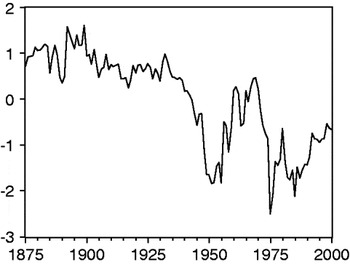
The results obtained from the application of the methodology described are presented in Table 1. The variables under study have positive weightings in the first component. This indicates that they are inversely associated with economic freedom.Footnote 47 Each of them has subsequently been multiplied by −1 in order to obtain the components of the ‘reduced index of economic freedom’ (RIEF). Finally, the RIEF has been obtained as a linear combination of each of these variables, where the values assigned by factorial analysis for each component as a proportion of its total value have been used as the respective weightings.Footnote 48 The results of the principal components analysis and the graph of the index obtained are as follows:
Reduced Index of Economic Freedom in Argentina, 1875–2000 (normalised data)Footnote 49.

Principal Components Analysis to obtain the RIEF

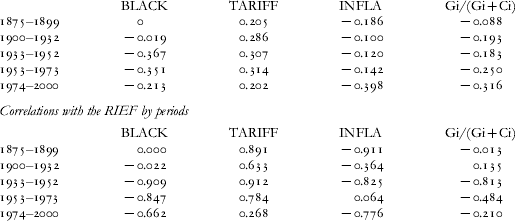
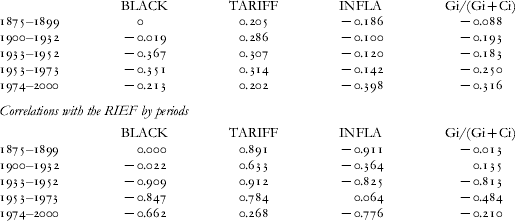
DoesFootnote 49 the evolution of the index correspond with the real historical facts of the Argentine economy? Looking at the RIEF, we can first observe a period from 1875 until the end of the 1890s, during which the index increased. This was a period with few macroeconomic distortions, despite the expansionary nature of the monetary and fiscal policies in place, as shown in the high values of the RIEF. During this period exports provided a very important source of income and foreign capital entered the country, attracted by the high level of returns that were available. This made it possible to implement expansionary spending policies which, together with the high level of openness typical of the laissez faire policy that was then dominant, would explain the high level of current account deficits as well as the enormous increase in public expenditure.Footnote 50 Monetary policy was also expansionary. Although the country adhered to the Gold Standard between 1861 and 1876 and in 1883–1884, convertibility was suspended in 1885 and it did not return until the period between 1899 and 1914. This situation allowed some flexibility as far as the issue of money was concerned.Footnote 51 However, it is clear that during the periods outside the Gold Standard, Argentinian governments made efforts not to stray too far from the rules of the game, with the result that the value of the peso remained fairly stable.Footnote 52 All of these facts concord with the results obtained in Appendix 1, in which we can see that Infla and Tariff are the variables with the highest levels of correlation and the greatest impact in this period. The former reflects the consequences of the monetary and fiscal policies implemented and has negative effects, while the fact that Tariff is positive is consistent with the prevailing free trade philosophy.
This phase was interrupted by the Baring Crisis which can be explained, according to della Paolera and Taylor, in terms of the conflict between a high fiscal deficit, the impossibility of maintaining a fixed exchange rate, and a poorly regulated banking system.Footnote 53 According to these authors, the lack of co-ordination between monetary and fiscal policy was the factor which, in the final analysis, caused the crisis and led to the collapse of the banking system.Footnote 54 Other interpretations, such as that of Roberto Cortés Conde, support this idea, highlighting the fact that the crisis was caused by internal factors rather than external causes connected with balance of payments problems. Cortés Conde insists that while the government intervened to maintain an undervalued exchange rate due to its fiscal requirements, there was an enormous expansion of the money supply and the public bought foreign assets while borrowing in the local currency.Footnote 55 This situation caused a massive outflow of gold, culminating in the 1890 crisis. In view of this situation it is logical to observe that there was a decline in the RIEF between 1889 and 1891.
The turn of the century signalled the beginning of a period which lasted until the middle of the 1930s and in which, despite the expansionary nature of fiscal policy, a more restrictive monetary policy was adopted.Footnote 56 For this reason we see that Gi/(Gi+Ci) is the variable with the greatest negative impact on the RIEF in this period, and the reason why the index fell at times in comparison with the earlier period (see Table A1.2 in Appendix 1). Moreover, one of the most important characteristics of this period is the fact that between 1890 and 1935 Argentina was anchored to a currency board regime, thanks to the operations of the Caja de Conversión, whose principal mission was to guarantee the currency's value abroad, so there were no black market problems in this phase.Footnote 57 In addition, a restrictive monetary policy, reflected in high interest rates, was implemented.Footnote 58 The free trade policy continued more or less unchanged until the crisis of the 1930s.Footnote 59 In fact, Tariff has a positive impact and is the variable most highly correlated with the RIEF in this phase (see Table A1.2 in Appendix 1). All these factors are reflected in consistently high levels of the RIEF, although they are lower than in the earlier period.
After 1933 the fall in the level of the RIEF is linked with changes in macroeconomic policy. In the wake of the Great Depression a more restrictive fiscal policy was introduced which, as well as cutting spending, also required new sources of income.Footnote 60 This would have led to a rise in the index as the (Gi/Gi+Ci) variable decreased. Other factors, however, contributed to a fall. In fact interest payments on the public debt accounted for a significant proportion of public spending. In an attempt to reduce this the government set up a reconversion plan, reducing the interest rate payable and extending the payment period. This permitted a more expansionary monetary policy and pushed up inflation.Footnote 61 Nevertheless, we see that while the inflation variable is closely correlated with the RIEF during this period, its impact was limited and it was not a significant factor in the fall of the index. The creation of the Banco Central in 1935 led to a revaluation of gold stocks, which could have been the cause of the enormous increase in the money supply and a subsequent increase in prices but which was, in fact, sterilised by a significant increase in mandatory bank reserves.Footnote 62
It is more likely that the change in trade policy led to a reduction in economic freedom and, in turn, in the values of this index.Footnote 63 Exchange controls were introduced following the devaluation of the pound sterling in 1931, and the peso suffered significant devaluations. At the same time, a system of quotas was established.Footnote 64 The fact that Black is the most significant and most highly correlated variable during this period supports these ideas and explains the gradual fall in the RIEF. The differences between the rate at which the government bought foreign exchange from exporters on the official market and the price at which it was sold, an ‘exchange margin’, was a significant source of income which was used, among other things, to service the foreign debt.Footnote 65
Perón's arrival in power in 1946 and his two consecutive terms of office coincide with an altogether greater fall in the RIEF. The first Peronist administration was one of macroeconomic distortions during which the strategy of ISI was expanded. Bilateral trade, exchange controls and multiple exchange rates were its most important characteristics.Footnote 66 This was accompanied by a growth in the role of the state, which is reflected in the increase in public property, interventionism, and higher levels of public spending, financed mainly by the ‘inflation tax’.Footnote 67 The expansionary macroeconomic policy, which aimed at the redistribution of wealth and increases in government spending, led to high rates of inflation. The rediscounting policy of the Banco Central, under which it was able to emit money not only with the backing of gold and currency reserves, but also on the basis of the loans that it supplied to government and the private sector, further contributed to this situation.Footnote 68
The RIEF recovered between 1953 and 1955, the second phase of Peronism, and in 1973. This coincided with a series of short-term policies designed to bring inflation, the fiscal deficit and the foreign debt under control and to promote the opening of the economy.Footnote 69 However, the success of these measures was limited, and the stop-go policies pursued after 1958 were not entirely successful. The index did not, therefore, regain the average levels achieved before 1933. Specifically, the system of staggered devaluations to make exports more competitive helped, in the end, to feed inflation. The reduction in tariffs, another of the measures designed to promote commercial liberalisation, led to a reduction in the price of imports, which served to perpetuate the trade deficit.Footnote 70 Perhaps for these two reasons Black still had the strongest negative impact despite the fact that Tariff had a positive effect in this period and in fact more than compensated for the negative effects of exchange rate policy, thus helping the RIEF to rise (see Table A1.2 in Appendix 1).
The period of the Peronist administrations after 1973 was characterised by an expansionary monetary policy, which resulted in an uncontrolled rise in inflation.Footnote 71 The change in economic thinking after the mid-1970s, moving towards policies designed to open up the economy, and the financial reform of 1977, in a context of hyperinflation and negative real rates of interest, only achieved short-lived success, which was interrupted by the crisis of 1980.Footnote 72 This was followed by capital flight, high fiscal and balance of payments deficits, and, above all, a massive foreign debt which would peak in 1982, the year the Falklands/Malvinas War broke out.Footnote 73 The attempts made after 1983 to control hyperinflation and carry out fiscal reform failed once more. This situation corresponds with a slump in the RIEF.Footnote 74 For this reason we can see Infla as the most powerful negative variable in this period (see Table A1.2 in Appendix 1). The RIEF would recover only in the 1990s, when the Menem government brought hyperinflation under control, after establishing a fixed exchange rate and introducing a process of economic deregulation.
Summing up, the RIEF appears to behave as an indicator of the results of the macroeconomic policies pursued in Argentina throughout the period under consideration. It remains to be seen whether these outcomes affected the position of the Argentine economy relative to those of Australia and Canada. To this end, two other indexes were constructed, one to compare Argentina with Australia and the other to compare it with Canada. These relative indices were constructed using the same variables as for the RIEF in Argentina but, in this case, they are taken as the differences between the values in Argentina and those in Australia and Canada respectively. This is in line with the way in which the relative series of GDP per capita were constructed, and they have been calculated as logarithmic differences.
Economic Freedom and Argentina's Position compared with Australia and Canada
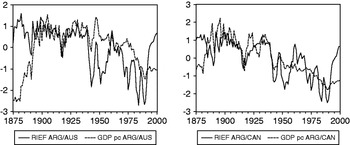
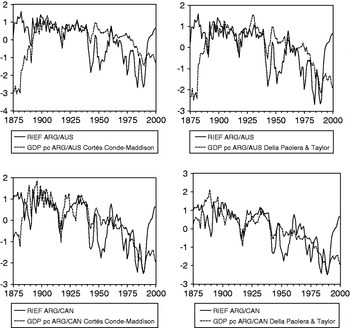
The graphs in Figure 3 suggest a correlation between Argentina's position compared with Australia and Canada in terms of per capita GDP and the relative evolution of the RIEF for each country.Footnote 75 We can, therefore, attempt to discover the relationship between the variables represented in the previous graphs; that is, between the relative series for Argentina's per capita GDP compared with that of Australia with the respective relative RIEF (RIEF ARG/AUS) on the one hand, and between the relative series for Argentina's per capita GDP compared with that of Canada and the respective relative RIEF (RIEF ARG/CAN) on the other.
Joint evolution of the relative position of the Argentinean economy and the relative Reduced Index of Economic Freedom in Argentina vs Australia and Canada: 1875–2000 (normalised data).
Where GDP pc ARG/AUS is Argentina's GDP relative to that of Australia, calculated as the logarithmic difference of both series taken from Maddison; RIEF ARG/AUS is the reduced index of economic freedom for Argentina compared with that of Australia. GDP pc ARG/CAN and RIEF ARG/CAN represent the same for Argentina compared with Canada.

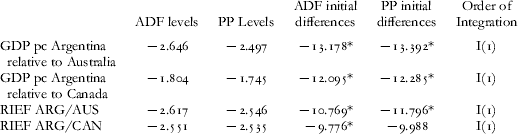
Initially, this means that we have to establish a relationship of cointegration between each of these pairs of variables and then check how the causality between them operates. We will begin by analysing the order of integration of the variables: TheFootnote 76 Dickey-Fuller and Phillips-Perron tests state that the variables follow a process I(I), so a long-term cointegration relationship between them can be established. The long-term relationship discovered in Argentina's GDP per capita relative to that of Australia with the respective RIEF after estimating for MLS (Minimum Least Squares) is as follows:Footnote 77

where T represents the trend variable, the t-ratios are expressed in brackets, and et represents the residuals.
Order of Integration of the Variables:Footnote 76
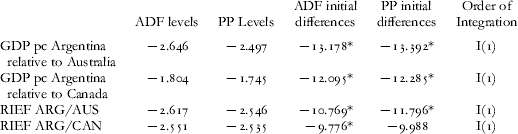
* Indicates rejection of the null hypothesis which maintains the existence of a unit root at 1% significance.
The ADF test established on these residuals (et) in order to test the null hypothesis, which states that cointegration between the two variables does not exist, allows us to reject it up to a 1 per cent significance level, given that the value is −2.869, which is greater than the −2.583 which is the critical value at this level of significance. Consequently we can observe that over the long-term this relationship is stable, meaning that we can establish the error correction model which will allow us to detect the direction in which causality between the two variables is operating. To this end, the following equations are created using MLS:
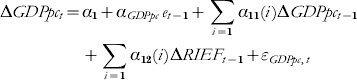
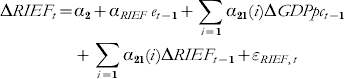
In this sense we can say that relative ΔRIEF does not cause relative ΔGDPpc in Granger's sense if αGDPpc is zero and all α12 (i)=0. Similarly, relative ΔGDPpc will not cause ΔRIEF if αRIEF=0 and all α21(i)=0.
Thus, the Wald test applied in order to check the joint significance of the coefficients αGDPpc and α12 (i)=0, indicates that the null hypothesis, which states that all these coefficients are zero, can be rejected.

Nevertheless, the Wald test applied to the second equation does not make it possible to reject the hypothesis which status that αRIEF=0 and α22(i)=0.

Consequently, in line with all the previous results, it is shown that the RIEF of Argentina with respect to Australia lies behind Argentina's relative position in terms of GDP per capita, but that the opposite is not true. The cointegration relation between the two variables then, is from relative RIEF to relative GDP per capita. Similarly, undertaking the same procedure for the relationship between Argentine GDP per capita relative to that of Canada and the respective relative RIEF provides the following results:
The MLS estimate between the two variables offers the following long-term relationship:

The ADF test applied to the residuals of this equation gives a value of −4.011, higher than the −2.583 which corresponds to the critical value at 1 per cent significance. We can, therefore, reject the null hypothesis at 1 per cent concluding that, once again, there is a stable, long-term relationship between these variables. Moreover, the causality analysis carried out between the variables under consideration once again shows that Argentina's position relative to Canada in terms of per capita GDP is caused by the relative RIEF as shown by the following results:

Again, applying the Wald test to the second equation does not allow us to reject the hypothesis which states that αRIEF=0 and α21(i)=0.

It seems clear, therefore, that from a long-term historical perspective the set of macroeconomic policy results represented in the REIF was the cause of Argentina's economic experience relative to Australia and Canada.Footnote 78 The analysis carried out here demonstrates that the paths followed by the respective indices of economic freedom that have been calculated and the trends observed in the evolution of the relative series of GDP per capita for Argentina compared with those for Australia and Canada are similar in the long term, indicating that the relationship between the two variables is maintained over time.
The mean level of this index for Argentina compared with Australia for the period 1875–1899 is 0.80, and it displays a tendency to increase.Footnote 79 This period coincides with that for which we observed a closing of the gap between the economies of Argentina and Australia in terms of GDP per capita. This trend reverses slightly in the period between 1900 and 1932, when the mean value of the relative index is 0.67, falling to −0.34, −0.39 and −0.99 respectively for the periods 1933–1952, 1953–1973 and 1973–2000, during which Argentina slowly falls further and further behind.Footnote 80 A similar situation can be observed for the relative index for Argentina and Canada and the corresponding series for relative GDP per capita. This index reaches 0.78 during the first period and then falls to 0.60, −0.19, −0.39 and −0.01 in the subsequent periods.
A more detailed study of the short-term movements reveals that, in spite of deviations at certain conjunctures, the general long-term trend is stable. This short-term synergy is even maintained during the final period analysed, 1980–1990, when a discrepancy in the relationship appears to crop up with respect to both Australia and Canada. In fact, the degree of econometric correction found between the relative series for GDP per capita and the respective indices compared with the corresponding differences is greater in the case of the 1980–2000 sub-sample than in that corresponding to the period 1875–1980.Footnote 81
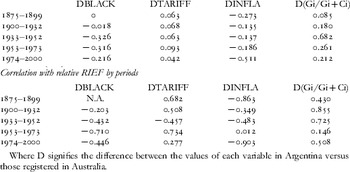
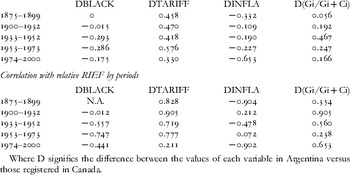
If we look at the information included in Appendix 2, relating to the impact and correlation that each of the components of the respective relative indices presents, we can observe that, in general terms, the indices that represent the real depreciation of the currency (Infla) and distortions in the exchange rate (Black) appear as the main differences between Argentina and the other two countries of recent settlement.Footnote 82 The impact of both variables is negative throughout the whole period under consideration, and both this and their correlation with the global index become greater after 1933. More specifically, Black is more significant between 1953 and 1973, while Infla is almost exclusively responsible for the deterioration during the period from 1974 until 2000, which includes the phase of hyperinflation. This variable had similar levels of significance in the final quarter of the nineteenth century, but then with less impact and virulence. In other words, problems of inflation and unstable exchange rates were the distortions which would have restricted economic freedom in Argentina between 1933 and 1974, leading to a situation which got consistently worse. The result was to be a situation of clear divergence after 1974, whose fundamental cause is to be found in the grave problem of hyperinflation that the country experienced, at least until 1990.Footnote 83
In contrast, it can be observed that the proportion of government consumption in total consumption (Gi/Gi+Ci) has a strong and positive impact throughout the period between 1875 and the year 2000 when comparing the case of Argentina with both Australia and Canada. This is because, on average, this variable has a higher value in Australia and Canada with proportions of 16.2 per cent and 19.2 per cent respectively compared with a figure of 13.2 per cent for Argentina. The differences are even more remarkable between 1933 and 1952, when the proportions are 17.4 per cent and 19.4 per cent in Australia and Canada respectively and only 13.4 per cent for Argentina, and the gap increases with time.
In the same way, the Tariff variable is another which acts positively in the long-run, presenting a negative, but reduced, correlation only during the period between 1933 and 1952 in the comparative case of Argentina with Australia, although in this period the global impact of this variable is very reduced. For the whole period the levels of protection in the three countries do not differ much: Argentina has a ratio of tariff revenue to imports of 16.5 per cent, similar to Australia's figure of 16.2 per cent and slightly higher than the figure of 12.0 per cent for Canada. Moreover, this variable has a positive impact because its values decrease with time, at least until 1952. For example, during the 1875–1899 period Argentina's ratio of 24.1 per cent contrasted with the figure of 18.9 per cent for both the other two economies. However, during the 1900–1932 and 1933–1952 periods, the values of 18.0 per cent and 15 per cent respectively for Argentina contrast clearly with 20.8 per cent and 21.9 per cent for Australia in these same two periods. For Canada, on the contrary, these values are similar to Argentina's (16.8 per cent and 11.3 per cent). Finally, during the 1953–1973 and the 1974–2000 periods, the values for Tariff, while decreasing, are on average slightly higher in Argentina (15.0 per cent in the first period and 10.0 per cent in the second) than those for Australia (11.2 per cent and 7.9 per cent respectively) and clearly higher than those for Canada (8.2 per cent and 3.4 per cent).
All these results are in line with the ideas of John Coatsworth and Jeffrey Williamson, for whom levels of protection in Latin America were higher before the Great Depression than after it. Moreover, in contrast with what is frequently argued in other analyses, the degree of protection in the region was not higher than in other more developed areas.Footnote 84
From the ideas presented in this paper we can conclude, therefore, that it was not tariffs but other forms of protection and isolation such as the devaluation of the currency and distortions in the exchange rate that marked the difference between Argentina and Australia and Canada.Footnote 85 The use and abuse of such measures reduced the degree of economic freedom in the country, making it impossible for Argentina to continue advancing in economic terms and placing the economy in a position of continuous relative stagnation. This was evident from a very early date, and it appears to have been somewhat timidly reversed only after 1991 when the elimination of these distortions began.
Conclusions
Scholars in the fields of Argentine economics and history have spent considerable time researching the reasons behind the nation's loss of economic ground compared with other developed countries, especially Australia and Canada, which have traditionally been considered alongside Argentina. A study of the Argentine historiography leads to the idea, shared by most who have studied the country's economy and history, that the institutional framework in place was not appropriate to stimulate and guarantee the nation's economic development.
However, despite the existence of a broad range of literature in the field, this question has not so far been studied from a formal analytical perspective. The objective of this paper was to fill this gap. In order to do so a reduced index of economic freedom, which summarises the results of the main economic policies that were implemented, and attempts to reflect Argentina's institutional framework between 1875 and the present, was constructed. The index reaches its highest values before 1899. After this year, although the figures remain high, there is a gradual falling trend, which becomes more pronounced in the 1930s. The decrease that took place after 1974 is dramatic. The country was not to show signs of recovery until 1990, as a result of the Ley de Convertibilidad.
In order to put the situation in Argentina in context, in comparison with Australia and Canada, a convergence analysis in terms of GDP per capita has been presented for the three countries, and indices of relative economic freedom constructed for each. It is clear that the point at which the Argentine economy began to fall behind that of Australia and Canada can be located in the late nineteenth century in both cases. This conclusion locates the beginning of the decline to an earlier date than any of those which prevail within the historiography.
The comparative situation of Argentina worsened gradually following the turn of the century until there was a rapid widening of the gap after 1974. Curiously, this coincides with the general trend of the relative index for Argentina compared with the other two countries. The values here, although still high, also begin to tail off in the late nineteenth century and, following a similar path to the index for Argentina alone, continue to decline in the 1930s, a decline that gathers pace in the 1970s. This fact suggests that the relative evolution of GDP per capita in Argentina and the evolution of both indices of relative economic freedom show the same trends and can be seen as being closely connected.
The cointegration analysis carried out between this index for Argentina relative to Australia and Canada and the respective series of relative Argentine GDP per capita leads us to the conclusion that Argentina's comparative economic performance may have been shaped by the different level of economic freedom present in this country throughout the period under consideration. It has been shown, moreover, that this analysis is robust whichever of the series for GDP per capita in Argentina is used.
Consequently, this study identifies the outcomes of macroeconomic policies as being responsible for Argentina's economic failure and its relative loss of ground, a conclusion which is in line with the ideas of Mundalk, Cavallo and Doménech, Cortés Conde and Taylor. However, this study suggests that the poor combination of policies was not limited to the period following the First World War, the 1920s, or the 1930s as suggested respectively by these authors. We conclude Argentina's relative decline had already commenced by the end of the nineteenth century.
In the long term, the variables referring to the real depreciation of the currency (Infla) and deviations in the exchange rate (Black) are the most powerful and those which are most significant in explaining the nation's backwardness. They are the main distortions which cause the differences between Argentina and Australia and Canada in the historical context, given that, in general terms, the values of the tariff protection variable for Argentina (Tariff) were fairly similar to those of Australia and Canada and the proportion of government spending (Gi/Gi+Ci) in these two countries was clearly higher.
These distortions would, it can be assumed, have acted as a disincentive to saving and by extension to investing in Argentina, as maintained in Alan Taylor's interpretation. They would also have prevented a higher degree of technology transfer and innovation. The combined result of these factors, according to the theory of endogenous growth, would have meant that Argentina found itself behind Australia and Canada, and unable to continue in the direction of convergence with them.
This line of argument cannot be elaborated further in this paper since it would require a more rigorous analysis of these three economies, and involve the construction of a more complete index of economic freedom, including aspects related with the definition of property rights, legal structures and regulation. While such an inquiry is beyond the objectives of this paper – which were concerned with investigating whether economic policies had some explanatory rule in Argentina's relative economic failure – it may serve as a basis for future research of this kind.
APPENDIX 1
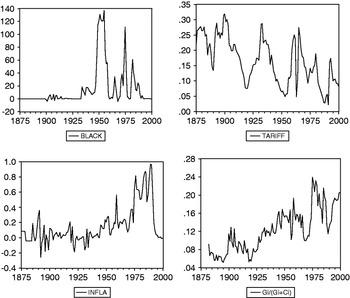
Evolution of the variables which make up the RIEF in Argentina.
Where BLACK represents the difference between the official exchange rate and the market rate calculated as a logarithmic difference; TARIFF represents the percentage of the income from tariffs compared with the total value of imports; similarly, INFLA and the Gi/(Gi+Ci) variable represent the real percentage rate of depreciation of the currency and the proportion of public consumption compared with total consumption. All the variables are therefore expressed as a ratio.
Sources: BLACK: 1913–1984, IEERAL, ‘Estadìsticas de la Evolución Económica de Argentina 1913–1984’, Estudios, no. 9 (1986), pp. 103–84; since 1985, Vicente Vázquez-Presedo, Estadìsticas históricas argentinas, Supplement (1970–1990) (Buenos Aires, 1994).
TARIFF: Gerardo della Paolera, Alan M. Taylor and Guillermo Bózilli, ‘Historical Statistics’, in Gerardo della Paolera and Alan M. Taylor (eds.), A New Economic History of Argentina (Cambridge, 2003), pp. 376–85; Vicente Vázquez Presedo Estadìsticas; IEERAL, ‘Estadìsticas de la Evolución’; Pablo Astorga, Ame R. Bergés and Valpy K. Fitzgerald, ‘The Oxford Latin American Economic History Database’, <http://oxlad.qeh.ox.ac.uk/=.
INFLA: IEERAL, ‘Estadìsticas de la Evolución Económica de Argentina 1913–1984’, Estudios, no. 9, (1986); INDEC (Instituto Nacional de Estadìstica y Censos de la República Argentina), on-line version. http://www.indec.mecon.ar
Gi/(Gi+Ci): Brian R. Mitchell, International Historical Statistics: The Americas, 1870–1993 (New York, 1998); Della Paolera et al., ‘Historical Statistics’; Astorga et al., ‘The Oxford Latin American Economic History Database’.

Correlation Matrix between the variables included in the RIEF

Impact of the variables included in the RIEF during each periodFootnote 86
Impacts (a change of a standard deviation)
APPENDIX 2
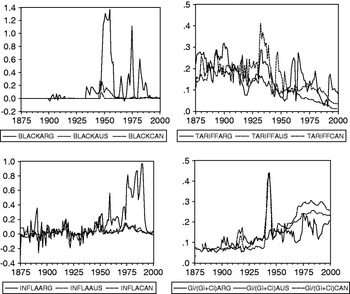
Evolution of the variables included in the relative indices.
Where BLACKARG, BLACKAUS and BLACKCAN represent the difference between the official exchange rate and the market rate, calculated as a logarithmic difference, for Argentina, Australia and Canada respectively. TARIFFARG, TARIFFAUS and TARIFFCAN represent the percentage of income from tariffs compared with the value of imports for Argentina, Australia and Canada. Similarly, INFLAARG, INFLAAUS and INFLACAN and the variables Gi/(Gi+Ci)ARG, Gi/(Gi+Ci)AUS and Gi/(Gi+Ci)CAN represent the percentage rate for real depreciation of the currency and the proportion of public consumption compared with total consumption for Argentina, Australia and Canada respectively. All the variables are expressed as a ratio.
Sources: Australia: Mitchell, International Historical Statistics; Wray Vamplew, Australians: Historical Statistics (Canberra, 1987); Reserve Bank of Australia, ‘Australian Economic Statistics 1949–1950 to 1996–1997’ (Occasional Paper, no. 8): available at [www.rba.gov.au/statistics/op8_index.html].
Canada: Mitchell, International Historical Statistics; Statistics of Canada (2004); International Monetary Fund, International Financial Statistics (various issues).

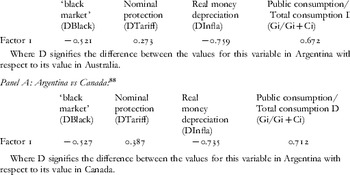
Results of the principal components analysis to obtain the relative RIEFs
Panel A: Argentina vs Australia: Footnote 87

Impacts of the most important variables of the relative RIEFs during each periodFootnote 89
Panel A: Argentina vs Australia:
Impacts (changes in standard deviation):

APPENDIX 3: Cointegration analysis for the relative RIEFs and the alternative relative GDP per head series
Evolution of the relative RIEFs and GDP per capita series (normalised data).

Cointegration análisisFootnote 90
Argentina/Australia
Impacts (changes in standard deviation(:

The symbol * indicates rejection of the null hypothesis at 1 per cent significance.