Bilingualism has been associated with performance advantages across various cognitive tasks, including Stroop (e.g., Bialystok, Craik & Luk, Reference Bialystok, Craik and Luk2008; Carlson & Meltzoff, Reference Carlson and Meltzoff2008; Hernández, Costa, Fuentes, Vivas & Sebastián-Gallés, Reference Hernández, Costa, Fuentes, Vivas and Sebastián-Gallés2010) and Simon tasks (e.g., Bialystok, Craik, Klein & Viswanathan, Reference Bialystok, Craik, Klein and Viswanathan2004; Salvatierra & Rosselli, Reference Salvatierra and Rosselli2011). On the classic Stroop task, participants are presented with color words, and are instructed to name the color of the ink as rapidly as possible. If the word blue is written in blue ink, then there is congruence of information; however, if the word green is written in blue ink, then there is incongruence and conflict of information. On the classic Simon task, participants press a right key to respond to a blue-color square or a left key to respond to a red-color square. Conflict arises when the blue-color square (requiring a right-key press) appears on the left or the red-color square (requiring a left-key press) appears on the right.
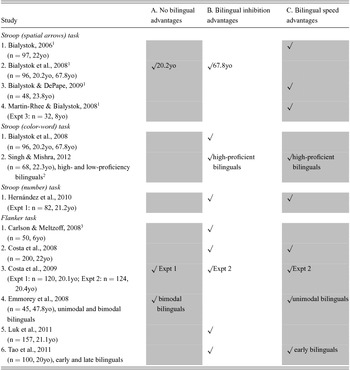
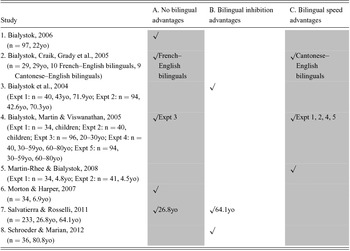
Bilingual advantages are not always found in young adults (e.g., Hilchey & Klein, Reference Hilchey and Klein2011). However, Stroop-type advantages have been identified more frequently in young bilingual adults (Bialystok et al., Reference Bialystok, Craik and Luk2008; Costa, Hernández, Costa-Faidella & Sebastián-Gallés, Reference Costa, Hernández, Costa-Faidella and Sebastián-Gallés2009; Costa, Hernández & Sebastián-Gallés, Reference Costa, Hernández and Sebastián-Gallés2008; Hernández et al., Reference Hernández, Costa, Fuentes, Vivas and Sebastián-Gallés2010; Luk, de Sa & Bialystok, Reference Luk, de Sa and Bialystok2011, see Table 1 for an overview) compared to Simon-type advantages (e.g., Bialystok, Reference Bialystok2006; Morton & Harper, Reference Morton and Harper2007). Simon-type advantages appear to be more constrained to children (Bialystok, Martin & Viswanathan, Reference Bialystok, Martin and Viswanathan2005, Martin-Rhee & Bialystok, Reference Martin-Rhee and Bialystok2008) and older adults (Bialystok et al., Reference Bialystok, Craik, Klein and Viswanathan2004; Salvatierra & Rosselli, Reference Salvatierra and Rosselli2011, Schroeder & Marian, Reference Schroeder and Marian2012, see Table 2 for an overview). This task difference may be a result of bilingualism influencing some aspects of cognitive control more than others, which is likely the case since cognitive advantages are thought to emerge due to specific linguistic demands in bilinguals (e.g., Bialystok & Craik, Reference Bialystok and Craik2010; Kroll, Reference Kroll2008). To examine the extent to which Stroop-type and Simon-type cognitive control mechanisms are engaged and shaped by bilingual experience, bilinguals’ and monolinguals’ performance on these two types of inhibitory control are compared in the current study.
Stimulus–Stimulus Conflict: Stroop Task. Overview of studies where (A) no bilingual Stroop advantage was identified, where (B) a bilingual Stroop inhibition advantage was identified, or (C) where a bilingual overall speed advantage was identified on the Stroop task. Stimulus–Stimulus inhibition tasks include Stroop spatial arrows, Stroop color-word, Stroop number, and flanker tasks. When only specific groups or experiments show an effect, they are listed next to the relevant check mark.

yo = years old
1 Even though effects are reported as Simon effects, they are categorized here as Stroop-like effects because perceptual conflict also exists within the same stimulus (e.g., a right-pointing arrow presented on the left side of the display), also see footnote 1. Bialystok (Reference Bialystok2006): Speed-advantages were found only in a high-switch condition.
2 High-proficiency bilinguals were compared to low-proficiency bilinguals and there was no monolingual control group. In all other studies reported in Table 1, monolingual reference groups were present.
3 No analyses reported to evaluate bilingual advantage on the flanker task, but a composite conflict resolution advantage emerged across tasks.
Stimulus–Response Conflict: Simon Task. Overview of studies where (A) no bilingual Simon advantage was identified, where (B) a bilingual Simon inhibition advantage was identified, or (C) where a bilingual overall speed advantage was identified on the Simon task. When only specific groups or experiments show an effect, they are listed next to the relevant check mark.

yo = years old
Differences between Stroop-type (MacLeod, Reference MacLeod1991, Stroop, Reference Stroop1935) and Simon-type inhibition (Simon & Rudell, Reference Simon and Rudell1967) can be examined within the context of the Dimensional Overlap Model (Kornblum, Stevens, Whipple & Requin, Reference Kornblum, Stevens, Whipple and Requin1999), a model that accounts for a variety of different inhibition mechanisms. On the classic Stroop task, there are two stimulus dimensions: the color of a word's ink (e.g., blue, green) and the meaning of the word (e.g., blue, green). The Dimensional Overlap Model posits that this conflict between two dimensions of the same stimulus (i.e., Stimulus–Stimulus conflict) originates and is resolved at the perceptual level of word representations (blue, green). In contrast, the pure Simon task is conceptualized within the Dimensional Overlap Model as a task where no overlap is present between perceptual dimensions of the same stimulus (stimulus color and stimulus location). Instead, overlap is present between the stimulus dimension that is irrelevant to the response rule (e.g., stimulus location: right, left), and the response dimension (e.g., right key, left key, Kornblum, Reference Kornblum1994). In short, conflict is created between two alternative Stimulus–Response mappings.Footnote 1
Despite the apparent absence of bilingual advantages on pure Simon tasks in young adults (i.e., 20–30-year-olds), it is likely that there are more subtle differences on Simon performance between young monolinguals and bilinguals. For example, Bialystok, Craik, Grady et al. (Reference Bialystok, Martin and Viswanathan2005) found that neural networks associated with Simon performance differed between young monolinguals and bilinguals, despite an absence of behavioral differences between the French–English bilingual and monolingual participants. Along similar lines, Linck, Schwieter, and Sunderman (Reference Linck, Schwieter and Sunderman2012) found that smaller Simon effects in trilingual young adults correlated with a smaller switching cost from L2 or L3 into L1. In contrast, clear cognitive Stroop advantages have been found across a number of studies with young bilingual participants (Bialystok, Reference Bialystok2006; Bialystok et al., Reference Bialystok, Craik and Luk2008; Bialystok & DePape, Reference Bialystok and DePape2009; Costa et al., Reference Costa, Hernández and Sebastián-Gallés2008; Hernández et al., Reference Hernández, Costa, Fuentes, Vivas and Sebastián-Gallés2010), and performance on the spatial Stroop task has been linked to conflict resolution during auditory word comprehension in bilinguals (Blumenfeld & Marian, Reference Blumenfeld and Marian2011, Reference Blumenfeld and Marian2013). Mercier, Pivneva and Titone (Reference Mercier, Pivneva and Titone2014) show a link between auditory word recognition in bilinguals and a composite cognitive control measure including two tasks with Stimulus–Stimulus conflict (the spatial Stroop task employed here and a number Stroop task) as well as a task with only Stimulus–Response conflict (the Simon task employed here). Taken together, while both Stimulus–Response (Simon-type) performance and Stimulus–Stimulus (Stroop-type) performance have been linked to bilingual language processing, it is possible that advantages on pure Simon tasks may be more subtle and limited compared to advantages on tasks that incorporate Stimulus–Stimulus conflict. The possibility that there are differences between bilinguals’ Stroop and Simon performance is consistent with previously-identified neural differences between the two tasks in monolinguals (e.g., Egner, Reference Egner2008; Liu, Banich, Jacobson & Tanabe, Reference Liu, Banich, Jacobson and Tanabe2004).
Experiment overview and hypotheses
The aim of the present study is to tease apart Stimulus–Stimulus and Stimulus–Response inhibition in bilinguals relative to performance patterns in monolinguals, by comparing performance on Stroop-type and Simon-type inhibitory control tasks. The nonlinguistic spatial Stroop task employed in the present study was also used by Blumenfeld and Marian (Reference Blumenfeld and Marian2011, Reference Blumenfeld and Marian2013) and is highly similar to the tasks employed by Bialystok (Reference Bialystok2006) and Bialystok and DePape (Reference Bialystok and DePape2009). To examine whether perceptual overlap of stimulus dimensions on this nonlinguistic Stroop task created an inhibition context that is particularly sensitive to bilingual experience, participants’ performance on this task was contrasted with performance on a spatial and nonlinguistic Simon task. Importantly, the spatial Stroop and Simon tasks were designed to be highly similar to each other in terms of visual input, stimulus dimensions, task requirements, and timing. Therefore, performance differences between the tasks can be ascribed to differences in overlap between the two stimulus dimensions.Footnote 2 On the Simon task, the two perceptual stimulus dimensions of arrow location (right, left) and arrow direction (up, down) did not overlap and no conflict was present between perceptual dimensions of the same stimulus. Instead, conflict was created when the irrelevant stimulus dimension overlapped with the response dimension (right key, left key), creating two competing response options. In sum, in the current Stroop task, the Stroop-characteristic perceptual overlap between stimulus dimensions was maintained, while in the Simon task this overlap was absent.
It was reasoned that, in bilinguals, differences would emerge between the Stroop and Simon tasks because bilingual language processing may rely more heavily on Stimulus–Stimulus inhibition than on Stimulus–Response inhibition as a result of cross-linguistic competition that is resolved at the lexical level. Within the framework of the Dimensional Overlap Model (Kornblum, Reference Kornblum1994), Stimulus–Stimulus inhibition refers to conflict between co-activated language representations. In contrast, Stimulus–Response inhibition refers to conflict between two overt responses if cross-linguistic conflict has not been resolved by the time the response stage is reached. Models of bilingual language processing suggest involvement of inhibition mechanisms at various levels of bilingual processing, typically focusing on the lexical level, where cross-linguistic competition is hypothesized to be resolved via inhibition (Dijkstra & Van Heuven, Reference Dijkstra, Heuven, Grainger and Jacobs1998; Green, Reference Green1986, Reference Green1998; Grosjean, Reference Grosjean, de and Kroll1997; Shook & Marian, Reference Shook and Marian2013).
Stimulus–Stimulus inhibition is likely to be recruited for bilingual language comprehension as well as production processes. During the early stages of bilingual language comprehension, phonological and lexical representations that match auditory input have been shown to be activated cross-linguistically (e.g., Blumenfeld & Marian, Reference Blumenfeld and Marian2007; Marian & Spivey, Reference Marian and Spivey2003a, Reference Marian and Spiveyb; Weber & Cutler, Reference Weber and Cutler2004). For example, when participants hear /pɛ/-, they might activate the English word pebble as well as the Spanish word perro “dog”. In this sense, the initially perceived signal, /pɛ/-, is ambiguous. Such perceptual conflict has been extensively documented during language comprehension, both within languages (e.g., can–candy, Blumenfeld & Marian, Reference Blumenfeld and Marian2011; Marian & Spivey, Reference Marian and Spivey2003b) and between languages (e.g., Blumenfeld & Marian, Reference Blumenfeld and Marian2007; Reference Blumenfeld and Marian2013; Macizo, Bajo & Martín, Reference Martín, Macizo and Bajo2010; Marian & Spivey, Reference Marian and Spivey2003a, Reference Marian and Spiveyb; Martín, Macizo & Bajo, Reference Macizo, Bajo and Martín2010). Models of bilingual language comprehension suggest that, as similar-sounding words compete within a cross-linguistically integrated lexicon, inhibitory control can be applied to competitors in the process of word identification (e.g., Shook & Marian, Reference Shook and Marian2013). This Stimulus–Stimulus type of inhibition is driven by perceptual similarity of word candidates within and across languages, resulting in competition at the lexical level.
In addition to comprehension, cross-linguistic conflict is also likely to arise during bilingual language production. During production, cross-linguistic co-activation and competition have been shown between representations at the concept level, the lemma level, the phonological level, and the speech planning level (for a review, see Kroll, Bobb & Wodniecka, Reference Kroll, Bobb and Wodniecka2006). For example, during picture naming, words that sound similar to the translation-equivalents of naming-targets have been shown to create interference (Hermans, Bongaerts, de Bot & Schreuder, Reference Hermans, Bongaerts, de Bot and Schreuder1998), suggesting lemma-level cross-linguistic competition. Similarly, cross-linguistic homophones are named slower than non-homophones, and Kroll, Dijkstra, Janssen and Schriefers (Reference Kroll, Dijkstra, Janssen and Schriefers2000) have suggested that this effect is due to co-activated phonologies (e.g., English leaf and Dutch lief “nice”), which in turn trigger bottom–up activation of competing lemmas and conceptual representations that will compete for selection. Kroll et al. (Reference Kroll, Bobb and Wodniecka2006, p. 126) have referred to scenarios such as these as “internally generated Stroop effect[s]”. With cross-linguistically integrated lexical representations, they have argued, competition and selection for production may occur at various loci throughout the representational hierarchy, depending on factors such as proficiency and context. In terms of the Dimensional Overlap Model, bilingual language production can therefore be argued to recruit both Stimulus–Stimulus and Stimulus–Response inhibition mechanisms. In this case, Stimulus–Stimulus inhibition refers to language-internal inhibition of competing representations at the concept and lexical levels. In turn, Stimulus–Response inhibition refers to inhibition of a competing response if two production options do remain co-active and compete for selection at the output level (i.e., at the response planning stages).
Although both Stimulus–Stimulus and Stimulus–Response conflict are likely present during bilingual production, it can be reasoned that they do not always arise together. For example, bilinguals who operate in their most proficient language and in a unilingual context may co-activate both languages up to the lemma level, with cross-linguistic competition resolved at this stage and with language-selective processing at the output level (Costa & Santesteban, Reference Costa and Santesteban2004). In such a context, Stimulus–Stimulus competition is present, but Stimulus–Response competition may not be involved. Language switching contexts provide an alternative example: When bilinguals expect to switch between languages, different-language output options are likely co-active and compete for selection. Language switching has indeed been found to correlate with Stimulus–Response inhibition indexed by the Simon task (e.g., Linck et al., Reference Linck, Schwieter and Sunderman2012).
Considering cross-linguistic competition during both bilingual comprehension and production, we reasoned that Stimulus–Stimulus competition would be most susceptible to bilingual influences. Although Stimulus–Response inhibition may also be more likely in bilinguals vs. monolinguals, Stimulus–Stimulus competition may be the most common type of bilingual competition because lexical between-language competition is present during both comprehension and production, while Stimulus–Response inhibition may be limited to production contexts where both languages remain active until the response stage. Because cross-linguistic co-activation may result in Stimulus–Stimulus competition more frequently than in Stimulus–Response competition, we predicted that bilinguals would perform best on the Stroop task, relative to the Simon task and relative to monolingual Stroop performance.
In sum, it was predicted that, if bilingual language processing places particular demands on Stimulus–Stimulus inhibition, then enhanced bilingual performance should be found on the nonlinguistic Stroop task relative to the nonlinguistic Simon inhibition task. As a result, performance differences between Stroop and Simon tasks were predicted to be more pronounced in bilinguals than in monolinguals. Conversely, if bilingual language processing makes equal use of a broad range of inhibitory control processes, including inhibition of competing Stimulus–Response mappings, then bilinguals’ performance should be similar across Stroop and Simon tasks, and patterns of Stroop vs. Simon performance should be similar for bilinguals and monolinguals.
Experiment 1: Identification of a Bilingual Stroop (Stimulus–Stimulus) – Simon (Stimulus–Response) Dissociation in Bilinguals vs. Monolinguals
To examine whether bilingual experience influences Stroop-type (Stimulus–Stimulus) inhibition more than Simon-type (Stimulus–Response) inhibition, a group of bilinguals and a group of monolinguals were compared on nonlinguistic Stroop and Simon tasks. Since highly proficient bilinguals have been found to be more likely to show cognitive advantages relative to monolinguals (e.g., Luk et al., Reference Luk, de Sa and Bialystok2011; Singh & Mishra, Reference Singh and Mishra2012), early proficient bilinguals were chosen. The nonlinguistic Stroop task selected for the current study had previously been associated with bilingual experience (Bialystok, Reference Bialystok2006; Bialystok & DePape, Reference Bialystok and DePape2009; Blumenfeld & Marian, Reference Blumenfeld and Marian2011, Reference Blumenfeld and Marian2013). In order to create a direct comparison between Stimulus–Stimulus inhibition and Stimulus–Response inhibition, a nonlinguistic Simon task was selected that was highly similar to the Stroop task.
Method
Participants
Thirty English–Spanish bilinguals (Mage = 22.0 years, range 18–38 years, SD = 5.2; 9 males) and 30 English monolinguals (Mage = 21.4 years, range 18–33 years, SD = 3.9; 6 males) were tested at a large private university in the Midwestern United States. Bilinguals and monolinguals were matched on age, t(58) = 0.5, p > .5, English receptive vocabulary (assessed by the Peabody Picture Vocabulary Task, Dunn and Dunn (Reference Dunn and Dunn1997); bilinguals: M = 116.2, SD = 12.2; monolinguals: M = 116.7, SD = 11.7; t(58) = 0.1, p > .5), expressive vocabulary (assessed by letter and semantic category verbal fluency tasks: letter fluency – bilinguals: M = 13.3, SD = 2.7; monolinguals: M = 13.9, SD = 3.4; t(58) = 0.7, p > .4; category fluency – bilinguals: M = 16.4, SD = 3.0; monolinguals: M = 16.7, SD = 4.5; t(58) = 0.3, p > .5), digit span (assessed by a digit span task, Wagner, Torgesen and Rashotte (Reference Wagner, Torgesen and Rashotte1999); bilinguals: M = 17.6, SD = 2.5; monolinguals: M = 17.5, SD = 2.1; t(58) = 0.2, p > .5), and nonverbal IQ (assessed by the Wechsler Abbreviated Scale of Intelligence (WASI), PsychCorp (1999); bilinguals: M = 110.0, SD = 11.7; monolinguals: M = 110.5, SD = 11.8; t(58) = 0.2, p > .5). Monolinguals (M = 9.6, SD = 0.5) and bilinguals (M = 9.4, SD = 0.7) did not differ on self-reported English proficiency across comprehension, speaking, and reading modalities, t(58) = 1.4, p > .1. Bilingual English–Spanish participants spoke English as a native language and rated their Spanish proficiency at 7.7 on a scale from 0 to 10 (SD = 1.1, where 0 = “no proficiency” and 10 = “perfect proficiency”) across comprehension, speaking, and reading modalities. Bilinguals had acquired Spanish at the average age of 2.9 years (SD = 3.8) and were currently exposed to Spanish 20.5% of the time (SD = 13.4). On the expressive vocabulary verbal fluency tasks, bilinguals performed significantly better in English than in Spanish (Spanish letter fluency = 9.7, SD = 3.0; Spanish category fluency = 8.8, SD = 3.7; t(29) = 6.7, p < .001). Monolinguals had only minimal exposure to foreign languages (M = 1.8% of the time, SD = 2.7).
Study design
The current study followed a 2 × 2 × 2 design, with trial type (incongruent, congruent) and task (nonlinguistic Stroop task, nonlinguistic Simon task) as within-subject factors, and Group (monolingual, bilingual) as a between-subjects factor. The dependent variables were response accuracies and latencies. In addition, difference scores were calculated comparing performance on incongruent vs. congruent trials (i.e., Stroop and Simon effects, indexing the extent of inhibition of conflicting information during incongruent Stimulus–Stimulus or Stimulus–Response contexts).
Materials
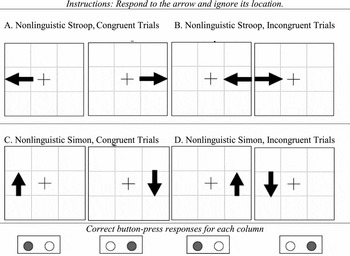
The nonlinguistic Stroop task employed in the present study was adapted from previous studies (Bialystok, Reference Bialystok2006; Liu et al., Reference Liu, Banich, Jacobson and Tanabe2004) and was also used in Blumenfeld and Marian (Reference Blumenfeld and Marian2011). The two stimulus dimensions arrow direction and arrow location were manipulated to be either congruent or incongruent. Participants were asked to respond to arrow direction but to ignore location. They were instructed to press a response-key located on the left side of the keyboard when they saw a leftward-facing arrow, and a response-key on the right when they saw a rightward-facing arrow. Sixty congruent trials contained a leftward-facing arrow presented to the left of the central fixation cross, and 60 contained a rightward-facing arrow presented to the right of the central fixation cross. Twenty incongruent trials contained a leftward-facing arrow presented to the right of the central fixation cross, and 20 contained a rightward-facing arrow presented to the left of the central fixation cross. See Figure 1 (panels A–B) for an illustration of this task.
Illustration of the cognitive inhibition tasks. Panels A and B show the nonlinguistic Stroop task (congruent conditions and incongruent Stimulus–Stimulus conflict conditions, respectively). Panels C and D show the nonlinguistic Simon task (congruent conditions and incongruent Stimulus–Response conflict conditions, respectively). Correct responses (right button or left button) are shown at the bottom of each column.

On the nonlinguistic Simon task, response conflict was created by varying the irrelevant stimulus dimension arrow location (right, left) and the response dimension (right-key press, left-key press) to be either congruent or incongruent. Participants monitored and responded to the stimulus dimension arrow direction (e.g., upward-pointing, downward-pointing). They were instructed to press a response key located on the left side of the keyboard when they saw an upward-facing arrow, and to press a response key located on the right when they saw a downward-facing arrow. Participants were also instructed to ignore the location of the arrows. For example, response conflict was created when the stimulus occurred on the left side and was a downward-pointing arrow (in this case, participants might follow the location cue and press the left response key, even though the correct response was the right key). Sixty congruent trials contained an upward-facing arrow presented to the left of the central fixation cross, and 60 contained a downward-facing arrow presented to the right of the central fixation cross. Twenty incongruent trials contained an upward-facing arrow presented to the right of the central fixation cross, and 20 contained a downward-facing arrow presented to the left of the central fixation cross. See Figure 1 (panels C–D) for an illustration of this task.
For both the Stroop and Simon tasks, the ratio of incongruent to congruent trials was maintained at 1:3, and each trial started with a 500 ms central fixation cross (to call participants’ attention towards the middle of the screen), followed by a 700 ms presentation of the congruent or incongruent stimulus display, and an 800 ms presentation of a blank screen. All trials were presented in a fixed pseudo-randomized order.
Procedure
Monolinguals and bilinguals completed the nonlinguistic Stroop and Simon tasks (with the order of presentation of the two tasks counterbalanced across participants). Participants were instructed to respond by pressing two keys on the keyboard using their right and left index fingers. Before starting each task, participants read instructions on the screen; in addition, the experimenter verbally explained each task. Following instructions, participants completed 20 trials where the relevant stimulus was placed in the center of the screen (i.e., an arrow pointing right or left for the Stroop task and an arrow pointing up or down for the Simon task). Participants were then instructed (both verbally and via text on the screen) that, on the following task, they should respond exactly as they had practiced, that the stimulus would appear at different locations on the screen, and that they should ignore these changes in location as much as possible. Participants were instructed to respond as rapidly and accurately as possible. Participants also completed the Language Experience and Proficiency Questionnaire (Marian, Blumenfeld & Kaushanskaya, Reference Marian, Blumenfeld and Kaushanskaya2007) and provided self-reported proficiency ratings and the percentage of time they were exposed to each language on a daily basis.
To measure proficiency in both languages, participants were administered the receptive Peabody Picture Vocabulary Test (PPVT–III; Dunn & Dunn, Reference Dunn and Dunn1997, and its Spanish equivalent, the Test de Vocabulario en Imágenes Peabody; Dunn, Padilla, Lugo & Dunn, Reference Dunn, Padilla, Lugo and Dunn1986), and verbal fluency tasks. On verbal fluency tasks, participants responded to cues to list as many words as possible that started with a given letter within 60 seconds, and to semantic category cues to list as many words as possible that belonged to a given category within 60 seconds. In English, half of all participants received letter cues E, P, and M, and the other half received letters A, L, and C. Half of all participants received category cues “animals”, “vegetables”, and “clothes”, and the other half received “colors”, and “fruits”. In Spanish, bilingual participants received letter and category sets that they had not seen in English. In addition, participants were administered the digit span subtest of the Comprehensive Test of Phonological Processing (CTOPP; Wagner et al., Reference Wagner, Torgesen and Rashotte1999), and the performance subtests of the WASI, PsychCorp, 1999). All participants were tested in English first, followed by language testing in Spanish.
Data coding
Decision accuracies and latencies on congruent vs. incongruent trials were captured by using Superlab software. For each participant, incorrect responses were removed from consideration when response latencies were analyzed. Response latencies below 200 ms and values below or above 2.5 standard deviations from the mean were also removed. This procedure resulted in the omission of 2.5% of data.
Results
To compare monolinguals’ and bilinguals’ performance across Simon and Stroop measures, a 2 × 2 × 2 mixed ANOVA was conducted, with trial type (incongruent, congruent) and task (nonlinguistic Stroop task, nonlinguistic Simon task) as within-subject factors, and group (monolingual, bilingual) as a between-subjects factor. Results are presented separately for accuracy rates and response latencies, including follow-up analyses.
Accuracy rates
Results yielded a main effect of trial type, F(1,58) = 160.6, p < .0001, ŋp 2 = .7, suggesting that participants were overall less accurate responding to incongruent Stroop and Simon trials (M = 82.7%, SE = 1.3) than to congruent trials (M = 98.8%, SE = 0.3). Performance accuracy was equivalent on nonlinguistic Stroop (M = 91.8%, SE = 0.8) and Simon tasks (M = 89.7%, SE = 1.0), F(1,58) = 3.1, p = .08, ŋp 2 = .05. No main effect of group was observed, F(1,58) = 0.4, p > .1, ŋp 2 = .006, suggesting that overall response accuracy rates were equal for monolinguals (M = 90.3%, SE = 1.0) and bilinguals (M = 91.2%, SE = 1.0). However, a three-way interaction emerged between trial type, task, and group, F(1,58) = 5.0, p < .05, ŋp 2 = .1, together with a marginal two-way interaction between task and group, F(1,58) = 3.8, p = .06, ŋp 2 = .1.
Follow-up 2 × 2 ANOVAs with competitor (incongruent, congruent) and task (nonlinguistic Stroop, nonlinguistic Simon) were conducted for each group separately. Monolinguals performed equivalently across the two tasks, with no main effect of task, F(1,58) = 0.01, p > .5, ŋp 2 < .0001, and no interaction between trial type and task, F(1,58) = 0.08, p > .5, ŋp 2 = .003, see Figure 2. In contrast, bilingual participants showed a main effect of task, F(1,58) = 8.7, p < .01, ŋp 2 = .2, and an interaction between trial type and task, F(1,58) = 8.5, p < .01, ŋp 2 = .2. Follow-up t-tests revealed that bilinguals had higher overall accuracy rates on the nonlinguistic Stroop task (M = 93.4%, SE = 0.6) than on the nonlinguistic Simon task (M = 89.0%, SE = 1.1), t(29) = 2.9, p < .01. In addition, bilinguals showed a smaller difference between congruent and incongruent trials on the nonlinguistic Stroop task (difference score = 11.9%, SE = 1.4), than between congruent and incongruent trials on the nonlinguistic Simon task (difference score = 19.8%, SE = 2.9), t(29) = 2.9, p < .01, see Figure 2. Follow-up between-group analyses suggested that differences between Stroop and Simon effects in bilinguals, but not in monolinguals, were driven by monolingual–bilingual performance differences on incongruent Stroop trials, with bilinguals (M = 87.4%, SE = 1.6) performing more accurately than monolinguals (M = 81.8%, SE = 2.6) on these trials, t(58) = 1.8, p = .038 (one-tailed). In contrast, no monolingual–bilingual differences were found on incongruent Simon trials, or on congruent Stroop or Simon trials (all ps > .1).
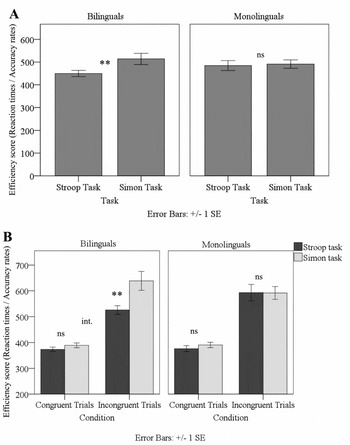
Experiment 1. Performance efficiency (reaction times divided by accuracy rates) on the nonlinguistic Stroop task, as compared to the nonlinguistic Simon task. A: Overall performance on nonlinguistic Stroop and Simon tasks. B: Performance on congruent and incongruent trials across tasks, **p < .001, ns = not significant; int. = task × condition interaction.

Response latencies
When response latencies were analyzed with the 2 × 2 × 2 mixed ANOVA, results yielded a main effect of trial type, F(1,58) = 769.6, p < .0001, ŋp 2 = .9, suggesting that participants were overall slower on incongruent trials (M = 475.5 ms, SE = 6.8) than on congruent trials (M = 380.1 ms, SE = 5.8). In addition, a main effect of task, F(1,58) = 11.4, p = .001, ŋp 2 = .2, showed that overall response times on the nonlinguistic Stroop task (M = 418.9 ms, SE = 6.4) were faster than overall response times on the Simon task (M = 436.8 ms, SE = 6.6). However, no main effect of group was observed, F(1,58) = 0.007, p > .5, ŋp 2 < .001, suggesting that overall response latencies were equal for monolinguals (M = 427.4 ms, SE = 8.6) and bilinguals (M = 428.3 ms, SE = 8.6). Two-way interactions between task and group, F(1,58) = 0.3, p > .5, ŋp 2 = .005, and three-way interactions between competitor, task, and group, F(1,58) = 1.5, p > .1, ŋp 2 = .03, were not significant, suggesting that monolinguals and bilinguals had comparable response latencies across the two inhibition tasks.
Efficiency scores
To protect against speed–accuracy trade-offs in comparing the two groups, accuracy and reaction time data were combined into efficiency scores, which were calculated by dividing reaction times by accuracy proportions (Christie & Klein, Reference Christie and Klein1995; Townsend & Ashby, Reference Townsend and Ashby1983). Smaller efficiency scores are interpreted as more efficient performance, characterized by shorter reaction times and higher accuracy rates. Results of efficiency score analyses were similar to reported accuracy results and revealed main effects of trial (incongruent, congruent), F(1,58) = 200.3, p < .001, ŋp 2 = .8, and task (Stroop, Simon), F(1,58) = 6.8, p = .01, ŋp 2 = .1. In addition, a significant two-way interaction between task and group (F(1,58) = 4.6, p < .05, ŋp 2 = .1) and a significant three-way interaction between trial, task, and group (F(1,58) = 5.4, p < .05, ŋp 2 = .1) emerged. As in the accuracy analyses, separate follow-up analyses for monolinguals yielded no differences between Stroop and Simon tasks, F(1,29) = 0.11, p > .5, ŋp 2 = .004, and no interaction between trial and task, F(1,29) = 0.27, p > .5, ŋp 2 = .009. Conversely, follow-up analyses for bilinguals confirmed significant differences between Stroop (M = 455.3 ms/proportion correct, SE = 11.9) and Simon performance (M = 528.5 ms/proportion correct, SE = 22.9), F(1,29) = 12.4, p = .001, ŋp 2 = .3. Bilinguals also showed a significant interaction between trial and task, F(1,29) = 6.5, p < .05, ŋp 2 = .2, with smaller Stroop effects (156.9 ms/proportion correct) than Simon effects (271.1 ms/proportion correct), t(29) = 2.6, p < .05. Finally, as previously, analyses suggested that differences between bilinguals and monolinguals were driven by performance differences on the Stroop task, with bilinguals (M = 533.8 ms/proportion correct, SE = 17.3) performing more efficiently than monolinguals (M = 599.6 ms/proportion correct, SE = 32.9) on incongruent Stroop trials, t(58) = 1.9, p = .03 (one-tailed), and with smaller Stroop effects in bilinguals (152.2 ms/proportion correct, SE = 13.0) than in monolinguals (217.0 ms/proportion correct, SE = 28.9), t(58) = 2.1, p < .05. Together, results suggest that bilinguals were more efficient at inhibiting irrelevant information on the Stroop task than on the Simon task.
Discussion
In Experiment 1, bilinguals’ and monolinguals’ performance was compared on nonlinguistic Stroop and Simon tasks that involved identification of arrow direction in the presence of congruent or incongruent location information. Within the bilingual group, an advantage was found on performance during the nonlinguistic Stroop task relative to the nonlinguistic Simon task and relative to monolingual Stroop performance. In contrast, monolinguals performed equivalently across the two tasks. These findings of bilinguals’ better Stroop performance can be explained within the framework of the Dimensional Overlap Model. Specifically, the Stroop task generates perceptual Stimulus–Stimulus conflict based on a bivalent stimulus (e.g., a right-pointing arrow on the left side of a display) that may be analogous to bilingual cross-linguistic lexical competition (e.g., Kroll et al., Reference Kroll, Bobb and Wodniecka2006; Shook & Marian, Reference Shook and Marian2013). It is possible that resolution of Stimulus–Stimulus conflict is honed in bilinguals who experience both within-language and between-language ambiguity. To replicate the identified pattern of Stroop–Simon dissociations in a different group of bilinguals and to further examine the nature of Stroop vs. Simon effects, a second experiment was conducted. Critically, Experiment 2 contained an additional “neutral” condition in both the Stroop and Simon task where arrows appeared in the center of the screen. In this condition, participants were subject to neither interference effects (due to incongruent location information) nor facilitation effects (due to congruent location information). Therefore, presence of location-neutral trials would allow for identification of inhibition components of Stroop and Simon effects (incongruent vs. neutral trials) as well as identification of facilitation components (congruent vs. neutral trials). It was predicted that, as in Experiment 1, bilinguals would be overall more efficient on the Stroop task relative to the Simon task. In addition, if bilingual–monolingual differences would emerge in Stroop vs. Simon performance, then group-differences could be localized to the inhibition or facilitation components.
Experiment 2: Replication of a Bilingual Stroop (Stimulus–Stimulus) – Simon (Stimulus Response) Dissociation and the Role of Inhibition vs. Facilitation
In Experiment 2, we aimed to (1) replicate Experiment 1 findings of enhanced bilingual performance on the Stroop relative to the Simon task, and to (2) examine whether task and group differences could be localized to inhibition or facilitation components of the two tasks. A different bilingual group was recruited for Experiment 2 in order to examine the stability of the previously-observed effects across a heterogeneous population of bilinguals. Specifically, participants in Experiment 2 were Spanish–English early bilinguals tested at a large public university in Southern California. We predicted that previously-observed effects would maintain in the new group of bilinguals, relative to monolingual peers. In addition, based on previous findings (e.g., Van Heuven, Conklin, Coderre, Guo & Dijkstra, Reference Van Heuven, Conklin, Coderre, Guo and Dijkstra2011), we expected a smaller magnitude of Stroop facilitation compared to Stroop inhibition. As a result, we predicted that bilingual effects would be driven by the inhibition component of the Stroop task.
Method
Participants
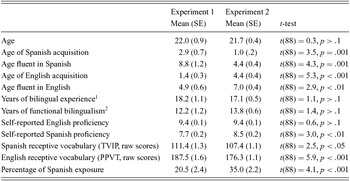
Sixty Spanish–English bilinguals (Mage = 21.7, range: 18 – 32, SD = 3.1; 6 males) and 60 English monolinguals (Mage = 22.2, range: 18–35, SD = 3.8; 8 males) participated. Bilinguals and monolinguals were matched on age, t(118) = 0.9, p > .3, English receptive vocabulary (assessed by the Peabody Picture Vocabulary Task (raw scores), Dunn & Dunn, Reference Dunn and Dunn1997; bilinguals: M = 176.2, SD = 8.4; monolinguals: M = 178.9, SD = 9.5; t(118) = 1.4, p > .1), backward digit span (assessed by a backward digit span task, Woodcock, McGrew & Mather, Reference Woodcock, McGrew and Mather2001; bilinguals: M = 16.6, SD = 3.9; monolinguals: M = 18.0, SD = 4.2; t(118) = 1.8, p = .07), and nonverbal reasoning (assessed by the Matrix Reasoning component raw score of the WASI, PsychCorp, 1999; bilinguals: M = 26.8, SD = 3.4; monolinguals: M = 27.4, SD = 3.8, t(118) = 1.1, p > .1). Monolinguals (M = 9.8, SD = 0.4) and bilinguals (M = 9.4, SD = 0.7) differed on self-reported English proficiency across comprehension, speaking, and reading modalities, t(118) = 3.8, p < .001, and on expressive vocabulary (assessed by letter and semantic category verbal fluency tasks: letter fluency – bilinguals: M = 12.6, SD = 3.3; monolinguals: M = 14.0, SD = 3.4, t(118) = 2.4, p < .05; category fluency – bilinguals: M = 14.2, SD = 3.4, monolinguals: M = 15.6, SD = 2.8, t(118) = 2.3, p < .05). Bilingual Spanish–English participants spoke Spanish as a native language and rated their Spanish proficiency at 8.5 on a scale from 0 to 10 (SD = 1.2, where 0 = no proficiency and 10 = perfect proficiency) across comprehension, speaking, and reading modalities. Bilinguals had acquired English at the average age of 4.4 years (SD = 2.8), had become fluent in it at 7.0 years (SD = 3.4), and were currently exposed to Spanish 35.0% of the time (SD = 16.8). On the expressive vocabulary verbal fluency tasks, bilinguals performed significantly better in English than in Spanish (Spanish letter fluency = 11.8, SD = 2.8; Spanish category fluency = 10.9, SD = 3.4, t(59) = 3.9, p < .001). Monolinguals had only minimal exposure to foreign languages (1.4% of the time, SD = 3.1). Table 3 provides a direct comparison of bilinguals in Experiments 1 and 2.
Comparison between bilingual participants in Experiments 1 and 2.

1 Years of bilingual experience = age at testing minus age when participants started acquiring their second language.
2 Years of functional bilingualism = age at testing minus the age when participants reported fluency in the language that became fluent last.
Materials and procedure
In addition to the 120 congruent trials and 40 incongruent trials described in Experiment 1, both Stroop and Simon tasks also contained 40 neutral trials where the arrow appeared in the center of the display. The rationale for including the neutral trials was to separate out facilitation and inhibition components of the Stroop and Simon effects by providing a condition that contained neither congruent nor incongruent information. The neutral trials were intermixed with the other trial types. On the Stroop task, 20 neutral trials contained an arrow that pointed right and 20 neutral trials contained an arrow that pointed left. On the Simon task, 20 neutral trials contained an arrow that pointed upward and 20 neutral trials contained an arrow that pointed downward. All remaining procedures were identical to those in Experiment 1. Response latencies below 200 ms and values below or above 2.5 standard deviations from the mean were removed from analyses, resulting in omission of 1.9% of data.
Results
Accuracy rates
When data were analyzed with a 3 (condition: incongruent, congruent, neutral) × 2 (task: Stroop, Simon) × 2 (group: bilingual, monolingual) ANOVA, results confirmed a main effect of trial type (incongruent, congruent, neutral), F(1,118) = 253.7, p < .001, ŋp 2 = .7, suggesting that participants were overall less accurate responding to incongruent Stroop and Simon trials (M = 85.8%, SE = 0.9) than to congruent trials (M = 98.2%, SE = 0.3) or to newly added neutral trials (M = 94.5%, SE = 0.5). As in Experiment 1, performance accuracy was higher on the nonlinguistic Stroop task (M = 94.5%, SE = 0.6) than on the Simon task (M = 91.1%, SE = 0.5), F(1,118) = 38.9, p < .001, ŋp 2 = .3, and no main effect of group was observed, F(1,118) < .001, p > .5, ŋp 2 < .001, with overall response accuracy rates equivalent for monolinguals (M = 92.8%, SE = 0.7) and bilinguals (M = 92.8%, SE = 0.7). In addition, an interaction between condition and task emerged, confirming differences in interference resolution across the two tasks. With the added neutral condition, this interaction was consistent with predicted differences in facilitation and inhibition across the Stroop and Simon tasks, F(1,118) = 64.0, p < .001, ŋp 2 = .4. Consistent with Experiment 1, there was also a two-way interaction between task and group, F(1,118) = 5.0, p < .05, ŋp 2 = .04, suggesting differences in Stroop vs. Simon performance across the two groups. However, in contrast to Experiment 1, no three-way interaction between trial type, task, and group was found, F(1,118) = 1.5, p > .1, ŋp 2 = .01. Follow-up t-tests to examine the interaction between task and group yielded larger differences between tasks for bilinguals (MSimon-Stroop = 4.7%, SE = 0.6) than for monolinguals (MSimon-Stroop = 2.2%, SE = 1.0), t(118) = 2.2, p < .05. Follow-up 2 × 2 ANOVAs were conducted to examine the interaction between condition and task. When neutral and incongruent conditions were entered into the analysis, no interaction was found between condition and task, F(1,118) = 0.6, p > .1, ŋp 2 = .005, suggesting that the Stroop and Simon tasks yielded similar inhibition effects. However, when neutral and congruent conditions were entered into the analysis, an interaction was identified between condition and task, F(1,118) = 55.4, p < .001, ŋp 2 = .3, suggesting differences in Stroop and Simon facilitation. Follow-up t-tests suggested that significant facilitation effects were present for both Stroop (t(119) = 3.6, p < .001) and Simon tasks (t(119) = 9.0, p < .001), with smaller effects on the Stroop task (M = 1.01%, SE = 0.3) than on the Simon task (M = 6.3%, SE = 0.7), t(119) = 7.4, p < .001.
Response latencies
When response latencies were entered into the 3 × 2 × 2 mixed ANOVA, results confirmed a main effect of trial type, F(1,118) = 943.0, p < .0001, ŋp 2 = .9, suggesting that participants were overall slower on incongruent trials (M = 523.6 ms, SE = 5.7) than on neutral trials (M = 478.9, SE = 5.3) or on congruent trials (M = 439.0 ms, SE = 4.9). In addition, as in Experiment 1, a main effect of task, F(1,118) = 71.7, p < .001, ŋp 2 = .4, showed that response times were faster on the Stroop task (M = 461.2 ms, SE = 5.8) than on the Simon task (M = 499.8 ms, SE = 5.4), while no main effect of group was observed (monolinguals: M = 473.3 ms, SE = 7.3; bilinguals: M = 487.7 ms, SE = 7.3), F(1,118) = 2.0, p > .1, ŋp 2 = .02. Critically, two-way interactions were found between task and group, F(1,118) = 6.9, p = .01, ŋp 2 = .1, and between task and condition, F(1,118) = 51.0, p < .001, ŋp 2 = .3, identifying group differences in overall reaction times on Stroop and Simon tasks that had not emerged in Experiment 1, as well as task differences in inhibition and facilitation components. The three-way interaction between competitor, task, and group remained insignificant, F(1,118) = 1.1, p > .1, ŋp 2 = .01. Follow-up t-tests to examine the task × group interaction replicated the pattern of findings identified in the accuracy analyses of Experiment 1, with bilinguals showing a bigger difference between Stroop and Simon performance (MSimon–Stroop = 50.5 ms, SE = 7.0) than the monolinguals (MSimon–Stroop = 26.6 ms, SE = 5.8), t(118) = 2.6, p = .01. Follow-up t-tests to examine the task × condition interaction suggested that the Stroop task yielded larger inhibition effects (M = –55.5 ms, SE = 2.7) than the Simon task (M = –33.9 ms, SE = 2.6), t(119) = 7.2, p < .001, but smaller facilitation effects (M = 29.7 ms, SE = 1.9) than the Simon task (M = 50.1 ms, SE = 2.6), t(119) = 8.0, p < .001.
Efficiency scores
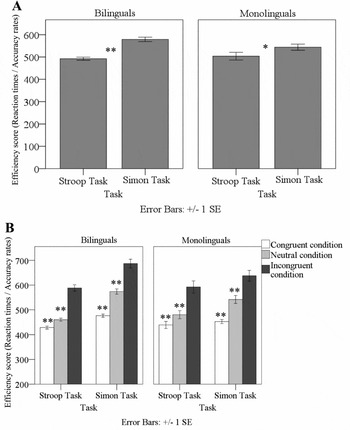
As in Experiment 1, accuracy and reaction time data were combined in efficiency scores to adjust for speed–accuracy trade-offs (see Figure 3). Consistent with Experiment 1 findings, main effects of trial (F(1,118) = 346.1, p < .001, ŋp 2 = .8) and task (F(1,118) = 69.7, p < .001, ŋp 2 = .4) emerged, together with the critical two-way interactions between task and group (F(1,118) = 9.4, p < .01, ŋp 2 = .1) and between task and condition (F(1,118) = 58.7, p < .001, ŋp 2 = .3). In contrast to Experiment 1 findings, the three-way interaction between trial, task, and group did not reach significance, F(1,118) = 2.1, p > .1, ŋp 2 = .02.
Experiment 2. Performance efficiency (reaction times divided by accuracy rates) on the nonlinguistic Stroop task, as compared to the nonlinguistic Simon task. A: Overall performance on nonlinguistic Stroop and Simon tasks. B: Performance on congruent, neutral, and incongruent trials across tasks, *p < .01, **p < .001.

Follow-up t-tests to examine the task × group interaction confirmed that differences between Stroop and Simon efficiency scores were larger for bilinguals (MSimon–Stroop = 86.8 ms/proportion correct, SE = 10.4) than for monolinguals (MSimon–Stroop = 40.2 ms/proportion correct, SE = 11.1), t(118) = 3.1, p < .01, replicating findings of a greater performance advantage on the Stroop task relative to the Simon task in bilinguals (Stroop: M = 492.3 ms/proportion correct, SE = 7.1; Simon: M = 579.1 ms/proportion correct, SE = 9.7) compared to monolinguals (Stroop: M = 503.8 ms/proportion correct, SE = 17.5; Simon: M = 544.0 ms/proportion correct, SE = 13.7). Follow-up t-tests to examine the task x condition interaction suggested that the Stroop (M = –120.1 ms/proportion correct, SE = 8.6) and Simon tasks (M = –104.4 ms/proportion correct, SE = 11.0) yielded similar inhibition effects, t(119) = 1.5, p > .1, with smaller facilitation effects on the Stroop task (M = 36.6 ms/proportion correct, SE = 3.2) than on the Simon task (M = 93.5 ms/proportion correct, SE = 6.0), t(119) = 9.7, p < .001.
Discussion
In Experiment 2, a larger group of bilinguals and monolinguals was recruited to replicate Experiment 1 findings of enhanced bilingual Stroop vs. Simon performance. Participants in Experiment 2 (M = 481.3, SE = 4.9) performed overall slower than participants in Experiment 1 (M = 422.1, SE = 7.0), F(1,176) = 48.2, p < .001, ŋp 2 = .2, with comparable accuracy rates across Experiment 2 (M = 92.0, SE = 0.5) and Experiment 1 (M = 90.7, SE = 0.7), F(1,176) = 1.8, p > .1, ŋp 2 = .01. Therefore, efficiency scores provide the best comparison across the two cohorts in order to avoid group differences in speed–accuracy trade-offs. In both experiments, an interaction between group and task suggested that bilinguals showed better overall Stroop performance relative to Simon performance. In the monolingual groups, Stroop–Simon differences were either non-existent (Experiment 1) or significantly smaller than in bilinguals (Experiment 2).
In Experiment 1 a three-way interaction between task, trial type and group was identified, and follow-up tests yielded a smaller Stroop effect for bilinguals than for monolinguals. In Experiment 2, the three-way interaction between task, trial type and group did not reach significance, suggesting similar inhibition processes across groups. Therefore, findings from the two experiments suggest that while bilingual–monolingual absolute differences in inhibition are variable across young populations, stable group differences are consistently found in the relationship between Stroop and Simon performance. In addition, Experiment 2 confirmed previous findings by Van Heuven et al. (Reference Van Heuven, Conklin, Coderre, Guo and Dijkstra2011) that the magnitude of the Stroop inhibition effect is bigger than the magnitude of the Stroop facilitation effect. The finding of comparable Simon inhibition and facilitation effects is also consistent with previous research (e.g., Lu & Proctor, Reference Lu and Proctor1995). For the specific spatial Stroop and Simon tasks employed in Experiments 1 and 2, these findings suggest that the inhibition component accounts for 77% of the Stroop effect and 53% of the Simon effect. It is therefore likely that the smaller bilingual Stroop effect observed in Experiment 1 was driven by bilingual–monolingual differences in Stroop inhibition. In sum, the shared finding across both studies is that bilinguals showed better Stroop performance relative to Simon performance, while monolinguals showed no differences or smaller differences between the two tasks. To identify findings that generalize across both bilingual groups, an overall analysis was conducted across the two data sets.
Comparisons across Experiments 1 and 2
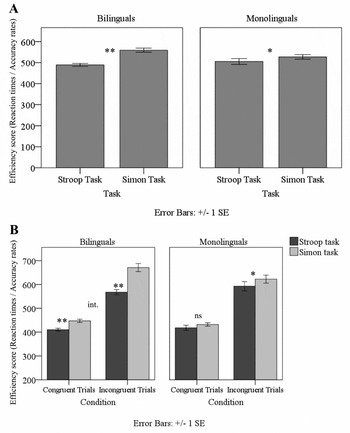
To establish the consistency of patterns obtained across the two participant samples, findings for efficiency scores are reported for all participants combined on the congruent and incongruent conditions of the Stroop and Simon tasks (see Figure 4). Across all bilinguals and monolinguals, a main effect of trial type, F(1,176) = 463.4, p < .001, ŋp 2 = .7, and a main effect of task, F(1,176) = 35.2, p < .001, ŋp 2 = .2, were confirmed. No main effect of group was observed, F(1,176) = 0.1, p > .5, ŋp 2 = .001, suggesting similar overall efficiency scores across monolinguals and bilinguals. However, the critical two-way interaction between task (Stroop, Simon) and group, F(1,176) = 12.0, p = .001, ŋp 2 = .1, as well as a three-way interaction between task, trial type, and group, F(1,176) = 8.7, p < .01, ŋp 2 = .1, were observed. To examine the interaction between task and group, overall Simon vs. Stroop efficiency scores were compared across bilinguals and monolinguals, and findings confirmed that performance differences on the Stroop vs. the Simon task were significantly bigger for bilinguals (MSimon–Stroop = 70.3 ms/proportion correct, SE = 9.8) than for monolinguals (MSimon–Stroop = 21.2 ms/proportion correct, SE = 9.6), t(178) = 3.6, p < .001.
Experiments 1 and 2 combined. Performance efficiency (reaction times divided by accuracy rates) for all participants combined (90 bilinguals and 90 monolinguals). A: Overall performance on nonlinguistic Stroop and Simon tasks. B: Performance on congruent and incongruent trials across tasks, *p < .05, **p < .001; ns = not significant; int. = task × condition interaction.

To examine the three-way interaction between trial type, task and group, separate ANOVAs were conducted for bilinguals and monolinguals. In bilinguals, a main effect of task confirmed better performance on the Stroop task (M = 488.8 ms/proportion correct, SE = 7.2) than on the Simon task (M = 559.1 ms/proportion correct, SE = 9.8), F(1,89) = 51.5, p < .001, ŋp 2 = .4. In addition, an interaction between trial type and task was identified, F(1,89) = 16.7, p < .001, ŋp 2 = .2, with the Stroop effect (MCongruent–Incongruent = –157.4 ms/proportion correct, SE = 9.1) smaller than the Simon effect (MCongruent–Incongruent = –223.6 ms/proportion correct, SE = 16.9), t(89) = 4.1, p < .001. The monolinguals also showed a main effect of task (MStroop = 505.3, SE = 13.8; MSimon = 527.2, SE = 10.8), F(1,89) = 5.1, p < .05, ŋp 2 = .1, but did not show an interaction between condition and task, F(1,89) = 1.4, p > .1, ŋp 2 = .02, suggesting that they performed more similarly across the Stroop and Simon tasks, with no task differences in conflict resolution. Together, findings confirm that bilinguals show a relative advantage for overall Stroop vs. Simon performance for Stroop-type inhibition compared to Simon performance, while monolinguals show more similar conflict resolution patterns across these two tasks.
General discussion
The aim of the current study was to examine the relative sensitivity of perceptual-level (Stimulus–Stimulus) and response-level (Stimulus–Response) inhibition mechanisms to bilingual experience. Under the hypothesis that bilingual experience acts on specific inhibition mechanisms, performance of young bilinguals and monolinguals was compared on a nonlinguistic Stroop task and a nonlinguistic Simon task. It was expected that if, through cross-linguistic competition, Stimulus–Stimulus inhibition of lexical information were particularly sensitive to bilingual experience, then bilinguals would be more likely to show an advantage on inhibition tasks that also call for conflict resolution of two conflicting stimulus dimensions. The results were consistent with this prediction: In bilinguals, a specific advantage was found on performance during the nonlinguistic Stroop task relative to the Simon task. In contrast, monolinguals performed more similarly across the two tasks. The finding of better bilingual Stroop performance relative to bilingual Simon performance suggests that bilingualism may be particularly likely to modulate cognitive control mechanisms that are dedicated to resolving Stimulus–Stimulus competition between two dimensions of the same stimulus.
In the combined sample of bilinguals in Experiment 1 and 2, a Stroop–Simon dissociation in overall performance was identified, with more efficient Stroop performance, and with a smaller Stroop than Simon effect, relative to monolinguals who showed less marked differences between Stroop and Simon tasks. In addition, Experiment 1 yielded a bilingual Stroop inhibition advantage over monolinguals. The current set of experiments suggests that, across diverse groups of young bilinguals and their monolingual peers, Stroop and Simon performance are significantly more differentiated in bilinguals than monolinguals, a stable finding that can co-occur with subtle bilingual Stroop advantages relative to monolinguals (Experiment 1). It is likely that the nature of bilingual Stroop advantages, relative to monolinguals, is somewhat variable given that all individuals in this age group are peak performers, and given subtle overall differences across populations. Examination of within-group patterns across tasks, and comparison of such patterns between groups, may better reflect the influence of bilingualism on specific cognitive mechanisms, because each participant effectively acts as their own baseline (see Paradis, Reference Paradis2011, for a similar approach to the assessment of bilinguals). In sum, we can conclude that, within the bilingual cognitive system, and across bilinguals with different backgrounds, Stroop-type mechanisms are privileged over conflict resolution mechanisms that underlie Simon performance.
One factor that may drive the robustness of Stroop–Simon dissociations, and may have contributed to the observed differences between Experiment 1 and 2, is code-switching and the differences in previous code-switching experience across the two samples of bilinguals. During code-switching, bilinguals are likely to communicate most efficiently if lexical representations are active in both languages, because output may be produced in either language and input may be received in either language. With lexical activation of both languages relevant for communication, Stimulus–Stimulus inhibition may be recruited less since there is less need to inhibit cross-linguistic lexical activation. During production, the response language may be selected at the output level and irrelevant responses may be inhibited via Stimulus–Response inhibition (Linck et al., Reference Linck, Schwieter and Sunderman2012; Marian, Blumenfeld, Mizrahi, Kania & Cordes, Reference Marian, Blumenfeld, Mizrahi, Kania and Cordes2013). During comprehension, cross-linguistic word candidates may be considered longer in both languages if code-switches are expected, also potentially reducing the need for efficient lexical-level Stimulus–Stimulus inhibition. In contrast to the code-switching scenario, during unilingual processing bilinguals are likely to communicate most efficiently if co-activation of the irrelevant language is muted as soon as it occurs. As a result, Stimulus–Stimulus inhibition can consistently operate at the lexical level to reduce cross-linguistic co-activation of the irrelevant language (e.g., Shook & Marian, Reference Shook and Marian2013). Following this logic, fewer opportunities may be present for lexical Stimulus–Stimulus inhibition if bilinguals are immersed in code-switching environments. The bilinguals in Experiment 2 were native Spanish-speakers from Southern California, who spent more time in Spanish-speaking environments (35%) than the Midwestern native English-speaking bilinguals in Experiment 1 (21%). The bilinguals in Experiment 2 may have been more exposed to code-switching as a result of more balanced language exposure and inter-generational differences in language preferences that are frequently present in families of Spanish heritage speakers (e.g., Ortman & Stevens, Reference Ortman and Stevens2008). Therefore, it is possible that one of the reasons why the bilinguals in Experiment 2 did not show as large a difference between Stroop and Simon inhibition is because their linguistic background may include more experience with code-switching than that of bilinguals in Experiment 1 (but note that Stimulus–Stimulus performance was still stronger than Stimulus–Response performance, even in this population, supporting the hypothesis that Stimulus–Stimulus conflict is generally more common within the bilingual system). Thus, the nature of bilingual experience may influence the type of bilingual advantage present (e.g., Tao, Marzecová, Taft, Asanowicz & Wodniecka, Reference Tao, Marzecová, Taft, Asanowicz and Wodniecka2011). Future research can further examine the relationship between specific aspects of bilingual experience and inhibitory control.
The main finding of enhanced Stroop vs. Simon performance in young bilinguals is consistent with the observation that Stroop advantages are more commonly reported than Simon advantages in this age-group (e.g., Costa et al., Reference Costa, Hernández and Sebastián-Gallés2008; Hernández et al., Reference Hernández, Costa, Fuentes, Vivas and Sebastián-Gallés2010; Luk et al., Reference Luk, de Sa and Bialystok2011; see Tables 1 and 2). On Stroop tasks, previous studies identified both speed advantages (Bialystok, Reference Bialystok2006; Bialystok & De Pape, Reference Bialystok and DePape2009; Costa et al., Reference Costa, Hernández and Sebastián-Gallés2008; Costa et al., Reference Costa, Hernández, Costa-Faidella and Sebastián-Gallés2009; Hernández et al., Reference Hernández, Costa, Fuentes, Vivas and Sebastián-Gallés2010) and conflict resolution advantages (Bialystok et al., Reference Bialystok, Craik and Luk2008; Costa et al., Reference Costa, Hernández and Sebastián-Gallés2008; Costa et al., Reference Costa, Hernández, Costa-Faidella and Sebastián-Gallés2009; Hernández et al., Reference Hernández, Costa, Fuentes, Vivas and Sebastián-Gallés2010; Luk et al., Reference Luk, de Sa and Bialystok2011). In contrast, studies examining bilingual Simon advantages have not found advantages in young adults (Bialystok, Reference Bialystok2006; Bialystok, Martin & Viswanathan, Reference Bialystok, Craik, Grady, Chau, Ishii and Christo2005; Salvatierra & Rosselli, Reference Salvatierra and Rosselli2011) but have found advantages in other age groups (Bialystok, Martin & Viswanathan, Reference Bialystok, Martin and Viswanathan2005: children, 30–59-year-olds, 60–80-year-olds; Bialystok et al., Reference Bialystok, Craik, Klein and Viswanathan2004: mean age = 43 years, 72 years; Salvatierra & Rosselli, Reference Salvatierra and Rosselli2011: mean age = 61 years; Schroeder & Marian, Reference Schroeder and Marian2012: mean age = 81 years). Bialystok (Reference Bialystok2006) tested the same group of undergraduate participants on both an arrow-based Stroop inhibition task similar to the one in the current study and a classic Simon task, with blue or red shapes appearing on either the right side or the left side of the display. Bialystok (Reference Bialystok2006) identified a bilingual advantage only on the most difficult condition of the Stroop arrow-task, a finding that was ascribed to overall task difficulty as well as to greater perceptual conflict on the arrows task, consistent with the current findings. Interestingly, while bilingual advantages have previously been identified on more challenging tasks (e.g., Bialystok, Reference Bialystok2006), the current findings show a relative advantage for bilinguals on the task that was less challenging for both groups. This finding suggests that a mechanistic explanation rather than a task-difficulty explanation may be more appropriate for the current data. In sum, our findings align well with previous research that has been more likely to reveal honed Stroop than Simon performance in young bilingual adults, and the emerging pattern can be explained within the framework of the Dimensional Overlap model, with distinct loci and roles for Stimulus–Stimulus and Stimulus–Response inhibition.
While a recent meta-analysis suggests that Stroop advantages are not always present in young adult bilinguals (Hilchey & Klein, Reference Hilchey and Klein2011), findings from the current study suggest that, even in the absence of clear bilingual–monolingual advantages, cognitive effects of bilingualism can be observed by comparing relative performance across cognitive control tasks. Bilingual–monolingual differences in the relationship between separable inhibitory control mechanisms provide an important source of information on how bilingual experience shapes the cognitive system. This is especially the case in young adult peak performers where absolute bilingual advantages are more elusive but important cognitive differences may nevertheless be present. Hilchey and Klein (Reference Hilchey and Klein2011) also note that absolute speed advantages may be found in addition or instead of inhibition advantages. Absolute speed advantages have been attributed to enhanced skills in conflict monitoring (Costa et al., Reference Costa, Hernández and Sebastián-Gallés2008). A number of studies have identified overall speed advantages on Stroop-type tasks (e.g., Bialystok, Reference Bialystok2006; Bialystok & De Pape, Reference Bialystok and DePape2009; Emmorey, Luk, Pyers & Bialystok, Reference Bialystok, Craik and Luk2008; Hernández et al., Reference Hernández, Costa, Fuentes, Vivas and Sebastián-Gallés2010). Our main finding of bilinguals’ overall smaller efficiency scores (i.e., quicker and more accurate performance) on the Stroop relative to the Simon task falls within the same category of enhanced monitoring skills, and suggests that bilinguals may be particularly sensitive to Stimulus–Stimulus conflict. These findings can be conceptualized within the Dimensional Overlap Model where Stroop tasks (but not Simon tasks) are characterized by perceptual overlap between stimulus dimensions. It is possible that honed performance on Stroop relative to Simon tasks is present because bilinguals experience a higher amount of Stimulus–Stimulus conflict across a number of language processing contexts (comprehension and production), resulting in a bigger training ground for Stroop-type competition resolution.
Across the two experiments, Stroop effects emerged from different aspects of bilinguals’ responses. Specifically, while effects were present in both experiments for efficiency scores, they were driven primarily by accuracy rates in Experiment 1 and by reaction times in Experiment 2. It is possible that Experiment 1 yielded a bilingual effect on response accuracies because the ratio of congruent to incongruent trials was high (3:1), resulting in a high potential for errors if participants did not monitor responses closely (e.g., West & Alain, Reference West and Alain2000). In Experiment 2, the ratio of congruent to other (neutral and incongruent) trials was 3:2, perhaps reducing strong expectancies for congruent trials, resulting in slower performance and pushing effects from response accuracies into latencies. Another reason for the accuracy effects may be faster reaction times in Experiment 1 (around 420 ms on the Stroop task) while reaction times in Experiment 2 (around 489 ms on the Stroop task) were aligned more closely with previous studies (473–550 ms in Bialystok, Reference Bialystok2006; Bialystok et al., Reference Bialystok, Craik and Luk2008; Bialystok & De Pape, Reference Bialystok and DePape2009). Participants’ faster responses in Experiment 1 may have resulted in speed–accuracy trade-offs, yielding the accuracy effects across tasks and groups. Notably, efficiency scores, which were calculated to account for potential speed–accuracy trade-offs, confirmed differences between Stroop and Simon effects in the bilingual but not the monolingual group across both experiments. In sum, despite differences between studies, findings suggest that bilinguals are more efficient at inhibiting irrelevant information and identifying correct responses on the Stroop task than the Simon task.
Evidence from bimodal vs. unimodal bilinguals converges with the hypothesis that same-modality perceptual conflict may enhance lexical competition and underlie some bilingual advantages. Emmorey et al. (Reference Emmorey, Luk, Pyers and Bialystok2008) compared inhibition performance in unimodal bilinguals (speakers of English as well as Cantonese, Italian, or Vietnamese) and bimodal bilinguals (users of English and American Sign Language) on a flanker task. Emmorey et al. found that, relative to a monolingual control group, only unimodal bilinguals showed an inhibition advantage. While parallel activation of ASL has been observed during English word recognition in bimodal bilinguals (e.g., Shook & Marian, Reference Shook and Marian2012), and Stimulus–Stimulus inhibition is recruited to resolve such cross-linguistic competition (Giezen, Blumenfeld, Shook, Marian & Emmorey, Reference Giezen, Blumenfeld, Shook, Marian and Emmorey2013), such inhibition mechanisms may be less engaged in bimodal than unimodal bilinguals. Emmorey et al. argued that a bilingual advantage likely arises from the fact that two language systems interact and interfere within the same modality (Emmorey, Borinstein, Thompson & Gollan, Reference Emmorey, Borinstein, Thompson and Gollan2008; Pyers & Emmorey, Reference Pyers and Emmorey2008), necessitating more consistent application of Stimulus–Stimulus inhibition.
The current finding that Stroop and Simon tasks are differentially influenced by bilingual experience is also consistent with neuroimaging studies showing that Stroop and Simon tasks have different loci of inhibition. Liu et al. (Reference Liu, Banich, Jacobson and Tanabe2004) compared neural correlates of inhibition on a Stroop and a Simon task similar to the tasks employed in the current experiment. Findings showed activation patterns in the inferior parietal cortex that were unique to Stroop-type inhibition. Crucially, the current pattern of findings is consistent with Luk, Anderson, Craik, Grady & Bialystok (Reference Luk, Anderson, Craik, Grady and Bialystok2010) who showed that monolinguals and bilinguals activated different neural networks during interference control on a flanker (Stimulus–Stimulus inhibition) task but showed similar activation patterns on a go no-go task (Stimulus–Response inhibition) task. When Luk et al. correlated performance on the flanker task with neural activation, they found that bilinguals (but not monolinguals) who performed better on the flanker task also showed greater activation in a network of areas that have been implicated in bilingual language control (Abutalebi, Reference Abutalebi2008). These findings are consistent with the conclusion that shared mechanisms may underlie Stroop-type and linguistic processing and that Stroop-type inhibition may be particularly sensitive to bilingualism.
While the current experiments highlight one aspect of cognitive control that may be particularly sensitive to bilingual experience – perceptual-level Stimulus–Stimulus inhibition – other cognitive control mechanisms are likely to yield bilingual advantages (e.g., Colzato, Bajo, van den Wildenberg & Paolieri, Reference Colzato, Bajo, van den Wildenberg and Paolieri2008; Treccani, Argyri, Sorace & Della Sala, Reference Treccani, Argyri, Sorace and Della Sala2009). For example, a number of studies suggest bilingual advantages on task-switching (Bialystok, Reference Bialystok1999; Bialystok & Martin, Reference Bialystok and Martin2004; Kovács & Mehler, Reference Kovács and Mehler2009; Prior & MacWhinney, Reference Prior and MacWhinney2010). Such tasks may have Stimulus–Stimulus components (e.g., on the Dimensional Card Sort task, the perceptual salience of shape must be suppressed when the rule to sort according to shape no longer applies, Bialystok, Reference Bialystok1999). However, task-switching, which may be honed by bilinguals’ need to switch languages (e.g., Festman, Rodriguez-Fornells & Münte, Reference Festman, Rodriguez-Fornells and Münte2010), likely relies on Stimulus–Response inhibition (e.g., Linck et al., Reference Linck, Schwieter and Sunderman2012). Together with findings of Simon advantages in older bilinguals (Bialystok et al., Reference Bialystok, Craik, Klein and Viswanathan2004), these results suggest that Simon-type inhibition may also be related to bilingual processing but in a manner that may be constrained to linguistic contexts different from contexts associated with Stroop-type inhibition. Relatedly, both tasks in the present study contained Simon-components, with two possible Stimulus–Response mappings (in addition to Stimulus–Stimulus overlap on the Stroop task). It is possible that, while Stimulus–Response competition on its own did not yield processing advantages in bilinguals, Stimulus–Stimulus competition in combination with Stimulus–Response competition created advantages. In fact, other Stroop-type tasks (the classic Stroop task, the flanker task, etc.) contain a Stimulus–Response competition element. Since Stroop performance was generally better in the current study, it is unlikely that multiple levels of conflict (Stimulus–Stimulus and Stimulus–Response) increased difficulty and yielded processing advantages in bilinguals because of greater cognitive demands. Whether Stimulus–Stimulus competition on its own or in combination with Stimulus–Response competition yields advantages can be examined in future research.
In sum, current findings suggest that an increased need to inhibit perceptually-ambiguous information (including cross-linguistic lexical alternatives), may play a key role in driving bilingual Stimulus–Stimulus inhibition performance. Different findings for Stroop and Simon tasks are likely due to differences in the loci of inhibition: While interference on the Simon task is created by incongruent mappings between stimulus and response (e.g., an upward-facing arrow on the right side of the screen requiring a left key-press), interference on the Stroop tasks is created by incongruent information within the stimulus (e.g., a right-facing arrow on the left side of the screen, e.g., Liu et al., Reference Liu, Banich, Jacobson and Tanabe2004). The current findings provide a direct comparison between Stroop and Simon tasks in bilinguals, and point to specific task components (as specified by the Dimensional Overlap Model; Kornblum, Reference Kornblum1994) that may be most influenced by bilingual experience. It is likely that comparisons of cognitive control tasks with varying loci of interference will be instrumental in unifying diverse findings of bilingual performance and language–cognition interactions.